
A process boundary is the clear definition of where a process starts and where it ends. It sets the parameters for what is included in the process and, just as importantly, what is not. The boundary marks the transition points: the initial trigger that sets the process in motion and the final output or result that signals its completion. By establishing these boundaries, organizations can identify the interactions and dependencies between processes, ensuring that each process is manageable, measurable, and aligned with objectives.
Why Are Process Boundaries Important?
Defining process boundaries is essential for several reasons:
- Clarity and Focus: Boundaries help teams focus on the specific activities, roles, and outcomes that are relevant to the process at hand, avoiding unnecessary complexity and scope creep.
- Effective Resource Allocation: With clear boundaries, organizations can allocate resources efficiently and prioritize improvement efforts where they will have the greatest impact.
- Accountability: Boundaries clarify who is responsible for each part of the process, making it easier to assign ownership and measure performance.
- Process Optimization: Well-defined boundaries make it possible to analyze, improve, and optimize processes systematically, as each process can be evaluated on its own terms before considering its interfaces with others.
How to Determine Process Boundaries
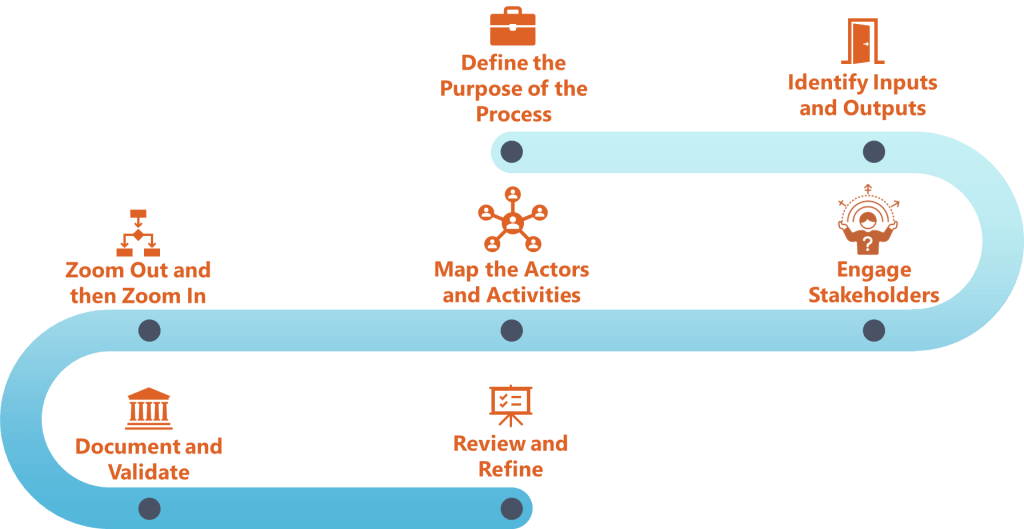
Determining process boundaries is both an art and a science. Here’s a step-by-step approach, drawing on best practices from process mapping and business process analysis:
1. Define the Purpose of the Process
Before mapping, clarify the purpose of the process. What transformation or value does it deliver? For example, is the process about onboarding a new supplier, designing new process equipment, or resolving a non-conformance? Knowing the purpose helps you focus on the relevant start and end points.
2. Identify Inputs and Outputs
Every process transforms inputs into outputs. Clearly articulate what triggers the process (the input) and what constitutes its completion (the output). For instance, in a cake-baking process, the input might be “ingredients assembled,” and the output is “cake baked.” This transformation defines the process boundary.
3. Engage Stakeholders
Involve process owners, participants, and other stakeholders in boundary definition. They bring practical knowledge about where the process naturally starts and ends, as well as insights into handoffs and dependencies with other processes. Workshops, interviews, and surveys can be effective for gathering these perspectives.
4. Map the Actors and Activities
Decide which roles (“actors”) and activities are included within the boundary. Are you mapping only the activities of a laboratory analyst, or also those of supervisors, internal customers who need the results, or external partners? The level of detail should match your mapping purpose-whether you’re looking at a high-level overview or a detailed workflow.
5. Zoom Out, Then Zoom In
Start by zooming out to see the process as a whole in the context of the organization, then zoom in to set precise start and end points. This helps avoid missing upstream dependencies or downstream impacts that could affect the process’s effectiveness.
6. Document and Validate
Once you’ve defined the boundaries, document them clearly in your process map or supporting documentation. Validate your boundaries with stakeholders to ensure accuracy and buy-in. This step helps prevent misunderstandings and ensures the process map will be useful for analysis and improvement.
7. Review and Refine
Process boundaries are not set in stone. As the organization evolves or as you learn more through process analysis, revisit and adjust boundaries as needed to reflect changes in scope, objectives, or business environment.
Common Pitfalls and How to Avoid Them
- Scope Creep: Avoid letting the process map expand beyond its intended boundaries. Stick to the defined start and end points unless there’s a compelling reason to adjust them7.
- Overlapping Boundaries: Ensure that processes don’t overlap unnecessarily, which can create confusion about ownership and accountability.
- Ignoring Interfaces: While focusing on boundaries, don’t neglect to document key interactions and handoffs with other processes. These interfaces are often sources of risk or inefficiency.
Conclusion
Defining process boundaries is a foundational step in business process mapping and analysis. It provides the clarity needed to manage, measure, and improve processes effectively. By following a structured approach-clarifying purpose, identifying inputs and outputs, engaging stakeholders, and validating your work-you set the stage for successful process optimization and organizational growth. Remember: a well-bounded process is a manageable process, and clarity at the boundaries is the first step toward operational excellence.

 Investigations of a Dog
One thought on “Process Boundary”