
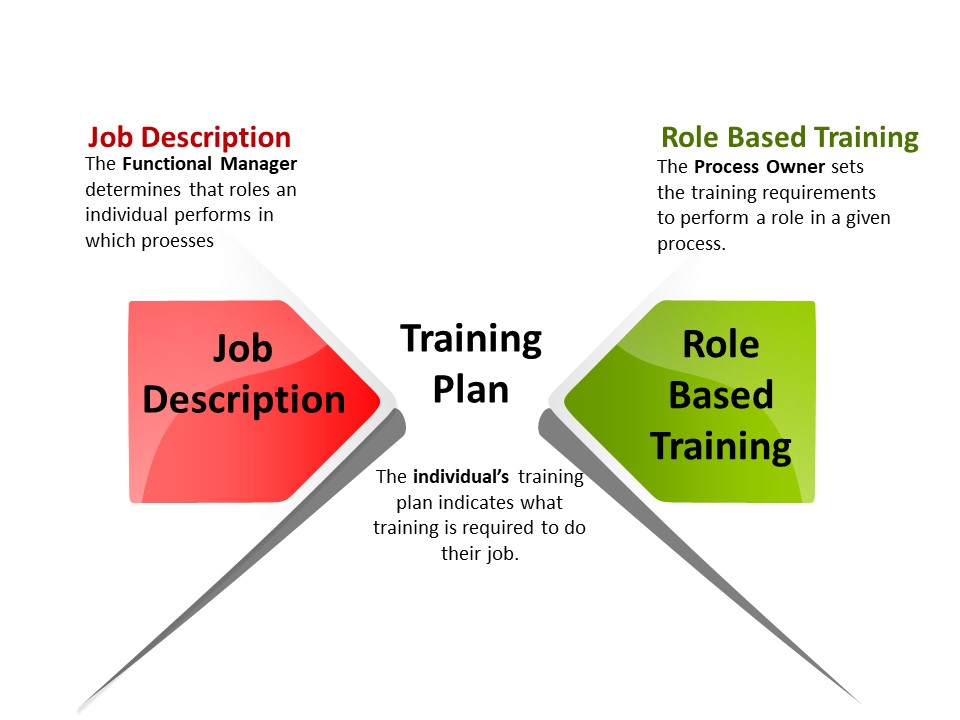
Training Plan

As discussed in the post “CVs and JDs and Training Plans” the training plan takes the job description and then says what a given individual needs for training requirements. It does this by looking at the role on a job description and cross-referencing it with the training requirements for the role established by the process owner.

The functional manager is responsible for determining for any given job which roles within a process an individual has.

The process owner, for each process, then sets the training requirements for each role.

Take, for example, a job description that has these three job responsibilities

  • Lead inspection readiness activities and provide support during regulatory site inspections
  • Participate in the vendor management process including the creation and review of Quality Agreements with suppliers
  • Write, review and manage approval of deviations, change controls and CAPA’s

Those three bullets contain a ton of job requirements that translate to roles in processes.

ProcessRole
Inspection ReadinessLead
Regulatory Site InspectionsSupport
Vendor Managementparticipant
Quality AgreementsAuthor
Review
Deviation/CAPAAuthor
Reviewer
Approver
Change ControlAuthor
Reviewer
Approver
Roles and Processes from an Example Job Description

The functional manager when writing the job description should understand the exact roles in the processes. A good practice is to have a catalog as part of the process framework. For example, participant may not be the right role name and a more specific role should be used.

The process owner for each of those processes has (usually with help from the training unit) determined the right training for each role. These are usually made up of curricula with individual items.

It’s useful to think of these curricula as building blocks. For example, quality agreements, deviation/CAPA, and change control all have a technical writing curricula. The training unit can have a curricula for technical writing and add that to specific roles as appropriate.

The training plan is a key record, on which everything else hinges.

In an ideal world this should be automated. But in my experience it is manual as the job description is not functionality in the Learning Management System and it involves a degree of translation to build the training plan. This is an excellent opportunity for anyone who reads my blog that works for a company doing an LMS to wow me.

Changes to the job description drive changes to the training plan. As an individuals work changes, so to does the processes and roles they interact with. This is the responsibility of the individual and the functional manager is accountable.

Changes to the processes drive changes to the training plan. The process owner is accountable here.
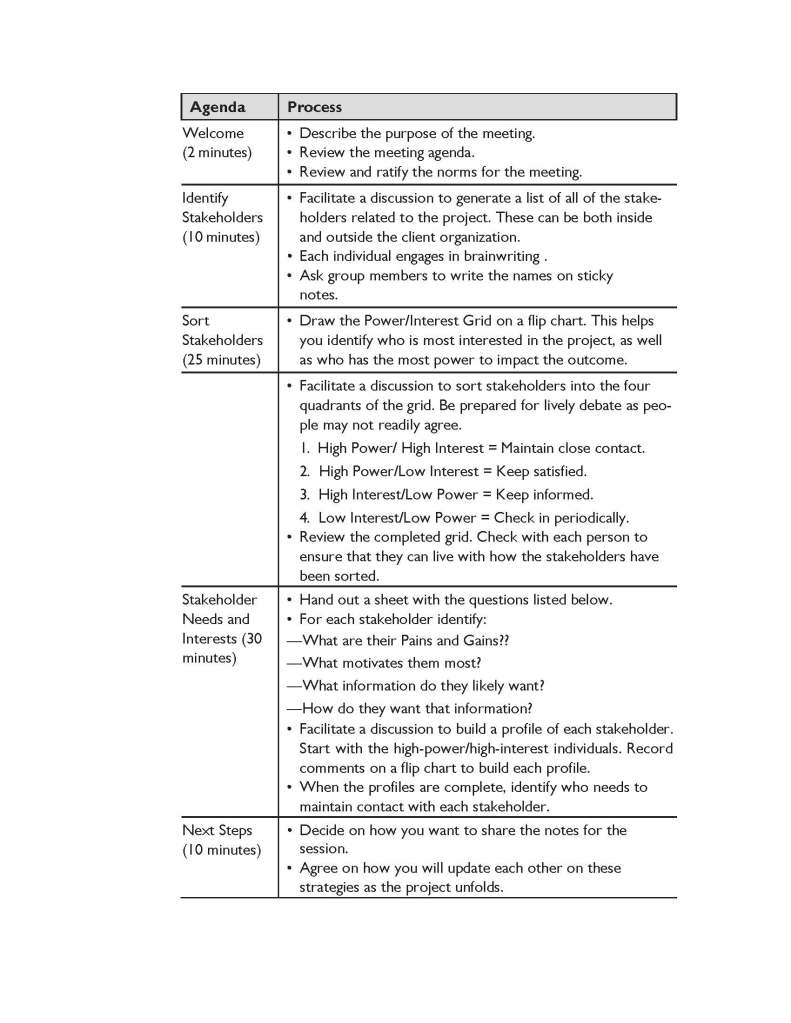
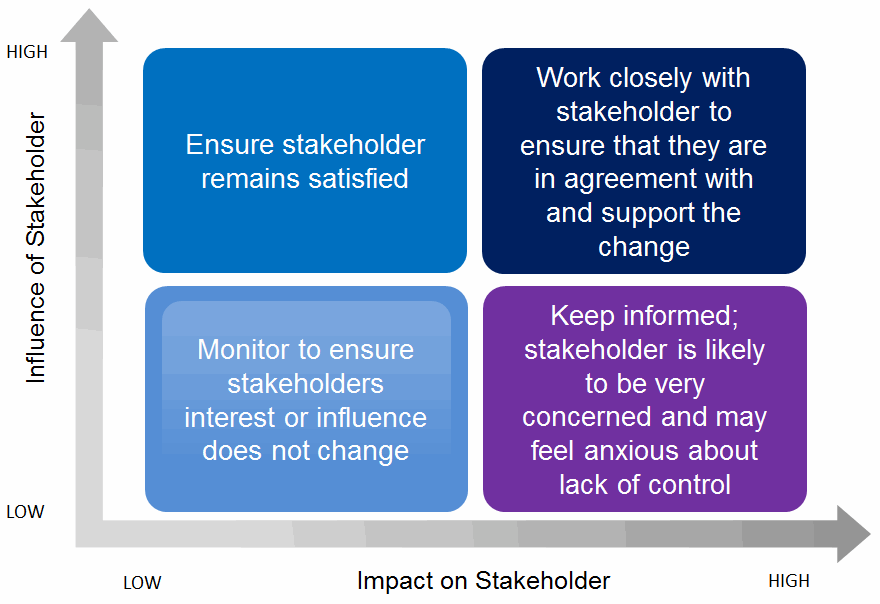
Records in the Training System

Records serve the purpose of controlling and directing the organization, helping to orient personnel to a common goal or purpose. For the purpose of training these records includes a training plan (and its subparts like curricula) and evidence of training performance (e.g.  attendance) and assessment

There are two main audiences for record-keeping: operational staff and various auditors/inspectors. The operational perspective is ideally proactive, while the auditor’s perspective is typically retroactive.

For the training program this breaks down as:

  • Operational staff are interested in the trainee’s currency in their individual training plans for purposes of work assignments. Supervisors need to be sure people are doing the tasks they are trained on. Management is also ensuring they have enough capacity of trained individuals to ensure upcoming activities can be supported.
  • Auditors (internal and external) are interested  in whether the individual who completed a task (e.g. approved a document) was trained to the appropriate process/procedure before doing the task. In this case the training records provide evidence of the organization’s past fulfillment of its regulatory obligations. Auditors will also look at the general health of the training system.

Training records (like all records) must demonstrate that training is implemented, responsible, consistent:

  • Implemented means that training events can be duly recorded in the system.
  • A responsible system’s controlled documents (i.e. procedure for training record-keeping) are written and followed, plus the procedure clearly identifies the responsible party for each task. For example, training is completed within the specified period.
  • Consistent systems ensure identical activities generate identical outcomes. Therefore, we validate Learning Management Systems (LMS)

Documentation of individual training is a captured record (training is captured as it happens), a maintained record (training can be verified after it happened) and a usable record (decisions can be made).

Captured records means the record has the following:

Record Management TermALCOA PrincipleMeans
AuthorizedAttributableCreated by an authorized person, for example a qualified trainer.  
ComprehensiveContemporaneousA record is created for every training event.
IdentifiableAttributableThe created record can be linked to the particular training event  
CompleteAccurateIncludes all information on the training event (who participated, what was covered, who trained and when)

Maintained records means the record has the following:

Record Management TermALCOA PrincipleMeans
InviolateLegibleAny alteration or modification is traceable
AuditableOriginalEvery use of the record leaves an audit trail
Appropriately retainedOriginalTraining records must be subject to a retention schedule and then disposed according to procedure

Usable means the training records can be used by authorized parties to make decisions:

Record Management TermALCOA PrincipleMeans
RetrievableOriginalTraining records are I a form that can be searched and retrieved within a reasonable period of time and expenditure of resources
Accessible to Authorized PartiesLegibleAvailable to those who are authorized to access them

Training Unit as Audience for Records

The training unit is a special case as an audience of documentation that has both operational and audit similarities. Some uses include:

  • Level of effort being applied to training oversight
  • Test and verify accuracy of statements about the benefits and impact of training

Culture is Complex, Experiment for Success

In the post “Quality Culture is Fundamental to Actually Providing Quality” I discussed some of the elements of organizational culture and how it fits into conceptualizing a quality culture. I think it is important to discuss some of the complexities and how these complexities need to be solved through iterative experiments.

John Traphagan in his 2017 HBR article “We’re Thinking about Organizational Culture All Wrong” discusses how that the study of organizational culture commonly conveys the idea of culture as a unifying force that brings people together to work productively toward the attainment of organizational goals. The approach implies that or­ganizational culture is understood as a collective project able to create unity and cohesion in some simple steps. But reality presents a quite different picture because today culture is not only about cohesiveness and unity. It is also about disagreement, discrepancy and disparities constantly testing the capacity of people to work together and benefit advancing common and ethical organizational goals in spite of in­dividual differences.

Traphagan ends his article with a powerful statement that should be kept front and center in any culture initiative: “The idea that unity can be generated among employees by fixing or creating an organizational culture relies on a naïve assumption that culture unambiguously brings people together. But the reality of culture is that it represents a tremendously complex variable that can both bring people together and pull them apart — or do both at the same time.”

Because of the reality Traphagan discusses, we need to realize that work on culture is really about experiments. I’ll point you to another article in HBR by Stefan Thomke “Building a Culture of Experimentations“. This article empha­sizes that the main obstacles obstructing change are lodged in the culture, in deep shared behaviors, beliefs and values that shape a culture over time and perpetuate in place without periodic or effectiveness assessment and in spite of obsolescent outcomes. Thomke writes that a successful culture of experimentation is built on five critical elements: cultivation of people’s curiosity, insisting that data trump educated opinions (avoiding guessing), democratize experimentation across organizational divisions, promoting ethical sensitivity in all functions and embracing a humane and agile leadership model.

Culture is a complex problem and the only true path for addressing is small scale experimentation iteratively applied with the end-goal of transformation.

Complex Problems, a rant

Inevitably you will sit in on a meeting and hear someone say “We need to find the root cause of this complex problem.”

If you are me, you possibly think one of two things:

  1. Complex problems don’t have root causes. In fact, they don’t even have clear cause-effect paths
  2. That’s not complex. It’s complicated.

Occasionally, I think both.

In my post “The difference between complex and complicated” I went into detail on the differences between the two.

Does it matter? Mostly not, but sometimes very much so. The approach you bring to the two can be very different, and if you think you are tackling the wrong type of problem you could spend some time banging against a wall.

For an example:

  • Wanting to reduce cycle time for release of product is a complicated problem. You can reduce the problems and solve for them (e.g. tackle deviation cycle time, specific areas of deviations, processing in the lab, capacity in the value stream, etc)
  • Ensuring a robust and resilient supply chain is a complex problem. This problem is multifunctional and the system is open.

It is for this reason I continue to use Art Smalley’s Four Types of Problems. This gives a nice setup of language for talking about problems in the organization.

We definitely need a School-House-Rock style song for this, or good rap.