Virtual WCQI

The ASQ is hosting a virtual World Conference on Quality Improvement. Glad to see thisexperiment. While a lot of organizations have been holding virtual conferences, this use of technology is a stretch for a lot of ASQ Members.

James Clear – 1% Better Every Day

Clear’s 2019 book Atomic Habits was definitely one of the most talked about self-help books from last year.

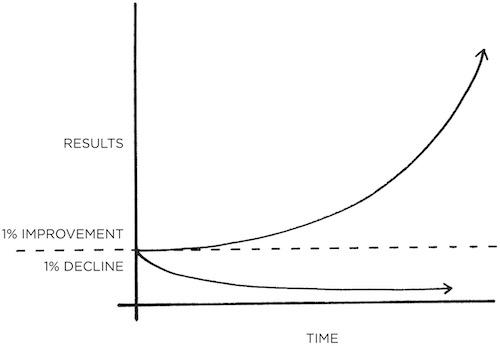
1% Better Every Day

The book has some concerns, for example do a little googling on the Marshmallow Test, and Clear still starts his talk referencing the British Cycling Team, probably not the most convincing given their doping scandals. Clear has actually written about the scandal, so I’m surprised he continues to use it in talks.

That said, I really like his use of a score card and his four rules. No argument from me on the importance of systems.

The four laws for building good habits according to Atomic Habits:

  1. Make the habit obvious.  
  2. Make it attractive
  3. Make it easy
  4. Make it satisfying  

To break bad habits the inverse applies:

  1. Make the habit invisible
  2. Make it unattractive
  3. Make it difficult
  4. Make it unsatisfying

Great discussion on how design and environment shapes our choices. Fits nicely into “nudges.” How we organize our work space and homes is a critical thing that we as quality professionals need to spend more time on. The structuring of an environment, including social, fits nicely into quality culture.

It may be pop psychology goes, but it is a very well written book. And James Clear is a great speaker, even from comfort of his living room or study.

EU Annex 21 Published in Draft

On 20 March the new Annex 21 to the EU-GMP Guidelines was published as a draft. The document is entitled “Importation of medicinal Products”. The “Concept Paper” was published on 13 May 2015 (EMA/238299/2015) and the consultation phase ended in August 2015. The first draft for regulatory consultation was published in November 2016. Since then, no further activities or versions have been issued.

The Guidance is aimed at Manufacturing and Importation Authorisation holders (MIA holders) who import human or veterinary medicinal products from third countries. It does not cover products that do not have a marketing authorisation in the EU/EEA and are directly re-exported. The following points are to be regulated by the new Annex:

  • Physical transfer from the third country to the EU/EEA
  • Certification by the Qualified Person (QP) (link with the requirements of Annex 16)
  • Requirements for equipment and facilities
  • Required documentation
  • GMP requirements for manufacturers and exporters in third countries
  • Qualification and audits under the responsibility of the importing company and the Qualified Person (QP)
  • Import testing
  • Contractual regulations between all companies or persons involved in the import

Not much new here, but folks should be aware.

Pandemics and the failure to think systematically

As it turns out, the reality-based, science-friendly communities and information sources many of us depend on also largely failed. We had time to prepare for this pandemic at the state, local, and household level, even if the government was terribly lagging, but we squandered it because of widespread asystemic thinking: the inability to think about complex systems and their dynamics. We faltered because of our failure to consider risk in its full context, especially when dealing with coupled risk—when multiple things can go wrong together. We were hampered by our inability to think about second- and third-order effects and by our susceptibility to scientism—the false comfort of assuming that numbers and percentages give us a solid empirical basis. We failed to understand that complex systems defy simplistic reductionism.

Zeynep Tufekci, “What Really Doomed Americas Coronovirus Response” published 24-Mar-2020 in the Atlantic

On point analysis. Hits many of the themes of this blog, including system thinking, complexity and risk and makes some excellent points that all of us in quality should be thinking deeply upon.

COVID-19 is not a black swan. Pandemics like this have been well predicted. This event is a different set of failures, that on a hopefully smaller scale most of us are unfortunately familiar with in our organizations.

I certainly didn’t break out of the mainstream narrative. I traveled in February, went to a conference and then held a small event on the 29th.

The article stresses the importance of considering the trade-offs between resilience, efficiency, and redundancy within the system, and how the second- and third-order impacts can reverberate. It’s well worth reading for the analysis of the growth of COVID-19, and more importantly our reaction to it, from a systems perspective.

Now is a good time to be active in a professional organization

Many of us are wondering just how we are going to get through the next few months of self-isolation. I’d like to recommend getting active in a professional organization.

Amazingly enough this can be a good time to strengthen your network, further your career or maybe even build some friendships. Professional organizations can enhance your personal and professional development and provide endless networking opportunities. Look around your community—there are bound to be a plethora of organizations (from small local start-ups to national chapters) for you to join.

A professional association can your professional home. It is the place where people in the same field will come to know you, support you, and nurture your growth and development. Especially now for those of us who are self-isolating, our professional associations can mitigate the potential isolation and loneliness of our work. There’s nothing quite like sharing in the excitement of learning about new understandings and techniques with others who share the challenges and the joys of the profession. There’s nothing quite as supportive as a group of people who have “been there and done that”. There is nothing quite like sharing your own experiences and hard-won lessons.

Like I said above, there are a lot of professional associations out there. I belong to a plethora of industry (PDA, RAPS), subject area (ACMP, PPA) and domain (ASQ). Right now my heart is certainly fully committed to the ASQ and the Team and Workplace Excellence Forum, but you do you and find the organizations that work for you. But if you need help navigating the ASQ, or are looking for opportunities to get involved, let me know.

So what can you be doing right now to leverage a professional organization? Especially right now? I think there are four major areas to look at:

Colleagueship: Associations are the primary way that people do face-time networking with people who share our professional interests. Most organizations are offering a lot of online options to make it possible to network with people all over the world. Get your face out there and build those connections. And when we can all get together again, keep at it.

Education: We’re in a rapidly changing field. It can take years for good research to make it into print. Now is a great time to catch up and then stay up to date and knowledgeable about new trends in the field. Take an online course. Ask questions.

Information: Association journals, bulletins and newsletters, websites and mailing lists are often the first place that new developments in the field are published. Many associations use their media to alert their members to more than research. Articles and news items also inform us about changes in governmental policies, new trends and other issues that impact the field.

Career Development: Engage in education offerings. Now is a good time to work on that certification. Eventually there will be opportunities again to attend conferences and present a poster or workshop, but right now heavily use the forums and other tools to get that experience of sharing your work and develop your credentials. Further, associations often have listings of job opportunities that are only available to members.

Above all, Stay Inspired and Stay Motivated.  Love what you do! It is important to be proactive about things you discover on the journey. Get out there, post, ask questions, answer questions, read and then share what you are reading.

In the routine of remote working you are building, now is a great time to make a habit of blocking off a little time in your calendar to go online and contribute. For fellow ASQ members I hope to see you at my.ASQ.

Procedure Lifecycle

We write and use procedures to help the user complete the task successfully and avoid undesired outcomes. Well-written procedures are an integral part of any organization for operation, managing risks, and continuous improvement. Effective procedures are important for the transfer of knowledge from the engineers/architects of the system to the users of the system.

Good procedures, and we are not talking format so this can be paper documents to a mixed reality guide, provide these four categories of information:

  1. Goal: The goal presented to the user as a state to be realized. This can be an end state or an intermediate state of the overall system.
  2. Prerequisites: The condition for moving toward the desired state or goal. These are the conditions that must be satisfied so that the user can achieve the goal.
  3. Actions and reactions: These states are reached through actions of the user and the reactions of the system. They may have milestones or sub-goals. It involves the description of (a series of) action steps.
  4. Unwanted: These are the states to be avoided (e.g., errors, malfunctions, injuries). It provides guidelines on what to avoid for successful and safe execution of procedure and may include warning, caution, or instruction for solving a potential problem.

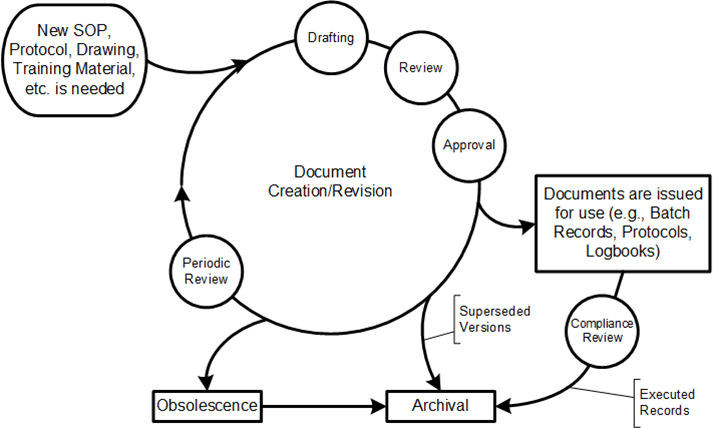
Procedures have a lifecycle through which they are developed, administered, used, reviewed, and updated. In the post “Document Management” I discussed the document management lifecycle.

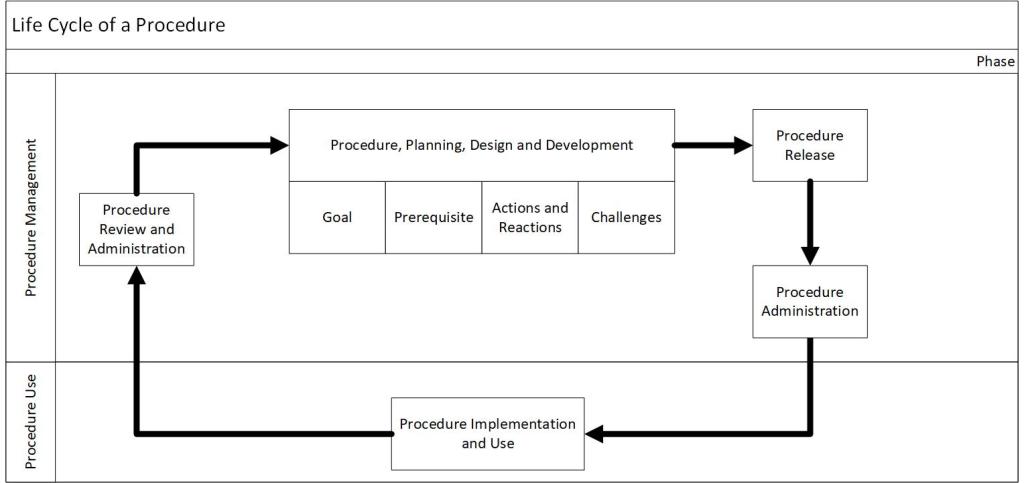
I want to focus specifically on procedures by covering five distinct phases: procedure plan, design and development, procedure authorization, procedure administration, procedure implementation and use, and procedure review and maintenance.

Outlines the 5 phases of a procedure lifecycle
Lifecycle of a procedure
PhaseIncludesDocument Management Steps
Procedure plan, design and developmentIdentifying whether a procedure is necessary; collecting required information; producing instructions and information on the work, regulatory compliance, process and personnel safety; a walkthrough to ensure quality and potential compliance of the procedure“New SOP is needed”   Drafting    
Procedure AuthorizationProcedure review; publishing the final document; revision control; the approval process.Review Approval
Procedure AdministrationManaging procedure repository, control, and deployment; identifying administers how, when, and to whom procedures are to be delivered. 
Procedure Implementation and UseProcedure is used in operations 
Procedure review and maintenancePeriodic review of documents, as well as updates from the CAPA and Change Management processesPeriodic Review

References

  • Procedure Professionals Association (PPA), 2016. Procedure Process Description. (PPA AP-907-001)
  • Van der Meij, H., Gellevij, M., 2004. The four components of a procedure. IEEE Trans. Prof. Commun. 47 (1), 5–14