The Risk-Based Electronic Signature Decision Framework

In my recent exploration of the Jobs-to-Be-Done tool I examined how customer-centric thinking could revolutionize our understanding of complex quality processes. Today, I want to extend that analysis to one of the most persistent challenges in pharmaceutical data integrity: determining when electronic signatures are truly required to meet regulatory standards and data integrity expectations.

Most organizations approach electronic signature decisions through what I call “compliance theater”—mechanically applying rules without understanding the fundamental jobs these signatures need to accomplish. They focus on regulatory checkbox completion rather than building genuine data integrity capability. This approach creates elaborate signature workflows that satisfy auditors but fail to serve the actual needs of users, processes, or the data integrity principles they’re meant to protect.

The cost of getting this wrong extends far beyond regulatory findings. When organizations implement electronic signatures incorrectly, they create false confidence in their data integrity controls while potentially undermining the very protections these signatures are meant to provide. Conversely, when they avoid electronic signatures where they would genuinely improve data integrity, they perpetuate manual processes that introduce unnecessary risks and inefficiencies.

The Electronic Signature Jobs Users Actually Hire

When quality professionals, process owners and system owners consider electronic signature requirements, what job are they really trying to accomplish? The answer reveals a profound disconnect between regulatory intent and operational reality.

The Core Functional Job

“When I need to ensure data integrity, establish accountability, and meet regulatory requirements for record authentication, I want a signature method that reliably links identity to action and preserves that linkage throughout the record lifecycle, so I can demonstrate compliance and maintain trust in my data.”

This job statement immediately exposes the inadequacy of most electronic signature decisions. Organizations often focus on technical implementation rather than the fundamental purpose: creating trustworthy, attributable records that support decision-making and regulatory confidence.

The Consumption Jobs: The Hidden Complexity

Electronic signature decisions involve numerous consumption jobs that organizations frequently underestimate:

  • Evaluation and Selection: “I need to assess when electronic signatures provide genuine value versus when they create unnecessary complexity.”
  • Implementation and Training: “I need to build electronic signature capability without overwhelming users or compromising data quality.”
  • Maintenance and Evolution: “I need to keep my signature approach current as regulations evolve and technology advances.”
  • Integration and Governance: “I need to ensure electronic signatures integrate seamlessly with my broader data integrity strategy.”

These consumption jobs represent the difference between electronic signature systems that users genuinely want to hire and those they grudgingly endure.

The Emotional and Social Dimensions

Electronic signature decisions involve profound emotional and social jobs that traditional compliance approaches ignore:

  • Confidence: Users want to feel genuinely confident that their signature approach provides appropriate protection, not just regulatory coverage.
  • Professional Credibility: Quality professionals want signature systems that enhance rather than complicate their ability to ensure data integrity.
  • Organizational Trust: Executive teams want assurance that their signature approach genuinely protects data integrity rather than creating administrative overhead.
  • User Acceptance: Operational staff want signature workflows that support rather than impede their work.

The Current Regulatory Landscape: Beyond the Checkbox

Understanding when electronic signatures are required demands a sophisticated appreciation of the regulatory landscape that extends far beyond simple rule application.

FDA 21 CFR Part 11: The Foundation

21 CFR Part 11 establishes that electronic signatures can be equivalent to handwritten signatures when specific conditions are met. However, the regulation’s scope is explicitly limited to situations where signatures are required by predicate rules—the underlying FDA regulations that mandate signatures for specific activities.

The critical insight that most organizations miss: Part 11 doesn’t create new signature requirements. It simply establishes standards for electronic signatures when signatures are already required by other regulations. This distinction is fundamental to proper implementation.

Key Part 11 requirements include:

  • Unique identification for each individual
  • Verification of signer identity before assignment
  • Certification that electronic signatures are legally binding equivalents
  • Secure signature/record linking to prevent falsification
  • Comprehensive signature manifestations showing who signed what, when, and why

EU Annex 11: The European Perspective

EU Annex 11 takes a similar approach, requiring that electronic signatures “have the same impact as hand-written signatures”. However, Annex 11 places greater emphasis on risk-based decision making throughout the computerized system lifecycle.

Annex 11’s approach to electronic signatures emphasizes:

  • Risk assessment-based validation
  • Integration with overall data integrity strategy
  • Lifecycle management considerations
  • Supplier assessment and management

GAMP 5: The Risk-Based Framework

GAMP 5 provides the most sophisticated framework for electronic signature decisions, emphasizing risk-based approaches that consider patient safety, product quality, and data integrity throughout the system lifecycle.

GAMP 5’s key principles for electronic signature decisions include:

  • Risk-based validation approaches
  • Supplier assessment and leverage
  • Lifecycle management
  • Critical thinking application
  • User requirement specification based on intended use

The Predicate Rule Reality: Where Signatures Are Actually Required

The foundation of any electronic signature decision must be a clear understanding of where signatures are required by predicate rules. These requirements fall into several categories:

  • Manufacturing Records: Batch records, equipment logbooks, cleaning records where signature accountability is mandated by GMP regulations.
  • Laboratory Records: Analytical results, method validations, stability studies where analyst and reviewer signatures are required.
  • Quality Records: Deviation investigations, CAPA records, change controls where signature accountability ensures proper review and approval.
  • Regulatory Submissions: Clinical data, manufacturing information, safety reports where signatures establish accountability for submitted information.

The critical insight: electronic signatures are only subject to Part 11 requirements when handwritten signatures would be required in the same circumstances.

The Eight-Step Electronic Signature Decision Framework

Applying the Jobs-to-Be-Done universal job map to electronic signature decisions reveals where current approaches systematically fail and how organizations can build genuinely effective signature strategies.

Step 1: Define Context and Purpose

What users need: Clear understanding of the business process, data integrity requirements, regulatory obligations, and decisions the signature will support.

Current reality: Electronic signature decisions often begin with technology evaluation rather than purpose definition, leading to solutions that don’t serve actual needs.

Best practice approach: Begin every electronic signature decision by clearly articulating:

  • What business process requires authentication
  • What regulatory requirements mandate signatures
  • What data integrity risks the signature will address
  • What decisions the signed record will support
  • Who will use the signature system and in what context

Step 2: Locate Regulatory Requirements

What users need: Comprehensive understanding of applicable predicate rules, data integrity expectations, and regulatory guidance specific to their process and jurisdiction.

Current reality: Organizations often apply generic interpretations of Part 11 or Annex 11 without understanding the specific predicate rule requirements that drive signature needs.

Best practice approach: Systematically identify:

  • Specific predicate rules requiring signatures for your process
  • Applicable data integrity guidance (MHRA, FDA, EMA)
  • Relevant industry standards (GAMP 5, ICH guidelines)
  • Jurisdictional requirements for your operations
  • Industry-specific guidance for your sector

Step 3: Prepare Risk Assessment

What users need: Structured evaluation of risks associated with different signature approaches, considering patient safety, product quality, data integrity, and regulatory compliance.

Current reality: Risk assessments often focus on technical risks rather than the full spectrum of data integrity and business risks associated with signature decisions.

Best practice approach: Develop comprehensive risk assessment considering:

  • Patient safety implications of signature failure
  • Product quality risks from inadequate authentication
  • Data integrity risks from signature system vulnerabilities
  • Regulatory risks from non-compliant implementation
  • Business risks from user acceptance and system reliability
  • Technical risks from system integration and maintenance

Step 4: Confirm Decision Criteria

What users need: Clear criteria for evaluating signature options, with appropriate weighting for different risk factors and user needs.

Current reality: Decision criteria often emphasize technical features over fundamental fitness for purpose, leading to over-engineered or under-protective solutions.

Best practice approach: Establish explicit criteria addressing:

  • Regulatory compliance requirements
  • Data integrity protection level needed
  • User experience and adoption requirements
  • Technical integration and maintenance needs
  • Cost-benefit considerations
  • Long-term sustainability and evolution capability

Step 5: Execute Risk Analysis

What users need: Systematic comparison of signature options against established criteria, with clear rationale for recommendations.

Current reality: Risk analysis often becomes feature comparison rather than genuine assessment of how different approaches serve the jobs users need accomplished.

Best practice approach: Conduct structured analysis that:

  • Evaluates each option against established criteria
  • Considers interdependencies with other systems and processes
  • Assesses implementation complexity and resource requirements
  • Projects long-term implications and evolution needs
  • Documents assumptions and limitations
  • Provides clear recommendation with supporting rationale

Step 6: Monitor Implementation

What users need: Ongoing validation that the chosen signature approach continues to serve its intended purposes and meets evolving requirements.

Current reality: Organizations often treat electronic signature implementation as a one-time decision rather than an ongoing capability requiring continuous monitoring and adjustment.

Best practice approach: Establish monitoring systems that:

  • Track signature system performance and reliability
  • Monitor user adoption and satisfaction
  • Assess continued regulatory compliance
  • Evaluate data integrity protection effectiveness
  • Identify emerging risks or opportunities
  • Measure business value and return on investment

Step 7: Modify Based on Learning

What users need: Responsive adjustment of signature strategies based on monitoring feedback, regulatory changes, and evolving business needs.

Current reality: Electronic signature systems often become static implementations, updated only when forced by system upgrades or regulatory findings.

Best practice approach: Build adaptive capability that:

  • Regularly reviews signature strategy effectiveness
  • Updates approaches based on regulatory evolution
  • Incorporates lessons learned from implementation experience
  • Adapts to changing business needs and user requirements
  • Leverages technological advances and industry best practices
  • Maintains documentation of changes and rationale

Step 8: Conclude with Documentation

What users need: Comprehensive documentation that captures the rationale for signature decisions, supports regulatory inspections, and enables knowledge transfer.

Current reality: Documentation often focuses on technical specifications rather than the risk-based rationale that supports the decisions.

Best practice approach: Create documentation that:

  • Captures the complete decision rationale and supporting analysis
  • Documents risk assessments and mitigation strategies
  • Provides clear procedures for ongoing management
  • Supports regulatory inspection and audit activities
  • Enables knowledge transfer and training
  • Facilitates future reviews and updates

The Risk-Based Decision Tool: Moving Beyond Guesswork

The most critical element of any electronic signature strategy is a robust decision tool that enables consistent, risk-based choices. This tool must address the fundamental question: when do electronic signatures provide genuine value over alternative approaches?

The Electronic Signature Decision Matrix

The decision matrix evaluates six critical dimensions:

Regulatory Requirement Level:

  • High: Predicate rules explicitly require signatures for this activity
  • Medium: Regulations require documentation/accountability but don’t specify signature method
  • Low: Good practice suggests signatures but no explicit regulatory requirement

Data Integrity Risk Level:

  • High: Data directly impacts patient safety, product quality, or regulatory submissions
  • Medium: Data supports critical quality decisions but has indirect impact
  • Low: Data supports operational activities with limited quality impact

Process Criticality:

  • High: Process failure could result in patient harm, product recall, or regulatory action
  • Medium: Process failure could impact product quality or regulatory compliance
  • Low: Process failure would have operational impact but limited quality implications

User Environment Factors:

  • High: Users are technically sophisticated, work in controlled environments, have dedicated time for signature activities
  • Medium: Users have moderate technical skills, work in mixed environments, have competing priorities
  • Low: Users have limited technical skills, work in challenging environments, face significant time pressures

System Integration Requirements:

  • High: Must integrate with validated systems, requires comprehensive audit trails, needs long-term data integrity
  • Medium: Moderate integration needs, standard audit trail requirements, medium-term data retention
  • Low: Limited integration needs, basic documentation requirements, short-term data use

Business Value Potential:

  • High: Electronic signatures could significantly improve efficiency, reduce errors, or enhance compliance
  • Medium: Moderate improvements in operational effectiveness or compliance capability
  • Low: Limited operational or compliance benefits from electronic implementation

Decision Logic Framework

Electronic Signature Strongly Recommended (Score: 15-18 points):
All high-risk factors align with strong regulatory requirements and favorable implementation conditions. Electronic signatures provide clear value and are essential for compliance.

Electronic Signature Recommended (Score: 12-14 points):
Multiple risk factors support electronic signature implementation, with manageable implementation challenges. Benefits outweigh costs and complexity.

Electronic Signature Optional (Score: 9-11 points):
Mixed risk factors with both benefits and challenges present. Decision should be based on specific organizational priorities and capabilities.

Alternative Controls Preferred (Score: 6-8 points):
Low regulatory requirements combined with implementation challenges suggest alternative controls may be more appropriate.

Electronic Signature Not Recommended (Score: Below 6 points):
Risk factors and implementation challenges outweigh potential benefits. Focus on alternative controls and process improvements.

Implementation Guidance by Decision Category

For Strongly Recommended implementations:

  • Invest in robust, validated electronic signature systems
  • Implement comprehensive training and competency programs
  • Establish rigorous monitoring and maintenance procedures
  • Plan for long-term system evolution and regulatory changes

For Recommended implementations:

  • Consider phased implementation approaches
  • Focus on high-value use cases first
  • Establish clear success metrics and monitoring
  • Plan for user adoption and change management

For Optional implementations:

  • Conduct detailed cost-benefit analysis
  • Consider pilot implementations in specific areas
  • Evaluate alternative approaches simultaneously
  • Maintain flexibility for future evolution

For Alternative Controls approaches:

  • Focus on strengthening existing manual controls
  • Consider semi-automated approaches (e.g., witness signatures, timestamp logs)
  • Plan for future electronic signature capability as conditions change
  • Maintain documentation of decision rationale for future reference

Practical Implementation Strategies: Building Genuine Capability

Effective electronic signature implementation requires attention to three critical areas: system design, user capability, and governance frameworks.

System Design Considerations

Electronic signature systems must provide robust identity verification that meets both regulatory requirements and practical user needs. This includes:

Authentication and Authorization:

  • Multi-factor authentication appropriate to risk level
  • Role-based access controls that reflect actual job responsibilities
  • Session management that balances security with usability
  • Integration with existing identity management systems where possible

Signature Manifestation Requirements:

Regulatory requirements for signature manifestation are explicit and non-negotiable. Systems must capture and display:

  • Printed name of the signer
  • Date and time of signature execution
  • Meaning or purpose of the signature (approval, review, authorship, etc.)
  • Unique identification linking signature to signer
  • Tamper-evident presentation in both electronic and printed formats

Audit Trail and Data Integrity:

Electronic signature systems must provide comprehensive audit trails that support both routine operations and regulatory inspections. Essential capabilities include:

  • Immutable recording of all signature-related activities
  • Comprehensive metadata capture (who, what, when, where, why)
  • Integration with broader system audit trail capabilities
  • Secure storage and long-term preservation of audit information
  • Searchable and reportable audit trail data

System Integration and Interoperability:

Electronic signatures rarely exist in isolation. Effective implementation requires:

  • Seamless integration with existing business applications
  • Consistent user experience across different systems
  • Data exchange standards that preserve signature integrity
  • Backup and disaster recovery capabilities
  • Migration planning for system upgrades and replacements

Training and Competency Development

User Training Programs:
Electronic signature success depends critically on user competency. Effective training programs address:

  • Regulatory requirements and the importance of signature integrity
  • Proper use of signature systems and security protocols
  • Recognition and reporting of signature system problems
  • Understanding of signature meaning and legal implications
  • Regular refresher training and competency verification

Administrator and Support Training:
System administrators require specialized competency in:

  • Electronic signature system configuration and maintenance
  • User account and role management
  • Audit trail monitoring and analysis
  • Incident response and problem resolution
  • Regulatory compliance verification and documentation

Management and Oversight Training:
Management personnel need understanding of:

  • Strategic implications of electronic signature decisions
  • Risk assessment and mitigation approaches
  • Regulatory compliance monitoring and reporting
  • Business continuity and disaster recovery planning
  • Vendor management and assessment requirements

Governance Framework Development

Policy and Procedure Development:
Comprehensive governance requires clear policies addressing:

  • Electronic signature use cases and approval authorities
  • User qualification and training requirements
  • System administration and maintenance procedures
  • Incident response and problem resolution processes
  • Periodic review and update procedures

Risk Management Integration:
Electronic signature governance must integrate with broader quality risk management:

  • Regular risk assessment updates reflecting system changes
  • Integration with change control and configuration management
  • Vendor assessment and ongoing monitoring
  • Business continuity and disaster recovery testing
  • Regulatory compliance monitoring and reporting

Performance Monitoring and Continuous Improvement:
Effective governance includes ongoing performance management:

  • Key performance indicators for signature system effectiveness
  • User satisfaction and adoption monitoring
  • System reliability and availability tracking
  • Regulatory compliance verification and trending
  • Continuous improvement process and implementation

Building Genuine Capability

The ultimate goal of any electronic signature strategy should be building genuine organizational capability rather than simply satisfying regulatory requirements. This requires a fundamental shift in mindset from compliance theater to value creation.

Design Principles for User-Centered Electronic Signatures

Purpose Over Process: Begin signature decisions with clear understanding of the jobs signatures need to accomplish rather than the technical features available.

Value Over Compliance: Prioritize implementations that create genuine business value and data integrity improvement rather than simply satisfying regulatory checkboxes.

User Experience Over Technical Sophistication: Design signature workflows that support rather than impede user productivity and data quality.

Integration Over Isolation: Ensure electronic signatures integrate seamlessly with broader data integrity and quality management strategies.

Evolution Over Stasis: Build signature capabilities that can adapt and improve over time rather than static implementations.
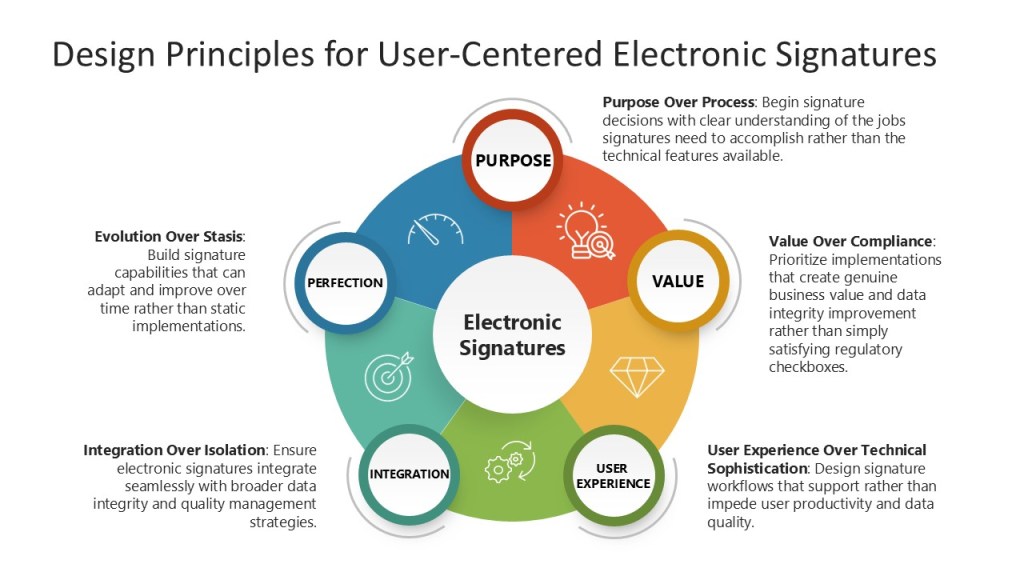
The image illustrates five design principles for user-centered electronic signatures in a circular infographic. At the center is the term "Electronic Signatures," surrounded by five labeled sections: Purpose, Value, User Experience, Integration, and Perfection. Each section contains a principle with supporting text:

Purpose Over Process: Emphasizes understanding the job requirements for signatures before technical features.

Value Over Compliance: Focuses on business value and data integrity, not just regulatory compliance.

User Experience Over Technical Sophistication: Encourages workflows that support productivity and data quality.

Integration Over Isolation: Stresses integrating electronic signatures with broader quality management strategies.

Evolution Over Stasis: Advocates capability improvements over static implementations. The design uses different colors for each principle and includes icons representing their themes.

Building Organizational Trust Through Electronic Signatures

Electronic signatures should enhance rather than complicate organizational trust in data integrity. This requires:

  • Transparency: Users should understand how electronic signatures protect data integrity and support business decisions.
  • Reliability: Signature systems should work consistently and predictably, supporting rather than impeding daily operations.
  • Accountability: Electronic signatures should create clear accountability and traceability without overwhelming users with administrative burden.
  • Competence: Organizations should demonstrate genuine competence in electronic signature implementation and management, not just regulatory compliance.

Future-Proofing Your Electronic Signature Approach

The regulatory and technological landscape for electronic signatures continues to evolve. Organizations need approaches that can adapt to:

  • Regulatory Evolution: Draft revisions to Annex 11, evolving FDA guidance, and new regulatory requirements in emerging markets.
  • Technological Advancement: Biometric signatures, blockchain-based authentication, artificial intelligence integration, and mobile signature capabilities.
  • Business Model Changes: Remote work, cloud-based systems, global operations, and supplier network integration.
  • User Expectations: Consumerization of technology, mobile-first workflows, and seamless user experiences.

The Path Forward: Hiring Electronic Signatures for Real Jobs

We need to move beyond electronic signature systems that create false confidence while providing no genuine data integrity protection. This happens when organizations optimize for regulatory appearance rather than user needs, creating elaborate signature workflows that nobody genuinely wants to hire.

True electronic signature strategy begins with understanding what jobs users actually need accomplished: establishing reliable accountability, protecting data integrity, enabling efficient workflows, and supporting regulatory confidence. Organizations that design electronic signature approaches around these jobs will develop competitive advantages in an increasingly digital world.

The framework presented here provides a structured approach to making these decisions, but the fundamental insight remains: electronic signatures should not be something organizations implement to satisfy auditors. They should be capabilities that organizations actively seek because they make data integrity demonstrably better.

When we design signature capabilities around the jobs users actually need accomplished—protecting data integrity, enabling accountability, streamlining workflows, and building regulatory confidence—we create systems that enhance rather than complicate our fundamental mission of protecting patients and ensuring product quality.

The choice is clear: continue performing electronic signature compliance theater, or build signature capabilities that organizations genuinely want to hire. In a world where data integrity failures can result in patient harm, product recalls, and regulatory action, only the latter approach offers genuine protection.

Electronic signatures should not be something we implement because regulations require them. They should be capabilities we actively seek because they make us demonstrably better at protecting data integrity and serving patients.
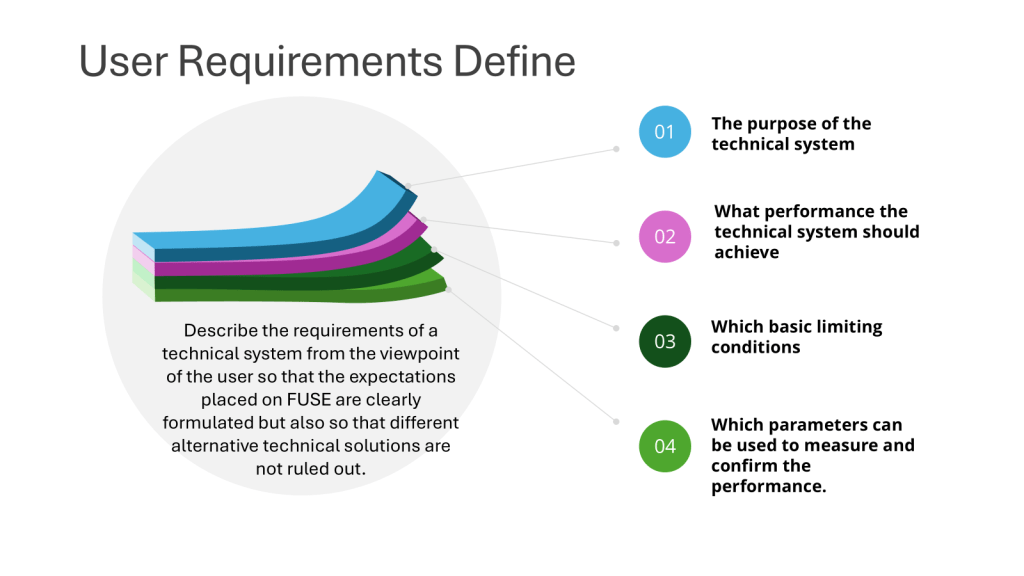
The Regulatory Red Herring: Why High-Level Compliance Requirements Have No Place in User Requirements Specifications

We have an unfortunate habit of conflating regulatory process requirements with specific system functionality requirements. This confusion manifests most perversely in User Requirements Specifications that contain nebulous statements like “the system shall comply with 21 CFR Part 11” or “the system must meet EU GMP Annex 11 requirements.” These high-level regulatory citations represent a fundamental misunderstanding of what user requirements should accomplish and demonstrate a dangerous abdication of the detailed thinking required for effective validation.

The core problem is simple yet profound: lifecycle, risk management, and validation are organizational processes, not system characteristics. When we embed these process-level concepts into system requirements, we create validation exercises that test compliance theater rather than functional reality.

The Distinction That Changes Everything

User requirements specifications serve as the foundational document identifying what a system must do to meet specific business needs, product requirements, and operational constraints. They translate high-level business objectives into measurable, testable, and verifiable system behaviors. User requirements focus on what the system must accomplish, not how the organization manages its regulatory obligations.

Consider the fundamental difference between these approaches:

Problematic High-Level Requirement: “The system shall comply with 21 CFR Part 11 validation requirements.”

Proper Detailed Requirements:

  • “The system shall generate time-stamped audit trails for all data modifications, including user ID, date/time, old value, new value, and reason for change”
  • “The system shall enforce unique user identification through username/password combinations with minimum 8-character complexity requirements”
  • “The system shall prevent deletion of electronic records while maintaining complete audit trail visibility”
  • “The system shall provide electronic signature functionality that captures the printed name, date/time, and meaning of the signature”

The problematic version tells us nothing about what the system actually needs to do. The detailed versions provide clear, testable criteria that directly support Part 11 compliance while specifying actual system functionality.

Process vs. System: Understanding the Fundamental Categories

Lifecycle management, risk assessment, and validation represent organizational processes that exist independently of any specific system implementation. These processes define how an organization approaches system development, operation, and maintenance—they are not attributes that can be “built into” software.

Lifecycle processes encompass the entire journey from initial system conception through retirement, including stages such as requirements definition, design, development, testing, deployment, operation, and eventual decommissioning. A lifecycle approach ensures systematic progression through these stages with appropriate documentation, review points, and decision criteria. However, lifecycle management cannot be embedded as a system requirement because it describes the framework within which system development occurs, not system functionality itself.

Risk management processes involve systematic identification, assessment, and mitigation of potential hazards throughout system development and operation. Risk management influences system design decisions and validation approaches, but risk management itself is not a system capability—it is an organizational methodology for making informed decisions about system requirements and controls.

Validation processes establish documented evidence that systems consistently perform as intended and meet all specified requirements. Validation involves planning, execution, and documentation of testing activities, but validation is something done to systems, not something systems possess as an inherent characteristic.

The Illusion of Compliance Through Citation

When user requirements specifications contain broad regulatory citations rather than specific functional requirements, they create several critical problems that undermine effective validation:

  • Untestable Requirements: How does one verify that a system “complies with Part 11”? Such requirements provide no measurable criteria, no specific behaviors to test, and no clear success/failure conditions. Verification becomes a subjective exercise in regulatory interpretation rather than objective measurement of system performance.
  • Validation Theater: Broad compliance statements encourage checkbox validation exercises where teams demonstrate regulatory awareness without proving functional capability. These validations often consist of mapping system features to regulatory sections rather than demonstrating that specific user needs are met.
  • Scope Ambiguity: Part 11 and Annex 11 contain numerous requirements, many of which may not apply to specific systems or use cases. Blanket compliance statements fail to identify which specific regulatory requirements are relevant and which system functions address those requirements.
  • Change Management Nightmares: When requirements reference entire regulatory frameworks rather than specific system behaviors, any regulatory update potentially impacts system validation status. This creates unnecessary re-validation burdens and regulatory uncertainty.

Building Requirements That Actually Work

Effective user requirements specifications address regulatory compliance through detailed, system-specific functional requirements that directly support regulatory objectives. This approach ensures that validation activities test actual system capabilities rather than regulatory awareness

Focus on Critical Quality Attributes: Rather than citing broad compliance frameworks, identify the specific product and process attributes that regulatory requirements are designed to protect. For pharmaceutical systems, this might include data integrity, product traceability, batch genealogy, or contamination prevention.

Translate Regulatory Intent into System Functions: Understand what each applicable regulation is trying to achieve, then specify system behaviors that accomplish those objectives. Part 11’s audit trail requirements, for example, aim to ensure data integrity and accountability—translate this into specific system capabilities for logging, storing, and retrieving change records.

Maintain Regulatory Traceability: Document the relationship between specific system requirements and regulatory drivers, but do so through traceability matrices or design rationale documents rather than within the requirements themselves. This maintains clear regulatory justification while keeping requirements focused on system functionality.

Enable Risk-Based Validation: Detailed functional requirements support risk-based validation approaches by clearly identifying which system functions are critical to product quality, patient safety, or data integrity. This enables validation resources to focus on genuinely important capabilities rather than comprehensive regulatory coverage.

The Process-System Interface: Getting It Right

The relationship between organizational processes and system requirements should be managed through careful analysis and translation, not through broad regulatory citations. Effective user requirements development involves several critical steps:

Process Analysis: Begin by understanding the organizational processes that the system must support. This includes manufacturing processes, quality control workflows, regulatory reporting requirements, and compliance verification activities. However, the focus should be on what the system must enable, not how the organization manages compliance.

Regulatory Gap Analysis: Identify specific regulatory requirements that apply to the intended system use. Analyze these requirements to understand their functional implications for system design, but avoid copying regulatory language directly into system requirements.

Functional Translation: Convert regulatory requirements into specific, measurable system behaviors. This translation process requires deep understanding of both regulatory intent and system capabilities, but produces requirements that can be objectively verified.

Organizational Boundary Management: Clearly distinguish between requirements for system functionality and requirements for organizational processes. System requirements should focus exclusively on what the technology must accomplish, while process requirements address how the organization will use, maintain, and govern that technology.

Real-World Consequences of the Current Approach

The practice of embedding high-level regulatory requirements in user requirements specifications has created systemic problems throughout the pharmaceutical industry:

  • Validation Inefficiency: Teams spend enormous resources demonstrating broad regulatory compliance rather than proving that systems meet specific user needs. This misallocation of validation effort undermines both regulatory compliance and system effectiveness.
  • Inspection Vulnerability: When regulatory inspectors evaluate systems against broad compliance claims, they often identify gaps between high-level assertions and specific system capabilities. Detailed functional requirements provide much stronger inspection support by demonstrating specific regulatory compliance mechanisms.
  • System Modification Complexity: Changes to systems with broad regulatory requirements often trigger extensive re-validation activities, even when the changes don’t impact regulatory compliance. Specific functional requirements enable more targeted change impact assessments.
  • Cross-Functional Confusion: Development teams, validation engineers, and quality professionals often interpret broad regulatory requirements differently, leading to inconsistent implementation and validation approaches. Detailed functional requirements provide common understanding and clear success criteria.

A Path Forward: Detailed Requirements for Regulatory Success

The solution requires fundamental changes in how the pharmaceutical industry approaches user requirements development and regulatory compliance documentation:

Separate Compliance Strategy from System Requirements: Develop comprehensive regulatory compliance strategies that identify applicable requirements and define organizational approaches for meeting them, but keep these strategies distinct from system functional requirements. Use the compliance strategy to inform requirements development, not replace it.

Invest in Requirements Translation: Build organizational capability for translating regulatory requirements into specific, testable system functions. This requires regulatory expertise, system knowledge, and requirements engineering skills working together.

Implement Traceability Without Embedding: Maintain clear traceability between system requirements and regulatory drivers through external documentation rather than embedded citations. This preserves regulatory justification while keeping requirements focused on system functionality.

Focus Validation on Function: Design validation approaches that test system capabilities directly rather than compliance assertions. This produces stronger regulatory evidence while ensuring system effectiveness.

Lifecycle, risk management, and validation are organizational processes that guide how we develop and maintain systems—they are not system requirements themselves. When we treat them as such, we undermine both regulatory compliance and system effectiveness. The time has come to abandon this regulatory red herring and embrace requirements practices worthy of the products and patients we serve.

The Problem with High-Level Regulatory User Requirements: Why “Meet Part 11” is Bad Form

Writing user requirements that simply state “the system shall meet FDA 21 CFR Part 11 requirements” or “the system shall comply with EU Annex 11” is fundamentally bad practice. These high-level regulatory statements create ambiguity, shift responsibility inappropriately, and fail to provide the specific, testable criteria that effective requirements demand.

The Core Problem: Regulatory References Aren’t Technical Requirements

User requirements must be specific, measurable, and testable. When we write “the system shall meet Annex 11 and Part 11 requirements,” we’re not writing a technical requirement at all—we’re writing a reference to a collection of regulatory provisions that may or may not apply to our specific system context. This creates several fundamental problems that undermine the entire validation and verification process.

The most critical issue is ambiguity of technical scope. Annex 11 and Part 11 contains numerous provisions, but not all apply to every system. Some provisions address closed systems, others open systems. Some apply only when electronic records replace paper records, others when organizations rely on electronic records to perform regulated activities. Without specifying which technical provisions apply and how they translate into system functionality, we leave interpretation to individual team members—a recipe for inconsistent implementation.

Technical verification becomes impossible with such high-level statements. How does a tester verify that a system “meets Part 11”? They would need to become regulatory experts, interpret which provisions apply, translate those into testable criteria, and then execute tests—work that should have been done during requirements definition. This shifting of analytical responsibility from requirements authors to testers violates fundamental engineering principles.

Why This Happens: The Path of Least Resistance

The temptation to write high-level regulatory requirements stems from several understandable but misguided motivations. Requirements authors often lack deep regulatory knowledge and find it easier to reference entire regulations rather than analyze which specific technical provisions apply to their system. This approach appears comprehensive while avoiding the detailed work of regulatory interpretation.

Time pressure exacerbates this tendency. Writing “meet Part 11” takes minutes; properly analyzing regulatory requirements, determining technical applicability, and translating them into specific, testable statements takes days or weeks. Under project pressure, teams often choose the quick path without considering downstream consequences.

There’s also a false sense of completeness. Referencing entire regulations gives the impression of thorough coverage when it actually provides no technical coverage at all. It’s the requirements equivalent of writing “the system shall work properly”, technically correct but utterly useless for implementation or testing purposes.

Better Approach: Technical User Requirements

Effective regulatory user requirements break down high-level regulatory concepts into specific, measurable technical statements that directly address system functionality. Rather than saying “meet Part 11,” we need requirements that specify exactly what the system must do technically.

Access Control Requirements

Instead of: “The system shall meet Part 11 access control requirements”

Write:

  • “The system shall authenticate users through unique user ID and password combinations, where each combination is assigned to only one individual”
  • “The system shall automatically lock user sessions after 30 minutes of inactivity and require re-authentication”
  • “The system shall maintain an electronic log of all user authentication attempts, including failed attempts, with timestamps and user identifiers”

Electronic Record Generation Requirements

Instead of: “The system shall generate Part 11 compliant electronic records”

Write:

  • “The system shall generate electronic records that include all data required by the predicate rule, with no omission of required information”
  • “The system shall time-stamp all electronic records using computer-generated timestamps that cannot be altered by system users”
  • “The system shall detect and flag any unauthorized alterations to electronic records through checksum validation”

Audit Trail Requirements

Instead of: “The system shall maintain Part 11 compliant audit trails”

Write:

  • “The system shall automatically record the user ID, date, time, and type of action for all data creation, modification, and deletion operations”
  • “The system shall store audit trail records in a format that prevents user modification or deletion”
  • “The system shall provide audit trail search and filter capabilities by user, date range, and record type”

Electronic Signature Requirements

Instead of: “The system shall support Part 11 electronic signatures”

Write:

  • “Electronic signature records shall include the signer’s printed name, date and time of signing, and the purpose of the signature”
  • “The system shall verify signer identity through authentication requiring both user ID and password before accepting electronic signatures
  • “The system shall cryptographically link electronic signatures to their associated records to prevent signature transfer or copying”

Annex 11 Technical Examples

EU Annex 11 requires similar technical specificity but with some European-specific nuances. Here are better technical requirement examples:

System Security Requirements

Instead of: “The system shall meet Annex 11 security requirements”

Write:

  • “The system shall implement role-based access control where user privileges are assigned based on documented job responsibilities”
  • “The system shall encrypt all data transmission between system components using AES 256-bit encryption”
  • “The system shall maintain user session logs that record login time, logout time, and all system functions accessed during each session”

Data Integrity Requirements

Instead of: “The system shall ensure Annex 11 data integrity”

Write:

  • “The system shall implement automated backup procedures that create complete system backups daily and verify backup integrity”
  • “The system shall prevent simultaneous modification of the same record by multiple users through record locking mechanisms”
  • “The system shall maintain original raw data in unalterable format while allowing authorized users to add comments or corrections with full audit trails”

System Change Control Requirements

Instead of: “The system shall implement Annex 11 change control”

Write:

  • “The system shall require authorized approval through electronic workflow before implementing any configuration changes that affect GMP functionality”
  • “The system shall maintain a complete history of all system configuration changes including change rationale, approval records, and implementation dates”
  • “The system shall provide the ability to revert system configuration to any previous approved state through documented rollback procedures”

The Business Case for Technical Requirements

Technical requirements save time and money. While writing detailed requirements requires more upfront effort, it prevents costly downstream problems. Clear technical requirements eliminate the need for interpretation during design, reduce testing iterations, and prevent regulatory findings during inspections.

Technical traceability becomes meaningful when requirements are specific. We can trace from business needs through technical specifications to test cases and validation results. This traceability is essential for regulatory compliance and change control.

System quality improves systematically when everyone understands exactly what technical functionality needs to be built and tested. Vague requirements lead to assumption-driven development where different team members make different assumptions about what’s technically needed.

Implementation Strategy for Technical Requirements

Start by conducting regulatory requirement analysis as a separate technical activity before writing user requirements. Identify which regulatory provisions apply to your specific system and translate them into technical functionality. Document this analysis and use it as the foundation for technical requirement writing.

Engage both regulatory and technical experts early in the requirements process. Don’t expect requirements authors to become overnight regulatory experts, but do ensure they have access to both regulatory knowledge and technical understanding when translating regulatory concepts into system requirements.

Use technical requirement templates that capture the essential technical elements of common regulatory requirements. This ensures consistency across projects and reduces the analytical burden on individual requirements authors.

Review requirements for technical testability. Every requirement should have an obvious technical verification method. If you can’t immediately see how to test a requirement technically, it needs to be rewritten.

Technical Requirements That Actually Work

High-level regulatory references have no place in technical user requirements documents. They create technical ambiguity where clarity is needed, shift analytical work to inappropriate roles, and fail to provide the specific technical guidance necessary for successful system implementation.

Better technical requirements translate regulatory concepts into specific, measurable, testable statements that directly address system technical functionality. This approach requires more upfront effort but delivers better technical outcomes: clearer system designs, more efficient testing, stronger regulatory compliance, and systems that actually meet user technical needs.

The pharmaceutical industry has matured beyond accepting “it must be compliant” as adequate technical guidance. Our technical requirements must mature as well, providing the specific, actionable technical direction that modern development teams need to build quality systems that truly serve patients and regulatory expectations.

As I’ve emphasized in previous posts about crafting good user requirements and building FUSE(P) user requirements, technical specificity and testability remain the hallmarks of effective requirements writing. Regulatory compliance requirements demand this same technical rigor—perhaps more so, given the patient safety implications of getting the technical implementation wrong.

Draft Annex 11’s Identity & Access Management Changes: Why Your Current SOPs Won’t Cut It

The draft EU Annex 11 Section 11 “Identity and Access Management” reads like a complete demolition of every lazy access-control practice organizations might have been coasting on for years. Gone are the vague handwaves about “appropriate controls.” The new IAM requirements are explicitly designed to eliminate the shared-account shortcuts and password recycling schemes that have made pharma IT security a running joke among auditors.

The regulatory bar for access management has been raised so high that most existing computerized systems will need major overhauls to comply. Organizations that think a username-password combo and quarterly access reviews will satisfy the new requirements are about to learn some expensive lessons about modern data integrity enforcement.

What Makes This Different from Every Other Access Control Update

The draft Annex 11’s Identity and Access Management section is a complete philosophical shift from “trust but verify” to “prove everything, always.” Where the 2011 version offered generic statements about restricting access to “authorised persons,” the 2025 draft delivers 11 detailed subsections that read like a cybersecurity playbook written by paranoid auditors who’ve spent too much time investigating data integrity failures.

This isn’t incremental improvement. Section 11 transforms IAM from a compliance checkbox into a fundamental pillar of data integrity that touches every aspect of how users interact with GMP systems. The draft makes it explicitly clear that poor access controls are considered violations of data integrity—not just security oversights.

European regulators have decided that the EU needs robust—and arguably more prescriptive—guidance for managing user access in an era where cloud services, remote work, and cyber threats have fundamentally changed the risk landscape. The result is regulatory text that assumes bad actors, compromised credentials, and insider threats as baseline conditions rather than edge cases.

The Eleven Subsections That Will Break Your Current Processes

11.1: Unique Accounts – The Death of Shared Logins

The draft opens with a declaration that will send shivers through organizations still using shared service accounts: “All users should have unique and personal accounts. The use of shared accounts except for those limited to read-only access (no data or settings can be changed), constitute a violation of data integrity”.

This isn’t a suggestion—it’s a flat prohibition with explicit regulatory consequences. Every shared “QC_User” account, every “Production_Shift” login, every “Maintenance_Team” credential becomes a data integrity violation the moment this guidance takes effect. The only exception is read-only accounts that cannot modify data or settings, which means most shared accounts used for batch record reviews, approval workflows, and system maintenance will need complete redesign.

The impact extends beyond just creating more user accounts. This sets out the need to address all the legacy systems that have coasted along for years. There are a lot of filter integrity testers, pH meters and balances, among other systems, that will require some deep views.

11.2: Continuous Management – Beyond Set-and-Forget

Where the 2011 Annex 11 simply required that access changes “should be recorded,” the draft demands “continuous management” with timely granting, modification, and revocation as users “join, change, and end their involvement in GMP activities”. The word “timely” appears to be doing significant regulatory work here—expect inspectors to scrutinize how quickly access is updated when employees change roles or leave the organization.

This requirement acknowledges the reality that modern pharmaceutical operations involve constant personnel changes, contractor rotations, and cross-functional project teams. Static annual access reviews become insufficient when users need different permissions for different projects, temporary elevated access for system maintenance, and immediate revocation when employment status changes. The continuous management standard implies real-time or near-real-time access administration that most organizations currently lack.

The operational implications are clear. It is no longer optional not to integrate HR systems with IT provisioning tools and tie it into your GxP systems. Contractor management processes will require pre-defined access templates and automatic expiration dates. Organizations that treat access management as a periodic administrative task rather than a dynamic business process will find themselves fundamentally out of compliance.

11.3: Certain Identification – The End of Token-Only Authentication

Perhaps the most technically disruptive requirement, Section 11.3 mandates authentication methods that “identify users with a high degree of certainty” while explicitly prohibiting “authentication only by means of a token or a smart card…if this could be used by another user”. This effectively eliminates proximity cards, USB tokens, and other “something you have” authentication methods as standalone solutions.

The regulation acknowledges biometric authentication as acceptable but requires username and password as the baseline, with other methods providing “at least the same level of security”. For organizations that have invested heavily in smart card infrastructure or hardware tokens, this represents a significant technology shift toward multi-factor authentication combining knowledge and possession factors.

The “high degree of certainty” language introduces a subjective standard that will likely be interpreted differently across regulatory jurisdictions. Organizations should expect inspectors to challenge any authentication method that could reasonably be shared, borrowed, or transferred between users. This standard effectively rules out any authentication approach that doesn’t require active user participation—no more swiping someone else’s badge to help them log in during busy periods.

Biometric systems become attractive under this standard, but the draft doesn’t provide guidance on acceptable biometric modalities, error rates, or privacy considerations. Organizations implementing fingerprint, facial recognition, or voice authentication systems will need to document the security characteristics that meet the “high degree of certainty” requirement while navigating European privacy regulations that may restrict biometric data collection.

11.4: Confidential Passwords – Personal Responsibility Meets System Enforcement

The draft’s password confidentiality requirements combine personal responsibility with system enforcement in ways that current pharmaceutical IT environments rarely support. Section 11.4 requires passwords to be “kept confidential and protected from all other users, both at system and at a personal level” while mandating that “passwords received from e.g. a manager, or a system administrator should be changed at the first login, preferably required by the system”1.

This requirement targets the common practice of IT administrators assigning temporary passwords that users may or may not change, creating audit trail ambiguity about who actually performed specific actions. The “preferably required by the system” language suggests that technical controls should enforce password changes rather than relying on user compliance with written procedures.

The personal responsibility aspect extends beyond individual users to organizational accountability. Companies must demonstrate that their password policies, training programs, and technical controls work together to prevent password sharing, writing passwords down, or other practices that compromise authentication integrity. This creates a documentation burden for organizations to prove that their password management practices support data integrity objectives.

11.5: Secure Passwords – Risk-Based Complexity That Actually Works

Rather than mandating specific password requirements, Section 11.5 takes a risk-based approach that requires password rules to be “commensurate with risks and consequences of unauthorised changes in systems and data”. For critical systems, the draft specifies passwords should be “of sufficient length to effectively prevent unauthorised access and contain a combination of uppercase, lowercase, numbers and symbols”.

The regulation prohibits common password anti-patterns: “A password should not contain e.g. words that can be found in a dictionary, the name of a person, a user id, product or organisation, and should be significantly different from a previous password”. This requirement goes beyond basic complexity rules to address predictable password patterns that reduce security effectiveness.

The risk-based approach means organizations must document their password requirements based on system criticality assessments. Manufacturing control systems, quality management databases, and regulatory submission platforms may require different password standards than training systems or general productivity applications. This creates a classification burden where organizations must justify their password requirements through formal risk assessments.

“Sufficient length” and “significantly different” introduce subjective standards that organizations must define and defend. Expect regulatory discussions about whether 8-character passwords meet the “sufficient length” requirement for critical systems, and whether changing a single character constitutes “significantly different” from previous passwords.

11.6: Strong Authentication – MFA for Remote Access

Section 11.6 represents the draft’s most explicit cybersecurity requirement: “Remote authentication on critical systems from outside controlled perimeters, should include multifactor authentication (MFA)”. This requirement acknowledges the reality of remote work, cloud services, and mobile access to pharmaceutical systems while establishing clear security expectations.

The “controlled perimeters” language requires organizations to define their network security boundaries and distinguish between internal and external access. Users connecting from corporate offices, manufacturing facilities, and other company-controlled locations may use different authentication methods than those connecting from home, hotels, or public networks.

“Critical systems” must be defined through risk assessment processes, creating another classification requirement. Organizations must identify which systems require MFA for remote access and document the criteria used for this determination. Laboratory instruments, manufacturing equipment, and quality management systems will likely qualify as critical, but organizations must make these determinations explicitly.

The MFA requirement doesn’t specify acceptable second factors, leaving organizations to choose between SMS codes, authenticator applications, hardware tokens, biometric verification, or other technologies. However, the emphasis on security effectiveness suggests that easily compromised methods like SMS may not satisfy regulatory expectations for critical system access.

11.7: Auto Locking – Administrative Controls for Security Failures

Account lockout requirements in Section 11.7 combine automated security controls with administrative oversight in ways that current pharmaceutical systems rarely implement effectively. The draft requires accounts to be “automatically locked after a pre-defined number of successive failed authentication attempts” with “accounts should only be unlocked by the system administrator after it has been confirmed that this was not part of an unauthorised login attempt or after the risk for such attempt has been removed”.

This requirement transforms routine password lockouts from simple user inconvenience into formal security incident investigations. System administrators cannot simply unlock accounts upon user request—they must investigate the failed login attempts and document their findings before restoring access. For organizations with hundreds or thousands of users, this represents a significant administrative burden that requires defined procedures and potentially additional staffing.

The “pre-defined number” must be established through risk assessment and documented in system configuration. Three failed attempts may be appropriate for highly sensitive systems, while five or more attempts might be acceptable for lower-risk applications. Organizations must justify their lockout thresholds based on balancing security protection with operational efficiency.

“Unauthorised login attempt” investigations require forensic capabilities that many pharmaceutical IT organizations currently lack. System administrators must be able to analyze login patterns, identify potential attack signatures, and distinguish between user errors and malicious activity. This capability implies enhanced logging, monitoring tools, and security expertise that extends beyond traditional IT support functions.

11.8: Inactivity Logout – Session Management That Users Cannot Override

Session management requirements in Section 11.8 establish mandatory timeout controls that users cannot circumvent: “Systems should include an automatic inactivity logout, which logs out a user after a defined period of inactivity. The user should not be able to change the inactivity logout time (outside defined and acceptable limits) or deactivate the functionality”.

The requirement for re-authentication after inactivity logout means users cannot simply resume their sessions—they must provide credentials again, creating multiple authentication points throughout extended work sessions. This approach prevents unauthorized access to unattended workstations while ensuring that long-running analytical procedures or batch processing operations don’t compromise security.

“Defined and acceptable limits” requires organizations to establish timeout parameters based on risk assessment while potentially allowing users some flexibility within security boundaries. A five-minute timeout might be appropriate for systems that directly impact product quality, while 30-minute timeouts could be acceptable for documentation or training applications.

The prohibition on user modification of timeout settings eliminates common workarounds where users extend session timeouts to avoid frequent re-authentication. System configurations must enforce these settings at a level that prevents user modification, requiring administrative control over session management parameters.

11.9: Access Log – Comprehensive Authentication Auditing

Section 11.9 establishes detailed logging requirements that extend far beyond basic audit trail functionality: “Systems should include an access log (separate, or as part of the audit trail) which, for each login, automatically logs the username, user role (if possible, to choose between several roles), the date and time for login, the date and time for logout (incl. inactivity logout)”.

The “separate, or as part of the audit trail” language recognizes that authentication events may need distinct handling from data modification events. Organizations must decide whether to integrate access logs with existing audit trail systems or maintain separate authentication logging capabilities. This decision affects log analysis, retention policies, and regulatory presentation during inspections.

Role logging requirements are particularly significant for organizations using role-based access control systems. Users who can assume different roles during a session (QC analyst, batch reviewer, system administrator) must have their role selections logged with each login event. This requirement supports accountability by ensuring auditors can determine which permissions were active during specific time periods.

The requirement for logs to be “sortable and searchable, or alternatively…exported to a tool which provides this functionality” establishes performance standards for authentication logging systems. Organizations cannot simply capture access events—they must provide analytical capabilities that support investigation, trend analysis, and regulatory review.

11.10: Guiding Principles – Segregation of Duties and Least Privilege

Section 11.10 codifies two fundamental security principles that transform access management from user convenience to risk mitigation: “Segregation of duties, i.e. that users who are involved in GMP activities do not have administrative privileges” and “Least privilege principle, i.e. that users do not have higher access privileges than what is necessary for their job function”.

Segregation of duties eliminates the common practice of granting administrative rights to power users, subject matter experts, or senior personnel who also perform GMP activities. Quality managers cannot also serve as system administrators. Production supervisors cannot have database administrative privileges. Laboratory directors cannot configure their own LIMS access permissions. This separation requires organizations to maintain distinct IT support functions independent from GMP operations.

The least privilege principle requires ongoing access optimization rather than one-time role assignments. Users should receive minimum necessary permissions for their specific job functions, with temporary elevation only when required for specific tasks. This approach conflicts with traditional pharmaceutical access management where users often accumulate permissions over time or receive broad access to minimize support requests.

Implementation of these principles requires formal role definition, access classification, and privilege escalation procedures. Organizations must document job functions, identify minimum necessary permissions, and establish processes for temporary access elevation when users need additional capabilities for specific projects or maintenance activities.

11.11: Recurrent Reviews – Documented Access Verification

The final requirement establishes ongoing access governance through “recurrent reviews where managers confirm the continued access of their employees in order to detect accesses which should have been changed or revoked during daily operation, but were accidentally forgotten”. This requirement goes beyond periodic access reviews to establish manager accountability for their team’s system permissions.

Manager confirmation creates personal responsibility for access accuracy rather than delegating reviews to IT or security teams. Functional managers must understand what systems their employees access, why those permissions are necessary, and whether access levels remain appropriate for current job responsibilities. This approach requires manager training on system capabilities and access implications.

Role-based access reviews extend the requirement to organizational roles rather than just individual users: “If user accounts are managed by means of roles, these should be subject to the same kind of reviews, where the accesses of roles are confirmed”. Organizations using role-based access control must review role definitions, permission assignments, and user-to-role mappings with the same rigor applied to individual account reviews.

Documentation and action requirements ensure that reviews produce evidence and corrections: “The reviews should be documented, and appropriate action taken”. Organizations cannot simply perform reviews—they must record findings, document decisions, and implement access modifications identified during the review process.

Risk-based frequency allows organizations to adjust review cycles based on system criticality: “The frequency of these reviews should be commensurate with the risks and consequences of changes in systems and data made by unauthorised individuals”. Critical manufacturing systems may require monthly reviews, while training systems might be reviewed annually.

How This Compares to 21 CFR Part 11 and Current Best Practices

The draft Annex 11’s Identity and Access Management requirements represent a significant advancement over 21 CFR Part 11, which addressed access control through basic authority checks and user authentication rather than comprehensive identity management. Part 11’s requirement for “at least two distinct identification components” becomes the foundation for much more sophisticated authentication and access control frameworks.

Multi-factor authentication requirements in the draft Annex 11 exceed Part 11 expectations by mandating MFA for remote access to critical systems, while Part 11 remains silent on multi-factor approaches. This difference reflects 25 years of cybersecurity evolution and acknowledges that username-password combinations provide insufficient protection for modern threat environments.

Current data integrity best practices have evolved toward comprehensive access management, risk-based authentication, and continuous monitoring—approaches that the draft Annex 11 now mandates rather than recommends. Organizations following ALCOA+ principles and implementing robust access controls will find the new requirements align with existing practices, while those relying on minimal compliance approaches will face significant gaps.

The Operational Reality of Implementation

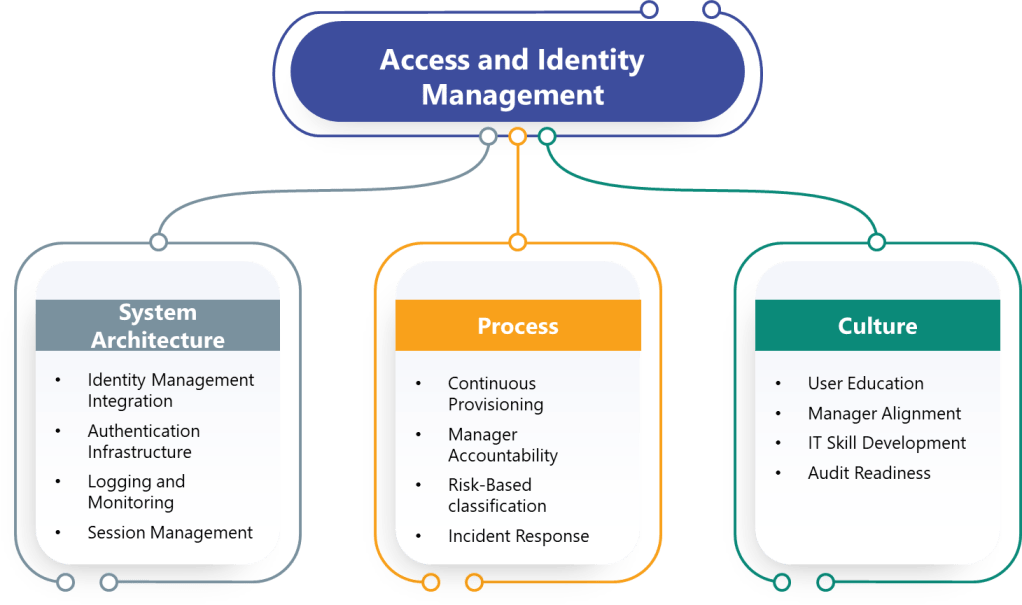
 Three major implementation areas of AIM represented graphically

System Architecture Changes

Most pharmaceutical computerized systems were designed assuming manual access management and periodic reviews would satisfy regulatory requirements. The draft Annex 11 requirements will force fundamental architecture changes including:

Identity Management Integration: Manufacturing execution systems, laboratory information management systems, and quality management platforms must integrate with centralized identity management systems to support continuous access management and role-based controls.

Authentication Infrastructure: Organizations must deploy multi-factor authentication systems capable of supporting diverse user populations, remote access scenarios, and integration with existing applications.

Logging and Monitoring: Enhanced access logging requirements demand centralized log management, analytical capabilities, and integration between authentication systems and audit trail infrastructure.

Session Management: Applications must implement configurable session timeout controls, prevent user modification of security settings, and support re-authentication without disrupting long-running processes.

Process Reengineering Requirements

The regulatory requirements will force organizations to redesign fundamental access management processes:

Continuous Provisioning: HR onboarding, role changes, and termination processes must trigger immediate access modifications rather than waiting for periodic reviews.

Manager Accountability: Access review processes must shift from IT-driven activities to manager-driven confirmations with documented decision-making and corrective actions.

Risk-Based Classification: Organizations must classify systems based on criticality, define access requirements accordingly, and maintain documentation supporting these determinations.

Incident Response: Account lockout events must trigger formal security investigations rather than simple password resets, requiring enhanced forensic capabilities and documented procedures.

Training and Cultural Changes

Implementation success requires significant organizational change management:

Manager Training: Functional managers must understand system capabilities, access implications, and review responsibilities rather than delegating access decisions to IT teams.

User Education: Password security, MFA usage, and session management practices require user training programs that emphasize data integrity implications rather than just security compliance.

IT Skill Development: System administrators must develop security investigation capabilities, risk assessment skills, and regulatory compliance expertise beyond traditional technical support functions.

Audit Readiness: Organizations must prepare to demonstrate access control effectiveness through documentation, metrics, and investigative capabilities during regulatory inspections.

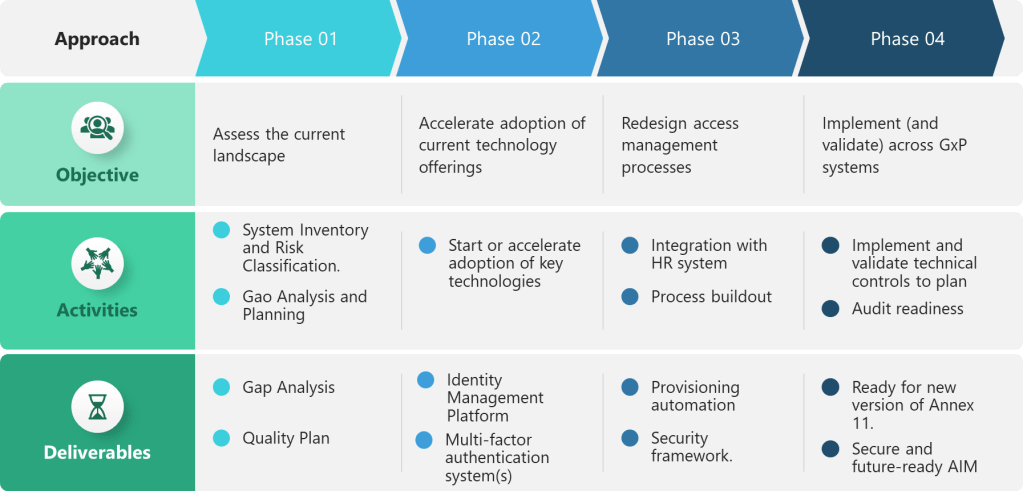
Strategic Implementation Approach

The Annex 11 Draft is just taking good cybersecurity and enshrining it more firmly in the GMPs. Organizations should not wait for the effective version to implement. Get that budget prioritized and start now.

Phase 1: Assessment and Classification

Organizations should begin with comprehensive assessment of current access control practices against the new requirements:

  • System Inventory: Catalog all computerized systems used in GMP activities, identifying shared accounts, authentication methods, and access control capabilities.
  • Risk Classification: Determine which systems qualify as “critical” requiring enhanced authentication and access controls.
  • Gap Analysis: Compare current practices against each subsection requirement, identifying technical, procedural, and training gaps.
  • Compliance Timeline: Develop implementation roadmap aligned with expected regulatory effective dates and system upgrade cycles.

Phase 2: Infrastructure Development

Focus on foundational technology changes required to support the new requirements:

  • Identity Management Platform: Deploy or enhance centralized identity management systems capable of supporting continuous provisioning and role-based access control.
  • Multi-Factor Authentication: Implement MFA systems supporting diverse authentication methods and integration with existing applications.
  • Enhanced Logging: Deploy log management platforms capable of aggregating, analyzing, and presenting access events from distributed systems.
  • Session Management: Upgrade applications to support configurable timeout controls and prevent user modification of security settings.

Phase 3: Process Implementation

Redesign access management processes to support continuous management and enhanced accountability:

  • Provisioning Automation: Integrate HR systems with IT provisioning tools to support automatic access changes based on employment events.
  • Manager Accountability: Train functional managers on access review responsibilities and implement documented review processes.
  • Security Incident Response: Develop procedures for investigating account lockouts and documenting security findings.
  • Audit Trail Integration: Ensure access events are properly integrated with existing audit trail review and batch release processes.

Phase 4: Validation and Documentation

When the Draft becomes effective you’ll be ready to complete validation activities demonstrating compliance with the new requirements:

  • Access Control Testing: Validate that technical controls prevent unauthorized access, enforce authentication requirements, and log security events appropriately.
  • Process Verification: Demonstrate that access management processes support continuous management, manager accountability, and risk-based reviews.
  • Training Verification: Document that personnel understand their responsibilities for password security, session management, and access control compliance.
  • Audit Readiness: Prepare documentation, metrics, and investigative capabilities required to demonstrate compliance during regulatory inspections.
4 phases represented graphically

The Competitive Advantage of Early Implementation

Organizations that proactively implement the draft Annex 11 IAM requirements will gain significant advantages beyond regulatory compliance:

  • Enhanced Security Posture: The access control improvements provide protection against cyber threats, insider risks, and accidental data compromise that extend beyond GMP applications to general IT security.
  • Operational Efficiency: Automated provisioning, role-based access, and centralized identity management reduce administrative overhead while improving access accuracy.
  • Audit Confidence: Comprehensive access logging, manager accountability, and continuous management provide evidence of control effectiveness that regulators and auditors will recognize.
  • Digital Transformation Enablement: Modern identity and access management infrastructure supports cloud adoption, mobile access, and advanced analytics initiatives that drive business value.
  • Risk Mitigation: Enhanced access controls reduce the likelihood of data integrity violations, security incidents, and regulatory findings that can disrupt operations and damage reputation.

Looking Forward: The End of Security Theater

The draft Annex 11’s Identity and Access Management requirements represent the end of security theater in pharmaceutical access control. Organizations can no longer satisfy regulatory expectations through generic policies and a reliance on periodic reviews to provide the appearance of control without actual security effectiveness.

The new requirements assume that user access is a continuous risk requiring active management, real-time monitoring, and ongoing verification. This approach aligns with modern cybersecurity practices while establishing regulatory expectations that reflect the actual threat environment facing pharmaceutical operations.

Implementation success will require significant investment in technology infrastructure, process reengineering, and organizational change management. However, organizations that embrace these requirements as opportunities for security improvement rather than compliance burdens will build competitive advantages that extend far beyond regulatory satisfaction.

The transition period between now and the expected 2026 effective date provides a ideal window for organizations to assess their current practices, develop implementation strategies, and begin the technical and procedural changes required for compliance. Organizations that delay implementation risk finding themselves scrambling to achieve compliance while their competitors demonstrate regulatory leadership through proactive adoption.

For pharmaceutical organizations serious about data integrity, operational security, and regulatory compliance, the draft Annex 11 IAM requirements aren’t obstacles to overcome—they’re the roadmap to building access control practices worthy of the products and patients we serve. The only question is whether your organization will lead this transformation or follow in the wake of those who do.

RequirementCurrent Annex 11 (2011)Draft Annex 11 Section 11 (2025)21 CFR Part 11
User Account ManagementBasic – creation, change, cancellation should be recordedContinuous management – grant, modify, revoke as users join/change/leaveBasic user management, creation/change/cancellation recorded
Authentication MethodsPhysical/logical controls, pass cards, personal codes with passwords, biometricsUsername + password or equivalent (biometrics); tokens/smart cards alone insufficientAt least two distinct identification components (ID code + password)
Password RequirementsNot specified in detailSecure passwords enforced by systems, length/complexity based on risk, dictionary words prohibitedUnique ID/password combinations, periodic checking/revision required
Multi-factor AuthenticationNot mentionedRequired for remote access to critical systems from outside controlled perimetersNot explicitly required
Access Control PrinciplesRestrict access to authorized personsSegregation of duties + least privilege principle explicitly mandatedAuthority checks to ensure only authorized individuals access system
Account LockoutNot specifiedAuto-lock after failed attempts, admin unlock only after investigationNot specified
Session ManagementNot specifiedAuto inactivity logout with re-authentication requiredNot specified
Access LoggingRecord identity of operators with date/timeAccess log with username, role, login/logout times, searchable/exportableAudit trails record operator entries and actions
Role-based AccessNot explicitly mentionedRole-based access controls explicitly requiredAuthority checks for different functions
Access ReviewsNot specifiedRecurrent reviews of user accounts and roles, documented with action takenPeriodic checking of ID codes and passwords
Segregation of DutiesNot mentionedUsers cannot have administrative privileges for GMP activitiesNot explicitly stated
Unique User AccountsNot explicitly requiredAll users must have unique personal accounts, shared accounts violate data integrityEach electronic signature unique to one individual
Remote Access ControlNot specifiedMFA required for remote access to critical systemsAdditional controls for open systems
Password ConfidentialityNot specifiedPasswords confidential at system and personal level, change at first loginPassword security and integrity controls required
Account AdministrationNot detailedSystem administrators control unlock, access privilege assignmentAdministrative controls over password issuance

Draft Annex 11, Section 13: What the Proposed Electronic Signature Rules Mean

Ready or not, the EU’s draft revision of Annex 11 is moving toward finalization, and its brand-new Section 13 on electronic signatures is a wake-up call for anyone still treating digital authentication as just Part 11 with an accent. In this post I will take a deep dive into what’s changing, why it matters, and how to keep your quality system out of the regulatory splash zone.

Section 13 turns electronic signatures from a check-the-box formality into a risk-based, security-anchored discipline. Think multi-factor authentication, time-zone stamps, hybrid wet-ink safeguards, and explicit “non-repudiation” language—all enforced at the same rigor as system login. If your current SOPs still assume username + password = done, it’s time to start planning some improvements.

Why the Rewrite?

  1. Tech has moved on: Biometric ID, cloud PaaS, and federated identity management were sci-fi when the 2011 Annex 11 dropped.
  2. Threat landscape: Ransomware and credential stuffing didn’t exist at today’s scale. Regulators finally noticed.
  3. Global convergence: The FDA’s Computer Software Assurance (CSA) draft and PIC/S data-integrity guides pushed the EU to level up.

For the bigger regulatory context, see my post on EMA GMP Plans for Regulation Updates.

What’s Actually New in Section 13?

Topic2011 Annex 11Draft Annex 11 (2025)21 CFR Part 11Why You Should Care
Authentication at SignatureSilentMust equal or exceed login strength; first sign = full re-auth, subsequent signs = pwd/biometric; smart-card-only = bannedTwo identification componentsForces MFA or biometrics; goodbye “remember me” shortcuts
Time & Time-ZoneDate + time (manual OK)Auto-captured and time-zone loggedDate + time (no TZ)Multisite ops finally get defensible chronology
Signature Meaning PromptNot requiredSystem must ask user for purpose (approve, review…)Required but less prescriptiveEliminates “mystery clicks” that auditors love to exploit
Manifestation ElementsMinimalFull name, username, role, meaning, date/time/TZName, date, meaningCloses attribution gaps; boosts ALCOA+ “Legible”
Indisputability Clause“Same impact”Explicit non-repudiation mandateEquivalent legal weightSets the stage for eIDAS/federated ID harmonization
Record Linking After ChangePermanent linkIf record altered post-sign, signature becomes void/flaggedLink cannot be excisedEnds stealth edits after approval
Hybrid Wet-Ink ControlSilentHash code or similar to break link if record changesSilentLets you keep occasional paper without tanking data integrity
Open Systems / Trusted ServicesSilentMust comply with “national/international trusted services” (read: eIDAS)Extra controls, but legacy wordingValidates cloud signing platforms out of the box

The Implications

Multi-Factor Authentication (MFA) Is Now Table Stakes

Because the draft explicitly bars any authentication method that relies solely on a smart card or a static PIN, every electronic signature now has to be confirmed with an additional, independent factor—such as a password, biometric scan, or time-limited one-time code—so that the credential used to apply the signature is demonstrably different from the one that granted the user access to the system in the first place.

Time-Zone Logging Kills Spreadsheet Workarounds

One of the more subtle but critical updates in Draft Annex 11’s Section 13.4 is the explicit requirement for automatic logging of the time zone when electronic signatures are applied. Unlike previous guidance—whether under the 2011 Annex 11 or 21 CFR Part 11—that only mandated the capture of date and time (often allowing manual entry or local system time), the draft stipulates that systems must automatically capture the precise time and associated time zone for each signature event. This seemingly small detail has monumental implications for data integrity, traceability, and regulatory compliance. Why does this matter? For global pharmaceutical operations spanning multiple time zones, manual or local-only timestamps often create ambiguous or conflicting audit trails, leading to discrepancies in event sequencing. Companies relying on spreadsheets or legacy systems that do not incorporate time zone information effectively invite errors where a signature in one location appears to precede an earlier event simply due to zone differences. This ambiguity can undermine the “Contemporaneous” and “Enduring” principles of ALCOA+, principles the draft Annex 11 explicitly reinforces throughout electronic signature requirements. By mandating automated, time zone-aware timestamping, Draft Annex 11 Section 13.4 ensures that electronic signature records maintain a defensible and standardized chronology across geographies, eliminating the need for cumbersome manual reconciliation or retrospective spreadsheet corrections. This move not only tightens compliance but also supports modern, centralized data review and analytics where uniform timestamping is essential. If your current systems or SOPs rely on manual date/time entry or overlook time zone logging, prepare for significant system and procedural updates to meet this enhanced expectation once the draft Annex 11 is finalized. .

Hybrid Records Are Finally Codified

If you still print a batch record for wet-ink QA approval, Section 13.9 lets you keep the ritual—but only if a cryptographic hash or similar breaks when someone tweaks the underlying PDF. Expect a flurry of DocuSign-scanner-hash utilities.

Open-System Signatures Shift Liability

Draft Annex 11’s Section 13.2 represents perhaps the most strategically significant change in electronic signature liability allocation since 21 CFR Part 11 was published in 1997. The provision states that “Where the system owner does not have full control of system accesses (open systems), or where required by other legislation, electronic signatures should, in addition, meet applicable national and international requirements, such as trusted services”. This seemingly simple sentence fundamentally reshapes liability relationships in modern pharmaceutical IT architectures.

Defining the Open System Boundary

The draft Annex 11 adopts the 21 CFR Part 11 definition of open systems—environments where system owners lack complete control over access and extends it into contemporary cloud, SaaS, and federated identity scenarios. Unlike the original Part 11 approach, which merely required “additional measures such as document encryption and use of appropriate digital signature standards”, Section 13.2 creates a positive compliance obligation by mandating adherence to “trusted services” frameworks.

This distinction is critical: while Part 11 treats open systems as inherently risky environments requiring additional controls, draft Annex 11 legitimizes open systems provided they integrate with qualified trust service providers. Organizations no longer need to avoid cloud-based signature services; instead, they must ensure those services meet eIDAS-qualified standards or equivalent national frameworks.

The Trusted Services Liability Transfer

Section 13.2’s reference to “trusted services” directly incorporates European eIDAS Regulation 910/2014 into pharmaceutical GMP compliance, creating what amounts to a liability transfer mechanism. Under eIDAS, Qualified Trust Service Providers (QTSPs) undergo rigorous third-party audits, maintain certified infrastructure, and provide legal guarantees about signature validity and non-repudiation. When pharmaceutical companies use eIDAS-qualified signature services, they effectively transfer signature validity liability from their internal systems to certified external providers.

This represents a fundamental shift from the 21 CFR Part 11 closed-system preference, where organizations maintained complete control over signature infrastructure but also bore complete liability for signature failures. Draft Annex 11 acknowledges that modern pharmaceutical operations often depend on cloud service providers, federated authentication systems, and external trust services—and provides a regulatory pathway to leverage these technologies while managing liability exposure.

Practical Implications for SaaS Platforms

The most immediate impact affects organizations using Software-as-a-Service platforms for clinical data management, quality management, or document management. Under current Annex 11 and Part 11, these systems often require complex validation exercises to demonstrate signature integrity, with pharmaceutical companies bearing full responsibility for signature validity even when using external platforms.

Section 13.2 changes this dynamic by validating reliance on qualified trust services. Organizations using platforms like DocuSign, Adobe Sign, or specialized pharmaceutical SaaS providers can now satisfy Annex 11 requirements by ensuring their chosen platforms integrate with eIDAS-qualified signature services. The pharmaceutical company’s validation responsibility shifts from proving signature technology integrity to verifying trust service provider qualifications and proper integration.

Integration with Identity and Access Management

Draft Annex 11’s Section 11 (Identity and Access Management) works in conjunction with Section 13.2 to support federated identity scenarios common in modern pharmaceutical operations. Organizations can now implement single sign-on (SSO) systems with external identity providers, provided the signature components integrate with trusted services. This enables scenarios where employees authenticate through corporate Active Directory systems but execute legally binding signatures through eIDAS-qualified providers.

The liability implications are significant: authentication failures become the responsibility of the identity provider (within contractual limits), while signature validity becomes the responsibility of the qualified trust service provider. The pharmaceutical company retains responsibility for proper system integration and user access controls, but shares technical implementation liability with certified external providers.

Cloud Service Provider Risk Allocation

For organizations using cloud-based LIMS, MES, or quality management systems, Section 13.2 provides regulatory authorization to implement signature services hosted entirely by external providers. Cloud service providers offering eIDAS-compliant signature services can contractually accept liability for signature technical implementation, cryptographic integrity, and legal validity—provided they maintain proper trust service qualifications.

This risk allocation addresses a long-standing concern in pharmaceutical cloud adoption: the challenge of validating signature infrastructure owned and operated by external parties. Under Section 13.2, organizations can rely on qualified trust service provider certifications rather than conducting detailed technical validation of cloud provider signature implementations.

Harmonization with Global Standards

Section 13.2’s “national and international requirements” language extends beyond eIDAS to encompass other qualified electronic signature frameworks. This includes Swiss ZertES standards and Canadian digital signature regulations,. Organizations operating globally can implement unified signature platforms that satisfy multiple regulatory requirements through single trusted service provider integrations.

The practical effect is regulatory arbitrage: organizations can choose signature service providers based on the most favorable combination of technical capabilities, cost, and regulatory coverage, rather than being constrained by local regulatory limitations.

Supplier Assessment Transformation

Draft Annex 11’s Section 7 (Supplier and Service Management) requires comprehensive supplier assessment for computerized systems. However, Section 13.2 creates a qualified exception for eIDAS-certified trust service providers: organizations can rely on third-party certification rather than conducting independent technical assessments of signature infrastructure.

This significantly reduces supplier assessment burden for signature services. Instead of auditing cryptographic implementations, hardware security modules, and signature validation algorithms, organizations can verify trust service provider certifications and assess integration quality. The result: faster implementation cycles and reduced validation costs for signature-enabled systems.

Audit Trail Integration Considerations

The liability shift enabled by Section 13.2 affects audit trail management requirements detailed in draft Annex 11’s expanded Section 12 (Audit Trails). When signature events are managed by external trust service providers, organizations must ensure signature-related audit events are properly integrated with internal audit trail systems while maintaining clear accountability boundaries.

Qualified trust service providers typically provide comprehensive signature audit logs, but organizations remain responsible for correlation with business process audit trails. This creates shared audit trail management where signature technical events are managed externally but business context remains internal responsibility.

Competitive Advantages of Early Adoption

Organizations that proactively implement Section 13.2 requirements gain several strategic advantages:

  • Reduced Infrastructure Costs: Elimination of internal signature infrastructure maintenance and validation overhead
  • Enhanced Security: Leverage specialized trust service provider security expertise and certified infrastructure
  • Global Scalability: Unified signature platforms supporting multiple regulatory jurisdictions through single provider relationships
  • Accelerated Digital Transformation: Faster deployment of signature-enabled processes through validated external services
  • Risk Transfer: Contractual liability allocation with qualified external providers rather than complete internal risk retention

Section 13.2 transforms open system electronic signatures from compliance challenges into strategic enablers of digital pharmaceutical operations. By legitimizing reliance on qualified trust services, the draft Annex 11 enables organizations to leverage best-in-class signature technologies while managing regulatory compliance and liability exposure through proven external partnerships. The result: more secure, cost-effective, and globally scalable electronic signature implementations that support advanced digital quality management systems.

How to Get Ahead (Instead of Playing Cleanup)

  1. Perform a gap assessment now—map every signature point to the new rules.
  2. Prototype MFA in your eDMS or MES. If users scream about friction, remind them that ransomware is worse.
  3. Update validation protocols to include time-zone, hybrid record, and non-repudiation tests.
  4. Rewrite SOPs to include signature-meaning prompts and periodic access-right recertification.
  5. Train users early. A 30-second “why you must re-authenticate” explainer video beats 300 deviations later.

Final Thoughts

The draft Annex 11 doesn’t just tweak wording—it yanks electronic signatures into the 2020s. Treat Section 13 as both a compliance obligation and an opportunity to slash latent data-integrity risk. Those who adapt now will cruise through 2026/2027 inspections while the laggards scramble for remediation budgets.