
Take-the-Best Heuristic for Causal Investigation

The integration of Gigerenzer’s take-the-best heuristic with a causal reasoning framework creates a powerful approach to root cause analysis that addresses one of the most persistent problems in quality investigations: the tendency to generate exhaustive lists of contributing factors without identifying the causal mechanisms that actually drove the event.

Traditional root cause analysis often suffers from what we might call “factor proliferation”—the systematic identification of every possible contributing element without distinguishing between those that were causally necessary for the outcome and those that merely provide context. This comprehensive approach feels thorough but often obscures the most important causal relationships by giving equal weight to diagnostic and non-diagnostic factors.

The take-the-best heuristic offers an elegant solution by focusing investigative effort on identifying the single most causally powerful factor—the factor that, if changed, would have been most likely to prevent the event from occurring. This approach aligns perfectly with causal reasoning’s emphasis on identifying what was actually present and necessary for the outcome, rather than cataloging everything that might have been relevant.

From Counterfactuals to Causal Mechanisms

The most significant advantage of applying take-the-best to causal investigation is its natural resistance to the negative reasoning trap that dominates traditional root cause analysis. When investigators ask “What single factor was most causally responsible for this outcome?” they’re forced to identify positive causal mechanisms rather than falling back on counterfactuals like “failure to follow procedure” or “inadequate training.”

Consider a typical pharmaceutical deviation where a batch fails specification due to contamination. Traditional analysis might identify multiple contributing factors: inadequate cleaning validation, operator error, environmental monitoring gaps, supplier material variability, and equipment maintenance issues. Each factor receives roughly equal attention in the investigation report, leading to broad but shallow corrective actions.

A take-the-best causal approach would ask: “Which single factor, if it had been different, would most likely have prevented this contamination?” The investigation might reveal that the cleaning validation was adequate under normal conditions, but a specific equipment configuration created dead zones that weren’t addressed in the original validation. This equipment configuration becomes the take-the-best factor because changing it would have directly prevented the contamination, regardless of other contributing elements.

This focus on the most causally powerful factor doesn’t ignore other contributing elements—it prioritizes them based on their causal necessity rather than their mere presence during the event.

The Diagnostic Power of Singular Focus

One of Gigerenzer’s key insights about take-the-best is that focusing on the single most diagnostic factor can actually improve decision accuracy compared to complex multivariate approaches. In causal investigation, this translates to identifying the factor that had the greatest causal influence on the outcome—the factor that represents the strongest link in the causal chain.

This approach forces investigators to move beyond correlation and association toward genuine causal understanding. Instead of asking “What factors were present during this event?” the investigation asks “What factor was most necessary and sufficient for this specific outcome to occur?” This question naturally leads to the kind of specific, testable causal statements.

For example, rather than concluding that “multiple factors contributed to the deviation including inadequate procedures, training gaps, and environmental conditions,” a take-the-best causal analysis might conclude that “the deviation occurred because the procedure specified a 30-minute hold time that was insufficient for complete mixing under the actual environmental conditions present during manufacturing, leading to stratification that caused the observed variability.” This statement identifies the specific causal mechanism (insufficient hold time leading to incomplete mixing) while providing the time, place, and magnitude specificity that causal reasoning demands.

Preventing the Generic CAPA Trap

The take-the-best approach to causal investigation naturally prevents one of the most common failures in pharmaceutical quality: the generation of generic, unfocused corrective actions that address symptoms rather than causes. When investigators identify multiple contributing factors without clear causal prioritization, the resulting CAPAs often become diffuse efforts to “improve” everything without addressing the specific mechanisms that drove the event.

By focusing on the single most causally powerful factor, take-the-best investigations generate targeted corrective actions that address the specific mechanism identified as most necessary for the outcome. This creates more effective prevention strategies while avoiding the resource dilution that often accompanies broad-based improvement efforts.

The causal reasoning framework enhances this focus by requiring that the identified factor be described in terms of what actually happened rather than what failed to happen. Instead of “failure to follow cleaning procedures,” the investigation might identify “use of abbreviated cleaning cycle during shift change because operators prioritized production schedule over cleaning thoroughness.” This causal statement directly leads to specific corrective actions: modify shift change procedures, clarify prioritization guidance, or redesign cleaning cycles to be robust against time pressure.

Systematic Application

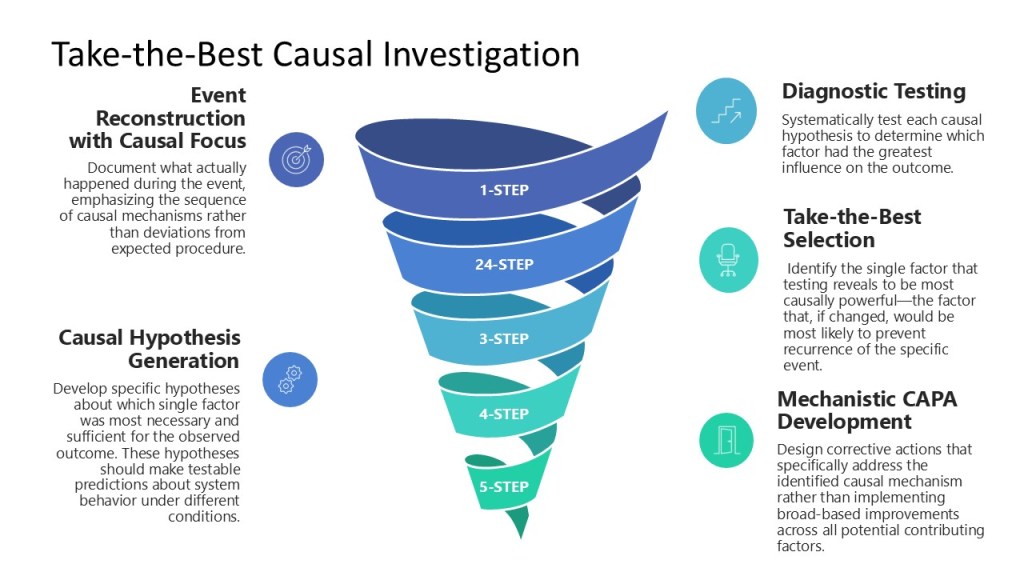
Implementing take-the-best causal investigation in pharmaceutical quality requires systematic attention to identifying and testing causal hypotheses rather than simply cataloging potential contributing factors. This process follows a structured approach:

Step 1: Event Reconstruction with Causal Focus – Document what actually happened during the event, emphasizing the sequence of causal mechanisms rather than deviations from expected procedure. Focus on understanding why actions made sense to the people involved at the time they occurred.

Step 2: Causal Hypothesis Generation – Develop specific hypotheses about which single factor was most necessary and sufficient for the observed outcome. These hypotheses should make testable predictions about system behavior under different conditions.

Step 3: Diagnostic Testing – Systematically test each causal hypothesis to determine which factor had the greatest influence on the outcome. This might involve data analysis, controlled experiments, or systematic comparison with similar events.

Step 4: Take-the-Best Selection – Identify the single factor that testing reveals to be most causally powerful—the factor that, if changed, would be most likely to prevent recurrence of the specific event.

Step 5: Mechanistic CAPA Development – Design corrective actions that specifically address the identified causal mechanism rather than implementing broad-based improvements across all potential contributing factors.
Integration with Falsifiable Quality Systems

The take-the-best approach to causal investigation creates naturally falsifiable hypotheses that can be tested and validated over time. When an investigation concludes that a specific factor was most causally responsible for an event, this conclusion makes testable predictions about system behavior that can be validated through subsequent experience.

For example, if a contamination investigation identifies equipment configuration as the take-the-best causal factor, this conclusion predicts that similar contamination events will be prevented by addressing equipment configuration issues, regardless of training improvements or procedural changes. This prediction can be tested systematically as the organization gains experience with similar situations.

This integration with falsifiable quality systems creates a learning loop where investigation conclusions are continuously refined based on their predictive accuracy. Investigations that correctly identify the most causally powerful factors will generate effective prevention strategies, while investigations that miss the key causal mechanisms will be revealed through continued problems despite implemented corrective actions.

The Leadership and Cultural Implications

Implementing take-the-best causal investigation requires leadership commitment to genuine learning rather than blame assignment. This approach often reveals system-level factors that leadership helped create or maintain, requiring the kind of organizational humility that the Energy Safety Canada framework emphasizes.

The cultural shift from comprehensive factor identification to focused causal analysis can be challenging for organizations accustomed to demonstrating thoroughness through exhaustive documentation. Leaders must support investigators in making causal judgments and prioritizing factors based on their diagnostic power rather than their visibility or political sensitivity.

This cultural change aligns with the broader shift toward scientific quality management that both the adaptive toolbox and falsifiable quality frameworks require. Organizations must develop comfort with making specific causal claims that can be tested and potentially proven wrong, rather than maintaining the false safety of comprehensive but non-specific factor lists.

The take-the-best approach to causal investigation represents a practical synthesis of rigorous scientific thinking and adaptive decision-making. By focusing on the single most causally powerful factor while maintaining the specific, testable language that causal reasoning demands, this approach generates investigations that are both scientifically valid and operationally useful—exactly what pharmaceutical quality management needs to move beyond the recurring problems that plague traditional root cause analysis.

How Gigerenzer’s Adaptive Toolbox Complements Falsifiable Quality Risk Management

The relationship between Gigerenzer’s adaptive toolbox approach and the falsifiable quality risk management framework outlined in “The Effectiveness Paradox” represents and incredibly intellectually satisfying convergences. Rather than competing philosophies, these approaches form a powerful synergy that addresses different but complementary aspects of the same fundamental challenge: making good decisions under uncertainty while maintaining scientific rigor.

The Philosophical Bridge: Bounded Rationality Meets Popperian Falsification

At first glance, heuristic decision-making and falsifiable hypothesis testing might seem to pull in opposite directions. Heuristics appear to shortcut rigorous analysis, while falsification demands systematic testing of explicit predictions. However, this apparent tension dissolves when we recognize that both approaches share a fundamental commitment to ecological rationality—the idea that good decision-making must be adapted to the actual constraints and characteristics of the environment in which decisions are made.

The effectiveness paradox reveals how traditional quality risk management falls into unfalsifiable territory by focusing on proving negatives (“nothing bad happened, therefore our system works”). Gigerenzer’s adaptive toolbox offers a path out of this epistemological trap by providing tools that are inherently testable and context-dependent. Fast-and-frugal heuristics make specific predictions about performance under different conditions, creating exactly the kind of falsifiable hypotheses that the effectiveness paradox demands.

Consider how this works in practice. A traditional risk assessment might conclude that “cleaning validation ensures no cross-contamination risk.” This statement is unfalsifiable—no amount of successful cleaning cycles can prove that contamination is impossible. In contrast, a fast-and-frugal approach might use the simple heuristic: “If visual inspection shows no residue AND the previous product was low-potency AND cleaning time exceeded standard protocol, then proceed to next campaign.” This heuristic makes specific, testable predictions about when cleaning is adequate and when additional verification is needed.

Resolving the Speed-Rigor Dilemma

One of the most persistent challenges in quality risk management is the apparent trade-off between decision speed and analytical rigor. The effectiveness paradox approach emphasizes the need for rigorous hypothesis testing, which seems to conflict with the practical reality that many quality decisions must be made quickly under pressure. Gigerenzer’s work dissolves this apparent contradiction by demonstrating that well-designed heuristics can be both fast AND more accurate than complex analytical methods under conditions of uncertainty.

This insight transforms how we think about the relationship between speed and rigor in quality decision-making. The issue isn’t whether to prioritize speed or accuracy—it’s whether our decision methods are adapted to the ecological structure of the problems we’re trying to solve. In quality environments characterized by uncertainty, limited information, and time pressure, fast-and-frugal heuristics often outperform comprehensive analytical approaches precisely because they’re designed for these conditions.

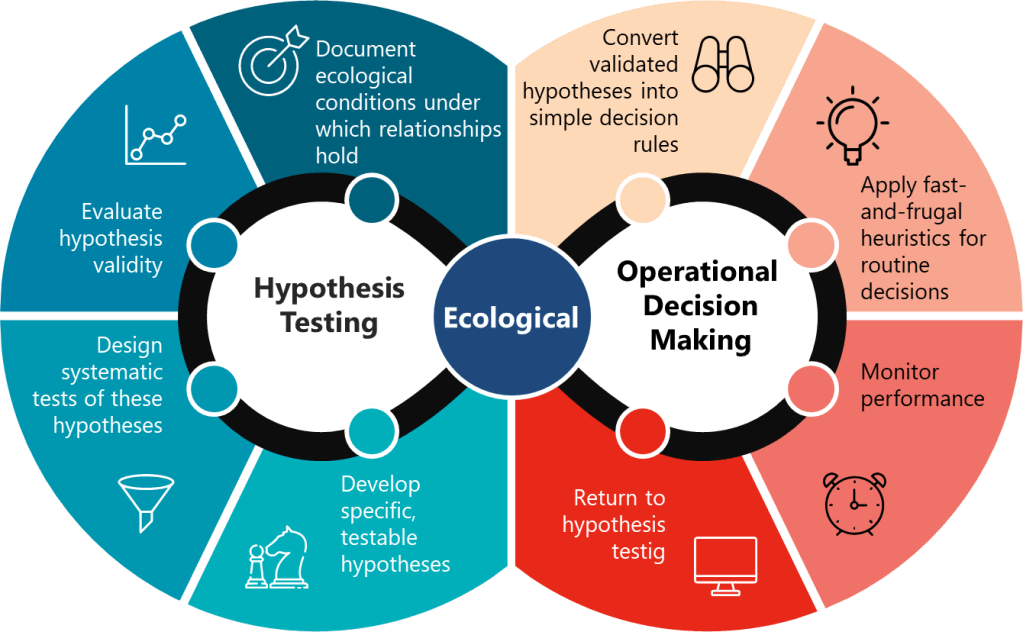
The key insight from combining both frameworks is that rigorous falsifiable testing should be used to develop and validate heuristics, which can then be applied rapidly in operational contexts. This creates a two-stage approach:

Stage 1: Hypothesis Development and Testing (Falsifiable Approach)

  • Develop specific, testable hypotheses about what drives quality outcomes
  • Design systematic tests of these hypotheses
  • Use rigorous statistical methods to evaluate hypothesis validity
  • Document the ecological conditions under which relationships hold

Stage 2: Operational Decision-Making (Adaptive Toolbox)

  • Convert validated hypotheses into simple decision rules
  • Apply fast-and-frugal heuristics for routine decisions
  • Monitor performance to detect when environmental conditions change
  • Return to Stage 1 when heuristics no longer perform effectively

The Recognition Heuristic in Quality Pattern Recognition

One of Gigerenzer’s most fascinating findings is the effectiveness of the recognition heuristic—the simple rule that recognized objects are often better than unrecognized ones. This heuristic works because recognition reflects accumulated positive experiences across many encounters, creating a surprisingly reliable indicator of quality or performance.

In quality risk management, experienced professionals develop sophisticated pattern recognition capabilities that often outperform formal analytical methods. A senior quality professional can often identify problematic deviations, concerning supplier trends, or emerging regulatory issues based on subtle patterns that would be difficult to capture in traditional risk matrices. The effectiveness paradox framework provides a way to test and validate these pattern recognition capabilities rather than dismissing them as “unscientific.”

For example, we might hypothesize that “deviations identified as ‘concerning’ by experienced quality professionals within 24 hours of initial review are 3x more likely to require extensive investigation than those not flagged.” This hypothesis can be tested systematically, and if validated, the experienced professionals’ pattern recognition can be formalized into a fast-and-frugal decision tree for deviation triage.

Take-the-Best Meets Hypothesis Testing

The take-the-best heuristic—which makes decisions based on the single most diagnostic cue—provides an elegant solution to one of the most persistent problems in falsifiable quality risk management. Traditional approaches to hypothesis testing often become paralyzed by the need to consider multiple interacting variables simultaneously. Take-the-best suggests focusing on the single most predictive factor and using that for decision-making.

This approach aligns perfectly with the falsifiable framework’s emphasis on making specific, testable predictions. Instead of developing complex multivariate models that are difficult to test and validate, we can develop hypotheses about which single factors are most diagnostic of quality outcomes. These hypotheses can be tested systematically, and the results used to create simple decision rules that focus on the most important factors.

For instance, rather than trying to predict supplier quality using complex scoring systems that weight multiple factors, we might test the hypothesis that “supplier performance on sterility testing is the single best predictor of overall supplier quality for this material category.” If validated, this insight can be converted into a simple take-the-best heuristic: “When comparing suppliers, choose the one with better sterility testing performance.”

The Less-Is-More Effect in Quality Analysis

One of Gigerenzer’s most counterintuitive findings is the less-is-more effect—situations where ignoring information actually improves decision accuracy. This phenomenon occurs when additional information introduces noise that obscures the signal from the most diagnostic factors. The effectiveness paradox provides a framework for systematically identifying when less-is-more effects occur in quality decision-making.

Traditional quality risk assessments often suffer from information overload, attempting to consider every possible factor that might affect outcomes. This comprehensive approach feels more rigorous but can actually reduce decision quality by giving equal weight to diagnostic and non-diagnostic factors. The falsifiable approach allows us to test specific hypotheses about which factors actually matter and which can be safely ignored.

Consider CAPA effectiveness evaluation. Traditional approaches might consider dozens of factors: timeline compliance, thoroughness of investigation, number of corrective actions implemented, management involvement, training completion rates, and so on. A less-is-more approach might hypothesize that “CAPA effectiveness is primarily determined by whether the root cause was correctly identified within 30 days of investigation completion.” This hypothesis can be tested by examining the relationship between early root cause identification and subsequent recurrence rates.

If validated, this insight enables much simpler and more effective CAPA evaluation: focus primarily on root cause identification quality and treat other factors as secondary. This not only improves decision speed but may actually improve accuracy by avoiding the noise introduced by less diagnostic factors.

Satisficing Versus Optimizing in Risk Management

Herbert Simon’s concept of satisficing—choosing the first option that meets acceptance criteria rather than searching for the optimal solution—provides another bridge between the adaptive toolbox and falsifiable approaches. Traditional quality risk management often falls into optimization traps, attempting to find the “best” possible solution through comprehensive analysis. But optimization requires complete information about alternatives and their consequences—conditions that rarely exist in quality management.

The effectiveness paradox reveals why optimization-focused approaches often produce unfalsifiable results. When we claim that our risk management approach is “optimal,” we create statements that can’t be tested because we don’t have access to all possible alternatives or their outcomes. Satisficing approaches make more modest claims that can be tested: “This approach meets our minimum requirements for patient safety and operational efficiency.”

The falsifiable framework allows us to test satisficing criteria systematically. We can develop hypotheses about what constitutes “good enough” performance and test whether decisions meeting these criteria actually produce acceptable outcomes. This creates a virtuous cycle where satisficing criteria become more refined over time based on empirical evidence.

Ecological Rationality in Regulatory Environments

The concept of ecological rationality—the idea that decision strategies should be adapted to the structure of the environment—provides crucial insights for applying both frameworks in regulatory contexts. Regulatory environments have specific characteristics: high uncertainty, severe consequences for certain types of errors, conservative decision-making preferences, and emphasis on process documentation.

Traditional approaches often try to apply the same decision methods across all contexts, leading to over-analysis in some situations and under-analysis in others. The combined framework suggests developing different decision strategies for different regulatory contexts:

High-Stakes Novel Situations: Use comprehensive falsifiable analysis to develop and test hypotheses about system behavior. Document the logic and evidence supporting conclusions.

Routine Operational Decisions: Apply validated fast-and-frugal heuristics that have been tested in similar contexts. Monitor performance and return to comprehensive analysis if performance degrades.

Emergency Situations: Use the simplest effective heuristics that can be applied quickly while maintaining safety. Design these heuristics based on prior falsifiable analysis of emergency scenarios.

The Integration Challenge: Building Hybrid Systems

The most practical application of combining these frameworks involves building hybrid quality systems that seamlessly integrate falsifiable hypothesis testing with adaptive heuristic application. This requires careful attention to when each approach is most appropriate and how transitions between approaches should be managed.

Trigger Conditions for Comprehensive Analysis:

  • Novel quality issues without established patterns
  • High-consequence decisions affecting patient safety
  • Regulatory submissions requiring documented justification
  • Significant changes in manufacturing conditions
  • Performance degradation in existing heuristics

Conditions Favoring Heuristic Application:

  • Familiar quality issues with established patterns
  • Time-pressured operational decisions
  • Routine risk classifications and assessments
  • Situations where speed of response affects outcomes
  • Decisions by experienced personnel in their area of expertise

The key insight is that these aren’t competing approaches but complementary tools that should be applied strategically based on situational characteristics.

Practical Implementation: A Unified Framework

Implementing the combined approach requires systematic attention to both the development of falsifiable hypotheses and the creation of adaptive heuristics based on validated insights. This implementation follows a structured process:

Phase 1: Ecological Analysis

  • Characterize the decision environment: information availability, time constraints, consequence severity, frequency of similar decisions
  • Identify existing heuristics used by experienced personnel
  • Document decision patterns and outcomes in historical data

Phase 2: Hypothesis Development

  • Convert existing heuristics into specific, testable hypotheses
  • Develop hypotheses about environmental factors that affect decision quality
  • Create predictions about when different approaches will be most effective

Phase 3: Systematic Testing

  • Design studies to test hypothesis validity under different conditions
  • Collect data on decision outcomes using different approaches
  • Analyze performance across different environmental conditions

Phase 4: Heuristic Refinement

  • Convert validated hypotheses into simple decision rules
  • Design training materials for consistent heuristic application
  • Create monitoring systems to track heuristic performance

Phase 5: Adaptive Management

  • Monitor environmental conditions for changes that might affect heuristic validity
  • Design feedback systems that detect when re-analysis is needed
  • Create processes for updating heuristics based on new evidence

The Cultural Transformation: From Analysis Paralysis to Adaptive Excellence

Perhaps the most significant impact of combining these frameworks is the cultural shift from analysis paralysis to adaptive excellence. Traditional quality cultures often equate thoroughness with quality, leading to over-analysis of routine decisions and under-analysis of genuinely novel challenges. The combined framework provides clear criteria for matching analytical effort to decision importance and novelty.

This cultural shift requires leadership that understands the complementary nature of rigorous analysis and adaptive heuristics. Organizations must develop comfort with different decision approaches for different situations while maintaining consistent standards for decision quality and documentation.

Key Cultural Elements:

  • Scientific Humility: Acknowledge that our current understanding is provisional and may need revision based on new evidence
  • Adaptive Confidence: Trust validated heuristics in appropriate contexts while remaining alert to changing conditions
  • Learning Orientation: View both successful and unsuccessful decisions as opportunities to refine understanding
  • Contextual Wisdom: Develop judgment about when comprehensive analysis is needed versus when heuristics are sufficient

Addressing the Regulatory Acceptance Question

One persistent concern about implementing either falsifiable or heuristic approaches is regulatory acceptance. Will inspectors accept decision-making approaches that deviate from traditional comprehensive documentation? The answer lies in understanding that regulators themselves use both approaches routinely.

Experienced regulatory inspectors develop sophisticated heuristics for identifying potential problems and focusing their attention efficiently. They don’t systematically examine every aspect of every system—they use diagnostic shortcuts to guide their investigations. Similarly, regulatory agencies increasingly emphasize risk-based approaches that focus analytical effort where it provides the most value for patient safety.

The key to regulatory acceptance is demonstrating that combined approaches enhance rather than compromise patient safety through:

  • More Reliable Decision-Making: Heuristics validated through systematic testing are more reliable than ad hoc judgments
  • Faster Problem Detection: Adaptive approaches can identify and respond to emerging issues more quickly
  • Resource Optimization: Focus intensive analysis where it provides the most value for patient safety
  • Continuous Improvement: Systematic feedback enables ongoing refinement of decision approaches

The Future of Quality Decision-Making

The convergence of Gigerenzer’s adaptive toolbox with falsifiable quality risk management points toward a future where quality decision-making becomes both more scientific and more practical. This future involves:

Precision Decision-Making: Matching decision approaches to situational characteristics rather than applying one-size-fits-all methods.

Evidence-Based Heuristics: Simple decision rules backed by rigorous testing and validation rather than informal rules of thumb.

Adaptive Systems: Quality management approaches that evolve based on performance feedback and changing conditions rather than static compliance frameworks.

Scientific Culture: Organizations that embrace both rigorous hypothesis testing and practical heuristic application as complementary aspects of effective quality management.

Conclusion: The Best of Both Worlds

The relationship between Gigerenzer’s adaptive toolbox and falsifiable quality risk management demonstrates that the apparent tension between scientific rigor and practical decision-making is a false dichotomy. Both approaches share a commitment to ecological rationality and empirical validation, but they operate at different time scales and levels of analysis.

The effectiveness paradox reveals the limitations of traditional approaches that attempt to prove system effectiveness through negative evidence. Gigerenzer’s adaptive toolbox provides practical tools for making good decisions under the uncertainty that characterizes real quality environments. Together, they offer a path toward quality risk management that is both scientifically rigorous and operationally practical.

This synthesis doesn’t require choosing between speed and accuracy, or between intuition and analysis. Instead, it provides a framework for applying the right approach at the right time, backed by systematic evidence about when each approach works best. The result is quality decision-making that is simultaneously more rigorous and more adaptive—exactly what our industry needs to meet the challenges of an increasingly complex regulatory and competitive environment.