
When things go seriously bad

An owner and four former employees of a now-shuttered Framingham compounding pharmacy were convicted Thursday of federal charges related to a 2012 meningitis outbreak that’s killed more than 100 people who took tainted drugs made at the facility, authorities said.

Travis Anderson “5 people convicted of federal charges in Framingham compounding pharmacy case” Boston Globe (2018)

To say that the crimes of the  New England Compounding Center have changed the very regulations for compounding pharmacy in this country is no overstatement. For those of us in other  regulated industries, and for those in quality in other fields, this is an important case to reflect on.

According to prosecutors, pharmacists “knowingly made and sold numerous drugs” in an unsafe manner. “The unsafe manner included, among other things, the pharmacists’ failure to properly sterilize NECC’s drugs, failure to properly test NECC’s drugs for sterility, and failure to wait for test results before sending the drugs to customers. They also approved the use of expired drug ingredients, and the mislabeling of those drugs in order to deceive customers.”

Travis Anderson “5 people convicted of federal charges in Framingham compounding pharmacy case” Boston Globe (2018)

It is important to reflect that we in Quality, that everyone in our industries, has a commitment to the health and well-being of our customers that is nothing less than a moral imperative. That the imperative question for us and our organizations is always “Have I done enough to ensure the best quality and safety.”

There have now been 11 employees or executives of the drug compounding company convicted of ignoring safety precautions and forging documents to allow contaminated drugs to be manufactured and shipped.

Shira Schoenberg “Former compounding center employees convicted in deadly meningitis outbreak ” Boston Business Journal (2018)
Mylan Warning Letter

Mylan’s West Virginia plant received a Warning Letter this month and US FDA Commission Scott Gottlieb tweeted on it, and Mylan recently issued a press release.

I’ve made a few posts on their 483:

Mylan’s issues really need to be viewed as a lens of current regulatory body thinking and not as an issue of a company behind the times. In short, this could be you and if your company is not pouring through these and evaluating your own systems you should be.

The Warning Letter has a few trends we see in this sort of document:

  1. Requiring an independent review. If your system is broke than the agency doesn’t trust you to say its okay. Get an independent consultant.
  2. Lack of quality unit authority. One of the best things my site head of quality ever said (and if he is reading this, take this as a serious compliment) was to a group of high school interns when he said the quality unit is the only part of the Pharma manufacturing organization with duties required by law. That we have a legal duty to our companies and to the patients.
  3. Go to the ICH guidance documents
  4. This is happening at more than one site. Clean it up corporate wide.

The last one is worth further thought:

These repeated failures at multiple sites demonstrate that Mylan’s management oversight and control over the manufacture of drugs is inadequate.Your executive management remains responsible for fully resolving all deficiencies and ensuring ongoing CGMP compliance. You should immediately and comprehensively assess your company’s global manufacturing operations to ensure that systems and processes, and ultimately, the products you manufacture, consistently conform to FDA requirements.

It is a critical part of your inspection program to be evaluating issues at each and every one of your sites for all your sites. The CAPA program needs to have the ability to assess CAPAs for similar root cause at all sites, that’s part of the preventive, and without it you are truly not addressing all the potential risks in your organization.

In past decades Mylan was a golden-child of cGMPs, and a lot of thought has gone into why the massive backslide. Cases like this, and Toyota, really reaffirm how a quality culture is something that must be constantly maintained and grown, and how easy it is to go backwards.


Quality Culture requires men being better allies to women

ISO 26000: Guidance on social responsibility defines social responsibility as:

The responsibility of an organization for the impacts of its decisions and activities on society and the environment, through transparent and ethical behavior that:

  • Contributes to sustainable development, including health and the welfare of society
  • Takes into account the expectations of stakeholders
  • Is in compliance with applicable laws and consistent with international norms of behavior
  • Is integrated throughout the organization and practiced in its relationships

ISO 26000 also defines seven key principles of socially responsible behavior:

  • Accountability
  • Transparency
  • Ethical behavior
  • Respect for stakeholder interests
  • Respect for the rule of law
  • Respect for international norms of behavior
  • Respect for human rights

One shouldn’t have to look for reasons for human rights and the drive towards to diversity, but let us simply say there are a ton of studies that show that diversity improves decision making, problem solving and even make us smarter.

In short diversity is critical towards a Quality Culture. Gender equality is a critical part of being a successful quality leader, and it behooves each and every one of us men to drive towards it. To figure out how to make our own workplaces more diverse.

There are many aspects of creating diverse culture but I want to discuss how it is critical that men support women, that we be allies. Too many organizations still miss the mark on gender equity efforts by focusing gender initiatives solely on changing women — from the way they network to the way the lead. Individualistic approaches to solving gender inequities overlook systemic structural causes and reinforce the perception that these are women’s issues — effectively telling men they don’t need to be involved. As always, it is always about the system thinking. Without the avid support of men progress toward ending gender disparities is unlikely and organizations cannot find reap the benefits.

Men need to become better allies by focusing on listening, support, and respect. We need to listen to women’s voices and bring all those core skills of  focus, sincerity, empathy, refusal to interrupt, and genuine valuing to systematically addressing inequities, whether the ubiquitous workplace sexual harassment or gender exclusion. End your silence and support and ally. No matter what level of your organization you are in.

By being a deliberate male ally, by actively promoting gender fairness and equity in the workplace we can drive systematic improvements. To lean on Deming, we can drive out fear. And isn’t that what Quality is all about?

Look for trends in inspection activities

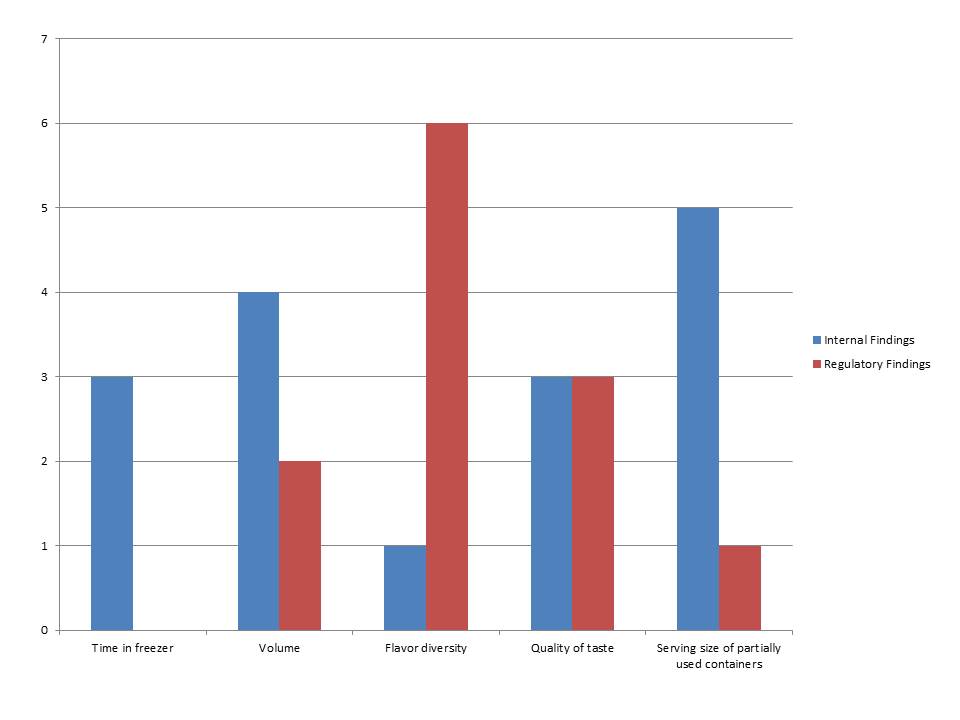
I’m in charge of ice cream, an important element of my household and as a result there are agreed upon criteria for success. I have internal inspectors (me) and external (my teenagers). I can thus produce a fairly simple graph of internal and external inspections and see the areas where there is a difference.

ice cream audit

From this I can tell which categories of findings are pain points and can look for systematic ways to fix them.

In my case, it’s clear the kids do not appreciate only having vanilla, strawberry and chocolate ice cream.

You can apply the same process to your internal vs. regulatory agencies (or certifying body or similar) audit findings.

You can quickly find two major patterns:

  1. Places you are gapping
  2. Places you are tougher than regulatory agencies

For those areas where you are gapping, evaluate your systems and determine what process improvements are necessary. A good area to include in this evaluation is the skill set of your internal auditors. For example, do you need more intensive data integrity training?

For those areas where you are tougher than regulatory agencies, do a quick check to ensure internal expectations are appropriately aligned. And then congratulate yourself.

You might have some areas where you have internal findings but absolutely no external. This might be a good indication that this might be a cutting edge area and you are doing a great job keeping ahead of the curve.

Take an additional step. Go to a source of inspection findings, such as the FDA’s 483 collection, and add them to your graph. This can help you identify additional areas of potential improvement. This can be especially helpful if you are a smaller company that does not have a wealth of data to draw.

We should all be doing what we can to anticipate trends and benchmark ourselves. This sort of data review and go a long way to finding some potential pain points before they get worse.