
Mylan gets a 32 page 483

The FDA’s April 483 for Mylan Pharmaceuticals has been in the fore-front of a lot of conversations in the last week. Let’s be honest, the FDA posts a 32 page, 13 observation 483 report on any manufacturer and it will be news. One as prominent as Mylan and doubly so. On the same day, the FDA also posted a 2016 483 and 2017 warning letter against a Mylan facility in India.

The 483 is a hit parade of observations, like the 1st observation of failure of the quality unit, including a reference to lack of quality approval of change controls.

What everyone has been intensely focusing on is the strong emphasis on cleaning, with 11 pages dedicated to failures in cleaning validation.

Which to be frank, is a big deal in a multi-product facility.

Read the 483, and when doing so evaluate your site’s cleaning program. Ask yourself some of these questions:

  • Are there appropriate cleaning procedures in place for all products-contact equipment, product contact accessories?
  • Are there appropriate cleaning procedures in place for facility cleaning (dispensing, sampling room…)?
  • Do your procedures include the sequence of the cleaning activities? Is it significantly detailed?
  • Do the procedures address the different scenarios (cleaning between different batches of the same product, cleaning between products changes, holding time before and after cleaning…)?
  • Do the procedures address who is responsible for performing the cleaning?
  • Does the validation study, the acceptance criteria and when revalidation justification and keys documentation approved by Quality? Does it include a clear status on the cleaning process?
  • Is the strategy used for the cleaning validation clearly established? (matrix approach, dedicated equipment, worst case scenario, grouping equipment, equipment train…)
  • Are batches that come after the cleaning validation run, released after completion of the cleaning validation?
  • Are the acceptance criteria (products, detergents, cleaning agent, micro… ) scientifically established and followed? Do these acceptance criteria include a safety margin?

Approval of cleaning validation is a key responsibility of the quality unit that involves some very specific requirements. These requirements should be built into the quality systems, including validation, deviation, and change management.
Communication of Changes between sites

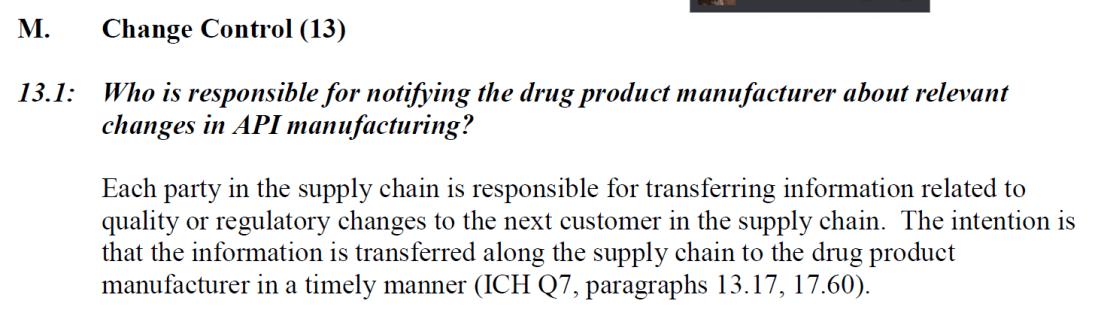
Yesterday, the FDA finalized the ICH Q7 Q&A Guidance on GMPs following its endorsement by the regulatory agencies participating in the ICH in June 2015.

Two-and-a-half-years. And I sometimes wonder why the ICHs aren’t more broadly adopted or why some of my colleagues are a little pessimistic about their impact on this industry

However, re-reading these questions and answers gave me a good topic.

QA on Q7 change management

With complex and virtual supply chains, with world wide distribution, it is important to understand who needs to be communicated about what changes.

This communication should be evaluated for it’s directionality. It helps to break down your types of changes and determine what are:

  • Consult – those changes where the other site needs to provide an assessment. For example, if a change impacts testing that is conducted at another site, or it impacts the way the next site will receive the material (don’t forget ERP changes). These communications are always push.
  • Inform – the other site needs to be aware but will not need to take any action. A great example of this notifying the QP.

Include your suppliers in this process as well, and ensure your suppliers are also appropriately communicating. Include this in your quality/technical agreements or contract terms.

Risk Management and Quality Intelligence

Kris Kelly on the Advantu blog brought to my attention a February post he wrote titled “Medical Device Recalls – Do You See the Pattern…?

While specific in intent to medical devices, the content is very relevant to my last post. Risk Management is a major enabler of quality system, and a big part of risk assessments is moving beyond the expected to find the unexpected.

The other part of the article that stood out to me was how this was a great example of regulatory intelligence as a part of knowledge management. Kris took a trend of medical device recalls and evaluated the need for action. And you should too. Regulatory intelligence should be informing your quality system, it needs to be an input to decision making from design through change management activities and every step of the way. Regulatory intelligence should be an input to your organization. This idea can be expanded to quality intelligence, which also looks at best practices, pharmacopeias and a whole assortment of inputs from agencies to industry associations to benchmarking with other companies.

To bring this post around to one of my long-term preoccupations, change management, the following request is found in 3 of the drug cGMP warning letters on the FDA website since the 01Mar2018.

A comprehensive, independent evaluation and remediation of your change management system. The evaluation should include, but not be limited to, assuring changes are appropriately justified, approved by your quality unit, and evaluated for effectiveness. Also, include a retrospective assessment of all changes executed outside an appropriate change management process.

Is your quality system strong enough? Have you evaluated the risks of your change management system? Are you prepared for your next regulatory inspection? How do you ensure you are evaluating these trends as they develop? Do you have a process in place to make sure you are not surprised?