FDA Cycle Times and Compliance

Mark Schwarz reviews FDA compliance times in “Does FDA Need Statutorily Imposed Incentives for Regulatory Compliance Matters?” at FDA Law Blog (a must read blog for those in pharmaceutical, medical device or food quality). I found these cycle-times fascinating.

It also amazes me that after the last few years of the agency pushing quality metrics, this is the first time these numbers have been shared. I deeply hope they drive improvements.

Given these lead times I find it interesting that the FDA has taken to pointing out the need for a consultant in warning letters. By the time a warning letter is obtained, a meeting perhaps held, and a consultant obtained it is easily a year before real work is happening. This does not provide the most nimble of approaches.

Again, a good article I strongly recommend.

Barriers and root cause analysis

Barriers, or controls, are one of the (not-at-all) secret sauces of root cause analysis.

By understanding barriers, we can understand both why a problem happened and how it can be prevented in the future. An evaluation of current process controls as part of root cause analysis can help determine whether all the current barriers pertaining to the problem you are investigating were present and effective (even if they worked or not).

At its simplest it is just a three-part brainstorm:

Barrier Analysis
Barriers that failedThe barrier was in place and operational at the time of the accident, but it failed to prevent the accident.
Barriers that were not usedThe barrier was available, but workers chose not to use it.
Barriers that did not existThe barrier did not exist at the time of the event. A source of potential corrective and preventive actions (depending on what they are)
Three questions of barrier analysis

The key to this brainstorming session is to try to find all of the failed, unused, or nonexistent barriers. Do not be concerned if you are not certain which category they belong in.

Most forms of barrier analysis look at two types, technical and administrative, and we can further breakdown administrative into “human” and “organization.”

ChooseTechnicalHumanOrganization
IfA technical or engineering control existsThe control relies on a human reviewer or operatorThe control involves a transfer of responsibility. For example, a document reviewed by both manufacturing and quality.
ExamplesSeparation among manufacturing or packaging lines


Emergency power supply

Dedicated equipment

Barcoding

Keypad controlled doors

Separated storage for components

Software that prevents a workflow from going further if a field is not completed Redundant designs

Training and certifications


Use of checklist

Verification of critical task by a second person


Clear procedures and policies


Adequate supervision

Adequate load of work

Periodic process audits

These barriers are the same as current controls is in a risk assessment, which is key in a wide variety of risk assessment tools.

Risk Management and Quality Intelligence

Kris Kelly on the Advantu blog brought to my attention a February post he wrote titled “Medical Device Recalls – Do You See the Pattern…?

While specific in intent to medical devices, the content is very relevant to my last post. Risk Management is a major enabler of quality system, and a big part of risk assessments is moving beyond the expected to find the unexpected.

The other part of the article that stood out to me was how this was a great example of regulatory intelligence as a part of knowledge management. Kris took a trend of medical device recalls and evaluated the need for action. And you should too. Regulatory intelligence should be informing your quality system, it needs to be an input to decision making from design through change management activities and every step of the way. Regulatory intelligence should be an input to your organization. This idea can be expanded to quality intelligence, which also looks at best practices, pharmacopeias and a whole assortment of inputs from agencies to industry associations to benchmarking with other companies.

To bring this post around to one of my long-term preoccupations, change management, the following request is found in 3 of the drug cGMP warning letters on the FDA website since the 01Mar2018.

A comprehensive, independent evaluation and remediation of your change management system. The evaluation should include, but not be limited to, assuring changes are appropriately justified, approved by your quality unit, and evaluated for effectiveness. Also, include a retrospective assessment of all changes executed outside an appropriate change management process.

Is your quality system strong enough? Have you evaluated the risks of your change management system? Are you prepared for your next regulatory inspection? How do you ensure you are evaluating these trends as they develop? Do you have a process in place to make sure you are not surprised?


Knowledge Management

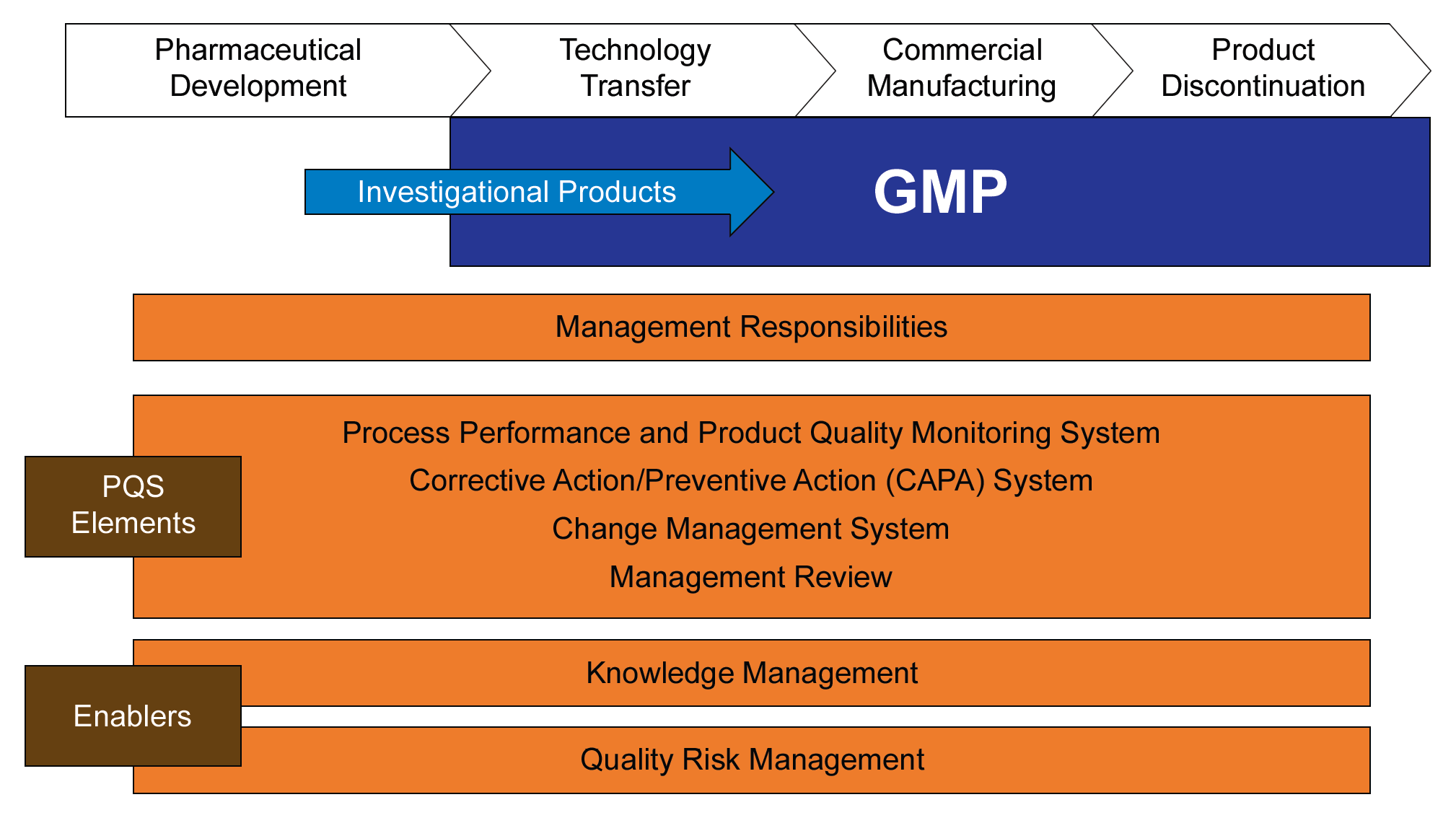
ICH Q10 “Pharmaceutical Quality System” describes a lifecycle approach, from development through product discontinuation. The knowledge about a pharmaceutical product and the processes required to reliably produce that product starts with product and process development. An effective pharmaceutical quality system (PQS) uses the knowledge acquired throughout the lifecycle of the product, builds on that knowledge, and applies it to:

  • Other stages of the product lifecycle
  • Other product lifecycles

A change management system is defined as an important element of a PQS as seen in this figure reproduced from ICH Q10.
Q10

There are two enablers to this quality system model, knowledge management and risk management. The thing about those enablers is that they are really intertwined. Or put another way, risk management is a powerful way to make use of your knowledge.

ICHQ12 “Technical and Regulatory Considerations for Pharmaceutical Product Lifecycle Management” (in draft) expands on knowledge management and provides more examples of its use. The below illustration is an adaptation of one found in the draft Q12.

knowledge and change

There are many ways to tap into knowledge management in change management. The subject matter experts are critical, as is checklists and risk ranking and filtering tools. Knowledge should drive the development of an effectiveness review.

One of my favorite is the Living Risk Assessment approach. Living risk assessments are a holistic view of a system, product, or process in an effort to prevent risk realization. They are updated throughout the product /system lifecycle to continuously assess risks that may arise or change.

In the context of change management, the living risk assessment is both an input and an output. A rigorous, maintained, living risk assessment allows us to prospectively mitigate potential risks as part of our change management program.

Living Risk Assessments have a schedule, a review period (for example, once a year) to evaluate how risk has changed, drawing from all the sources of knowledge. It is also important to have a way to trigger adhoc reviews (for example, major process changes or critical deviations).

living risk assessments

In my ASQ World Conference workshop I will be going into more detail on knowledge management, risk management and the pharmaceutical quality system. I’ll also be discussing what non-Pharma companies can learn from the PQS.

Change Control SIPOC

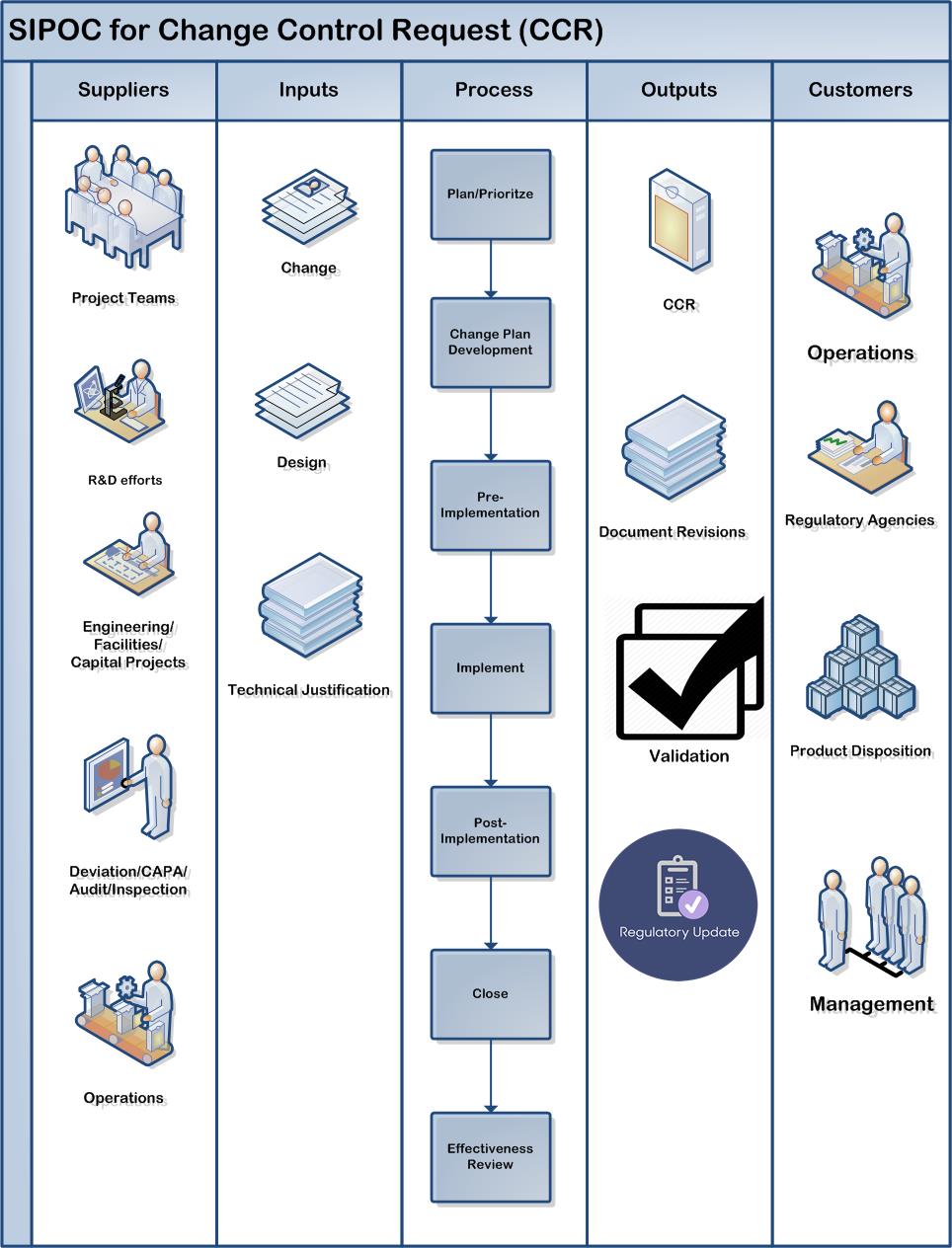
Always start with a SIPOC is a mantra many of us steeped in Six Sigma have heard a lot. There is some truth to having a good visual diagram that helps define a system or project. As this blog will be discussing change management and change control quite a bit, here is a SIPOC that governs change control.

SIPOC for CCR

This SIPOC represents change control from the perspective of a pharmaceutical manufacturing plant. But this will apply to many manufacturing industries, though the focus on regulatory might shift.