When things go seriously bad

An owner and four former employees of a now-shuttered Framingham compounding pharmacy were convicted Thursday of federal charges related to a 2012 meningitis outbreak that’s killed more than 100 people who took tainted drugs made at the facility, authorities said.

Travis Anderson “5 people convicted of federal charges in Framingham compounding pharmacy case” Boston Globe (2018)

To say that the crimes of the  New England Compounding Center have changed the very regulations for compounding pharmacy in this country is no overstatement. For those of us in other  regulated industries, and for those in quality in other fields, this is an important case to reflect on.

According to prosecutors, pharmacists “knowingly made and sold numerous drugs” in an unsafe manner. “The unsafe manner included, among other things, the pharmacists’ failure to properly sterilize NECC’s drugs, failure to properly test NECC’s drugs for sterility, and failure to wait for test results before sending the drugs to customers. They also approved the use of expired drug ingredients, and the mislabeling of those drugs in order to deceive customers.”

Travis Anderson “5 people convicted of federal charges in Framingham compounding pharmacy case” Boston Globe (2018)

It is important to reflect that we in Quality, that everyone in our industries, has a commitment to the health and well-being of our customers that is nothing less than a moral imperative. That the imperative question for us and our organizations is always “Have I done enough to ensure the best quality and safety.”

There have now been 11 employees or executives of the drug compounding company convicted of ignoring safety precautions and forging documents to allow contaminated drugs to be manufactured and shipped.

Shira Schoenberg “Former compounding center employees convicted in deadly meningitis outbreak ” Boston Business Journal (2018)

Pfizer plant in Kansas repeatedly hit with form 483 infractions

In the last 6 years, Pfizer’s Hospira plant in Kansas has received eight FDA Form 483 citations, as well as other observations for regulatory bodies, such as this summer’s  from the MHRA.

The latest FDA 483 was in August 2018.

Comparing these observations with this year’s from Mylan certainly brings to mind a lot of thoughts about cleaning validation and contamination control.

All eight observations are repeat, some from multiple years. I find this troubling given the June 2018 Close Out letter to the 2017 Warning Letter.

Considerations when validating and auditing algorithms

The future is now. Industry 4.0 probably means you have algorithms in your process. For example, if you aren’t using algorithims to analyze deviations, you probably soon will.

 And with those algorithms come a whole host of questions on how to validate and how to ensure they work properly over time. The FDA has indicated that ““we want to get an understanding of your general idea for model maintenance.” FDA also wants to know the “trigger” for updating the model, the criteria for recalibration, and the level of validation of the model.”

Kate Crawford at Microsoft speaks about “data fundamentalism” – the notion that massive datasets are repositories that yield reliable and objective truths, if only we can extract them using machine learning tools. It shouldn’t take much to realize the reasons why this trap can produce some very bad decision making. Our algorithm’s have biases, just as human beings have biases. They are dependent on the data models used to build and refine them.

Based on reported FDA thinking, and given where European regulators are in other areas, it is very clear we need to be able to explain and justify our algorithmic decisions. Machine learning in here now and will only grow more important.

Basic model of data science

Ask an Interesting Question

The first step is to be very clear on why there is a need for this system and what problem it is trying to solve. Having alignment across all the stakeholders is key to guarantee that the entire team is here with the same purpose. Here we start building a framework

Get the Data

The solution will only be as good as what it learns from. Following the common saying “garbage in, garbage out”, the problem is not with the machine learning tool itself, it lies with how it’s been trained and what data it is learning from.

Explore the Data

Look at the raw data. Look at data summary. Visualize the data. Do it all again a different way. Notice things. Do it again. Probably get more data.  Design experiments with the data.

Model the Data

The only true way to validate a model is to observe, iterate and audit. If we take a traditional csv model to machine learning, we are in for a lot of hurt. We need to take the framework we built and validate to it. Ensure there are emchanisms to observe to this framework and audit to performance over time.

PIC/S Draft Guidance on Data Integrity

On 30-Nov-2018 PIC/S published the third draft of guidance PI 041-1 “Good Practices for Data Management and Data Integrity in regulated GMP/GDP Environments“. The first draft was published back in 2016, and the third draft is subject to a focused stakeholder consultation seeking substantive comments from trade and professional associations on specific questions relating to the proportionality, clarity and implementation of the guidance requirements. In parallel to this stakeholder consultation, the new draft is applied by PIC/S Participating Authorities on a trial basis for a new implementation trial period (3 months).

In short, you can expect inspectors to have reviewed and be reviewing against this. Do your gap analysis now and have plans in place to address the gaps. Yes, there will be a little while before this is finally published, but at this point this guidance neatly triangulates with other guidances on data integrity and we can expect most of this to be in the final version.

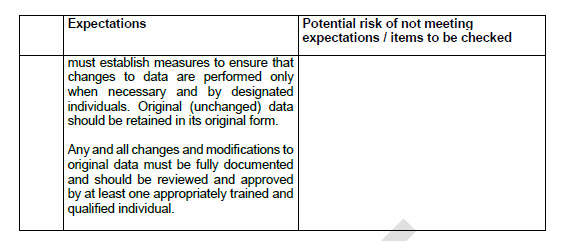
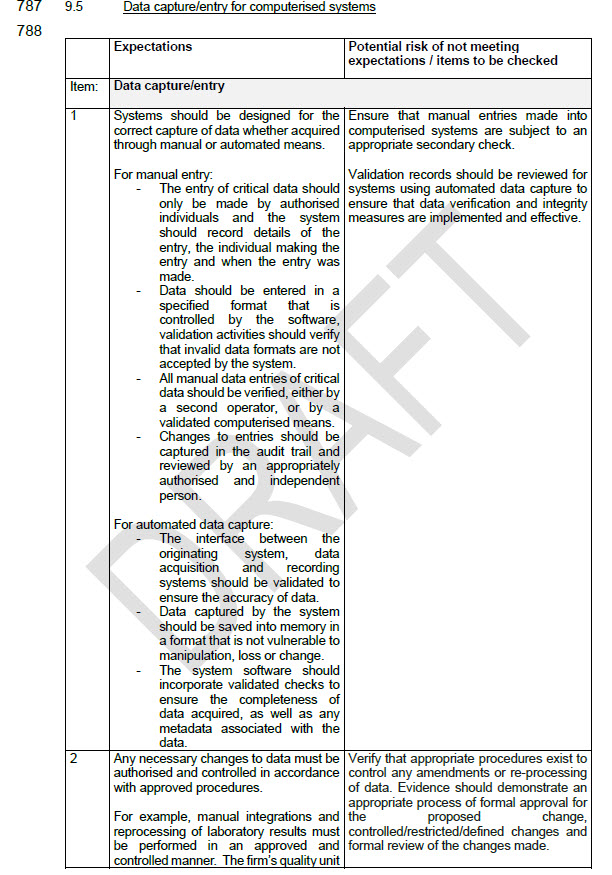
This document is a great place to start and can be used to develop whole sections of the quality management system. I find it very actionable. For example this table from 9.5 “Data capture/entry for computerised systems”:

pics data capture part 1pics data capture part 2