
When undertaking a project to enhance your validation program, it’s crucial to have a robust method for measuring success. This is especially important as you aim to increase maturity and address organizational challenges, with a significant focus on training and personnel qualification. The Kirkpatrick model, originally designed for evaluating training programs, can be effectively adapted to assess the success of your validation program improvements.

Level 1: Reaction
This level measures how participants react to the validation program.
- Survey validation team members on their satisfaction with the validation approach
- Gather feedback on the clarity of risk-based validation concepts
- Assess perceived relevance and applicability of the new validation methodology
Level 2: Learning
This level evaluates the knowledge and skills acquired.
- Conduct assessments to measure understanding of key principles
- Test ability to perform risk assessments and develop verification strategies
- Evaluate comprehension of good engineering practices (GEP) and their integration into validation activities
Level 3: Behavior
This level examines how participants apply what they’ve learned on the job.
- Observe validation team members implementing risk-based approaches in actual projects
- Review documentation to ensure proper application of methodologies and assess the quality of user requirements, risk assessments, and verification plans. This is where I would use a rubric.
- Create some key behavior indicators, such as right-the-first time.
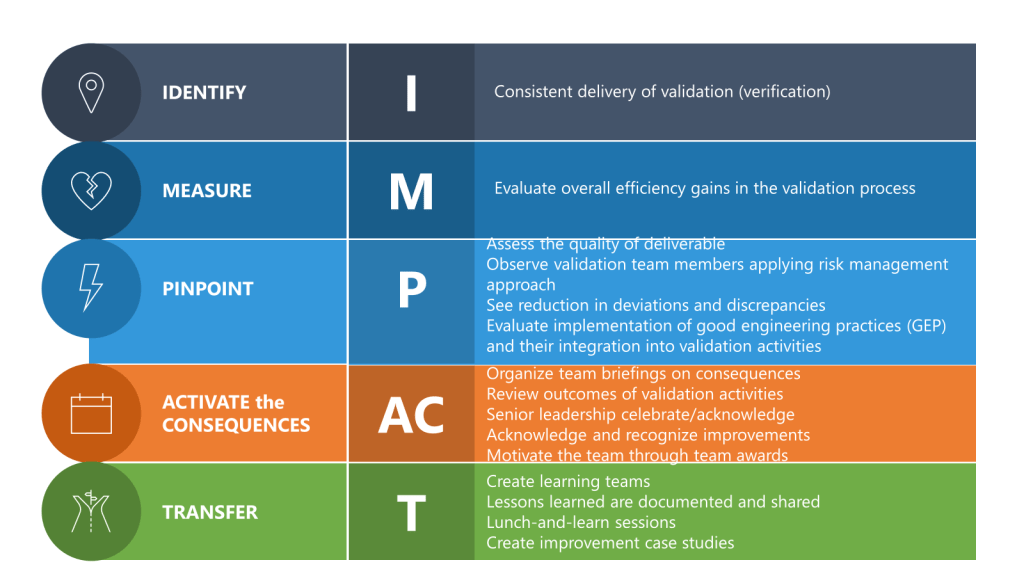
I use IMPACT as a tool here.
And then come up with a set of leading and lagging quality and behavioral indicators.
Leading
- Measure and report attendance at risk assessments and project team meetings
- Number of employee/team improvement suggestions implemented
- Number of good catches identified
Trended Lagging
- % RFT validation deliverables
- % RFT executions (looking at discrepancies)
Level 4: Results
This level measures the impact on the organization.
- Track reduction in validation cycle times and associated costs
- Monitor improvements in product quality and reduction in deviations
- Assess regulatory inspection outcomes and feedback on validation approach
- Evaluate overall efficiency gains in the validation process
By applying the Kirkpatrick Model to a validation program improvements we can systematically evaluate the effectiveness of their implementation and identify areas for continuous improvement.

 Investigations of a Dog
One thought on “Assessing the Impact of Changes to Your Validation Program”