Models of Verification

In the pharmaceutical industry, qualification and validation is a critical process to ensure the quality, safety, and efficacy of products. Over the years, several models have emerged to guide efforts for facilities, utilities, systems, equipment, and processes. This blog post will explore three prominent models: the 4Q model, the V-model, and the W-model. We’ll also discuss relevant regulatory guidelines and industry standards.

The 4Q Model

The 4Q model is a widely accepted approach to qualification in the pharmaceutical industry. It consists of four stages:

  1. Design Qualification (DQ): This initial stage focuses on documenting that the design of facilities, systems, and equipment is suitable for the intended purpose. DQ should verify that the proposed design of facilities, systems, and equipment is suitable for the intended purpose. The requirements of the user requirements specification (URS) should be verified during DQ.
  2. Installation Qualification (IQ): IQ verifies that the equipment or system has been properly installed according to specifications. IQ should include verification of the correct installation of components and instrumentation against engineering drawings and specifications — the pre-defined criteria.
  3. Operational Qualification (OQ): This stage demonstrates that the equipment or system operates as intended across the expected operating ranges. OQ should ensure the system is operating as designed, confirming the upper and lower operating limits, and/or “worst case” conditions. Depending on the complexity of the equipment, OQ may be performed as a combined Installation/Operation Qualification (IOQ). The completion of a successful OQ should allow for the finalization of standard operating and cleaning procedures, operator training, and preventative maintenance requirements.
  4. Performance Qualification (PQ): PQ confirms that the equipment or system consistently performs as expected under routine production conditions. PQ should normally follow the successful completion of IQ and OQ, though in some cases, it may be appropriate to perform PQ in conjunction with OQ or Process Validation. PQ should include tests using production materials, qualified substitutes, or simulated products proven to have equivalent behavior under normal operating conditions with worst-case batch sizes. The extent of PQ tests depends on the results from development and the frequency of sampling during PQ should be justified.

The V-Model

The V-model, introduced by the International Society of Pharmaceutical Engineers (ISPE) in 1994, provides a visual representation of the qualification process:

  1. The left arm of the “V” represents the planning and specification phases.
  2. The bottom of the “V” represents the build and unit testing phases.
  3. The right arm represents the execution and qualification phases.

This model emphasizes the relationship between each development stage and its corresponding testing phase, promoting a systematic approach to validation.

The W-Model

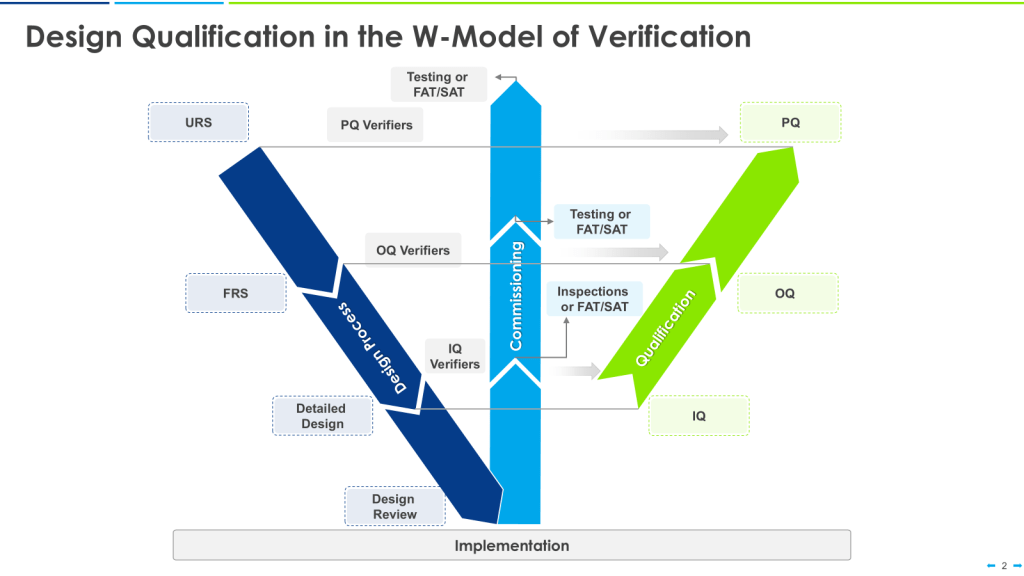
The W-model is an extension of the V-model that explicitly incorporates commissioning activities:

  1. The first “V” represents the traditional V-model stages.
  2. The center portion of the “W” represents commissioning activities.
  3. The second “V” represents qualification activities.

This model provides more granularity to what is identified as “verification testing,” including both commissioning (e.g., FAT, SAT) and qualification testing (IQ, OQ, PQ).
Aspect4Q ModelV-ModelW-Model
StagesDQ, IQ, OQ, PQUser Requirements, Functional Specs, Design Specs, IQ, OQ, PQUser Requirements, Functional Specs, Design Specs, Commissioning, IQ, OQ, PQ
FocusSequential qualification stagesLinking development and testing phasesIntegrating commissioning with qualification
FlexibilityModerateHighHigh
Emphasis on CommissioningLimitedLimitedExplicit
Risk-based ApproachCan be incorporatedCan be incorporatedInherently risk-based

Where Qualifcation Fits into the Regulatory Landscape and Industry Guidelines

WHO Guidelines

The World Health Organization (WHO) provides guidance on validation and qualification in its “WHO good manufacturing practices for pharmaceutical products: main principles”. While not explicitly endorsing a specific model, WHO emphasizes the importance of a systematic approach to validation.

EMA Guidelines

The European Medicines Agency (EMA) has published guidelines on process validation for the manufacture of biotechnology-derived active substances and data to be provided in regulatory submissions. These guidelines align with the principles of ICH Q8, Q9, and Q10, promoting a lifecycle approach to validation.

Annex 15 provides guidance on qualification and validation in pharmaceutical manufacturing. Regarding Design Qualification (DQ), Installation Qualification (IQ), Operational Qualification (OQ), and Performance Qualification (PQ) which is pretty much either the V or W model.

Annex 15 emphasizes a lifecycle approach to validation, considering all stages from initial development of the user requirements specification through to the end of use of the equipment, facility, utility, or system. The main stages of qualification and some suggested criteria are indicated as a “could” option, allowing for flexibility in approach.

Annex 15 provides a structured yet flexible approach to qualification, allowing pharmaceutical manufacturers to adapt their validation strategies to the complexity of their equipment and processes while maintaining compliance with regulatory requirements.

FDA Guidance

The U.S. Food and Drug Administration (FDA) issued its “Guidance for Industry: Process Validation: General Principles and Practices” in 2011. This guidance emphasizes a lifecycle approach to process validation, consisting of three stages: process design, process qualification, and continued process verification.

ASTM E2500

ASTM E2500, “Standard Guide for Specification, Design, and Verification of Pharmaceutical and Biopharmaceutical Manufacturing Systems and Equipment,” provides a risk-based approach to validation. It introduces the concept of “verification” as an alternative to traditional qualification steps, allowing for more flexible and efficient validation processes.

ISPE Guidelines

The International Society for Pharmaceutical Engineering (ISPE) has published several baseline guides and good practice guides that complement regulatory requirements. These include guides on commissioning and qualification, as well as on the implementation of ASTM E2500.

Baseline Guide Vol 5: Commissioning & Qualification (Second Edition)

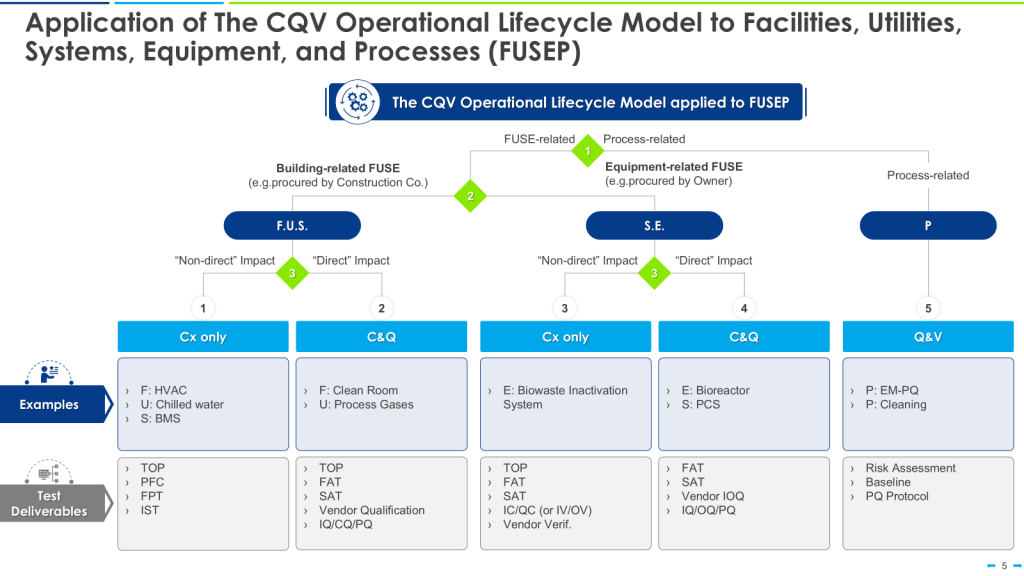
This guide offers practical guidance on implementing a science and risk-based approach to commissioning and qualification (C&Q). Key aspects include:

  • Applying Quality Risk Management to C&Q
  • Best practices for User Requirements Specification, Design Review, Design Qualification, and acceptance/release
  • Efficient use of change management to support C&Q
  • Good Engineering Practice documentation standards

The guide aims to simplify and improve the C&Q process by integrating concepts from regulatory guidances (EMA, FDA, ISO) and replacing certain aspects of previous approaches with Quality Risk Management and Good Engineering Practice concepts.

Conclusion

While the 4Q, V, and W models provide structured approaches to validation, the pharmaceutical industry is increasingly moving towards risk-based and science-driven methodologies. Regulatory agencies and industry organizations are promoting flexible approaches that focus on critical aspects of product quality and patient safety.

By leveraging guidelines such as ASTM E2500 and ISPE recommendations, pharmaceutical companies can develop efficient validation strategies that meet regulatory requirements while optimizing resources. The key is to understand the principles behind these models and guidelines and apply them in a way that best suits the specific needs of each facility, system, or process.
Limiting and Delaying Inspections – Brands International as Example

I think many of us have been discussing the blatant obstruction demonstrated in the December 2024 Warning Letter to Brands International Corporation, a drug manufacturer located in Ontario, Canada, citing it for limiting and delaying FDA’s inspection. Which it is important to remember congress has said is a big no-no.

I just want to stress that the Quality Manager there had a really bad day, week, month, year.

Good writeup of what to do around building your procedure for interviewing of employees during an inspection over at FDA Law blog.

Data and a Good Data Culture

I often joke that as a biotech company employee I am primarily responsible for the manufacture of data (and water) first and foremost, and as a result we get a byproduct of a pharmaceutical drugs.

Many of us face challenges within organizations when it comes to effectively managing data. There tends to be a prevailing mindset that views data handling as a distinct activity, often relegated to the responsibility of someone else, rather than recognizing it as an integral part of everyone’s role. This separation can lead to misunderstandings and missed opportunities for utilizing data to its fullest potential.

Many organizations suffer some multifaceted challenges around data management:

  1. Lack of ownership: When data is seen as “someone else’s job,” it often falls through the cracks.
  2. Inconsistent quality: Without a unified approach, data quality can vary widely across departments.
  3. Missed insights: Siloed data management can result in missed opportunities for valuable insights.
  4. Inefficient processes: Disconnected data handling often leads to duplicated efforts and wasted resources.

Integrate Data into Daily Work

  1. Make data part of job descriptions: Clearly define data-related responsibilities for each role, emphasizing how data contributes to overall job performance.
  2. Provide context: Help employees understand how their data-related tasks directly impact business outcomes and decision-making processes.
  3. Encourage data-driven decision making: Train employees to use data in their daily work, from small decisions to larger strategic choices.

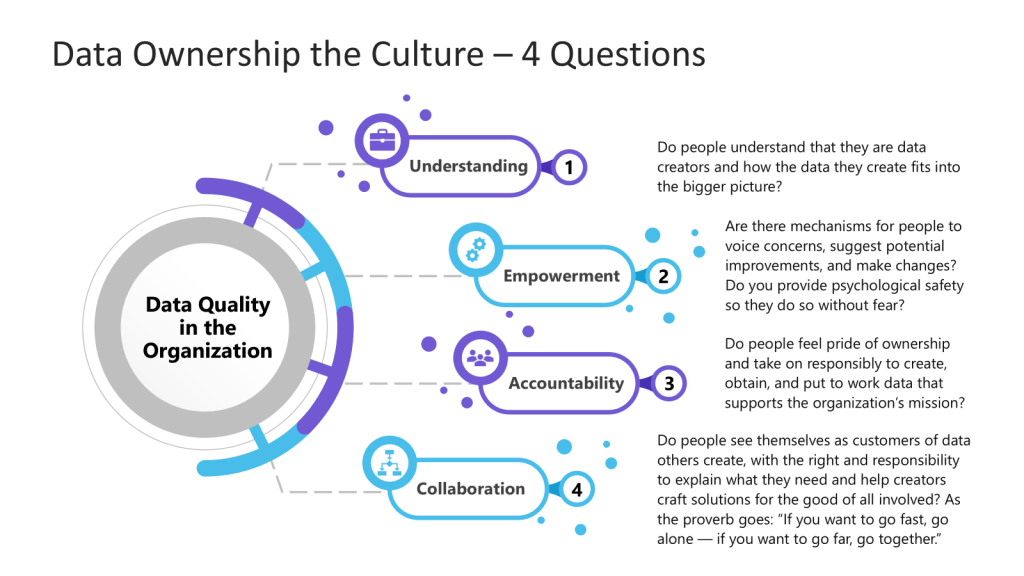
We want to strive to ask four questions.

  1. UnderstandingDo people understand that they are data creators and how the data they create fits into the bigger picture?
  2. Empowerment: Are there mechanisms for people to voice concerns, suggest potential improvements, and make changes? Do you provide psychological safety so they do so without fear?
  3. AccountabilityDo people feel pride of ownership and take on responsibly to create, obtain, and put to work data that supports the organization’s mission?
  4. CollaborationDo people see themselves as customers of data others create, with the right and responsibility to explain what they need and help creators craft solutions for the good of all involved?

Foster a Data-Driven Culture

Fostering a data-driven culture is essential for organizations seeking to leverage the full potential of their data assets. This cultural shift requires a multi-faceted approach that starts at the top and permeates throughout the entire organization.

Leadership by example is crucial in establishing a data-driven culture. Managers and executives must actively incorporate data into their decision-making processes and discussions. By consistently referencing data in meetings, presentations, and communications, leaders demonstrate the value they place on data-driven insights. This behavior sets the tone for the entire organization, encouraging employees at all levels to adopt a similar approach. When leaders ask data-informed questions and base their decisions on factual evidence, it reinforces the importance of data literacy and analytical thinking across the company.

Continuous learning is another vital component of a data-driven culture. Organizations should invest in regular training sessions that enhance data literacy and proficiency with relevant analysis tools. These educational programs should be tailored to each role within the company, ensuring that employees can apply data skills directly to their specific responsibilities. By providing ongoing learning opportunities, companies empower their workforce to make informed decisions and contribute meaningfully to data-driven initiatives. This investment in employee development not only improves individual performance but also strengthens the organization’s overall analytical capabilities.

Creating effective feedback loops is essential for refining and improving data processes over time. Organizations should establish systems that allow employees to provide input on data-related practices and suggest enhancements. This two-way communication fosters a sense of ownership and engagement among staff, encouraging them to actively participate in the data-driven culture. By valuing employee feedback, companies can identify bottlenecks, streamline processes, and uncover innovative ways to utilize data more effectively. These feedback mechanisms also help in closing the loop between data insights and actionable outcomes, ensuring that the organization continually evolves its data practices to meet changing needs and challenges.

Build Data as a Core Principle

  1. Focus on quality: Emphasize the importance of data quality to the mission of the organization
  2. Continuous improvement: Encourage ongoing refinement of data processes,.
  3. Pride in workmanship: Foster a sense of ownership and pride in data-related tasks, .
  4. Break down barriers: Promote cross-departmental collaboration on data initiatives and eliminate silos.
  5. Drive out fear: Create a safe environment for employees to report data issues or inconsistencies without fear of reprisal.

By implementing these strategies, organizations can effectively tie data to employees’ daily work and create a robust data culture that enhances overall performance and decision-making capabilities.

FDA Continues the Discussion on AI/ML

Many of our organizations are somewhere in the journey of using AI/ML some where in the drug product lifecycle, so it is no surprise that the FDA is continuing the dialogue with the recently published draft of “Considerations for the Use of Artificial Intelligence to Support Regulatory Decision-Making for Drug and Biological Products.”

This draft guidance lays out a solid approach by using a risk-based credibility assessment framework to establish and evaluate the credibility of AI models. This involves:

  • Determining if the model is adequate for the intended use
  • Defining the question of interest the AI model will address
  • Defining the context of use for the AI model
  • Assessing the AI model risk based on model influence and decision consequence
  • Developing a plan to establish model credibility commensurate with the risk
  • Executing the plan and documenting results

I think may of us are in the midst of figuring out how to provide sufficient transparency around AI model development, evaluation, and outputs to support regulatory decision-making and what will be found to be acceptable. This sort of guidance is a good way for the agency to further that discussion and I definitely plan on commenting on this one.

Photo by HARUN BENLu0130 on Pexels.com

Semantic Meaning

Over on Squire to Giants, Steve Schefer, writes about the semantic drift of the word triage in business talk.

I think it can be a really valuable exercise to consider, and align on semantic meaning of words, even words that may seem to everyone to mean one particular thing, and triage is a great example of that. When we spend time agonizing over words in documents, arguing about glossaries, what we are doing is aligning over semantic usage for terms that may have drifted a lot.

And don’t even get started on cultural appropriation of words.

The technical nature of our work means that semantic change, which is already a natural and inevitable process in language evolution, is going to happen. Words that we regularly use acquire new meanings or shift in their usage over time. Look what we’ve done to the poor word leverage or pipeline for just to examples.

Like data, we need word stewards, the keeper of the glossary. This role is in service to the process owners to enforce them agreeing on terms and using them the same way as possible. This is why I strongly believe in central glossaries. The dangers of not doing this can be impaired communication, with the message being lost or misinterpreted. And that leads to inefficiencies, and errors, and history has shown us those errors can get pretty significant.

    Photo by Leeloo The First on Pexels.com