
In an era where organizational complexity and interdisciplinary collaboration define success, decision-making frameworks like DACI and RAPID have emerged as critical tools for aligning stakeholders, mitigating biases, and accelerating outcomes. While both frameworks aim to clarify roles and streamline processes, their structural nuances and operational philosophies reveal distinct advantages and limitations.
Foundational Principles and Structural Architectures
The DACI Framework: Clarity Through Role Segmentation
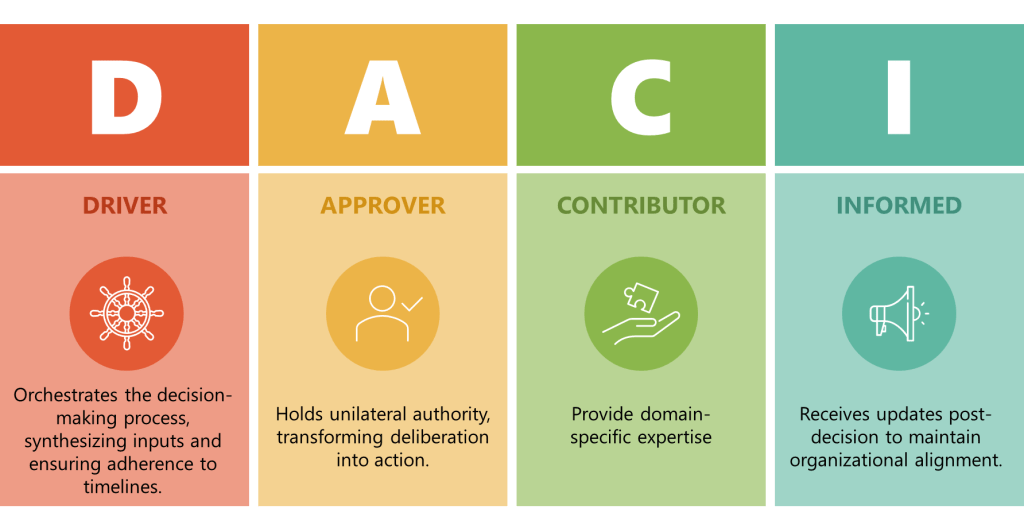
Originating at Intuit in the 1980s, the DACI framework (Driver, Approver, Contributor, Informed) was designed to eliminate ambiguity in project-driven environments. The Driver orchestrates the decision-making process, synthesizing inputs and ensuring adherence to timelines. The Approver holds unilateral authority, transforming deliberation into action. Contributors provide domain-specific expertise, while the Informed cohort receives updates post-decision to maintain organizational alignment.
This structure thrives in scenarios where hierarchical accountability is paramount, such as product development or regulatory submissions. For instance, in pharmaceutical validation processes, the Driver might coordinate cross-functional teams to align on compliance requirements, while the Approver-often a senior quality executive-finalizes the risk control strategy. The framework’s simplicity, however, risks oversimplification in contexts requiring iterative feedback, such as innovation cycles where emergent behaviors defy linear workflows.
The RAPID Framework: Balancing Input and Execution
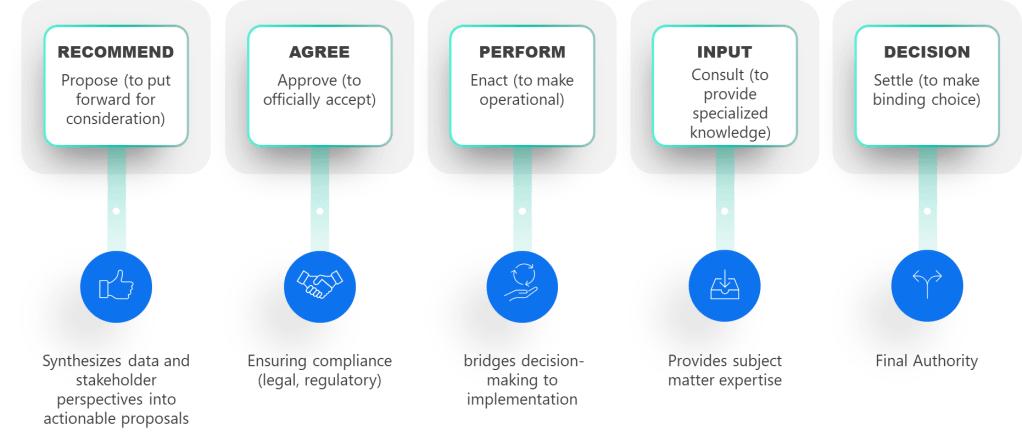
Developed by Bain & Company, RAPID (Recommend, Agree, Perform, Input, Decide) introduces granularity by separating recommendation development from execution. The Recommender synthesizes data and stakeholder perspectives into actionable proposals, while the Decider retains final authority. Crucially, RAPID formalizes the Agree role, ensuring legal or regulatory compliance, and the Perform role, which bridges decision-making to implementation-a gap often overlooked in DACI.
RAPID’s explicit focus on post-decision execution aligns with the demands of an innovative organization. However, the framework’s five-role structure can create bottlenecks if stakeholders misinterpret overlapping responsibilities, particularly in decentralized teams.
Cognitive and Operational Synergies
Mitigating Bias Through Structured Deliberation
Both frameworks combat cognitive noise-a phenomenon where inconsistent judgments undermine decision quality. DACI’s Contributor role mirrors the Input function in RAPID, aggregating diverse perspectives to counter anchoring bias. For instance, when evaluating manufacturing site expansions, Contributors/Inputs might include supply chain analysts and environmental engineers, ensuring decisions balance cost, sustainability, and regulatory risk.
The Mediating Assessments Protocol (MAP), a structured decision-making method highlighted complements these frameworks by decomposing complex choices into smaller, criteria-based evaluations. A pharmaceutical company using DACI could integrate MAP to assess drug launch options through iterative scoring of market access, production scalability, and pharmacovigilance requirements, thereby reducing overconfidence in the Approver’s final call.
Temporal Dynamics in Decision Pathways
DACI’s linear workflow (Driver → Contributors → Approver) suits time-constrained scenarios, such as regulatory submissions requiring rapid consensus. Conversely, RAPID’s non-sequential process-where Recommenders iteratively engage Input and Agree roles-proves advantageous in adaptive contexts like digital validation system adoption, where AI/ML integration demands continuous stakeholder recalibration.
Integrating Strength of Knowledge (SoK)
The Strength of Knowledge framework, which evaluates decision reliability based on data robustness and expert consensus, offers a synergistic lens for both models. For instance, RAPID teams could assign Recommenders to quantify SoK scores for each Input and Agree stakeholder, preemptively addressing dissent through targeted evidence.
Role-Specific Knowledge Weighting
Both frameworks benefit from assigning credibility scores to inputs based on SoK:
In DACI:
- Contributors: Domain experts submit inputs with attached SoK scores (e.g., “Toxicity data: SoK 2/3 due to incomplete genotoxicity studies”).
- Driver: Prioritizes contributions using SoK-weighted matrices, escalating weak-knowledge items for additional scrutiny.
- Approver: Makes final decisions using a knowledge-adjusted risk profile, favoring options supported by strong/moderate SoK.
In RAPID:
- Recommenders: Proposals include SoK heatmaps highlighting evidence quality (e.g., clinical trial endpoints vs. preclinical extrapolations).
- Input: Stakeholders rate their own contributions’ SoK levels, enabling meta-analyses of confidence intervals
- Decide: Final choices incorporate knowledge-adjusted weighted scoring, discounting weak-SoK factors by 30-50%
Contextualizing Frameworks in the Decision Factory Paradigm
Organizations must reframe themselves as “decision factories,” where structured processes convert data into actionable choices. DACI serves as a precision tool for hierarchical environments, while RAPID offers a modular toolkit for adaptive, cross-functional ecosystems. However, neither framework alone addresses the cognitive and temporal complexities of modern industries.
Future iterations will likely blend DACI’s role clarity with RAPID’s execution focus, augmented by AI-driven tools that dynamically assign roles based on decision-criticality and SoK metrics. As validation landscapes and innovation cycles accelerate, the organizations thriving will be those treating decision frameworks not as rigid templates, but as living systems iteratively calibrated to their unique risk-reward contours.

 Investigations of a Dog
2 thoughts on “DACI and RAPID Decision-Making Frameworks”