Engineering runs (ERs) represent a critical yet often underappreciated component of modern biopharmaceutical validation strategies. Defined as non-GMP-scale trials that simulate production processes to identify risks and optimize parameters, Engineering Runs bridge the gap between theoretical process design and manufacturing. Their integration into the ASTM E2500 verification framework creates a powerful synergy – combining Good Engineering Practice (GEP) with Quality Risk Management (QRM) to meet evolving regulatory expectations.
When aligned with ICH Q10’s pharmaceutical quality system (PQS) and the ASTM E2500 lifecycle approach, ERs transform from operational exercises into strategic tools for:
Design space verification per ICH Q8
Scale-up risk mitigation during technology transfer
Specification & Design The standard mandates “right-sized” documentation – detailed enough to ensure product quality without unnecessary bureaucracy.
Verification This phase provides a unified verification approach focusing on:
Critical process parameters (CPPs)
Worst-case scenario testing
Leveraging vendor testing data
Acceptance & Release Final review incorporates ICH Q10’s management responsibilities, ensuring traceability from initial risk assessments to verification outcomes.
Engineering runs serve as a critical bridge between design verification and formal Process Performance Qualification (PPQ). ERs validate critical aspects of manufacturing systems by confirming:
Equipment functionality under simulated GMP conditions
Process parameter boundaries for Critical Process Parameters (CPPs)
Facility readiness through stress-testing utilities, workflows, and contamination controls
Demonstration/ Training Run prior to GMP area
Shakedown. Demonstration/Training Run in GMP area
Engineering Run
cGMP Manufacturing
Room and Equipment
Room
N/A
IOQ Post-Approval
Released and Active
Process Gas
Generation and Distribution Released Point of use assembly PQ complete
Process utility
Process Equipment
Functionally verified or calibrated as required (commissioned)
IOQ Approved
Full released
Analytical Equipment
Released
Alarms
N/A
Alarm ranges and plan defined
Alarms qualified
Raw Materials
Bill of Materials
RM in progress
Approved
Suppliers
Approval in Progress
Approved
Specifications
In Draft
Effective
Release
Non-GMP Usage decision
Released
Process Documentation
Source Documentation
To be defined in Tech Transfer Plan
Engineering Run Protocol
Tech Transfer closed
Batch Records and product specific Work Instructions
Draft
Reviewed Draft
Approved
Process and Equipment SOPs
N/A
Draft
Effective
Product Labels
N/A
Draft Labels
Approved Labels
QC Testing and Documentation
BSC and Personnel Environmental Monitoring
N/A
Effective
Analytical Methods
Suitable for use
Phase Appropriate Validation
Stability
N/A
In place
Certificate of Analysis
N/A
Defined in Engineering Protocol
Effective
Sampling Plan
Draft
Draft use as defined in engineering protocol
Effective
Operations/Execution
Operator Training
Observe and perform operations to gain hands on experience with SME observation
Process specific equipment OJT Gown qualifiedBSC OJT Aseptic OJT Material Transfer OJT (All training in eQMS)
Training in Use
Process Lock
As defined in Tech Transfer Plan
6-week prior to execution
Approved Process Description
Deviations
N/A
N/A
Process – Per Engineering Run protocol FUSE – per SOP
Two concepts—impact and risk — are often discussed but sometimes conflated within quality systems. While related, these concepts serve distinct purposes and drive different decisions throughout the quality system. Let’s explore.
The Fundamental Difference: Impact vs. Risk
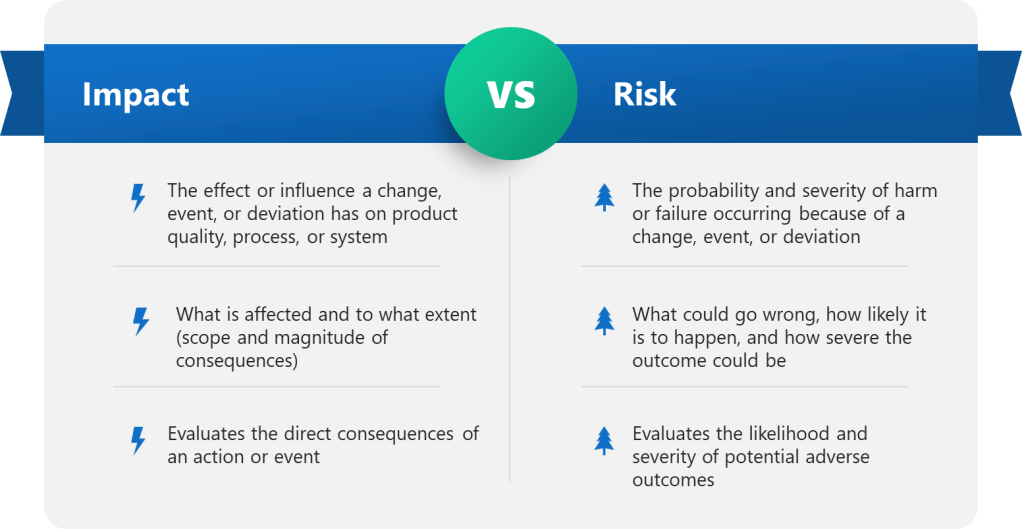
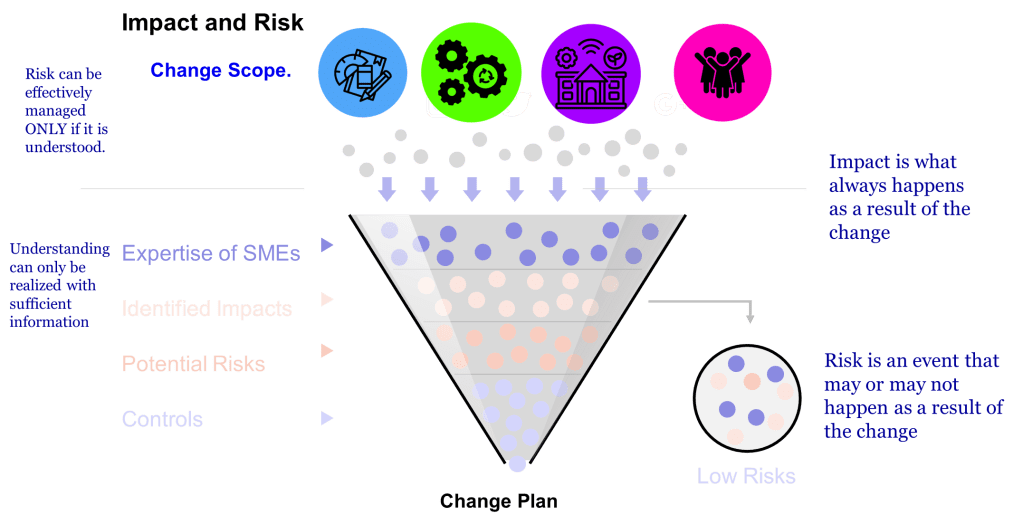
The difference between impact and risk is fundamental to effective quality management. The difference between impact and risk is critical. Impact is best thought of as ‘What do I need to do to make the change.’ Risk is ‘What could go wrong in making this change?'”
Impact assessment focuses on evaluating the effects of a proposed change on various elements such as documentation, equipment, processes, and training. It helps identify the scope and reach of a change. Risk assessment, by contrast, looks ahead to identify potential failures that might occur due to the change – it’s preventive and focused on possible consequences.
This distinction isn’t merely academic – it directly affects how we approach actions and decisions in our quality systems, impacting core functions of CAPA, Change Control and Management Review.
Aspect
Impact
Risk
Definition
The effect or influence a change, event, or deviation has on product quality, process, or system
The probability and severity of harm or failure occurring as a result of a change, event, or deviation
Focus
What is affected and to what extent (scope and magnitude of consequences)
What could go wrong, how likely it is to happen, and how severe the outcome could be
Assessment Type
Evaluates the direct consequences of an action or event
Evaluates the likelihood and severity of potential adverse outcomes
Typical Use
Used in change control to determine which documents, systems, or processes are impacted
Used to prioritize actions, allocate resources, and implement controls to minimize negative outcomes
Measurement
Usually described qualitatively (e.g., minor, moderate, major, critical)
Often quantified by combining probability and impact scores to assign a risk level (e.g., low, medium, high)
Example
A change in raw material supplier impacts the manufacturing process and documentation.
The risk is that the new supplier’s material could fail to meet quality standards, leading to product defects.
Change Control: Different Questions, Different Purposes
Within change management, the PIC/S Recommendation PI 054-1 notes that “In some cases, especially for simple and minor/low risk changes, an impact assessment is sufficient to document the risk-based rationale for a change without the use of more formal risk assessment tools or approaches.”
Impact Assessment in Change Control
Determines what documentation requires updating
Identifies affected systems, equipment, and processes
Identifies potential failures that could result from the change
Evaluates possible consequences to product quality and patient safety
Determines likelihood of those consequences occurring
Guides preventive measures
A common mistake is conflating these concepts or shortcutting one assessment. For example, companies often rush to designate changes as “like-for-like” without supporting data, effectively bypassing proper risk assessment. This highlights why maintaining the distinction is crucial.
Impact in validation relates to identifying what aspects of product quality could be affected by a system or process. For example, when qualifying manufacturing equipment, we determine which critical quality attributes (CQAs) might be influenced by the equipment’s performance.
Risk assessment in validation explores what could go wrong with the equipment or process that might lead to quality failures. Risk management plays a pivotal role in validation by enabling a risk-based approach to defining validation strategies, ensuring regulatory compliance, mitigating product quality and safety risks, facilitating continuous improvement, and promoting cross-functional collaboration.
In Design Qualification, we verify that the critical aspects (CAs) and critical design elements (CDEs) necessary to control risks identified during the quality risk assessment (QRA) are present in the design. This illustrates how impact assessment (identifying critical aspects) works together with risk assessment (identifying what could go wrong).
When we perform Design Review and Design Qualification, we focus on Critical Aspects: Prioritize design elements that directly impact product quality and patient safety. Here, impact assessment identifies critical aspects, while risk assessment helps prioritize based on potential consequences.
Following Design Qualification, Verification activities such as Installation Qualification (IQ), Operational Qualification (OQ), and Performance Qualification (PQ) serve to confirm that the system or equipment performs as intended under actual operating conditions. Here, impact assessment identifies the specific parameters and functions that must be verified to ensure no critical quality attributes are compromised. Simultaneously, risk assessment guides the selection and extent of tests by focusing on areas with the highest potential for failure or deviation. This dual approach ensures that verification not only confirms the intended impact of the design but also proactively mitigates risks before routine use.
Validation does not end with initial qualification. Continuous Validation involves ongoing monitoring and trending of process performance and product quality to confirm that the validated state is maintained over time. Impact assessment plays a role in identifying which parameters and quality attributes require ongoing scrutiny, while risk assessment helps prioritize monitoring efforts based on the likelihood and severity of potential deviations. This continuous cycle allows quality systems to detect emerging risks early and implement corrective actions promptly, reinforcing a proactive, risk-based culture that safeguards product quality throughout the product lifecycle.
Data Integrity: A Clear Example
Data integrity offers perhaps the clearest illustration of the impact-risk distinction.
As I’ve previously noted, Data quality is not a risk. It is a causal factor in the failure or severity. Poor data quality isn’t itself a risk; rather, it’s a factor that can influence the severity or likelihood of risks.
When assessing data integrity issues:
Impact assessment identifies what data is affected and which processes rely on that data
Risk assessment evaluates potential consequences of data integrity lapses
In my risk-based data integrity assessment methodology, I use a risk rating system that considers both impact and risk factors:
Risk Rating
Action
Mitigation
>25
High Risk-Potential Impact to Patient Safety or Product Quality
Mandatory
12-25
Moderate Risk-No Impact to Patient Safety or Product Quality but Potential Regulatory Risk
Recommended
<12
Negligible DI Risk
Not Required
This system integrates both impact (on patient safety or product quality) and risk (likelihood and detectability of issues) to guide mitigation decisions.
The Golden Day: Impact and Risk in Deviation Management
The Golden Day concept for deviation management provides an excellent practical example. Within the first 24 hours of discovering a deviation, we conduct:
An impact assessment to determine:
Which products, materials, or batches are affected
Potential effects on critical quality attributes
Possible regulatory implications
A risk assessment to evaluate:
Patient safety implications
Product quality impact
Compliance with registered specifications
Level of investigation required
This impact assessment is also the initial risk assessment, which will help guide the level of effort put into the deviation. This statement shows how the two concepts, while distinct, work together to inform quality decisions.
Quality Escalation: When Impact Triggers a Response
In quality escalation, we often use specific criteria based on both impact and risk:
Escalation Criteria
Examples of Quality Events for Escalation
Potential to adversely affect quality, safety, efficacy, performance or compliance of product
– Contamination – Product defect/deviation from process parameters or specification – Significant GMP deviations
Product counterfeiting, tampering, theft
– Product counterfeiting, tampering, theft reportable to Health Authority – Lost/stolen IMP
Product shortage likely to disrupt patient care
– Disruption of product supply due to product quality events
Potential to cause patient harm associated with a product quality event
These criteria demonstrate how we use both impact (what’s affected) and risk (potential consequences) to determine when issues require escalation.
Both Are Essential
Understanding the difference between impact and risk fundamentally changes how we approach quality management. Impact assessment without risk assessment may identify what’s affected but fails to prevent potential issues. Risk assessment without impact assessment might focus on theoretical problems without understanding the actual scope.
The pharmaceutical quality system requires both perspectives:
Impact tells us the scope – what’s affected
Risk tells us the consequences – what could go wrong
By maintaining this distinction and applying both concepts appropriately across change control, validation, and data integrity management, we build more robust quality systems that not only comply with regulations but actually protect product quality and patient safety.

 Investigations of a Dog