Equipment Lifecycle Management in the Eyes of the FDA

The October 2025 Warning Letter to Apotex Inc. is fascinating not because it reveals anything novel about FDA expectations, but because it exposes the chasm between what we know we should do and what we actually allow to happen on our watch. Evaluate it together with what we are seeing for Complete Response Letter (CRL) data, we can see that companies continue to struggle with the concept of equipment lifecycle management.

This isn’t about a few leaking gloves or deteriorated gaskets. This is about systemic failure in how we conceptualize, resource, and execute equipment management across the entire GMP ecosystem. Let me walk you through what the Apotex letter really tells us, where the FDA is heading next, and why your current equipment qualification program is probably insufficient.

The Apotex Warning Letter: A Case Study in Lifecycle Management Failure

The FDA’s Warning Letter to Apotex (WL: 320-26-12, October 31, 2025) reads like a checklist of every equipment lifecycle management failure I’ve witnessed in two decades of quality oversight. The agency cited 21 CFR 211.67(a) equipment maintenance failures, 21 CFR 211.192 inadequate investigations, and 21 CFR 211.113(b) aseptic processing deficiencies. But these citations barely scratch the surface of what actually went wrong.

The Core Failures: A Pattern of Deferral and Neglect

Between September 2023 and April 2025—18 months—Apotex experienced at least eight critical equipment failures during leak testing. Their personnel responded by retesting until they achieved passing results rather than investigating root causes. Think about that timeline. Eight failures over 18 months means a failure every 2-3 months, each one representing a signal that their equipment was degrading. When investigators finally examined the system, they found over 30 leaking areas. This wasn’t a single failure; this was systemic equipment deterioration that the organization chose to work around rather than address.

The letter documents white particle buildup on manufacturing equipment surfaces, particles along conveyor systems, deteriorated gasket seals, and discolored gloves. Investigators observed a six-millimeter glove breach that was temporarily closed with a cable tie before production continued. They found tape applied to “false covers” as a workaround. These aren’t just housekeeping issues—they’re evidence that Apotex had crossed from proactive maintenance into reactive firefighting, and then into dangerous normalization of deviation.

Most damning: Apotex had purchased upgraded equipment nearly a year before the FDA inspection but continued using the deteriorating equipment that was actively generating particles contaminating their nasal spray products. They had the solution in their possession. They chose not to implement it.

The Investigation Gap: Equipment Failures as Quality System Failures

The FDA hammered Apotex on their failure to investigate, but here’s what’s really happening: equipment failures are quality system failures until proven otherwise. When a leak happens , you don’t just replace whatever component leaked. You ask:

  • Why did this component fail when others didn’t?
  • Is this a batch-specific issue or a systemic supplier problem?
  • How many products did this breach potentially affect?
  • What does our environmental monitoring data tell us about the timeline of contamination?
  • Are our maintenance intervals appropriate?

Apotex’s investigators didn’t ask these questions. Their personnel retested until they got passing results—a classic example of “testing into compliance” that I’ve seen destroy quality cultures. The quality unit failed to exercise oversight, and management failed to resource proper root cause analysis. This is what happens when quality becomes a checkbox exercise rather than an operational philosophy.​

BLA CRL Trends: The Facility Equipment Crisis Is Accelerating

The Apotex warning letter doesn’t exist in isolation. It’s part of a concerning trend in FDA enforcement that’s becoming impossible to ignore. Facility inspection concerns dominate CRL justifications. Manufacturing and CMC deficiencies account for approximately 44% of all CRLs. For biologics specifically, facility-related issues are even more pronounced.​

The Biologics-Specific Challenge

Biologics license applications face unique equipment lifecycle scrutiny. The 2024-2025 CRL data shows multiple biosimilars rejected due to third-party manufacturing facility issues despite clean clinical data. Tab-cel (tabelecleucel) received a CRL citing problems at a contract manufacturing organization—the FDA rejected an otherwise viable therapy because the facility couldn’t demonstrate equipment control.​

This should terrify every biotech quality leader. The FDA is telling us: your clinical data is worthless if your equipment lifecycle management is suspect. They’re not wrong. Biologics manufacturing depends on consistent equipment performance in ways small molecule chemistry doesn’t. A 0.2°C deviation in a bioreactor temperature profile, caused by a poorly maintained chiller, can alter glycosylation patterns and change the entire safety profile of your product. The agency knows this, and they’re acting accordingly.

The Top 10 Facility Equipment Deficiencies Driving CRLs

Genesis AEC’s analysis of 200+ CRLs identified consistent equipment lifecycle themes:​

  1. Inadequate Facility Segregation and Flow (cross-contamination risks from poor equipment placement)
  2. Missing or Incomplete Commissioning & Qualification (especially HVAC, WFI, clean steam systems)
  3. Fire Protection and Hazardous Material Handling Deficiencies (equipment safety systems)
  4. Critical Utility System Failures (WFI loops with dead legs, inadequate sanitization)
  5. Environmental Monitoring System Gaps (manual data recording, lack of 21 CFR Part 11 compliance)
  6. Container Closure and Packaging Validation Issues (missing extractables/leachables data, CCI testing gaps)
  7. Inadequate Cleanroom Classification and Control (ISO 14644 and EU Annex 1 compliance failures)
  8. Lack of Preventive Maintenance and Asset Management (missing calibration records, unclear maintenance responsibilities)
  9. Inadequate Documentation and Change Control (HVAC setpoint changes without impact assessment)
  10. Sustainability and Environmental Controls Overlooked (temperature/humidity excursions affecting product stability)

Notice what’s not on this list? Equipment selection errors. The FDA isn’t seeing companies buy the wrong equipment. They’re seeing companies buy the right equipment and then fail to manage it across its lifecycle. This is a crucial distinction. The problem isn’t capital allocation—it’s operational execution.

FDA’s Shift to “Equipment Lifecycle State of Control”

The FDA has introduced a significant conceptual shift in how they discuss equipment management. The Apotex Warning Letter is part of the agency’s new emphasis on “equipment lifecycle state of control” . This isn’t just semantic gamesmanship. It represents a fundamental understanding that discrete qualification events are not enough and that continuous lifecycle management is long overdue.

What “State of Control” Actually Means

Traditional equipment qualification followed a linear path: DQ → IQ → OQ → PQ → periodic requalification. State of control means:

  • Continuous monitoring of equipment performance parameters, not just periodic checks
  • Predictive maintenance based on performance data, not just manufacturer-recommended intervals
  • Real-time assessment of equipment degradation signals (particle generation, seal wear, vibration changes)
  • Integrated change management that treats equipment modifications as potential quality events
  • Traceable decision-making about when to repair, refurbish, or retire equipment

The FDA is essentially saying: qualification is a snapshot; state of control is a movie. And they want to see the entire film, not just the trailer.

This aligns perfectly with the agency’s broader push toward Quality Management Maturity. As I’ve previously written about QMM, the FDA is moving away from checking compliance boxes and toward evaluating whether organizations have the infrastructure, culture, and competence to manage quality dynamically. Equipment lifecycle management is the perfect test case for this shift because equipment degradation is inevitable, predictable, and measurable. If you can’t manage equipment lifecycle, you can’t manage quality.​

Global Regulatory Convergence: WHO, EMA, and PIC/S Perspectives

The FDA isn’t operating in a vacuum. Global regulators are converging on equipment lifecycle management as a critical inspection focus, though their approaches differ in emphasis.

EMA: The Annex 15 Lifecycle Approach

EMA’s process validation guidance explicitly requires IQ, OQ, and PQ for equipment and facilities as part of the validation lifecycle. Unlike FDA’s three-stage process validation model, EMA frames qualification as ongoing throughout the product lifecycle. Their 2023 revision of Annex 15 emphasizes:​

  • Validation Master Plans that include equipment lifecycle considerations
  • Ongoing Process Verification that incorporates equipment performance data
  • Risk-based requalification triggered by changes, deviations, or trends
  • Integration with Product Quality Reviews (PQRs) to assess equipment impact on product quality

The EMA expects you to prove your equipment remains qualified through annual PQRs and continuous data review having been more explicit about a lifecycle approach for years.

PIC/S: The Change Management Imperative

PIC/S PI 054-1 on change management provides crucial guidance on equipment lifecycle triggers. The document explicitly identifies equipment upgrades as changes that require formal assessment, planning, and implementation controls. Critically, PIC/S emphasizes:​

  • Interim controls when equipment issues are identified but not yet remediated
  • Post-implementation monitoring to ensure changes achieve intended risk reduction
  • Documentation of rejected changes, especially those related to quality/safety hazard mitigation

The Apotex case is a PIC/S textbook violation: they identified equipment deterioration (hazard), purchased upgraded equipment (change proposal), but failed to implement it with appropriate interim controls or timeline management. The result was continued production with deteriorating equipment—exactly what PIC/S guidance is designed to prevent.

WHO: The Resource-Limited Perspective

WHO’s equipment lifecycle guidance, while focused on medical equipment in low-resource settings, offers surprisingly relevant insights for GMP facilities. Their framework emphasizes:​

  • Planning based on lifecycle cost, not just purchase price
  • Skill development and training as core lifecycle components
  • Decommissioning protocols that ensure data integrity and product segregation

The WHO model is refreshingly honest about resource constraints, which applies to many GMP facilities facing budget pressure. Their key insight: proper lifecycle management actually reduces total cost of ownership by 3-10x compared to run-to-failure approaches. This is the business case that quality leaders need to make to CFOs who view maintenance as a cost center.​

The Six-System Inspection Model: Where Equipment Lifecycle Fits

FDA’s Six-System Inspection Model—particularly the Facilities and Equipment System—provides the structural framework for understanding equipment lifecycle requirements. As I’ve previously written, this system “ensures that facilities and equipment are suitable for their intended use and maintained properly” with focus on “design, maintenance, cleaning, and calibration.”​

The Interconnectedness Problem

Here’s where many organizations fail: they treat the six systems as silos. Equipment lifecycle management bleeds across all of them:

  • Production System: Equipment performance directly impacts process capability
  • Laboratory Controls: Analytical equipment lifecycle affects data integrity
  • Materials System: Equipment changes can affect raw material compatibility
  • Packaging and Labeling: Equipment modifications require revalidation
  • Quality System: Equipment deviations trigger CAPA and change control

The Apotex warning letter demonstrates this interconnectedness perfectly. Their equipment failures (Facilities & Equipment) led to container-closure integrity issues (Packaging), which they failed to investigate properly (Quality), resulting in distributed product that was potentially adulterated (Production). The FDA’s response required independent assessments of investigations, CAPA, and change management—three separate systems all impacted by equipment lifecycle failures.

The “State of Control” Assessment Questions

If FDA inspectors show up tomorrow, here’s what they’ll ask about your equipment lifecycle management:

  1. Design Qualification: Do your User Requirements Specifications include lifecycle maintenance requirements? Are you specifying equipment with modular upgrade paths, or are you buying disposable assets?
  2. Change Management: When you purchase upgraded equipment, what triggers its implementation? Is there a formal risk assessment linking equipment deterioration to product quality? Or do you wait for failures?
  3. Preventive Maintenance: Are your PM intervals based on manufacturer recommendations, or on actual performance data? Do you have predictive maintenance programs using vibration analysis, thermal imaging, or particle counting?
  4. Decommissioning: When equipment reaches end-of-life, do you have formal retirement protocols that assess data integrity impact? Or does old equipment sit in corners of the cleanroom “just in case”?
  5. Training: Do your operators understand equipment lifecycle concepts? Can they recognize early degradation signals? Or do they just call maintenance when something breaks?

These aren’t theoretical questions. They’re directly from recent 483 observations and CRL deficiencies.​

The Business Case: Why Equipment Lifecycle Management Is Economic Imperative

Let’s be blunt: the pharmaceutical industry has treated equipment as a capital expense to be minimized, not an asset to be optimized. This is catastrophically wrong. The Apotex warning letter shows the true cost of this mindset:

  • Product recalls: Multiple ophthalmic and oral solutions recalled
  • Production suspension: Sterile manufacturing halted
  • Independent assessments: Required third-party evaluation of entire quality system
  • Reputational damage: Public warning letter, potential import alert
  • Opportunity cost: Products stuck in regulatory limbo while competitors gain market share

Contrast this with the investment required for proper lifecycle management:

  • Predictive maintenance systems: $50,000-200,000 for sensors and software
  • Enhanced training programs: $10,000-30,000 annually
  • Lifecycle documentation systems: $20,000-100,000 implementation
  • Total: Less than the cost of a single batch recall

The ROI is undeniable. Equipment lifecycle management isn’t a cost center—it’s risk mitigation with quantifiable financial returns.

The CFO Conversation

I’ve had this conversation with CFOs more times than I can count. Here’s what works:

Don’t say: “We need more maintenance budget.”

Say: “Our current equipment lifecycle risk exposure is $X million based on recent CRL trends and warning letters. Investing $Y in lifecycle management reduces that risk by Z% and extends asset utilization by 2-3 years, deferring $W million in capital expenditures.”

Bring data. Show them the Apotex letter. Show them the Tab-cel CRL. Show them the 51 CRLs driven by facility concerns. CFOs understand risk-adjusted returns. Frame equipment lifecycle management as portfolio risk management, not engineering overhead.

Practical Framework: Building an Equipment Lifecycle Management Program

Enough theory. Here’s the practical framework I’ve implemented across multiple DS facilities, refined through inspections, and validated against regulatory expectations.
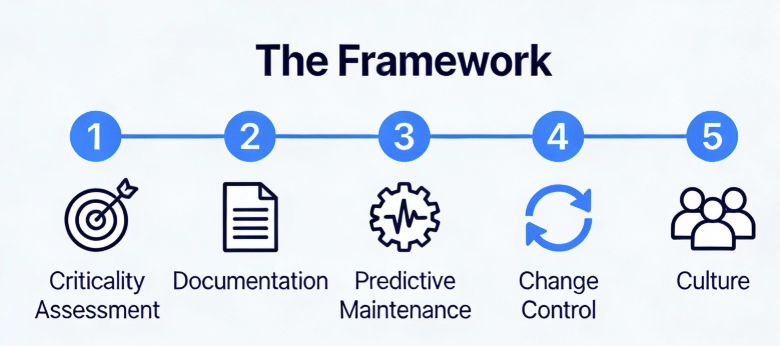
Phase 1: Asset Criticality Assessment

Not all equipment deserves equal lifecycle attention. Use a risk-based approach:

Criticality Class A (Direct Impact): Equipment whose failure directly impacts product quality, safety, or efficacy. Bioreactors, purification skids, sterile filling lines, environmental monitoring systems. These require full lifecycle management including continuous monitoring, predictive maintenance, and formal retirement protocols.

Criticality Class B (Indirect Impact): Equipment whose failure impacts GMP environment but not direct product attributes. HVAC units, WFI systems, clean steam generators. These require enhanced lifecycle management with robust PM programs and performance trending.

Criticality Class C (No Impact): Non-GMP equipment. Standard maintenance practices apply.

Phase 2: Lifecycle Documentation Architecture

Create a master equipment lifecycle file for each Class A and B asset containing:

  1. User Requirements Specification with lifecycle maintenance requirements
  2. Design Qualification including maintainability and upgrade path assessment
  3. Commissioning Protocol (IQ/OQ/PQ) with acceptance criteria that remain valid throughout lifecycle
  4. Maintenance Master Plan defining PM intervals, spare parts strategy, and predictive monitoring
  5. Performance Trending Protocol specifying parameters to monitor, alert limits, and review frequency
  6. Change Management History documenting all modifications with impact assessment
  7. Retirement Protocol defining end-of-life triggers and data migration requirements

As I’ve written about in my posts on GMP-critical systems, documentation must be living documents that evolve with the asset, not static files that gather dust after qualification.​

Phase 3: Predictive Maintenance Implementation

Move beyond manufacturer-recommended intervals to condition-based maintenance:

  • Vibration analysis for rotating equipment (pumps, agitators)
  • Thermal imaging for electrical systems and heat transfer equipment
  • Particle counting for cleanroom equipment and filtration systems
  • Pressure decay testing for sterile barrier systems
  • Oil analysis for hydraulic and lubrication systems

The goal is to detect degradation 6-12 months before failure, allowing planned intervention during scheduled shutdowns.

Phase 4: Integrated Change Control

Equipment changes must flow through formal change control with:

  • Technical assessment by engineering and quality
  • Risk evaluation using FMEA or similar tools
  • Regulatory assessment for potential prior approval requirements
  • Implementation planning with interim controls if needed
  • Post-implementation review to verify effectiveness

The Apotex case shows what happens when you skip the interim controls. They identified the need for upgraded equipment (change) but failed to implement the necessary bridge measures to ensure product quality while waiting for that equipment to come online. They allowed the “future state” (new equipment) to become an excuse for neglecting the “current state” (deteriorating equipment).

This is a failure of Change Management Logic. In a robust quality system, the moment you identify that equipment requires replacement due to performance degradation, you have acknowledged a risk. If you cannot replace it immediately—due to capital cycles, lead times, or qualification timelines—you must implement interim controls to mitigate that risk.

For Apotex, those interim controls should have been:

  • Reduced run durations to minimize stress on failing seals.
  • Increased sampling plans (e.g., 100% leak testing verification or enhanced AQLs).
  • Shortened maintenance intervals (replacing gaskets every batch instead of every campaign).
  • Enhanced environmental monitoring focused specifically on the degrade zones.

Instead, they did nothing. They continued business as usual, likely comforting themselves with the purchase order for the new machine. The FDA’s response was unambiguous: A purchase order is not a CAPA. Until the new equipment is qualified and operational, your legacy equipment must remain in a state of control, or production must stop. There is no regulatory “grace period” for deteriorating assets.

Phase 5: The Cultural Shift—From “Repair” to “Reliability”

The final and most difficult phase of this framework is cultural. You cannot write a SOP for this; you have to lead it.

Most organizations operate on a “Break-Fix” mentality:

  1. Equipment runs until it alarms or fails.
  2. Maintenance fixes it.
  3. Quality investigates (or papers over) the failure.
  4. Production resumes.

The FDA’s “Lifecycle State of Control” demands a “Predict-Prevent” mentality:

  1. Equipment is monitored for degradation signals (vibration, heat, particle counts).
  2. Maintenance intervenes before failure limits are reached.
  3. Quality reviews trends to confirm the intervention was effective.
  4. Production continues uninterrupted.

To achieve this, you need to change how you incentivize your teams. Stop rewarding “heroic” fixes at 2 AM. Start rewarding the boring, invisible work of preventing the failure in the first place. As I’ve written before regarding Quality Management Maturity (QMM), mature quality systems are quiet systems. Chaos is not a sign of hard work; it’s a sign of lost control.

Conclusion: The Choice Before Us

The warning letter to Apotex Inc. and the rising tide of facility-related CRLs are not random compliance noise. They are signal flares. The regulatory expectations for equipment management have fundamentally shifted from static qualification (Is it validated?) to dynamic lifecycle management (Is it in a state of control right now?).

The FDA, EMA, and PIC/S have converged on a single truth: You cannot assure product quality if you cannot guarantee equipment performance.

We are at an inflection point. The industry’s aging infrastructure, combined with the increasing complexity of biologic processes and the unforgiving nature of residue control, has created a perfect storm. We can no longer treat equipment maintenance as a lower-tier support function. It is a core GMP activity, equal in criticality to batch record review or sterility testing.

As Quality Leaders, we have two choices:

  1. The Apotex Path: Treat equipment upgrades as capital headaches to be deferred. Ignore the “minor” leaks and “insignificant” residues. Let the maintenance team bandage the wounds while we focus on “strategic” initiatives. This path leads to 483s, warning letters, CRLs, and the excruciating public failure of seeing your facility’s name in an FDA press release.
  2. The Lifecycle Path: Embrace the complexity. Resource the predictive maintenance programs. Validate the residue removal. Treat every equipment change as a potential risk to patient safety. Build a system where equipment reliability is the foundation of your quality strategy, not an afterthought.

The second path is expensive. It is technically demanding. It requires fighting for budget dollars that don’t have immediate ROI. But it allows you to sleep at night, knowing that when—not if—the FDA investigator asks to see your equipment maintenance history, you won’t have to explain why you used a cable tie to fix a glove port.

You’ll simply show them the data that proves you’re in control.

Choose wisely.
Equipment Qualification for Multi-Purpose Manufacturing: Mastering Process Transitions with Single-Use Systems

In today’s pharmaceutical and biopharmaceutical manufacturing landscape, operational agility through multi-purpose equipment utilization has evolved from competitive advantage to absolute necessity. The industry’s shift toward personalized medicines, advanced therapies, and accelerated development timelines demands manufacturing systems capable of rapid, validated transitions between different processes and products. However, this operational flexibility introduces complex regulatory challenges that extend well beyond basic compliance considerations.

As pharmaceutical professionals navigate this dynamic environment, equipment qualification emerges as the cornerstone of a robust quality system—particularly when implementing multi-purpose manufacturing strategies with single-use technologies. Having guided a few organizations through these qualification challenges over the past decade, I’ve observed a fundamental misalignment between regulatory expectations and implementation practices that creates unnecessary compliance risk.

In this post, I want to explore strategies for qualifying equipment across different processes, with particular emphasis on leveraging single-use technologies to simplify transitions while maintaining robust compliance. We’ll explore not only the regulatory framework but the scientific rationale behind qualification requirements when operational parameters change. By implementing these systematized approaches, organizations can simultaneously satisfy regulatory expectations and enhance operational efficiency—transforming compliance activities from burden to strategic advantage.

The Fundamentals: Equipment Requalification When Parameters Change

When introducing a new process or expanding operational parameters, a fundamental GMP requirement applies: equipment qualification ranges must undergo thorough review and assessment. Regulatory guidance is unambiguous on this point: Whenever a new process is introduced the qualification ranges should be reviewed. If equipment has been qualified over a certain range and is required to operate over a wider range than before, prior to use it should be re-qualified over the wider range.

This requirement stems from the scientific understanding that equipment performance characteristics can vary significantly across different operational ranges. Temperature control systems that maintain precise stability at 37°C may exhibit unacceptable variability at 4°C. Mixing systems designed for aqueous formulations may create detrimental shear forces when processing more viscous products. Control algorithms optimized for specific operational setpoints might perform unpredictably at the extremes of their range.

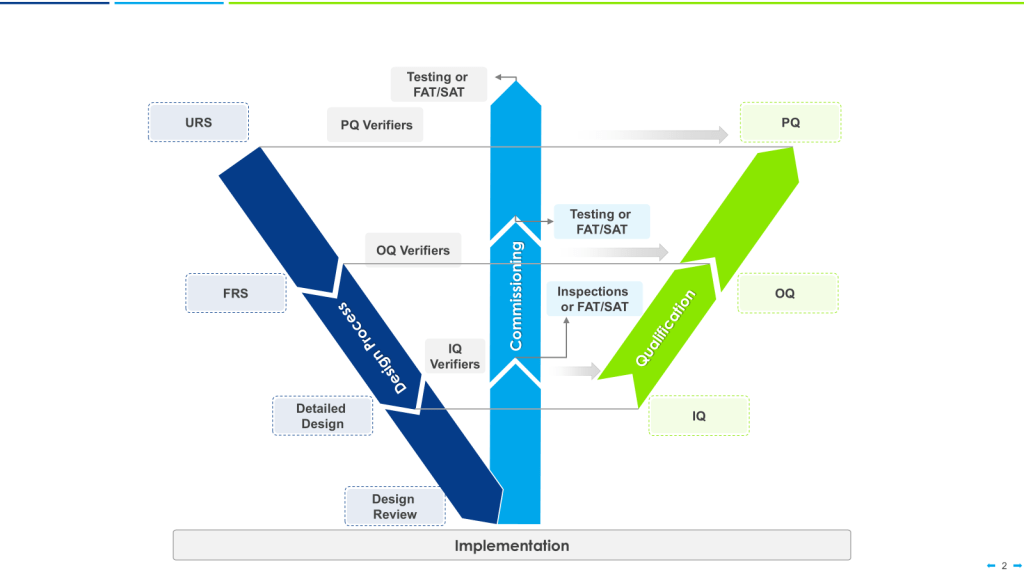
There are a few risk-based models of verification, such as the 4Q qualification model—consisting of Design Qualification (DQ), Installation Qualification (IQ), Operational Qualification (OQ), and Performance Qualification (PQ)— or the W-Model which can provide a structured framework for evaluating equipment performance across varied operating conditions. These widely accepted approaches ensures comprehensive verification that equipment will consistently produce products meeting quality requirements. For multi-purpose equipment specifically, the Performance Qualification phase takes on heightened importance as it confirms consistent performance under varied processing conditions.

I cannot stress the importance of risk based approach of ASTM E2500 here which emphasizes a flexible verification strategy focused on critical aspects that directly impact product quality and patient safety. ASTM E2500 integrates several key principles that transform equipment qualification from a documentation exercise to a scientific endeavor:

Risk-based approach: Verification activities focus on critical aspects with the potential to affect product quality, with the level of effort and documentation proportional to risk. As stated in the standard, “The evaluation of risk to quality should be based on scientific knowledge and ultimately link to the protection of the patient”.

  • Science-based decisions: Product and process information, including critical quality attributes (CQAs) and critical process parameters (CPPs), drive verification strategies. This ensures that equipment verification directly connects to product quality requirements.
  • Quality by Design integration: Critical aspects are designed into systems during development rather than tested in afterward, shifting focus from testing quality to building it in from the beginning.
  • Subject Matter Expert (SME) leadership: Technical experts take leading roles in verification activities appropriate to their areas of expertise.
  • Good Engineering Practice (GEP) foundation: Engineering principles and practices underpin all specification, design, and verification activities, creating a more technically robust approach to qualification

Organizations frequently underestimate the technical complexity and regulatory significance of equipment requalification when operational parameters change. The common misconception that equipment qualified for one process can simply be repurposed for another without formal assessment creates not only regulatory vulnerability but tangible product quality risks. Each expansion of operational parameters requires systematic evaluation of equipment capabilities against new requirements—a scientific approach rather than merely a documentation exercise.

Single-Use Systems: Revolutionizing Multi-Purpose Manufacturing

Single-use technologies (SUT) have fundamentally transformed how organizations approach process transitions in biopharmaceutical manufacturing. By eliminating cleaning validation requirements and dramatically reducing cross-contamination risks, these systems enable significantly more rapid equipment changeovers between different products and processes. However, this operational advantage comes with distinct qualification considerations that require specialized expertise.

The qualification approach for single-use systems differs fundamentally from traditional stainless equipment due to the redistribution of quality responsibility across the supply chain. I conceptualize SUT validation as operating across three interconnected domains, each requiring distinct validation strategies:

  1. Process operation validation: This domain focuses on the actual processing parameters, aseptic operations, product hold times, and process closure requirements specific to each application. For multi-purpose equipment, this validation must address each process’s unique requirements while ensuring compatibility across all intended applications.
  2. Component manufacturing validation: This domain centers on the supplier’s quality systems for producing single-use components, including materials qualification, manufacturing controls, and sterilization validation. For organizations implementing multi-purpose strategies, supplier validation becomes particularly critical as component properties must accommodate all intended processes.
  3. Supply chain process validation: This domain ensures consistent quality and availability of single-use components throughout their lifecycle. For multi-purpose applications, supply chain robustness takes on heightened importance as component variability could affect process consistency across different applications.

This redistribution of quality responsibility creates both opportunities and challenges. Organizations can leverage comprehensive vendor validation packages to accelerate implementation, reducing qualification burden compared to traditional equipment. However, this necessitates implementing unusually robust supplier qualification programs that thoroughly evaluate manufacturer quality systems, change control procedures, and extractables/leachables studies applicable across all intended process conditions.

When qualifying single-use systems for multi-purpose applications, material science considerations become paramount. Each product formulation may interact differently with single-use materials, potentially affecting critical quality attributes through mechanisms like protein adsorption, leachable compound introduction, or particulate generation. These product-specific interactions must be systematically evaluated for each application, requiring specialized analytical capabilities and scientifically sound acceptance criteria.

Proving Effective Process Transitions Without Compromising Quality

For equipment designed to support multiple processes, qualification must definitively demonstrate the system can transition effectively between different applications without compromising performance or product quality. This demonstration represents a frequent focus area during regulatory inspections, where the integrity of product changeovers is routinely scrutinized.

When utilizing single-use systems, the traditional cleaning validation burden is substantially reduced since product-contact components are replaced between processes. However, several critical elements still require rigorous qualification:

Changeover procedures must be meticulously documented with detailed instructions for disassembly, disposal of single-use components, assembly of new components, and verification steps. These procedures should incorporate formal engineering assessments of mechanical interfaces to prevent connection errors during reassembly. Verification protocols should include explicit acceptance criteria for visual inspection of non-disposable components and connection points, with particular attention to potential entrapment areas where residual materials might accumulate.

Product-specific impact assessments represent another critical element, evaluating potential interactions between product formulations and equipment materials. For single-use systems specifically, these assessments should include:

  • Adsorption potential based on product molecular properties, including molecular weight, charge distribution, and hydrophobicity
  • Extractables and leachables unique to each formulation, with particular attention to how process conditions (temperature, pH, solvent composition) might affect extraction rates
  • Material compatibility across the full range of process conditions, including extreme parameter combinations that might accelerate degradation
  • Hold time limitations considering both product quality attributes and single-use material integrity under process-specific conditions

Process parameter verification provides objective evidence that critical parameters remain within acceptable ranges during transitions. This verification should include challenging the system at operational extremes with each product formulation, not just at nominal settings. For temperature-controlled processes, this might include verification of temperature recovery rates after door openings or evaluation of temperature distribution patterns under different loading configurations.

An approach I’ve found particularly effective is conducting “bracketing studies” that deliberately test worst-case combinations of process parameters with different product formulations. These studies specifically evaluate boundary conditions where performance limitations are most likely to manifest, such as minimum/maximum temperatures combined with minimum/maximum agitation rates. This provides scientific evidence that the equipment can reliably handle transitions between the most challenging operating conditions without compromising performance.

When applying the W-model approach to validation, special attention should be given to the verification stages for multi-purpose equipment. Each verification step must confirm not only that the system meets individual requirements but that it can transition seamlessly between different requirement sets without compromising performance or product quality.

Developing Comprehensive User Requirement Specifications

The foundation of effective equipment qualification begins with meticulously defined User Requirement Specifications (URS). For multi-purpose equipment, URS development requires exceptional rigor as it must capture the full spectrum of intended uses while establishing clear connections to product quality requirements.

A URS for multi-purpose equipment should include:

Comprehensive operational ranges for all process parameters across all intended applications. Rather than simply listing individual setpoints, the URS should define the complete operating envelope required for all products, including normal operating ranges, alert limits, and action limits. For temperature-controlled processes, this should specify not only absolute temperature ranges but stability requirements, recovery time expectations, and distribution uniformity standards across varied loading scenarios.

Material compatibility requirements for all product formulations, particularly critical for single-use technologies where material selection significantly impacts extractables profiles. These requirements should reference specific material properties (rather than just general compatibility statements) and establish explicit acceptance criteria for compatibility studies. For pH-sensitive processes, the URS should define the acceptable pH range for all contact materials and specify testing requirements to verify material performance across that range.

Changeover requirements detailing maximum allowable transition times, verification methodologies, and product-specific considerations. This should include clearly defined acceptance criteria for changeover verification, such as visual inspection standards, integrity testing parameters for assembled systems, and any product-specific testing requirements to ensure residual clearance.

Future flexibility considerations that build in reasonable operational margins beyond current requirements to accommodate potential process modifications without complete requalification. This forward-looking approach avoids the common pitfall of qualifying equipment for the minimum necessary range, only to require requalification when minor process adjustments are implemented.

Explicit connections between equipment capabilities and product Critical Quality Attributes (CQAs), demonstrating how equipment performance directly impacts product quality for each application. This linkage establishes the scientific rationale for qualification requirements, helping prioritize testing efforts around parameters with direct impact on product quality.

The URS should establish unambiguous, measurable acceptance criteria that will be used during qualification to verify equipment performance. These criteria should be specific, testable, and directly linked to product quality requirements. For temperature-controlled processes, rather than simply stating “maintain temperature of X°C,” specify “maintain temperature of X°C ±Y°C as measured at multiple defined locations under maximum and minimum loading conditions, with recovery to setpoint within Z minutes after a door opening event.”

Qualification Testing Methodologies: Beyond Standard Approaches

Qualifying multi-purpose equipment requires more sophisticated testing strategies than traditional single-purpose equipment. The qualification protocols must verify performance not only at standard operating conditions but across the full operational spectrum required for all intended applications.

Installation Qualification (IQ) Considerations

For multi-purpose equipment using single-use systems, IQ should verify proper integration of disposable components with permanent equipment, including:

  • Comprehensive documentation of material certificates for all product-contact components, with particular attention to material compatibility with all intended process conditions
  • Verification of proper connections between single-use assemblies and fixed equipment, including mechanical integrity testing of connection points under worst-case pressure conditions
  • Confirmation that utilities meet specifications across all intended operational ranges, not just at nominal settings
  • Documentation of system configurations for each process the equipment will support, including component placement, connection arrangements, and control system settings
  • Verification of sensor calibration across the full operational range, with particular attention to accuracy at the extremes of the required range

The IQ phase should be expanded for multi-purpose equipment to include verification that all components and instrumentation are properly installed to support each intended process configuration. When additional processes are added after the fact a retrospective fit-for-purpose assessment should be conducted and gaps addressed.

Operational Qualification (OQ) Approaches

OQ must systematically challenge the equipment across the full range of operational parameters required for all processes:

  • Testing at operational extremes, not just nominal setpoints, with particular attention to parameter combinations that represent worst-case scenarios
  • Challenge testing under boundary conditions for each process, including maximum/minimum loads, highest/lowest processing rates, and extreme parameter combinations
  • Verification of control system functionality across all operational ranges, including all alarms, interlocks, and safety features specific to each process
  • Assessment of performance during transitions between different parameter sets, evaluating control system response during significant setpoint changes
  • Robustness testing that deliberately introduces disturbances to evaluate system recovery capabilities under various operating conditions

For temperature-controlled equipment specifically, OQ should verify temperature accuracy and stability not only at standard operating temperatures but also at the extremes of the required range for each process. This should include assessment of temperature distribution patterns under different loading scenarios and recovery performance after system disturbances.

Performance Qualification (PQ) Strategies

PQ represents the ultimate verification that equipment performs consistently under actual production conditions:

  • Process-specific PQ protocols demonstrating reliable performance with each product formulation, challenging the system with actual production-scale operations
  • Process simulation tests using actual products or qualified substitutes to verify that critical quality attributes are consistently achieved
  • Multiple assembly/disassembly cycles when using single-use systems to demonstrate reliability during process transitions
  • Statistical evaluation of performance consistency across multiple runs, establishing confidence intervals for critical process parameters
  • Worst-case challenge tests that combine boundary conditions for multiple parameters simultaneously

For organizations implementing the W-model, the enhanced verification loops in this approach provide particular value for multi-purpose equipment, establishing robust evidence of equipment performance across varied operating conditions and process configurations.

Fit-for-Purpose Assessment Table: A Practical Tool

When introducing a new platform product to existing equipment, a systematic assessment is essential. The following table provides a comprehensive framework for evaluating equipment suitability across all relevant process parameters.

ColumnInstructions for Completion
Critical Process Parameter (CPP)List each process parameter critical to product quality or process performance. Include all parameters relevant to the unit operation (temperature, pressure, flow rate, mixing speed, pH, conductivity, etc.). Each parameter should be listed on a separate row. Parameters should be specific and measurable, not general capabilities.
Current Qualified RangeDocument the validated operational range from the existing equipment qualification documents. Include both the absolute range limits and any validated setpoints. Specify units of measurement. Note if the parameter has alerting or action limits within the qualified range. Reference the specific qualification document and section where this range is defined.
New Required RangeSpecify the range required for the new platform product based on process development data. Include target setpoint and acceptable operating range. Document the source of these requirements (e.g., process characterization studies, technology transfer documents, risk assessments). Specify units of measurement identical to those used in the Current Qualified Range column for direct comparison.
Gap AnalysisQuantitatively assess whether the new required range falls completely within the current qualified range, partially overlaps, or falls completely outside. Calculate and document the specific gap (numerical difference) between ranges. If the new range extends beyond the current qualified range, specify in which direction (higher/lower) and by how much. If completely contained within the current range, state “No Gap Identified.”
Equipment Capability AssessmentEvaluate whether the equipment has the physical/mechanical capability to operate within the new required range, regardless of qualification status. Review equipment specifications from vendor documentation to confirm design capabilities. Consult with equipment vendors if necessary to confirm operational capabilities not explicitly stated in documentation. Document any physical limitations that would prevent operation within the required range.
Risk AssessmentPerform a risk assessment evaluating the potential impact on product quality, process performance, and equipment integrity when operating at the new parameters. Use a risk ranking approach (High/Medium/Low) with clear justification. Consider factors such as proximity to equipment design limits, impact on material compatibility, effect on equipment lifespan, and potential failure modes. Reference any formal risk assessment documents that provide more detailed analysis.
Automation CapabilityAssess whether the current automation system can support the new required parameter ranges. Evaluate control algorithm suitability, sensor ranges and accuracy across the new parameters, control loop performance at extreme conditions, and data handling capacity. Identify any required software modifications, control strategy updates, or hardware changes to support the new operating ranges. Document testing needed to verify automation performance across the expanded ranges.
Alarm StrategyDefine appropriate alarm strategies for the new parameter ranges, including warning and critical alarm setpoints. Establish allowable excursion durations before alarm activation for dynamic parameters. Compare new alarm requirements against existing configured alarms, identifying gaps. Evaluate alarm prioritization and ensure appropriate operator response procedures exist for new or modified alarms. Consider nuisance alarm potential at expanded operating ranges and develop mitigation strategies.
Required ModificationsDocument any equipment modifications, control system changes, or additional components needed to achieve the new required range. Include both hardware and software modifications. Estimate level of effort and downtime required for implementation. If no modifications are needed, explicitly state “No modifications required.”
Testing ApproachOutline the specific qualification approach for verifying equipment performance within the new required range. Define whether full requalification is needed or targeted testing of specific parameters is sufficient. Specify test methodologies, sampling plans, and duration of testing. Detail how worst-case conditions will be challenged during testing. Reference any existing protocols that will be leveraged or modified. For single-use systems, address how single-use component integration will be verified.
Acceptance CriteriaDefine specific, measurable acceptance criteria that must be met to demonstrate equipment suitability. Criteria should include parameter accuracy, stability, reproducibility, and control precision. Specify statistical requirements (e.g., capability indices) if applicable. Ensure criteria address both steady-state operation and response to disturbances. For multi-product equipment, include criteria related to changeover effectiveness.
Documented Evidence RequiredList specific documentation required to support the fit-for-purpose determination. Include qualification protocols/reports, engineering assessments, vendor statements, material compatibility studies, and historical performance data. For single-use components, specify required vendor documentation (e.g., extractables/leachables studies, material certificates). Identify whether existing documentation is sufficient or new documentation is needed.
Impact on Concurrent ProductsAssess how qualification activities or equipment modifications for the new platform product might impact other products currently manufactured using the same equipment. Evaluate schedule conflicts, equipment availability, and potential changes to existing qualified parameters. Document strategies to mitigate any negative impacts on existing production.

Implementation Guidelines

The Equipment Fit-for-Purpose Assessment Table should be completed through structured collaboration among cross-functional stakeholders, with each Critical Process Parameter (CPP) evaluated independently while considering potential interaction effects.

  1. Form a cross-functional team including process engineering, validation, quality assurance, automation, and manufacturing representatives. For technically complex assessments, consider including representatives from materials science and analytical development to address product-specific compatibility questions.
  2. Start with comprehensive process development data to clearly define the required operational ranges for the new platform product. This should include data from characterization studies that establish the relationship between process parameters and Critical Quality Attributes, enabling science-based decisions about qualification requirements.
  3. Review existing qualification documentation to determine current qualified ranges and identify potential gaps. This review should extend beyond formal qualification reports to include engineering studies, historical performance data, and vendor technical specifications that might provide additional insights about equipment capabilities.
  4. Evaluate equipment design capabilities through detailed engineering assessment. This should include review of design specifications, consultation with equipment vendors, and potentially non-GMP engineering runs to verify equipment performance at extended parameter ranges before committing to formal qualification activities.
  5. Conduct parameter-specific risk assessments for identified gaps, focusing on potential impact to product quality. These assessments should apply structured methodologies like FMEA (Failure Mode and Effects Analysis) to quantify risks and prioritize qualification efforts based on scientific rationale rather than arbitrary standards.
  6. Develop targeted qualification strategies based on gap analysis and risk assessment results. These strategies should pay particular attention to Performance Qualification under process-specific conditions.
  7. Generate comprehensive documentation to support the fit-for-purpose determination, creating an evidence package that would satisfy regulatory scrutiny during inspections. This documentation should establish clear scientific rationale for all decisions, particularly when qualification efforts are targeted rather than comprehensive.

The assessment table should be treated as a living document, updated as new information becomes available throughout the implementation process. For platform products with established process knowledge, leveraging prior qualification data can significantly streamline the assessment process, focusing resources on truly critical parameters rather than implementing blanket requalification approaches.

When multiple parameters show qualification gaps, a science-based prioritization approach should guide implementation strategy. Parameters with direct impact on Critical Quality Attributes should receive highest priority, followed by those affecting process consistency and equipment integrity. This prioritization ensures that qualification efforts address the most significant risks first, creating the greatest quality benefit with available resources.

Building a Robust Multi-Purpose Equipment Strategy

As biopharmaceutical manufacturing continues evolving toward flexible, multi-product facilities, qualification of multi-purpose equipment represents both a regulatory requirement and strategic opportunity. Organizations that develop expertise in this area position themselves advantageously in an increasingly complex manufacturing landscape, capable of rapidly introducing new products while maintaining unwavering quality standards.

The systematic assessment approaches outlined in this article provide a scientific framework for equipment qualification that satisfies regulatory expectations while optimizing operational efficiency. By implementing tools like the Fit-for-Purpose Assessment Table and leveraging a risk-based validation model, organizations can navigate the complexities of multi-purpose equipment qualification with confidence.

Single-use technologies offer particular advantages in this context, though they require specialized qualification considerations focusing on supplier quality systems, material compatibility across different product formulations, and supply chain robustness. Organizations that develop systematic approaches to these considerations can fully realize the benefits of single-use systems while maintaining robust compliance.

The most successful organizations in this space recognize that multi-purpose equipment qualification is not merely a regulatory obligation but a strategic capability that enables manufacturing agility. By building expertise in this area, biopharmaceutical manufacturers position themselves to rapidly introduce new products while maintaining the highest quality standards—creating a sustainable competitive advantage in an increasingly dynamic market.

Timely Equipment/Facility Upgrades

One of the many fascinating items in the recent Warning Letter to Sanofi is the FDA’s direction to provide a plan to perform “timely technological upgrades to the equipment/facility infrastructure.” This point drives home the point that staying current with technological advancements is crucial for maintaining compliance, improving efficiency, and ensuring product quality. Yet, I think it is fair to say we rarely see it this bluntly put as a requirement.

One of the many reasons this Warning Letter stands out is that this is (as far as I can tell) the same facility that won the ISPE’s Facility of the Year award in 2020. This means it is still a pretty new facility, and since it is one of the templates that many single-use biotech manufacturing facilities are based on, we had best pay attention. If a failure to maintain a state-of-the-art facility can contribute to this sort of Warning Letter, then many companies had best be paying close attention. There is a lot to unpack and learn here.

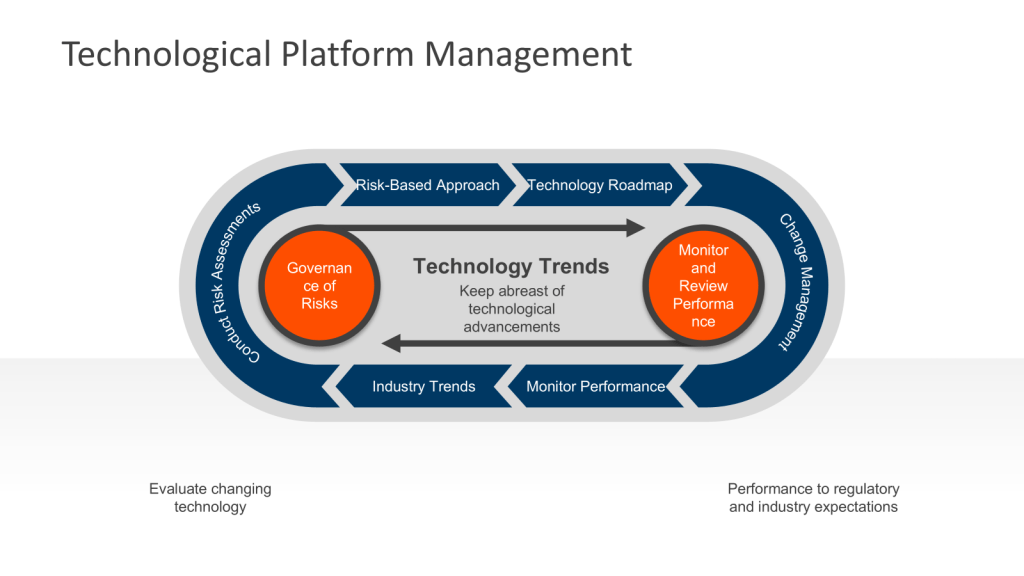
Establishing an Ongoing Technology Platform Process

To meet regulatory requirements and industry standards, facilities should implement a systematic approach to technological upgrades.

1. Conduct Regular Assessments

At least annually, perform comprehensive evaluations of your facility’s equipment, systems, and processes. This assessment should include:

  • Review of equipment performance and maintenance, including equipment effectiveness
  • Analysis of deviation reports and quality issues
  • Evaluation of current technologies against emerging industry standards
  • Assessment of facility design and layout for potential improvements

This should be captured as part of the FUSE metrics plan and appropriately evaluated as part of quality governance.

2. Stay Informed on Industry Trends

Keep abreast of technological advancements in biotech manufacturing at minimum by:

  • Attending industry conferences and workshops
  • Participating in working groups for key consensus standard writers, such as ISPE and ASTM
  • Subscribing to relevant publications and regulatory updates
  • Engaging with equipment vendors and technology providers

3. Develop a Risk-Based Approach

Prioritize upgrades based on their potential impact on product quality, patient safety, and regulatory compliance. Utilize living risk assessments to get a sense of where issues are developing. These should be the evolution of the risk management that built the facility.

4. Create a Technology Roadmap

Develop a long-term plan for implementing upgrades, considering:

  • Budget constraints and return on investment
  • Regulatory timelines for submissions and approvals
  • Production schedules and potential downtime
  • Integration with existing systems and processes

5. Implement Change Management Procedures

Ensure there is a robust change management process in place to ensure that upgrades are implemented safely and effectively. This should include:

6. Appropriate Verification – Commissioning, Qualification and Validation

Conduct thorough verification activities to demonstrate that the upgraded equipment or systems meet predetermined specifications and regulatory requirements.

7. Monitor and Review Performance

Continuously monitor the performance of upgraded systems and equipment to ensure they meet expectations and comply with cGMP requirements. Conduct periodic reviews to identify any necessary adjustments or further improvements. This is all part of Stage 3 of the FDA’s process validation model focusing on ongoing assurance that the process remains in a state of control during routine commercial manufacture. This stage is designed to:

  • Anticipate and prevent issues before they occur
  • Detect unplanned deviations from the process
  • Identify and correct problems

Leveraging Advanced Technologies

To stay ahead of regulatory expectations and industry trends, consider incorporating advanced technologies into your upgrade plans:

  • Single-Use Systems (SUS): Implement disposable components to reduce cleaning and validation requirements while improving flexibility.
  • Modern Microbial Methods (MMM): Implement advanced techniques used in microbiology that offer significant advantages over traditional culture-based methods
  • Process Analytical Technology (PAT): Integrate real-time monitoring and control systems to enhance product quality and process understanding.
  • Data Analytics and Artificial Intelligence: Implement advanced data analysis tools to identify trends, predict maintenance needs, and optimize processes.

Conclusion

Maintaining a state-of-the-art biotech facility requires a proactive and systematic approach to technological upgrades. By establishing an ongoing process for identifying and implementing improvements, facilities can ensure compliance with FDA requirements, align with industry standards, and stay competitive in the rapidly evolving biotech landscape.

Remember that the goal is not just to meet current regulatory expectations but to anticipate future requirements and position your facility at the forefront of biotech manufacturing excellence. By following this comprehensive approach and staying informed on industry developments, you can create a robust, flexible, and compliant manufacturing environment that supports the production of high-quality biopharmaceutical products.

FUSE and FUSE(P) – Definitions

I’ve been utilizing a few acronyms in a lazy way, and it is important to define them moving forward.

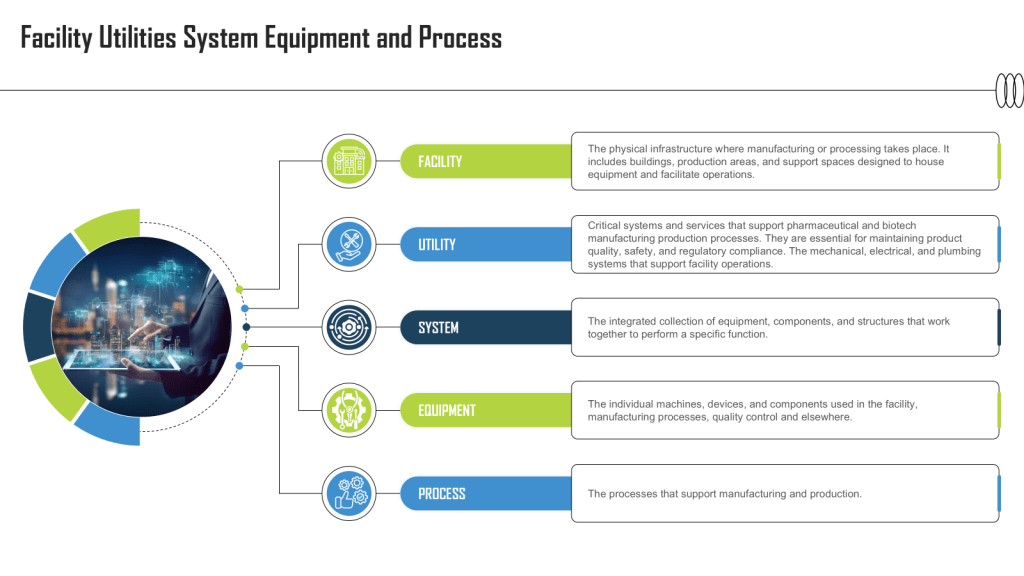
The acronyms FUSE stands for Facility Utility System Equipment; and FUSE(P) adds Process. This framework is used to describe and manage critical components of systems in facilities, particularly in industrial and pharmaceutical manufacturing settings. Here’s a breakdown of its elements:

Facility

This refers to the physical infrastructure where manufacturing or processing takes place. It includes buildings, production areas, and support spaces designed to house equipment and facilitate operations.

Utility Systems

Utilities are critical systems and services that support pharmaceutical and biotech manufacturing production processes. They are essential for maintaining product quality, safety, and regulatory compliance. The mechanical, electrical, and plumbing systems that support facility operations. Key utility systems include:

  • Heating, Ventilation, and Air Conditioning (HVAC)
  • Electrical distribution
  • Water systems (purified, process, and domestic)
  • Compressed air and gas systems
  • Waste management systems

System

In this context, a system refers to the integrated collection of equipment, components, and structures that work together to perform a specific function.

Equipment

This encompasses the individual machines, devices, and components used in the facility, manufacturing processes, quality control and elsewhere. Examples include mixing tanks, filling machines, packaging equipment, and quality control instruments

Process

This element refers to the manufacturing or production processes that the facility and its utility systems support. It includes:

  • Production workflows
  • Environmental control
  • Cleaning
  • Computer systems for managing manufacturing and operational processes:

The FUSE(P) framework emphasizes the interconnected nature of these elements and their collective impact on product quality, safety, and operational efficiency. It guides the design, implementation, and management of facility utility systems to ensure they meet Good Manufacturing Practice (GMP) standards and support reliable production processes.

Not all Equipment is Category 3 in GAMP5

I think folks tend to fall into a trap when it comes to equipment and GAMP5, automatically assuming that because it is equipment it must be Category 3. Oh, how that can lead to problems.

When thinking about equipment it is best to think in terms of “No Configuration” and ” Low Configuration” software. This terminology is used to describe software that requires little to no configuration or customization to meet the user’s needs.

No Configuration(NoCo) aligns with GAMP 5 Category 3 software, which is described as “Non-Configured Products”. These are commercial off-the-shelf software applications that are used as-is, without any customization or with only minimal parameter settings. My microwave is NoCo.

Low Configuration(LoCo) typically falls between Category 3 and Category 4 software. It refers to software that requires some configuration, but not to the extent of fully configurable systems. My PlayStation is LoCo.

The distinction between these categories is important for determining the appropriate validation approach:

  • Category 3 (NoCo) software generally requires less extensive validation efforts, as it is used without significant modifications. Truly it can be implicit testing.
  • Software with low configuration may require a bit more scrutiny in validation, but still less than fully configurable or custom-developed systems.

Remember that GAMP 5 emphasizes a continuum approach rather than strict categorization. The level of validation effort should be based on the system’s impact on patient safety, product quality, and data integrity, as well as the extent of configuration or customization.

When is Something Low Configuration?

Low Configuration refers to software that requires minimal setup or customization to meet user needs, falling between Category 3 (Non-Configured Products) and Category 4 (Configured Products) software. Here’s a breakdown of what counts as low configuration:

  1. Parameter settings: Software that allows basic parameter adjustments without altering core functionality.
  2. Limited customization: Applications that permit some tailoring to specific workflows, but not extensive modifications.
  3. Standard modules: Software that uses pre-built, configurable modules to adapt to business processes.
  4. Default configurations: Systems that can be used with supplier-provided default settings or with minor adjustments.
  5. Simple data input: Applications that allow input of specific data or ranges, such as electronic chart recorders with input ranges and alarm setpoints.
  6. Basic user interface customization: Software that allows minor changes to the user interface without altering underlying functionality.
  7. Report customization: Systems that permit basic report formatting or selection of data fields to display.
  8. Simple workflow adjustments: Applications that allow minor changes to predefined workflows without complex programming.

It’s important to note that the distinction between low configuration and more extensive configuration (Category 4) can sometimes be subjective. The key is to assess the extent of configuration required and its impact on the system’s core functionality and GxP compliance. Organizations should document their rationale for categorization in system risk assessments or validation plans.

AttributeCategory 3 (No Configuration)Low ConfigurationCategory 4
Configuration LevelNo configurationMinimal configurationExtensive configuration
Parameter SettingsFixed or minimalBasic adjustmentsComplex adjustments
CustomizationNoneLimitedExtensive
ModulesPre-built, non-configurableStandard, slightly configurableHighly configurable
Default SettingsUsed as-isMinor adjustmentsSignificant modifications
Data InputFixed formatSimple data/range inputComplex data structures
User InterfaceFixedBasic customizationExtensive customization
Workflow AdjustmentsNoneMinor changesSignificant alterations
User Account ManagementBasic, often single-userLimited user roles and permissionsAdvanced user management with multiple roles and access levels
Report CustomizationPre-defined reportsBasic formatting/field selectionAdvanced report design
Example EquipmentpH meterElectronic chart recorderChromatography data system
Validation EffortMinimalModerateExtensive
Risk LevelLowLow to MediumMedium to High
Supplier DocumentationHeavily relied uponPartially relied uponSupplemented with in-house testing

Here’s the thing to be aware of, a lot of equipment these days is more category 4 than 3, as the manufacturers include all sorts of features, such as user account management and trending and configurable reports. And to be frank, I’ve seen too many situations where Programmable Logic Controllers (PLCs) didn’t take into account all that configuration from standard function libraries to control specific manufacturing processes.

Your methodology needs to keep up with the technological growth curve.