Risk Management and Quality Intelligence

Kris Kelly on the Advantu blog brought to my attention a February post he wrote titled “Medical Device Recalls – Do You See the Pattern…?

While specific in intent to medical devices, the content is very relevant to my last post. Risk Management is a major enabler of quality system, and a big part of risk assessments is moving beyond the expected to find the unexpected.

The other part of the article that stood out to me was how this was a great example of regulatory intelligence as a part of knowledge management. Kris took a trend of medical device recalls and evaluated the need for action. And you should too. Regulatory intelligence should be informing your quality system, it needs to be an input to decision making from design through change management activities and every step of the way. Regulatory intelligence should be an input to your organization. This idea can be expanded to quality intelligence, which also looks at best practices, pharmacopeias and a whole assortment of inputs from agencies to industry associations to benchmarking with other companies.

To bring this post around to one of my long-term preoccupations, change management, the following request is found in 3 of the drug cGMP warning letters on the FDA website since the 01Mar2018.

A comprehensive, independent evaluation and remediation of your change management system. The evaluation should include, but not be limited to, assuring changes are appropriately justified, approved by your quality unit, and evaluated for effectiveness. Also, include a retrospective assessment of all changes executed outside an appropriate change management process.

Is your quality system strong enough? Have you evaluated the risks of your change management system? Are you prepared for your next regulatory inspection? How do you ensure you are evaluating these trends as they develop? Do you have a process in place to make sure you are not surprised?


Knowledge Management

ICH Q10 “Pharmaceutical Quality System” describes a lifecycle approach, from development through product discontinuation. The knowledge about a pharmaceutical product and the processes required to reliably produce that product starts with product and process development. An effective pharmaceutical quality system (PQS) uses the knowledge acquired throughout the lifecycle of the product, builds on that knowledge, and applies it to:

  • Other stages of the product lifecycle
  • Other product lifecycles

A change management system is defined as an important element of a PQS as seen in this figure reproduced from ICH Q10.

Q10

There are two enablers to this quality system model, knowledge management and risk management. The thing about those enablers is that they are really intertwined. Or put another way, risk management is a powerful way to make use of your knowledge.

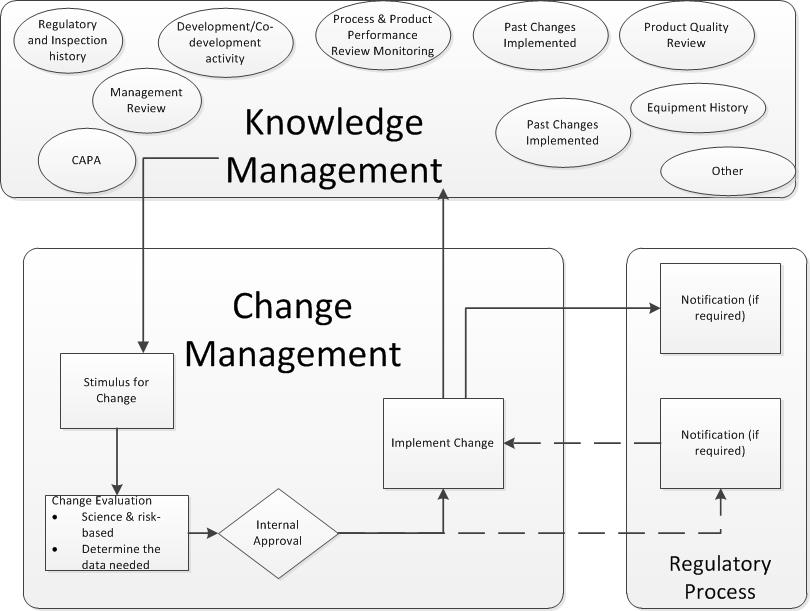
ICHQ12 “Technical and Regulatory Considerations for Pharmaceutical Product Lifecycle Management” (in draft) expands on knowledge management and provides more examples of its use. The below illustration is an adaptation of one found in the draft Q12.

knowledge and change

There are many ways to tap into knowledge management in change management. The subject matter experts are critical, as is checklists and risk ranking and filtering tools. Knowledge should drive the development of an effectiveness review.

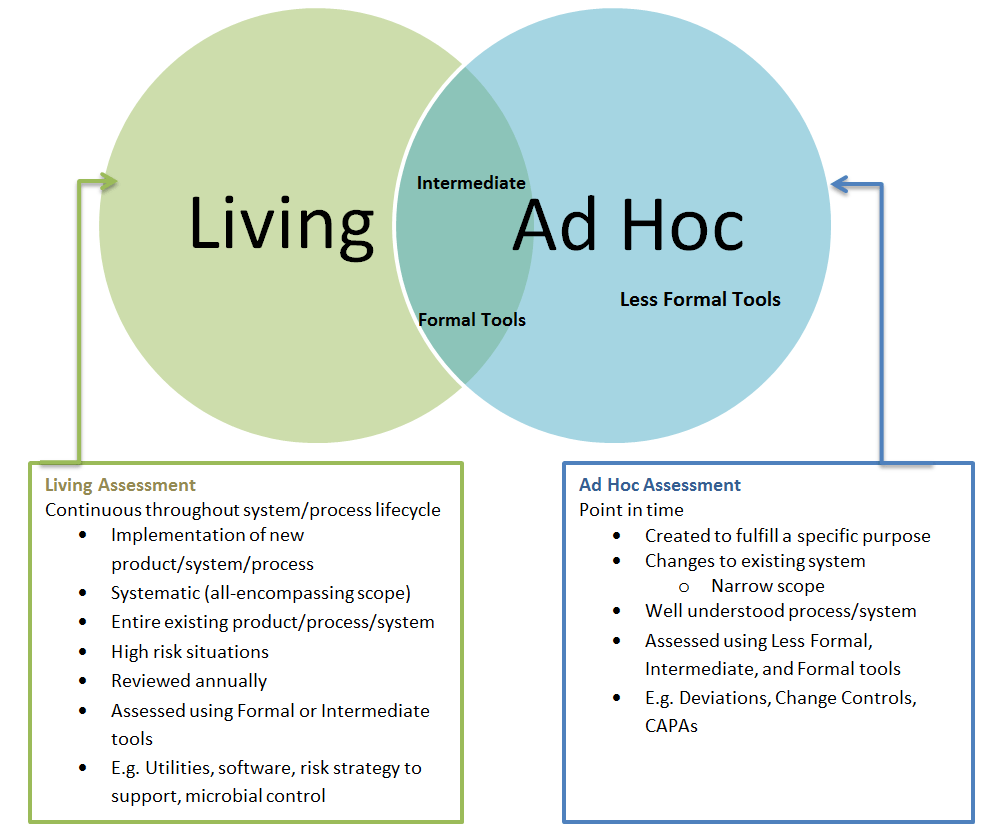
One of my favorite is the Living Risk Assessment approach. Living risk assessments are a holistic view of a system, product, or process in an effort to prevent risk realization. They are updated throughout the product /system lifecycle to continuously assess risks that may arise or change.

In the context of change management, the living risk assessment is both an input and an output. A rigorous, maintained, living risk assessment allows us to prospectively mitigate potential risks as part of our change management program.

Living Risk Assessments have a schedule, a review period (for example, once a year) to evaluate how risk has changed, drawing from all the sources of knowledge. It is also important to have a way to trigger adhoc reviews (for example, major process changes or critical deviations).

living risk assessments

In my ASQ World Conference workshop I will be going into more detail on knowledge management, risk management and the pharmaceutical quality system. I’ll also be discussing what non-Pharma companies can learn from the PQS.

Change Control SIPOC

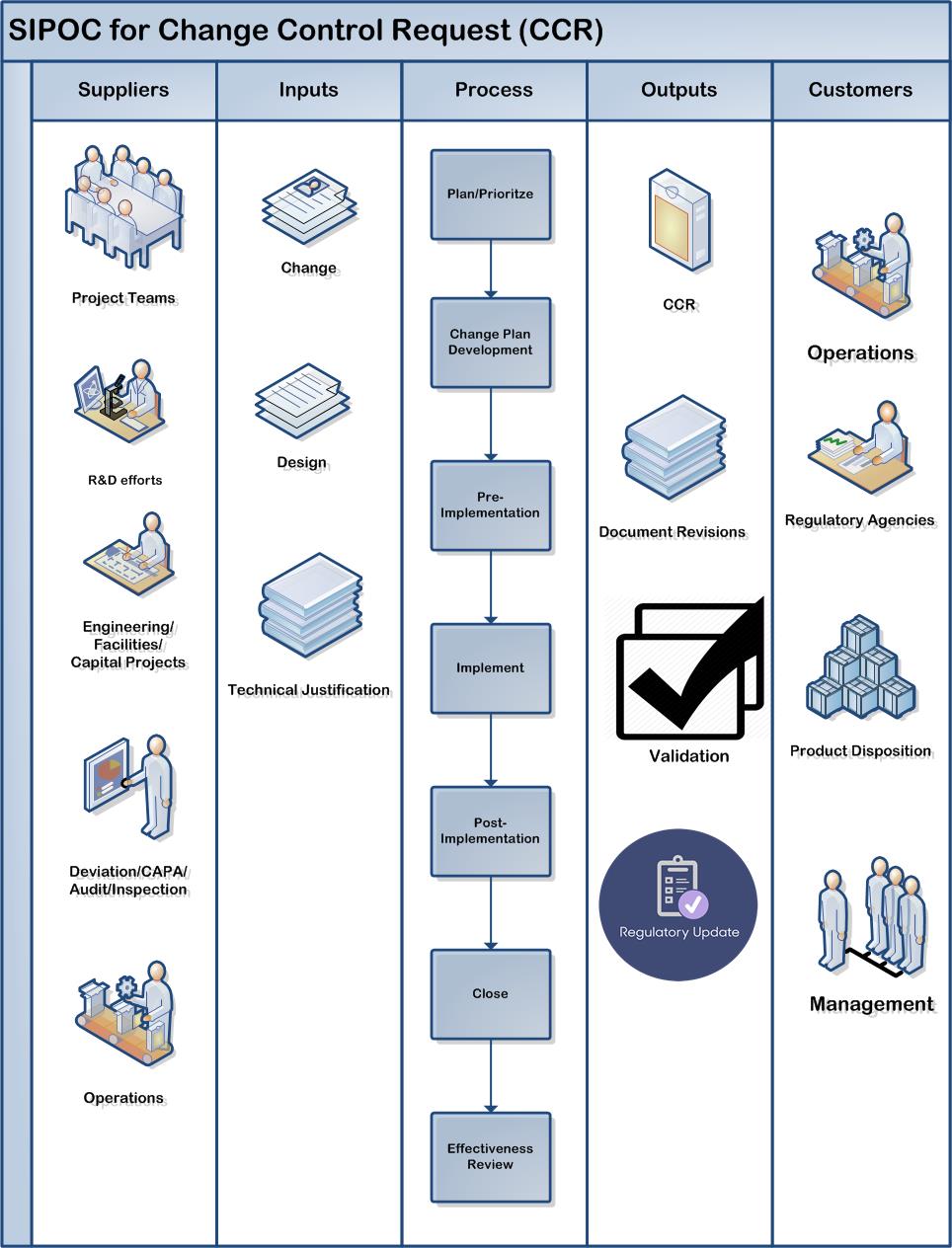
Always start with a SIPOC is a mantra many of us steeped in Six Sigma have heard a lot. There is some truth to having a good visual diagram that helps define a system or project. As this blog will be discussing change management and change control quite a bit, here is a SIPOC that governs change control.

SIPOC for CCR

This SIPOC represents change control from the perspective of a pharmaceutical manufacturing plant. But this will apply to many manufacturing industries, though the focus on regulatory might shift.


Change Management and Change Control

Change Is

Change Management and Change Control is a topic that I cannot discuss enough. Which is a good thing because I am presenting on it at the 2018 ASQ World Conference.

Below is the proposal I submitted.

Session Type: Workshop

Title: Change Mgmt & Control-Lessons from Consent Decree

Presentation Description:

Drawing on the experiences of a company under a FDA consent decree, this workshop will consider change management and change control, and how they are improved upon by a grounding in knowledge management and risk management. The lessons learned and applied are relevant not only to the pharmaceutical industry, but to other FDA industries (medical devices, cosmetics, food, etc.), and to other heavily regulated industries (energy, mining, financial services and beyond). It is easy for a company in these situations to focus on change control and forget the wider scope of change management. During this workshop we will share improvements made in our processes as a result of being under the consent decree, as well as several templates, and tools to enable good change management, and change control activities.

Presentation Summary:

The Pharmaceutical Quality System described by the International Conference of Harmonization (ICH) is a holistic approach which facilitates the consistent development and production of high quality pharmaceutical products. It aims to support innovation and continual improvement of products, processes, and methodologies using knowledge management and quality risk management. Providing a lifecycle approach to pharmaceuticals, change management is a key element to this approach.

The Pharmaceutical Industry is one of the most regulated industries. In the US, the Food and Drug Administration (FDA) often uses the consent decree as the ultimate enforcement tool for those who break the rules. A company under consent decree needs to prove, via third party, that it has achieved and can sustain regulatory compliance. Companies under a consent decree must break down and build up their entire quality system.

After this workshop attendees will be able to:

  • Evaluate lessons learned from a consent decree and building a robust pharmaceutical quality system for your use.
  • Explain how the pharmaceutical experience can deepen your understanding of ISO 9001:2015, especially risk based thinking
  • Identify how change management fits into a culture of quality
  • Understand how the change management system increases compliance
  • Use a few simple but effective tools for change management.

The ICH quality approach developed from ISO 9001:2008 but in many ways preceded the risk based thinking pivotal to IS 9001:2015. Utilizing a matrix of similarities and differences between traditional GMPs, the ICHs and ISO 9001:2015, we will explore several lessons learned from consent decree activities, and demonstrate principles of change management.

This workshop will explore change management from the three lenses of science, regulation and risk, with a focus on knowledge management and risk management as enablers of successful change management. Several examples will be shared to demonstrate the fundamental connections between these systems.

The basis of this workshop will be change management as a fundamental part of a culture of quality. We will share best practices based on lessons learned from the consent decree around the impact of cumulative changes and large-scale versus incremental change.

Compliance for change management necessitates clear accountabilities, prioritization of changes, and the role of the quality unit – including the importance of a change champion or steward. This workshop will explore the relationship between change control, which often refers to the execution step of an individual change, and change management, which is a more systematic, holistic approach to the review and management of a portfolio of changes and the change process.

Managing change on the personnel and organization will be evaluated, especially as it interfaces with knowledge management. Several tools will be shared for determining and mitigating risk and impact, including a training matrix.

By the end of the workshop we will have shared several tools, including a matrix to evaluate cumulative changes, a risk-based change evaluation tool, and a scope setting method that incorporates an evaluation of knowledge and risk.

Focus Area: Risk and Change

Presentation level: Intermediate

Industry Area: Food/Drug/Cosmetic, but all manufacturing can benefit

Presentation Best Matches this Technical Area: Quality Management Principles

Who should attend: Senior/Executive Officer, Director, Manager, Supervisor, and all others involved in change management

Presenter information: Jeremiah Genest, CMQ/OE, CPGP. Sanofi – Genzyme, Quality Systems Manager

Biography: Jeremiah Genest has 20 years quality systems experience in the energy and pharmaceutical industry, with over a decade’s experience implementing and running quality systems in the biotech field. For the last four years, he has managed change management at Sanofi’s Allston Landing Facility, which is under an FDA Consent Decree. He is a Certified Manager of Quality/Operation Excellence and Pharmaceutical GMP Professional.


 

harvesterlink-3118-205

Quality Book Shelf – Kafka

In a past job interview I was asked two questions that stay with me, “What degree do you think every quality professional should have” and “Which of your favorite authors reflects on you as a quality manager.”

For the first, I said philosophy, a rather tongue in cheek answer that I hope will become clear as this blog develops.

For the second, I answered LeCarre and Kafka. I’d like to expand on Kafka, as it has to do a lot with the name of this blog.

Kafka is, probably, one of the 20th century’s greatest writers on organizational life. His writing is often a dystopian counter to much of the cheerleaders, even today, of the mythology of organizations. In this way he serves as a needed balance to all the cheerleaders of holarchy, of agile and lean organizations and everything else that dominates modern business since Weber. Through exploring these dark contemplations I strongly believe we grow in our understanding and that understanding can make us more humble.

Kafka deals with issues that lie at the heart of the challenges that await the modern organization, and of quality as a profession: rationality, bureaucracy, power, and how we make sense of the work and the value of the work we do.

As this blog is going to be about applying rationality to the work we do, grappling with bureaucracy and power, and how quality practices bring sense to the work we do, Kafka is an appropriate inspiration.