Risk Assessment for Environmental Monitoring

Maybe you’ve been there too, you need to take a risk-based approach to determine environmental monitoring, so you go to a HAACP or FMEA and realize those tools just do not work to provide information to determine how to distribute monitoring to best verify that processes are operating under control.

What you want to do is build a heat map showing the relative probability of contamination in a defined area or room| covering six areas:

  1. Amenability of equipment and surfaces to cleaning and sanitization
  2. Personnel presence and flow
  3. Material flow
  4. Proximity to open product or exposed direct product-contact material
  5. Interventions/operations by personnel and their complexity
  6. Frequency of interventions/process operations.

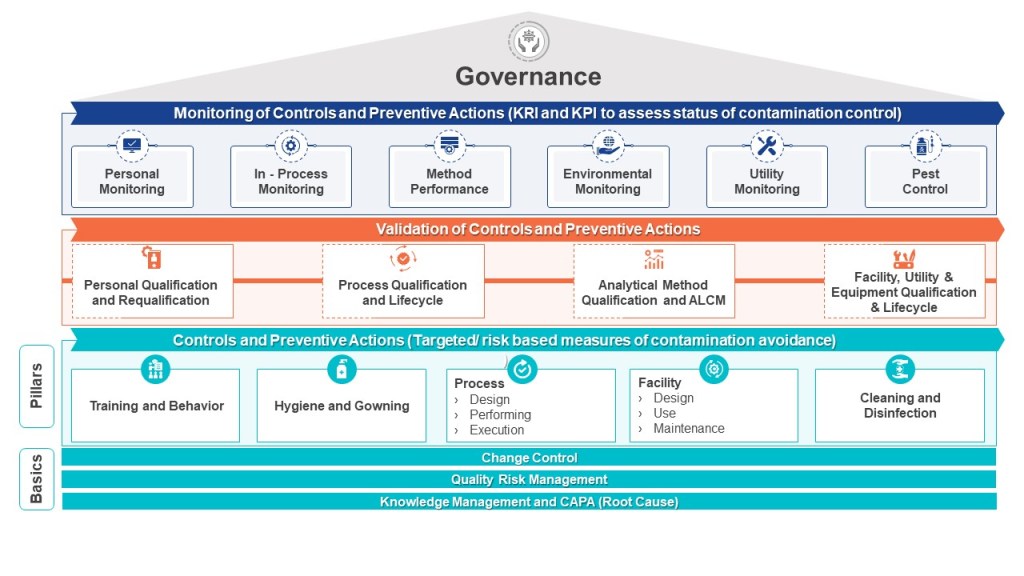
This approach builds off of the design activities and is part of a set of living risk assessments that inform the environmental monitoring part of your contamination control strategy.

Hope to see you in Bethesda to discuss more!
Sackler family sweetens deal to $6billion

I will not be happy with this story until every member of the Sackler family who was involved in the decision-making at Perdue is in jail and the family has lost every dollar they made. But I am heartened to see the failure of their failed bankruptcy ploy leading to the addition of another 1.5 billion in settlement.

Sackler family members to contribute up to $6 billion in latest agreement to resolve opioid claims

For the regulatory state to function there needs to be teeth, and quite frankly we do not see the teeth nearly enough.

Guidances in Administrative Law

Edward Rubin over on the Administrative Law JOTWELL, in the post “Uncovering the Hidden World of Administrative Guidance” exposed me to the 2019 article by Nicholas R. Parrillo “Federal Agency Guidance and the Power to Bind: An Empirical Study of Agencies and Industries” which I just find fascinating.

Guidances are an interesting part of our job. As a best practice, they show one way to get to the desired end result, but there can be other ways but the presence of guidance can obscure those possibilities. Often times if an agency goes to the level of detail to show you what good looks like you’d be foolish not to try to meet them there. Other times guidance can be a real head scratcher.

Good article, and of interest to the non-lawyers like myself who have to live within the boundaries.

The Program Level in the Document Hierarchy

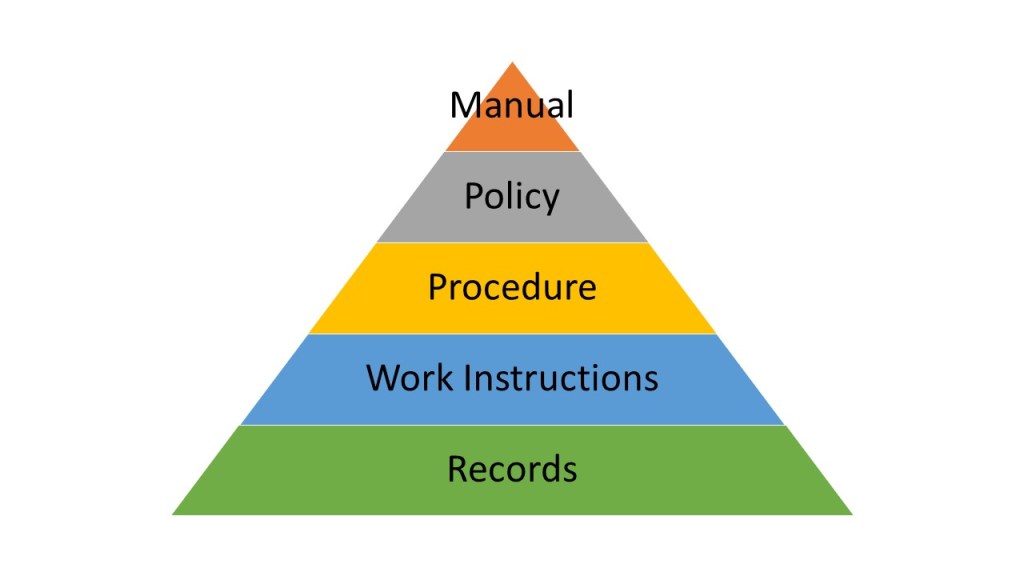
A fairly traditional document hierarchy, in line with ISO 9001 and other standards looks like this:

Document hierarchy

This process tends to support best an approach where there is a policy that states requirements to do X, a procedure that gives the who, what, when of X, and work instructions that provide the how of X, which results in a lot of records providing X was done.

But life is complicated, and there are sets of activities that combine the Xs in a wide variety, and in complicated environments there may be multiple ways to bundle the Xs.

This is why I add a layer between policy and procedure, called the program, which is a mapping requirement that shows the various ways to interpret the requirements to specific needs.

Document hierarchy with Programs

The program document level shouldn’t be a stranger to those in the GMP world, ICH Q11 control strategy and the Annex 1 contamination control strategy are two good examples. What this document does is tie together processes and demonstrates the design that went into it.

The beauty of this document is that it helps translate down from the requirements (internal and external) to the process and procedures (including technology), how they interact, and how they are supported by technical assessments, risk management, and other control activities. Think of it as the design document and the connective tissue.

Similac Recall is a Systematic Failure in our Food/Drug Safety

There has been a lot of press lately for the Abbott Nutrition recall of infant formula. Fundamentally this is a colossal failure of our regulatory program, another failure in a long string of failures, and confirmation that the time is now for radical changes in the agency.

Consumer Reports, in the article “How the FDA Bungled the Powdered Infant Formula Recall” does a good job covering the important points, so please read that article.

The optimist in me hopes that this calamity will drive needed change, as has been the unfortunate history of regulatory change in this country. I’m just not sure I hold enough confidence in Congress to get the job done.