Section 4 of Draft Annex 11: Quality Risk Management—The Scientific Foundation That Transforms Validation

If there is one section that serves as the philosophical and operational backbone for everything else in the new regulation, it’s Section 4: Risk Management. This section embodies current regulatory thinking on how risk management, in light of the recent ICH Q9 (R1) is the scientific methodology that transforms how we think about, design, validate, and operate s in GMP environments.

Section 4 represents the regulatory codification of what quality professionals have long advocated: that every decision about computerized systems, from initial selection through operational oversight to eventual decommissioning, must be grounded in rigorous, documented, and scientifically defensible risk assessment. But more than that, it establishes quality risk management as the living nervous system of digital compliance, continuously sensing, evaluating, and responding to threats and opportunities throughout the system lifecycle.

For organizations that have treated risk management as a checkbox exercise or a justification for doing less validation, Section 4 delivers a harsh wake-up call. The new requirements don’t just elevate risk management to regulatory mandate—they transform it into the primary lens through which all computerized system activities must be viewed, planned, executed, and continuously improved.

The Philosophical Revolution: From Optional Framework to Mandatory Foundation

The transformation between the current Annex 11’s brief mention of risk management and Section 4’s comprehensive requirements represents more than regulatory updating—it reflects a fundamental shift in how regulators view the relationship between risk assessment and system control. Where the 2011 version offered generic guidance about applying risk management “throughout the lifecycle,” Section 4 establishes specific, measurable, and auditable requirements that make risk management the definitive basis for all computerized system decisions.

Section 4.1 opens with an unambiguous statement that positions quality risk management as the foundation of system lifecycle management: “Quality Risk Management (QRM) should be applied throughout the lifecycle of a computerised system considering any possible impact on product quality, patient safety or data integrity.” This language moves beyond the permissive “should consider” of the old regulation to establish QRM as the mandatory framework through which all system activities must be filtered.

The explicit connection to ICH Q9(R1) in Section 4.2 represents a crucial evolution. By requiring that “risks associated with the use of computerised systems in GMP activities should be identified and analysed according to an established procedure” and specifically referencing “examples of risk management methods and tools can be found in ICH Q9 (R1),” the regulation transforms ICH Q9 from guidance into regulatory requirement. Organizations can no longer treat ICH Q9 principles as aspirational best practices—they become the enforceable standard for pharmaceutical risk management.

This integration creates powerful synergies between pharmaceutical quality system requirements and computerized system validation. Risk assessments conducted under Section 4 must align with broader ICH Q9 principles while addressing the specific challenges of digital systems, cloud services, and automated processes. The result is a comprehensive risk management framework that bridges traditional pharmaceutical operations with modern digital infrastructure.

The requirement in Section 4.3 that “validation strategy and effort should be determined based on the intended use of the system and potential risks to product quality, patient safety and data integrity” establishes risk assessment as the definitive driver of validation scope and approach. This eliminates the historical practice of using standardized validation templates regardless of system characteristics or applying uniform validation approaches across diverse system types.

Under Section 4, every validation decision—from the depth of testing required to the frequency of periodic reviews—must be traceable to specific risk assessments that consider the unique characteristics of each system and its role in GMP operations. This approach rewards organizations that invest in comprehensive risk assessment while penalizing those that rely on generic, one-size-fits-all validation approaches.
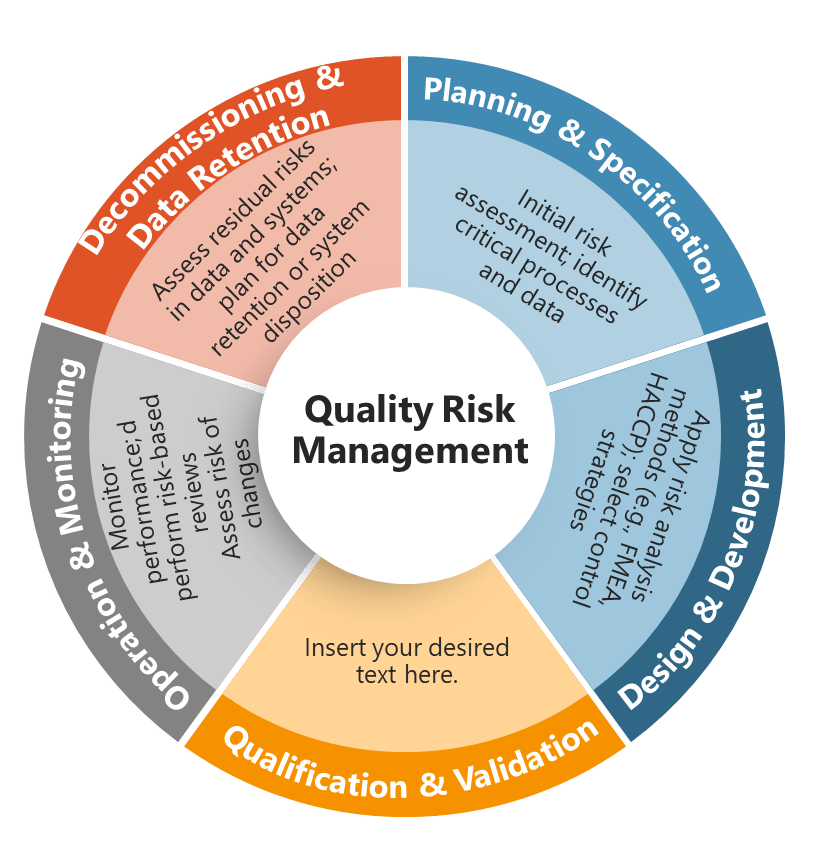
Risk-Based System Design: Architecture Driven by Assessment

Perhaps the most transformative aspect of Section 4 is found in Section 4.4, which requires that “risks associated with the use of computerised systems in GMP activities should be mitigated and brought down to an acceptable level, if possible, by modifying processes or system design.” This requirement positions risk assessment as a primary driver of system architecture rather than simply a validation planning tool.

The language “modifying processes or system design” establishes a hierarchy of risk control that prioritizes prevention over detection. Rather than accepting inherent system risks and compensating through enhanced testing or operational controls, Section 4 requires organizations to redesign systems and processes to eliminate or minimize risks at their source. This approach aligns with fundamental safety engineering principles while ensuring that risk mitigation is built into system architecture rather than layered on top.

The requirement that “the outcome of the risk management process should result in the choice of an appropriate computerised system architecture and functionality” makes risk assessment the primary criterion for system selection and configuration. Organizations can no longer choose systems based purely on cost, vendor relationships, or technical preferences—they must demonstrate that system architecture aligns with risk assessment outcomes and provides appropriate risk mitigation capabilities.

This approach particularly impacts cloud system implementations, SaaS platform selections, and integrated system architectures where risk assessment must consider not only individual system capabilities but also the risk implications of system interactions, data flows, and shared infrastructure. Organizations must demonstrate that their chosen architecture provides adequate risk control across the entire integrated environment.

The emphasis on system design modification as the preferred risk mitigation approach will drive significant changes in vendor selection criteria and system specification processes. Vendors that can demonstrate built-in risk controls and flexible architecture will gain competitive advantages over those that rely on customers to implement risk mitigation through operational procedures or additional validation activities.

Data Integrity Risk Assessment: Scientific Rigor Applied to Information Management

Section 4.5 introduces one of the most sophisticated requirements in the entire draft regulation: “Quality risk management principles should be used to assess the criticality of data to product quality, patient safety and data integrity, the vulnerability of data to deliberate or indeliberate alteration, deletion or loss, and the likelihood of detection of such actions.”

This requirement transforms data integrity from a compliance concept into a systematic risk management discipline. Organizations must assess not only what data is critical but also how vulnerable that data is to compromise and how likely they are to detect integrity failures. This three-dimensional risk assessment approach—criticality, vulnerability, and detectability—provides a scientific framework for prioritizing data protection efforts and designing appropriate controls.

The distinction between “deliberate or indeliberate” data compromise acknowledges that modern data integrity threats encompass both malicious attacks and innocent errors. Risk assessments must consider both categories and design controls that address the full spectrum of potential data integrity failures. This approach requires organizations to move beyond traditional access control and audit trail requirements to consider the full range of technical, procedural, and human factors that could compromise data integrity.

The requirement to assess “likelihood of detection” introduces a crucial element often missing from traditional data integrity approaches. Organizations must evaluate not only how to prevent data integrity failures but also how quickly and reliably they can detect failures that occur despite preventive controls. This assessment drives requirements for monitoring systems, audit trail analysis capabilities, and incident detection procedures that can identify data integrity compromises before they impact product quality or patient safety.

This risk-based approach to data integrity creates direct connections between Section 4 and other draft Annex 11 requirements, particularly Section 10 (Handling of Data), Section 11 (Identity and Access Management), and Section 12 (Audit Trails). Risk assessments conducted under Section 4 drive the specific requirements for data input verification, access controls, and audit trail monitoring implemented through other sections.

Lifecycle Risk Management: Dynamic Assessment in Digital Environments

The lifecycle approach required by Section 4 acknowledges that computerized systems exist in dynamic environments where risks evolve continuously due to technology changes, process modifications, security threats, and operational experience. Unlike traditional validation approaches that treat risk assessment as a one-time activity during system implementation, Section 4 requires ongoing risk evaluation and response throughout the system lifecycle.

This dynamic approach particularly impacts cloud-based systems and SaaS platforms where underlying infrastructure, security controls, and functional capabilities change regularly without direct customer involvement. Organizations must establish procedures for evaluating the risk implications of vendor-initiated changes and updating their risk assessments and control strategies accordingly.

The lifecycle risk management approach also requires integration with change control processes, periodic review activities, and incident management procedures. Every significant system change must trigger risk reassessment to ensure that new risks are identified and appropriate controls are implemented. This creates a feedback loop where operational experience informs risk assessment updates, which in turn drive control system improvements and validation strategy modifications.

Organizations implementing Section 4 requirements must develop capabilities for continuous risk monitoring that can detect emerging threats, changing system characteristics, and evolving operational patterns that might impact risk assessments. This requires investment in risk management tools, monitoring systems, and analytical capabilities that extend beyond traditional validation and quality assurance functions.

Integration with Modern Risk Management Methodologies

The explicit reference to ICH Q9(R1) in Section 4.2 creates direct alignment between computerized system risk management and the broader pharmaceutical quality risk management framework. This integration ensures that computerized system risk assessments contribute to overall product and process risk understanding while benefiting from the sophisticated risk management methodologies developed for pharmaceutical operations.

ICH Q9(R1)’s emphasis on managing and minimizing subjectivity in risk assessment becomes particularly important for computerized system applications where technical complexity can obscure risk evaluation. Organizations must implement risk assessment procedures that rely on objective data, established methodologies, and cross-functional expertise rather than individual opinions or vendor assertions.

The ICH Q9(R1) toolkit—including Failure Mode and Effects Analysis (FMEA), Hazard Analysis and Critical Control Points (HACCP), and Fault Tree Analysis (FTA)—provides proven methodologies for systematic risk identification and assessment that can be applied to computerized system environments. Section 4’s reference to these tools establishes them as acceptable approaches for meeting regulatory requirements while providing flexibility for organizations to choose methodologies appropriate to their specific circumstances.

The integration with ICH Q9(R1) also emphasizes the importance of risk communication throughout the organization and with external stakeholders including suppliers, regulators, and business partners. Risk assessment results must be communicated effectively to drive appropriate decision-making at all organizational levels and ensure that risk mitigation strategies are understood and implemented consistently.

Operational Implementation: Transforming Risk Assessment from Theory to Practice

Implementing Section 4 requirements effectively requires organizations to develop sophisticated risk management capabilities that extend far beyond traditional validation and quality assurance functions. The requirement for “established procedures” means that risk assessment cannot be ad hoc or inconsistent—organizations must develop repeatable, documented methodologies that produce reliable and auditable results.

The procedures must address risk identification methods that can systematically evaluate the full range of potential threats to computerized systems including technical failures, security breaches, data integrity compromises, supplier issues, and operational errors. Risk identification must consider both current system states and future scenarios including planned changes, emerging threats, and evolving operational requirements.

Risk analysis procedures must provide quantitative or semi-quantitative methods for evaluating risk likelihood and impact across the three critical dimensions specified in Section 4.1: product quality, patient safety, and data integrity. This analysis must consider the interconnected nature of modern computerized systems where risks in one system or component can cascade through integrated environments to impact multiple processes and outcomes.

Risk evaluation procedures must establish criteria for determining acceptable risk levels and identifying risks that require mitigation. These criteria must align with organizational risk tolerance, regulatory expectations, and business objectives while providing clear guidance for risk-based decision making throughout the system lifecycle.

Risk mitigation procedures must prioritize design and process modifications over operational controls while ensuring that all risk mitigation strategies are evaluated for effectiveness and maintained throughout the system lifecycle. Organizations must develop capabilities for implementing system architecture changes, process redesign, and operational control enhancements based on risk assessment outcomes.

Technology and Tool Requirements for Effective Risk Management

Section 4’s emphasis on systematic, documented, and traceable risk management creates significant requirements for technology tools and platforms that can support sophisticated risk assessment and management processes. Organizations must invest in risk management systems that can capture, analyze, and track risks throughout complex system lifecycles while maintaining traceability to validation activities, change control processes, and operational decisions.

Risk assessment tools must support the multi-dimensional analysis required by Section 4, including product quality impacts, patient safety implications, and data integrity vulnerabilities. These tools must accommodate the dynamic nature of computerized system environments where risks evolve continuously due to technology changes, process modifications, and operational experience.

Integration with existing quality management systems, validation platforms, and operational monitoring tools becomes essential for maintaining consistency between risk assessments and other quality activities. Organizations must ensure that risk assessment results drive validation planning, change control decisions, and operational monitoring strategies while receiving feedback from these activities to update and improve risk assessments.

Documentation and traceability requirements create needs for sophisticated document management and workflow systems that can maintain relationships between risk assessments, system specifications, validation protocols, and operational procedures. Organizations must demonstrate clear traceability from risk identification through mitigation implementation and effectiveness verification.

Regulatory Expectations and Inspection Implications

Section 4’s comprehensive risk management requirements fundamentally change regulatory inspection dynamics by establishing risk assessment as the foundation for evaluating all computerized system compliance activities. Inspectors will expect to see documented, systematic, and scientifically defensible risk assessments that drive all system-related decisions from initial selection through ongoing operation.

The integration with ICH Q9(R1) provides inspectors with established criteria for evaluating risk management effectiveness including assessment methodology adequacy, stakeholder involvement appropriateness, and decision-making transparency. Organizations must demonstrate that their risk management processes meet ICH Q9(R1) standards while addressing the specific challenges of computerized system environments.

Risk-based validation approaches will receive increased scrutiny as inspectors evaluate whether validation scope and depth align appropriately with documented risk assessments. Organizations that cannot demonstrate clear traceability between risk assessments and validation activities will face significant compliance challenges regardless of validation execution quality.

The emphasis on system design and process modification as preferred risk mitigation strategies means that inspectors will evaluate whether organizations have adequately considered architectural and procedural alternatives to operational controls. Simply implementing extensive operational procedures to manage inherent system risks may no longer be considered adequate risk mitigation.

Ongoing risk management throughout the system lifecycle will become a key inspection focus as regulators evaluate whether organizations maintain current risk assessments and adjust control strategies based on operational experience, technology changes, and emerging threats. Static risk assessments that remain unchanged throughout system operation will be viewed as inadequate regardless of initial quality.

Strategic Implications for Pharmaceutical Operations

Section 4’s requirements represent a strategic inflection point for pharmaceutical organizations as they transition from compliance-driven computerized system approaches to risk-based digital strategies. Organizations that excel at implementing Section 4 requirements will gain competitive advantages through more effective system selection, optimized validation strategies, and superior operational risk management.

The emphasis on risk-driven system architecture creates opportunities for organizations to differentiate themselves through superior system design and integration strategies. Organizations that can demonstrate sophisticated risk assessment capabilities and implement appropriate system architectures will achieve better operational outcomes while reducing compliance costs and regulatory risks.

Risk-based validation approaches enabled by Section 4 provide opportunities for more efficient resource allocation and faster system implementation timelines. Organizations that invest in comprehensive risk assessment capabilities can focus validation efforts on areas of highest risk while reducing unnecessary validation activities for lower-risk system components and functions.

The integration with ICH Q9(R1) creates opportunities for pharmaceutical organizations to leverage their existing quality risk management capabilities for computerized system applications while enhancing overall organizational risk management maturity. Organizations can achieve synergies between product quality risk management and system risk management that improve both operational effectiveness and regulatory compliance.

Future Evolution and Continuous Improvement

Section 4’s lifecycle approach to risk management positions organizations for continuous improvement in risk assessment and mitigation capabilities as they gain operational experience and encounter new challenges. The requirement for ongoing risk evaluation creates feedback loops that enable organizations to refine their risk management approaches based on real-world performance and emerging best practices.

The dynamic nature of computerized system environments means that risk management capabilities must evolve continuously to address new technologies, changing threats, and evolving operational requirements. Organizations that establish robust risk management foundations under Section 4 will be better positioned to adapt to future regulatory changes and technology developments.

The integration with broader pharmaceutical quality systems creates opportunities for organizations to develop comprehensive risk management capabilities that span traditional manufacturing operations and modern digital infrastructure. This integration enables more sophisticated risk assessment and mitigation strategies that consider the full range of factors affecting product quality, patient safety, and data integrity.

Organizations that embrace Section 4’s requirements as strategic capabilities rather than compliance obligations will build sustainable competitive advantages through superior risk management that enables more effective system selection, optimized operational strategies, and enhanced regulatory relationships.

The Foundation for Digital Transformation

Section 4 ultimately serves as the scientific foundation for pharmaceutical digital transformation by providing the risk management framework necessary to evaluate, implement, and operate sophisticated computerized systems with appropriate confidence and control. The requirement for systematic, documented, and traceable risk assessment provides the methodology necessary to navigate the complex risk landscapes of modern pharmaceutical operations.

The emphasis on risk-driven system design creates the foundation for implementing advanced technologies including artificial intelligence, machine learning, and automated process control with appropriate risk understanding and mitigation. Organizations that master Section 4’s requirements will be positioned to leverage these technologies effectively while maintaining regulatory compliance and operational control.

The lifecycle approach to risk management provides the framework necessary to manage the continuous evolution of computerized systems in dynamic business and regulatory environments. Organizations that implement Section 4 requirements effectively will build the capabilities necessary to adapt continuously to changing circumstances while maintaining consistent risk management standards.

Section 4 represents more than regulatory compliance—it establishes the scientific methodology that enables pharmaceutical organizations to harness the full potential of digital technologies while maintaining the rigorous risk management standards essential for protecting product quality, patient safety, and data integrity. Organizations that embrace this transformation will lead the industry’s evolution toward more sophisticated, efficient, and effective pharmaceutical operations.

Requirement AreaDraft Annex 11 Section 4 (2025)Current Annex 11 (2011)ICH Q9(R1) 2023Implementation Impact
Lifecycle ApplicationQRM applied throughout entire lifecycle considering product quality, patient safety, data integrityRisk management throughout lifecycle considering patient safety, data integrity, product qualityQuality risk management throughout product lifecycleRequires continuous risk assessment processes rather than one-time validation activities
Risk Assessment FocusRisks identified and analyzed per established procedure with ICH Q9(R1) methodsRisk assessment should consider patient safety, data integrity, product qualitySystematic risk identification, analysis, and evaluationMandates systematic procedures using proven methodologies rather than ad hoc approaches
Validation StrategyValidation strategy and effort determined based on intended use and potential risksValidation extent based on justified and documented risk assessmentRisk-based approach to validation and control strategiesLinks validation scope directly to risk assessment outcomes, potentially reducing or increasing validation burden
Risk MitigationRisks mitigated to acceptable level through process/system design modificationsRisk mitigation not explicitly detailedRisk control through reduction and acceptance strategiesPrioritizes system design changes over operational controls, potentially requiring architecture modifications
Data Integrity RiskQRM principles assess data criticality, vulnerability, detection likelihoodData integrity risk mentioned but not detailedData integrity risks as part of overall quality risk assessmentRequires sophisticated three-dimensional risk assessment for all data management activities
Documentation RequirementsDocumented risk assessments required for all computerized systemsRisk assessment should be justified and documentedDocumented, transparent, and reproducible risk management processesElevates documentation standards and requires traceability throughout system lifecycle
Integration with QRMFully integrated with ICH Q9(R1) quality risk management principlesGeneral risk management principlesCore principle of pharmaceutical quality systemCreates mandatory alignment between system and product risk management activities
Ongoing Risk ReviewRisk review required for changes and incidents throughout lifecycleRisk review not explicitly requiredRegular risk review based on new knowledge and experienceEstablishes continuous risk monitoring as operational requirement rather than periodic activity

The Evolution of ALCOA: From Inspector’s Tool to Global Standard e

In the annals of pharmaceutical regulation, few acronyms have generated as much discussion, confusion, and controversy as ALCOA. What began as a simple mnemonic device for FDA inspectors in the 1990s has evolved into a complex framework that has sparked heated debates across regulatory agencies, industry associations, and boardrooms worldwide. The story of ALCOA’s evolution from a five-letter inspector’s tool to the comprehensive ALCOA++ framework represents one of the most significant regulatory harmonization challenges of the modern pharmaceutical era.

With the publication of Draft EU GMP Chapter 4 in 2025, this three-decade saga of definitional disputes, regulatory inconsistencies, and industry resistance finally reaches its definitive conclusion. For the first time in regulatory history, a major jurisdiction has provided comprehensive, legally binding definitions for all ten ALCOA++ principles, effectively ending years of interpretive debates and establishing the global gold standard for pharmaceutical data integrity.

The Genesis: Stan Woollen’s Simple Solution

The ALCOA story begins in the early 1990s with Stan W. Woollen, an FDA inspector working in the Office of Enforcement. Faced with the challenge of training fellow GLP inspectors on data quality assessment, Woollen needed a memorable framework that could be easily applied during inspections. Drawing inspiration from the ubiquitous aluminum foil manufacturer, he created the ALCOA acronym: Attributable, Legible, Contemporaneous, Original, and Accurate.

“The ALCOA acronym was first coined by me while serving in FDA’s Office of Enforcement back in the early 1990’s,” Woollen later wrote in a 2010 retrospective. “Exactly when I first used the acronym I don’t recall, but it was a simple tool to help inspectors evaluate data quality”.

Woollen’s original intent was modest—create a practical checklist for GLP inspections. He explicitly noted that “the individual elements of ALCOA were already present in existing Good Manufacturing Practice (GMP) and GLP regulations. What he did was organize them into an easily memorized acronym”. This simple organizational tool would eventually become the foundation for a global regulatory framework.

The First Expansion: EMA’s ALCOA+ Revolution

The pharmaceutical landscape of 2010 bore little resemblance to Woollen’s 1990s GLP world. Electronic systems had proliferated, global supply chains had emerged, and data integrity violations were making headlines. Recognizing that the original five ALCOA principles, while foundational, were insufficient for modern pharmaceutical operations, the European Medicines Agency took a bold step.

In their 2010 “Reflection paper on expectations for electronic source data and data transcribed to electronic data collection tools in clinical trials,” the EMA introduced four additional principles: Complete, Consistent, Enduring, and Available—creating ALCOA+. This expansion represented the first major regulatory enhancement to Woollen’s original framework and immediately sparked industry controversy.

The Industry Backlash

The pharmaceutical industry’s response to ALCOA+ was swift and largely negative. Trade associations argued that the original five principles were sufficient and that additional requirements represented regulatory overreach. “The industry argued that the original 5 were sufficient; regulators needed modern additions,” as contemporary accounts noted.

The resistance wasn’t merely philosophical—it was economic. Each new principle required system validations, process redesigns, and staff retraining. For companies operating legacy paper-based systems, the “Enduring” and “Available” requirements posed particular challenges, often necessitating expensive digitization projects.

The Fragmentation: Regulatory Babel

What followed ALCOA+’s introduction was a period of regulatory fragmentation that would plague the industry for over a decade. Different agencies adopted different interpretations, creating a compliance nightmare for multinational pharmaceutical companies.

FDA’s Conservative Approach

The FDA, despite being the birthplace of ALCOA, initially resisted the European additions. Their 2016 “Data Integrity and Compliance with CGMP Guidance for Industry” focused primarily on the original five ALCOA principles, with only implicit references to the additional requirements8. This created a transatlantic divide where companies faced different standards depending on their regulatory jurisdiction.

MHRA’s Independent Path

The UK’s MHRA further complicated matters by developing their own interpretations in their 2018 “GxP Data Integrity Guidance.” While generally supportive of ALCOA+, the MHRA included unique provisions such as their emphasis on “permanent and understandable” under “legible,” creating yet another variant.

WHO’s Evolving Position

The World Health Organization initially provided excellent guidance in their 2016 document, which included comprehensive ALCOA explanations in Appendix 1. However, their 2021 revision removed much of this detail.

PIC/S Harmonization Attempt

The Pharmaceutical Inspection Co-operation Scheme (PIC/S) attempted to bridge these differences with their 2021 “Guidance on Data Integrity,” which formally adopted ALCOA+ principles. However, even this harmonization effort failed to resolve fundamental definitional inconsistencies between agencies.

The Traceability Controversy: ALCOA++ Emerges

Just as the industry began adapting to ALCOA+, European regulators introduced another disruption. The EMA’s 2023 “Guideline on computerised systems and electronic data in clinical trials” added a tenth principle: Traceability, creating ALCOA++.

The Redundancy Debate

The addition of Traceability sparked the most intense regulatory debate in ALCOA’s history. Industry experts argued that traceability was already implicit in the original ALCOA principles. As R.D. McDowall noted in Spectroscopy Online, “Many would argue that the criterion ‘traceable’ is implicit in ALCOA and ALCOA+. However, the implication of the term is the problem; it is always better in data regulatory guidance to be explicit”.

The debate wasn’t merely academic. Companies that had invested millions in ALCOA+ compliance now faced another round of system upgrades and validations. The terminology confusion was equally problematic—some agencies used ALCOA++, others preferred ALCOA+ with implied traceability, and still others created their own variants like ALCOACCEA.

Industry Frustration

By 2023, industry frustration had reached a breaking point. Pharmaceutical executives complained about “multiple naming conventions (ALCOA+, ALCOA++, ALCOACCEA) created market confusion”. Quality professionals struggled to determine which version applied to their operations, leading to over-engineering in some cases and compliance gaps in others.

The regulatory inconsistencies created particular challenges for multinational companies. A facility manufacturing for both US and European markets might need to maintain different data integrity standards for the same product, depending on the intended market—an operationally complex and expensive proposition.

The Global Harmonization Failure

Despite multiple attempts at harmonization through ICH, PIC/S, and bilateral agreements, the regulatory community failed to establish a unified ALCOA standard. Each agency maintained sovereign authority over their interpretations, leading to:

Definitional Inconsistencies: The same ALCOA principle had different definitions across agencies. “Attributable” might emphasize individual identification in one jurisdiction while focusing on system traceability in another.

Technology-Specific Variations: Some agencies provided technology-neutral guidance while others specified different requirements for paper versus electronic systems.

Enforcement Variations: Inspection findings varied significantly between agencies, with some inspectors focusing on traditional ALCOA elements while others emphasized ALCOA+ additions.

Economic Inefficiencies: Companies faced redundant validation efforts, multiple audit preparations, and inconsistent training requirements across their global operations.

Draft EU Chapter 4: The Definitive Resolution

Against this backdrop of regulatory fragmentation and industry frustration, the European Commission’s Draft EU GMP Chapter 4 represents a watershed moment in pharmaceutical regulation. For the first time in ALCOA’s three-decade history, a major regulatory jurisdiction has provided comprehensive, legally binding definitions for all ten ALCOA++ principles.

Comprehensive Definitions

The draft chapter doesn’t merely list the ALCOA++ principles—it provides detailed, unambiguous definitions for each. The “Attributable” definition spans multiple sentences, covering not just identity but also timing, change control, and system attribution. The “Legible” definition explicitly addresses dynamic data and search capabilities, resolving years of debate about electronic system requirements.

Technology Integration

Unlike previous guidance documents that treated paper and electronic systems separately, Chapter 4 provides unified definitions that apply regardless of technology. The “Original” definition explicitly addresses both static (paper) and dynamic (electronic) data, stating that “Information that is originally captured in a dynamic state should remain available in that state”.

Risk-Based Framework

The draft integrates ALCOA++ principles into a broader risk-based data governance framework, addressing long-standing industry concerns about proportional implementation. The risk-based approach considers both data criticality and data risk, allowing companies to tailor their ALCOA++ implementations accordingly.

Hybrid System Recognition

Acknowledging the reality of modern pharmaceutical operations, the draft provides specific guidance for hybrid systems that combine paper and electronic elements—a practical consideration absent from earlier ALCOA guidance.

The End of Regulatory Babel

Draft Chapter 4’s comprehensive approach should effectively ends the definitional debates that have plagued ALCOA implementation for over a decade. By providing detailed, legally binding definitions, the EU has created the global gold standard that other agencies will likely adopt or reference.

Global Influence

The EU’s pharmaceutical market represents approximately 20% of global pharmaceutical sales, making compliance with EU standards essential for most major manufacturers. When EU GMP requirements are updated, they typically influence global practices due to the market’s size and regulatory sophistication.

Regulatory Convergence

Early indications suggest other agencies are already referencing the EU’s ALCOA++ definitions in their guidance development. The comprehensive nature of Chapter 4’s definitions makes them attractive references for agencies seeking to update their own data integrity requirements.

Industry Relief

For pharmaceutical companies, Chapter 4 represents regulatory clarity after years of uncertainty. Companies can now design global data integrity programs based on the EU’s comprehensive definitions, confident that they meet or exceed requirements in other jurisdictions.

Lessons from the ALCOA Evolution

The three-decade evolution of ALCOA offers several important lessons for pharmaceutical regulation:

  • Organic Growth vs. Planned Development: ALCOA’s organic evolution from inspector tool to global standard demonstrates how regulatory frameworks can outgrow their original intent. The lack of coordinated development led to inconsistencies that persisted for years.
  • Industry-Regulatory Dialogue Importance: The most successful ALCOA developments occurred when regulators engaged extensively with industry. The EU’s consultation process for Chapter 4, while not without controversy, produced a more practical and comprehensive framework than previous unilateral developments.
  • Technology Evolution Impact: Each ALCOA expansion reflected technological changes in pharmaceutical manufacturing. The original principles addressed paper-based GLP labs, ALCOA+ addressed electronic clinical systems, and ALCOA++ addresses modern integrated manufacturing environments.
  • Global Harmonization Challenges: Despite good intentions, regulatory harmonization proved extremely difficult to achieve through international cooperation. The EU’s unilateral approach may prove more successful in creating de facto global standards.

The Future of Data Integrity

With Draft Chapter 4’s comprehensive ALCOA++ framework, the regulatory community has finally established a mature, detailed standard for pharmaceutical data integrity. The decades of debate, expansion, and controversy have culminated in a framework that addresses the full spectrum of modern pharmaceutical operations.

Implementation Timeline

The EU’s implementation timeline provides the industry with adequate preparation time while establishing clear deadlines for compliance. Companies have approximately 18-24 months to align their systems with the new requirements, allowing for systematic implementation without rushed remediation efforts.

Global Adoption

Early indications suggest rapid global adoption of the EU’s ALCOA++ definitions. Regulatory agencies worldwide are likely to reference or adopt these definitions in their own guidance updates, finally achieving the harmonization that eluded the international community for decades.

Technology Integration

The framework’s technology-neutral approach while addressing specific technology requirements positions it well for future technological developments. Whether dealing with artificial intelligence, blockchain, or yet-to-be-developed technologies, the comprehensive definitions provide a stable foundation for ongoing innovation.

Conclusion: From Chaos to Clarity

The evolution of ALCOA from Stan Woollen’s simple inspector tool to the comprehensive ALCOA++ framework represents one of the most significant regulatory development sagas in pharmaceutical history. Three decades of expansion, controversy, and fragmentation have finally culminated in the European Union’s definitive resolution through Draft Chapter 4.

For an industry that has struggled with regulatory inconsistencies, definitional debates, and implementation uncertainties, Chapter 4 represents more than just updated guidance—it represents regulatory maturity. The comprehensive definitions, risk-based approach, and technology integration provide the clarity that has been absent from data integrity requirements for over a decade.

The pharmaceutical industry can now move forward with confidence, implementing data integrity programs based on clear, comprehensive, and legally binding definitions. The era of ALCOA debates is over; the era of ALCOA++ implementation has begun.

As we look back on this regulatory journey, Stan Woollen’s simple aluminum foil-inspired acronym has evolved into something he likely never envisioned—a comprehensive framework for ensuring data integrity across the global pharmaceutical industry. The transformation from inspector’s tool to global standard demonstrates how regulatory innovation, while often messy and contentious, ultimately serves the critical goal of ensuring pharmaceutical product quality and patient safety.

The Draft EU Chapter 4 doesn’t just end the ALCOA debates—it establishes the foundation for the next generation of pharmaceutical data integrity requirements. For an industry built on evidence and data, having clear, comprehensive standards for data integrity represents a fundamental advancement in regulatory science and pharmaceutical quality assurance.

References

Draft Annex 11 Section 6: System Requirements—When Regulatory Guidance Becomes Validation Foundation

The pharmaceutical industry has operated for over a decade under the comfortable assumption that GAMP 5’s risk-based guidance for system requirements represented industry best practice—helpful, comprehensive, but ultimately voluntary. Section 6 of the draft Annex 11 moves many things from recommended to mandated. What GAMP 5 suggested as scalable guidance, Annex 11 codifies as enforceable regulation. For computer system validation professionals, this isn’t just an update—it’s a fundamental shift from “how we should do it” to “how we must do it.”

This transformation carries profound implications that extend far beyond documentation requirements. Section 6 represents the regulatory codification of modern system engineering practices, forcing organizations to abandon the shortcuts, compromises, and “good enough” approaches that have persisted despite GAMP 5’s guidance. More significantly, it establishes system requirements as the immutable foundation of validation rather than merely an input to the process.

For CSV experts who have spent years evangelizing GAMP 5 principles within organizations that treated requirements as optional documentation, Section 6 provides regulatory teeth that will finally compel comprehensive implementation. However, it also raises the stakes dramatically—what was once best practice guidance subject to interpretation becomes regulatory obligation subject to inspection.

The Mandatory Transformation: From Guidance to Regulation

6.1: GMP Functionality—The End of Requirements Optionality

The opening requirement of Section 6 eliminates any ambiguity about system requirements documentation: “A regulated user should establish and approve a set of system requirements (e.g. a User Requirements Specification, URS), which accurately describe the functionality the regulated user has automated and is relying on when performing GMP activities.”

This language transforms what GAMP 5 positioned as risk-based guidance into regulatory mandate. The phrase “should establish and approve” in regulatory context carries the force of must—there is no longer discretion about whether to document system requirements. Every computerized system touching GMP activities requires formal requirements documentation, regardless of system complexity, development approach, or organizational preference.

The scope is deliberately comprehensive, explicitly covering “whether a system is developed in-house, is a commercial off-the-shelf product, or is provided as-a-service” and “independently on whether it is developed following a linear or iterative software development process.” This eliminates common industry escapes: cloud services can’t claim exemption because they’re external; agile development can’t avoid documentation because it’s iterative; COTS systems can’t rely solely on vendor documentation because they’re pre-built.

The requirement for accuracy in describing “functionality the regulated user has automated and is relying on” establishes a direct link between system capabilities and GMP dependencies. Organizations must explicitly identify and document what GMP activities depend on system functionality, creating traceability between business processes and technical capabilities that many current validation approaches lack.

Major Strike Against the Concept of “Indirect”

The new draft Annex 11 explicitly broadens the scope of requirements for user requirements specifications (URS) and validation to cover all computerized systems with GMP relevance—not just those with direct product or decision-making impact, but also indirect GMP systems. This means systems that play a supporting or enabling role in GMP activities (such as underlying IT infrastructure, databases, cloud services, SaaS platforms, integrated interfaces, and any outsourced or vendor-managed digital environments) are fully in scope.

Section 6 of the draft states that user requirements must “accurately describe the functionality the regulated user has automated and is relying on when performing GMP activities,” with no exemption or narrower definition for indirect systems. It emphasizes that this principle applies “regardless of whether a system is developed in-house, is a commercial off-the-shelf product, or is provided as-a-service, and independently of whether it is developed following a linear or iterative software development process.” The regulated user is responsible for approving, controlling, and maintaining these requirements over the system’s lifecycle—even if the system is managed by a third party or only indirectly involved in GMP data or decision workflows.

Importantly, the language and supporting commentaries make it clear that traceability of user requirements throughout the lifecycle is mandatory for all systems with GMP impact—direct or indirect. There is no explicit exemption in the draft for indirect GMP systems. Regulatory and industry analyses confirm that the burden of documented, risk-assessed, and lifecycle-maintained user requirements sits equally with indirect systems as with direct ones, as long as they play a role in assuring product quality, patient safety, or data integrity.

In practice, this means organizations must extend their URS, specification, and validation controls to any computerized system that through integration, support, or data processing could influence GMP compliance. The regulated company remains responsible for oversight, traceability, and quality management of those systems, whether or not they are operated by a vendor or IT provider. This is a significant expansion from previous regulatory expectations and must be factored into computerized system inventories, risk assessments, and validation strategies going forward.

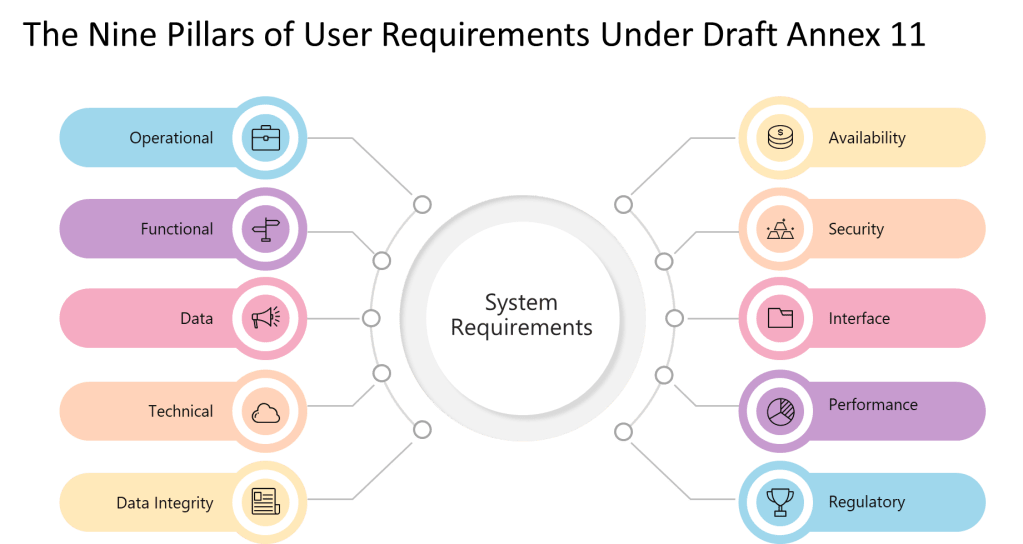
9 Pillars of a User Requirements

PillarDescriptionPractical Examples
OperationalRequirements describing how users will operate the system for GMP tasks.Workflow steps, user roles, batch record creation.
FunctionalFeatures and functions the system must perform to support GMP processes.Electronic signatures, calculation logic, alarm triggers.
Data IntegrityControls to ensure data is complete, consistent, correct, and secure.Audit trails, ALCOA+ requirements, data record locking.
TechnicalTechnical characteristics or constraints of the system.Platform compatibility, failover/recovery, scalability.
InterfaceHow the system interacts with other systems, hardware, or users.Equipment integration, API requirements, data lakes
PerformanceSpeed, capacity, or throughput relevant to GMP operations.Batch processing times, max concurrent users, volume limits.
AvailabilitySystem uptime, backup, and disaster recovery necessary for GMP.99.9% uptime, scheduled downtime windows, backup frequency.
SecurityHow access is controlled and how data is protected against threats.Password policy, MFA, role-based access, encryption.
RegulatoryExplicit requirements imposed by GMP regulations and standards.Part 11/Annex 11 compliance, data retention, auditability.

6.2: Extent and Detail—Risk-Based Rigor, Not Risk-Based Avoidance

Section 6.2 appears to maintain GAMP 5’s risk-based philosophy by requiring that “extent and detail of defined requirements should be commensurate with the risk, complexity and novelty of a system.” However, the subsequent specifications reveal a much more prescriptive approach than traditional risk-based frameworks.

The requirement that descriptions be “sufficient to support subsequent risk analysis, specification, design, purchase, configuration, qualification and validation” establishes requirements documentation as the foundation for the entire system lifecycle. This moves beyond GAMP 5’s emphasis on requirements as input to validation toward positioning requirements as the definitive specification against which all downstream activities are measured.

The explicit enumeration of requirement types—”operational, functional, data integrity, technical, interface, performance, availability, security, and regulatory requirements”—represents a significant departure from GAMP 5’s more flexible categorization. Where GAMP 5 allows organizations to define requirement categories based on system characteristics and business needs, Annex 11 mandates coverage of nine specific areas regardless of system type or risk level.

This prescriptive approach reflects regulatory recognition that organizations have historically used “risk-based” as justification for inadequate requirements documentation. By specifying minimum coverage areas, Section 6 establishes a floor below which requirements documentation cannot fall, regardless of risk assessment outcomes.

The inclusion of “process maps and data flow diagrams” as recommended content acknowledges the reality that modern pharmaceutical operations involve complex, interconnected systems where understanding data flows and process dependencies is essential for effective validation. This requirement will force organizations to develop system-level understanding rather than treating validation as isolated technical testing.

6.3: Ownership—User Accountability in the Cloud Era

Perhaps the most significant departure from traditional industry practice, Section 6.3 addresses the growing trend toward cloud services and vendor-supplied systems by establishing unambiguous user accountability for requirements documentation. The requirement that “the regulated user should take ownership of the document covering the implemented version of the system and formally approve and control it” eliminates common practices where organizations rely entirely on vendor-provided documentation.

This requirement acknowledges that vendor-supplied requirements specifications rarely align perfectly with specific organizational needs, GMP processes, or regulatory expectations. While vendors may provide generic requirements documentation suitable for broad market applications, pharmaceutical organizations must customize, supplement, and formally adopt these requirements to reflect their specific implementation and GMP dependencies.

The language “carefully review and approve the document and consider whether the system fulfils GMP requirements and company processes as is, or whether it should be configured or customised” requires active evaluation rather than passive acceptance. Organizations cannot simply accept vendor documentation as sufficient—they must demonstrate that they have evaluated system capabilities against their specific GMP needs and either confirmed alignment or documented necessary modifications.

This ownership requirement will prove challenging for organizations using large cloud platforms or SaaS solutions where vendors resist customization of standard documentation. However, the regulatory expectation is clear: pharmaceutical companies cannot outsource responsibility for demonstrating that system capabilities meet their specific GMP requirements.

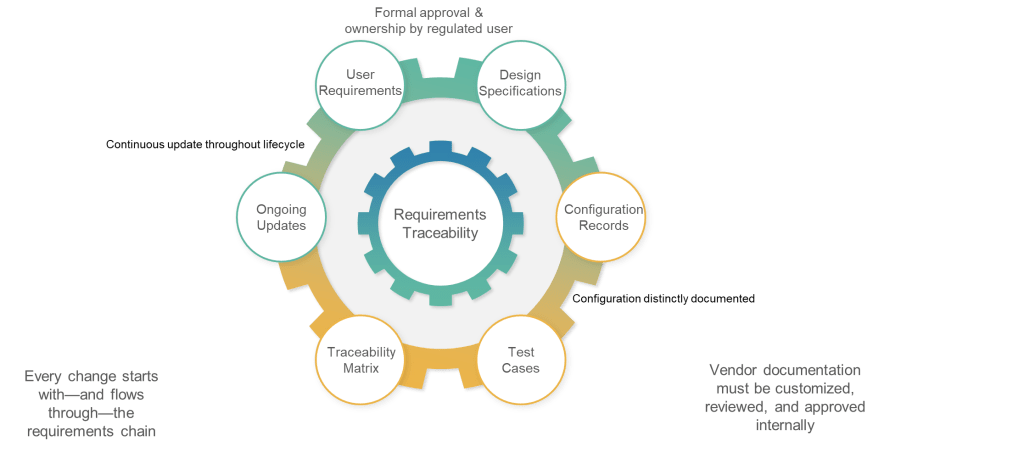
A horizontal or looping chain that visually demonstrates the lifecycle of system requirements from initial definition to sustained validation:

User Requirements → Design Specifications → Configuration/Customization Records → Qualification/Validation Test Cases → Traceability Matrix → Ongoing Updates

6.4: Update—Living Documentation, Not Static Archives

Section 6.4 addresses one of the most persistent failures in current validation practice: requirements documentation that becomes obsolete immediately after initial validation. The requirement that “requirements should be updated and maintained throughout the lifecycle of a system” and that “updated requirements should form the very basis for qualification and validation” establishes requirements as living documentation rather than historical artifacts.

This approach reflects the reality that modern computerized systems undergo continuous change through software updates, configuration modifications, hardware refreshes, and process improvements. Traditional validation approaches that treat requirements as fixed specifications become increasingly disconnected from operational reality as systems evolve.

The phrase “form the very basis for qualification and validation” positions requirements documentation as the definitive specification against which system performance is measured throughout the lifecycle. This means that any system change must be evaluated against current requirements, and any requirements change must trigger appropriate validation activities.

This requirement will force organizations to establish requirements management processes that rival those used in traditional software development organizations. Requirements changes must be controlled, evaluated for impact, and reflected in validation documentation—capabilities that many pharmaceutical organizations currently lack.

6.5: Traceability—Engineering Discipline for Validation

The traceability requirement in Section 6.5 codifies what GAMP 5 has long recommended: “Documented traceability between individual requirements, underlaying design specifications and corresponding qualification and validation test cases should be established and maintained.” However, the regulatory context transforms this from validation best practice to compliance obligation.

The emphasis on “effective tools to capture and hold requirements and facilitate the traceability” acknowledges that manual traceability management becomes impractical for complex systems with hundreds or thousands of requirements. This requirement will drive adoption of requirements management tools and validation platforms that can maintain automated traceability throughout the system lifecycle.

Traceability serves multiple purposes in the validation context: ensuring comprehensive test coverage, supporting impact assessment for changes, and providing evidence of validation completeness. Section 6 positions traceability as fundamental validation infrastructure rather than optional documentation enhancement.

For organizations accustomed to simplified validation approaches where test cases are developed independently of detailed requirements, this traceability requirement represents a significant process change requiring tool investment and training.

6.6: Configuration—Separating Standard from Custom

The final subsection addresses configuration management by requiring clear documentation of “what functionality, if any, is modified or added by configuration of a system.” This requirement recognizes that most modern pharmaceutical systems involve significant configuration rather than custom development, and that configuration decisions have direct impact on validation scope and approaches.

The distinction between standard system functionality and configured functionality is crucial for validation planning. Standard functionality may be covered by vendor testing and certification, while configured functionality requires user validation. Section 6 requires this distinction to be explicit and documented.

The requirement for “controlled configuration specification” separate from requirements documentation reflects recognition that configuration details require different management approaches than functional requirements. Configuration specifications must reflect the actual system implementation rather than desired capabilities.

Comparison with GAMP 5: Evolution Becomes Revolution

Philosophical Alignment with Practical Divergence

Section 6 maintains GAMP 5’s fundamental philosophy—risk-based validation supported by comprehensive requirements documentation—while dramatically changing implementation expectations. Both frameworks emphasize user ownership of requirements, lifecycle management, and traceability as essential validation elements. However, the regulatory context of Annex 11 transforms voluntary guidance into enforceable obligation.

GAMP 5’s flexibility in requirements categorization and documentation approaches reflects its role as guidance suitable for diverse organizational contexts and system types. Section 6’s prescriptive approach reflects regulatory recognition that flexibility has often been interpreted as optionality, leading to inadequate requirements documentation that fails to support effective validation.

The risk-based approach remains central to both frameworks, but Section 6 establishes minimum standards that apply regardless of risk assessment outcomes. While GAMP 5 might suggest that low-risk systems require minimal requirements documentation, Section 6 mandates coverage of nine requirement areas for all GMP systems.

Documentation Structure and Content

GAMP 5’s traditional document hierarchy—URS, Functional Specification, Design Specification—becomes more fluid under Section 6, which focuses on ensuring comprehensive coverage rather than prescribing specific document structures. This reflects recognition that modern development approaches, including agile and DevOps practices, may not align with traditional waterfall documentation models.

However, Section 6’s explicit enumeration of requirement types provides more prescriptive guidance than GAMP 5’s flexible approach. Where GAMP 5 might allow organizations to define requirement categories based on system characteristics, Section 6 mandates coverage of operational, functional, data integrity, technical, interface, performance, availability, security, and regulatory requirements.

The emphasis on process maps, data flow diagrams, and use cases reflects modern system complexity where understanding interactions and dependencies is essential for effective validation. GAMP 5 recommends these approaches for complex systems; Section 6 suggests their use “where relevant” for all systems.

Vendor and Service Provider Management

Both frameworks emphasize user responsibility for requirements even when vendors provide initial documentation. However, Section 6 uses stronger language about user ownership and control, reflecting increased regulatory concern about organizations that delegate requirements definition to vendors without adequate oversight.

GAMP 5’s guidance on supplier assessment and leveraging vendor documentation remains relevant under Section 6, but the regulatory requirement for user ownership and approval creates higher barriers for simply accepting vendor-provided documentation as sufficient.

Implementation Challenges for CSV Professionals

Organizational Capability Development

Most pharmaceutical organizations will require significant capability development to meet Section 6 requirements effectively. Traditional validation teams focused on testing and documentation must develop requirements engineering capabilities comparable to those found in software development organizations.

This transformation requires investment in requirements management tools, training for validation professionals, and establishment of requirements governance processes. Organizations must develop capabilities for requirements elicitation, analysis, specification, validation, and change management throughout the system lifecycle.

The traceability requirement particularly challenges organizations accustomed to informal relationships between requirements and test cases. Automated traceability management requires tool investments and process changes that many validation teams are unprepared to implement.

Integration with Existing Validation Approaches

Section 6 requirements must be integrated with existing validation methodologies and documentation structures. Organizations following traditional IQ/OQ/PQ approaches must ensure that requirements documentation supports and guides qualification activities rather than existing as parallel documentation.

The requirement for requirements to “form the very basis for qualification and validation” means that test cases must be explicitly derived from and traceable to documented requirements. This may require significant changes to existing qualification protocols and test scripts.

Organizations using risk-based validation approaches aligned with GAMP 5 guidance will find philosophical alignment with Section 6 but must adapt to more prescriptive requirements for documentation content and structure.

Technology and Tool Requirements

Effective implementation of Section 6 requirements typically requires requirements management tools capable of supporting specification, traceability, change control, and lifecycle management. Many pharmaceutical validation teams currently lack access to such tools or experience in their use.

Tool selection must consider integration with existing validation platforms, support for regulated environments, and capabilities for automated traceability maintenance. Organizations may need to invest in new validation platforms or significantly upgrade existing capabilities.

The emphasis on maintaining requirements throughout the system lifecycle requires tools that support ongoing requirements management rather than just initial documentation. This may conflict with validation approaches that treat requirements as static inputs to qualification activities.

Strategic Implications for the Industry

Convergence of Software Engineering and Pharmaceutical Validation

Section 6 represents convergence between pharmaceutical validation practices and mainstream software engineering approaches. Requirements engineering, long established in software development, becomes mandatory for pharmaceutical computerized systems regardless of development approach or vendor involvement.

This convergence benefits the industry by leveraging proven practices from software engineering while maintaining the rigor and documentation requirements essential for regulated environments. However, it requires pharmaceutical organizations to develop capabilities traditionally associated with software development rather than manufacturing and quality assurance.

The result should be more robust validation practices better aligned with modern system development approaches and capable of supporting the complex, interconnected systems that characterize contemporary pharmaceutical operations.

Vendor Relationship Evolution

Section 6 requirements will reshape relationships between pharmaceutical companies and system vendors. The requirement for user ownership of requirements documentation means that vendors must support more sophisticated requirements management processes rather than simply providing generic specifications.

Vendors that can demonstrate alignment with Section 6 requirements through comprehensive documentation, traceability tools, and support for user customization will gain competitive advantages. Those that resist pharmaceutical-specific requirements management approaches may find their market opportunities limited.

The emphasis on configuration management will drive vendors to provide clearer distinctions between standard functionality and customer-specific configurations, supporting more effective validation planning and execution.

The Regulatory Codification of Modern Validation

Section 6 of the draft Annex 11 represents the regulatory codification of modern computerized system validation practices. What GAMP 5 recommended through guidance, Annex 11 mandates through regulation. What was optional becomes obligatory; what was flexible becomes prescriptive; what was best practice becomes compliance requirement.

For CSV professionals, Section 6 provides regulatory support for comprehensive validation approaches while raising the stakes for inadequate implementation. Organizations that have struggled to implement effective requirements management now face regulatory obligation rather than just professional guidance.

The transformation from guidance to regulation eliminates organizational discretion about requirements documentation quality and comprehensiveness. While risk-based approaches remain valid for scaling validation effort, minimum standards now apply regardless of risk assessment outcomes.

Success under Section 6 requires pharmaceutical organizations to embrace software engineering practices for requirements management while maintaining the documentation rigor and process control essential for regulated environments. This convergence benefits the industry by improving validation effectiveness while ensuring compliance with evolving regulatory expectations.

The industry faces a choice: proactively develop capabilities to meet Section 6 requirements or reactively respond to inspection findings and enforcement actions. For organizations serious about digital transformation and validation excellence, Section 6 provides a roadmap for regulatory-compliant modernization of validation practices.

Requirement AreaDraft Annex 11 Section 6GAMP 5 RequirementsKey Implementation Considerations
System Requirements DocumentationMandatory – Must establish and approve system requirements (URS)Recommended – URS should be developed based on system category and complexityOrganizations must document requirements for ALL GMP systems, regardless of size or complexity
Risk-Based ApproachExtent and detail must be commensurate with risk, complexity, and noveltyRisk-based approach fundamental – validation effort scaled to riskRisk assessment determines documentation detail but cannot eliminate requirement categories
Functional RequirementsMust include 9 specific requirement types: operational, functional, data integrity, technical, interface, performance, availability, security, regulatoryFunctional requirements should be SMART (Specific, Measurable, Achievable, Realistic, Testable)All 9 areas must be addressed; risk determines depth, not coverage
Traceability RequirementsDocumented traceability between requirements, design specs, and test cases requiredTraceability matrix recommended – requirements linked through design to testingRequires investment in traceability tools and processes for complex systems
Requirement OwnershipRegulated user must take ownership even if vendor provides initial requirementsUser ownership emphasized, even for purchased systemsCannot simply accept vendor documentation; must customize and formally approve
Lifecycle ManagementRequirements must be updated and maintained throughout system lifecycleRequirements managed through change control throughout lifecycleRequires ongoing requirements management process, not just initial documentation
Configuration ManagementConfiguration options must be described in requirements; chosen configuration documented in controlled specConfiguration specifications separate from URSMust clearly distinguish between standard functionality and configured features
Vendor-Supplied RequirementsVendor requirements must be reviewed, approved, and owned by regulated userSupplier assessment required – leverage supplier documentation where appropriateHigher burden on users to customize vendor documentation for specific GMP needs
Validation BasisUpdated requirements must form basis for system qualification and validationRequirements drive validation strategy and testing scopeRequirements become definitive specification against which system performance is measured

Annex 11 Section 5.1 “Cooperation”—The Real Test of Governance and Project Team Maturity

The draft Annex 11 is a cultural shift, a new way of working that reaches beyond pure compliance to emphasize accountability, transparency, and full-system oversight. Section 5.1, simply titled: “Cooperation” is a small but might part of this transformation

On its face, Section 5.1 may sound like a pleasantry: the regulation states that “there should be close cooperation between all relevant personnel such as process owner, system owner, qualified persons and IT.” In reality, this is a direct call to action for the formation of empowered, cross-functional, and highly integrated governance structures. It’s a recognition that, in an era when computerized systems underpin everything from batch release to deviation investigation, a siloed or transactional approach to system ownership is organizational malpractice.

Governance: From Siloed Ownership to Shared Accountability

Let’s breakdown what “cooperation” truly means in the current pharmaceutical digital landscape. Governance in the Annex 11 context is no longer a paperwork obligation but the backbone for digital trust. The roles of Process Owner (who understands the GMP-critical process), System Owner (managing the integrity and availability of the system), Quality (bearing regulatory release or oversight risk), and the IT function (delivering the technical and cybersecurity expertise) all must be clearly defined, actively engaged, and jointly responsible for compliance outcomes.

This shared ownership translates directly into how organizations structure project teams. Legacy models—where IT “owns the system,” Quality “owns compliance,” and business users “just use the tool”—are explicitly outdated. Section 5.1 obligates that these domains work in seamless partnership, not simply at “handover” moments but throughout every lifecycle phase from selection and implementation to maintenance and retirement. Each group brings indispensable knowledge: the process owner knows process risks and requirements; the system owner manages configuration and operational sustainability; Quality interprets regulatory standards and ensure release integrity; IT enables security, continuity, and technical change.

Practical Project Realities: Embedding Cooperation in Every Phase

In my experience, the biggest compliance failures often do not hinge on technical platform choices, but on fractured or missing cross-functional cooperation. Robust governance, under Section 5.1, doesn’t just mean having an org chart—it means everyone understands and fulfills their operational and compliance obligations every day. In practice, this requires formal documents (RACI matrices, governance charters), clear escalation routes, and regular—preferably, structured—forums for project and system performance review.

During system implementation, deep cooperation means all stakeholders are involved in requirements gathering and risk assessment, not just as “signatories” but as active contributors. It is not enough for the business to hand off requirements to IT with minimal dialogue, nor for IT to configure a system and expect the Qulity sign-off at the end. Instead, expect joint workshops, shared risk assessments (tying from process hazard analysis to technical configuration), and iterative reviews where each stakeholder is empowered to raise objections or demand proof of controls.

At all times, communication must be systematic, not ad hoc: regular governance meetings, with pre-published minutes and action tracking; dashboards or portals where issues, risks, and enhancement requests can be logged, tracked, and addressed; and shared access to documentation, validation reports, CAPA records, and system audit trails. This is particularly crucial as digital systems (cloud-based, SaaS, hybrid) increasingly blur the lines between “IT” and “business” roles.

Training, Qualifications, and Role Clarity: Everyone Is Accountable

Section 5.1 further clarifies that relevant personnel—regardless of functional home—must possess the appropriate qualifications, documented access rights, and clearly defined responsibilities. This raises the bar on both onboarding and continuing education. “Cooperation” thus demands rotational training and knowledge-sharing among core team members. Process owners must understand enough of IT and validation to foresee configuration-related compliance risks. IT staff must be fluent in GMP requirements and data integrity. Quality must move beyond audit response and actively participate in system configuration choices, validation planning, and periodic review.

In my own project experience, the difference between a successful, inspection-ready implementation and a troubled, remediation-prone rollout is almost always the presence, or absence, of this cross-trained, truly cooperative project team.

Supplier and Service Provider Partnerships: Extending Governance Beyond the Walls

The rise of cloud, SaaS, and outsourced system management means that “cooperation” extends outside traditional organizational boundaries. Section 5.1 works in concert with supplier sections of Annex 11—everyone from IT support to critical SaaS vendors must be engaged as partners within the governance framework. This requires clear, enforceable contracts outlining roles and responsibilities for security, data integrity, backup, and business continuity. It also means periodic supplier reviews, joint planning sessions, and supplier participation in incidents and change management when systems span organizations.

Internal IT must also be treated with the same rigor—a department supporting a GMP system is, under regulation, no different than a third-party vendor; it must be a named party in the cooperation and governance ecosystem.

Oversight and Monitoring: Governance as a Living Process

Effective cooperation isn’t a “set and forget”—it requires active, joint oversight. That means frequent management reviews (not just at system launch but periodically throughout the lifecycle), candid CAPA root cause debriefs across teams, and ongoing risk and performance evaluations done collectively. Each member of the governance body—be they system owner, process owner, or Quality—should have the right to escalate issues and trigger review of system configuration, validation status, or supplier contracts.

Structured communication frameworks—regularly scheduled project or operations reviews, joint documentation updates, and cross-functional risk and performance dashboards—turn this principle into practice. This is how validation, data integrity, and operational performance are confidently sustained (not just checked once) in a rigorous, documented, and inspection-ready fashion.

The “Cooperation” Imperative and the Digital GMP Transformation

With the explosion of digital complexity—artificial intelligence, platform integrations, distributed teams—the management of computerized systems has evolved well beyond technical mastery or GMP box-ticking. True compliance, under the new Annex 11, hangs on the ability of organizations to operationalize interdisciplinary governance. Section 5.1 thus becomes a proxy for digital maturity: teams that still operate in silos or treat “cooperation” as a formality will be missed by the first regulatory deep dive or major incident.

Meanwhile, sites that embed clear role assignment, foster cross-disciplinary partnership, and create active, transparent governance processes (documented and tracked) will find not only that inspections run smoothly—they’ll spend less time in audit firefighting, make faster decisions during technology rollouts, and spot improvement opportunities early.

Teams that embrace the cooperation mandate see risk mitigation, continuous improvement, and regulatory trust as the natural byproducts of shared accountability. Those that don’t will find themselves either in chronic remediation or watching more agile, digitally mature competitors pull ahead.

Key Governance and Project Team Implications

To provide a summary for project, governance, and operational leaders, here is a table distilling the new paradigm:

Governance AspectImplications for Project & Governance Teams
Clear Role AssignmentDefine and document responsibilities for process owners, system owners, and IT.
Cross-Functional PartnershipEnsure collaboration among quality, IT, validation, and operational teams.
Training & QualificationClarify required qualifications, access levels, and competencies for personnel.
Supplier OversightEstablish contracts with roles, responsibilities, and audit access rights.
Proactive MonitoringMaintain joint oversight mechanisms to promptly address issues and changes.
Communication FrameworkSet up regular, documented interaction channels among involved stakeholders.

In this new landscape, “cooperation” is not a regulatory afterthought. It is the hinge on which the entire digital validation and integrity culture swings. How and how well your teams work together is now as much a matter of inspection and business success as any technical control, risk assessment, or test script.

Draft Annex 11 Section 10: “Handling of Data” — Where Digital Reality Meets Data Integrity

Pharmaceutical compliance is experiencing a tectonic shift, and nowhere is that more clear than in the looming overhaul of EU GMP Annex 11. Most quality leaders have been laser-focused on the revised demands for electronic signatures, access management, or supplier oversight—as I’ve detailed in my previous deep analyses, but few realize that Section 10: Handling of Data is the sleeping volcano in the draft. It is here that the revised Annex 11 transforms data handling controls from “do your best and patch with SOPs” into an auditable, digital, risk-based discipline shaped by technological change.

This isn’t about stocking up your data archive or flipping the “audit trail” switch. This is about putting every point of data entry, transfer, migration, and security under the microscope—and making their control, verification, and risk mitigation the default, not the exception. If, until now, your team has managed GMP data with a cocktail of trust, periodic spot checks, and a healthy dose of hope, you are about to discover just how high the bar has been raised.

The Heart of Section 10: Every Data Touchpoint Is Critical

Section 10, as rewritten in the draft Annex 11, isn’t long, but it is dense. Its brevity belies the workload it creates: a mandate for systematizing, validating, and documenting every critical movement or entry of GMP-relevant data. The section is split into four thematic requirements, each of which deserves careful analysis:

  1. Input verification—requiring plausibility checks for all manual entry of critical data,
  2. Data transfer—enforcing validated electronic interfaces and exceptional controls for any manual transcription,
  3. Data migration—demanding that every one-off or routine migration goes through a controlled, validated process,
  4. Encryption—making secure storage and movement of critical data a risk-based expectation, not an afterthought.

Understanding these not as checkboxes but as an interconnected risk-control philosophy is the only way to achieve robust compliance—and to survive inspection without scrambling for a “procedural explanation” for each data error found.

Input Verification: Automating the Frontline Defense

The End of “Operator Skill” as a Compliance Pillar

Human error, for as long as there have been batch records and lab notebooks, has been a known compliance risk. Before electronic records, the answer was redundancy: a second set of eyes, a periodic QC review, or—let’s be realistic—a quick initial on a form the day before an audit. But in the age of digital systems, Section 10.1 recognizes the simple truth: where technology can prevent senseless or dangerous entries, it must.

Manual entry of critical data—think product counts, analytical results, process parameters—is now subject to real-time, system-enforced plausibility checks. Gone are the days when outlandish numbers in a yield calculation raises no flag, or when an analyst logs a temperature outside any physically possible range with little more than a raised eyebrow. Section 10 demands that every critical data field is bounded by logic—ranges, patterns, value consistency checks—and that nonsensical entries are not just flagged but, ideally, rejected automatically.

Any field that is critical to product quality or patient safety must be controlled at the entry point by automated means. If such logic is technically feasible but not deployed, expect intensive regulatory scrutiny—and be prepared to defend, in writing, why it isn’t in place.

Designing Plausibility Controls: Making Them Work

What does this mean on a practical level? It means scoping your process maps and digitized workflows to inventory every manual input touching GMP outcomes. For each, you need to:

  • Establish plausible ranges and patterns based on historical data, scientific rationale, and risk analysis.
  • Program system logic to enforce these boundaries, including mandatory explanatory overrides for any values outside “normal.”
  • Ensure every override is logged, investigated, and trended—because “frequent overrides” typically signal either badly set limits or a process slipping out of control.

But it’s not just numeric entries. Selectable options, free-text assessments, and uploads of evidence (e.g., images or files) must also be checked for logic and completeness, and mechanisms must exist to prevent accidental omissions or nonsensical entries (like uploading the wrong batch report for a product lot).

These expectations put pressure on system design teams and user interface developers, but they also fundamentally change the culture: from one where error detection is post hoc and personal, to one where error prevention is systemic and algorithmic.

Data Transfer: Validated Interfaces as the Foundation

Automated Data Flows, Not “Swivel Chair Integration”

The next Section 10 pillar wipes out the old “good enough” culture of manually keying critical data between systems—a common practice all the way up to the present day, despite decades of technical options to network devices, integrate systems, and use direct data feeds.

In this new paradigm, critical data must be transferred between systems electronically whenever possible. That means, for example, that:

  • Laboratory instruments should push their results to the LIMS automatically, not rely on an analyst to retype them.
  • The MES should transmit batch data to ERP systems for release decisions without recourse to copy-pasting or printout scanning.
  • Environmental monitoring systems should use validated data feeds into digital reports, not rely on handwritten transcriptions or spreadsheet imports.

Where technology blocks this approach—due to legacy equipment, bespoke protocols, or prohibitive costs—manual transfer is only justifiable as an explicitly assessed and mitigated risk. In those rare cases, organizations must implement secondary controls: independent verification by a second person, pre- and post-transfer checks, and logging of every step and confirmation.

What does a validated interface mean in this context? Not just that two systems can “talk,” but that the transfer is:

  • Complete (no dropped or duplicated records)
  • Accurate (no transformation errors or field misalignments)
  • Secure (with no risk of tampering or interception)

Every one of these must be tested at system qualification (OQ/PQ) and periodically revalidated if either end of the interface changes. Error conditions (such as data out of expected range, failed transfers, or discrepancies) must be logged, flagged to the user, and if possible, halt the associated GMP process until resolved.

Practical Hurdles—and Why They’re No Excuse

Organizations will protest: not every workflow can be harmonized, and some labyrinthine legacy systems lack the APIs or connectivity for automation. The response is clear: you can do manual transfer only when you’ve mapped, justified, and mitigated the added risk. This risk assessment and control strategy will be expected, and if auditors spot critical data being handed off by paper (including the batch record) or spreadsheet without robust double verification, you’ll have a finding that’s impossible to “train away.”

Remember, Annex 11’s philosophy flows from data integrity risk, not comfort or habit. In the new digital reality, technically possible is the compliance baseline.

Data Migration: Control, Validation, and Traceability

Migration Upgrades Are Compliance Projects, Not IT Favors

Section 10.3 brings overdue clarity to a part of compliance historically left to “IT shops” rather than Quality or data governance leads: migrations. In recent years, as cloud moves and system upgrades have exploded, so have the risks. Data gaps, incomplete mapping, field mismatches, and “it worked in test but not in prod” errors lurk in every migration, and their impact is enormous—lost batch records, orphaned critical information, and products released with documentation that simply vanished after a system reboot.

Annex 11 lays down a clear gauntlet: all data migrations must be planned, risk-assessed, and validated. Both the sending and receiving platforms must be evaluated for data constraints, and the migration process itself is subject to the same quality rigor as any new computerized system implementation.

This requires a full lifecycle approach:

  • Pre-migration planning to document field mapping, data types, format and allowable value reconciliations, and expected record counts.
  • Controlled execution with logs of each action, anomalies, and troubleshooting steps.
  • Post-migration verification—not just a “looks ok” sample, but a full reconciliation of batch counts, search for missing or duplicated records, and (where practical) data integrity spot checks.
  • Formal sign-off, with electronic evidence and supporting risk assessment, that the migration did not introduce errors, losses, or uncontrolled transformations.

Validating the Entire Chain, Not Just the Output

Annex 11’s approach is process-oriented. You can’t simply “prove a few outputs match”; you must show that the process as executed controlled, logged, and safeguarded every record. If source data was garbage, destination data will be worse—so validation includes both the “what” and the “how.” Don’t forget to document how you’ll highlight or remediate mismatched or orphaned records for future investigation or reprocessing; missing this step is a quality and regulatory land mine.

It’s no longer acceptable to treat migration as a purely technical exercise. Every migration is a compliance event. If you can’t show the system’s record—start-to-finish—of how, by whom, when, and under what procedural/corrective control migrations have been performed, you are vulnerable on every product released or batch referencing that data.

Encryption: Securing Data as a Business and Regulatory Mandate

Beyond “Defense in Depth” to a Compliance Expectation

Historically, data security and encryption were IT problems, and the GMP justification for employing them was often little stronger than “everyone else is doing it.” The revised Section 10 throws that era in the trash bin. Encryption is now a risk-based compliance requirement for storage and transfer of critical GMP data. If you don’t use strong encryption “where applicable,” you’d better have a risk assessment ready that shows why the threat is minimal or the technical/operational risk of encryption is greater than the gain.

This requirement is equally relevant whether you’re holding batch record files, digital signatures, process parameter archives, raw QC data, or product release records. Security compromises aren’t just a hacking story; they’re a data integrity, fraud prevention, and business continuity story. In the new regulatory mindset, unencrypted critical data is always suspicious. This is doubly so when the data moves through cloud services, outsourced IT, or is ever accessible outside the organization’s perimeter.

Implementing and Maintaining Encryption: Avoiding Hollow Controls

To comply, you need to specify and control:

  • Encryption standards (e.g., minimum AES-256 for rest and transit)
  • Robust key management (with access control, periodic audits, and revocation/logging routines)
  • Documentation for every location and method where data is or isn’t encrypted, with reference to risk assessments
  • Procedures for regularly verifying encryption status and responding to incidents or suspected compromises

Regulators will likely want to see not only system specifications but also periodic tests, audit trails of encryption/decryption, and readouts from recent patch cycles or vulnerability scans proving encryption hasn’t been silently “turned off” or configured improperly.

Section 10 Is the Hub of the Data Integrity Wheel

Section 10 cannot be treated in isolation. It underpins and is fed by virtually every other control in the GMP computerized system ecosystem.

  • Input controls support audit trails: If data can be entered erroneously or fraudulently, the best audit trail is just a record of error.
  • Validated transfers prevent downstream chaos: If system A and system B don’t transfer reliably, everything “downstream” is compromised.
  • Migrations touch batch continuity and product release: If you lose or misplace records, your recall and investigation responses are instantly impaired.
  • Encryption protects change control and deviation closure: If sensitive data is exposed, audit trails and signature controls can’t protect you from the consequences.

Risk-Based Implementation: From Doctrine to Daily Practice

The draft’s biggest strength is its honest embrace of risk-based thinking. Every expectation in Section 10 is to be scaled by impact to product quality and patient safety. You can—and must—document decisions for why a given control is (or is not) necessary for every data touchpoint in your process universe.

That means your risk assessment does more than check a box. For every GMP data field, every transfer, every planned or surprise migration, every storage endpoint, you need to:

  • Identify every way the data could be made inaccurate, incomplete, unavailable, or stolen.
  • Define controls appropriate both to the criticality of the data and the likelihood and detectability of error or compromise.
  • Test and document both normal and failure scenarios—because what matters in a recall, investigation, or regulatory challenge is what happens when things go wrong, not just when they go right.

ALCOA+ is codified by these risk processes: accuracy via plausibility checks, completeness via transfer validation, longevity via robust migration and storage; contemporaneity and endurability via encryption and audit linkage.

Handling of Data vs. Previous Guidance and Global Norms

While much of this seems “good practice,” make no mistake: the regulatory expectations have fundamentally changed. In 2011, Annex 11 was silent on specifics, and 21 CFR Part 11 relied on broad “input checks” and an expectation that organizations would design controls relative to what was reasonable at the time.

Now:

  • Electronic input plausibility is not just a “should” but a “must”—if your system can automate it, you must.
  • Manual transfer is justified, not assumed; all manual steps must have procedural/methodological reinforcement and evidence logs.
  • Migration is a qualification event. The entire lifecycle, not just the output, must be documented, trended, and reviewed.
  • Encryption is an expectation, not a best effort. The risk burden now falls on you to prove why it isn’t needed, not why it is.
  • Responsibility is on the MAH/manufacturer, not the vendor, IT, or “business owner.” You outsource activity, not liability.

This matches, in setting, recent FDA guidance via Computer Software Assurance (CSA), GAMP 5’s digital risk lifecycle, and every modern data privacy regulation. The difference is that, starting with the new Annex 11, these approaches are not “suggested”—they are codified.

Real-Life Scenarios: Application of Section 10

Imagine a high-speed packaging line. The operator enters the number of rejected vials per shift. In the old regime, the operator could mistype “80” as “800” or enter a negative number during a hasty correction. With section 10 in force, the system simply will not permit it—90% confidence that any such error will be caught before it mars the official record.

Now think about laboratory results—analysts transferring HPLC data into the LIMS manually. Every entry runs a risk of decimal misplacement or sample ID mismatch. Annex 11 now demands full instrument-to-LIMS interfacing (where feasible), and when not, a double verification protocol meticulously executed, logged, and reviewed.

On the migration front, consider upgrading your document management system. The stakes: decades of batch release records. In 2019, you might have planned a database export, a few spot checks, and post-migration validation of “high value” documents. Under the new Annex 11, you require a documented mapping of every critical field, technical and process reconciliation, error reporting, and lasting evidence for defensibility two or ten years from now.

Encryption is now expected as a default. Cloud-hosted data with no encryption? Prepare to be asked why, and to defend your choice with up-to-date, context-specific risk assessments—not hand-waving.

Bringing Section 10 to Life: Steps for Implementation

A successful strategy for aligning to Annex 11 Section 10 begins with an exhaustive mapping of all critical data touchpoints and their methods of entry, transfer, and storage. This is a multidisciplinary process, requiring cooperation among quality, IT, operations, and compliance teams.

For each critical data field or process, define:

  • The party responsible for its entry and management
  • The system’s capability for plausibility checking, range enforcement, and error prevention;
  • Mechanisms to block or correct entry outside expected norms
  • Methods of data handoff and transfer between systems, with documentation of integration or a procedural justification for unavoidable manual steps
  • Protocols and evidence logs for validation of both routine transfers and one-off (migration) events

For all manual data handling that remains, create detailed, risk-based procedures for independent verification and trending review. For data migration, walk through an end-to-end lifecycle—pre-migration risk mapping, execution protocols, post-migration review, discrepancy handling, and archiving of all planning/validation evidence.

For storage and transfer, produce a risk matrix for where and how critical data is held, updated, and moved, and deploy encryption accordingly. Document both technical standards and the process for periodic review and incident response.

Quality management is not the sole owner; business leads, system admins, and IT architects must be brought to the table. For every major change, tie change control procedures to a Section 10 review—any new process, upgrade, or integration comes back to data handling risk, with a closing check for automation and procedural compliance.

Regulatory Impact and Inspection Strategy

Regulatory expectations around data integrity are not only becoming more stringent—they are also far more precise and actionable than in the past. Inspectors now arrive prepared and trained to probe deeply into what’s called “data provenance”: that is, the complete, traceable life story of every critical data point. It’s no longer sufficient to show where a value appears in a final batch record or report; regulators want to see how that data originated, through which systems and interfaces it was transferred, how each entry or modification was verified, and exactly what controls were in place (or not in place) at each step.

Gone are the days when, if questioned about persistent risks like error-prone manual transcription, a company could deflect with, “that’s how we’ve always done it.” Now, inspectors expect detailed explanations and justifications for every manual, non-automated, or non-encrypted data entry or transfer. They will require you to produce not just policies but actual logs, complete audit trails, electronic signature evidence where required, and documented decision-making within your risk assessments for every process step that isn’t fully controlled by technology.

In practical terms, this means you must be able to reconstruct and defend the exact conditions and controls present at every point data is created, handled, moved, or modified. If a process relies on a workaround, a manual step, or an unvalidated migration, you will need transparent evidence that risks were understood, assessed, and mitigated—not simply asserted away.

The implications are profound: mastering Section 10 isn’t just about satisfying the regulator. Robust, risk-based data handling is fundamental to your operation’s resilience—improving traceability, minimizing costly errors or data loss, ensuring you can withstand disruption, and enabling true digital transformation across your business. Leaders who excel here will find that their compliance posture translates into real business value, competitive differentiation, and lasting operational stability.

The Bigger Picture: Section 10 as Industry Roadmap

What’s clear is this: Section 10 eliminates the excuses that have long made “data handling risk” a tolerated, if regrettable, feature of pharmaceutical compliance. It replaces them with a pathway for digital, risk-based, and auditable control culture. This is not just for global pharma behemoths—cloud-native startups, generics manufacturers, and even virtual companies reliant on CDMOs must take note. The same expectations now apply to every regulated data touchpoint, wherever in the supply chain or manufacturing lifecycle it lies.

Bringing your controls into compliance with Section 10 is a strategic imperative in 2025 and beyond. Those who move fastest will spend less time and money on post-inspection remediation, operate more efficiently, and have a defensible record for every outcome.

Requirement AreaAnnex 11 (2011)Draft Annex 11 Section 10 (2025)21 CFR Part 11GAMP 5 / Best Practice
Input verificationGeneral expectation, not definedMandatory for critical manual entry; system logic and boundaries“Input checks” required, methods not specifiedRisk-based, ideally automated
Data transferManual allowed, interface preferredValidated interfaces wherever possible; strict controls for manualImplicit through system interface requirementsAutomated transfer is the baseline, double checked for manual
Manual transcriptionAllowed, requires reviewOnly justified exceptions; robust secondary verification & documentationNot directly mentionedTwo-person verification, periodic audit and trending
Data migrationMentioned, not detailedMust be planned, risk-assessed, validated, and be fully auditableImplied via system lifecycle controlsFull protocol: mapping, logs, verification, and discrepancy handling
EncryptionNot referencedMandated for critical data; exceptions need documented, defensible riskRecommended, not strictly requiredDefault for sensitive data; standard in cloud, backup, and distributed setups
Audit trail for handlingImplied via system change auditingAll data moves and handling steps linked/logged in audit trailRequired for modifications/rest/correctionIntegrated with system actions, trended for error and compliance
Manual exceptionsNot formally addressedMust be justified and mitigated; always subject to periodic reviewNot directly statedException management, always with trending, review, and CAPA

Handling of Data as Quality Culture, Not Just IT Control

Section 10 in the draft Annex 11 is nothing less than the codification of real data integrity for the digitalized era. It lays out a field guide for what true GMP data governance looks like—not in the clouds of intention, but in the minutiae of everyday operation. Whether you’re designing a new MES integration, cleaning up the residual technical debt of manual record transfer, or planning the next system migration, take heed: how you handle data when no one’s watching is the new standard of excellence in pharmaceutical quality.

As always, the organizations that embrace these requirements as opportunities—not just regulatory burdens—will build a culture, a system, and a supply chain that are robust, efficient, and genuinely defensible.