The FDA has published the 2024 Inspectional Observation Data Sets. I don’t think there are any surprise that on what the inspection observations data for fiscal year 2024 shows and what key GMP inspection themes emerge for drug manufacturers:
Quality Systems and Documentation
Inadequate Procedures and Documentation
Failure to establish or follow written procedures for various operations, including quality control, production, and process controls.
Lack of complete documentation for investigations, batch records, and laboratory testing.
Quality Control Unit Deficiencies
Inadequate responsibilities and authority of the quality control unit.
Failure to approve or reject components, products, procedures, or specifications.
Manufacturing and Process Controls
Equipment and Facility Issues
Inadequate design, maintenance, or cleaning of manufacturing equipment.
Deficiencies in facility maintenance, sanitation, and environmental controls.
Process Validation and Control
Lack of adequate process validation, especially for sterile drug products.
Insufficient control procedures to monitor and validate manufacturing processes.
Laboratory Controls
Inadequate Laboratory Practices
Failure to establish scientifically sound laboratory controls.
Deficiencies in test methods validation and stability testing programs.
Component Testing
Inadequate testing of drug components and reliance on supplier certificates without proper verification.
Sterile Drug Manufacturing
Aseptic Processing Deficiencies
Inadequate procedures and validation for sterile drug products.
Deficiencies in environmental monitoring and control systems for aseptic processing areas.
Training and Personnel
Inadequate Employee Training
Insufficient training of employees in GMP and specific job function.
Complaint Handling and Product Quality Reviews
Deficient Complaint Procedures
Inadequate procedures for handling product complaints.
Annual Product Quality Review
Failure to conduct adequate annual product quality reviews.
Equipment Related
Out of the 365 observations that mention equipment, 277 are from just 5 regulations. Let’s take a deeper look.
Reference Number
Short Description
Long Description
Frequency
21 CFR 211.63
Equipment Design, Size and Location
Equipment used in the manufacture, processing, packing or holding of drug products is not [of appropriate design] [of adequate size] [suitably located] to facilitate operations for its [intended use] [cleaning and maintenance]. Specifically, ***
85
21 CFR 211.67(a)
Cleaning / Sanitizing / Maintenance
Equipment and utensils are not [cleaned] [maintained] [sanitized] at appropriate intervals to prevent [malfunctions] [contamination] that would alter the safety, identity, strength, quality or purity of the drug product. Specifically, ***
76
21 CFR 211.67(b)
Written procedures not established/followed
Written procedures are not [established] [followed] for the cleaning and maintenance of equipment, including utensils, used in the manufacture, processing, packing or holding of a drug product. Specifically, ***
60
21 CFR 211.68(a)
Calibration/Inspection/Checking not done
Routine [calibration] [inspection] [checking] of [automatic] [mechanical] [electronic] equipment is not performed according to a written program designed to assure proper performance. Specifically, ***
30
Improper design and qualification, improper cleaning, improper calibration and inspections. Yes these take work, but these are all areas that effort can improve.
I often joke that as a biotech company employee I am primarily responsible for the manufacture of data (and water) first and foremost, and as a result we get a byproduct of a pharmaceutical drugs.
Many of us face challenges within organizations when it comes to effectively managing data. There tends to be a prevailing mindset that views data handling as a distinct activity, often relegated to the responsibility of someone else, rather than recognizing it as an integral part of everyone’s role. This separation can lead to misunderstandings and missed opportunities for utilizing data to its fullest potential.
Many organizations suffer some multifaceted challenges around data management:
Lack of ownership: When data is seen as “someone else’s job,” it often falls through the cracks.
Inconsistent quality: Without a unified approach, data quality can vary widely across departments.
Missed insights: Siloed data management can result in missed opportunities for valuable insights.
Inefficient processes: Disconnected data handling often leads to duplicated efforts and wasted resources.
Integrate Data into Daily Work
Make data part of job descriptions: Clearly define data-related responsibilities for each role, emphasizing how data contributes to overall job performance.
Provide context: Help employees understand how their data-related tasks directly impact business outcomes and decision-making processes.
Encourage data-driven decision making: Train employees to use data in their daily work, from small decisions to larger strategic choices.
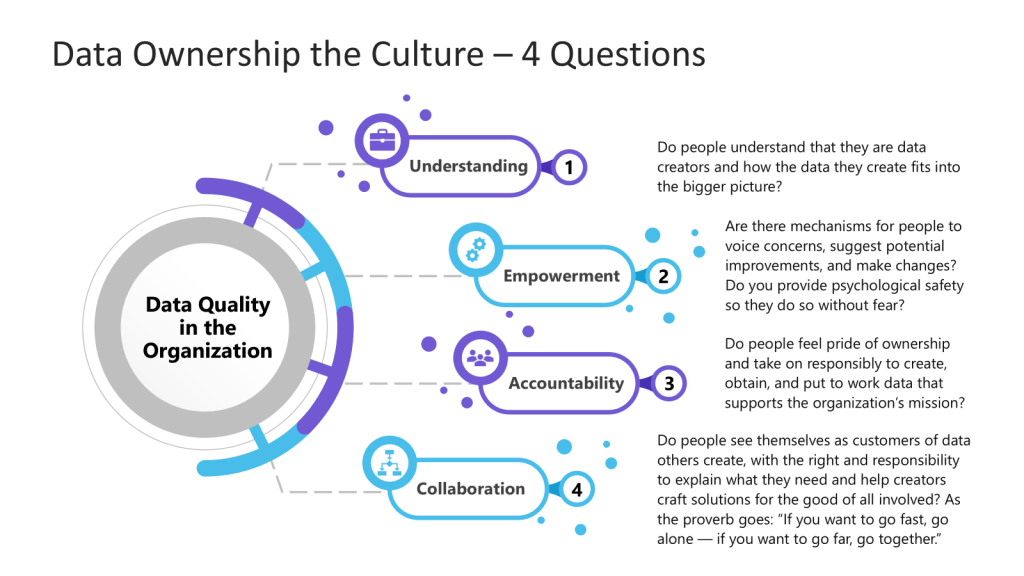
We want to strive to ask four questions.
Understanding: Do people understand that they are data creators and how the data they create fits into the bigger picture?
Empowerment: Are there mechanisms for people to voice concerns, suggest potential improvements, and make changes? Do you provide psychological safety so they do so without fear?
Accountability: Do people feel pride of ownership and take on responsibly to create, obtain, and put to work data that supports the organization’s mission?
Collaboration: Do people see themselves as customers of data others create, with the right and responsibility to explain what they need and help creators craft solutions for the good of all involved?
Foster a Data-Driven Culture
Fostering a data-driven culture is essential for organizations seeking to leverage the full potential of their data assets. This cultural shift requires a multi-faceted approach that starts at the top and permeates throughout the entire organization.
Leadership by example is crucial in establishing a data-driven culture. Managers and executives must actively incorporate data into their decision-making processes and discussions. By consistently referencing data in meetings, presentations, and communications, leaders demonstrate the value they place on data-driven insights. This behavior sets the tone for the entire organization, encouraging employees at all levels to adopt a similar approach. When leaders ask data-informed questions and base their decisions on factual evidence, it reinforces the importance of data literacy and analytical thinking across the company.
Continuous learningis another vital component of a data-driven culture. Organizations should invest in regular training sessions that enhance data literacy and proficiency with relevant analysis tools. These educational programs should be tailored to each role within the company, ensuring that employees can apply data skills directly to their specific responsibilities. By providing ongoing learning opportunities, companies empower their workforce to make informed decisions and contribute meaningfully to data-driven initiatives. This investment in employee development not only improves individual performance but also strengthens the organization’s overall analytical capabilities.
Creating effective feedback loops is essential for refining and improving data processes over time. Organizations should establish systems that allow employees to provide input on data-related practices and suggest enhancements. This two-way communication fosters a sense of ownership and engagement among staff, encouraging them to actively participate in the data-driven culture. By valuing employee feedback, companies can identify bottlenecks, streamline processes, and uncover innovative ways to utilize data more effectively. These feedback mechanisms also help in closing the loop between data insights and actionable outcomes, ensuring that the organization continually evolves its data practices to meet changing needs and challenges.
Build Data as a Core Principle
Focus on quality: Emphasize the importance of data quality to the mission of the organization
Continuous improvement: Encourage ongoing refinement of data processes,.
Pride in workmanship: Foster a sense of ownership and pride in data-related tasks, .
Break down barriers: Promote cross-departmental collaboration on data initiatives and eliminate silos.
Drive out fear: Create a safe environment for employees to report data issues or inconsistencies without fear of reprisal.
By implementing these strategies, organizations can effectively tie data to employees’ daily work and create a robust data culture that enhances overall performance and decision-making capabilities.
Usually I expect the FDA to publish some basic primer material as a webinar, so I was a little surprised when “Considerations for Complying With 21 CFR 211.110” was recently published as a draft. I’ve been rereading it, looking for what is actually worthy of a guidance here, and quite frankly, struggling.
It literally is a refresher course on 21CFR211.110. Maybe I should read it as “No we were serious about ICH Q8 and critical quality attributes.” Or maybe it is just the result of one too many bad Type C meetings lately.
Anyway, good refresher on product quality, in-process controls and samples. Still I think this would be better as a webinar with some graphics. Maybe I’ll better understand why this was published based on what sort of crazy comments are made and I can scratch my head and wonder what shenanigans some of these companies are up to.
One thing we should all agree with is that we need reliable reliable, accurate, and trustworthy data. Which is why we strive for the principles of data governance, data quality, and data integrity, three interconnected concepts that work together to create a robust data management framework.
Overarching Framework: Data Governance
Data governance serves as the overarching framework that establishes the policies, procedures, and standards for managing data within an organization. It provides the structure and guidance necessary for effective data management, including:
Defining roles and responsibilities for data management
Establishing data policies and standards
Creating processes for data handling and decision-making
Ensuring compliance with regulations and internal policies
Data governance sets the stage for both data quality and data integrity initiatives by providing the necessary organizational structure and guidelines.
Data Quality: Ensuring Fitness for Purpose
Within the data governance framework, data quality focuses on ensuring that data is fit for its intended use. This involves:
Assessing data against specific quality dimensions (e.g., accuracy, completeness, consistency, validity, timeliness)
Implementing data cleansing and standardization processes
Monitoring and measuring data quality metrics
Continuously improving data quality through feedback loops and corrective actions
Data quality initiatives are guided by the policies and standards set forth in the data governance framework, ensuring that quality efforts align with organizational goals and requirements.
Data Integrity: Maintaining Trustworthiness
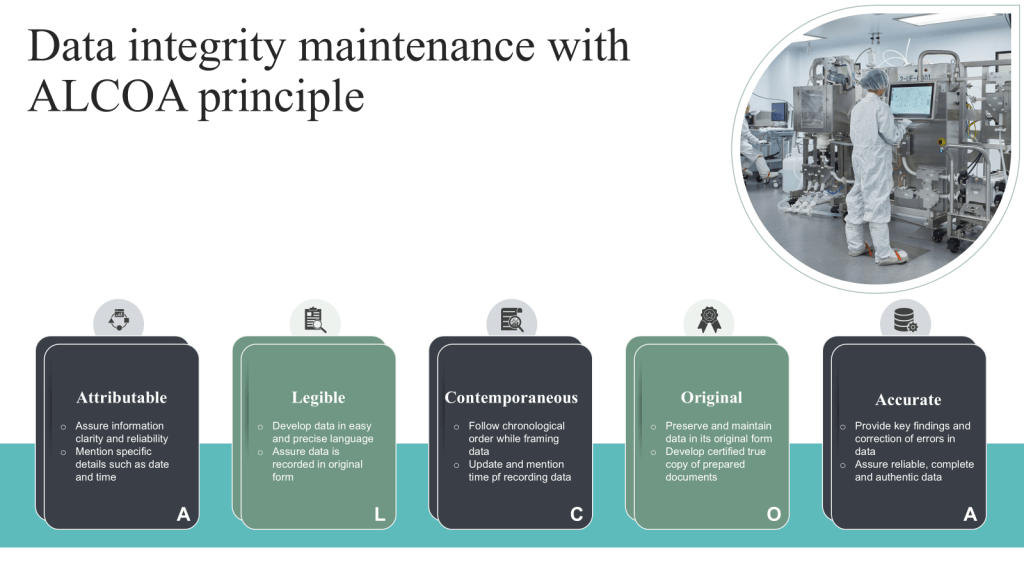
Data integrity works in tandem with data quality to ensure that data remains accurate, complete, consistent, and reliable throughout its lifecycle. The ALCOA+ principles, widely used in regulated industries, provide a comprehensive framework for ensuring data integrity.
ALCOA+ Principles
Attributable: Ensuring that data can be traced back to its origin and the individual responsible for its creation or modification.
Legible: Maintaining data in a clear, readable format that is easily understandable.
Contemporaneous: Recording data at the time of the event or observation to ensure accuracy and prevent reliance on memory.
Original: Preserving the original record or a certified true copy to maintain data authenticity.
Accurate: Ensuring data correctness and freedom from errors.
Complete: Capturing all necessary information without omissions.
Consistent: Maintaining data coherence across different systems and over time.
Enduring: Preserving data for the required retention period in a format that remains accessible.
Available: Ensuring data is readily accessible when needed for review or inspection.
Additional Data Integrity Measures
Security Measures: Implementing robust security protocols to protect data from unauthorized access, modification, or deletion.
Data Lineage Tracking: Establishing systems to monitor and document data transformations and origins throughout its lifecycle.
Auditability: Ensuring data changes are traceable through comprehensive logging and change management processes.
Data Consistency: Maintaining uniformity of data across various systems and databases.
Data integrity measures are often defined and enforced through data governance policies, while also supporting data quality objectives by preserving the accuracy and reliability of data. By adhering to the ALCOA+ principles and implementing additional integrity measures, organizations can ensure their data remains trustworthy and compliant with regulatory requirements.
Synergy in Action
The collaboration between these three elements can be illustrated through a practical example:
Data Governance Framework: An organization establishes a data governance committee that defines policies for GxP data management, including data quality standards and security requirements.
Data Quality Initiative: Based on the governance policies, the organization implements data quality checks to ensure GxP information is accurate, complete, and up-to-date. This includes:
Regular data profiling to identify quality issues
Data cleansing processes to correct errors
Validation rules to prevent the entry of incorrect data
Data Integrity Measures: To maintain the trustworthiness of GxP data, the organization:
Implements access controls to prevent unauthorized modifications
The data remains has a secure and unaltered lineage (data integrity)
All processes align with organizational policies and regulatory requirements (data governance)
Continuous Improvement Cycle
The relationship between data governance, quality, and integrity is not static but forms a continuous improvement cycle:
Data governance policies inform data quality and integrity standards.
Data quality assessments and integrity checks provide feedback on the effectiveness of governance policies.
This feedback is used to refine and improve governance policies, which in turn enhance data quality and integrity practices.
This ongoing cycle ensures that an organization’s data management practices evolve to meet changing business needs and technological advancements.
Data governance, data quality, and data integrity work together as a cohesive system to ensure that an organization’s data is not only accurate and reliable but also properly managed, protected, and utilized in alignment with business objectives and regulatory requirements. This integrated approach is essential for organizations seeking to maximize the value of their data assets while minimizing risks associated with poor data management.
A GMP Application based on ISA S88.01
A great example of Data governance is applying ISA S88.01 to enhance batch control processes and improve overall manufacturing operations.
Data Standardization and Structure
ISA S88.01 provides a standardized framework for batch control, including models and terminology that define the physical, procedural, and recipe aspects of batch manufacturing. This standardization directly supports data governance efforts by:
Establishing a common language for batch processes across the organization
Defining consistent data structures and hierarchies
Facilitating clear communication between different departments and systems
Improved Data Quality
By following the ISA S88.01 standard, organizations can ensure higher data quality throughout the batch manufacturing process:
Consistent Data Collection: The standard defines specific data points to be collected at each stage of the batch process, ensuring comprehensive and uniform data capture.
Traceability: ISA S88.01 enables detailed tracking of each phase of the batch process, including raw materials used, process parameters, and quality data.
Data Integrity: The structured approach helps maintain data integrity by clearly defining data sources, formats, and relationships.
Enhanced Data Management
The ISA S88.01 model supports effective data management practices:
Modular Approach: The standard’s modular structure allows for easier management of data related to specific equipment, procedures, or recipes.
Scalability: As processes or equipment change, the modular nature of ISA S88.01 facilitates easier updates to data structures and governance policies.
Data Lifecycle Management: The standard’s clear delineation of process stages aids in managing data throughout its lifecycle, from creation to archival.
Regulatory Compliance
ISA S88.01 supports data governance efforts related to regulatory compliance:
Audit Trails: The standard’s emphasis on traceability aligns with regulatory requirements for maintaining detailed records of batch processes.
Consistent Documentation: Standardized terminology and structures facilitate the creation of consistent, compliant documentation.
Decision Support and Analytics
The structured data approach of ISA S88.01 enhances data governance initiatives aimed at improving decision-making:
Data Integration: The standard facilitates easier integration of batch data with other enterprise systems, supporting comprehensive analytics.
Performance Monitoring: Standardized data structures enable more effective monitoring and comparison of batch processes across different units or sites.
Continuous Improvement
Both data governance and ISA S88.01 support continuous improvement efforts:
Process Optimization: The structured data from ISA S88.01 compliant systems can be more easily analyzed to identify areas for process improvement.
Knowledge Management: The standard terminology and models facilitate better knowledge sharing and retention within the organization.
By leveraging ISA S88.01 in conjunction with robust data governance practices, organizations can create a powerful framework for managing batch processes, ensuring data quality, and driving operational excellence in manufacturing environments.
A consensus standards organization, also known as a voluntary consensus standards body, is an entity that develops and publishes technical standards through a collaborative, consensus-based process involving various stakeholders. Here are the key characteristics of consensus standards organizations:
Voluntary participation: Involvement in the standards development process is voluntary for interested parties.
Consensus-based approach: Standards are developed through a process that seeks general agreement among participants, considering the views of all parties and reconciling conflicting arguments.
Openness: The procedures and processes for developing standards are open to interested parties, providing meaningful opportunities for participation on a non-discriminatory basis.
Balance: The standards development process aims to achieve balance among different stakeholder groups, ensuring no single interest dominates.
Due process: The organization follows established procedures that include provisions for appeals and addressing objections.
Transparency: The procedures for developing standards and the standards themselves are transparent and accessible.
Non-profit status: Many consensus standards organizations operate as non-profit entities.
Diverse stakeholder involvement: Participants typically include industry experts, government representatives, academics, and consumer groups.
Accreditation: In some cases, these organizations may be accredited by national bodies (e.g., ANSI in the United States) to ensure they follow proper procedures.
Wide range of applications: Consensus standards can cover various fields, including product specifications, testing methods, management systems, and more.
Examples of well-known consensus standards organizations include:
International Organization for Standardization (ISO)
American National Standards Institute (ANSI)
ASTM International (formerly American Society for Testing and Materials)
British Standards Institution (BSI)
These organizations play a crucial role in promoting quality, safety, and interoperability across various industries and sectors by developing widely accepted standards through collaborative processes.
The Unique Role of Inter-Governmental Agencies in Pharmaceutical Standards
These organizations share some key characteristics with consensus standard bodies:
They focus on harmonization efforts in the pharmaceutical industry.
They operate internationally, involving multiple countries and regulatory authorities.
They provide frameworks for collaboration among stakeholders.
However, ICH and PIC/S differ from typical consensus standard organizations in several ways:
Membership: They primarily comprise regulatory authorities rather than a broad range of industry stakeholders.
Authority: While not legally binding, their guidelines and standards often carry significant weight with regulatory bodies worldwide.
These organizations play a crucial role in shaping global pharmaceutical regulations, bridging the gap between formal regulatory requirements and industry-led standards. Their work complements that of traditional consensus standard organizations, contributing to a more cohesive and harmonized global regulatory environment for pharmaceuticals.


 Investigations of a Dog