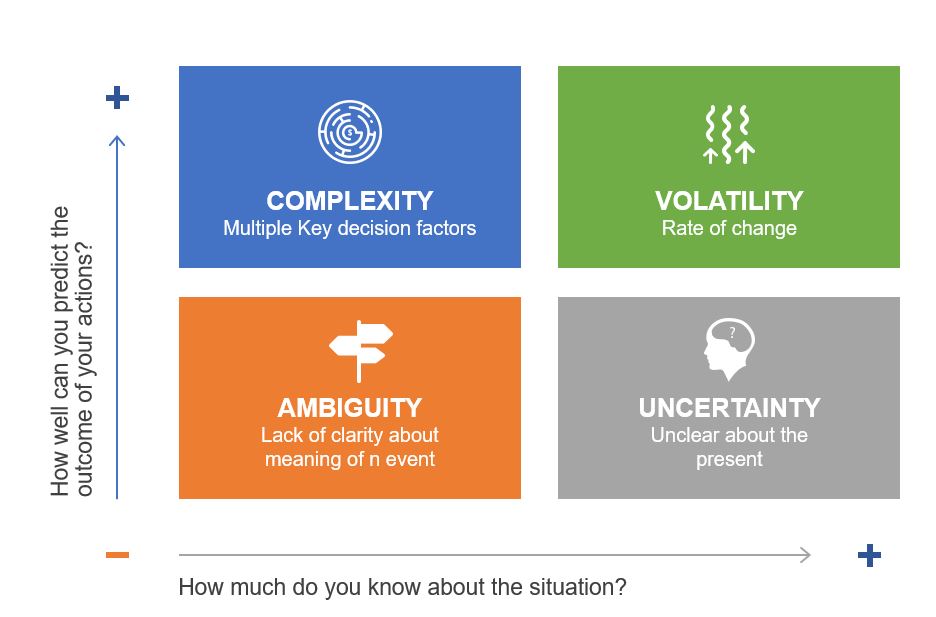
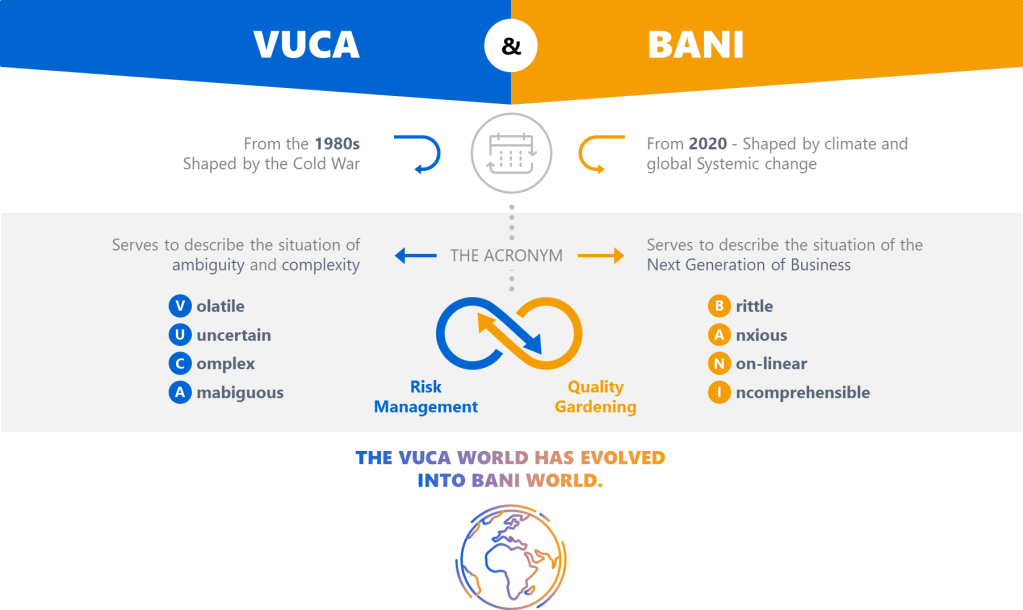
The quality management landscape has always been a battlefield of competing priorities, but today’s environment demands more than just compliance-it requires systems that thrive in chaos. For years, frameworks like VUCA (Volatility, Uncertainty, Complexity, Ambiguity) have dominated discussions about organizational resilience. But as the world fractures into what Jamais Cascio terms a BANI reality (Brittle, Anxious, Non-linear, Incomprehensible), our quality systems must evolve beyond 20th-century industrial thinking. Drawing from my decade of dissecting quality systems on Investigations of a Dog, let’s explore how these frameworks can inform modern quality management systems (QMS) and drive maturity.
Volatility-rapid, unpredictable shifts-calls for adaptive processes. Think of commodity markets where prices swing wildly. In pharma, this mirrors supply chain disruptions. The solution isn’t tighter controls but modular systems that allow quick pivots without compromising quality. My post on operational stability highlights how mature systems balance flexibility with consistency.
Ambiguity ≠ Uncertainty
Ambiguity-the “gray zones” where cause-effect relationships blur-is where traditional QMS often stumble. As I noted in Dealing with Emotional Ambivalence, ambiguity aversion leads to over-standardization. Instead, build experimentation loops into your QMS. For example, use small-scale trials to test contamination controls before full implementation.
BANI: The New Reality Check
Cascio’s BANI framework isn’t just an update to VUCA-it’s a wake-up call. Let’s break it down through a QMS lens:
Brittle Systems Break Without Warning
The FDA’s Quality Management Maturity (QMM) program emphasizes that mature systems withstand shocks. But brittleness lurks in overly optimized processes. Consider a validation program that relies on a single supplier: efficient, yes, but one disruption collapses the entire workflow. My maturity model analysis shows that redundancy and diversification are non-negotiable in brittle environments.
Anxiety Demands Psychological Safety
Anxiety isn’t just an individual burden, it’s systemic. In regulated industries, fear of audits often drives document hoarding rather than genuine improvement. The key lies in cultural excellence, where psychological safety allows teams to report near-misses without blame.
Non-Linear Cause-Effect Upends Root Cause Analysis
Traditional CAPA assumes linearity: find the root cause, apply a fix. But in a non-linear world, minor deviations cascade unpredictably. We need to think more holistically about problem solving.
Incomprehensibility Requires Humility
When even experts can’t grasp full system interactions, transparency becomes strategic. Adopt open-book quality metrics to share real-time data across departments. Cross-functional reviews expose blind spots.
The House of Quality model positions operational stability as the bridge between culture and excellence. In BANI’s brittle world, stability isn’t rigidity-it’s dynamic equilibrium. For example, a plant might maintain ±1% humidity control not by tightening specs but by diversifying HVAC suppliers and using real-time IoT alerts.
The Path Forward
VUCA taught us to expect chaos; BANI forces us to surrender the illusion of control. For quality leaders, this means:
Resist checklist thinking: VUCA’s four elements aren’t boxes to tick but lenses to sharpen focus.
Embrace productive anxiety: As I wrote in Ambiguity, discomfort drives innovation when channeled into structured experimentation.
The future belongs to quality systems that don’t just survive chaos but harness it. As Cascio reminds us, the goal isn’t to predict the storm but to learn to dance in the rain.
For deeper dives into these concepts, explore my series on VUCA and Quality Systems.
How you respond in the first 24 hours after discovering a deviation can make the difference between a minor quality issue and a major compliance problem. This critical window-what I call “The Golden Day”-represents your best opportunity to capture accurate information, contain potential risks, and set the stage for a successful investigation. When managed effectively, this initial day creates the foundation for identifying true root causes and implementing effective corrective actions that protect product quality and patient safety.
Why the First 24 Hours Matter: The Evidence
The initial response to a deviation is crucial for both regulatory compliance and effective problem-solving. Industry practice and regulatory expectations align on the importance of quick, systematic responses to deviations.
Regulatory expectations explicitly state that deviation investigation and root cause determination should be completed in a timely manner, and industry expectations usually align on deviations being completed within 30 days of discovery.
In the landmark U.S. v. Barr Laboratories case, “the Court declared that all failure investigations must be performed promptly, within thirty business days of the problem’s occurrence”
Best practices recommend assembling a cross-functional team immediately after deviation discovery and conduct initial risk assessment within 24 hours”
Initial actions taken in the first day directly impact the quality and effectiveness of the entire investigation process
When you capitalize on this golden window, you’re working with fresh memories, intact evidence, and the highest chance of observing actual conditions that contributed to the deviation.
Clear, precise problem definition forms the foundation of any effective investigation. Vague or incomplete problem statements lead to misdirected investigations and ultimately, inadequate corrective actions.
Document using specific, factual language that describes what occurred versus what was expected
Include all relevant details such as procedure and equipment numbers, product names and lot numbers
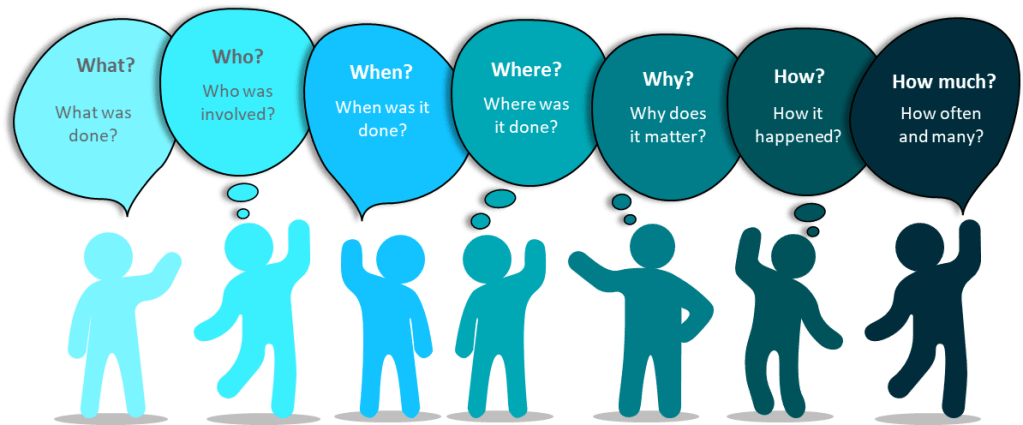
Apply the 5W2H method (What, When, Where, Who, Why if known, How much is involved, and How it was discovered)
Avoid speculation about causes in the initial description
Remember that the description should incorporate relevant records and photographs of discovered defects.
5W2H
Typical questions
Contains
Who?
Who are the people directly concerned with the problem? Who does this? Who should be involved but wasn’t? Was someone involved who shouldn’t be?
User IDs, Roles and Departments
What?
What happened?
Action, steps, description
When?
When did the problem occur?
Times, dates, place In process
Where?
Where did the problem occur?
Location
Why is it important?
Why did we do this? What are the requirements? What is the expected condition?
Justification, reason
How?
How did we discover. Where in the process was it?
Method, process, procedure
How Many? How Much?
How many things are involved? How often did the situation happen? How much did it impact?
Number, frequency
The quality of your deviation documentation begins with this initial identification. As I’ve emphasized in previous posts, the investigation/deviation report should tell a story that can be easily understood by all parties well after the event and the investigation. This narrative begins with clear identification on day one.
Elements
Problem Statement
Is used to…
Understand and target a problem. Providing a scope. Evaluate any risks. Make objective decisions
Answers the following… (5W2H)
What? (problem that occurred);When? (timing of what occurred); Where? (location of what occurred); Who? (persons involved/observers); Why? (why it matters, not why it occurred); How Much/Many? (volume or count); How Often? (First/only occurrence or multiple)
Contains…
Object (What was affected?); Defect (What went wrong?)
GEMBA-the actual place where work happens-is a cornerstone concept in quality management. When a deviation occurs, there is no substitute for being physically present at the location.
Observe the actual conditions and environment firsthand
Notice details that might not be captured in written reports
Understand the workflow and context surrounding the deviation
Gather physical evidence before it’s lost or conditions change
Create the opportunity for meaningful conversations with operators
Human error occurs because we are human beings. The extent of our knowledge, training, and skill has little to do with the mistakes we make. We tire, our minds wander and lose concentration, and we must navigate complex processes while satisfying competing goals and priorities – compliance, schedule adherence, efficiency, etc.
Foremost to understanding human performance is knowing that people do what makes sense to them given the available cues, tools, and focus of their attention at the time. Simply put, people come to work to do a good job – if it made sense for them to do what they did, it will make sense to others given similar conditions. The following factors significantly shape human performance and should be the focus of any human error investigation:
Physical Environment Environment, tools, procedures, process design
Organizational Culture Just- or blame-culture, attitude towards error
Management and Supervision Management of personnel, training, procedures
We do not want to see or experience human error – but when we do, it’s imperative to view it as a valuable opportunity to improve the system or process. This mindset is the heart of effective human error prevention.
Conducting an Effective GEMBA Walk for Deviations
When conducting your GEMBA walk specifically for deviation investigation:
Arrive with a clear purpose and structured approach
Observe before asking questions
Document observations with photos when appropriate
Look for environmental factors that might not appear in reports
Pay attention to equipment configuration and conditions
Note how operators interact with the process or equipment
A deviation gemba is a cross-functional team meeting that is assembled where a potential deviation event occurred. Going to the gemba and “freezing the scene” as close as possible to the time the event occurred will yield valuable clues about the environment that existed at the time – and fresher memories will provide higher quality interviews. This gemba has specific objectives:
Obtain a common understanding of the event: what happened, when and where it happened, who observed it, who was involved – all the facts surrounding the event. Is it a deviation?
Clearly describe actions taken, or that need to be taken, to contain impact from the event: product quarantine, physical or mechanical interventions, management or regulatory notifications, etc.
Interview involved operators: ask open-ended questions, like how the event unfolded or was discovered, from their perspective, or how the event could have been prevented, in their opinion – insights from personnel experienced with the process can prove invaluable during an investigation.
Deviation GEMBA Tips
Typically there is time between when notification of a deviation gemba goes out and when the team is scheduled to assemble. It is important to come prepared to help facilitate an efficient gemba:
Assemble procedures and other relevant documents and records. This will make references easier during the gemba.
Keep your team on-track – the gemba should end with the team having a common understanding of the event, actions taken to contain impact, and the agreed-upon next steps of the investigation.
You will gain plenty of investigational leads from your observations and interviews at the gemba – which documents to review, which personnel to interview, which equipment history to inspect, and more. The gemba is such an invaluable experience that, for many minor events, root cause and CAPA can be determined fairly easily from information gathered solely at the gemba.
Informal Rubric for Conducting a Good Deviation GEMBA
Describe the timeliness of the team gathering at the gemba.
Were all required roles and experts present?
Was someone leading or facilitating the gemba?
Describe any interviews the team performed during the gemba.
Did the team get sidetracked or off-topic during the gemba
Was the team prepared with relevant documentation or information?
Did the team determine batch impact and any reportability requirements?
Did the team satisfy the objectives of the gemba?
What did the team do well?
What could the team improve upon?
Speaking with Operators: The Power of Cognitive Interviewing
Interviewing personnel who were present when the deviation occurred requires special techniques to elicit accurate, complete information. Traditional questioning often fails to capture critical details.
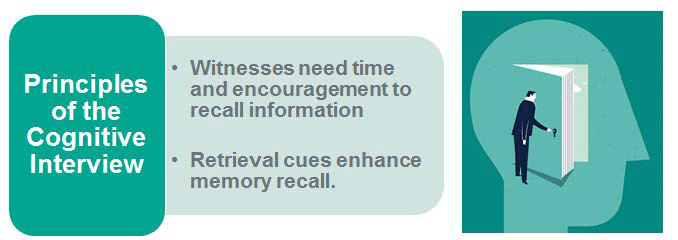
Cognitive interviewing, as I outlined in my previous post on “Interviewing,” was originally created for law enforcement and later adopted during accident investigations by the National Transportation Safety Board (NTSB). This approach is based on two key principles:
Witnesses need time and encouragement to recall information
Retrieval cues enhance memory recall
How to Apply Cognitive Interviewing in Deviation Investigations
Mental Reinstatement: Encourage the interviewee to mentally recreate the environment and people involved
In-Depth Reporting: Encourage the reporting of all the details, even if it is minor or not directly related
Multiple Perspectives: Ask the interviewee to recall the event from others’ points of view
Several Orders: Ask the interviewee to recount the timeline in different ways. Beginning to end, end to beginning
Most importantly, conduct these interviews at the actual location where the deviation occurred. A key part of this is that retrieval cues access memory. This is why doing the interview on the scene (or Gemba) is so effective.
Component
What It Consists of
Mental Reinstatement
Encourage the interviewee to mentally recreate the environment and people involved.
In-Depth Reporting
Encourage the reporting of all the details.
Multiple Perspectives
Ask the interviewee to recall the event from others’ points of view.
Several Orders
Ask the interviewee to recount the timeline in different ways.
Approach the Interviewee Positively:
Ask for the interview.
State the purpose of the interview.
Tell interviewee why he/she was selected.
Avoid statements that imply blame.
Focus on the need to capture knowledge
Answer questions about the interview.
Acknowledge and respond to concerns.
Manage negative emotions.
Apply these Four Components:
Use mental reinstatement.
Report everything.
Change the perspective.
Change the order.
Apply these Two Principles:
Witnesses need time and encouragement to recall information.
Retrieval cues enhance memory recall.
Demonstrate these Skills:
Recreate the original context and had them walk you through process.
Tell the witness to actively generate information.
Adopt the witness’s perspective.
Listen actively, do not interrupt, and pause before asking follow-up questions.
Ask open-ended questions.
Encourage the witness to use imagery.
Perform interview at the Gemba.
Follow sequence of the four major components.
Bring support materials.
Establish a connection with the witness.
Do Not tell them how they made the mistake.
Initial Impact Assessment: Understanding the Scope
Within the first 24 hours, a preliminary impact assessment is essential for determining the scope of the deviation and the appropriate response.
Apply a risk-based approach to categorize the deviation as critical, major, or minor
Evaluate all potentially affected products, materials, or batches
Consider potential effects on critical quality attributes
Assess possible regulatory implications
Determine if released products may be affected
This impact assessment is also the initial risk assessment, which will help guide the level of effort put into the deviation.
Factors to Consider in Initial Risk Assessment
Patient safety implications
Product quality impact
Compliance with registered specifications
Potential for impact on other batches or products
Regulatory reporting requirements
Level of investigation required
This initial assessment will guide subsequent decisions about quarantine, notification requirements, and the depth of investigation needed. Remember, this is a preliminary assessment that will be refined as the investigation progresses.
Immediate Actions: Containing the Issue
Once you’ve identified the deviation and assessed its potential impact, immediate actions must be taken to contain the issue and prevent further risk.
Quarantine potentially affected products or materials to prevent their release or further use
Notify key stakeholders, including quality assurance, production supervision, and relevant department heads
Implement temporary corrective or containment measures
Document the deviation in your quality management system
Secure relevant evidence and documentation
Consider whether to stop related processes
Industry best practices emphasize that you should Report the deviation in real-time. Notify QA within 24 hours and hold the GEMBA. Remember that “if you don’t document it, it didn’t happen” – thorough documentation of both the deviation and your immediate response is essential.
Affected vs Related Batches
Not every Impact is the same, so it can be helpful to have two concepts: Affected and Related.
Affected Batch: Product directly impacted by the event at the time of discovery, for instance, the batch being manufactured or tested when the deviation occurred.
Related Batch: Product manufactured or tested under the same conditions or parameters using the process in which the deviation occurred and determined as part of the deviation investigation process to have no impact on product quality.
Setting Up for a Successful Full Investigation
The final step in the golden day is establishing the foundation for the comprehensive investigation that will follow.
Assemble a cross-functional investigation team with relevant expertise
Define clear roles and responsibilities for team members
Establish a timeline for the investigation (remembering the 30-day guideline)
Identify additional data or evidence that needs to be collected
Plan for any necessary testing or analysis
Schedule follow-up interviews or observations
In my post on handling deviations, I emphasized that you must perform a time-sensitive and thorough investigation within 30 days. The groundwork laid during the golden day will make this timeline achievable while maintaining investigation quality.
Planning for Root Cause Analysis
During this setup phase, you should also begin planning which root cause analysis tools might be most appropriate for your investigation. Select tools based on the event complexity and the number of potential root causes and when “human error” appears to be involved, prepare to dig deeper as this is rarely the true root cause
Identifying Phase of your Investigation
If
Then you are at
The problem is not understood. Boundaries have not been set. There could be more than one problem
Problem Understanding
Data needs to be collected. There are questions about frequency or occurrence. You have not had interviews
Data Collection
Data has been collected but not analyszed
Data Analysis
The root cause needs to be determined from the analyzed data
A picture of the separate steps of a process in sequential order, including:
materials or services entering or leaving the process (inputs and outputs)
decisions that must be made
people who become involved
time involved at each step, and/or
process measurements.
Critical Incident Technique (CIT)
A process used for collecting direct observations of human behavior that
have critical significance, and
meet methodically defined criteria.
Comparative Analysis
A technique that focuses a problem-solving team on a problem. It compares one or more elements of a problem or process to evaluate elements that are similar or different (e.g. comparing a standard process to a failing process).
Performance Matrix
A tool that describes the participation by various roles in completing tasks or deliverables for a project or business process. Note: It is especially useful in clarifying roles and responsibilities in cross-functional/departmental positions.
5W2H Analysis
An approach that defines a problem and its underlying contributing factors by systematically asking questions related to who, what, when, where, why, how, and how much/often.
Data Collection
Surveys
A technique for gathering data from a targeted audience based on a standard set of criteria.
Check Sheets
A technique to compile data or observations to detect and show trends/patterns.
Cognitive Interview
An interview technique used by investigators to help the interviewee recall specific memories from a specific event.
KNOT Chart
A data collection and classification tool to organize data based on what is
Known
Need to know
Opinion, and
Think we know.
Data Analysis
Pareto Chart
A technique that focuses efforts on problems offering the greatest potential for improvement.
Histogram
A tool that
summarizes data collected over a period of time, and
graphically presents frequency distribution.
Scatter Chart
A tool to study possible relationships between changes in two different sets of variables.
Run Chart
A tool that captures study data for trends/patterns over time.
Affinity Diagram
A technique for brainstorming and summarizing ideas into natural groupings to understand a problem.
Root Cause Analysis
Interrelationship Digraphs
A tool to identify, analyze, and classify cause and effect relationships among issues so that drivers become part of an effective solution.
Why-Why
A technique that allows one to explore the cause-and-effect relationships of a particular problem by asking why; drilling down through the underlying contributing causes to identify root cause.
Is/Is Not
A technique that guides the search for causes of a problem by isolating the who, what, when, where, and how of an event. It narrows the investigation to factors that have an impact and eliminates factors that do not have an impact. By comparing what the problem is with what the problem is not, we can see what is distinctive about a problem which leads to possible causes.
Structured Brainstorming
A technique to identify, explore, and display the
factors within each root cause category that may be affecting the problem/issue, and/or
effect being studied through this structured idea-generating tool.
Cause and Effect Diagram (Ishikawa/Fishbone)
A tool to display potential causes of an event based on root cause categories defined by structured brainstorming using this tool as a visual aid.
Causal Factor Charting
A tool to
analyze human factors and behaviors that contribute to errors, and
identify behavior-influencing factors and gaps.
Other Tools
Prioritization Matrix
A tool to systematically compare choices through applying and weighting criteria.
Control Chart
A tool to monitor process performance over time by studying its variation and source.
Process Capability
A tool to determine whether a process is capable of meeting requirements or specifications.
Making the Most of Your Golden Day
The first 24 hours after discovering a deviation represent a unique opportunity that should not be wasted. By following the structured approach outlined in this post-identifying the problem clearly, going to the GEMBA, interviewing operators using cognitive techniques, conducting an initial impact assessment, taking immediate containment actions, and setting up for the full investigation-you maximize the value of this golden day.
Remember that excellent deviation management is directly linked to product quality, patient safety, and regulatory compliance. Each well-managed deviation is an opportunity to strengthen your quality system.
I encourage you to assess your current approach to the first 24 hours of deviation management. Are you capturing the full value of this golden day, or are you letting critical information slip away? Implement these strategies, train your team on proper deviation triage, and transform your deviation response from reactive to proactive.
Your deviation management effectiveness doesn’t begin when the investigation report is initiated-it begins the moment a deviation is discovered. Make that golden day count.
When considering the engagement of an external consultant for your facility, the decision should not be taken lightly. Consultants can provide invaluable insights when addressing compliance gaps, resolving environmental control issues, or conducting design reviews. However, the real value lies in their ability to bring expertise and actionable solutions tailored to your specific needs. To ensure this, assessing their relevant expertise and experience is paramount.
The first step in evaluating a consultant’s expertise is to scrutinize their professional background and track record. This involves examining their history of projects within your industry and determining whether they have successfully addressed challenges similar to yours. For instance, if you are dealing with deviations in environmental monitoring trends, you should confirm that the consultant has prior experience diagnosing and resolving such issues in facilities governed by comparable regulatory frameworks. Look for evidence of their familiarity with regulations and standards such as FDA 21 CFR Part 211 or ISO 14644 for cleanroom environments. Additionally, assess whether they have worked with facilities of a similar scale and complexity to yours—what works for a small-scale operation may not translate effectively to a larger, more intricate system.
To gain deeper insights into their qualifications, ask targeted questions during the evaluation process. For example:
“Can you describe a recent project where you addressed similar challenges? What were the outcomes?”
“How do you approach identifying root causes in complex systems?”
“What methodologies or tools do you use to ensure compliance with regulatory standards?” These questions not only help verify their technical knowledge but also reveal their problem-solving approach and adaptability.
Another critical aspect of assessing expertise is understanding their familiarity with current regulations and industry trends. A consultant who actively engages with updated guidelines from regulatory bodies like the FDA or EMA demonstrates a commitment to staying relevant. You might ask: “How do you stay informed about changes in regulations or advancements in technology that could impact our operations?” Their response can indicate whether they are proactive in maintaining their expertise or rely on outdated practices.
Experience is equally important in assessing whether a consultant can deliver practical, actionable recommendations. Review case studies or examples of past work that demonstrate measurable results—such as improved compliance rates, reduced deviations, or enhanced operational efficiency. Requesting references from previous clients is another effective way to validate their claims. When speaking with references, inquire about the consultant’s ability to communicate effectively, collaborate with internal teams, and deliver results within agreed timelines.
Ultimately, assessing expertise and experience requires a thorough evaluation of both technical qualifications and practical application. By asking detailed questions and reviewing tangible evidence of success, you can ensure that the consultant you hire has the skills and knowledge necessary to address your facility’s unique challenges effectively.
Companies that have participated in GMP remediation in response to warning letters or consent decrees offer a unique perspective on the intricacies of the facility. This experience allows them to:
Identify systemic issues more effectively: Remediation veterans are better equipped to recognize underlying problems that may not be immediately apparent, having seen how seemingly minor issues can cascade into major compliance failures.
Understand regulatory expectations: Direct experience with regulatory agencies during remediation provides insight into their thought processes, priorities, and interpretation of GMP requirements.
Implement sustainable solutions: Those who have been through remediation understand the importance of addressing root causes rather than applying superficial fixes, ensuring long-term compliance.
Prioritize effectively: Experience helps in distinguishing between critical issues that require immediate attention and those that can be addressed over time, allowing for more efficient resource allocation
Questions to Ask During Evaluation
To identify the best fit for your needs, ask potential consultants these critical questions:
Can you provide examples of similar projects you’ve completed?
This helps verify their experience with challenges of GMP facilities.
Look for previous remediation experience
What methodologies do you use?
Ensure their approach aligns with your facility’s operational style and regulatory requirements.
How do you ensure actionable recommendations?
Look for consultants who provide clear implementation plans rather than vague advice.
How do you handle confidentiality?
Confirm safeguards are in place to protect sensitive information.
Can you share references from past clients?
Contact references to assess reliability, responsiveness, and outcomes achieved.
What is your communication style?
Evaluate their ability to provide timely updates and collaborate effectively with your team.
Ensuring Actionable Outcomes
The ultimate goal of hiring a consultant is actionable improvements that enhance compliance, efficiency, or performance. To achieve this:
Define Clear Objectives
Before engaging a consultant, outline your project scope, goals, budget, and desired outcomes. This clarity helps both parties align expectations.
Insist on Detailed Proposals
Request proposals that include timelines, deliverables, methodologies, and pricing structures. This ensures transparency and sets benchmarks for success.
Collaborate Throughout the Process
Involve your team in discussions with the consultant to ensure alignment on priorities and feasibility of recommendations.
Monitor Implementation
Establish metrics to track progress against the consultant’s recommendations (e.g., compliance rates, operational efficiency improvements).
I get asked a lot where the name of this blog comes from, and then I have to explain my love of Kafka. This past week, I got asked what a book club would look like.
The Metamorphosis by Franz Kafka Kafka’s iconic novella critiques the alienation and dehumanization inherent in modern work, as Gregor Samsa’s transformation into an insect mirrors the loss of identity under corporate systems.
War with the Newts by Karel Čapek This satirical novel explores exploitation and capitalism through the enslavement of intelligent newts. It critiques corporate greed and globalization, offering insights into the commodification of labor. It is very timely as you think of the impact of AI.
The Jungle by Upton Sinclair Sinclair’s exposé of the meatpacking industry highlights the brutal realities of corporate exploitation and immigrant labor, themes that remain relevant in discussions about workplace ethics today. And are feeling really relevant in today’s political climate in the US.
À la ligne: Feuillets d’usine by Joseph Ponthus This poetic novel recounts the author’s experiences as a factory worker, vividly portraying the physical and emotional toll of repetitive labor. It critiques the corporate drive for profit at the expense of human dignity. English version is titled On the Line: Notes from a Factory and was translated by Stephanie Smee.
The Other Black Girl by Zakiya Dalila Harris Set in a publishing house, this thriller examines workplace racism, microaggressions, and systemic inequities within corporate environments.
Severance by Ling Ma A satirical take on office work and consumerism, this novel critiques the monotony of corporate culture while blending apocalyptic fiction.
The Reader on the 6.27 by Jean-Paul Didierlaurent This novel follows a book-pulping machine operator who salvages random pages to read aloud during his commute. It explores tensions between intellectual life and manual labor within a corporate framework.
Infinite Country by Patricia Engel This novel examines how immigration policies intersect with labor exploitation, highlighting systemic inequities faced by immigrant workers.
The reading list explores the complex interplay between corporate culture, alienation, and the human condition in modern society. Kafka’s The Metamorphosis and Čapek’s War with the Newts serve as foundational texts, critiquing the dehumanizing effects of capitalism and labor exploitation. Sinclair’s The Jungle exposes the brutal realities of industrial work, while contemporary novels like On the Line by Ponthus and The Other Black Girl by Harris examine the physical and emotional toll of repetitive labor and systemic inequities in corporate environments. French author Ponthus offers unique perspectives on factory work and corporate language, respectively, highlighting the global nature of these issues. The list also includes works that satirize office culture, such as Ling Ma’s Severance, which blends corporate critique with apocalyptic fiction. Throughout these selections, themes of alienation, identity loss, and the struggle for dignity in the face of corporate demands are prevalent, reflecting the ongoing relevance of these issues in modern work life.
The list has French representation, because frankly I started thinking of the list in Toulouse. I’m sure I could come up with a lot more global authors, though it might be hard to stick to 8 or 10 then.
I think every quality professional should, somewhere between individual contributor and manager, have to do a deep study into philosophy.
Studying philosophy offers several important benefits for the modern professional, enhancing both personal development and professional capabilities. Here are some reasons why philosophy is valuable in today’s professional quality leader:
Critical Thinking and Problem-Solving: Philosophy teaches individuals to think clearly, carefully, and logically about a wide range of topics. This skill is crucial for analyzing complex problems, making informed decisions, and developing innovative solutions in any professional field.
Communication Skills: Engaging with philosophical texts and discussions enhances one’s ability to read closely, write clearly, and articulate thoughts effectively. These communication skills are essential for conveying ideas persuasively and collaborating with others in a professional setting.
Ethical Reasoning: Philosophy provides a framework for addressing ethical questions and dilemmas. Understanding ethical principles helps professionals navigate moral challenges and make decisions that align with their values and societal norms. Ethical reasoning provides a framework for making decisions that are fair and just to all parties involved, ensuring that the organization’s actions align with its values and ethical standards
Cultural Awareness and Adaptability: Studying philosophy fosters cultural awareness and sensitivity, enabling professionals to work effectively in diverse environments. This awareness is particularly valuable in globalized industries where understanding different perspectives and cultural contexts is crucial.
Leadership and Strategic Thinking: Philosophy encourages big-picture thinking and strategic planning. Leaders who study philosophy are better equipped to anticipate future challenges, understand complex systems, and inspire others with a vision that goes beyond immediate concerns.
Career Versatility: Philosophy graduates pursue careers in various fields, including technology, business, law, government, and journalism. The skills acquired through studying philosophy are transferable and valued across multiple industries, providing a strong foundation for diverse career paths.
I’m certainly not an expert, but I do believe my professional life has benefited from philosophical study. I tend to be drawn to deontological ethics, a branch of moral philosophy that emphasizes the importance of rules, duties, and obligations in determining the morality of actions, rather than focusing on the consequences of those actions.
I can apply deontological ethics to the philosophy of quality management, particularly in the work of one of my favorite thinkers, W. Edwards Deming, which resonates with the principles of duty, rules, and respect for individuals. Here are some of the integrations I draw from:
Duty and Moral Rules: Deontological ethics emphasizes adherence to moral rules and duties. In quality management, this can translate to a commitment to ethical standards and practices that prioritize quality and integrity over short-term gains. Deming’s emphasis on building quality into the product from the start (rather than relying on inspection) aligns with a deontological focus on doing what is right as a matter of principle.
Respect for Individuals: Deontological ethics stresses the importance of treating individuals with respect and dignity. Deming’s philosophy includes driving out fear and fostering an environment where employees can take pride in their work without fear of retribution. This reflects a deontological commitment to respecting the autonomy and rights of workers. Bocheński’s distinction between the nature of authority based on knowledge (epistemic) and authority based on power or obligation (deontic) is a fundamental read for understanding quality culture.
Leadership and Responsibility: Deming’s points on leadership—such as instituting leadership that helps people and systems perform better—can be seen through a deontological lens as a duty to lead ethically and responsibly. This involves creating systems that support ethical behavior and quality improvement as a core value.
Systemic Integrity: Deming’s approach to quality management, which includes breaking down barriers between departments and fostering collaboration, can be aligned with deontological ethics by emphasizing the duty to maintain systemic integrity and fairness. This involves ensuring that all parts of an organization work together ethically to achieve common goals.
Commitment to Continuous Improvement: While utilitarian approaches might focus on outcomes, a deontological perspective in quality management would emphasize the duty to continuously improve processes and systems as a moral obligation, regardless of immediate outcomes. This aligns with Deming’s focus on constant improvement and education.
By integrating deontological ethics into quality management, I feel we can create a framework that not only seeks to improve quality and efficiency but also adheres to ethical principles that respect and empower individuals within the system.
A Reading List
The Right and the Good by W.D. Ross: This classic work introduces Ross’s theory of prima facie duties, which is central to his deontological framework.
The View from Nowhere by Thomas Nagel: This book explores the tension between subjective and objective perspectives, which is relevant to understanding ethical duties and objectivity in decision-making.
On Human Nature by Roger Scruton: Scruton discusses human nature and ethics, providing insights into moral duties and the philosophical underpinnings of ethical behavior.
Intention by G.E.M. Anscombe: This influential work examines the philosophy of action and intention, contributing to discussions on moral responsibility and ethics.
Postures of the Mind by Annette Baier: Baier’s essays explore trust, ethics, and the moral psychology underlying ethical relationships.
What is Authority? by Józef Maria Bocheński: This book delves into the concept of authority, distinguishing between deontic and epistemic authority and is hugely influential.


 Investigations of a Dog