Measuring Training Effectiveness for Organizational Performance

When designing training we want to make sure four things happen:

  • Training is used correctly as a solution to a performance problem
  • Training has the the right content, objectives or methods
  • Trainees are sent to training for which they do have the basic skills, prerequisite skills, or confidence needed to learn
  • Training delivers the expected learning

Training is a useful lever in organization change and improvement. We want to make sure the training drives organization metrics. And like everything, you need to be able to measure it to improve.

The Kirkpatrick model is a simple and fairly accurate way to measure the effectiveness of adult learning events (i.e., training), and while other methods are introduced periodically, the Kirkpatrick model endures because of its simplicity. The model consists of four levels, each designed to measure a specific element of the training. Created by Donald Kirkpatrick, this model has been in use for over 50 years, evolving over multiple decades through application by learning and development professionals around the world. It is the most recognized method of evaluating the effectiveness of training programs. The model has stood the test of time and became popular due to its ability to break down complex subject into manageable levels. It takes into account any style of training, both informal and formal.
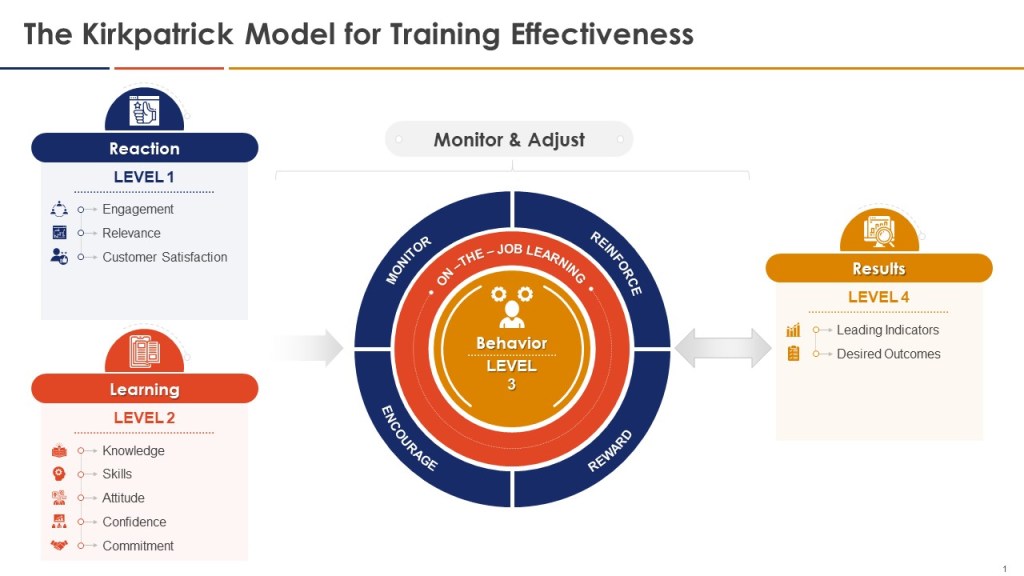
Level 1: Reaction

Kirkpatrick’s first level measures the learners’ reaction to the training. A level 1 evaluation is leveraging the strong correlation between learning retention and how much the learners enjoyed the time spent and found it valuable. Level 1 evaluations, euphemistically called a “smile sheet” should delve deeper than merely whether people liked the course. A good course evaluation will concentrate on three elements: course content, the physical environment and the instructor’s presentation/skills.

Level 2: Learning

Level 2 of Kirkpatrick’s model, learning, measures how much of the content attendees learned as a result of the training session. The best way to make this evaluation is through the use of a pre- and posttest. Pre- and posttests are key to ascertaining whether the participants learned anything in the learning event. Identical pre- and posttests are essential because the difference between the pre- and posttest scores indicates the amount of learning that took place. Without a pretest, one does not know if the trainees knew the material before the session, and unless the questions are the same, one cannot be certain that trainees learned the material in the session.

Level 3: Behavior

Level 3 measures whether the learning is transferred into practice in the workplace.

Level 4: Results

Measures the effect on the business environment. Do we meet objectives?

Evaluation LevelCharacteristicsExamples
Level 1: ReactionReaction evaluation is how the delegates felt, and their personal reactions to the training or learning experience, for example: ▪ Did trainee consider the training relevant?
▪ Did they like the venue, equipment, timing, domestics, etc?
▪ Did the trainees like and enjoy the training?
▪ Was it a good use of their time?
▪ Level of participation
▪ Ease and comfort of experience
▪ feedback forms based on subjective personal reaction to the training experience
▪ Verbal reaction which can be analyzed
▪ Post-training surveys or questionnaires
▪ Online evaluation or grading by delegates
▪ Subsequent verbal or written reports given by delegates to managers back at their jobs
▪ typically ‘happy sheets’
Level 2: LearningLearning evaluation is the measurement of the increase in knowledge or intellectual capability from before to after the learning experience:
▪ Did the trainees learn what intended to be taught?
▪ Did the trainee experience what was intended for them to experience?
▪ What is the extent of advancement or change in the trainees after the training, in the direction or area that was intended?
▪ Interview or observation can be used before and after although it is time-consuming and can be inconsistent
▪ Typically assessments or tests before and after the training
▪ Methods of assessment need to be closely related to the aims of the learning
▪ Reliable, clear scoring and measurements need to be established
▪ hard-copy, electronic, online or interview style assessments are all possible
Level 3: BehaviorBehavior evaluation is the extent to which the trainees applied the learning and changed their behavior, and this can be immediately and several months after the training, depending on the situation:
▪ Did the trainees put their learning into effect when back on the job?
▪ Were the relevant skills and knowledge used?
▪ Was there noticeable and measurable change in the activity and performance of the trainees when back in their roles?
▪ Would the trainee be able to transfer their learning to another person? is the trainee aware of their change in behavior, knowledge, skill level?
▪ Was the change in behavior and new level of knowledge sustained?
▪ Observation and interview over time are required to assess change, relevance of change, and sustainability of change
▪ Assessments need to be designed to reduce subjective judgment of the observer
▪ 360-degree feedback is useful method and need not be used before training, because respondents can make a judgment as to change after training, and this can be analyzed for groups of respondents and trainees
▪ Online and electronic assessments are more difficult to incorporate – assessments tend to be more successful when integrated within existing management and coaching protocols
Level 4: ResultsResults evaluation is the effect on the business or environment resulting from the improved performance of the trainee – it is the acid test

Measures would typically be business or organizational key performance indicators, such as: volumes, values, percentages, timescales, return on investment, and other quantifiable aspects of organizational performance, for instance; numbers of complaints, staff turnover, attrition, failures, wastage, non-compliance, quality ratings, achievement of standards and accreditations, growth, retention, etc.
The challenge is to identify which and how relate to the trainee’s input and influence. Therefore it is important to identify and agree accountability and relevance with the trainee at the start of the training, so they understand what is to be measured
▪ This process overlays normal good management practice – it simply needs linking to the training input
▪ For senior people particularly, annual appraisals and ongoing agreement of key business objectives are integral to measuring business results derived from training
4 Levels of Training Effectiveness

Example in Practice – CAPA

When building a training program, start with the intended behaviors that will drive results. Evaluating our CAPA program, we have two key aims, which we can apply measures against.

BehaviorMeasure
Investigate to find root cause% recurring issues
Implement actions to eliminate root causePreventive to corrective action ratio

To support each of these top-level measures we define a set of behavior indicators, such as cycle time, right the first time, etc. To support these, a review rubric is implemented.

Our four levels to measure training effectiveness will now look like this:

LevelMeasure
Level 1: Reaction Personal action plan and a happy sheet
Level 2: Learning Completion of Rubric on a sample event
Level 3: Behavior Continued performance and improvement against the Rubric and the key review behavior indicators
Level 4: Results Improvements in % of recurring issues and an increase in preventive to corrective actions

This is all about measuring the effectiveness of the transfer of behaviors.

Strong Signals of Transfer Expectations in the OrganizationSignals that Weaken Transfer Expectations in the Organization
Training participants are required to attend follow-up sesions and other transfer interventions.

What is indicates:
Individuals and teams are committed to the change and obtaining the intended benefits.
Attending the training is compulsory, but participating in follow-up sessions or oter transfer interventions is voluntary or even resisted by the organization.

What is indicates:
They key factor of a trainee is attendance, not behavior change.
The training description specifies transfer goals (e.g. “Trainee increases CAPA success by driving down recurrence of root cause”)

What is indicates:
The organization has a clear vision and expectation on what the training should accomplish.
The training description roughly outlines training goals (e.g. “Trainee improves their root cause analysis skills”)

What is indicates:
The organization only has a vague idea of what the training should accomplish.
Supervisors take time to support transfer (e.g. through pre- and post-training meetings). Transfer support is part of regular agendas.

What is indicates:
Transfer is considered important in the organization and supported by supervisors and managers, all the way to the top.
Supervisors do not invest in transfer support. Transfer support is not part of the supervisor role.

What is indicates:
Transfer is not considered very important in the organziaiton. Managers have more important things to do.
Each training ends with careful planning of individual transfer intentions.

What is indicates:
Defining transfer intentions is a central component of the training.
Transfer planning at the end of the training does not take place or only sporadically.

What is indicates:
Defining training intentions is not (or not an essential) part of the training.

Good training, and thus good and consistent transfer, builds that into the process. It is why I such a fan of utilizing a Rubric to drive consistent performance.
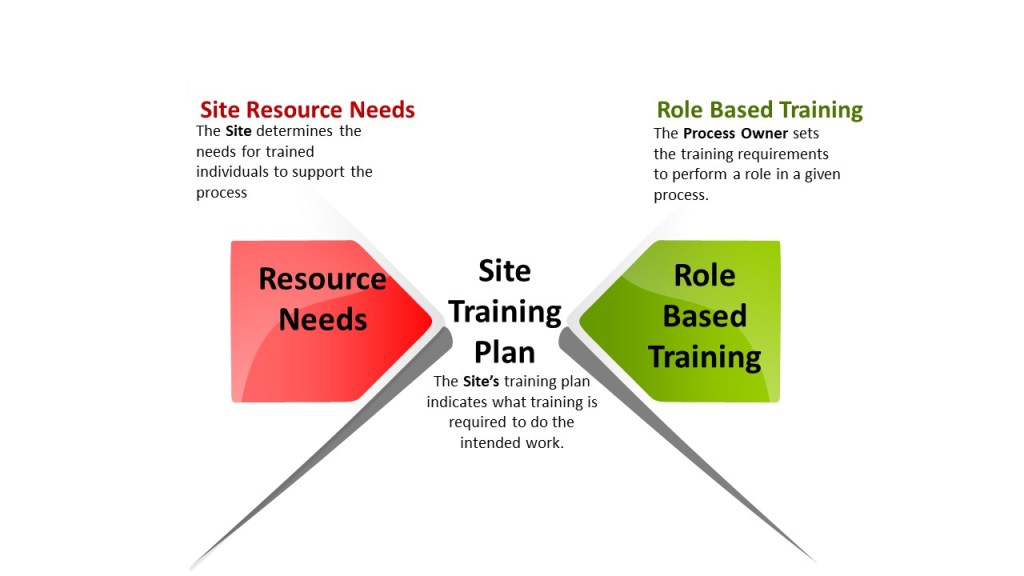
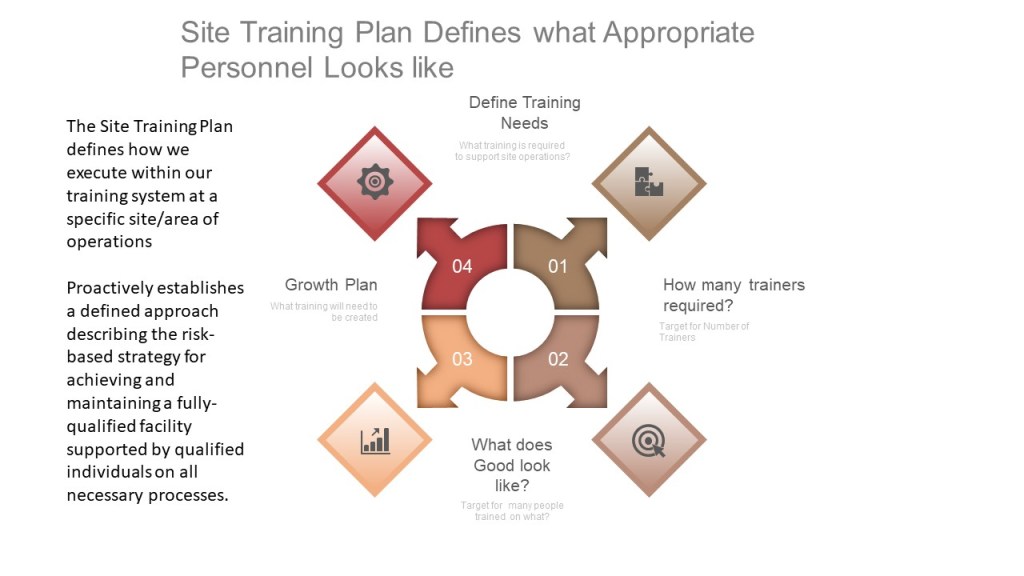
Site Training Needs

Institute training on the job.

Principle 6, W. Edwards Deming

(a) Each person engaged in the manufacture, processing, packing, or holding of a drug product shall have education, training, and experience, or any combination thereof, to enable that person to perform the assigned functions. Training shall be in the particular operations that the employee performs and in current good manufacturing practice (including the current good manufacturing practice regulations in this chapter and written procedures required by these regulations) as they relate to the employee’s functions. Training in current good manufacturing practice shall be conducted by qualified individuals on a continuing basis and with sufficient frequency to assure that employees remain familiar with CGMP requirements applicable to them.

(b) Each person responsible for supervising the manufacture, processing, packing, or holding of a drug product shall have the education, training, and experience, or any combination thereof, to perform assigned functions in such a manner as to provide assurance that the drug product has the safety, identity, strength, quality, and purity that it purports or is represented to possess.

(c) There shall be an adequate number of qualified personnel to perform and supervise the manufacture, processing, packing, or holding of each drug product.

US FDA 21CFR 210.25

All parts of the Pharmaceutical Quality system should be adequately resourced with competent personnel, and suitable and sufficient premises, equipment and facilities.

EU EMA/INS/GMP/735037/201 2.1

The organization shall determine and provide the resources needed for the establishment,
implementation, maintenance and continual improvement of the quality management system. The organization shall consider:

a) the capabilities of, and constraints on, existing internal resources;
b) what needs to be obtained from external providers.

ISO 9001:2015 requirement 7.1.1

It is critical to have enough people with the appropriate level of training to execute their tasks.

It is fairly easy to define the individual training plan, stemming from the job description and the process training requirements. In the aggregate we get the ability to track overdue training, and a forward look at what training is coming due. Quite frankly, lagging indicators that show success at completing assigned training but give no insight to the central question – do we have enough qualified individuals to do the work?

To get this proactive, we start with the resource plan. What operations need to happen in a time frame and what are the resources needed. We then compare that to the training requirements for those operations.

We can then evaluate current training status and retention levels and determine how many instructors we will need to ensure adequate training.

We perform a gap assessment to determine what new training needs exist

We then take a forward look at what new improvements are planned and ensure appropriate training is forecasted.

Now we have a good picture of what an “adequate number” is. We can now set a leading KPI to ensure that training is truly proactive.

Structured What-If Technique as a Risk Assessment Tool

The structured what-if technique, SWIFT, is a high-level and less formal risk identification technique that can be used independently, or as part of a staged approach to make bottom-up methods such as FMEA more efficient. SWIFT uses structured brainstorming in a facilitated workshop where a predetermined set of guidewords (timing, amount, etc.) are combined with prompts elicited from participants that often begin with phrases such as “what if?” or “how could?”.

At the heart of a SWIFT is a list of guidewords to enable a comprehensive review of risks or sources of risk. At the start of the workshop the context, scope and purpose of the SWIFT is discussed and criteria for success articulated. Using the guidewords and “what if?” prompts, the facilitator asks the participants to raise and discuss issues such as:

  • known risks
  • risk sources and drivers
  • previous experience, successes and incidents
  • known and existing controls
  • regulatory requirements and constraints

The list of guidewords is utilized by the facilitator to monitor the discussion and to suggest additional issues and scenarios for the team to discuss. The team considers whether controls are adequate and if not considers potential treatments. During this discussion, further “what if?” questions are posed.

Often the list of risks generated can be used to fuel a qualitative or semi-quantitative risk assessment method, such as an FMEA is.

A SWIFT Analysis allows participants to look at the system response to problems rather than just examining the consequences of component failure. As such, it can be used to identify opportunities for improvement of processes and systems and generally can be used to identify actions that lead to and enhance their probabilities of success.

What-If Analysis

What–If Analysis is a structured brainstorming method of determining what things can go wrong and judging the likelihood and consequences of those situations occurring.  The answers to these questions form the basis for making judgments regarding the acceptability of those risks and determining a recommended course of action for those risks judged to be unacceptable.  An experienced review team can effectively and productively discern major issues concerning a process or system.  Lead by an energetic and focused facilitator, each member of the review team participates in assessing what can go wrong based on their past experiences and knowledge of similar situations.

What If?AnswerLikelihoodSeverityRecommendations
What could go wrong?What would happen if it did?How likely?ConsequencesWhat will we do about them Again – prevent and monitor
What-If Analysis

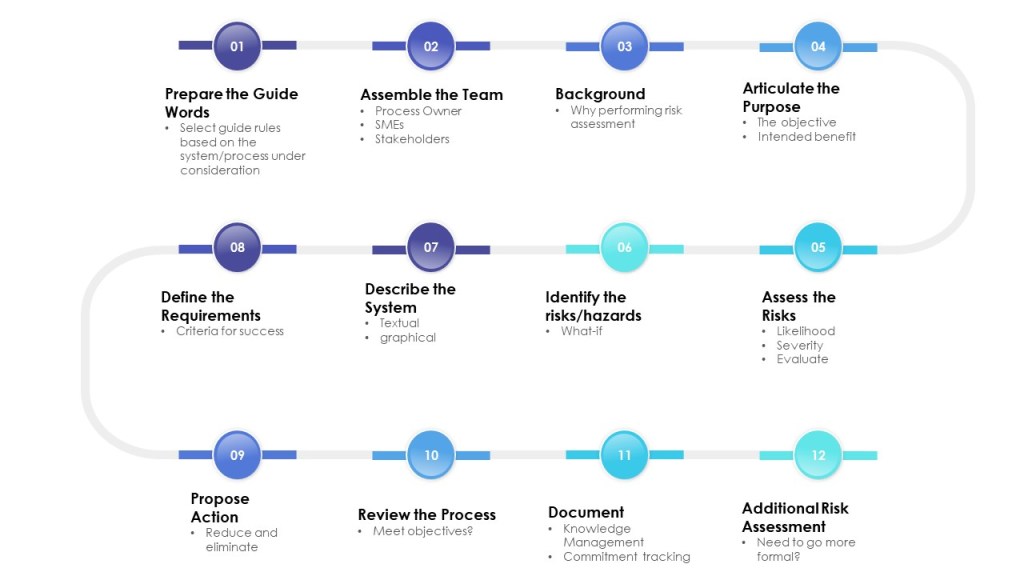
Steps in a SWIFT Analysis

SWIFT Risk Assessment
  1. Prepare the guide words: The facilitator should select a set of guide words to be used in the SWIFT.
  2. Assemble the team: Select participants for the SWIFT workshop based on their knowledge of the system/process being assessed and the degree to which they represent the full range of stakeholder groups.
  3. Background: Describe the trigger for the SWIFT (e.g., a regulatory change, an adverse event, etc.).
  4. Articulate the purpose: Clearly explain the purpose to be served by the SWIFT (e.g., to improve effectiveness of the process).
  5. Define the requirements: Articulate the criteria for success
  6. Describe the system: Provide appropriate-level textual and graphical descriptions of the system or process to be risk assessed. A clear understanding is necessary and can be is established through interviews, gathering a multifunctional team and through the study of documents, plans and other records. Normally the
  7. Identify the risks/hazards: This is where the structured what-if technique is applied. Use the guide words/headings with each system, high-level subsystem, or process step in turn. Participants should use prompts starting with the phrases like “What if…” or “How could…” to elicit potential risks/hazards associated with the guide word. For instance, if the process is “Receipt of samples,” and the guide word is “time, timing or speed,” prompts might include: “What if the sample is delivered at a shift change” (wrong time) or “How could the sample be left waiting too long in ambient conditions?” (wrong timing).
  8. Assess the risks: With the use of either a generic approach or a supporting risk analysis technique, estimate the risk associated with the identified hazards. In light of existing controls, assess the likelihood that they could lead to harm and the severity of harm they might cause. Evaluate the acceptability of these risk levels, and identify any aspects of the system that may require more detailed risk identification and analysis.
  9. Propose actions: Propose risk control action plans to reduce the identified risks to an acceptable level.
  10. Review the process: Determine whether the SWIFT met its objectives, or whether a more detailed risk assessment is required for some parts of the system.
  11. Document: Produce an overview document to communicate the results of the SWIFT.
  12. Additional risk assessment: Conduct additional risk assessments using more detailed or quantitative techniques, if required. The SWIFT Analysis is really effective as a filtering mechanism to focus effort on the most valuable areas.

Guideword Examples

The facilitator and process owner can choose any guide words that seem appropriate. Guidewords usually stem around:

  • Wrong: Person or people
  • Wrong: Place, location, site, or environment
  • Wrong: Thing or things
  • Wrong: Idea, information, or understanding
  • Wrong: Time, timing, or speed
  • Wrong: Process
  • Wrong: Amount
  • Failure: Control or Detection
  • Failure: Equipment

If your organization has invested time to create root cause categories and sub-categories, the guidewords can easily start there.

Information Gaps

An information gap is a known unknown, a question that one is aware of but for which one is uncertain of the answer. It is a disparity between what the decision maker knows and what could be known The attention paid to such an information gap depends on two key factors: salience, and importance.

  • The salience of a question indicates the degree to which contextual factors in a situation highlight it. Salience might depend, for example, on whether there is an obvious counterfactual in which the question can be definitively answered.
  • The importance of a question is a measure of how much one’s utility would depend on the actual answer. It is this factor—importance—which is influenced by actions like gambling on the answer or taking on risk that the information gap would be relevant for assessing.

Information gaps often dwell in the land of knightian uncertainty.

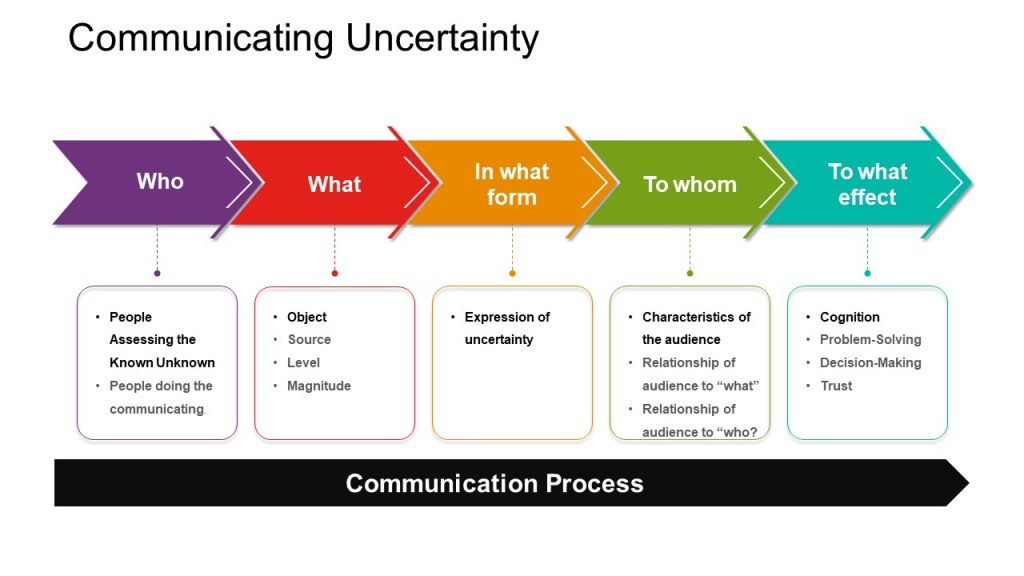
Communicating these Known Unknowns

Communicating around Known Unknowns and other forms of uncertainty

A wide range of reasons for information gaps exist:

  • variability within a sampled population or repeated measures leading to, for example, statistical margins-of-error
  • computational or systematic inadequacies of measurement
  • limited knowledge and ignorance about underlying processes
  • expert disagreement.

Process and procedure complexity

People are at the heart of any organization. They set the organization’s goals, they manage it, they deal with suppliers and customers and they work together to produce results.

We manage this by processes. Process are on a continuum by how complicated and complex they are. Simpler jobs can be reliably done by following procedure. More complex ones require the ability to analyze a situation – using established rules – and decide which of several alternative paths to follow. In even more complex cases they analyze, diagnose, design, redesign, program, plan or schedule. In some cases, they create new products, processes and new ways of being. Very complex jobs require individuals who can analyze and solve very complex problems.

These complex, knowledge driven processes get difficult to provide as work-as-prescribed. The work involves thought and creativity, and finding the right balance is a continual balancing act of knowledge management.