The Risk-Based Electronic Signature Decision Framework

In my recent exploration of the Jobs-to-Be-Done tool I examined how customer-centric thinking could revolutionize our understanding of complex quality processes. Today, I want to extend that analysis to one of the most persistent challenges in pharmaceutical data integrity: determining when electronic signatures are truly required to meet regulatory standards and data integrity expectations.

Most organizations approach electronic signature decisions through what I call “compliance theater”—mechanically applying rules without understanding the fundamental jobs these signatures need to accomplish. They focus on regulatory checkbox completion rather than building genuine data integrity capability. This approach creates elaborate signature workflows that satisfy auditors but fail to serve the actual needs of users, processes, or the data integrity principles they’re meant to protect.

The cost of getting this wrong extends far beyond regulatory findings. When organizations implement electronic signatures incorrectly, they create false confidence in their data integrity controls while potentially undermining the very protections these signatures are meant to provide. Conversely, when they avoid electronic signatures where they would genuinely improve data integrity, they perpetuate manual processes that introduce unnecessary risks and inefficiencies.

The Electronic Signature Jobs Users Actually Hire

When quality professionals, process owners and system owners consider electronic signature requirements, what job are they really trying to accomplish? The answer reveals a profound disconnect between regulatory intent and operational reality.

The Core Functional Job

“When I need to ensure data integrity, establish accountability, and meet regulatory requirements for record authentication, I want a signature method that reliably links identity to action and preserves that linkage throughout the record lifecycle, so I can demonstrate compliance and maintain trust in my data.”

This job statement immediately exposes the inadequacy of most electronic signature decisions. Organizations often focus on technical implementation rather than the fundamental purpose: creating trustworthy, attributable records that support decision-making and regulatory confidence.

The Consumption Jobs: The Hidden Complexity

Electronic signature decisions involve numerous consumption jobs that organizations frequently underestimate:

  • Evaluation and Selection: “I need to assess when electronic signatures provide genuine value versus when they create unnecessary complexity.”
  • Implementation and Training: “I need to build electronic signature capability without overwhelming users or compromising data quality.”
  • Maintenance and Evolution: “I need to keep my signature approach current as regulations evolve and technology advances.”
  • Integration and Governance: “I need to ensure electronic signatures integrate seamlessly with my broader data integrity strategy.”

These consumption jobs represent the difference between electronic signature systems that users genuinely want to hire and those they grudgingly endure.

The Emotional and Social Dimensions

Electronic signature decisions involve profound emotional and social jobs that traditional compliance approaches ignore:

  • Confidence: Users want to feel genuinely confident that their signature approach provides appropriate protection, not just regulatory coverage.
  • Professional Credibility: Quality professionals want signature systems that enhance rather than complicate their ability to ensure data integrity.
  • Organizational Trust: Executive teams want assurance that their signature approach genuinely protects data integrity rather than creating administrative overhead.
  • User Acceptance: Operational staff want signature workflows that support rather than impede their work.

The Current Regulatory Landscape: Beyond the Checkbox

Understanding when electronic signatures are required demands a sophisticated appreciation of the regulatory landscape that extends far beyond simple rule application.

FDA 21 CFR Part 11: The Foundation

21 CFR Part 11 establishes that electronic signatures can be equivalent to handwritten signatures when specific conditions are met. However, the regulation’s scope is explicitly limited to situations where signatures are required by predicate rules—the underlying FDA regulations that mandate signatures for specific activities.

The critical insight that most organizations miss: Part 11 doesn’t create new signature requirements. It simply establishes standards for electronic signatures when signatures are already required by other regulations. This distinction is fundamental to proper implementation.

Key Part 11 requirements include:

  • Unique identification for each individual
  • Verification of signer identity before assignment
  • Certification that electronic signatures are legally binding equivalents
  • Secure signature/record linking to prevent falsification
  • Comprehensive signature manifestations showing who signed what, when, and why

EU Annex 11: The European Perspective

EU Annex 11 takes a similar approach, requiring that electronic signatures “have the same impact as hand-written signatures”. However, Annex 11 places greater emphasis on risk-based decision making throughout the computerized system lifecycle.

Annex 11’s approach to electronic signatures emphasizes:

  • Risk assessment-based validation
  • Integration with overall data integrity strategy
  • Lifecycle management considerations
  • Supplier assessment and management

GAMP 5: The Risk-Based Framework

GAMP 5 provides the most sophisticated framework for electronic signature decisions, emphasizing risk-based approaches that consider patient safety, product quality, and data integrity throughout the system lifecycle.

GAMP 5’s key principles for electronic signature decisions include:

  • Risk-based validation approaches
  • Supplier assessment and leverage
  • Lifecycle management
  • Critical thinking application
  • User requirement specification based on intended use

The Predicate Rule Reality: Where Signatures Are Actually Required

The foundation of any electronic signature decision must be a clear understanding of where signatures are required by predicate rules. These requirements fall into several categories:

  • Manufacturing Records: Batch records, equipment logbooks, cleaning records where signature accountability is mandated by GMP regulations.
  • Laboratory Records: Analytical results, method validations, stability studies where analyst and reviewer signatures are required.
  • Quality Records: Deviation investigations, CAPA records, change controls where signature accountability ensures proper review and approval.
  • Regulatory Submissions: Clinical data, manufacturing information, safety reports where signatures establish accountability for submitted information.

The critical insight: electronic signatures are only subject to Part 11 requirements when handwritten signatures would be required in the same circumstances.

The Eight-Step Electronic Signature Decision Framework

Applying the Jobs-to-Be-Done universal job map to electronic signature decisions reveals where current approaches systematically fail and how organizations can build genuinely effective signature strategies.

Step 1: Define Context and Purpose

What users need: Clear understanding of the business process, data integrity requirements, regulatory obligations, and decisions the signature will support.

Current reality: Electronic signature decisions often begin with technology evaluation rather than purpose definition, leading to solutions that don’t serve actual needs.

Best practice approach: Begin every electronic signature decision by clearly articulating:

  • What business process requires authentication
  • What regulatory requirements mandate signatures
  • What data integrity risks the signature will address
  • What decisions the signed record will support
  • Who will use the signature system and in what context

Step 2: Locate Regulatory Requirements

What users need: Comprehensive understanding of applicable predicate rules, data integrity expectations, and regulatory guidance specific to their process and jurisdiction.

Current reality: Organizations often apply generic interpretations of Part 11 or Annex 11 without understanding the specific predicate rule requirements that drive signature needs.

Best practice approach: Systematically identify:

  • Specific predicate rules requiring signatures for your process
  • Applicable data integrity guidance (MHRA, FDA, EMA)
  • Relevant industry standards (GAMP 5, ICH guidelines)
  • Jurisdictional requirements for your operations
  • Industry-specific guidance for your sector

Step 3: Prepare Risk Assessment

What users need: Structured evaluation of risks associated with different signature approaches, considering patient safety, product quality, data integrity, and regulatory compliance.

Current reality: Risk assessments often focus on technical risks rather than the full spectrum of data integrity and business risks associated with signature decisions.

Best practice approach: Develop comprehensive risk assessment considering:

  • Patient safety implications of signature failure
  • Product quality risks from inadequate authentication
  • Data integrity risks from signature system vulnerabilities
  • Regulatory risks from non-compliant implementation
  • Business risks from user acceptance and system reliability
  • Technical risks from system integration and maintenance

Step 4: Confirm Decision Criteria

What users need: Clear criteria for evaluating signature options, with appropriate weighting for different risk factors and user needs.

Current reality: Decision criteria often emphasize technical features over fundamental fitness for purpose, leading to over-engineered or under-protective solutions.

Best practice approach: Establish explicit criteria addressing:

  • Regulatory compliance requirements
  • Data integrity protection level needed
  • User experience and adoption requirements
  • Technical integration and maintenance needs
  • Cost-benefit considerations
  • Long-term sustainability and evolution capability

Step 5: Execute Risk Analysis

What users need: Systematic comparison of signature options against established criteria, with clear rationale for recommendations.

Current reality: Risk analysis often becomes feature comparison rather than genuine assessment of how different approaches serve the jobs users need accomplished.

Best practice approach: Conduct structured analysis that:

  • Evaluates each option against established criteria
  • Considers interdependencies with other systems and processes
  • Assesses implementation complexity and resource requirements
  • Projects long-term implications and evolution needs
  • Documents assumptions and limitations
  • Provides clear recommendation with supporting rationale

Step 6: Monitor Implementation

What users need: Ongoing validation that the chosen signature approach continues to serve its intended purposes and meets evolving requirements.

Current reality: Organizations often treat electronic signature implementation as a one-time decision rather than an ongoing capability requiring continuous monitoring and adjustment.

Best practice approach: Establish monitoring systems that:

  • Track signature system performance and reliability
  • Monitor user adoption and satisfaction
  • Assess continued regulatory compliance
  • Evaluate data integrity protection effectiveness
  • Identify emerging risks or opportunities
  • Measure business value and return on investment

Step 7: Modify Based on Learning

What users need: Responsive adjustment of signature strategies based on monitoring feedback, regulatory changes, and evolving business needs.

Current reality: Electronic signature systems often become static implementations, updated only when forced by system upgrades or regulatory findings.

Best practice approach: Build adaptive capability that:

  • Regularly reviews signature strategy effectiveness
  • Updates approaches based on regulatory evolution
  • Incorporates lessons learned from implementation experience
  • Adapts to changing business needs and user requirements
  • Leverages technological advances and industry best practices
  • Maintains documentation of changes and rationale

Step 8: Conclude with Documentation

What users need: Comprehensive documentation that captures the rationale for signature decisions, supports regulatory inspections, and enables knowledge transfer.

Current reality: Documentation often focuses on technical specifications rather than the risk-based rationale that supports the decisions.

Best practice approach: Create documentation that:

  • Captures the complete decision rationale and supporting analysis
  • Documents risk assessments and mitigation strategies
  • Provides clear procedures for ongoing management
  • Supports regulatory inspection and audit activities
  • Enables knowledge transfer and training
  • Facilitates future reviews and updates

The Risk-Based Decision Tool: Moving Beyond Guesswork

The most critical element of any electronic signature strategy is a robust decision tool that enables consistent, risk-based choices. This tool must address the fundamental question: when do electronic signatures provide genuine value over alternative approaches?

The Electronic Signature Decision Matrix

The decision matrix evaluates six critical dimensions:

Regulatory Requirement Level:

  • High: Predicate rules explicitly require signatures for this activity
  • Medium: Regulations require documentation/accountability but don’t specify signature method
  • Low: Good practice suggests signatures but no explicit regulatory requirement

Data Integrity Risk Level:

  • High: Data directly impacts patient safety, product quality, or regulatory submissions
  • Medium: Data supports critical quality decisions but has indirect impact
  • Low: Data supports operational activities with limited quality impact

Process Criticality:

  • High: Process failure could result in patient harm, product recall, or regulatory action
  • Medium: Process failure could impact product quality or regulatory compliance
  • Low: Process failure would have operational impact but limited quality implications

User Environment Factors:

  • High: Users are technically sophisticated, work in controlled environments, have dedicated time for signature activities
  • Medium: Users have moderate technical skills, work in mixed environments, have competing priorities
  • Low: Users have limited technical skills, work in challenging environments, face significant time pressures

System Integration Requirements:

  • High: Must integrate with validated systems, requires comprehensive audit trails, needs long-term data integrity
  • Medium: Moderate integration needs, standard audit trail requirements, medium-term data retention
  • Low: Limited integration needs, basic documentation requirements, short-term data use

Business Value Potential:

  • High: Electronic signatures could significantly improve efficiency, reduce errors, or enhance compliance
  • Medium: Moderate improvements in operational effectiveness or compliance capability
  • Low: Limited operational or compliance benefits from electronic implementation

Decision Logic Framework

Electronic Signature Strongly Recommended (Score: 15-18 points):
All high-risk factors align with strong regulatory requirements and favorable implementation conditions. Electronic signatures provide clear value and are essential for compliance.

Electronic Signature Recommended (Score: 12-14 points):
Multiple risk factors support electronic signature implementation, with manageable implementation challenges. Benefits outweigh costs and complexity.

Electronic Signature Optional (Score: 9-11 points):
Mixed risk factors with both benefits and challenges present. Decision should be based on specific organizational priorities and capabilities.

Alternative Controls Preferred (Score: 6-8 points):
Low regulatory requirements combined with implementation challenges suggest alternative controls may be more appropriate.

Electronic Signature Not Recommended (Score: Below 6 points):
Risk factors and implementation challenges outweigh potential benefits. Focus on alternative controls and process improvements.

Implementation Guidance by Decision Category

For Strongly Recommended implementations:

  • Invest in robust, validated electronic signature systems
  • Implement comprehensive training and competency programs
  • Establish rigorous monitoring and maintenance procedures
  • Plan for long-term system evolution and regulatory changes

For Recommended implementations:

  • Consider phased implementation approaches
  • Focus on high-value use cases first
  • Establish clear success metrics and monitoring
  • Plan for user adoption and change management

For Optional implementations:

  • Conduct detailed cost-benefit analysis
  • Consider pilot implementations in specific areas
  • Evaluate alternative approaches simultaneously
  • Maintain flexibility for future evolution

For Alternative Controls approaches:

  • Focus on strengthening existing manual controls
  • Consider semi-automated approaches (e.g., witness signatures, timestamp logs)
  • Plan for future electronic signature capability as conditions change
  • Maintain documentation of decision rationale for future reference

Practical Implementation Strategies: Building Genuine Capability

Effective electronic signature implementation requires attention to three critical areas: system design, user capability, and governance frameworks.

System Design Considerations

Electronic signature systems must provide robust identity verification that meets both regulatory requirements and practical user needs. This includes:

Authentication and Authorization:

  • Multi-factor authentication appropriate to risk level
  • Role-based access controls that reflect actual job responsibilities
  • Session management that balances security with usability
  • Integration with existing identity management systems where possible

Signature Manifestation Requirements:

Regulatory requirements for signature manifestation are explicit and non-negotiable. Systems must capture and display:

  • Printed name of the signer
  • Date and time of signature execution
  • Meaning or purpose of the signature (approval, review, authorship, etc.)
  • Unique identification linking signature to signer
  • Tamper-evident presentation in both electronic and printed formats

Audit Trail and Data Integrity:

Electronic signature systems must provide comprehensive audit trails that support both routine operations and regulatory inspections. Essential capabilities include:

  • Immutable recording of all signature-related activities
  • Comprehensive metadata capture (who, what, when, where, why)
  • Integration with broader system audit trail capabilities
  • Secure storage and long-term preservation of audit information
  • Searchable and reportable audit trail data

System Integration and Interoperability:

Electronic signatures rarely exist in isolation. Effective implementation requires:

  • Seamless integration with existing business applications
  • Consistent user experience across different systems
  • Data exchange standards that preserve signature integrity
  • Backup and disaster recovery capabilities
  • Migration planning for system upgrades and replacements

Training and Competency Development

User Training Programs:
Electronic signature success depends critically on user competency. Effective training programs address:

  • Regulatory requirements and the importance of signature integrity
  • Proper use of signature systems and security protocols
  • Recognition and reporting of signature system problems
  • Understanding of signature meaning and legal implications
  • Regular refresher training and competency verification

Administrator and Support Training:
System administrators require specialized competency in:

  • Electronic signature system configuration and maintenance
  • User account and role management
  • Audit trail monitoring and analysis
  • Incident response and problem resolution
  • Regulatory compliance verification and documentation

Management and Oversight Training:
Management personnel need understanding of:

  • Strategic implications of electronic signature decisions
  • Risk assessment and mitigation approaches
  • Regulatory compliance monitoring and reporting
  • Business continuity and disaster recovery planning
  • Vendor management and assessment requirements

Governance Framework Development

Policy and Procedure Development:
Comprehensive governance requires clear policies addressing:

  • Electronic signature use cases and approval authorities
  • User qualification and training requirements
  • System administration and maintenance procedures
  • Incident response and problem resolution processes
  • Periodic review and update procedures

Risk Management Integration:
Electronic signature governance must integrate with broader quality risk management:

  • Regular risk assessment updates reflecting system changes
  • Integration with change control and configuration management
  • Vendor assessment and ongoing monitoring
  • Business continuity and disaster recovery testing
  • Regulatory compliance monitoring and reporting

Performance Monitoring and Continuous Improvement:
Effective governance includes ongoing performance management:

  • Key performance indicators for signature system effectiveness
  • User satisfaction and adoption monitoring
  • System reliability and availability tracking
  • Regulatory compliance verification and trending
  • Continuous improvement process and implementation

Building Genuine Capability

The ultimate goal of any electronic signature strategy should be building genuine organizational capability rather than simply satisfying regulatory requirements. This requires a fundamental shift in mindset from compliance theater to value creation.

Design Principles for User-Centered Electronic Signatures

Purpose Over Process: Begin signature decisions with clear understanding of the jobs signatures need to accomplish rather than the technical features available.

Value Over Compliance: Prioritize implementations that create genuine business value and data integrity improvement rather than simply satisfying regulatory checkboxes.

User Experience Over Technical Sophistication: Design signature workflows that support rather than impede user productivity and data quality.

Integration Over Isolation: Ensure electronic signatures integrate seamlessly with broader data integrity and quality management strategies.

Evolution Over Stasis: Build signature capabilities that can adapt and improve over time rather than static implementations.
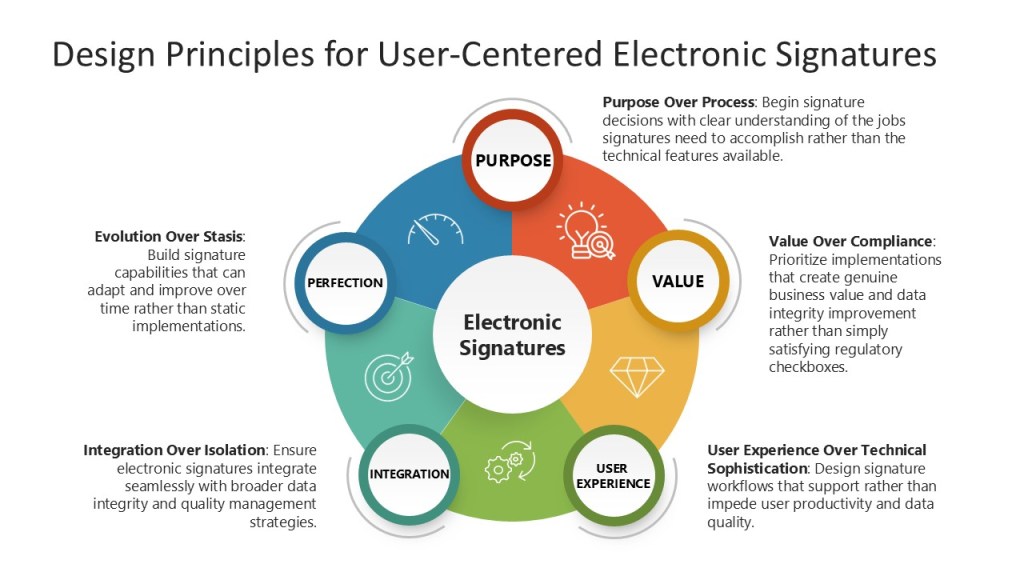
The image illustrates five design principles for user-centered electronic signatures in a circular infographic. At the center is the term "Electronic Signatures," surrounded by five labeled sections: Purpose, Value, User Experience, Integration, and Perfection. Each section contains a principle with supporting text:

Purpose Over Process: Emphasizes understanding the job requirements for signatures before technical features.

Value Over Compliance: Focuses on business value and data integrity, not just regulatory compliance.

User Experience Over Technical Sophistication: Encourages workflows that support productivity and data quality.

Integration Over Isolation: Stresses integrating electronic signatures with broader quality management strategies.

Evolution Over Stasis: Advocates capability improvements over static implementations. The design uses different colors for each principle and includes icons representing their themes.

Building Organizational Trust Through Electronic Signatures

Electronic signatures should enhance rather than complicate organizational trust in data integrity. This requires:

  • Transparency: Users should understand how electronic signatures protect data integrity and support business decisions.
  • Reliability: Signature systems should work consistently and predictably, supporting rather than impeding daily operations.
  • Accountability: Electronic signatures should create clear accountability and traceability without overwhelming users with administrative burden.
  • Competence: Organizations should demonstrate genuine competence in electronic signature implementation and management, not just regulatory compliance.

Future-Proofing Your Electronic Signature Approach

The regulatory and technological landscape for electronic signatures continues to evolve. Organizations need approaches that can adapt to:

  • Regulatory Evolution: Draft revisions to Annex 11, evolving FDA guidance, and new regulatory requirements in emerging markets.
  • Technological Advancement: Biometric signatures, blockchain-based authentication, artificial intelligence integration, and mobile signature capabilities.
  • Business Model Changes: Remote work, cloud-based systems, global operations, and supplier network integration.
  • User Expectations: Consumerization of technology, mobile-first workflows, and seamless user experiences.

The Path Forward: Hiring Electronic Signatures for Real Jobs

We need to move beyond electronic signature systems that create false confidence while providing no genuine data integrity protection. This happens when organizations optimize for regulatory appearance rather than user needs, creating elaborate signature workflows that nobody genuinely wants to hire.

True electronic signature strategy begins with understanding what jobs users actually need accomplished: establishing reliable accountability, protecting data integrity, enabling efficient workflows, and supporting regulatory confidence. Organizations that design electronic signature approaches around these jobs will develop competitive advantages in an increasingly digital world.

The framework presented here provides a structured approach to making these decisions, but the fundamental insight remains: electronic signatures should not be something organizations implement to satisfy auditors. They should be capabilities that organizations actively seek because they make data integrity demonstrably better.

When we design signature capabilities around the jobs users actually need accomplished—protecting data integrity, enabling accountability, streamlining workflows, and building regulatory confidence—we create systems that enhance rather than complicate our fundamental mission of protecting patients and ensuring product quality.

The choice is clear: continue performing electronic signature compliance theater, or build signature capabilities that organizations genuinely want to hire. In a world where data integrity failures can result in patient harm, product recalls, and regulatory action, only the latter approach offers genuine protection.

Electronic signatures should not be something we implement because regulations require them. They should be capabilities we actively seek because they make us demonstrably better at protecting data integrity and serving patients.
The Regulatory Red Herring: Why High-Level Compliance Requirements Have No Place in User Requirements Specifications

We have an unfortunate habit of conflating regulatory process requirements with specific system functionality requirements. This confusion manifests most perversely in User Requirements Specifications that contain nebulous statements like “the system shall comply with 21 CFR Part 11” or “the system must meet EU GMP Annex 11 requirements.” These high-level regulatory citations represent a fundamental misunderstanding of what user requirements should accomplish and demonstrate a dangerous abdication of the detailed thinking required for effective validation.

The core problem is simple yet profound: lifecycle, risk management, and validation are organizational processes, not system characteristics. When we embed these process-level concepts into system requirements, we create validation exercises that test compliance theater rather than functional reality.

The Distinction That Changes Everything

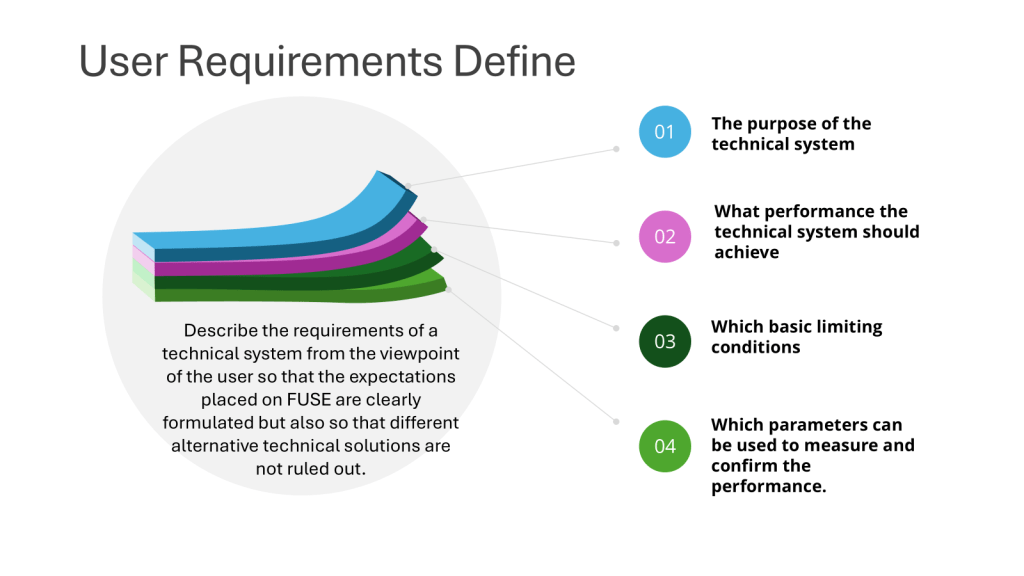
User requirements specifications serve as the foundational document identifying what a system must do to meet specific business needs, product requirements, and operational constraints. They translate high-level business objectives into measurable, testable, and verifiable system behaviors. User requirements focus on what the system must accomplish, not how the organization manages its regulatory obligations.

Consider the fundamental difference between these approaches:

Problematic High-Level Requirement: “The system shall comply with 21 CFR Part 11 validation requirements.”

Proper Detailed Requirements:

  • “The system shall generate time-stamped audit trails for all data modifications, including user ID, date/time, old value, new value, and reason for change”
  • “The system shall enforce unique user identification through username/password combinations with minimum 8-character complexity requirements”
  • “The system shall prevent deletion of electronic records while maintaining complete audit trail visibility”
  • “The system shall provide electronic signature functionality that captures the printed name, date/time, and meaning of the signature”

The problematic version tells us nothing about what the system actually needs to do. The detailed versions provide clear, testable criteria that directly support Part 11 compliance while specifying actual system functionality.

Process vs. System: Understanding the Fundamental Categories

Lifecycle management, risk assessment, and validation represent organizational processes that exist independently of any specific system implementation. These processes define how an organization approaches system development, operation, and maintenance—they are not attributes that can be “built into” software.

Lifecycle processes encompass the entire journey from initial system conception through retirement, including stages such as requirements definition, design, development, testing, deployment, operation, and eventual decommissioning. A lifecycle approach ensures systematic progression through these stages with appropriate documentation, review points, and decision criteria. However, lifecycle management cannot be embedded as a system requirement because it describes the framework within which system development occurs, not system functionality itself.

Risk management processes involve systematic identification, assessment, and mitigation of potential hazards throughout system development and operation. Risk management influences system design decisions and validation approaches, but risk management itself is not a system capability—it is an organizational methodology for making informed decisions about system requirements and controls.

Validation processes establish documented evidence that systems consistently perform as intended and meet all specified requirements. Validation involves planning, execution, and documentation of testing activities, but validation is something done to systems, not something systems possess as an inherent characteristic.

The Illusion of Compliance Through Citation

When user requirements specifications contain broad regulatory citations rather than specific functional requirements, they create several critical problems that undermine effective validation:

  • Untestable Requirements: How does one verify that a system “complies with Part 11”? Such requirements provide no measurable criteria, no specific behaviors to test, and no clear success/failure conditions. Verification becomes a subjective exercise in regulatory interpretation rather than objective measurement of system performance.
  • Validation Theater: Broad compliance statements encourage checkbox validation exercises where teams demonstrate regulatory awareness without proving functional capability. These validations often consist of mapping system features to regulatory sections rather than demonstrating that specific user needs are met.
  • Scope Ambiguity: Part 11 and Annex 11 contain numerous requirements, many of which may not apply to specific systems or use cases. Blanket compliance statements fail to identify which specific regulatory requirements are relevant and which system functions address those requirements.
  • Change Management Nightmares: When requirements reference entire regulatory frameworks rather than specific system behaviors, any regulatory update potentially impacts system validation status. This creates unnecessary re-validation burdens and regulatory uncertainty.

Building Requirements That Actually Work

Effective user requirements specifications address regulatory compliance through detailed, system-specific functional requirements that directly support regulatory objectives. This approach ensures that validation activities test actual system capabilities rather than regulatory awareness

Focus on Critical Quality Attributes: Rather than citing broad compliance frameworks, identify the specific product and process attributes that regulatory requirements are designed to protect. For pharmaceutical systems, this might include data integrity, product traceability, batch genealogy, or contamination prevention.

Translate Regulatory Intent into System Functions: Understand what each applicable regulation is trying to achieve, then specify system behaviors that accomplish those objectives. Part 11’s audit trail requirements, for example, aim to ensure data integrity and accountability—translate this into specific system capabilities for logging, storing, and retrieving change records.

Maintain Regulatory Traceability: Document the relationship between specific system requirements and regulatory drivers, but do so through traceability matrices or design rationale documents rather than within the requirements themselves. This maintains clear regulatory justification while keeping requirements focused on system functionality.

Enable Risk-Based Validation: Detailed functional requirements support risk-based validation approaches by clearly identifying which system functions are critical to product quality, patient safety, or data integrity. This enables validation resources to focus on genuinely important capabilities rather than comprehensive regulatory coverage.

The Process-System Interface: Getting It Right

The relationship between organizational processes and system requirements should be managed through careful analysis and translation, not through broad regulatory citations. Effective user requirements development involves several critical steps:

Process Analysis: Begin by understanding the organizational processes that the system must support. This includes manufacturing processes, quality control workflows, regulatory reporting requirements, and compliance verification activities. However, the focus should be on what the system must enable, not how the organization manages compliance.

Regulatory Gap Analysis: Identify specific regulatory requirements that apply to the intended system use. Analyze these requirements to understand their functional implications for system design, but avoid copying regulatory language directly into system requirements.

Functional Translation: Convert regulatory requirements into specific, measurable system behaviors. This translation process requires deep understanding of both regulatory intent and system capabilities, but produces requirements that can be objectively verified.

Organizational Boundary Management: Clearly distinguish between requirements for system functionality and requirements for organizational processes. System requirements should focus exclusively on what the technology must accomplish, while process requirements address how the organization will use, maintain, and govern that technology.

Real-World Consequences of the Current Approach

The practice of embedding high-level regulatory requirements in user requirements specifications has created systemic problems throughout the pharmaceutical industry:

  • Validation Inefficiency: Teams spend enormous resources demonstrating broad regulatory compliance rather than proving that systems meet specific user needs. This misallocation of validation effort undermines both regulatory compliance and system effectiveness.
  • Inspection Vulnerability: When regulatory inspectors evaluate systems against broad compliance claims, they often identify gaps between high-level assertions and specific system capabilities. Detailed functional requirements provide much stronger inspection support by demonstrating specific regulatory compliance mechanisms.
  • System Modification Complexity: Changes to systems with broad regulatory requirements often trigger extensive re-validation activities, even when the changes don’t impact regulatory compliance. Specific functional requirements enable more targeted change impact assessments.
  • Cross-Functional Confusion: Development teams, validation engineers, and quality professionals often interpret broad regulatory requirements differently, leading to inconsistent implementation and validation approaches. Detailed functional requirements provide common understanding and clear success criteria.

A Path Forward: Detailed Requirements for Regulatory Success

The solution requires fundamental changes in how the pharmaceutical industry approaches user requirements development and regulatory compliance documentation:

Separate Compliance Strategy from System Requirements: Develop comprehensive regulatory compliance strategies that identify applicable requirements and define organizational approaches for meeting them, but keep these strategies distinct from system functional requirements. Use the compliance strategy to inform requirements development, not replace it.

Invest in Requirements Translation: Build organizational capability for translating regulatory requirements into specific, testable system functions. This requires regulatory expertise, system knowledge, and requirements engineering skills working together.

Implement Traceability Without Embedding: Maintain clear traceability between system requirements and regulatory drivers through external documentation rather than embedded citations. This preserves regulatory justification while keeping requirements focused on system functionality.

Focus Validation on Function: Design validation approaches that test system capabilities directly rather than compliance assertions. This produces stronger regulatory evidence while ensuring system effectiveness.

Lifecycle, risk management, and validation are organizational processes that guide how we develop and maintain systems—they are not system requirements themselves. When we treat them as such, we undermine both regulatory compliance and system effectiveness. The time has come to abandon this regulatory red herring and embrace requirements practices worthy of the products and patients we serve.

The Problem with High-Level Regulatory User Requirements: Why “Meet Part 11” is Bad Form

Writing user requirements that simply state “the system shall meet FDA 21 CFR Part 11 requirements” or “the system shall comply with EU Annex 11” is fundamentally bad practice. These high-level regulatory statements create ambiguity, shift responsibility inappropriately, and fail to provide the specific, testable criteria that effective requirements demand.

The Core Problem: Regulatory References Aren’t Technical Requirements

User requirements must be specific, measurable, and testable. When we write “the system shall meet Annex 11 and Part 11 requirements,” we’re not writing a technical requirement at all—we’re writing a reference to a collection of regulatory provisions that may or may not apply to our specific system context. This creates several fundamental problems that undermine the entire validation and verification process.

The most critical issue is ambiguity of technical scope. Annex 11 and Part 11 contains numerous provisions, but not all apply to every system. Some provisions address closed systems, others open systems. Some apply only when electronic records replace paper records, others when organizations rely on electronic records to perform regulated activities. Without specifying which technical provisions apply and how they translate into system functionality, we leave interpretation to individual team members—a recipe for inconsistent implementation.

Technical verification becomes impossible with such high-level statements. How does a tester verify that a system “meets Part 11”? They would need to become regulatory experts, interpret which provisions apply, translate those into testable criteria, and then execute tests—work that should have been done during requirements definition. This shifting of analytical responsibility from requirements authors to testers violates fundamental engineering principles.

Why This Happens: The Path of Least Resistance

The temptation to write high-level regulatory requirements stems from several understandable but misguided motivations. Requirements authors often lack deep regulatory knowledge and find it easier to reference entire regulations rather than analyze which specific technical provisions apply to their system. This approach appears comprehensive while avoiding the detailed work of regulatory interpretation.

Time pressure exacerbates this tendency. Writing “meet Part 11” takes minutes; properly analyzing regulatory requirements, determining technical applicability, and translating them into specific, testable statements takes days or weeks. Under project pressure, teams often choose the quick path without considering downstream consequences.

There’s also a false sense of completeness. Referencing entire regulations gives the impression of thorough coverage when it actually provides no technical coverage at all. It’s the requirements equivalent of writing “the system shall work properly”, technically correct but utterly useless for implementation or testing purposes.

Better Approach: Technical User Requirements

Effective regulatory user requirements break down high-level regulatory concepts into specific, measurable technical statements that directly address system functionality. Rather than saying “meet Part 11,” we need requirements that specify exactly what the system must do technically.

Access Control Requirements

Instead of: “The system shall meet Part 11 access control requirements”

Write:

  • “The system shall authenticate users through unique user ID and password combinations, where each combination is assigned to only one individual”
  • “The system shall automatically lock user sessions after 30 minutes of inactivity and require re-authentication”
  • “The system shall maintain an electronic log of all user authentication attempts, including failed attempts, with timestamps and user identifiers”

Electronic Record Generation Requirements

Instead of: “The system shall generate Part 11 compliant electronic records”

Write:

  • “The system shall generate electronic records that include all data required by the predicate rule, with no omission of required information”
  • “The system shall time-stamp all electronic records using computer-generated timestamps that cannot be altered by system users”
  • “The system shall detect and flag any unauthorized alterations to electronic records through checksum validation”

Audit Trail Requirements

Instead of: “The system shall maintain Part 11 compliant audit trails”

Write:

  • “The system shall automatically record the user ID, date, time, and type of action for all data creation, modification, and deletion operations”
  • “The system shall store audit trail records in a format that prevents user modification or deletion”
  • “The system shall provide audit trail search and filter capabilities by user, date range, and record type”

Electronic Signature Requirements

Instead of: “The system shall support Part 11 electronic signatures”

Write:

  • “Electronic signature records shall include the signer’s printed name, date and time of signing, and the purpose of the signature”
  • “The system shall verify signer identity through authentication requiring both user ID and password before accepting electronic signatures
  • “The system shall cryptographically link electronic signatures to their associated records to prevent signature transfer or copying”

Annex 11 Technical Examples

EU Annex 11 requires similar technical specificity but with some European-specific nuances. Here are better technical requirement examples:

System Security Requirements

Instead of: “The system shall meet Annex 11 security requirements”

Write:

  • “The system shall implement role-based access control where user privileges are assigned based on documented job responsibilities”
  • “The system shall encrypt all data transmission between system components using AES 256-bit encryption”
  • “The system shall maintain user session logs that record login time, logout time, and all system functions accessed during each session”

Data Integrity Requirements

Instead of: “The system shall ensure Annex 11 data integrity”

Write:

  • “The system shall implement automated backup procedures that create complete system backups daily and verify backup integrity”
  • “The system shall prevent simultaneous modification of the same record by multiple users through record locking mechanisms”
  • “The system shall maintain original raw data in unalterable format while allowing authorized users to add comments or corrections with full audit trails”

System Change Control Requirements

Instead of: “The system shall implement Annex 11 change control”

Write:

  • “The system shall require authorized approval through electronic workflow before implementing any configuration changes that affect GMP functionality”
  • “The system shall maintain a complete history of all system configuration changes including change rationale, approval records, and implementation dates”
  • “The system shall provide the ability to revert system configuration to any previous approved state through documented rollback procedures”

The Business Case for Technical Requirements

Technical requirements save time and money. While writing detailed requirements requires more upfront effort, it prevents costly downstream problems. Clear technical requirements eliminate the need for interpretation during design, reduce testing iterations, and prevent regulatory findings during inspections.

Technical traceability becomes meaningful when requirements are specific. We can trace from business needs through technical specifications to test cases and validation results. This traceability is essential for regulatory compliance and change control.

System quality improves systematically when everyone understands exactly what technical functionality needs to be built and tested. Vague requirements lead to assumption-driven development where different team members make different assumptions about what’s technically needed.

Implementation Strategy for Technical Requirements

Start by conducting regulatory requirement analysis as a separate technical activity before writing user requirements. Identify which regulatory provisions apply to your specific system and translate them into technical functionality. Document this analysis and use it as the foundation for technical requirement writing.

Engage both regulatory and technical experts early in the requirements process. Don’t expect requirements authors to become overnight regulatory experts, but do ensure they have access to both regulatory knowledge and technical understanding when translating regulatory concepts into system requirements.

Use technical requirement templates that capture the essential technical elements of common regulatory requirements. This ensures consistency across projects and reduces the analytical burden on individual requirements authors.

Review requirements for technical testability. Every requirement should have an obvious technical verification method. If you can’t immediately see how to test a requirement technically, it needs to be rewritten.

Technical Requirements That Actually Work

High-level regulatory references have no place in technical user requirements documents. They create technical ambiguity where clarity is needed, shift analytical work to inappropriate roles, and fail to provide the specific technical guidance necessary for successful system implementation.

Better technical requirements translate regulatory concepts into specific, measurable, testable statements that directly address system technical functionality. This approach requires more upfront effort but delivers better technical outcomes: clearer system designs, more efficient testing, stronger regulatory compliance, and systems that actually meet user technical needs.

The pharmaceutical industry has matured beyond accepting “it must be compliant” as adequate technical guidance. Our technical requirements must mature as well, providing the specific, actionable technical direction that modern development teams need to build quality systems that truly serve patients and regulatory expectations.

As I’ve emphasized in previous posts about crafting good user requirements and building FUSE(P) user requirements, technical specificity and testability remain the hallmarks of effective requirements writing. Regulatory compliance requirements demand this same technical rigor—perhaps more so, given the patient safety implications of getting the technical implementation wrong.

Data Governance Systems: A Fundamental Shift in EU GMP Chapter 4

The draft revision of EU GMP Chapter 4 introduces what can only be described as a revolutionary framework for data governance systems. This isn’t merely an update to existing documentation requirements—it is a keystone document that cements the decade long paradigm shift of data governance as the cornerstone of modern pharmaceutical quality systems.

The Genesis of Systematic Data Governance

The most striking aspect of the draft Chapter 4 is the introduction of sections 4.10 through 4.18, which establish data governance systems as mandatory infrastructure within pharmaceutical quality systems. This comprehensive framework emerges from lessons learned during the past decade of data integrity enforcement actions and reflects the reality that modern pharmaceutical manufacturing operates in an increasingly digital environment where traditional documentation approaches are insufficient.

The requirement that regulated users “establish a data governance system integral to the pharmaceutical quality system” moves far beyond the current Chapter 4’s basic documentation requirements. This integration ensures that data governance isn’t treated as an IT afterthought or compliance checkbox, but rather as a fundamental component of how pharmaceutical companies ensure product quality and patient safety. The emphasis on integration with existing pharmaceutical quality systems builds on synergies that I’ve previously discussed in my analysis of how data governance, data quality, and data integrity work together as interconnected pillars.

The requirement for regular documentation and review of data governance arrangements establishes accountability and ensures continuous improvement. This aligns with my observations about risk-based thinking where effective quality systems must anticipate, monitor, respond, and learn from their operational environment.

Comprehensive Data Lifecycle Management

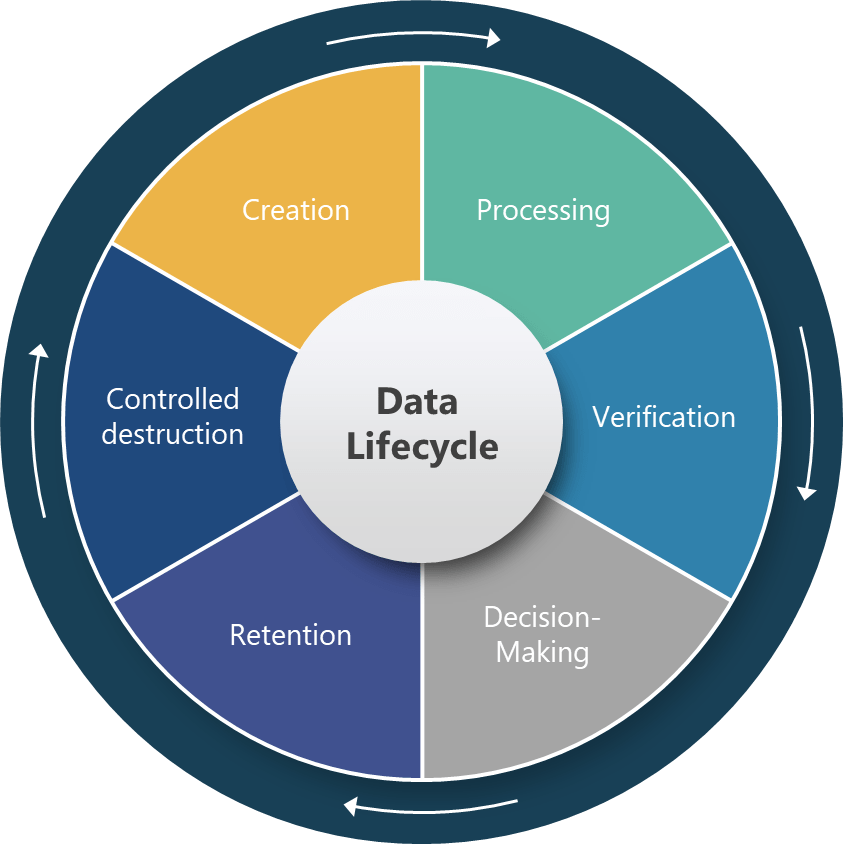
Section 4.12 represents perhaps the most technically sophisticated requirement in the draft, establishing a six-stage data lifecycle framework that covers creation, processing, verification, decision-making, retention, and controlled destruction. This approach acknowledges that data integrity cannot be ensured through point-in-time controls but requires systematic management throughout the entire data journey.

The specific requirement for “reconstruction of all data processing activities” for derived data establishes unprecedented expectations for data traceability and transparency. This requirement will fundamentally change how pharmaceutical companies design their data processing workflows, particularly in areas like process analytical technology (PAT), manufacturing execution systems (MES), and automated batch release systems where raw data undergoes significant transformation before supporting critical quality decisions.

The lifecycle approach also creates direct connections to computerized system validation requirements under Annex 11, as noted in section 4.22. This integration ensures that data governance systems are not separate from, but deeply integrated with, the technical systems that create, process, and store pharmaceutical data. As I’ve discussed in my analysis of computer system validation frameworks, effective validation programs must consider the entire system ecosystem, not just individual software applications.

Risk-Based Data Criticality Assessment

The draft introduces a sophisticated two-dimensional risk assessment framework through section 4.13, requiring organizations to evaluate both data criticality and data risk. Data criticality focuses on the impact to decision-making and product quality, while data risk considers the opportunity for alteration or deletion and the likelihood of detection. This framework provides a scientific basis for prioritizing data protection efforts and designing appropriate controls.

This approach represents a significant evolution from current practices where data integrity controls are often applied uniformly regardless of the actual risk or impact of specific data elements. The risk-based framework allows organizations to focus their most intensive controls on the data that matters most while applying appropriate but proportionate controls to lower-risk information. This aligns with principles I’ve discussed regarding quality risk management under ICH Q9(R1), where structured, science-based approaches reduce subjectivity and improve decision-making.

The requirement to assess “likelihood of detection” introduces a crucial element often missing from traditional data integrity approaches. Organizations must evaluate not only how to prevent data integrity failures but also how quickly and reliably they can detect failures that occur despite preventive controls. This assessment drives requirements for monitoring systems, audit trail analysis capabilities, and incident detection procedures.

Service Provider Oversight and Accountability

Section 4.18 establishes specific requirements for overseeing service providers’ data management policies and risk control strategies. This requirement acknowledges the reality that modern pharmaceutical operations depend heavily on cloud services, SaaS platforms, contract manufacturing organizations, and other external providers whose data management practices directly impact pharmaceutical company compliance.

The risk-based frequency requirement for service provider reviews represents a practical approach that allows organizations to focus oversight efforts where they matter most while ensuring that all service providers receive appropriate attention. For more details on the evolving regulatory expectations around supplier management see the post “draft Annex 11’s supplier oversight requirements“.

The service provider oversight requirement also creates accountability throughout the pharmaceutical supply chain, ensuring that data integrity expectations extend beyond the pharmaceutical company’s direct operations to encompass all entities that handle GMP-relevant data. This approach recognizes that regulatory accountability cannot be transferred to external providers, even when specific activities are outsourced.

Operational Implementation Challenges

The transition to mandatory data governance systems will present significant operational challenges for most pharmaceutical organizations. The requirement for “suitably designed systems, the use of technologies and data security measures, combined with specific expertise” in section 4.14 acknowledges that effective data governance requires both technological infrastructure and human expertise.

Organizations will need to invest in personnel with specialized data governance expertise, implement technology systems capable of supporting comprehensive data lifecycle management, and develop procedures for managing the complex interactions between data governance requirements and existing quality systems. This represents a substantial change management challenge that will require executive commitment and cross-functional collaboration.

The requirement for regular review of risk mitigation effectiveness in section 4.17 establishes data governance as a continuous improvement discipline rather than a one-time implementation project. Organizations must develop capabilities for monitoring the performance of their data governance systems and adjusting controls as risks evolve or new technologies are implemented.

The integration with quality risk management principles throughout sections 4.10-4.22 creates powerful synergies between traditional pharmaceutical quality systems and modern data management practices. This integration ensures that data governance supports rather than competes with existing quality initiatives while providing a systematic framework for managing the increasing complexity of pharmaceutical data environments.

The draft’s emphasis on data ownership throughout the lifecycle in section 4.15 establishes clear accountability that will help organizations avoid the diffusion of responsibility that often undermines data integrity initiatives. Clear ownership models provide the foundation for effective governance, accountability, and continuous improvement.

Section 15 Security: The Digital Fortress that Pharmaceutical IT Never Knew It Needed

The draft Annex 11’s Section 15 Security represents nothing less than the regulatory codification of modern cybersecurity principles into pharmaceutical GMP. Where the 2011 version offered three brief security provisions totaling fewer than 100 words, the 2025 draft delivers 20 comprehensive subsections that read like a cybersecurity playbook designed by paranoid auditors who’ve spent too much time investigating ransomware attacks on manufacturing facilities. As someone with a bit of experience in that, I find the draft fascinating.

Section 15 transforms cybersecurity from a peripheral IT concern into a mandatory foundation of pharmaceutical operations, requiring organizations to implement enterprise-grade security controls. The European regulators have essentially declared that pharmaceutical cybersecurity can no longer be treated as someone else’s problem. Nor can it be treated as something outside of the GMPs.

The Philosophical Transformation: From Trust-Based to Threat-Driven Security

The current Annex 11’s security provisions reflect a fundamentally different era of threat landscape with an approach centering on access restriction and basic audit logging, assuming that physical controls and password authentication provide adequate protection. The language suggests that security controls should be “suitable” and scale with system “criticality,” offering organizations considerable discretion in determining what constitutes appropriate protection.

Section 15 obliterates this discretionary approach by mandating specific, measurable security controls that assume persistent, sophisticated threats as the baseline condition. Rather than suggesting organizations “should” implement firewalls and access controls, the draft requires organizations to deploy network segmentation, disaster recovery capabilities, penetration testing programs, and continuous security improvement processes.

The shift from “suitable methods of preventing unauthorised entry” to requiring “effective information security management systems” represents a fundamental change in regulatory philosophy. The 2011 version treats security breaches as unfortunate accidents to be prevented through reasonable precautions. The 2025 draft treats security breaches as inevitable events requiring comprehensive preparation, detection, response, and recovery capabilities.

Section 15.1 establishes this new paradigm by requiring regulated users to “ensure an effective information security management system is implemented and maintained, which safeguards authorised access to, and detects and prevents unauthorised access to GMP systems and data”. This language transforms cybersecurity from an operational consideration into a regulatory mandate with explicit requirements for ongoing management and continuous improvement.

Quite frankly, I worry that many Quality Units may not be ready for this new level of oversight.

Comparing Section 15 Against ISO 27001: Pharmaceutical-Specific Cybersecurity

The draft Section 15 creates striking alignments with ISO 27001’s Information Security Management System requirements while adding pharmaceutical-specific controls that reflect the unique risks of GMP environments. ISO 27001’s emphasis on risk-based security management, continuous improvement, and comprehensive control frameworks becomes regulatory mandate rather than voluntary best practice.

Physical Security Requirements in Section 15.4 exceed typical ISO 27001 implementations by mandating multi-factor authentication for physical access to server rooms and data centers. Where ISO 27001 Control A.11.1.1 requires “physical security perimeters” and “appropriate entry controls,” Section 15.4 specifically mandates protection against unauthorized access, damage, and loss while requiring secure locking mechanisms for data centers.

The pharmaceutical-specific risk profile drives requirements that extend beyond ISO 27001’s framework. Section 15.5’s disaster recovery provisions require data centers to be “constructed to minimise the risk and impact of natural and manmade disasters” including storms, flooding, earthquakes, fires, power outages, and network failures. This level of infrastructure resilience reflects the critical nature of pharmaceutical manufacturing where system failures can impact patient safety and drug supply chains.

Continuous Security Improvement mandated by Section 15.2 aligns closely with ISO 27001’s Plan-Do-Check-Act cycle while adding pharmaceutical-specific language about staying “updated about new security threats” and implementing measures to “counter this development”. The regulatory requirement transforms ISO 27001’s voluntary continuous improvement into a compliance obligation with potential inspection implications.

The Security Training and Testing requirements in Section 15.3 exceed typical ISO 27001 implementations by mandating “recurrent security awareness training” with effectiveness evaluation through “simulated tests”. This requirement acknowledges that pharmaceutical environments face sophisticated social engineering attacks targeting personnel with access to valuable research data and manufacturing systems.

NIST Cybersecurity Framework Convergence: Functions Become Requirements

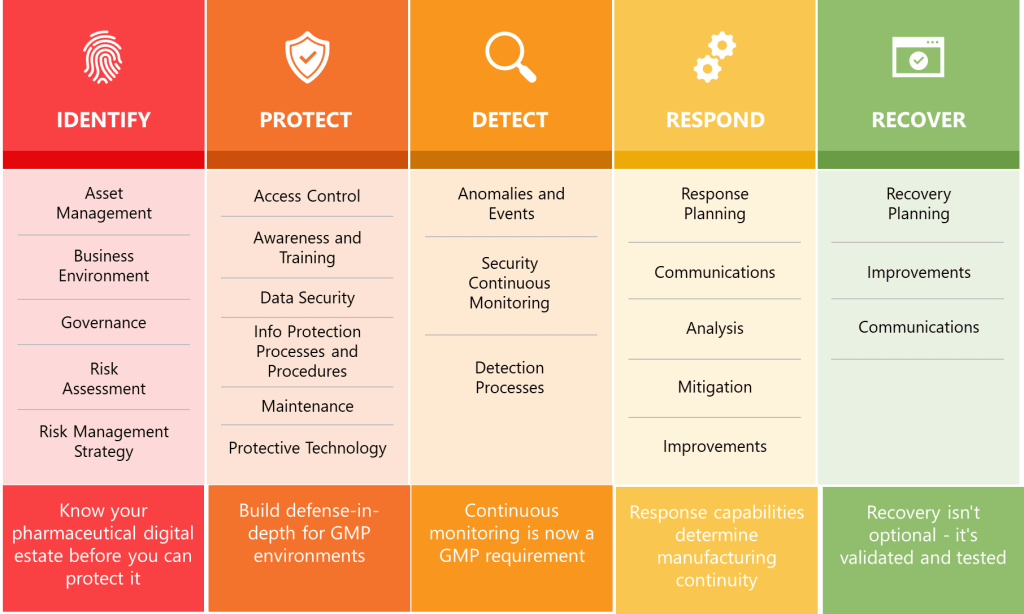
Section 15’s structure and requirements create remarkable alignment with NIST Cybersecurity Framework 2.0’s core functions while transforming voluntary guidelines into mandatory pharmaceutical compliance requirements. The NIST CSF’s Identify, Protect, Detect, Respond, and Recover functions become implicit organizing principles for Section 15’s comprehensive security controls.

Asset Management and Risk Assessment requirements embedded throughout Section 15 align with NIST CSF’s Identify function. Section 15.8’s network segmentation requirements necessitate comprehensive asset inventories and network topology documentation, while Section 15.10’s platform management requirements demand systematic tracking of operating systems, applications, and support lifecycles.

The Protect function manifests through Section 15’s comprehensive defensive requirements including network segmentation, firewall management, access controls, and encryption. Section 15.8 mandates that “networks should be segmented, and effective firewalls implemented to provide barriers between networks, and control incoming and outgoing network traffic”. This requirement transforms NIST CSF’s voluntary protective measures into regulatory obligations with specific technical implementations.

Detection capabilities appear in Section 15.19’s penetration testing requirements, which mandate “regular intervals” of ethical hacking assessments for “critical systems facing the internet”. Section 15.18’s anti-virus requirements extend detection capabilities to endpoint protection with requirements for “continuously updated” virus definitions and “effectiveness monitoring”.

The Respond function emerges through Section 15.7’s disaster recovery planning requirements, which mandate tested disaster recovery plans ensuring “continuity of operation within a defined Recovery Time Objective (RTO)”. Section 15.13’s timely patching requirements create response obligations for addressing “critical vulnerabilities” that “might be immediately” requiring patches.

Recovery capabilities center on Section 15.6’s data replication requirements, which mandate automatic replication of “critical data” from primary to secondary data centers with “delay which is short enough to minimise the risk of loss of data”. The requirement for secondary data centers to be located at “safe distance from the primary site” ensures geographic separation supporting business continuity objectives.

Summary Across Key Guidance Documents

Security Requirement AreaDraft Annex 11 Section 15 (2025)Current Annex 11 (2011)ISO 27001:2022NIST CSF 2.0 (2024)Implementation Complexity
Information Security Management SystemMandatory – Effective ISMS implementation and maintenance required (15.1)Basic – General security measures, no ISMS requirementCore – ISMS is fundamental framework requirement (Clause 4-10)Framework – Governance as foundational function across all activitiesHigh – Requires comprehensive ISMS deployment
Continuous Security ImprovementRequired – Continuous updates on threats and countermeasures (15.2)Not specified – No continuous improvement mandateMandatory – Continual improvement through PDCA cycle (Clause 10.2)Built-in – Continuous improvement through framework implementationMedium – Ongoing process establishment needed
Security Training & TestingMandatory – Recurrent training with simulated testing effectiveness evaluation (15.3)Not mentioned – No training or testing requirementsRequired – Information security awareness and training (A.6.3)Emphasized – Cybersecurity workforce development and training (GV.WF)Medium – Training programs and testing infrastructure
Physical Security ControlsExplicit – Multi-factor authentication for server rooms, secure data centers (15.4)Limited – “Suitable methods” for preventing unauthorized entryDetailed – Physical and environmental security controls (A.11.1-11.2)Addressed – Physical access controls within Protect function (PR.AC-2)Medium – Physical infrastructure and access systems
Network Segmentation & FirewallsMandatory – Network segmentation with strict firewall rules, periodic reviews (15.8-15.9)Basic – Firewalls mentioned without specific requirementsSpecified – Network security management and segmentation (A.13.1)Core – Network segmentation and boundary protection (PR.AC-5, PR.DS-5)High – Network architecture redesign often required
Platform & Patch ManagementRequired – Timely OS updates, validation before vendor support expires (15.10-15.14)Not specified – No explicit platform or patch managementRequired – System security and vulnerability management (A.12.6, A.14.2)Essential – Vulnerability management and patch deployment (ID.RA-1, RS.MI)High – Complex validation and lifecycle management
Disaster Recovery & Business ContinuityMandatory – Tested disaster recovery with defined RTO requirements (15.7)Not mentioned – No disaster recovery requirementsComprehensive – Information systems availability and business continuity (A.17)Fundamental – Recovery planning and business continuity (RC.RP, RC.CO)High – Business continuity infrastructure and testing
Data Replication & BackupRequired – Automatic critical data replication to geographically separated sites (15.6)Limited – Basic backup provisions onlyRequired – Information backup and recovery procedures (A.12.3)Critical – Data backup and recovery capabilities (PR.IP-4, RC.RP-1)High – Geographic replication and automated systems
Endpoint Security & Device ControlStrict – USB port controls, bidirectional device scanning, default deactivation (15.15-15.17)1Not specified – No device control requirementsDetailed – Equipment maintenance and secure disposal (A.11.2, A.11.2.7)Important – Removable media and device controls (PR.PT-2)Medium – Device management and scanning systems
Anti-virus & Malware ProtectionMandatory – Continuously updated anti-virus with effectiveness monitoring (15.18)Not mentioned – No anti-virus requirementsRequired – Protection against malware (A.12.2)Standard – Malicious code protection (PR.PT-1)Low – Standard anti-virus deployment
Penetration TestingRequired – Regular ethical hacking for internet-facing critical systems (15.19)Not specified – No penetration testing requirementsRecommended – Technical vulnerability testing (A.14.2.8)Recommended – Vulnerability assessments and penetration testing (DE.CM)Medium – External testing services and internal capabilities
Risk-Based Security AssessmentImplicit – Risk-based approach integrated throughout all requirementsGeneral – Risk assessment mentioned but not detailedFundamental – Risk management is core methodology (Clause 6.1.2)Core – Risk assessment and management across all functions (GV.RM, ID.RA)Medium – Risk assessment processes and documentation
Access Control & AuthenticationEnhanced – Beyond basic access controls, integrated with physical securityBasic – Password protection and access restriction onlyComprehensive – Access control management framework (A.9)Comprehensive – Identity management and access controls (PR.AC)Medium – Enhanced access control systems
Incident Response & ManagementImplied – Through disaster recovery and continuous improvement requirementsNot specified – No incident response requirementsRequired – Information security incident management (A.16)Detailed – Incident response and recovery processes (RS, RC functions)Medium – Incident response processes and teams
Documentation & Audit TrailComprehensive – Detailed documentation for all security controls and testingLimited – Basic audit trail and documentationMandatory – Documented information and records management (Clause 7.5)Integral – Documentation and communication throughout frameworkHigh – Comprehensive documentation and audit systems
Third-Party Risk ManagementImplicit – Through platform management and network security requirementsNot mentioned – No third-party risk provisionsRequired – Supplier relationships and information security (A.15)Addressed – Supply chain risk management (ID.SC, GV.SC)Medium – Supplier assessment and management processes
Encryption & Data ProtectionLimited – Not explicitly detailed beyond data replication requirementsNot specified – No encryption requirementsComprehensive – Cryptography and data protection controls (A.10)Included – Data security and privacy protection (PR.DS)Medium – Encryption deployment and key management
Change Management IntegrationIntegrated – Security updates must align with GMP validation processesBasic – Change control mentioned generallyIntegrated – Change management throughout ISMS (A.14.2.2)Embedded – Change management within improvement processesHigh – Integration with existing GMP change control
Compliance MonitoringBuilt-in – Regular reviews, testing, and continuous improvement mandatedLimited – Periodic review mentioned without specificsRequired – Monitoring, measurement, and internal audits (Clause 9)Systematic – Continuous monitoring and measurement (DE, GV functions)Medium – Monitoring and measurement systems
Executive Oversight & GovernanceImplied – Through ISMS requirements and continuous improvement mandatesNot specified – No governance requirementsMandatory – Leadership commitment and management responsibility (Clause 5)Essential – Governance and leadership accountability (GV function)4Medium – Governance structure and accountability

The alignment with ISO 27001 and NIST CSF demonstrates that pharmaceutical organizations can no longer treat cybersecurity as a separate concern from GMP compliance—they become integrated regulatory requirements demanding enterprise-grade security capabilities that most pharmaceutical companies have historically considered optional.

Technical Requirements That Challenge Traditional Pharmaceutical IT Architecture

Section 15’s technical requirements will force fundamental changes in how pharmaceutical organizations architect, deploy, and manage their IT infrastructure. The regulatory prescriptions extend far beyond current industry practices and demand enterprise-grade security capabilities that many pharmaceutical companies currently lack.

Network Architecture Revolution begins with Section 15.8’s segmentation requirements, which mandate that “networks should be segmented, and effective firewalls implemented to provide barriers between networks”. This requirement eliminates the flat network architectures common in pharmaceutical manufacturing environments where laboratory instruments, manufacturing equipment, and enterprise systems often share network segments for operational convenience.

The firewall rule requirements demand “IP addresses, destinations, protocols, applications, or ports” to be “defined as strict as practically feasible, only allowing necessary and permissible traffic”. For pharmaceutical organizations accustomed to permissive network policies that allow broad connectivity for troubleshooting and maintenance, this represents a fundamental shift toward zero-trust architecture principles.

Section 15.9’s firewall review requirements acknowledge that “firewall rules tend to be changed or become insufficient over time” and mandate periodic reviews to ensure firewalls “continue to be set as tight as possible”. This requirement transforms firewall management from a deployment activity into an ongoing operational discipline requiring dedicated resources and systematic review processes.

Platform and Patch Management requirements in Sections 15.10 through 15.14 create comprehensive lifecycle management obligations that most pharmaceutical organizations currently handle inconsistently. Section 15.10 requires operating systems and platforms to be “updated in a timely manner according to vendor recommendations, to prevent their use in an unsupported state”.

The validation and migration requirements in Section 15.11 create tension between security imperatives and GMP validation requirements. Organizations must “plan and complete” validation of applications on updated platforms “in due time prior to the expiry of the vendor’s support”. This requirement demands coordination between IT security, quality assurance, and validation teams to ensure system updates don’t compromise GMP compliance.

Section 15.12’s isolation requirements for unsupported platforms acknowledge the reality that pharmaceutical organizations often operate legacy systems that cannot be easily updated. The requirement that such systems “should be isolated from computer networks and the internet” creates network architecture challenges where isolated systems must still support critical manufacturing processes.

Endpoint Security and Device Management requirements in Sections 15.15 through 15.18 address the proliferation of connected devices in pharmaceutical environments. Section 15.15’s “strict control” of bidirectional devices like USB drives acknowledges that pharmaceutical manufacturing environments often require portable storage for equipment maintenance and data collection.

The effective scanning requirements in Section 15.16 for devices that “may have been used outside the organisation” create operational challenges for service technicians and contractors who need to connect external devices to pharmaceutical systems. Organizations must implement scanning capabilities that can “effectively” detect malware without disrupting operational workflows.

Section 15.17’s requirements to deactivate USB ports “by default” unless needed for essential devices like keyboards and mice will require systematic review of all computer systems in pharmaceutical facilities. Manufacturing computers, laboratory instruments, and quality control systems that currently rely on USB connectivity for routine operations may require architectural changes or enhanced security controls.

Operational Impact: How Section 15 Changes Day-to-Day Operations

The implementation of Section 15’s security requirements will fundamentally change how pharmaceutical organizations conduct routine operations, from equipment maintenance to data management to personnel access. These changes extend far beyond IT departments to impact every function that interacts with computerized systems.

Manufacturing and Laboratory Operations will experience significant changes through network segmentation and access control requirements. Section 15.8’s segmentation requirements may isolate manufacturing systems from corporate networks, requiring new procedures for accessing data, transferring files, and conducting remote troubleshooting1. Equipment vendors who previously connected remotely to manufacturing systems for maintenance may need to adapt to more restrictive access controls and monitored connections.

The USB control requirements in Sections 15.15-15.17 will particularly impact operations where portable storage devices are routinely used for data collection, equipment calibration, and maintenance activities. Laboratory personnel accustomed to using USB drives for transferring analytical data may need to adopt network-based file transfer systems or enhanced scanning procedures.

Information Technology Operations must expand significantly to support Section 15’s comprehensive requirements. The continuous security improvement mandate in Section 15.2 requires dedicated resources for threat intelligence monitoring, security tool evaluation, and control implementation. Organizations that currently treat cybersecurity as a periodic concern will need to establish ongoing security operations capabilities.

Section 15.19’s penetration testing requirements for “critical systems facing the internet” will require organizations to either develop internal ethical hacking capabilities or establish relationships with external security testing providers. The requirement for “regular intervals” suggests ongoing testing programs rather than one-time assessments.

The firewall review requirements in Section 15.9 necessitate systematic processes for evaluating and updating network security rules. Organizations must establish procedures for documenting firewall changes, reviewing rule effectiveness, and ensuring rules remain “as tight as possible” while supporting legitimate business functions.

Quality Unit functions must expand to encompass cybersecurity validation and documentation requirements. Section 15.11’s requirements to validate applications on updated platforms before vendor support expires will require QA involvement in IT infrastructure changes. Quality systems must incorporate procedures for evaluating the GMP impact of security patches, platform updates, and network changes.

The business continuity requirements in Section 15.7 necessitate testing of disaster recovery plans and validation that systems can meet “defined Recovery Time Objectives”. Quality assurance must develop capabilities for validating disaster recovery processes and documenting that backup systems can support GMP operations during extended outages.

Strategic Implications: Organizational Structure and Budget Priorities

Section 15’s comprehensive security requirements will force pharmaceutical organizations to reconsider their IT governance structures, budget allocations, and strategic priorities. The regulatory mandate for enterprise-grade cybersecurity capabilities creates organizational challenges that extend beyond technical implementation.

IT-OT Convergence Acceleration becomes inevitable as Section 15’s requirements apply equally to traditional IT systems and operational technology supporting manufacturing processes. Organizations must develop unified security approaches spanning enterprise networks, manufacturing systems, and laboratory instruments. The traditional separation between corporate IT and manufacturing systems operations becomes unsustainable when both domains require coordinated security management.

The network segmentation requirements in Section 15.8 demand comprehensive understanding of all connected systems and their communication requirements. Organizations must develop capabilities for mapping and securing complex environments where ERP systems, manufacturing execution systems, laboratory instruments, and quality management applications share network infrastructure.

Cybersecurity Organizational Evolution will likely drive consolidation of security responsibilities under dedicated chief information security officer roles with expanded authority over both IT and operational technology domains. The continuous improvement mandates and comprehensive technical requirements demand specialized cybersecurity expertise that extends beyond traditional IT administration.

Section 15.3’s training and testing requirements necessitate systematic cybersecurity awareness programs with “effectiveness evaluation” through simulated attacks1. Organizations must develop internal capabilities for conducting phishing simulations, security training programs, and measuring personnel security behaviors.

Budget and Resource Reallocation becomes necessary to support Section 15’s comprehensive requirements. The penetration testing, platform management, network segmentation, and disaster recovery requirements represent significant ongoing operational expenses that many pharmaceutical organizations have not historically prioritized.

The validation requirements for security updates in Section 15.11 create ongoing costs for qualifying platform changes and validating application compatibility. Organizations must budget for accelerated validation cycles to ensure security updates don’t result in unsupported systems.

Inspection and Enforcement: The New Reality

Section 15’s detailed technical requirements create specific inspection targets that regulatory authorities can evaluate objectively during facility inspections. Unlike the current Annex 11’s general security provisions, Section 15’s prescriptive requirements enable inspectors to assess compliance through concrete evidence and documentation.

Technical Evidence Requirements emerge from Section 15’s specific mandates for firewalls, network segmentation, patch management, and penetration testing. Inspectors can evaluate firewall configurations, review network topology documentation, assess patch deployment records, and verify penetration testing reports. Organizations must maintain detailed documentation demonstrating compliance with each technical requirement.

The continuous improvement mandate in Section 15.2 creates expectations for ongoing security enhancement activities with documented evidence of threat monitoring and control implementation. Inspectors will expect to see systematic processes for identifying emerging threats and implementing appropriate countermeasures.

Operational Process Validation requirements extend to security operations including incident response, access control management, and backup testing. Section 15.7’s disaster recovery testing requirements create inspection opportunities for validating recovery procedures and verifying RTO achievement1. Organizations must demonstrate that their business continuity plans work effectively through documented testing activities.

The training and testing requirements in Section 15.3 create audit trails for security awareness programs and simulated attack exercises. Inspectors can evaluate training effectiveness through documentation of phishing simulation results, security incident responses, and personnel security behaviors.

Industry Transformation: From Compliance to Competitive Advantage

Organizations that excel at implementing Section 15’s requirements will gain significant competitive advantages through superior operational resilience, reduced cyber risk exposure, and enhanced regulatory relationships. The comprehensive security requirements create opportunities for differentiation through demonstrated cybersecurity maturity.

Supply Chain Security Leadership emerges as pharmaceutical companies with robust cybersecurity capabilities become preferred partners for collaborations, clinical trials, and manufacturing agreements. Section 15’s requirements create third-party evaluation criteria that customers and partners can use to assess supplier cybersecurity capabilities.

The disaster recovery and business continuity requirements in Sections 15.6 and 15.7 create operational resilience that supports supply chain reliability. Organizations that can demonstrate rapid recovery from cyber incidents maintain competitive advantages in markets where supply chain disruptions have significant patient impact.

Regulatory Efficiency Benefits accrue to organizations that proactively implement Section 15’s requirements before they become mandatory. Early implementation demonstrates regulatory leadership and may result in more efficient inspection processes and enhanced regulatory relationships.

The systematic approach to cybersecurity documentation and process validation creates operational efficiencies that extend beyond compliance. Organizations that implement comprehensive cybersecurity management systems often discover improvements in change control, incident response, and operational monitoring capabilities.

Section 15 Security ultimately represents the transformation of pharmaceutical cybersecurity from optional IT initiative to mandatory operational capability that is part of the pharmaceutical quality system. The pharmaceutical industry’s digital future depends on treating cybersecurity as seriously as traditional quality assurance—and Section 15 makes that treatment legally mandatory.