
The Lotus Blossom Brainstorming Technique

In the world of creative problem-solving and idea generation, the Lotus Blossom technique stands out as a powerful and structured approach to brainstorming. Developed by Yasuo Matsumura, a Japanese management consultant, this method combines the free-flowing nature of traditional brainstorming with a systematic framework that encourages deeper exploration of ideas.

How It Works

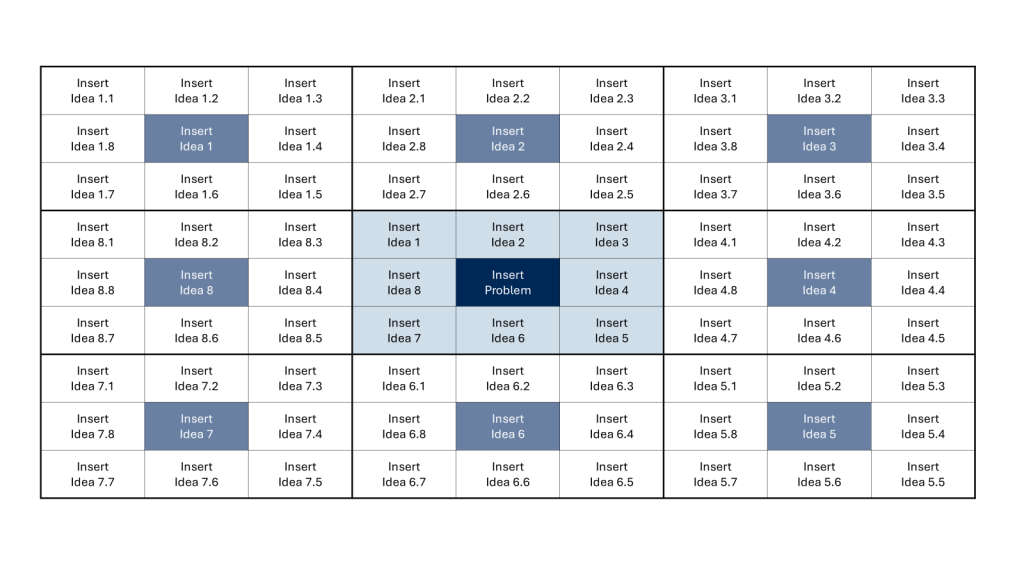
The Lotus Blossom technique uses a visual diagram resembling a lotus flower, hence its name. Here’s a step-by-step breakdown of the process:

  1. Start with a central idea or problem in the middle of a 3×3 grid.
  2. Surround the central concept with eight related ideas or themes.
  3. Take each of these eight ideas and make them the center of their own 3×3 grids.
  4. Generate eight new ideas for each of these secondary grids.
  5. Repeat the process until you have a fully bloomed “lotus” of ideas.

By the end of this process, you’ll have generated up to 64 ideas stemming from your original concept.

Benefits of the Lotus Blossom Technique

Structured Creativity: Unlike traditional brainstorming, which can sometimes feel chaotic, the Lotus Blossom method provides a clear structure for idea generation.

Depth and Breadth: This technique encourages both broad thinking and deep exploration of specific themes.

Visual Organization: The diagram format helps visualize connections between ideas and keeps the brainstorming process organized.

Flexibility: It can be used individually or in small groups, making it versatile for various settings.

Tips for Success

To make the most of the Lotus Blossom technique, consider these tips:

  • Embrace All Ideas: Don’t self-censor. Even seemingly unrelated or far-fetched ideas can spark innovation.
  • Time Management: Set time limits for each phase to maintain momentum and prevent overthinking.
  • Iterate and Refine: After completing the diagram, review and refine your ideas. Look for patterns or combinations that might lead to breakthrough solutions.
Brainstorming and Conflict

Like most facilitators I have strong opinions on brainstorming. And like a lot of the soft side of quality, these facilitation skills can really open themselves to a criticism of the vulnerability of scientific claims and there is a fair amount of justification for criticisms of the pursuit of novelty over truth. Add to it that there is this major pipeline of junk psychological science and there are good reasons for challenging these opinions.

It is for this reason I do less and less brainstorming as a verbal exercise, and rely more on brainwriting as I discussed in the post “Brainstorming usually sinks your ship.”

In the article “Should we allow criticism while brainstorming?” by Dylan Walsh we are exposed to some research from Jared Curhan at MIT that shows when criticism should be leveraged in brainstorming exercises. Well worth the read.

Brainstorming usually sinks your ship

If you work in teams, chances are you use brainstorming, gathering face-to-face in groups so that everyone can share ideas. This technique has been around since the late 1930s and many in quality and excellence pursuits view it as an effective technique.

Unfortunately, the science I’ve read is not quite in agreement. A group of four people typically generates approximately half as many ideas as a nominal group of four does. Production blocking, and a few other problems, lead to some key deficiencies in brainstorming:

  •  When group members are waiting for turn-taking, there are high chances that they may forget the ideas that they had in mind, they may focus on remembering those ideas rather than listening, or they may decide their ideas are no longer relevant.
  • The competing demand for coming up with one’s own idea and listening to other’s ideas makes it difficult to build on the ideas of others.
  • As the size of the group increases, the participants might feel less identifiable or accountable which might lead to decreased social loafing or level of motivation.

Overcoming production blocking requires the use of additional tools, such as brainwriting. Brainwriting encompasses the sharing of ideas through pieces of paper – usually having people write their ideas out on post-it notes for example. This technique makes brainstorming effective by overcoming the problem of verbal brainstorming. Though their seems to be some worry here about social cues kicking in, and there may be more benefit in having folks write all their ideas on one piece of paper, or better yet on their own before the meeting.

Brain writing, to be truly effective, requires solid collaborative evaluation process to follow the idea generation phase this is the foundation of decision quality. The research seems to indicate we see results better than the norm with this combination.

This appears to be an area where more research is needed to examine different variations , the boundary conditions for demonstrating the superiority of brainwriting over nominal groups, the optimum size of the group, and the potential of mixing verbal and nonverbal brainstorming. If anyone knows of good studies in this area, please point me to them.

References

  • Coskun, H. (2005). Cognitive stimulation with convergent and divergent thinking exercises in brainwriting: Incubation, sequence priming, and group context. Small Group Research, 36, 466-498. doi:10.1177/1046496405276475
  • Cragan, J. F., Wright, D. W., & Kasch, C. R. (2009). Communication in small groups : theory, process, skills. Boston, MA: Cengage Learning – Academic and Professional Group.
  • West, M. A. (2012). Effective teamwork : practical lessons from organizational research. Wiley-Blackwell.