The Minimal Viable Risk Assessment Team

Ineffective risk management and quality systems revolve around superficial risk management. The core issue? Teams designed for compliance as a check-the-box activity rather than cognitive rigor. These gaps create systematic blind spots that no checklist can fix. The solution isn’t more assessors—it’s fewer, more competent ones anchored in science, patient impact, and lived process reality.

Core Roles: The Non-Negotiables

1. Process Owner: The Reality Anchor

Not a title. A lived experience. Superficial ownership creates the “unjustified assumptions.” This role requires daily engagement with the process—not just signature authority. Without it, assumptions go unchallenged.

2. ASTM E2500 Molecule Steward: The Patient’s Advocate

Beyond “SME”—the protein whisperer. This role demands provable knowledge of degradation pathways, critical quality attributes (CQAs), and patient impact. Contrast this with generic “subject matter experts” who lack molecule-specific insights. Without this anchor, assessments overlook patient-centric failure modes.

3. Technical System Owner: The Engineer

The value of the Technical System Owner—often the engineer—lies in their unique ability to bridge the worlds of design, operations, and risk control throughout the pharmaceutical lifecycle. Far from being a mere custodian of equipment, the system owner is the architect who understands not just how a system is built, but how it behaves under real-world conditions and how it integrates with the broader manufacturing program

4. Quality: The Cognitive Warper

Forget the auditor—this is your bias disruptor. Quality’s value lies in forcing cross-functional dialogue, challenging tacit assumptions, and documenting debates. When Quality fails to interrogate assumptions, hazards go unidentified. Their real role: Mandate “assumption logs” where every “We’ve always done it this way” must produce data or die.
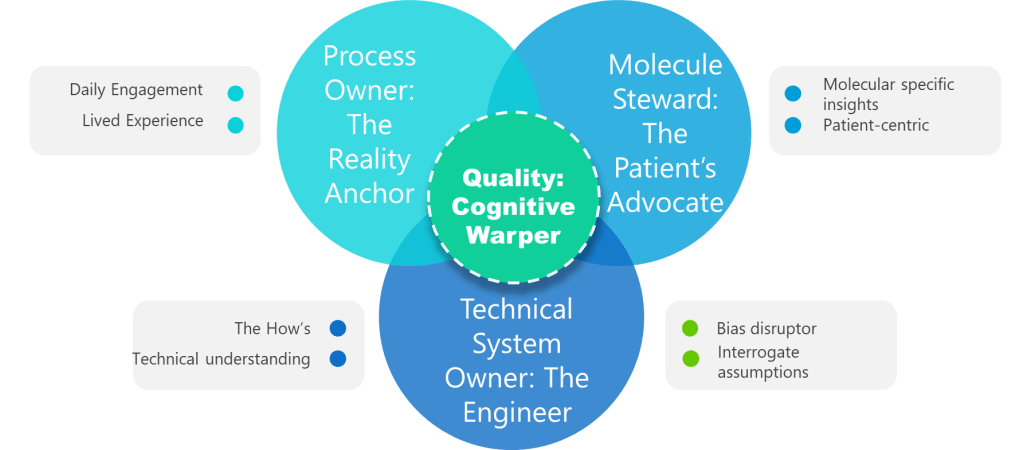
A Venn diagram with three overlapping blue circles, each representing a different role: "Process Owner: The Reality Anchor," "Molecule Steward: The Patient’s Advocate," and "Technical System Owner: The Engineer." In the center, where all three circles overlap, is a green dashed circle labeled "Quality: Cognitive Warper." Each role has associated bullet points in colored dots:

Process Owner (top left): "Daily Engagement" and "Lived Experience" (blue dots).

Molecule Steward (top right): "Molecular specific insights" and "Patient-centric" (blue dots).

Technical System Owner (bottom): "The How’s" and "Technical understanding" (blue dots).

Additional points for Technical System Owner (bottom right): "Bias disruptor" and "Interrogate assumptions" (green dots).

The diagram visually emphasizes the intersection of these roles in achieving quality through cognitive diversity.

Team Design as Knowledge Preservation

Team design in the context of risk management is fundamentally an act of knowledge preservation, not just an exercise in filling seats or meeting compliance checklists. Every effective risk team is a living repository of the organization’s critical process insights, technical know-how, and nuanced operational experience. When teams are thoughtfully constructed to include individuals with deep, hands-on familiarity—process owners, technical system engineers, molecule stewards, and quality integrators—they collectively safeguard the hard-won lessons and tacit knowledge that are so often lost when people move on or retire. This approach ensures that risk assessments are not just theoretical exercises but are grounded in the practical realities that only those with lived experience can provide.

Combating organizational forgetting requires more than documentation or digital knowledge bases; it demands intentional, cross-functional team design that fosters active knowledge transfer. When a risk team brings together diverse experts who routinely interact, challenge each other’s assumptions, and share context from their respective domains, they create a dynamic environment where critical information is surfaced, scrutinized, and retained. This living dialogue is far more effective than static records, as it allows for the continuous updating and contextualization of knowledge in response to new challenges, regulatory changes, and operational shifts. In this way, team design becomes a strategic defense against the silent erosion of expertise that can leave organizations exposed to avoidable risks.

Ultimately, investing in team design as a knowledge preservation strategy is about building organizational resilience. It means recognizing that the greatest threats often arise not from what is known, but from what is forgotten or never shared. By prioritizing teams that embody both breadth and depth of experience, organizations create a robust safety net—one that catches subtle warning signs, adapts to evolving risks, and ensures that critical knowledge endures beyond any single individual’s tenure. This is how organizations move from reactive problem-solving to proactive risk management, turning collective memory into a competitive advantage and a foundation for sustained quality.

Call to Action: Build the Risk Team

Moving from compliance theater to true protection starts with assembling a team designed for cognitive rigor, knowledge depth and psychological safety.

Start with a Clear Charter, Not a Checklist

An excellent risk team exists to frame, analyse and communicate uncertainty so that the business can make science-based, patient-centred decisions. Assigning authorities and accountabilities is a leadership duty, not an after-thought. Before naming people, write down:

  • the decisions the team must enable,
  • the degree of formality those decisions demand, and
  • the resources (time, data, tools) management will guarantee.

Without this charter, even star performers will default to box-ticking.

Fill Four Core Seats – And Prove Competence

ICH Q9 is blunt: risk work should be done by interdisciplinary teams that include experts from quality, engineering, operations and regulatory affairs. ASTM E2500 translates that into a requirement for documented subject-matter experts (SMEs) who own critical knowledge throughout the lifecycle. Map those expectations onto four non-negotiable roles.

  • Process Owner – The Reality Anchor: This individual has lived the operation in the last 90 days, not just signed SOPs. They carry the authority to change methods, budgets and training, and enough hands-on credibility to spot when a theoretical control will never work on the line. Authentic owners dismantle assumptions by grounding every risk statement in current shop-floor facts.
  • Molecule Steward – The Patient’s Advocate: Too often “SME” is shorthand for “the person available.” The molecule steward is different: a scientist who understands how the specific product fails and can translate deviations into patient impact. When temperature drifts two degrees during freeze-drying, the steward can explain whether a monoclonal antibody will aggregate or merely lose a day of shelf life. Without this anchor, the team inevitably under-scores hazards that never appear in a generic FMEA template.
  • Technical System Owner – The Engineering Interpreter: Equipment does not care about meeting minutes; it obeys physics. The system owner must articulate functional requirements, design limits and integration logic. Where a tool-focused team may obsess over gasket leaks, the system owner points out that a single-loop PLC has no redundancy and that a brief voltage dip could push an entire batch outside critical parameters—a classic case of method over physics.
  • Quality Integrator – The Bias Disruptor: Quality’s mission is to force cross-functional dialogue and preserve evidence. That means writing assumption logs, challenging confirmation bias and ensuring that dissenting voices are heard. The quality lead also maintains the knowledge repository so future teams are not condemned to repeat forgotten errors.

Secure Knowledge Accessibility, Not Just Possession

A credentialed expert who cannot be reached when the line is down at 2 a.m. is as useful as no expert at all. Conduct a Knowledge Accessibility Index audit before every major assessment.

Embed Psychological Safety to Unlock the Team’s Brainpower

No amount of SOPs compensates for a culture that punishes bad news. Staff speak up only when leaders are approachable, intolerant of blame and transparent about their own fallibility. Leaders must therefore:

  • Invite dissent early: begin meetings with “What might we be overlooking?”
  • Model vulnerability: share personal errors and how the system, not individuals, failed.
  • Reward candor: recognize the engineer who halted production over a questionable trend.

Psychological safety converts silent observers into active risk sensors.

Choose Methods Last, After Understanding the Science

Excellent teams let the problem dictate the tool, not vice versa. They build a failure-tree or block diagram first, then decide whether FMEA, FTA or bow-tie analysis will illuminate the weak spot. If the team defaults to a method because “it’s in the SOP,” stop and reassess. Tool selection is a decision, not a reflex.

Provide Time and Resources Proportionate to Uncertainty

ICH Q9 asks decision-makers to ensure resources match the risk question. Complex, high-uncertainty topics demand longer workshops, more data and external review, while routine changes may only need a rapid check. Resist the urge to shoehorn every assessment into a one-hour meeting because calendars are overloaded.
Institutionalize Learning Loops

Great teams treat every assessment as both analysis and experiment. They:

  1. Track prediction accuracy: did the “medium”-ranked hazard occur?
  2. Compare expected versus actual detectability: were controls as effective as assumed?
  3. Feed insights into updated templates and training so the next team starts smarter.

The loop closes when the knowledge base evolves at the same pace as the plant.

When to Escalate – The Abort-Mission Rule

If a risk scenario involves patient safety, novel technology and the molecule steward is unavailable, stop. The assessment waits until a proper team is in the room. Rushing ahead satisfies schedules, not safety.

Conclusion

Excellence in risk management is rarely about adding headcount; it is about curating brains with complementary lenses and giving them the culture, structure and time to think. Build that environment and the monsters stay on the storyboard, never in the plant.
Why ‘First-Time Right’ is a Dangerous Myth in Continuous Manufacturing

In manufacturing circles, “First-Time Right” (FTR) has become something of a sacred cow-a philosophy so universally accepted that questioning it feels almost heretical. Yet as continuous manufacturing processes increasingly replace traditional batch production, we need to critically examine whether this cherished doctrine serves us well or creates dangerous blind spots in our quality assurance frameworks.

The Seductive Promise of First-Time Right

Let’s start by acknowledging the compelling appeal of FTR. As commonly defined, First-Time Right is both a manufacturing principle and KPI that denotes the percentage of end-products leaving production without quality defects. The concept promises a manufacturing utopia: zero waste, minimal costs, maximum efficiency, and delighted customers receiving perfect products every time.

The math seems straightforward. If you produce 1,000 units and 920 are defect-free, your FTR is 92%. Continuous improvement efforts should steadily drive that percentage upward, reducing the resources wasted on imperfect units.

This principle finds its intellectual foundation in Six Sigma methodology, which can tend to give it an air of scientific inevitability. Yet even Six Sigma acknowledges that perfection remains elusive. This subtle but crucial nuance often gets lost when organizations embrace FTR as an absolute expectation rather than an aspiration.

First-Time Right in biologics drug substance manufacturing refers to the principle and performance metric of producing a biological drug substance that meets all predefined quality attributes and regulatory requirements on the first attempt, without the need for rework, reprocessing, or batch rejection. In this context, FTR emphasizes executing each step of the complex, multi-stage biologics manufacturing process correctly from the outset-starting with cell line development, through upstream (cell culture/fermentation) and downstream (purification, formulation) operations, to the final drug substance release.

Achieving FTR is especially challenging in biologics because these products are made from living systems and are highly sensitive to variations in raw materials, process parameters, and environmental conditions. Even minor deviations can lead to significant quality issues such as contamination, loss of potency, or batch failure, often requiring the entire batch to be discarded.

In biologics manufacturing, FTR is not just about minimizing waste and cost; it is critical for patient safety, regulatory compliance, and maintaining supply reliability. However, due to the inherent variability and complexity of biologics, FTR is best viewed as a continuous improvement goal rather than an absolute expectation. The focus is on designing and controlling processes to consistently deliver drug substances that meet all critical quality attributes-recognizing that, despite best efforts, some level of process variation and deviation is inevitable in biologics production

The Unique Complexities of Continuous Manufacturing

Traditional batch processing creates natural boundaries-discrete points where production pauses, quality can be assessed, and decisions about proceeding can be made. In contrast, continuous manufacturing operates without these convenient checkpoints, as raw materials are continuously fed into the manufacturing system, and finished products are continuously extracted, without interruption over the life of the production run.

This fundamental difference requires a complete rethinking of quality assurance approaches. In continuous environments:

  • Quality must be monitored and controlled in real-time, without stopping production
  • Deviations must be detected and addressed while the process continues running
  • The interconnected nature of production steps means issues can propagate rapidly through the system
  • Traceability becomes vastly more complex

Regulatory agencies recognize these unique challenges, acknowledging that understanding and managing risks is central to any decision to greenlight CM in a production-ready environment. When manufacturing processes never stop, quality assurance cannot rely on the same methodologies that worked for discrete batches.

The Dangerous Complacency of Perfect-First-Time Thinking

The most insidious danger of treating FTR as an achievable absolute is the complacency it breeds. When leadership becomes fixated on achieving perfect FTR scores, several dangerous patterns emerge:

Overconfidence in Automation

While automation can significantly improve quality, it is important to recognize the irreplaceable value of human oversight. Automated systems, no matter how advanced, are ultimately limited by their programming, design, and maintenance. Human operators bring critical thinking, intuition, and the ability to spot subtle anomalies that machines may overlook. A vigilant human presence can catch emerging defects or process deviations before they escalate, providing a layer of judgment and adaptability that automation alone cannot replicate. Relying solely on automation creates a dangerous blind spot-one where the absence of human insight can allow issues to go undetected until they become major problems. True quality excellence comes from the synergy of advanced technology and engaged, knowledgeable people working together.

Underinvestment in Deviation Management

If perfection is expected, why invest in systems to handle imperfections? Yet robust deviation management-the processes used to identify, document, investigate, and correct deviations becomes even more critical in continuous environments where problems can cascade rapidly. Organizations pursuing FTR often underinvest in the very systems that would help them identify and address the inevitable deviations.

False Sense of Process Robustness

Process robustness refers to the ability of a manufacturing process to tolerate the variability of raw materials, process equipment, operating conditions, environmental conditions and human factors. An obsession with FTR can mask underlying fragility in processes that appear to be performing well under normal conditions. When we pretend our processes are infallible, we stop asking critical questions about their resilience under stress.

Quality Culture Deterioration

When FTR becomes dogma, teams may become reluctant to report or escalate potential issues, fearing they’ll be seen as failures. This creates a culture of silence around deviations-precisely the opposite of what’s needed for effective quality management in continuous manufacturing. When perfection is the only acceptable outcome, people hide imperfections rather than address them.

Magical Thinking in Quality Management

The belief that we can eliminate all errors in complex manufacturing processes amounts to what organizational psychologists call “magical thinking” – the delusional belief that one can do the impossible. In manufacturing, this often manifests as pretending that doing more tasks with less resources will not hurt the work quality.

This is a pattern I’ve observed repeatedly in my investigations of quality failures. When leadership subscribes to the myth that perfection is not just desirable but achievable, they create the conditions for quality disasters. Teams stop preparing for how to handle deviations and start pretending deviations won’t occur.

The irony is that this approach actually undermines the very goal of FTR. By acknowledging the possibility of failure and building systems to detect and learn from it quickly, we actually increase the likelihood of getting things right.

Building a Healthier Quality Culture for Continuous Manufacturing

Rather than chasing the mirage of perfect FTR, organizations should focus on creating systems and cultures that:

  1. Detect deviations rapidly: Continuous monitoring through advanced process control systems becomes essential for monitoring and regulating critical parameters throughout the production process. The question isn’t whether deviations will occur but how quickly you’ll know about them.
  2. Investigate transparently: When issues occur, the focus should be on understanding root causes rather than assigning blame. The culture must prioritize learning over blame.
  3. Implement robust corrective actions: Deviations should be thoroughly documented including details about when and where it occurred, who identified it, a detailed description of the nonconformance, initial actions taken, results of the investigation into the cause, actions taken to correct and prevent recurrence, and a final evaluation of the effectiveness of these actions.
  4. Learn systematically: Each deviation represents a valuable opportunity to strengthen processes and prevent similar issues in the future. The organization that learns fastest wins, not the one that pretends to be perfect.

Breaking the Groupthink Cycle

The FTR myth thrives in environments characterized by groupthink, where challenging the prevailing wisdom is discouraged. When leaders obsess over FTR metrics while punishing those who report deviations, they create the perfect conditions for quality disasters.

This connects to a theme I’ve explored repeatedly on this blog: the dangers of losing institutional memory and critical thinking in quality organizations. When we forget that imperfection is inevitable, we stop building the systems and cultures needed to manage it effectively.

Embracing Humility, Vigilance, and Continuous Learning

True quality excellence comes not from pretending that errors don’t occur, but from embracing a more nuanced reality:

  • Perfection is a worthy aspiration but an impossible standard
  • Systems must be designed not just to prevent errors but to detect and address them
  • A healthy quality culture prizes transparency and learning over the appearance of perfection
  • Continuous improvement comes from acknowledging and understanding imperfections, not denying them

The path forward requires humility to recognize the limitations of our processes, vigilance to catch deviations quickly when they occur, and an unwavering commitment to learning and improving from each experience.

In the end, the most dangerous quality issues aren’t the ones we detect and address-they’re the ones our systems and culture allow to remain hidden because we’re too invested in the myth that they shouldn’t exist at all. First-Time Right should remain an aspiration that drives improvement, not a dogma that blinds us to reality.

From Perfect to Perpetually Improving

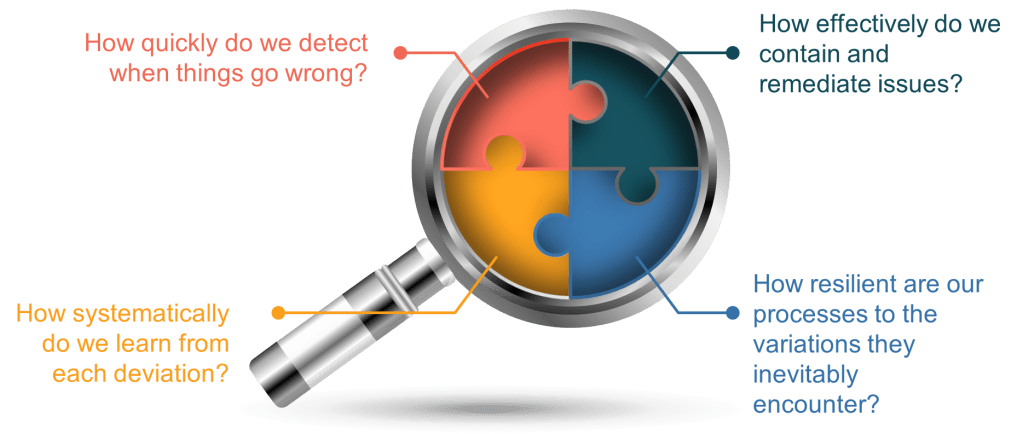
As continuous manufacturing becomes the norm rather than the exception, we need to move beyond the simplistic FTR myth toward a more sophisticated understanding of quality. Rather than asking, “Did we get it perfect the first time?” we should be asking:

  • How quickly do we detect when things go wrong?
  • How effectively do we contain and remediate issues?
  • How systematically do we learn from each deviation?
  • How resilient are our processes to the variations they inevitably encounter?

These questions acknowledge the reality of manufacturing-that imperfection is inevitable-while focusing our efforts on what truly matters: building systems and cultures capable of detecting, addressing, and learning from deviations to drive continuous improvement.

The companies that thrive in the continuous manufacturing future won’t be those with the most impressive FTR metrics on paper. They’ll be those with the humility to acknowledge imperfection, the systems to detect and address it quickly, and the learning cultures that turn each deviation into an opportunity for improvement.

Complacency Cycles and Their Impact on Quality Culture

In modern organizational dynamics, complacency operates as a silent saboteur—eroding innovation, stifling growth, and undermining the very foundations of quality culture. Defined as a state of self-satisfaction paired with unawareness of deficiencies, complacency creates cyclical patterns that perpetuate mediocrity and resistance to change. When left unchecked, these cycles corrode organizational resilience, diminish stakeholder trust, and jeopardize long-term viability. Conversely, a robust quality culture—characterized by shared values prioritizing excellence and continuous improvement—serves as the antidote.

The Anatomy of Complacency Cycles

Complacency arises when employees or teams grow overly comfortable with existing processes, outcomes, or performance levels. This manifests as:

Reduced Vigilance: The Silent Erosion of Risk Awareness

Reduced vigilance represents a critical failure mode in quality management systems, where repetitive tasks or historical success breed dangerous overconfidence. In manufacturing environments, for instance, workers performing identical quality checks thousands of times often develop “checklist fatigue”—a phenomenon where muscle memory replaces active observation. This complacency manifests in subtle but impactful ways:

  • Automation Blindness: Operators monitoring automated systems grow dependent on technology, failing to notice gradual sensor drift.
  • Normalization of Deviations
  • Metric Myopia: Organizations relying solely on lagging indicators like defect rates miss emerging risks.

The neuroscience behind this phenomenon reveals disturbing patterns: fMRI scans show reduced prefrontal cortex activation during routine quality checks compared to novel tasks, indicating genuine cognitive disengagement rather than intentional negligence.

Resistance to Innovation: The Institutionalization of Obsolescence

Complacency-driven resistance to innovation creates organizational calcification, where legacy processes become dogma despite market evolution. This dynamic operates through three interconnected mechanisms:

  1. Cognitive Lock-In: Teams develop “expertise traps” where deep familiarity with existing methods blinds them to superior alternatives.
  2. Risk Asymmetry Perception: Employees overestimate innovation risks while underestimating stagnation risks.
  3. Hierarchical Inertia: Leadership teams reward incremental improvements over transformational change.

Disengagement: The Metastasis of Organizational Apathy

Disengagement in complacent cultures operates as both symptom and accelerant, creating self-reinforcing cycles of mediocrity. Key dimensions include:

Cognitive Disinvestment: Employees mentally “clock out” during critical tasks. .

Professional Stagnation: Complacency suppresses upskilling initiatives.

Social Contagion Effects: Disengagement spreads virally through teams.

This triad of vigilance erosion, innovation resistance, and workforce disengagement forms a self-perpetuating complacency cycle that only conscious, systemic intervention can disrupt.

These behaviors form self-reinforcing loops. For example, employees who receive inadequate feedback may disengage, leading to errors that management ignores, further normalizing subpar performance.

    The Four-Phase Complacency Cycle

    1. Stagnation Phase: Initial success or routine workflows breed overconfidence. Teams prioritize efficiency over improvement, dismissing early warning signs.
    2. Normalization of Risk: Minor deviations from standards (e.g., skipped safety checks) become habitual. NASA’s Columbia disaster post-mortem highlighted how normalized risk-taking eroded safety protocols.
    3. Crisis Trigger: Accumulated oversights culminate in operational failures—product recalls, safety incidents, or financial losses.
    4. Temporary Vigilance: Post-crisis, organizations implement corrective measures, but without systemic change, complacency resurges within months.

    This cycle mirrors the “boom-bust” patterns observed in safety-critical industries, where post-incident reforms often lack staying power.

    How Complacency Undermines Quality Culture

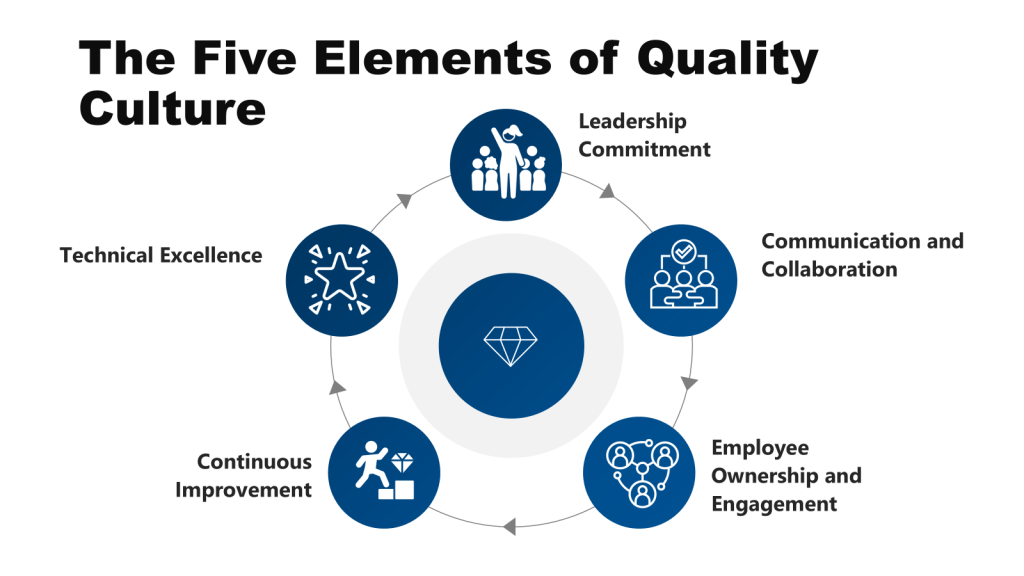
    Leadership Commitment: The Compromise of Strategic Stewardship

    Complacency transforms visionary leadership into passive oversight, directly undermining quality culture’s foundational pillar. When executives prioritize short-term operational efficiency over long-term excellence, they inadvertently normalize risk tolerance. This pattern reflects three critical failures:

    • Resource Misallocation: Complacent leaders starve quality initiatives of funding.
    • Ceremonial Governance
    • Metric Manipulation

    These behaviors create organizational whiplash—employees interpret leadership’s mixed signals as permission to deprioritize quality standards.

    Communication & Collaboration: The Silencing of Collective Intelligence

    Complacency breeds information silos that fracture quality systems. NASA’s Challenger disaster exemplifies how hierarchical filters and schedule pressures prevented engineers’ O-ring concerns from reaching decision-makers—a communication failure that cost lives and destroyed $3.2 billion in assets. Modern organizations replicate this dynamic through:

    • Digital Fragmentation
    • Meeting Rituals
    • Knowledge Hoarding

    Employee Ownership & Engagement: The Death of Frontline Vigilance

    Complacency converts empowered workforces into disengaged spectators.

    • Problem-Solving Atrophy: Complacent environments resolve fewer issues proactively.
    • Initiative Suppression
    • Skill Erosion

    Continuous Improvement: The Illusion of Progress

    Complacency reduces a learning culture to kabuki theater—visible activity without substantive change. Other failure modes include:

    • Incrementalism Trap
    • Metric Myopia
    • Benchmark Complacency

    Technical Excellence: The Rot of Core Competencies

    Complacency transforms cutting-edge capabilities into obsolete rituals. Specific erosion patterns include:

    • Standards Creep
    • Tribal Knowledge Loss
    • Tooling Obsolescence

    Mechanisms of Erosion

    1. Diminished Problem-Solving Rigor: Complacent teams favor quick fixes over root-cause analysis. In pharmaceuticals, retrospective risk assessments—used to justify releasing borderline batches—exemplify this decline.
    2. Erosion of Psychological Safety: Employees in complacent environments fear repercussions for raising concerns, leading to underreported issues.
    3. Supplier Quality Degradation: Over time, organizations accept lower-quality inputs to maintain margins, compromising end products.
    4. Customer Disengagement: As quality slips, customer feedback loops weaken, creating echo chambers of false confidence.

    The automotive industry’s recurring recall crises—from ignition switches to emissions scandals—illustrate how complacency cycles gradually dismantle quality safeguards.

    Leadership’s Pivotal Role in Breaking the Cycle

    Leadership’s Pivotal Role in Breaking the Cycle

    Leadership serves as the linchpin in dismantling complacency cycles, requiring a dual focus on strategic vision and operational discipline. Executives must first institutionalize quality as a non-negotiable organizational priority through tangible commitments. This begins with structurally aligning incentives—such as linking 30% of executive compensation to quality metrics like defect escape rates and preventative CAPA completion—to signal that excellence transcends rhetoric. For instance, a Fortune 500 medical device firm eliminated 72% of recurring compliance issues within 18 months by tying bonus structures to reduction targets for audit findings. Leaders must also champion resource allocation, exemplified by a semiconductor manufacturer dedicating 8% of annual R&D budgets to AI-driven predictive quality systems, which slashed wafer scrap rates by 57% through real-time anomaly detection.

    Equally critical is leadership’s role in modeling vulnerability and transparency. When executives participate in frontline audits—as seen in a chemical company where CEOs joined monthly gemba walks—they not only uncover systemic risks but also normalize accountability. This cultural shift proved transformative for an automotive supplier, where C-suite attendance at shift-change safety briefings reduced OSHA recordables by 24% in one year. Leaders must also revamp metrics systems to emphasize leading indicators over lagging ones.

    Operationalizing these principles demands tactical ingenuity. Dynamic goal-setting prevents stagnation. Cross-functional collaboration is accelerated through quality SWAT teams. Perhaps most impactful is leadership’s ability to democratize problem-solving through technology.

    Ultimately, leaders dismantle complacency by creating systems where quality becomes everyone’s responsibility—not through mandates, but by fostering environments where excellence is psychologically safe, technologically enabled, and personally rewarding. This requires perpetual vigilance: celebrating quality wins while interrogating successes for hidden risks, ensuring today’s solutions don’t become tomorrow’s complacent norms.

    Sustaining Quality Culture Through Anti-Complacency Practices

    Sustaining Quality Culture Through Anti-Complacency Practices

    Sustaining a quality culture demands deliberate practices that institutionalize vigilance against the creeping normalization of mediocrity. Central to this effort is the integration of continuous improvement methodologies into organizational workflows. Such systems thrive when paired with real-time feedback mechanisms—digital dashboards tracking suggestion implementation rates and their quantifiable impacts for example can create visible accountability loops.

    Cultural reinforcement rituals further embed anti-complacency behaviors by celebrating excellence and fostering collective ownership. Monthly “Quality Hero” town halls at a pharmaceutical firm feature frontline staff sharing stories of critical interventions, such as a technician who averted 17,000 mislabeled vaccine doses by catching a vial mismatch during final packaging. This practice increased peer-driven quality audits by 63% within six months by humanizing the consequences of vigilance. Reverse mentoring programs add depth to this dynamic: junior engineers at an aerospace firm trained executives on predictive maintenance tools, bridging generational knowledge gaps while updating leadership perspectives on emerging risks.

    Proactive risk mitigation tools like pre-mortem analyses disrupt complacency by forcing teams to confront hypothetical failures before they occur.

    Immersive learning experiences make the stakes of complacency tangible. A medical device company’s “Harm Simulation Lab” recreates scenarios like patients coding from insulin pump software failures, exposing engineers to the human consequences of design oversights. Participants identified 112% more risks in subsequent reviews compared to peers trained through conventional lectures.

    Together, these practices form an ecosystem where complacency struggles to take root. By aligning individual behaviors with systemic safeguards—from idea-driven improvement frameworks to emotionally resonant learning—organizations transform quality from a compliance obligation into a collective mission. The result is a self-reinforcing culture where vigilance becomes habitual, innovation feels inevitable, and excellence persists not through enforcement, but through institutionalized reflexes that outlast individual initiatives.

    Conclusion: The Never-Ending Journey

    Complacency cycles and quality culture exist in perpetual tension—the former pulling organizations toward entropy, the latter toward excellence. Breaking this cycle demands more than temporary initiatives; it requires embedding quality into organizational DNA through:

    1. Relentless leadership commitment to modeling and resourcing quality priorities.
    2. Systems thinking that connects individual actions to enterprise-wide outcomes.
    3. Psychological safety enabling transparent risk reporting and experimentation.

    Sustained quality cultures are possible, but only through daily vigilance against complacency’s seductive pull. In an era of accelerating change, the organizations that thrive will be those recognizing that quality isn’t a destination—it’s a mindset forged through perpetual motion.