
Prioritization tools are essential for effective decision-making. They help teams decide where to focus their efforts, ensuring that the most critical tasks are completed first.
MoSCoW Prioritization
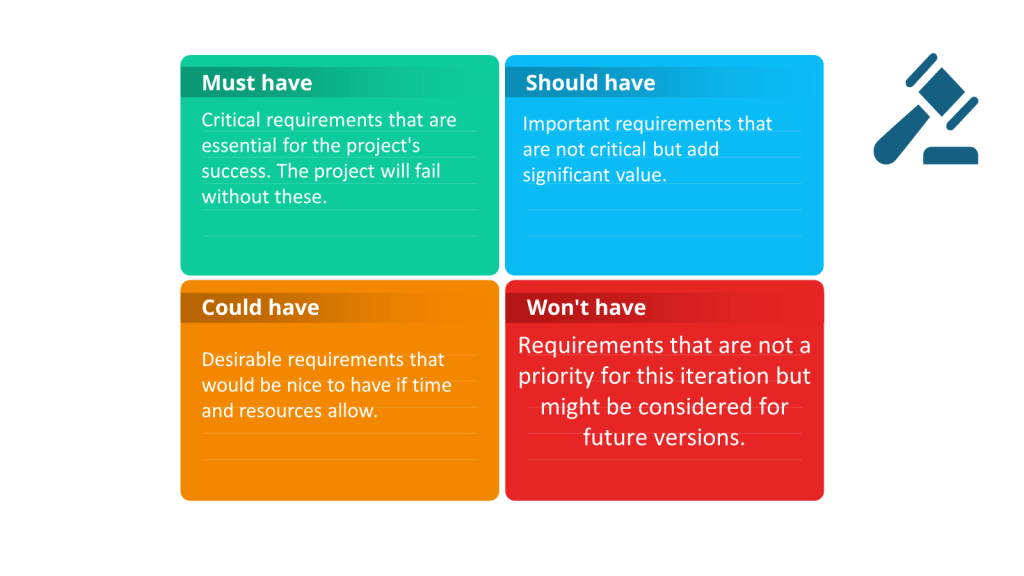
The MoSCoW method is a widely used prioritization technique in project management, particularly within agile frameworks. It categorizes tasks or requirements into four distinct categories:
- Must Have: Essential requirements that are critical for the project’s success. Without these, the project is considered a failure.
- Should Have: Important but not critical requirements. These can be deferred if necessary but should be included if possible.
- Could Have: Desirable but not necessary requirements. These are nice-to-haves that can be included if time and resources permit.
- Won’t Have: Requirements agreed to be excluded from the current project scope. These might be considered for future phases.
Advantages:
- Clarity and Focus: Clearly distinguish between essential and non-essential requirements, helping teams focus on what truly matters.
- Stakeholder Alignment: Facilitates discussions and alignment among stakeholders regarding priorities.
- Flexibility: Can be adapted to various project types and industries.
Disadvantages:
- Ambiguity: May not provide clear guidance on prioritizing within each category.
- Subjectivity: Decisions can be influenced by stakeholder biases or political considerations.
- Resource Allocation: Requires careful allocation of resources to ensure that “Must Have” items are prioritized appropriately.
Binary Prioritization
Binary prioritization, often implemented using a binary search tree, is a method for systematically comparing and ranking requirements. Each requirement is compared against others, creating a hierarchical list of priorities.
Process:
- Root Node: Start with one requirement as the root node.
- Comparison: Compare each succeeding requirement to the root node, establishing child nodes based on priority.
- Hierarchy: Continue creating a long list of prioritized requirements, forming a binary tree structure.
Advantages:
- Systematic Approach: Provides a clear, structured way to compare and rank requirements.
- Granularity: Offers detailed prioritization, ensuring that each requirement is evaluated against others.
- Objectivity: Reduces subjectivity by using a consistent comparison method.
Disadvantages:
- Complexity: Can be complex and time-consuming, especially for large projects with many requirements.
- Resource Intensive: Requires significant effort to compare each requirement systematically.
- Scalability: It may become unwieldy with many requirements, making it difficult to manage.
Pairwise Comparison
Pairwise or paired comparison is a method for prioritizing and ranking multiple options by comparing them in pairs. This technique is particularly useful when quantitative, objective data is not available, and decisions need to be made based on subjective criteria.
How Pairwise Comparison Works
- Define Criteria: Establish clear criteria for evaluation, such as cost, strategic importance, urgency, resource allocation, or alignment with objectives.
- Create a Matrix: List all the items to be compared along its rows and columns. Each cell in the matrix represents a comparison between two items.
- Make Comparisons: For each pair of items, decide which item is more important or preferred based on the established criteria. Mark the preferred item in the corresponding cell of the matrix.
- Calculate Scores: After all comparisons are made, count the times each item was preferred. The item with the highest count is ranked highest in priority.
Benefits of Pairwise Comparison
- Simplicity: It is easy to understand and implement, requiring no special training[3].
- Objectivity: Reduces bias and emotional influence in decision-making by focusing on direct comparisons.
- Clarity: Provides a clear ranking of options, making it easier to prioritize tasks or decisions.
- Engagement: Encourages collaborative discussions among team members, leading to a better understanding of different perspectives.
Limitations of Pairwise Comparison
- Scalability: The number of comparisons increases significantly with the number of items, making it less practical for large lists.
- Relative Importance: Does not allow for measuring the intensity of preferences, only the relative ranking.
- Cognitive Load: Can be mentally taxing if the list of items is long or the criteria are complex.
Applications of Pairwise Comparison
- Project Management: Prioritizing project tasks or deliverables.
- Product Development: Ranking features or requirements based on customer needs.
- Survey Research: Understanding preferences and establishing relative rankings in surveys.
- Strategic Decision-Making: Informing decisions by comparing strategic options or initiatives.
Example of Pairwise Comparison
Imagine a project team needs to prioritize seven project deliverables labeled A to G. They create a pairwise comparison matrix and compare each deliverable against the others. For instance, deliverable A is compared to B, then A to C, and so on. The team marks the preferred deliverable in each comparison. After completing all comparisons, they count the number of times each deliverable was preferred to determine the final ranking.
Comparison of MoSCoW Prioritization, Binary Prioritization, and Pairwise Comparison
Here’s a detailed comparison of the three prioritization methods in a tabular format:
| Aspect | MoSCoW Prioritization | Binary Prioritization | Pairwise Comparison |
|---|---|---|---|
| Key Aspects | Categorizes tasks into Must, Should, Could, and Won’t have | Compares requirements in pairs to create a hierarchical list | Compares options in pairs to determine relative preferences |
| Advantages | Simple to understand, clear categorization, stakeholder alignment | Systematic approach, detailed prioritization, reduces subjectivity | Intuitive, suitable for long lists, provides numerical results |
| Disadvantages | Subjective categorization, may oversimplify complex projects | Time-consuming for large projects, may become complex | Can be cognitively difficult, potential for inconsistency (transitivity violations) |
| Clarity | High-level categorization | Detailed prioritization within a hierarchy | Provides clear ranking based on direct comparisons |
| Stakeholder Involvement | High involvement and alignment required | Less direct involvement, more systematic | Encourages collaborative discussions, but can be intensive |
| Flexibility | Adaptable to various projects | Best suited for projects with clear requirements | Suitable for both small and large lists, but can be complex for very large sets |
| Complexity | Simple to understand and implement | More complex and time-consuming | Can be cognitively taxing, especially for large numbers of comparisons |
| Resource Allocation | Requires careful planning | Systematic but resource-intensive | Requires significant effort for large sets of comparisons |
Conclusion
Each prioritization method has its own strengths and weaknesses, making them suitable for different contexts:
- MoSCoW Prioritization is ideal for projects needing clear, high-level categorization and strong stakeholder alignment. It is simple and effective for initial prioritization but may lack the granularity needed for more complex projects.
- Binary Prioritization offers a systematic and detailed approach, reducing subjectivity. However, it can be time-consuming and complex, especially for large projects.
- Pairwise Comparison is intuitive and provides clear numerical results, making it suitable for long lists of options. It encourages collaborative decision-making but can be cognitively challenging and may lead to inconsistencies if not carefully managed.
Choosing the right method depends on the specific needs and context of the decision, including the number of items to prioritize, the level of detail required, and the involvement of stakeholders.

 Investigations of a Dog