A 2025 Retrospective for Investigations of a Dog

If the history of pharmaceutical quality management were written as a geological timeline, 2025 would hopefully mark the end of the Holocene of Compliance—a long, stable epoch where “following the procedure” was sufficient to ensure survival—and the beginning of the Anthropocene of Complexity.

For decades, our industry has operated under a tacit social contract. We agreed to pretend that “compliance” was synonymous with “quality.” We agreed to pretend that a validated method would work forever because we proved it worked once in a controlled protocol three years ago. We agreed to pretend that “zero deviations” meant “perfect performance,” rather than “blind surveillance.” We agreed to pretend that if we wrote enough documents, reality would conform to them.

If I had my wish 2025 would be the year that contract finally dissolved.

Throughout the year—across dozens of posts, technical analyses, and industry critiques on this blog—I have tried to dismantle the comfortable illusions of “Compliance Theater” and show how this theater collides violently with the unforgiving reality of complex systems.

The connecting thread running through every one of these developments is the concept I have returned to obsessively this year: Falsifiable Quality.

This Year in Review is not merely a summary of blog posts. It is an attempt to synthesize the fragmented lessons of 2025 into a coherent argument. The argument is this: A quality system that cannot be proven wrong is a quality system that cannot be trusted.

If our systems—our validation protocols, our risk assessments, our environmental monitoring programs—are designed only to confirm what we hope is true (the “Happy Path”), they are not quality systems at all. They are comfort blankets. And 2025 was the year we finally started pulling the blanket off.

The Philosophy of Doubt

(Reflecting on: The Effectiveness Paradox, Sidney Dekker, and Gerd Gigerenzer)

Before we dissect the technical failures of 2025, let me first establish the philosophical framework that defined this year’s analysis.

In August, I published The Effectiveness Paradox: Why ‘Nothing Bad Happened’ Doesn’t Prove Your Quality System Works.” It became one of the most discussed posts of the year because it attacked the most sacred metric in our industry: the trend line that stays flat.

We are conditioned to view stability as success. If Environmental Monitoring (EM) data shows zero excursions for six months, we throw a pizza party. If a method validation passes all acceptance criteria on the first try, we commend the development team. If a year goes by with no Critical deviations, we pay out bonuses.

But through the lens of Falsifiable Quality—a concept heavily influenced by the philosophy of Karl Popper, the challenging insights of Deming, and the safety science of Sidney Dekker, whom we discussed in November—these “successes” look suspiciously like failures of inquiry.

The Problem with Unfalsifiable Systems

Karl Popper famously argued that a scientific theory is only valid if it makes predictions that can be tested and proven false. “All swans are white” is a scientific statement because finding one black swan falsifies it. “God is love” is not, because no empirical observation can disprove it.

In 2025, I argued that most Pharmaceutical Quality Systems (PQS) are designed to be unfalsifiable.

  • The Unfalsifiable Alert Limit: We set alert limits based on historical averages + 3 standard deviations. This ensures that we only react to statistical outliers, effectively blinding us to gradual drift or systemic degradation that remains “within the noise.”
  • The Unfalsifiable Robustness Study: We design validation protocols that test parameters we already know are safe (e.g., pH +/- 0.1), avoiding the “cliff edges” where the method actually fails. We prove the method works where it works, rather than finding where it breaks.
  • The Unfalsifiable Risk Assessment: We write FMEAs where the conclusion (“The risk is acceptable”) is decided in advance, and the RPN scores are reverse-engineered to justify it.

This is “Safety Theater,” a term Dekker uses to describe the rituals organizations perform to look safe rather than be safe.

Safety-I vs. Safety-II

In November’s post Sidney Dekker: The Safety Scientist Who Influences How I Think About Quality, I explored Dekker’s distinction between Safety-I (minimizing things that go wrong) and Safety-II (understanding how things usually go right).

Traditional Quality Assurance is obsessed with Safety-I. We count deviations. We count OOS results. We count complaints. When those counts are low, we assume the system is healthy.
But as the LeMaitre Vascular warning letter showed us this year (discussed in Part III), a system can have “zero deviations” simply because it has stopped looking for them. LeMaitre had excellent water data—because they were cleaning the valves before they sampled them. They were measuring their ritual, not their water.

Falsifiable Quality is the bridge to Safety-II. It demands that we treat every batch record not as a compliance artifact, but as a hypothesis test.

  • Hypothesis: “The contamination control strategy is effective.”
  • Test: Aggressive monitoring in worst-case locations, not just the “representative” center of the room.
  • Result: If we find nothing, the hypothesis survives another day. If we find something, we have successfully falsified the hypothesis—which is a good thing because it reveals reality.

The shift from “fearing the deviation” to “seeking the falsification” is a cultural pivot point of 2025.

The Epistemological Crisis in the Lab (Method Validation)

(Reflecting on: USP <1225>, Method Qualification vs. Validation, and Lifecycle Management)

Nowhere was the battle for Falsifiable Quality fought more fiercely in 2025 than in the analytical laboratory.

The proposed revision to USP <1225> Validation of Compendial Procedures (published in Pharmacopeial Forum 51(6)) arrived late in the year, but it serves as the perfect capstone to the arguments I’ve been making since January.

For forty years, analytical validation has been the ultimate exercise in “Validation as an Event.” You develop a method. You write a protocol. You execute the protocol over three days with your best analyst and fresh reagents. You print the report. You bind it. You never look at it again.

This model is unfalsifiable. It assumes that because the method worked in the “Work-as-Imagined” conditions of the validation study, it will work in the “Work-as-Done” reality of routine QC for the next decade.

The Reportable Result: Validating Decisions, Not Signals

The revised USP <1225>—aligned with ICH Q14(Analytical Procedure Development) and USP <1220> (The Lifecycle Approach)—destroys this assumption. It introduces concepts that force falsifiability into the lab.

The most critical of these is the Reportable Result.

Historically, we validated “the instrument” or “the measurement.” We proved that the HPLC could inject the same sample ten times with < 1.0% RSD.

But the Reportable Result is the final value used for decision-making—the value that appears on the Certificate of Analysis. It is the product of a complex chain: Sampling -> Transport -> Storage -> Preparation -> Dilution -> Injection -> Integration -> Calculation -> Averaging.

Validating the injection precision (the end of the chain) tells us nothing about the sampling variability (the beginning of the chain).

By shifting focus to the Reportable Result, USP <1225> forces us to ask: “Does this method generate decisions we can trust?”

The Replication Strategy: Validating “Work-as-Done”

The new guidance insists that validation must mimic the replication strategy of routine testing.
If your SOP says “We report the average of 3 independent preparations,” then your validation must evaluate the precision and accuracy of that average, not of the individual preparations.

This seems subtle, but it is revolutionary. It prevents the common trick of “averaging away” variability during validation to pass the criteria, only to face OOS results in routine production because the routine procedure doesn’t use the same averaging scheme.

It forces the validation study to mirror the messy reality of the “Work-as-Done,” making the validation data a falsifiable predictor of routine performance, rather than a theoretical maximum capability.

Method Qualification vs. Validation: The June Distinction

I wrote Method Qualification and Validation,” clarifying a distinction that often confuses the industry.

  • Qualification is the “discovery phase” where we explore the method’s limits. It is inherently falsifiable—we want to find where the method breaks.
  • Validation has traditionally been the “confirmation phase” where we prove it works.

The danger, as I noted in that post, is when we skip the falsifiable Qualification step and go straight to Validation. We write the protocol based on hope, not data.

USP <1225> essentially argues that Validation must retain the falsifiable spirit of Qualification. It is not a coronation; it is a stress test.

The Death of “Method Transfer” as We Know It

In a Falsifiable Quality system, a method is never “done.” The Analytical Target Profile (ATP)—a concept from ICH Q14 that permeates the new thinking—is a standing hypothesis: “This method measures Potency within +/- 2%.”

Every time we run a system suitability check, every time we run a control standard, we are testing that hypothesis.

If the method starts drifting—even if it still passes broad system suitability limits—a falsifiable system flags the drift. An unfalsifiable system waits for the OOS.

The draft revision of USP <1225> is a call to arms. It asks us to stop treating validation as a “ticket to ride”—a one-time toll we pay to enter GMP compliance—and start treating it as a “ticket to doubt.” Validation gives us permission to use the method, but only as long as the data continues to support the hypothesis of fitness.

The Reality Check (The “Unholy Trinity” of Warning Letters)

Philosophy and guidelines are fine, but in 2025, reality kicked in the door. The regulatory year was defined by three critical warning letters—SanofiLeMaitre, and Rechon—that collectively dismantled the industry’s illusions of control.

It began, as these things often do, with a ghost from the past.

Sanofi Framingham: The Pendulum Swings Back

(Reflecting on: Failure to Investigate Critical Deviations and The Sanofi Warning Letter)

The year opened with a shock. On January 15, 2025, the FDA issued a warning letter to Sanofi’s Framingham facility—the sister site to the legacy Genzyme Allston landing, whose consent decree defined an entire generation of biotech compliance and of my career.

In my January analysis (Failure to Investigate Critical Deviations: A Cautionary Tale), I noted that the FDA’s primary citation was a failure to “thoroughly investigate any unexplained discrepancy.”

This is the cardinal sin of Falsifiable Quality.

An “unexplained discrepancy” is a signal from reality. It is the system telling you, “Your hypothesis about this process is wrong.”

  • The Falsifiable Response: You dive into the discrepancy. You assume your control strategy missed something. You use Causal Reasoning (the topic of my May post) to find the mechanism of failure.
  • The Sanofi Response: As the warning letter detailed, they frequently attributed failures to “isolated incidents” or superficial causes without genuine evidence.

This is the “Refusal to Falsify.” By failing to investigate thoroughly, the firm protects the comfortable status quo. They choose to believe the “Happy Path” (the process is robust) over the evidence (the discrepancy).

The Pendulum of Compliance

In my companion post (Sanofi Warning Letter”), I discussed the “pendulum of compliance.” The Framingham site was supposed to be the fortress of quality, built on the lessons of the Genzyme crisis.

The failure at Sanofi wasn’t a lack of SOPs; it was a lack of curiosity.

The investigators likely had checklists, templates, and timelines (Compliance Theater), but they lacked the mandate—or perhaps the Expertise —to actually solve the problem.

This set the thematic stage for the rest of 2025. Sanofi showed us that “closing the deviation” is not the same as fixing the problem. This insight led directly into my August argument in The Effectiveness Paradox: You can close 100% of your deviations on time and still have a manufacturing process that is spinning out of control.

If Sanofi was the failure of investigation (looking back), Rechon and LeMaitre were failures of surveillance (looking forward). Together, they form a complete picture of why unfalsifiable systems fail.

Reflecting on: Rechon Life Science and LeMaitre Vascular

Philosophy and guidelines are fine, but in September, reality kicked in the door.

Two warning letters in 2025—Rechon Life Science (September) and LeMaitre Vascular (August)—provided brutal case studies in what happens when “representative sampling” is treated as a buzzword rather than a statistical requirement.

Rechon Life Science: The Map vs. The Territory

The Rechon Life Science warning letter was a significant regulatory signal of 2025 regarding sterile manufacturing. It wasn’t just a list of observations; it was an indictment of unfalsifiable Contamination Control Strategies (CCS).

We spent 2023 and 2024 writing massive CCS documents to satisfy Annex 1. Hundreds of pages detailing airflows, gowning procedures, and material flows. We felt good about them. We felt “compliant.”

Then the FDA walked into Rechon and essentially asked: “If your CCS is so good, why does your smoke study show turbulence over the open vials?”

The warning letter highlighted a disconnect I’ve called “The Map vs. The Territory.”

  • The Map: The CCS document says the airflow is unidirectional and protects the product.
  • The Territory: The smoke study video shows air eddying backward from the operator to the sterile core.

In an unfalsifiable system, we ignore the smoke study (or film it from a flattering angle) because it contradicts the CCS. We prioritize the documentation (the claim) over the observation (the evidence).

In a falsifiable system, the smoke study is the test. If the smoke shows turbulence, the CCS is falsified. We don’t defend the CCS; we rewrite it. We redesign the line.

The FDA’s critique of Rechon’s “dynamic airflow visualization” was devastating because it showed that Rechon was using the smoke study as a marketing video, not a diagnostic tool. They filmed “representative” operations that were carefully choreographed to look clean, rather than the messy reality of interventions.

LeMaitre Vascular: The Sin of “Aspirational Data”

If Rechon was about air, LeMaitre Vascular (analyzed in my August post When Water Systems Fail) was about water. And it contained an even more egregious sin against falsifiability.

The FDA observed that LeMaitre’s water sampling procedures required cleaning and purging the sample valves before taking the sample.

Let’s pause and consider the epistemology of this.

  • The Goal: To measure the quality of the water used in manufacturing.
  • The Reality: Manufacturing operators do not purge and sanitize the valve for 10 minutes before filling the tank. They open the valve and use the water.
  • The Sample: By sanitizing the valve before sampling, LeMaitre was measuring the quality of the sampling process, not the quality of the water system.

I call this “Aspirational Data.” It is data that reflects the system as we wish it existed, not as it actually exists. It is the ultimate unfalsifiable metric. You can never find biofilm in a valve if you scrub the valve with alcohol before you open it.

The FDA’s warning letter was clear: “Sampling… must include any pathway that the water travels to reach the process.”

LeMaitre also performed an unauthorized “Sterilant Switcheroo,” changing their sanitization agent without change control or biocompatibility assessment. This is the hallmark of an unfalsifiable culture: making changes based on convenience, assuming they are safe, and never designing the study to check if that assumption is wrong.

The “Representative” Trap

Both warning letters pivot on the misuse of the word “representative.”

Firms love to claim their EM sampling locations are “representative.” But representative of what? Usually, they are representative of the average condition of the room—the clean, empty spaces where nothing happens.

But contamination is not an “average” event. It is a specific, localized failure. A falsifiable EM program places probes in the “worst-case” locations—near the door, near the operator’s hands, near the crimping station. It tries to find contamination. It tries to falsify the claim that the zone is sterile, asceptic or bioburden reducing.

When Rechon and LeMaitre failed to justify their sampling locations, they were guilty of designing an unfalsifiable experiment. They placed the “microscope” where they knew they wouldn’t find germs.

2025 taught us that regulators are no longer impressed by the thickness of the CCS binder. They are looking for the logic of control. They are testing your hypothesis. And if you haven’t tested it yourself, you will fail.

The Investigation as Evidence

(Reflecting on: The Golden Start to a Deviation InvestigationCausal ReasoningTake-the-Best Heuristics, and The Catalent Case)

If Rechon, LeMaitre, and Sanofi teach us anything, it is that the quality system’s ability to discover failure is more important than its ability to prevent failure.

A perfect manufacturing process that no one is looking at is indistinguishable from a collapsing process disguised by poor surveillance. But a mediocre process that is rigorously investigated, understood, and continuously improved is a path toward genuine control.

The investigation itself—how we respond to a deviation, how we reason about causation, how we design corrective actions—is where falsifiable quality either succeeds or fails.

The Golden Day: When Theory Meets Work-as-Done

In April, I published “The Golden Start to a Deviation Investigation,” which made a deceptively simple argument: The first 24 hours after a deviation is discovered are where your quality system either commits to discovering truth or retreats into theater.

This argument sits at the heart of falsifiable quality.

When a deviation occurs, you have a narrow window—what I call the “Golden Day”—where evidence is fresh, memories are intact, and the actual conditions that produced the failure still exist. If you waste this window with vague problem statements and abstract discussions, you permanently lose the ability to test causal hypotheses later.

The post outlined a structured protocol:

First, crystallize the problem. Not “potency was low”—but “Lot X234, potency measured at 87% on January 15th at 14:32, three hours after completion of blending in Vessel C-2.” Precision matters because only specific, bounded statements can be falsified. A vague problem statement can always be “explained away.”

Second, go to the Gemba. This is the antidote to “work-as-imagined” investigation. The SOP says the temperature controller should maintain 37°C +/- 2°C. But the Gemba walk reveals that the probe is positioned six inches from the heating element, the data logger is in a recessed pocket where humidity accumulates, and the operator checks it every four hours despite a requirement to check hourly. These are the facts that predict whether the deviation will recur.

Third, interview with cognitive discipline. Most investigations fail not because investigators lack information, but because they extract information poorly. Cognitive interviewing—developed by the FBI and the National Transportation Safety Board—uses mental reinstatement, multiple perspectives, and sequential reordering to access accurate recall rather than confabulated narrative. The investigator asks the operator to walk through the event in different orders, from different viewpoints, each time triggering different memory pathways. This is not “soft” technique; it is a mechanism for generating falsifiable evidence.

The Golden Day post makes it clear: You do not investigate deviations to document compliance. You investigate deviations to gather evidence about whether your understanding of the process is correct.

Causal Reasoning: Moving Beyond “What Was Missing”

Most investigation tools fail not because they are flawed, but because they are applied with the wrong mindset. In my May post “Causal Reasoning: A Transformative Approach to Root Cause Analysis,” I argued that pharmaceutical investigations are often trapped in “negative reasoning.”

Negative reasoning asks: “What barrier was missing? What should have been done but wasn’t?” This mindset leads to unfalsifiable conclusions like “Procedure not followed” or “Training was inadequate.” These are dead ends because they describe the absence of an ideal, not the presence of a cause.

Causal reasoning flips the script. It asks: “What was present in the system that made the observed outcome inevitable?”

Instead of settling for “human error,” causal reasoning demands we ask: What environmental cues made the action sensible to the operator at that moment? Were the instructions ambiguous? Did competing priorities make compliance impossible? Was the process design fragile?

This shift transforms the investigation from a compliance exercise into a scientific inquiry.

Consider the LeMaitre example:

  • Negative Reasoning: “Why didn’t they sample the true condition?” Answer: “Because they didn’t follow the intent of the sampling plan.”
  • Causal Reasoning: “What made the pre-cleaning practice sensible to them?” Answer: “They believed it ensured sample validity by removing valve residue.”

By understanding the why, we identify a knowledge gap that can be tested and corrected, rather than a negligence gap that can only be punished.

In September, “Take-the-Best Heuristic for Causal Investigation” provided a practical framework for this. Instead of listing every conceivable cause—a process that often leads to paralysis—the “Take-the-Best” heuristic directs investigators to focus on the most information-rich discriminators. These are the factors that, if different, would have prevented the deviation. This approach focuses resources where they matter most, turning the investigation into a targeted search for truth.

CAPA: Predictions, Not Promises

The Sanofi warning letter—analyzed in January—showed the destination of unfalsifiable investigation: CAPAs that exist mainly as paperwork.

Sanofi had investigation reports. They had “corrective actions.” But the FDA noted that deviations recurred in similar patterns, suggesting that the investigation had identified symptoms, not mechanisms, and that the “corrective” action had not actually addressed causation.

This is the sin of treating CAPA as a promise rather than a hypothesis.

A falsifiable CAPA is structured as an explicit prediction“If we implement X change, then Y undesirable outcome will not recur under conditions Z.”

This can be tested. If it fails the test, the CAPA itself becomes evidence—not of failure, but of incomplete causal understanding. Which is valuable.

In the Rechon analysis, this showed up concretely: The FDA’s real criticism was not just that contamination was found; it was that Rechon’s Contamination Control Strategy had no mechanism to falsify itself. If the CCS said “unidirectional airflow protects the product,” and smoke studies showed bidirectional eddies, the CCS had been falsified. But Rechon treated the falsification as an anomaly to be explained away, rather than evidence that the CCS hypothesis was wrong.

A falsifiable organization would say: “Our CCS predicted that Grade A in an isolator with this airflow pattern would remain sterile. The smoke study proves that prediction wrong. Therefore, the CCS is false. We redesign.”

Instead, they filmed from a different angle and said the aerodynamics were “acceptable.”

Knowledge Integration: When Deviations Become the Curriculum

The final piece of falsifiable investigation is what I call “knowledge integration.” A single deviation is a data point. But across the organization, deviations should form a curriculum about how systems actually fail.

Sanofi’s failure was not that they investigated each deviation badly (though they did). It was that they investigated them in isolation. Each deviation closed on its own. Each CAPA addressed its own batch. There was no organizational learning—no mechanism for a pattern of similar deviations to trigger a hypothesis that the control strategy itself was fundamentally flawed.

This is where the Catalent case study, analyzed in September’s “When 483s Reveal Zemblanity,” becomes instructive. Zemblanity is the opposite of serendipity: the seemingly random recurrence of the same failure through different paths. Catalent’s 483 observations were not isolated mistakes; they formed a pattern that revealed a systemic assumption (about equipment capability, about environmental control, about material consistency) that was false across multiple products and locations.

A falsifiable quality system catches zemblanity early by:

  1. Treating each deviation as a test of organizational hypotheses, not as an isolated incident.
  2. Trending deviation patterns to detect when the same causal mechanism is producing failures across different products, equipment, or operators.
  3. Revising control strategies when patterns falsify the original assumptions, rather than tightening parameters at the margins.

The Digital Hallucination (CSA, AI, and the Expertise Crisis)

(Reflecting on: CSA: The Emperor’s New Clothes, Annex 11, and The Expertise Crisis)

While we battled microbes in the cleanroom, a different battle was raging in the server room. 2025 was the year the industry tried to “modernize” validation through Computer Software Assurance (CSA) and AI, and in many ways, it was the year we tried to automate our way out of thinking.

CSA: The Emperor’s New Validation Clothes

In September, I published Computer System Assurance: The Emperor’s New Validation Clothes,” a critique of the the contortions being made around the FDA’s guidance. The narrative sold by consultants for years was that traditional Computer System Validation (CSV) was “broken”—too much documentation, too much testing—and that CSA was a revolutionary new paradigm of “critical thinking.”

My analysis showed that this narrative is historically illiterate.

The principles of CSA—risk-based testing, leveraging vendor audits, focusing on intended use—are not new. They are the core principles of GAMP5 and have been applied for decades now.

The industry didn’t need a new guidance to tell us to use critical thinking; we had simply chosen not to use the critical thinking tools we already had. We had chosen to apply “one-size-fits-all” templates because they were safe (unfalsifiable).

The CSA guidance is effectively the FDA saying: “Please read the GAMP5 guide you claimed to be following for the last 15 years.”

The danger of the “CSA Revolution” narrative is that it encourages a swing to the opposite extreme: “Unscripted Testing” that becomes “No Testing.”

In a falsifiable system, “unscripted testing” is highly rigorous—it is an expert trying to break the software (“Ad Hoc testing”). But in an unfalsifiable system, “unscripted testing” becomes “I clicked around for 10 minutes and it looked fine.”

The Expertise Crisis: AI and the Death of the Apprentice

This leads directly to the Expertise Crisis. In September, I wrote The Expertise Crisis: Why AI’s War on Entry-Level Jobs Threatens Quality’s Future.” This was perhaps the most personal topic I covered this year, because it touches on the very survival of our profession.

We are rushing to integrate Artificial Intelligence (AI) into quality systems. We have AI writing deviations, AI drafting SOPs, AI summarizing regulatory changes. The efficiency gains are undeniable. But the cost is hidden, and it is epistemological.

Falsifiability requires expertise.
To falsify a claim—to look at a draft investigation report and say, “No, that conclusion doesn’t follow from the data”—you need deep, intuitive knowledge of the process. You need to know what a “normal” pH curve looks like so you can spot the “abnormal” one that the AI smoothed over.

Where does that intuition come from? It comes from the “grunt work.” It comes from years of reviewing batch records, years of interviewing operators, years of struggling to write a root cause analysis statement.

The Expertise Crisis is this: If we give all the entry-level work to AI, where will the next generation of Quality Leaders come from?

  • The Junior Associate doesn’t review the raw data; the AI summarizes it.
  • The Junior Associate doesn’t write the deviation; the AI generates the text.
  • Therefore, the Junior Associate never builds the mental models necessary to critique the AI.

The Loop of Unfalsifiable Hallucination

We are creating a closed loop of unfalsifiability.

  1. The AI generates a plausible-sounding investigation report.
  2. The human reviewer (who has been “de-skilled” by years of AI reliance) lacks the deep expertise to spot the subtle logical flaw or the missing data point.
  3. The report is approved.
  4. The “hallucination” becomes the official record.

In a falsifiable quality system, the human must remain the adversary of the algorithm. The human’s job is to try to break the AI’s logic, to check the citations, to verify the raw data.
But in 2025, we saw the beginnings of a “Compliance Autopilot”—a desire to let the machine handle the “boring stuff.”

My warning in September remains urgent: Efficiency without expertise is just accelerated incompetence. If we lose the ability to falsify our own tools, we are no longer quality professionals; we are just passengers in a car driven by a statistical model that doesn’t know what “truth” is.

My post “The Missing Middle in GMP Decision Making: How Annex 22 Redefines Human-Machine Collaboration in Pharmaceutical Quality Assurance” goes a lot deeper here.

Annex 11 and Data Governance

In August, I analyzed the draft Annex 11 (Computerised Systems) in the post Data Governance Systems: A Fundamental Shift.”

The Europeans are ahead of the FDA here. While the FDA talks about “Assurance” (testing less), the EU is talking about “Governance” (controlling more). The new Annex 11 makes it clear: You cannot validate a system if you do not control the data lifecycle. Validation is not a test script; it is a state of control.

This aligns perfectly with USP <1225> and <1220>. Whether it’s a chromatograph or an ERP system, the requirement is the same: Prove that the data is trustworthy, not just that the software is installed.

The Process as a Hypothesis (CPV & Cleaning)

(Reflecting on: Continuous Process Verification and Hypothesis Formation)

The final frontier of validation we explored in 2025 was the manufacturing process itself.

CPV: Continuous Falsification

In March, I published Continuous Process Verification (CPV) Methodology and Tool Selection.”
CPV is the ultimate expression of Falsifiable Quality in manufacturing.

  • Traditional Validation (3 Batches): “We made 3 good batches, therefore the process is perfect forever.” (Unfalsifiable extrapolation).
  • CPV: “We made 3 good batches, so we have a license to manufacture, but we will statistically monitor every subsequent batch to detect drift.” (Continuous hypothesis testing).

The challenge with CPV, as discussed in the post, is that it requires statistical literacy. You cannot implement CPV if your quality unit doesn’t understand the difference between Cpk and Ppk, or between control limits and specification limits.

This circles back to the Expertise Crisis. We are implementing complex statistical tools (CPV software) at the exact moment we are de-skilling the workforce. We risk creating a “CPV Dashboard” that turns red, but no one knows why or what to do about it.

Cleaning Validation: The Science of Residue

In August, I tried to apply falsifiability to one of the most stubborn areas of dogma: Cleaning Validation.

In Building Decision-Making with Structured Hypothesis Formation, I argued that cleaning validation should not be about “proving it’s clean.” It should be about “understanding why it gets dirty.”

  • Traditional Approach: Swab 10 spots. If they pass, we are good.
  • Hypothesis Approach: “We hypothesize that the gasket on the bottom valve is the hardest to clean. We predict that if we reduce rinse time by 1 minute, that gasket will fail.”

By testing the boundaries—by trying to make the cleaning fail—we understand the Design Space of the cleaning process.

We discussed the “Visual Inspection” paradox in cleaning: If you can see the residue, it failed. But if you can’t see it, does it pass?

Only if you have scientifically determined the Visible Residue Limit (VRL). Using “visually clean” without a validated VRL is—you guessed it—unfalsifiable.

To: Jeremiah Genest
From: Perplexity Research
Subject: Draft Content – Single-Use Systems & E&L Section

Here is a section on Single-Use Systems (SUS) and Extractables & Leachables (E&L).

I have positioned this piece to bridge the gap between “Part III: The Reality Check” (Contamination/Water) and “Part V: The Process as a Hypothesis” (Cleaning Validation).

The argument here is that by switching from Stainless Steel to Single-Use, we traded a visible risk (cleaning residue) for an invisible one (chemical migration), and that our current approach to E&L is often just “Paper Safety”—relying on vendor data that doesn’t reflect the “Work-as-Done” reality of our specific process conditions.

The Plastic Paradox (Single-Use Systems and the E&L Mirage)

If the Rechon and LeMaitre warning letters were about the failure to control biological contaminants we can find, the industry’s struggle with Single-Use Systems (SUS) in 2025 was about the chemical contaminants we choose not to find.

We have spent the last decade aggressively swapping stainless steel for plastic. The value proposition was irresistible: Eliminate cleaning validation, eliminate cross-contamination, increase flexibility. We traded the “devil we know” (cleaning residue) for the “devil we don’t” (Extractables and Leachables).

But in 2025, with the enforcement reality of USP <665> (Plastic Components and Systems) settling in, we had to confront the uncomfortable truth: Most E&L risk assessments are unfalsifiable.

The Vendor Data Trap

The standard industry approach to E&L is the ultimate form of “Compliance Theater.”

  1. We buy a single-use bag.
  2. We request the vendor’s regulatory support package (the “Map”).
  3. We see that the vendor extracted the film with aggressive solvents (ethanol, hexane) for 7 days.
  4. We conclude: “Our process uses water for 24 hours; therefore, we are safe.”

This logic is epistemologically bankrupt. It assumes that the Vendor’s Model (aggressive solvents/short time) maps perfectly to the User’s Reality (complex buffers/long duration/specific surfactants).

It ignores the fact that plastics are dynamic systems. Polymers age. Gamma irradiation initiates free radical cascades that evolve over months. A bag manufactured in January might have a different leachable profile than a bag manufactured in June, especially if the resin supplier made a “minor” change that didn’t trigger a notification.

By relying solely on the vendor’s static validation package, we are choosing not to falsify our safety hypothesis. We are effectively saying, “If the vendor says it’s clean, we will not look for dirt.”

USP <665>: A Baseline, Not a Ceiling

The full adoption of USP <665> was supposed to bring standardization. And it has—it provides a standard set of extraction conditions. But standards can become ceilings.

In 2025, I observed a troubling trend of “Compliance by Citation.” Firms are citing USP <665> compliance as proof of absence of risk, stopping the inquiry there.

A Falsifiable E&L Strategy goes further. It asks:

  • “What if the vendor data is irrelevant to my specific surfactant?”
  • “What if the gamma irradiation dose varied?”
  • “What if the interaction between the tubing and the connector creates a new species?”

The Invisible Process Aid

We must stop viewing Single-Use Systems as inert piping. They are active process components. They are chemically reactive vessels that participate in our reaction kinetics.

When we treat them as inert, we are engaging in the same “Aspirational Thinking” that LeMaitre used on their water valves. We are modeling the system we want (pure, inert plastic), not the system we have (a complex soup of antioxidants, slip agents, and degradants).

The lesson of 2025 is that Material Qualification cannot be a paper exercise. If you haven’t done targeted simulation studies that mimic your actual “Work-as-Done” conditions, you haven’t validated the system. You’ve just filed the receipt.

The Mandate for 2026

As we look toward 2026, the path is clear. We cannot go back to the comfortable fiction of the pre-2025 era.

The regulatory environment (Annex 1, ICH Q14, USP <1225>, Annex 11) is explicitly demanding evidence of control, not just evidence of compliance. The technological environment (AI) is demanding that we sharpen our human expertise to avoid becoming obsolete. The physical environment (contamination, supply chain complexity) is demanding systems that are robust, not just rigid.

The mandate for the coming year is to build Falsifiable Quality Systems.

What does that look like practically?

  1. In the Lab: Implement USP <1225> logic now. Don’t wait for the official date. Validate your reportable results. Add “challenge tests” to your routine monitoring.
  2. In the Plant: Redesign your Environmental Monitoring to hunt for contamination, not to avoid it. If you have a “perfect” record in a Grade C area, move the plates until you find the dirt.
  3. In the Office: Treat every investigation as a chance to falsify the control strategy. If a deviation occurs that the control strategy said was impossible, update the control strategy.
  4. In the Culture: Reward the messenger. The person who finds the crack in the system is not a troublemaker; they are the most valuable asset you have. They just falsified a false sense of security.
  5. In Design: Embrace the Elegant Quality System (discussed in May). Complexity is the enemy of falsifiability. Complex systems hide failures; simple, elegant systems reveal them.

2025 was the year we stopped pretending. 2026 must be the year we start building. We must build systems that are honest enough to fail, so that we can build processes that are robust enough to endure.

Thank you for reading, challenging, and thinking with me this year. The investigation continues.
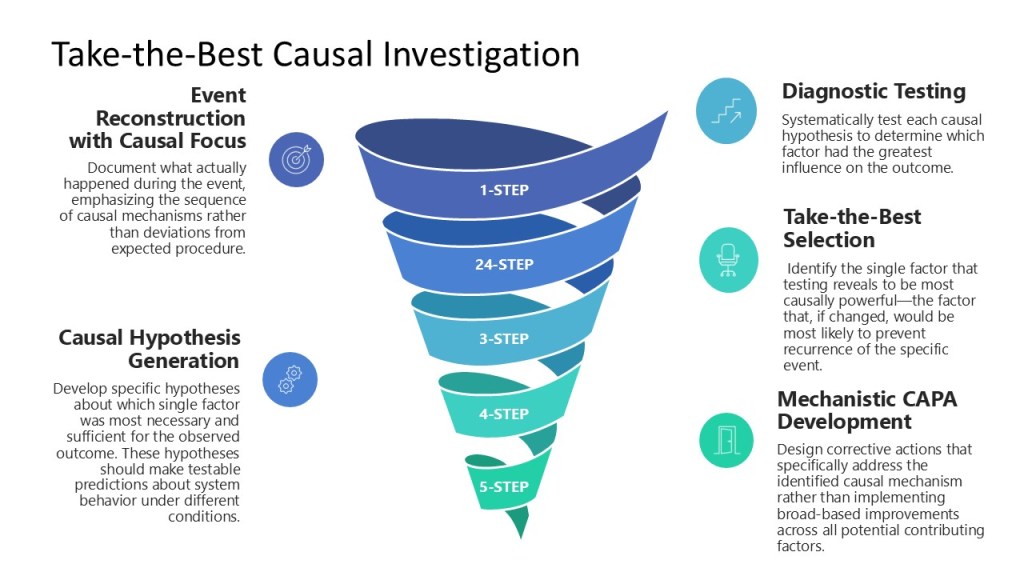
Take-the-Best Heuristic for Causal Investigation

The integration of Gigerenzer’s take-the-best heuristic with a causal reasoning framework creates a powerful approach to root cause analysis that addresses one of the most persistent problems in quality investigations: the tendency to generate exhaustive lists of contributing factors without identifying the causal mechanisms that actually drove the event.

Traditional root cause analysis often suffers from what we might call “factor proliferation”—the systematic identification of every possible contributing element without distinguishing between those that were causally necessary for the outcome and those that merely provide context. This comprehensive approach feels thorough but often obscures the most important causal relationships by giving equal weight to diagnostic and non-diagnostic factors.

The take-the-best heuristic offers an elegant solution by focusing investigative effort on identifying the single most causally powerful factor—the factor that, if changed, would have been most likely to prevent the event from occurring. This approach aligns perfectly with causal reasoning’s emphasis on identifying what was actually present and necessary for the outcome, rather than cataloging everything that might have been relevant.

From Counterfactuals to Causal Mechanisms

The most significant advantage of applying take-the-best to causal investigation is its natural resistance to the negative reasoning trap that dominates traditional root cause analysis. When investigators ask “What single factor was most causally responsible for this outcome?” they’re forced to identify positive causal mechanisms rather than falling back on counterfactuals like “failure to follow procedure” or “inadequate training.”

Consider a typical pharmaceutical deviation where a batch fails specification due to contamination. Traditional analysis might identify multiple contributing factors: inadequate cleaning validation, operator error, environmental monitoring gaps, supplier material variability, and equipment maintenance issues. Each factor receives roughly equal attention in the investigation report, leading to broad but shallow corrective actions.

A take-the-best causal approach would ask: “Which single factor, if it had been different, would most likely have prevented this contamination?” The investigation might reveal that the cleaning validation was adequate under normal conditions, but a specific equipment configuration created dead zones that weren’t addressed in the original validation. This equipment configuration becomes the take-the-best factor because changing it would have directly prevented the contamination, regardless of other contributing elements.

This focus on the most causally powerful factor doesn’t ignore other contributing elements—it prioritizes them based on their causal necessity rather than their mere presence during the event.

The Diagnostic Power of Singular Focus

One of Gigerenzer’s key insights about take-the-best is that focusing on the single most diagnostic factor can actually improve decision accuracy compared to complex multivariate approaches. In causal investigation, this translates to identifying the factor that had the greatest causal influence on the outcome—the factor that represents the strongest link in the causal chain.

This approach forces investigators to move beyond correlation and association toward genuine causal understanding. Instead of asking “What factors were present during this event?” the investigation asks “What factor was most necessary and sufficient for this specific outcome to occur?” This question naturally leads to the kind of specific, testable causal statements.

For example, rather than concluding that “multiple factors contributed to the deviation including inadequate procedures, training gaps, and environmental conditions,” a take-the-best causal analysis might conclude that “the deviation occurred because the procedure specified a 30-minute hold time that was insufficient for complete mixing under the actual environmental conditions present during manufacturing, leading to stratification that caused the observed variability.” This statement identifies the specific causal mechanism (insufficient hold time leading to incomplete mixing) while providing the time, place, and magnitude specificity that causal reasoning demands.

Preventing the Generic CAPA Trap

The take-the-best approach to causal investigation naturally prevents one of the most common failures in pharmaceutical quality: the generation of generic, unfocused corrective actions that address symptoms rather than causes. When investigators identify multiple contributing factors without clear causal prioritization, the resulting CAPAs often become diffuse efforts to “improve” everything without addressing the specific mechanisms that drove the event.

By focusing on the single most causally powerful factor, take-the-best investigations generate targeted corrective actions that address the specific mechanism identified as most necessary for the outcome. This creates more effective prevention strategies while avoiding the resource dilution that often accompanies broad-based improvement efforts.

The causal reasoning framework enhances this focus by requiring that the identified factor be described in terms of what actually happened rather than what failed to happen. Instead of “failure to follow cleaning procedures,” the investigation might identify “use of abbreviated cleaning cycle during shift change because operators prioritized production schedule over cleaning thoroughness.” This causal statement directly leads to specific corrective actions: modify shift change procedures, clarify prioritization guidance, or redesign cleaning cycles to be robust against time pressure.

Systematic Application

Implementing take-the-best causal investigation in pharmaceutical quality requires systematic attention to identifying and testing causal hypotheses rather than simply cataloging potential contributing factors. This process follows a structured approach:

Step 1: Event Reconstruction with Causal Focus – Document what actually happened during the event, emphasizing the sequence of causal mechanisms rather than deviations from expected procedure. Focus on understanding why actions made sense to the people involved at the time they occurred.

Step 2: Causal Hypothesis Generation – Develop specific hypotheses about which single factor was most necessary and sufficient for the observed outcome. These hypotheses should make testable predictions about system behavior under different conditions.

Step 3: Diagnostic Testing – Systematically test each causal hypothesis to determine which factor had the greatest influence on the outcome. This might involve data analysis, controlled experiments, or systematic comparison with similar events.

Step 4: Take-the-Best Selection – Identify the single factor that testing reveals to be most causally powerful—the factor that, if changed, would be most likely to prevent recurrence of the specific event.

Step 5: Mechanistic CAPA Development – Design corrective actions that specifically address the identified causal mechanism rather than implementing broad-based improvements across all potential contributing factors.

Integration with Falsifiable Quality Systems

The take-the-best approach to causal investigation creates naturally falsifiable hypotheses that can be tested and validated over time. When an investigation concludes that a specific factor was most causally responsible for an event, this conclusion makes testable predictions about system behavior that can be validated through subsequent experience.

For example, if a contamination investigation identifies equipment configuration as the take-the-best causal factor, this conclusion predicts that similar contamination events will be prevented by addressing equipment configuration issues, regardless of training improvements or procedural changes. This prediction can be tested systematically as the organization gains experience with similar situations.

This integration with falsifiable quality systems creates a learning loop where investigation conclusions are continuously refined based on their predictive accuracy. Investigations that correctly identify the most causally powerful factors will generate effective prevention strategies, while investigations that miss the key causal mechanisms will be revealed through continued problems despite implemented corrective actions.

The Leadership and Cultural Implications

Implementing take-the-best causal investigation requires leadership commitment to genuine learning rather than blame assignment. This approach often reveals system-level factors that leadership helped create or maintain, requiring the kind of organizational humility that the Energy Safety Canada framework emphasizes.

The cultural shift from comprehensive factor identification to focused causal analysis can be challenging for organizations accustomed to demonstrating thoroughness through exhaustive documentation. Leaders must support investigators in making causal judgments and prioritizing factors based on their diagnostic power rather than their visibility or political sensitivity.

This cultural change aligns with the broader shift toward scientific quality management that both the adaptive toolbox and falsifiable quality frameworks require. Organizations must develop comfort with making specific causal claims that can be tested and potentially proven wrong, rather than maintaining the false safety of comprehensive but non-specific factor lists.

The take-the-best approach to causal investigation represents a practical synthesis of rigorous scientific thinking and adaptive decision-making. By focusing on the single most causally powerful factor while maintaining the specific, testable language that causal reasoning demands, this approach generates investigations that are both scientifically valid and operationally useful—exactly what pharmaceutical quality management needs to move beyond the recurring problems that plague traditional root cause analysis.

A Guide to Essential Thinkers and Their Works

A curated exploration of the minds that have shaped my approach to organizational excellence, systems thinking, and quality culture

Quality management has evolved far beyond its industrial roots to become a sophisticated discipline that draws from psychology, systems theory, organizational behavior, and strategic management. The intellectual influences that shape how we think about quality today represent a rich tapestry of thinkers who have fundamentally changed how organizations approach excellence, learning, and continuous improvement.

This guide explores the key intellectual influences that inform my quality thinking, organized around the foundational concepts they’ve contributed. For each thinker, I’ve selected two essential books that capture their most important contributions to quality practice.

I want to caution that this list is not meant to be complete. It really explores some of the books I’ve been using again and again as I explore many of the concepts on this blog. Please share your foundational books in the comments!

And to make life easier, I provided links to the books.

https://bookshop.org/lists/quality-thinkers

Psychological Safety and Organizational Learning

Amy Edmondson

The pioneer of psychological safety research

Amy Edmondson’s work has revolutionized our understanding of how teams learn, innovate, and perform at their highest levels. Her research demonstrates that psychological safety—the belief that one can speak up without risk of punishment or humiliation—is the foundation of high-performing organizations.

Essential Books:

  1. The Fearless Organization: Creating Psychological Safety in the Workplace for Learning, Innovation, and Growth (2018) – The definitive guide to understanding and building psychological safety in organizations.
  2. The 4 Stages of Psychological Safety (HBR Emotional Intelligence Series) (2024) – A practical handbook featuring Edmondson’s latest insights alongside other leading voices in the field.

Timothy Clark

The architect of staged psychological safety development

Timothy Clark has extended Edmondson’s foundational work by creating a practical framework for how psychological safety develops in teams. His four-stage model provides leaders with a clear pathway for building psychologically safe environments.

Essential Books:

  1. The 4 Stages of Psychological Safety: Defining the Path to Inclusion and Innovation (2020) – Clark’s comprehensive framework for understanding how teams progress through inclusion safety, learner safety, contributor safety, and challenger safety.
  2. The 4 Stages of Psychological Safety™ Behavioral Guide (2025) – A practical companion with over 120 specific behaviors for implementing psychological safety in daily work.

Decision-Making and Risk Management

Gerd Gigerenzer

The champion of bounded rationality and intuitive decision-making

Gigerenzer’s work challenges the notion that rational decision-making requires complex analysis. His research demonstrates that simple heuristics often outperform sophisticated analytical models, particularly in uncertain environments—a key insight for quality professionals facing complex organizational challenges.

Essential Books:

  1. Risk Savvy: How to Make Good Decisions (2014) – A practical guide to understanding risk and making better decisions in uncertain environments.
  2. Gut Feelings: The Intelligence of the Unconscious (2007) – Explores how intuitive decision-making can be superior to analytical approaches in many situations.

Change Management and Organizational Transformation

John Kotter

The authority on leading organizational change

Kotter’s systematic approach to change management has become the standard framework for organizational transformation. His eight-step process provides quality leaders with a structured approach to implementing quality initiatives and cultural transformation.

Essential Books:

  1. Leading Change (2012) – The classic text on organizational change management featuring Kotter’s legendary eight-step process.
  2. Our Iceberg Is Melting: Changing and Succeeding Under Any Conditions (2006) – A business fable that makes change management principles accessible and memorable.

Systems Thinking and Organizational Design

Donella Meadows

The systems thinking pioneer

Meadows’ work on systems thinking provides the intellectual foundation for understanding organizations as complex, interconnected systems. Her insights into leverage points and system dynamics are essential for quality professionals seeking to create sustainable organizational change.

Essential Books:

  1. Thinking in Systems (2008) – The essential introduction to systems thinking, with practical examples and clear explanations of complex concepts.

Peter Senge

The learning organization architect

Senge’s concept of the learning organization has fundamentally shaped how we think about organizational development and continuous improvement. His five disciplines provide a framework for building organizations capable of adaptation and growth.

Essential Books:

  1. The Fifth Discipline: The Art & Practice of the Learning Organization (2006) – The foundational text on learning organizations and the five disciplines of systems thinking.
  2. The Fifth Discipline Fieldbook: Strategies and Tools for Building a Learning Organization (1994) – A practical companion with tools and techniques for implementing learning organization principles.

Edgar Schein

The organizational culture architect

Schein’s three-layer model of organizational culture (artifacts, espoused values, and basic assumptions) is fundamental to your approach to quality culture assessment and development. Schein’s work provides the structural foundation for understanding how culture actually operates in organizations.

Essential Books:

  1. Organizational Culture and Leadership (5th Edition, 2016) – The definitive text on understanding and changing organizational culture, featuring the three-level model that shapes your quality culture work.
  2. Humble Inquiry: The Gentle Art of Asking Instead of Telling (2013) – Essential insights into leadership communication and building psychological safety through questioning rather than commanding.

Quality Management and Continuous Improvement

W. Edwards Deming

The quality revolution catalyst

Deming’s work forms the philosophical foundation of modern quality management. His System of Profound Knowledge provides a comprehensive framework for understanding how to transform organizations through quality principles.

Essential Books:

  1. Out of the Crisis (1982) – Deming’s classic work introducing the 14 Points for Management and the foundations of quality transformation.
  2. The New Economics for Industry, Government, Education (2000) – Deming’s mature thinking on the System of Profound Knowledge and its application across sectors.

Worker Empowerment and Democratic Management

Mary Parker Follett

The prophet of participatory management

Follett’s early 20th-century work on “power-with” rather than “power-over” anticipated modern approaches to worker empowerment and participatory management. Her insights remain remarkably relevant for building quality cultures based on worker engagement.

Essential Books:

  1. Mary Parker Follett: Prophet of Management (1994) – A collection of Follett’s essential writings with commentary by leading management thinkers.
  2. The New State: Group Organization the Solution of Popular Government (1918) – Follett’s foundational work on democratic organization and group dynamics.

Data Communication, Storytelling and Visual Thinking

Nancy Duarte

The data storytelling pioneer

Duarte’s work bridges the gap between data analysis and compelling communication. Her frameworks help quality professionals transform complex data into persuasive narratives that drive action.

Essential Books:

  1. DataStory: Explain Data and Inspire Action Through Story (2019) – The definitive guide to transforming data into compelling narratives that inspire action.
  2. Slide:ology: The Art and Science of Creating Great Presentations (2008) – Essential techniques for visual communication and presentation design.

Dave Gray

The visual thinking and organizational innovation pioneer

Gray’s work bridges abstract organizational concepts and actionable solutions through visual frameworks, collaborative innovation, and belief transformation. His methodologies help quality professionals make complex problems visible, engage teams in creative problem-solving, and transform the beliefs that undermine quality culture.

Essential Books:

  1. Gamestorming: A Playbook for Innovators, Rulebreakers, and Changemakers (2010) – Co-authored with Sunni Brown and James Macanufo, this foundational text provides over 80 structured activities for transforming how teams collaborate, innovate, and solve problems. Essential for quality professionals seeking to make quality improvement more engaging and creative. Now in a 2nd edition!
  2. Liminal Thinking: Create the Change You Want by Changing the Way You Think (2016) – Gray’s most profound work on organizational transformation, offering nine practical approaches for transforming the beliefs that shape organizational reality.

Strategic Planning and Policy Deployment

Hoshin Kanri Methodology

The Japanese approach to strategic alignment

While not attributed to a single author, Hoshin Kanri represents a sophisticated approach to strategic planning that ensures organizational alignment from top to bottom. The X-Matrix and catch-ball processes provide powerful tools for quality planning.

Essential Books:

  1. Implementing Hoshin Kanri: How to Manage Strategy Through Policy Deployment and Continuous Improvement (2021) – A comprehensive guide to implementing Hoshin Kanri based on real-world experience with 14 companies.
  2. Hoshin Kanri: Policy Deployment for Successful TQM (1991) – The classic introduction to Hoshin planning principles and practice.

Lean Manufacturing and Process Excellence

Taiichi Ohno and Shigeo Shingo

The Toyota Production System architects

These two pioneers created the Toyota Production System, which became the foundation for lean manufacturing and continuous improvement methodologies worldwide.

Essential Books:

  1. Toyota Production System: Beyond Large-Scale Production by Taiichi Ohno (1988) – The creator of TPS explains the system’s foundations and philosophy.
  2. Fundamental Principles of Lean Manufacturing by Shigeo Shingo (2021) – Recently translated classic providing deep insights into process improvement thinking.

Strategic Decision-Making and Agility

John Boyd

The OODA Loop creator

Boyd’s work on rapid decision-making cycles has profound implications for organizational agility and continuous improvement. The OODA Loop provides a framework for staying ahead of change and competition.

Essential Books:

  1. Science, Strategy and War: The Strategic Theory of John Boyd by Frans Osinga (2007) – The most comprehensive analysis of Boyd’s strategic thinking and its applications.
  2. Certain to Win: The Strategy of John Boyd, Applied to Business by Chet Richards (2004) – Practical application of Boyd’s concepts to business strategy.

Dave Snowden

The complexity theory pioneer and creator of the Cynefin framework

Snowden’s work revolutionizes decision-making by providing practical frameworks for navigating uncertainty and complexity. The Cynefin framework helps quality professionals understand what type of situation they face and choose appropriate responses, distinguishing between simple problems that need best practices and complex challenges requiring experimentation.

Essential Books:

  1. Cynefin – Weaving Sense-Making into the Fabric of Our World (2020) – The comprehensive guide to the Cynefin framework and its applications across healthcare, strategy, organizational behavior, and crisis management. Essential for quality professionals seeking to match their response to the nature of their challenges.
  2. A Leader’s Framework for Decision Making (2007 Harvard Business Review) – Co-authored with Mary Boone, this article provides the essential introduction to complexity-based decision-making. Critical reading for understanding when traditional quality approaches work and when they fail.

This guide represents a synthesis of influences that shape my quality thinking. Each recommended book offers unique insights that, when combined, provide a comprehensive foundation for quality leadership in the 21st century.

How Gigerenzer’s Adaptive Toolbox Complements Falsifiable Quality Risk Management

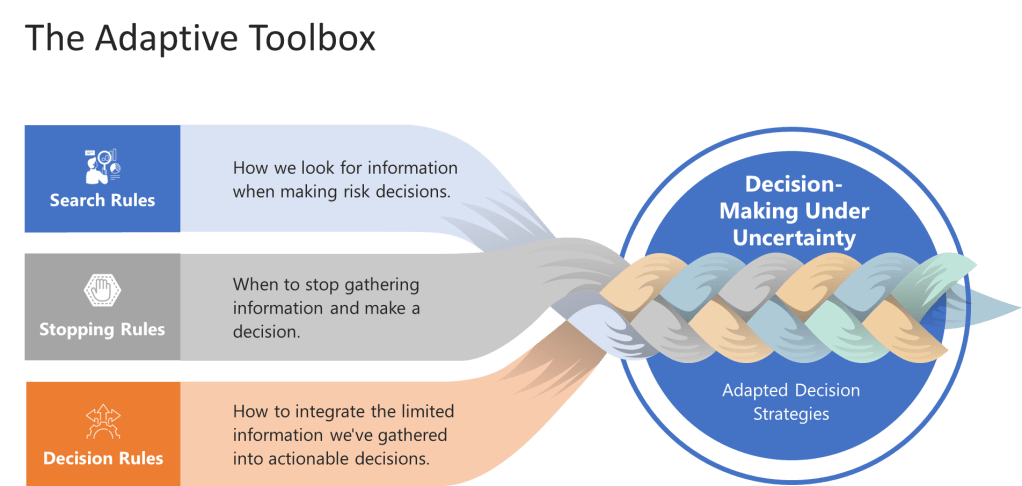
The relationship between Gigerenzer’s adaptive toolbox approach and the falsifiable quality risk management framework outlined in “The Effectiveness Paradox” represents and incredibly intellectually satisfying convergences. Rather than competing philosophies, these approaches form a powerful synergy that addresses different but complementary aspects of the same fundamental challenge: making good decisions under uncertainty while maintaining scientific rigor.

The Philosophical Bridge: Bounded Rationality Meets Popperian Falsification

At first glance, heuristic decision-making and falsifiable hypothesis testing might seem to pull in opposite directions. Heuristics appear to shortcut rigorous analysis, while falsification demands systematic testing of explicit predictions. However, this apparent tension dissolves when we recognize that both approaches share a fundamental commitment to ecological rationality—the idea that good decision-making must be adapted to the actual constraints and characteristics of the environment in which decisions are made.

The effectiveness paradox reveals how traditional quality risk management falls into unfalsifiable territory by focusing on proving negatives (“nothing bad happened, therefore our system works”). Gigerenzer’s adaptive toolbox offers a path out of this epistemological trap by providing tools that are inherently testable and context-dependent. Fast-and-frugal heuristics make specific predictions about performance under different conditions, creating exactly the kind of falsifiable hypotheses that the effectiveness paradox demands.

Consider how this works in practice. A traditional risk assessment might conclude that “cleaning validation ensures no cross-contamination risk.” This statement is unfalsifiable—no amount of successful cleaning cycles can prove that contamination is impossible. In contrast, a fast-and-frugal approach might use the simple heuristic: “If visual inspection shows no residue AND the previous product was low-potency AND cleaning time exceeded standard protocol, then proceed to next campaign.” This heuristic makes specific, testable predictions about when cleaning is adequate and when additional verification is needed.

Resolving the Speed-Rigor Dilemma

One of the most persistent challenges in quality risk management is the apparent trade-off between decision speed and analytical rigor. The effectiveness paradox approach emphasizes the need for rigorous hypothesis testing, which seems to conflict with the practical reality that many quality decisions must be made quickly under pressure. Gigerenzer’s work dissolves this apparent contradiction by demonstrating that well-designed heuristics can be both fast AND more accurate than complex analytical methods under conditions of uncertainty.

This insight transforms how we think about the relationship between speed and rigor in quality decision-making. The issue isn’t whether to prioritize speed or accuracy—it’s whether our decision methods are adapted to the ecological structure of the problems we’re trying to solve. In quality environments characterized by uncertainty, limited information, and time pressure, fast-and-frugal heuristics often outperform comprehensive analytical approaches precisely because they’re designed for these conditions.

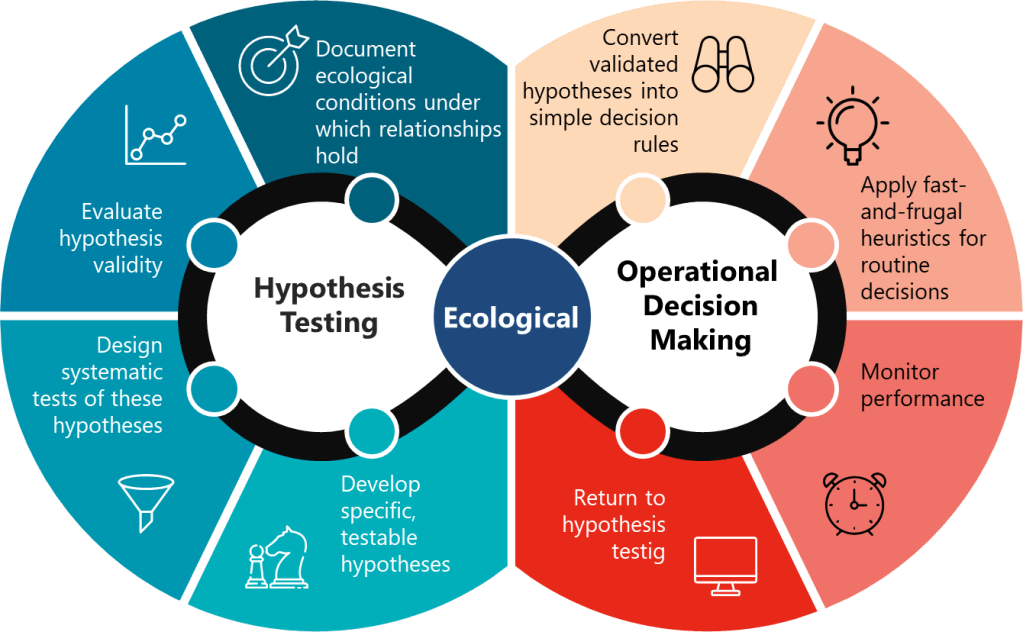
The key insight from combining both frameworks is that rigorous falsifiable testing should be used to develop and validate heuristics, which can then be applied rapidly in operational contexts. This creates a two-stage approach:

Stage 1: Hypothesis Development and Testing (Falsifiable Approach)

  • Develop specific, testable hypotheses about what drives quality outcomes
  • Design systematic tests of these hypotheses
  • Use rigorous statistical methods to evaluate hypothesis validity
  • Document the ecological conditions under which relationships hold

Stage 2: Operational Decision-Making (Adaptive Toolbox)

  • Convert validated hypotheses into simple decision rules
  • Apply fast-and-frugal heuristics for routine decisions
  • Monitor performance to detect when environmental conditions change
  • Return to Stage 1 when heuristics no longer perform effectively

The Recognition Heuristic in Quality Pattern Recognition

One of Gigerenzer’s most fascinating findings is the effectiveness of the recognition heuristic—the simple rule that recognized objects are often better than unrecognized ones. This heuristic works because recognition reflects accumulated positive experiences across many encounters, creating a surprisingly reliable indicator of quality or performance.

In quality risk management, experienced professionals develop sophisticated pattern recognition capabilities that often outperform formal analytical methods. A senior quality professional can often identify problematic deviations, concerning supplier trends, or emerging regulatory issues based on subtle patterns that would be difficult to capture in traditional risk matrices. The effectiveness paradox framework provides a way to test and validate these pattern recognition capabilities rather than dismissing them as “unscientific.”

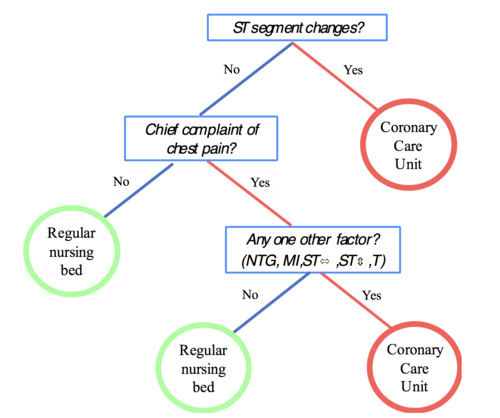
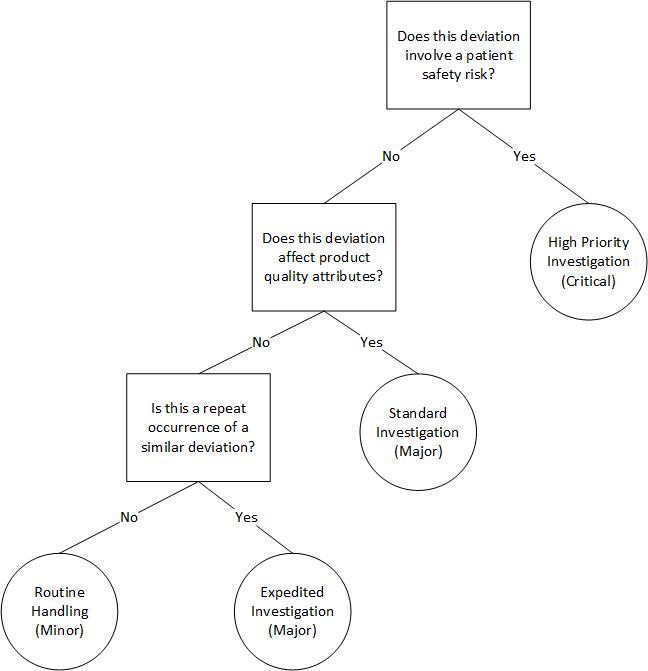
For example, we might hypothesize that “deviations identified as ‘concerning’ by experienced quality professionals within 24 hours of initial review are 3x more likely to require extensive investigation than those not flagged.” This hypothesis can be tested systematically, and if validated, the experienced professionals’ pattern recognition can be formalized into a fast-and-frugal decision tree for deviation triage.

Take-the-Best Meets Hypothesis Testing

The take-the-best heuristic—which makes decisions based on the single most diagnostic cue—provides an elegant solution to one of the most persistent problems in falsifiable quality risk management. Traditional approaches to hypothesis testing often become paralyzed by the need to consider multiple interacting variables simultaneously. Take-the-best suggests focusing on the single most predictive factor and using that for decision-making.

This approach aligns perfectly with the falsifiable framework’s emphasis on making specific, testable predictions. Instead of developing complex multivariate models that are difficult to test and validate, we can develop hypotheses about which single factors are most diagnostic of quality outcomes. These hypotheses can be tested systematically, and the results used to create simple decision rules that focus on the most important factors.

For instance, rather than trying to predict supplier quality using complex scoring systems that weight multiple factors, we might test the hypothesis that “supplier performance on sterility testing is the single best predictor of overall supplier quality for this material category.” If validated, this insight can be converted into a simple take-the-best heuristic: “When comparing suppliers, choose the one with better sterility testing performance.”

The Less-Is-More Effect in Quality Analysis

One of Gigerenzer’s most counterintuitive findings is the less-is-more effect—situations where ignoring information actually improves decision accuracy. This phenomenon occurs when additional information introduces noise that obscures the signal from the most diagnostic factors. The effectiveness paradox provides a framework for systematically identifying when less-is-more effects occur in quality decision-making.

Traditional quality risk assessments often suffer from information overload, attempting to consider every possible factor that might affect outcomes. This comprehensive approach feels more rigorous but can actually reduce decision quality by giving equal weight to diagnostic and non-diagnostic factors. The falsifiable approach allows us to test specific hypotheses about which factors actually matter and which can be safely ignored.

Consider CAPA effectiveness evaluation. Traditional approaches might consider dozens of factors: timeline compliance, thoroughness of investigation, number of corrective actions implemented, management involvement, training completion rates, and so on. A less-is-more approach might hypothesize that “CAPA effectiveness is primarily determined by whether the root cause was correctly identified within 30 days of investigation completion.” This hypothesis can be tested by examining the relationship between early root cause identification and subsequent recurrence rates.

If validated, this insight enables much simpler and more effective CAPA evaluation: focus primarily on root cause identification quality and treat other factors as secondary. This not only improves decision speed but may actually improve accuracy by avoiding the noise introduced by less diagnostic factors.

Satisficing Versus Optimizing in Risk Management

Herbert Simon’s concept of satisficing—choosing the first option that meets acceptance criteria rather than searching for the optimal solution—provides another bridge between the adaptive toolbox and falsifiable approaches. Traditional quality risk management often falls into optimization traps, attempting to find the “best” possible solution through comprehensive analysis. But optimization requires complete information about alternatives and their consequences—conditions that rarely exist in quality management.

The effectiveness paradox reveals why optimization-focused approaches often produce unfalsifiable results. When we claim that our risk management approach is “optimal,” we create statements that can’t be tested because we don’t have access to all possible alternatives or their outcomes. Satisficing approaches make more modest claims that can be tested: “This approach meets our minimum requirements for patient safety and operational efficiency.”

The falsifiable framework allows us to test satisficing criteria systematically. We can develop hypotheses about what constitutes “good enough” performance and test whether decisions meeting these criteria actually produce acceptable outcomes. This creates a virtuous cycle where satisficing criteria become more refined over time based on empirical evidence.

Ecological Rationality in Regulatory Environments

The concept of ecological rationality—the idea that decision strategies should be adapted to the structure of the environment—provides crucial insights for applying both frameworks in regulatory contexts. Regulatory environments have specific characteristics: high uncertainty, severe consequences for certain types of errors, conservative decision-making preferences, and emphasis on process documentation.

Traditional approaches often try to apply the same decision methods across all contexts, leading to over-analysis in some situations and under-analysis in others. The combined framework suggests developing different decision strategies for different regulatory contexts:

High-Stakes Novel Situations: Use comprehensive falsifiable analysis to develop and test hypotheses about system behavior. Document the logic and evidence supporting conclusions.

Routine Operational Decisions: Apply validated fast-and-frugal heuristics that have been tested in similar contexts. Monitor performance and return to comprehensive analysis if performance degrades.

Emergency Situations: Use the simplest effective heuristics that can be applied quickly while maintaining safety. Design these heuristics based on prior falsifiable analysis of emergency scenarios.

The Integration Challenge: Building Hybrid Systems

The most practical application of combining these frameworks involves building hybrid quality systems that seamlessly integrate falsifiable hypothesis testing with adaptive heuristic application. This requires careful attention to when each approach is most appropriate and how transitions between approaches should be managed.

Trigger Conditions for Comprehensive Analysis:

  • Novel quality issues without established patterns
  • High-consequence decisions affecting patient safety
  • Regulatory submissions requiring documented justification
  • Significant changes in manufacturing conditions
  • Performance degradation in existing heuristics

Conditions Favoring Heuristic Application:

  • Familiar quality issues with established patterns
  • Time-pressured operational decisions
  • Routine risk classifications and assessments
  • Situations where speed of response affects outcomes
  • Decisions by experienced personnel in their area of expertise

The key insight is that these aren’t competing approaches but complementary tools that should be applied strategically based on situational characteristics.

Practical Implementation: A Unified Framework

Implementing the combined approach requires systematic attention to both the development of falsifiable hypotheses and the creation of adaptive heuristics based on validated insights. This implementation follows a structured process:

Phase 1: Ecological Analysis

  • Characterize the decision environment: information availability, time constraints, consequence severity, frequency of similar decisions
  • Identify existing heuristics used by experienced personnel
  • Document decision patterns and outcomes in historical data

Phase 2: Hypothesis Development

  • Convert existing heuristics into specific, testable hypotheses
  • Develop hypotheses about environmental factors that affect decision quality
  • Create predictions about when different approaches will be most effective

Phase 3: Systematic Testing

  • Design studies to test hypothesis validity under different conditions
  • Collect data on decision outcomes using different approaches
  • Analyze performance across different environmental conditions

Phase 4: Heuristic Refinement

  • Convert validated hypotheses into simple decision rules
  • Design training materials for consistent heuristic application
  • Create monitoring systems to track heuristic performance

Phase 5: Adaptive Management

  • Monitor environmental conditions for changes that might affect heuristic validity
  • Design feedback systems that detect when re-analysis is needed
  • Create processes for updating heuristics based on new evidence

The Cultural Transformation: From Analysis Paralysis to Adaptive Excellence

Perhaps the most significant impact of combining these frameworks is the cultural shift from analysis paralysis to adaptive excellence. Traditional quality cultures often equate thoroughness with quality, leading to over-analysis of routine decisions and under-analysis of genuinely novel challenges. The combined framework provides clear criteria for matching analytical effort to decision importance and novelty.

This cultural shift requires leadership that understands the complementary nature of rigorous analysis and adaptive heuristics. Organizations must develop comfort with different decision approaches for different situations while maintaining consistent standards for decision quality and documentation.

Key Cultural Elements:

  • Scientific Humility: Acknowledge that our current understanding is provisional and may need revision based on new evidence
  • Adaptive Confidence: Trust validated heuristics in appropriate contexts while remaining alert to changing conditions
  • Learning Orientation: View both successful and unsuccessful decisions as opportunities to refine understanding
  • Contextual Wisdom: Develop judgment about when comprehensive analysis is needed versus when heuristics are sufficient

Addressing the Regulatory Acceptance Question

One persistent concern about implementing either falsifiable or heuristic approaches is regulatory acceptance. Will inspectors accept decision-making approaches that deviate from traditional comprehensive documentation? The answer lies in understanding that regulators themselves use both approaches routinely.

Experienced regulatory inspectors develop sophisticated heuristics for identifying potential problems and focusing their attention efficiently. They don’t systematically examine every aspect of every system—they use diagnostic shortcuts to guide their investigations. Similarly, regulatory agencies increasingly emphasize risk-based approaches that focus analytical effort where it provides the most value for patient safety.

The key to regulatory acceptance is demonstrating that combined approaches enhance rather than compromise patient safety through:

  • More Reliable Decision-Making: Heuristics validated through systematic testing are more reliable than ad hoc judgments
  • Faster Problem Detection: Adaptive approaches can identify and respond to emerging issues more quickly
  • Resource Optimization: Focus intensive analysis where it provides the most value for patient safety
  • Continuous Improvement: Systematic feedback enables ongoing refinement of decision approaches

The Future of Quality Decision-Making

The convergence of Gigerenzer’s adaptive toolbox with falsifiable quality risk management points toward a future where quality decision-making becomes both more scientific and more practical. This future involves:

Precision Decision-Making: Matching decision approaches to situational characteristics rather than applying one-size-fits-all methods.

Evidence-Based Heuristics: Simple decision rules backed by rigorous testing and validation rather than informal rules of thumb.

Adaptive Systems: Quality management approaches that evolve based on performance feedback and changing conditions rather than static compliance frameworks.

Scientific Culture: Organizations that embrace both rigorous hypothesis testing and practical heuristic application as complementary aspects of effective quality management.

Conclusion: The Best of Both Worlds

The relationship between Gigerenzer’s adaptive toolbox and falsifiable quality risk management demonstrates that the apparent tension between scientific rigor and practical decision-making is a false dichotomy. Both approaches share a commitment to ecological rationality and empirical validation, but they operate at different time scales and levels of analysis.

The effectiveness paradox reveals the limitations of traditional approaches that attempt to prove system effectiveness through negative evidence. Gigerenzer’s adaptive toolbox provides practical tools for making good decisions under the uncertainty that characterizes real quality environments. Together, they offer a path toward quality risk management that is both scientifically rigorous and operationally practical.

This synthesis doesn’t require choosing between speed and accuracy, or between intuition and analysis. Instead, it provides a framework for applying the right approach at the right time, backed by systematic evidence about when each approach works best. The result is quality decision-making that is simultaneously more rigorous and more adaptive—exactly what our industry needs to meet the challenges of an increasingly complex regulatory and competitive environment.

Harnessing the Adaptive Toolbox: How Gerd Gigerenzer’s Approach to Decision Making Works Within Quality Risk Management

As quality professionals, we can often fall into the trap of believing that more analysis, more data, and more complex decision trees lead to better outcomes. But what if this fundamental assumption is not just wrong, but actively harmful to effective risk management? Gerd Gigerenzer‘s decades of research on bounded rationality and fast-and-frugal heuristics suggests exactly that—and the implications for how we approach quality risk management are profound.

The Myth of Optimization in Risk Management

Too much of our risk management practice assumes we operate like Laplacian demons—omniscient beings with unlimited computational power and perfect information. Gigerenzer calls this “unbounded rationality,” and it’s about as realistic as expecting your quality management system to implement itself.

In reality, experts operate under severe constraints: limited time, incomplete information, constantly changing regulations, and the perpetual pressure to balance risk mitigation with operational efficiency. How we move beyond thinking of these as bugs to be overcome, and build tools that address these concerns is critical to thinking of risk management as a science.

Enter the Adaptive Toolbox

Gigerenzer’s adaptive toolbox concept revolutionizes how we think about decision-making under uncertainty. Rather than viewing our mental shortcuts (heuristics) as cognitive failures that need to be corrected, the adaptive toolbox framework recognizes them as evolved tools that can outperform complex analytical methods in real-world conditions.

The toolbox consists of three key components that every risk manager should understand:

Search Rules: How we look for information when making risk decisions. Instead of trying to gather all possible data (which is impossible anyway), effective heuristics use smart search strategies that focus on the most diagnostic information first.

Stopping Rules: When to stop gathering information and make a decision. This is crucial in quality management where analysis paralysis can be as dangerous as hasty decisions.

Decision Rules: How to integrate the limited information we’ve gathered into actionable decisions.

These components work together to create what Gigerenzer calls “ecological rationality”—decision strategies that are adapted to the specific environment in which they operate. For quality professionals, this means developing risk management approaches that fit the actual constraints and characteristics of pharmaceutical manufacturing, not the theoretical world of perfect information.

A conceptual diagram titled "The Adaptive Toolbox" showing three components that feed into decision-making under uncertainty. On the left are three colored boxes: blue "Search Rules" (described as "How we look for information when making risk decisions"), gray "Stopping Rules" ("When to stop gathering information and make a decision"), and orange "Decision Rules" ("How to integrate the limited information we've gathered into actionable decisions"). These three components are connected by flowing ribbons that weave together and lead to a circular blue target on the right labeled "Decision-Making Under Uncertainty" with "Adapted Decision Strategies" at the bottom. The visual represents how different cognitive tools work together to help make decisions when facing uncertainty.

This alt text captures the key visual elements, the hierarchical relationship between components, the flow from left to right, and the overall concept being illustrated about adaptive decision-making strategies under uncertainty.

The Less-Is-More Revolution

One of Gigerenzer’s most counterintuitive findings is the “less-is-more effect”—situations where ignoring information actually leads to better decisions. This challenges everything we think we know about evidence-based decision making in quality.

Consider an example from emergency medicine that directly parallels quality risk management challenges. When patients arrive with chest pain, doctors traditionally used complex diagnostic algorithms considering up to 19 different risk factors. But researchers found that a simple three-question decision tree outperformed the complex analysis in both speed and accuracy.

The fast-and-frugal tree asked only:

  1. Are there ST segment changes on the EKG?
  2. Is chest pain the chief complaint?
  3. Does the patient have any additional high-risk factors?
A fast-and-frugal tree that helps emergency room doctors decide whether to send a patient to a regular nursing bed or the coronary care unit (Green & Mehr, 1997).

Based on these three questions, doctors could quickly and accurately classify patients as high-risk (requiring immediate intensive care) or low-risk (suitable for regular monitoring). The key insight: the simple approach was not just faster—it was more accurate than the complex alternative.

Applying Fast-and-Frugal Trees to Quality Risk Management

This same principle applies directly to quality risk management decisions. Too often, we create elaborate risk assessment matrices that obscure rather than illuminate the critical decision factors. Fast-and-frugal trees offer a more effective alternative.

Let’s consider deviation classification—a daily challenge for quality professionals. Instead of complex scoring systems that attempt to quantify every possible risk dimension, a fast-and-frugal tree might ask:

  1. Does this deviation involve a patient safety risk? If yes → High priority investigation (exit to immediate action)
  2. Does this deviation affect product quality attributes? If yes → Standard investigation timeline
  3. Is this a repeat occurrence of a similar deviation? If yes → Expedited investigation, if no → Routine handling
Flowchart titled ‘Does this deviation involve a patient safety risk?’ At the top is a decision box with that question. An arrow labeled ‘Yes’ leads to a circle labeled ‘High Priority Investigation (Critical).’ An arrow labeled ‘No’ leads downward to a decision box reading ‘Does this deviation affect product quality attributes?’ From that box, an arrow labeled ‘Yes’ leads to a circle labeled ‘Standard Investigation (Major).’ An arrow labeled ‘No’ leads downward to a decision box reading ‘Is this a repeat occurrence of a similar deviation?’ From that box, an arrow labeled ‘Yes’ leads to a circle labeled ‘Expedited Investigation (Major),’ and an arrow labeled ‘No’ leads to a circle labeled ‘Routine Handling (Minor).

This simple decision tree accomplishes several things that complex matrices struggle with. First, it prioritizes patient safety above all other considerations—a value judgment that gets lost in numerical scoring systems. Second, it focuses investigative resources where they’re most needed. Third, it’s transparent and easy to train staff on, reducing variability in risk classification.

The beauty of fast-and-frugal trees isn’t just their simplicity. It is their robustness. Unlike complex models that break down when assumptions are violated, simple heuristics tend to perform consistently across different conditions.

The Recognition Heuristic in Supplier Quality

Another powerful tool from Gigerenzer’s adaptive toolbox is the recognition heuristic. This suggests that when choosing between two alternatives where one is recognized and the other isn’t, the recognized option is often the better choice.

In supplier qualification decisions, quality professionals often struggle with elaborate vendor assessment schemes that attempt to quantify every aspect of supplier capability. But experienced quality professionals know that supplier reputation—essentially a form of recognition—is often the best predictor of future performance.

The recognition heuristic doesn’t mean choosing suppliers solely on name recognition. Instead, it means understanding that recognition reflects accumulated positive experiences across the industry. When coupled with basic qualification criteria, recognition can be a powerful risk mitigation tool that’s more robust than complex scoring algorithms.

This principle extends to regulatory decision-making as well. Experienced quality professionals develop intuitive responses to regulatory trends and inspector concerns that often outperform elaborate compliance matrices. This isn’t unprofessional—it’s ecological rationality in action.

Take-the-Best Heuristic for Root Cause Analysis

The take-the-best heuristic offers an alternative approach to traditional root cause analysis. Instead of trying to weight and combine multiple potential root causes, this heuristic focuses on identifying the single most diagnostic factor and basing decisions primarily on that information.

In practice, this might mean:

  1. Identifying potential root causes in order of their diagnostic power
  2. Investigating the most powerful indicator first
  3. If that investigation provides a clear direction, implementing corrective action
  4. Only continuing to secondary factors if the primary investigation is inconclusive

This approach doesn’t mean ignoring secondary factors entirely, but it prevents the common problem of developing corrective action plans that try to address every conceivable contributing factor, often resulting in resource dilution and implementation challenges.

Managing Uncertainty in Validation Decisions

Validation represents one of the most uncertainty-rich areas of quality management. Traditional approaches attempt to reduce uncertainty through exhaustive testing, but Gigerenzer’s work suggests that some uncertainty is irreducible—and that trying to eliminate it entirely can actually harm decision quality.

Consider computer system validation decisions. Teams often struggle with determining how much testing is “enough,” leading to endless debates about edge cases and theoretical scenarios. The adaptive toolbox approach suggests developing simple rules that balance thoroughness with practical constraints:

The Satisficing Rule: Test until system functionality meets predefined acceptance criteria across critical business processes, then stop. Don’t continue testing just because more testing is theoretically possible.

The Critical Path Rule: Focus validation effort on the processes that directly impact patient safety and product quality. Treat administrative functions with less intensive validation approaches.

The Experience Rule: Leverage institutional knowledge about similar systems to guide validation scope. Don’t start every validation from scratch.

These heuristics don’t eliminate validation rigor—they channel it more effectively by recognizing that perfect validation is impossible and that attempting it can actually increase risk by delaying system implementation or consuming resources needed elsewhere.

Ecological Rationality in Regulatory Strategy

Perhaps nowhere is the adaptive toolbox more relevant than in regulatory strategy. Regulatory environments are characterized by uncertainty, incomplete information, and time pressure—exactly the conditions where fast-and-frugal heuristics excel.

Successful regulatory professionals develop intuitive responses to regulatory trends that often outperform complex compliance matrices. They recognize patterns in regulatory communications, anticipate inspector concerns, and adapt their strategies based on limited but diagnostic information.

The key insight from Gigerenzer’s work is that these intuitive responses aren’t unprofessional—they represent sophisticated pattern recognition based on evolved cognitive mechanisms. The challenge for quality organizations is to capture and systematize these insights without destroying their adaptive flexibility.

This might involve developing simple decision rules for common regulatory scenarios:

The Precedent Rule: When facing ambiguous regulatory requirements, look for relevant precedent in previous inspections or industry guidance rather than attempting exhaustive regulatory interpretation.

The Proactive Communication Rule: When regulatory risk is identified, communicate early with authorities rather than developing elaborate justification documents internally.

The Materiality Rule: Focus regulatory attention on changes that meaningfully affect product quality or patient safety rather than attempting to address every theoretical concern.

Building Adaptive Capability in Quality Organizations

Implementing Gigerenzer’s insights requires more than just teaching people about heuristics—it requires creating organizational conditions that support ecological rationality. This means:

Embracing Uncertainty: Stop pretending that perfect risk assessments are possible. Instead, develop decision-making approaches that are robust under uncertainty.

Valuing Experience: Recognize that experienced professionals’ intuitive responses often reflect sophisticated pattern recognition. Don’t automatically override professional judgment with algorithmic approaches.

Simplifying Decision Structures: Replace complex matrices and scoring systems with simple decision trees that focus on the most diagnostic factors.

Encouraging Rapid Iteration: Rather than trying to perfect decisions before implementation, develop approaches that allow rapid adjustment based on feedback.

Training Pattern Recognition: Help staff develop the pattern recognition skills that support effective heuristic decision-making.

The Subjectivity Challenge

One common objection to heuristic-based approaches is that they introduce subjectivity into risk management decisions. This concern reflects a fundamental misunderstanding of both traditional analytical methods and heuristic approaches.

Traditional risk matrices and analytical methods appear objective but are actually filled with subjective judgments: how risks are defined, how probabilities are estimated, how impacts are categorized, and how different risk dimensions are weighted. These subjective elements are simply hidden behind numerical facades.

Heuristic approaches make subjectivity explicit rather than hiding it. This transparency actually supports better risk management by forcing teams to acknowledge and discuss their value judgments rather than pretending they don’t exist.

The recent revision of ICH Q9 explicitly recognizes this challenge, noting that subjectivity cannot be eliminated from risk management but can be managed through appropriate process design. Fast-and-frugal heuristics support this goal by making decision logic transparent and teachable.

Four Essential Books by Gigerenzer

For quality professionals who want to dive deeper into this framework, here are four books by Gigerenzer to read:

1. “Simple Heuristics That Make Us Smart” (1999) – This foundational work, authored with Peter Todd and the ABC Research Group, establishes the theoretical framework for the adaptive toolbox. It demonstrates through extensive research how simple heuristics can outperform complex analytical methods across diverse domains. For quality professionals, this book provides the scientific foundation for understanding why less can indeed be more in risk assessment.

2. “Gut Feelings: The Intelligence of the Unconscious” (2007) – This more accessible book explores how intuitive decision-making works and when it can be trusted. It’s particularly valuable for quality professionals who need to balance analytical rigor with practical decision-making under pressure. The book provides actionable insights for recognizing when to trust professional judgment and when more analysis is needed.

3. “Risk Savvy: How to Make Good Decisions” (2014) – This book directly addresses risk perception and management, making it immediately relevant to quality professionals. It challenges common misconceptions about risk communication and provides practical tools for making better decisions under uncertainty. The sections on medical decision-making are particularly relevant to pharmaceutical quality management.

4. “The Intelligence of Intuition” (Cambridge University Press, 2023) – Gigerenzer’s latest work directly challenges the widespread dismissal of intuitive decision-making in favor of algorithmic solutions. In this compelling analysis, he traces what he calls the “war on intuition” in social sciences, from early gendered perceptions that dismissed intuition as feminine and therefore inferior, to modern technological paternalism that argues human judgment should be replaced by perfect algorithms. For quality professionals, this book is essential reading because it demonstrates that intuition is not irrational caprice but rather “unconscious intelligence based on years of experience” that evolved specifically to handle uncertain and dynamic situations where logic and big data algorithms provide little benefit. The book provides both theoretical foundation and practical guidance for distinguishing reliable intuitive responses from wishful thinking—a crucial skill for quality professionals who must balance analytical rigor with rapid decision-making under uncertainty.

The Implementation Challenge

Understanding the adaptive toolbox conceptually is different from implementing it organizationally. Quality systems are notoriously resistant to change, particularly when that change challenges fundamental assumptions about how decisions should be made.

Successful implementation requires a gradual approach that demonstrates value rather than demanding wholesale replacement of existing methods. Consider starting with pilot applications in lower-risk areas where the benefits of simpler approaches can be demonstrated without compromising patient safety.

Phase 1: Recognition and Documentation – Begin by documenting the informal heuristics that experienced staff already use. You’ll likely find that your most effective team members already use something resembling fast-and-frugal decision trees for routine decisions.

Phase 2: Formalization and Testing – Convert informal heuristics into explicit decision rules and test them against historical decisions. This helps build confidence and identifies areas where refinement is needed.

Phase 3: Training and Standardization – Train staff on the formalized heuristics and create simple reference tools that support consistent application.

Phase 4: Continuous Adaptation – Build feedback mechanisms that allow heuristics to evolve as conditions change and new patterns emerge.

Measuring Success with Ecological Metrics

Traditional quality metrics often focus on process compliance rather than decision quality. Implementing an adaptive toolbox approach requires different measures of success.

Instead of measuring how thoroughly risk assessments are documented, consider measuring:

  • Decision Speed: How quickly can teams classify and respond to different types of quality events?
  • Decision Consistency: How much variability exists in how similar situations are handled?
  • Resource Efficiency: What percentage of effort goes to analysis versus action?
  • Adaptation Rate: How quickly do decision approaches evolve in response to new information?
  • Outcome Quality: What are the actual consequences of decisions made using heuristic approaches?

These metrics align better with the goals of effective risk management: making good decisions quickly and consistently under uncertainty.

The Training Implication

If we accept that heuristic decision-making is not just inevitable but often superior, it changes how we think about quality training. Instead of teaching people to override their intuitive responses with analytical methods, we should focus on calibrating and improving their pattern recognition abilities.

This means:

  • Case-Based Learning: Using historical examples to help staff recognize patterns and develop appropriate responses
  • Scenario Training: Practicing decision-making under time pressure and incomplete information
  • Feedback Loops: Creating systems that help staff learn from decision outcomes
  • Expert Mentoring: Pairing experienced professionals with newer staff to transfer tacit knowledge
  • Cross-Functional Exposure: Giving staff experience across different areas to broaden their pattern recognition base

Addressing the Regulatory Concern

One persistent concern about heuristic approaches is regulatory acceptability. Will inspectors accept fast-and-frugal decision trees in place of traditional risk matrices?

The key insight from Gigerenzer’s work is that regulators themselves use heuristics extensively in their inspection and decision-making processes. Experienced inspectors develop pattern recognition skills that allow them to quickly identify potential problems and focus their attention appropriately. They don’t systematically evaluate every aspect of a quality system—they use diagnostic shortcuts to guide their investigations.

Understanding this reality suggests that well-designed heuristic approaches may actually be more acceptable to regulators than complex but opaque analytical methods. The key is ensuring that heuristics are:

  • Transparent: Decision logic should be clearly documented and explainable
  • Consistent: Similar situations should be handled similarly
  • Defensible: The rationale for the heuristic approach should be based on evidence and experience
  • Adaptive: The approach should evolve based on feedback and changing conditions

The Integration Challenge

The adaptive toolbox shouldn’t replace all analytical methods—it should complement them within a broader risk management framework. The key is understanding when to use which approach.

Use Heuristics When:

  • Time pressure is significant
  • Information is incomplete and unlikely to improve quickly
  • The decision context is familiar and patterns are recognizable
  • The consequences of being approximately right quickly outweigh being precisely right slowly
  • Resource constraints limit the feasibility of comprehensive analysis

Use Analytical Methods When:

  • Stakes are extremely high and errors could have catastrophic consequences
  • Time permits thorough analysis
  • The decision context is novel and patterns are unclear
  • Regulatory requirements explicitly demand comprehensive documentation
  • Multiple stakeholders need to understand and agree on decision logic

Looking Forward

Gigerenzer’s work suggests that effective quality risk management will increasingly look like a hybrid approach that combines the best of analytical rigor with the adaptive flexibility of heuristic decision-making.

This evolution is already happening informally as quality professionals develop intuitive responses to common situations and use analytical methods primarily for novel or high-stakes decisions. The challenge is making this hybrid approach explicit and systematic rather than leaving it to individual discretion.

Future quality management systems will likely feature:

  • Adaptive Decision Support: Systems that learn from historical decisions and suggest appropriate heuristics for new situations
  • Context-Sensitive Approaches: Risk management methods that automatically adjust based on situational factors
  • Rapid Iteration Capabilities: Systems designed for quick adjustment rather than comprehensive upfront planning
  • Integrated Uncertainty Management: Approaches that explicitly acknowledge and work with uncertainty rather than trying to eliminate it

The Cultural Transformation

Perhaps the most significant challenge in implementing Gigerenzer’s insights isn’t technical—it’s cultural. Quality organizations have invested decades in building analytical capabilities and may resist approaches that appear to diminish the value of that investment.

The key to successful cultural transformation is demonstrating that heuristic approaches don’t eliminate analysis—they optimize it by focusing analytical effort where it provides the most value. This requires leadership that understands both the power and limitations of different decision-making approaches.

Organizations that successfully implement adaptive toolbox principles often find that they can:

  • Make decisions faster without sacrificing quality
  • Reduce analysis paralysis in routine situations
  • Free up analytical resources for genuinely complex problems
  • Improve decision consistency across teams
  • Adapt more quickly to changing conditions

Conclusion: Embracing Bounded Rationality

Gigerenzer’s adaptive toolbox offers a path forward that embraces rather than fights the reality of human cognition. By recognizing that our brains have evolved sophisticated mechanisms for making good decisions under uncertainty, we can develop quality systems that work with rather than against our cognitive strengths.

This doesn’t mean abandoning analytical rigor—it means applying it more strategically. It means recognizing that sometimes the best decision is the one made quickly with limited information rather than the one made slowly with comprehensive analysis. It means building systems that are robust to uncertainty rather than brittle in the face of incomplete information.

Most importantly, it means acknowledging that quality professionals are not computers. They are sophisticated pattern-recognition systems that have evolved to navigate uncertainty effectively. Our quality systems should amplify rather than override these capabilities.

The adaptive toolbox isn’t just a set of decision-making tools—it’s a different way of thinking about human rationality in organizational settings. For quality professionals willing to embrace this perspective, it offers the possibility of making better decisions, faster, with less stress and more confidence.

And in an industry where patient safety depends on the quality of our decisions, that possibility is worth pursuing, one heuristic at a time.