Best Practices for Cross-Contamination Risk Assessment at Multi-Product Biologic Drug Substance Manufacturers

A multi-product facility does not become safe because every room is classified, every hose is labeled, and every changeover has a completed checklist. It becomes safe when the organization can make, and defend, a scientifically coherent claim that material from Product A cannot reach a patient receiving Product B at a level capable of causing harm.

That claim is harder to sustain in a contract development and manufacturing organization than in a conventional single-product facility. A CDMO must accommodate changing client portfolios, incomplete early-phase knowledge, different cell substrates and processes, short campaigns, accelerated technology transfers, and commercial pressure to use the same suites efficiently. Each new product changes the contamination problem. Each new process train changes the pathways. Each new piece of toxicological or clinical information may change what “acceptable” means.

The central task is therefore not simply cleaning validation. It is cross-contamination risk management across the product, process, facility, equipment, and patient-safety lifecycles.

For a multi-product CDMO, that system must distinguish clearly between two manufacturing architectures:

  • Reusable equipment, where previous-product carryover is controlled principally through equipment design, validated cleaning, sampling, analytical capability, maintenance, and changeover discipline.
  • Single-use systems (SUS), where direct carryover through the discarded product-contact path may be greatly reduced, but risk shifts toward assembly integrity, incorrect connections, retained reusable interfaces, extractables and leachables, particulates, supplier controls, sterilization assurance, and human manipulation.

Neither architecture is inherently safe. Both can be made safe. Both can fail in characteristic ways.

The Regulatory Question

The regulatory question is not, “Was the equipment cleaned?” It is, “Was the risk of cross-contamination identified, scientifically evaluated, controlled, and kept under review?”

ICH Q9(R1) defines quality risk management as a systematic process for assessing, controlling, communicating, and reviewing risks to product quality across the lifecycle. It also makes two points that matter directly to a CDMO: risk evaluation should be grounded in scientific knowledge and linked ultimately to patient protection, and the level of effort, formality, and documentation should be commensurate with risk. Resource limitations are not a valid reason to lower the formality of the assessment.

EU GMP Chapter 5 is more explicit about shared manufacture. It requires cross-contamination risk to be assessed, including contamination arising from product residues, aerosols, organisms, genetic material, and operators’ clothing. It further requires a quality risk management process that includes potency and toxicological evaluation and considers facility and equipment design, personnel and material flows, microbiological controls, physicochemical characteristics, cleaning processes, analytical capability, and the intended use of the product.

The EMA health-based exposure limit guideline replaces arbitrary carryover conventions with a structured scientific evaluation of pharmacological and toxicological data. A permitted daily exposure, or equivalent health-based exposure limit, represents a substance-specific daily exposure that is unlikely to cause an adverse effect over a lifetime; its derivation includes hazard identification, selection of the critical effect and point of departure, and application of adjustment factors for uncertainty.

FDA requirements approach the problem through enforceable expectations for buildings, flow, defined areas, equipment, procedures, and controls that prevent contamination and mix-ups. Under 21 CFR 211.42, material and product flow must be designed to prevent contamination, and operations must occur in defined areas or under other adequate control systems. FDA’s inspection program for protein drug substances also expects validated cleaning of nondisposable product-contact equipment, predetermined carryover limits for shared equipment, continued verification, and toxicologically derived acceptable daily exposures for highly potent or toxic residues; where limits cannot be achieved, dedicated or disposable equipment may be necessary.

For CDMOs, regulatory responsibility cannot be outsourced through the commercial contract. FDA’s quality-agreement guidance expects the owner and contract facility to define and document their respective CGMP responsibilities, but the agreement is a governance mechanism and not a transfer of accountability away from either party.

Begin With the Patient

The most common weakness in shared-facility risk assessments is that they begin with the room or equipment rather than the patient. The team draws process maps, scores hose connections, reviews cleaning cycles, and concludes that controls are strong. Only later, sometimes after the manufacturing decision has already been made, does anyone ask how much of the previous product could safely reach the next patient.

That sequence is backward.

The assessment should begin with a human product-safety evaluation for each molecule proposed for the facility. In EU terminology this is generally expressed through an HBEL, commonly a PDE or ADE. The evaluation is not merely a calculation and should not be reduced to a spreadsheet populated from the lowest clinical dose. It is an expert interpretation of all relevant pharmacological, toxicological, nonclinical, and clinical evidence.

EMA states that HBELs should be established for medicinal products and periodically reassessed as knowledge develops. It also specifies that the person deriving the HBEL should have adequate expertise and experience in toxicology or pharmacology, familiarity with pharmaceuticals, and experience establishing health-based limits. When the work is outsourced, the manufacturer must qualify the provider and the specific expert; simply purchasing an HBEL report without assessing the contractor’s suitability is not acceptable.

A defensible assessment should address, as applicable:

  • Molecular target and mechanism of action.
  • Intended and reasonably foreseeable off-target pharmacology.
  • Potency and dose-response relationships.
  • Route of administration and systemic bioavailability.
  • Patient population, including vulnerable or immunocompromised groups.
  • Acute, repeated-dose, reproductive, developmental, genotoxic, carcinogenic, immunotoxic, and local-tolerance information, where relevant.
  • Cytokine-release, immune agonism, immune suppression, complement activation, or unintended tissue cross-reactivity.
  • Clinical adverse-event data and the lowest exposure associated with the critical effect.
  • Pharmacokinetics, persistence, accumulation, and half-life.
  • Uncertainty arising from limited data, especially for early clinical programs.
  • The biological activity of fragments, aggregates, conjugated species, degradants, or process-transformed residues.
  • Whether route-to-route extrapolation is scientifically justified.

For biologics, the assessment may require judgment different from that used for a conventional small molecule. A protein may denature during alkaline cleaning, but “denatured” is not automatically synonymous with “non-hazardous.” Loss of the primary mechanism of action does not by itself establish the absence of immunogenic, inflammatory, allergenic, or other biological effects. Conversely, a large protein’s poor oral bioavailability may materially reduce risk for an orally administered next product, while offering little reassurance when the next product is parenteral. The conclusion must follow the exposure scenario and evidence, not a generic statement that proteins are readily degraded.

The resulting HBEL is an input to risk management, not the risk assessment’s conclusion. EMA explicitly states that once the health-based assessment is complete, the data should be used through QRM to determine whether existing technical and organizational controls are adequate or require supplementation.

The CDMO Information Problem

A sponsor often knows more about its molecule than the CDMO. The CDMO knows more about its facility, equipment, cleaning history, operators, and failure modes. A valid assessment requires both bodies of knowledge.

The sponsor should provide either a complete, reviewable HBEL assessment or the data needed for the CDMO to perform one. EMA expects the assessment, data references, and relevant expert information to be available during inspection. The quality agreement should therefore define ownership and timing for:

  • Provision and approval of the HBEL or toxicological monograph.
  • Disclosure of new clinical, nonclinical, or pharmacovigilance information.
  • Assessment of novel modalities, conjugates, linkers, payloads, or unusually potent mechanisms.
  • Product and process characterization relevant to cleanability and detectability.
  • Analytical reference standards and product-specific assays.
  • Review of cleaning limits and product-family placement.
  • Approval of shared-use, campaign, dedication, or exclusion decisions.
  • Notification when new information could invalidate the existing assessment.

This exchange must occur before facility fit is approved and not after the batch slot has been commercially committed. A CDMO that accepts a product before it understands the patient-safety boundary has allowed scheduling to precede science.

Hazard Is Not Risk

Cross-contamination discussions often collapse hazard and risk into one concept. They are not the same.

Hazard is the inherent capacity of the contaminant to cause harm. For a biologic drug substance, that may arise from potent pharmacology, immune modulation, sensitization, tissue cross-reactivity, or biologically active variants. Risk depends on both that hazard and the probability and extent of patient exposure through a credible contamination pathway.

This distinction matters because two products with similar HBELs may require different controls. A readily soluble biolgic processed in a closed, disposable flow path presents a different exposure likelihood from a sticky, difficult-to-detect protein processed through open transfers and a complex reusable skid. Likewise, the same previous product may present different risks depending on the next product’s route, maximum daily dose, batch size, population, and shared surface area.

The risk question should therefore be written explicitly:

Given the hazard of the previous product, the vulnerability and exposure of the next product’s patient population, the manufacturing sequence, and all credible transfer routes, are the proposed controls capable of maintaining carryover below a scientifically justified safe level with an adequate operating margin, even when foreseeable failures occur?

That final clause is important. A risk assessment that assumes every procedure is followed perfectly is not assessing risk. It is describing the intended state.

Map Every Transfer Route

The assessment should follow contamination as though it were tracing dye through the facility. Product residue does not recognize departmental boundaries, validation packages, or ownership charts.

At minimum, evaluate these pathways:

  • Direct product-contact carryover through shared tanks, columns, skids, piping, valves, pumps, sensors, transfer panels, and filling paths.
  • Indirect transfer from external equipment surfaces, carts, tools, hoses, parts, balances, bins, and mobile equipment.
  • Airborne transfer through aerosols, droplets, powders, open manipulations, pressure cascades, or HVAC recirculation.
  • Personnel transfer through gloves, gowns, footwear, tools, notebooks, radios, and movement between suites.
  • Material and waste transfer through staging areas, elevators, corridors, pass-throughs, cold rooms, and wash areas.
  • Mix-up through labels, status identification, electronic recipes, tubing connections, sampling materials, and component reconciliation.
  • Microbial or adventitious-agent transfer through shared utilities, insufficient segregation, retained moisture, open operations, or pre-viral and post-viral process crossover.
  • Laboratory transfer through shared sample-preparation areas, instruments, standards, retain storage, or incorrect sample identity.
  • Maintenance transfer through tools, removed components, lubricants, temporary hoses, bypasses, and post-maintenance restoration.

WHO guidance for biological products emphasizes QRM-based movement restrictions, logical and unidirectional flows, closed systems, qualified single-use components, and controls for open manipulations. It also warns against cross-use of certain reused components and highlights separation between activities with different biological risks.

The result should be a facility-wide contamination pathway map connected to process steps and equipment boundaries. A list of hazards without a spatial and temporal model of transfer is incomplete.

Select the Right Tool

No single risk tool is sufficient for the whole problem.

ToolBest useLimitation
Process and contamination-pathway mappingShows where product, people, materials, waste, air, and equipment intersectDoes not quantify control strength by itself
FMEA or FMECAEvaluates equipment- and step-specific failure modesRisk-priority numbers can hide severe events and create false precision
HACCPIdentifies critical points where control is essentialCan become too linear for complex facility-wide transfer pathways
LOPATests whether independent protection layers adequately reduce a defined scenarioRequires genuine independence and defensible failure assumptions
Fault-tree analysisWorks backward from a contamination outcome to combinations of causesCan become resource-intensive and difficult to maintain
Bow-tie analysisConnects threats, preventive controls, event, mitigations, and consequencesMay oversimplify technical detail unless supported by deeper assessments

ICH Q9(R1) permits different tools and degrees of formality but expects the approach to reflect uncertainty, importance, and complexity. In a multi-client CDMO, the most effective architecture is usually layered: pathway mapping at the facility level, FMEA for equipment and operations, and LOPA or bow-tie analysis for high-consequence scenarios.

Detectability should be used cautiously. A highly sensitive release test does not prevent cross-contamination, and routine product testing rarely provides enough sampling coverage to compensate for weak containment or cleaning. Detection controls can reduce uncertainty, but they should not be allowed to dominate the score merely because a method exists.
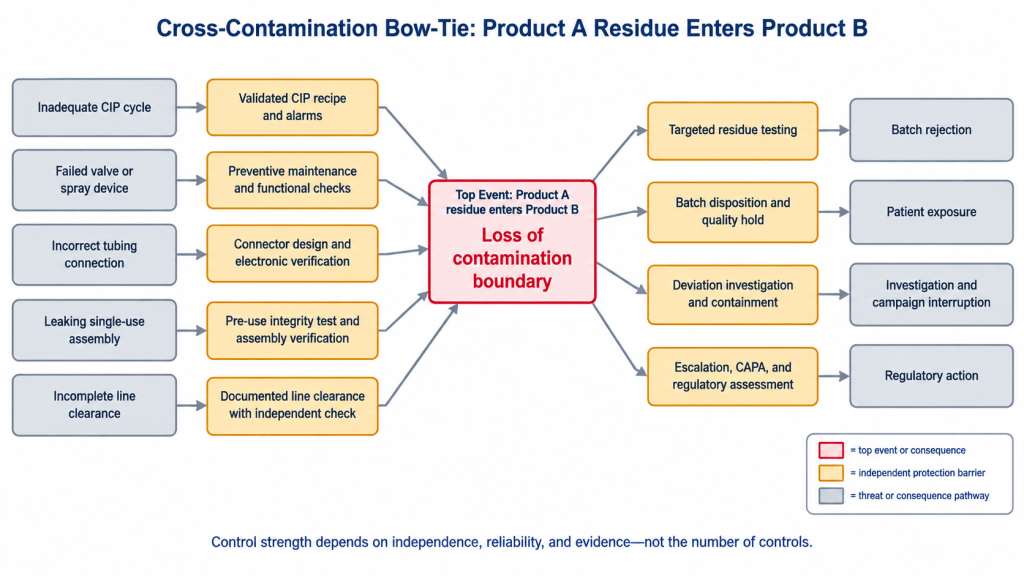
Bow-tie risk analysis showing how CIP failure, equipment faults, incorrect connections, single-use leaks, or incomplete line clearance can allow Product A residue into Product B, with preventive and mitigation barriers between threats, the loss of containment, and patient or regulatory consequences.

The Contamination Pathway and the Equipment Boundary

Reusable stainless equipmentSingle-use assembly
Fixed tank, piping, valves, CIP skidDisposable bag, tubing, connectors, filters
Main risk: retained product residueMain risks: assembly, integrity, E&L, mix-up
Primary assurance: validated cleaningPrimary assurance: supplier qualification and integrity
Key failure modes: dead legs, poor CIP coverage, failed valvesKey failure modes: leak, pinhole, wrong connection, package breach

Reusable Equipment

Reusable stainless-steel systems make the contamination boundary visible. The previous product contacted the equipment; the equipment will contact the next product; therefore, the organization must demonstrate that the transition is safe.

The principal controls are equipment design, defined cleaning procedures, validated cleaning performance, validated sampling and analytical methods, controlled dirty and clean hold times, inspection, preventive maintenance, status control, and periodic verification. FDA expects written cleaning procedures, predefined protocols, sensitive analytical methods, recovery studies, documented results, and management-approved conclusions that residues have been reduced to acceptable levels.

A reusable system assessment should examine:

  • Product-contact surface area and materials of construction.
  • Dead legs, low points, shadowed spray areas, valve bodies, diaphragms, gaskets, seals, and instrument ports.
  • Surface roughness, weld quality, drainability, slope, and retained-volume risk.
  • CIP coverage, flow, turbulence, spray-device performance, temperature, chemistry, concentration, time, and final-rinse endpoints.
  • Manual interventions and disassembly requirements.
  • Ability to inspect hard-to-clean locations.
  • Dirty-hold and clean-hold conditions.
  • Residue degradation or fixation during heat, drying, storage, or cleaning.
  • Microbial proliferation and endotoxin risk in retained moisture.
  • Maintenance failure modes such as blocked traps, failed valves, misaligned spray devices, sensor drift, or recipe changes.

Worst-case selection must be multidimensional. The lowest HBEL may identify the most hazardous product, but it may not be the hardest to remove. The most difficult cleaning challenge may instead be driven by solubility, concentration, viscosity, aggregation, drying behavior, adsorption, equipment geometry, or interaction with the cleaning agent. Health Canada’s guidance identifies HBEL, cleanability, solubility, physical characteristics, and prior experience among relevant worst-case factors and expects cleaning methods to be capable of measuring residue below the selected limit.

Cleaning limits

The HBEL for the previous product is translated into a maximum safe carryover for the next product using next-product batch size and maximum daily dose. That allowable mass is then allocated across the actual shared product-contact surface and converted into swab, rinse, or other sampling limits. The calculation must account for the entire shared process train and avoid allocating the same allowable carryover independently to multiple pieces of equipment.

The final operational limit should be no higher than the health-based limit and may need to be lower because of analytical capability, process control, variability, visual detectability, or company policy. “Visually clean” remains useful as an immediate gross-failure check but cannot replace a health-based and analytically verified criterion for product changeover.

The cleaning validation package should integrate:

  • Laboratory cleanability and degradation studies.
  • Coupon recovery for each relevant material of construction.
  • Swab and rinse method suitability.
  • Product-specific or scientifically justified nonspecific analytical methods.
  • Method specificity against degradants and cleaning-agent interference.
  • Worst-case locations selected from design and process knowledge.
  • Hold-time studies.
  • Automated recipe and alarm challenge.
  • Replicate validation runs under defined worst-case conditions.
  • Ongoing verification and periodic review of process capability.

A failed result cannot be repaired by repeated sampling until a passing value appears. FDA warns that routine “test until clean” behavior may demonstrate that the process is not validated rather than provide assurance of cleanliness.

Single-Use Systems

Single-use technology changes the risk architecture; it does not eliminate contamination control.

A fully disposable, closed product-contact path can sharply reduce the direct previous-product residue pathway because the contacted components are discarded rather than cleaned for the next product. It can also reduce cleaning-validation burden for those specific components. But the facility still contains reusable interfaces, support equipment, rooms, biosafety cabinets, external surfaces, transfer devices, sensors, exhaust pathways, and operators. The critical question becomes: Where does the disposable boundary begin and end?

EU GMP Annex 1 defines SUS broadly to include bags, filters, tubing, connectors, valves, bottles, and sensors and requires SUS-specific risks to be assessed within the contamination control strategy. Those risks include product-surface interactions, extractables and leachables, fragility relative to fixed systems, manual operations and connections, assembly complexity, holes and leakage, packaging opening, filter integrity, and particulate contamination.

A useful comparison is:

Risk dimensionReusable equipmentSingle-use system
Previous-product residueControlled by validated cleaningReduced where the complete contacted path is discarded
Main validation burdenCleaning process, sampling, analytical method, hold times, CIP performanceSupplier, sterilization, assembly, integrity, connection, shipping, installation, and use qualification
Typical hidden boundaryValves, seals, dead legs, skid piping, probesReusable probes, housings, manifolds, pumps, clamps, transfer ports, support vessels
Human contributionManual cleaning, assembly, inspection, status controlUnpacking, inspection, installation, connection, manipulation, and line clearance
Material interactionCorrosion, adsorption, surface condition, cleaning-agent compatibilityExtractables, leachables, adsorption, absorption, reactivity, and particles
Failure signatureResidue, retained liquid, ineffective cycle, maintenance degradationPinholes, leaks, misconnections, wrong assembly, compromised package, weld failure
Lifecycle dependenceEquipment maintenance and cleaning-state controlSupplier change control, lot consistency, irradiation or sterilization assurance, logistics

The boundary problem

The term “single-use process” is often applied too casually. A disposable bag connected to a reusable chromatography skid is not a completely single-use process. Neither is a disposable bioreactor connected through reusable probes or a stainless transfer panel. Every reusable product-contact or potentially product-contact interface must be identified and assigned an appropriate cleaning, sterilization, dedication, or disposal strategy.

Hybrid systems deserve particular scrutiny because responsibility can fall between programs. The cleaning-validation team may assume the flow path is disposable, while the SUS qualification team may assume reusable interfaces are covered elsewhere. The risk assessment should include a boundary diagram showing:

  • All direct product-contact components.
  • Indirect contact and splash-exposure surfaces.
  • Sterile boundaries and connection points.
  • Reusable sensors, housings, and hardware.
  • Components retained between campaigns.
  • Components disposed after each batch, campaign, or product.
  • Product-contact status following an integrity failure.
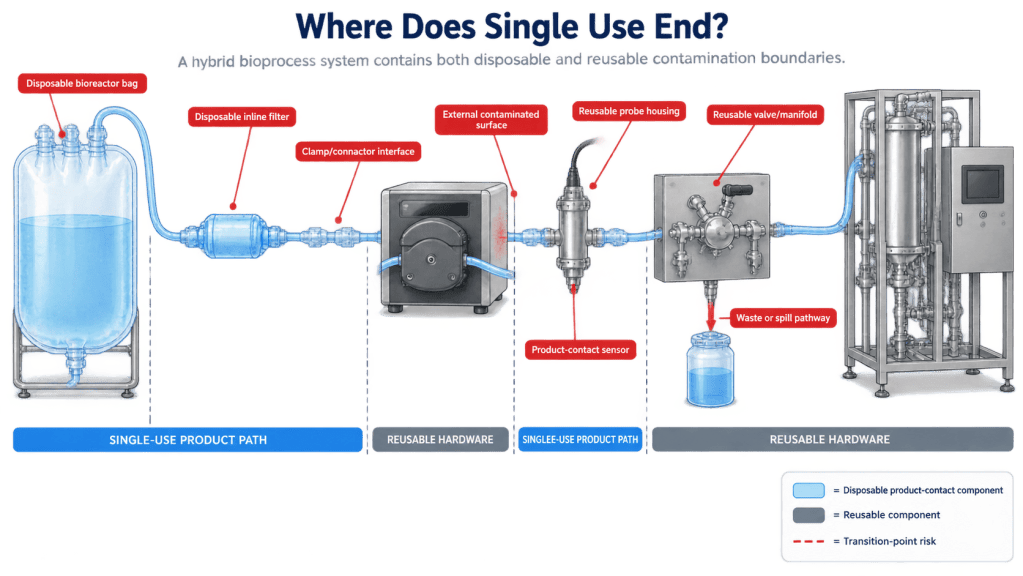
Hybrid bioprocess flow showing disposable bioreactor bags, tubing, filters, and connectors transitioning to reusable pump, sensor, transfer-panel, and chromatography hardware; red callouts mark contamination-control boundaries and spill pathways.

Integrity as contamination control

SUS integrity is both a sterility issue and a cross-contamination issue. A leak can release product into the room, contaminate equipment exteriors, expose operators, or create a pathway into another process. A loss of integrity may also allow environmental or adjacent-process contamination into the system.

Annex 1 expects SUS to maintain integrity under intended processing conditions and identifies extreme operations, including freezing, thawing, transport, and manipulation, as relevant challenges. Qualification should therefore address worst-case pressure, vacuum, agitation, temperature, duration, shipping, installation, connection, and operator handling, not merely supplier burst-test data.

Controls should include:

  • Qualified component and assembly suppliers.
  • Defined critical quality attributes and specifications.
  • Verification of sterilization evidence for each received unit where applicable.
  • Incoming inspection and packaging-integrity checks.
  • Controlled storage and handling.
  • Installation and connection instructions designed to prevent error.
  • Pre-use and, where justified, post-use integrity testing.
  • Leak response and contamination-boundary assessment.
  • Weld and connector qualification.
  • Operator qualification for assembly and manipulation.
  • Supplier change notification and comparability assessment.

Extractables and leachables

SUS removes one patient-safety concern, previous-product residue from reused contact surfaces, but introduces another: chemical species migrating from polymeric components. Annex 1 requires evaluation of product adsorption and reactivity under process conditions and assessment of extractable and leachable profiles, particularly for high-risk components, long contact times, or materials capable of absorbing process constituents.

The evaluation should consider the full process, including sterilization method and dose, contact time, temperature, pH, solvent characteristics, surface-area-to-volume ratio, agitation, storage, freezing and thawing, and cumulative contact across assemblies. Supplier extractables packages are inputs, not automatic proof of suitability. Their test conditions must be scientifically bridged to the actual process.

This is another point at which human safety expertise matters. A detected or predicted leachable should be evaluated against an appropriate toxicological threshold and clinical exposure scenario. The product-safety assessment for a multi-product facility therefore has two related but distinct jobs: establishing safe exposure to previous-product residues and evaluating patient exposure to process-material leachables.

Mix-up risk

SUS can reduce cleaning-related carryover while increasing configuration and mix-up risk. Multi-product facilities may hold visually similar bags, manifolds, filters, connectors, and tubing sets for several clients. A correct component assembled in the wrong orientation, or a wrong component with a compatible connection, can defeat the process while looking superficially acceptable.

Controls should include unique part numbers, electronic bill-of-material verification, barcode or equivalent identification, kitting, line clearance, independent verification of critical assemblies, connection maps, recipe interlocks where possible, and reconciliation of issued, used, and discarded components.

Facility and Process Controls

Equipment choice is only one layer. The facility must prevent contamination through the broader manufacturing environment.

EU GMP Chapter 5 identifies technical and organizational measures that may include dedicated premises or equipment, self-contained areas, closed systems, local extraction, pressure cascades, transfer controls, validated cleaning, waste management, protective clothing, campaign manufacture, and verification of control effectiveness. WHO similarly emphasizes technical and organizational controls, closed systems, cleaning validation, dedicated areas or equipment where justified, and periodic review of cross-contamination measures.

A hierarchy of controls is useful:

  1. Eliminate the pathway: Exclude an incompatible product, avoid open handling, or remove shared product contact.
  2. Physically contain or segregate: Use closed processing, dedicated suites, separate HVAC, barriers, isolators, or dedicated equipment.
  3. Engineer the interface: Use contained transfer, validated connectors, local extraction, pressure control, automation, and interlocks.
  4. Validate removal or inactivation: Apply reproducible cleaning and decontamination with adequate analytical verification.
  5. Control organization and sequence: Campaign, schedule, restrict personnel movement, segregate tools and materials, and perform line clearance.
  6. Detect loss of control: Use environmental, surface, residue, process, and maintenance monitoring targeted to credible failure modes.

Procedures and training are essential, but they are weaker than elimination, containment, and engineering controls. A risk assessment that accepts a high-consequence pathway because “operators are trained” is usually signaling that stronger controls were not seriously considered.

Campaigning

Campaign manufacture separates products in time, not space. It can reduce simultaneous exposure but does not remove residues already present in equipment, rooms, utilities, or shared support areas. Campaigning is acceptable only when paired with a validated and operationally controlled changeover capable of restoring the facility to the required state.

The campaign assessment should consider maximum campaign length, residue accumulation, microbial control, resin or membrane reuse, room and equipment cleaning, environmental persistence, maintenance during the campaign, and the likelihood that repeated setup creates normalized deviations.

Dedicated equipment

Dedication should be based on patient risk and control capability, not convention alone. Packed chromatography resins, membranes, or other retained components may be product-dedicated when they are difficult to clean, cannot be sampled representatively, retain product, or create unacceptable uncertainty. But a universal rule that every column or membrane must be dedicated is not a substitute for assessment.

Conversely, a low calculated carryover limit should not be used to justify sharing when the equipment cannot be cleaned, sampled, or verified with adequate margin. The decision to share requires alignment among toxicological acceptability, technical capability, analytical capability, and operational reliability.

Biological Hazards Beyond Product Residue

A cross-contamination assessment cannot stop at active-protein carryover. The process may contain host cells, cell-culture components, host-cell proteins, DNA, viruses or virus-like particles, mycoplasma, bacteria, fungi, endotoxin, cleaning agents, process additives, and product variants.

ICH Q5A(R2) describes three complementary viral-safety controls for biotechnology products: selection and testing of cell lines and raw materials, demonstration of process clearance for adventitious and endogenous viruses, and testing at appropriate production stages. These controls do not replace facility cross-contamination controls. They address product viral safety, while the facility assessment must also prevent pre-clearance material, cell-culture fluids, or laboratory challenge material from crossing into post-clearance or unrelated operations.

The assessment should distinguish at least:

  • Pre-viral-clearance from post-viral-clearance operations.
  • Live-cell or harvest operations from purified-product operations.
  • Product-specific residue from nonspecific organic residue.
  • Microbial contamination from adventitious viral contamination.
  • Endotoxin from viable organisms.
  • Process organisms from environmental organisms.
  • Laboratory viral-clearance studies from manufacturing operations.

Environmental monitoring can support control of viable and particulate contamination, but it is generally not the primary method for detecting product-to-productcarryover. Product-residue pathways require appropriately specific surface, rinse, process, or investigative methods. The monitoring strategy must match the contaminant and pathway.

Analytical Strategy

Analytical capability should be designed from the risk question, not selected because a platform method is already available.

For reusable equipment, the method must detect the residue or a justified surrogate at a level below the operational acceptance criterion, in the presence of cleaning agents, degradants, surface effects, and sampling losses. FDA expects evaluation of both method sensitivity and the ability of the sampling procedure to recover contamination from equipment surfaces.

Possible approaches include:

  • Product-specific immunoassays.
  • Total organic carbon where scientifically justified as a nonspecific measure.
  • HPLC or UPLC methods.
  • Mass spectrometric peptide or protein methods.
  • Protein assays, conductivity, or other process-specific techniques when sufficiently sensitive and selective.
  • PCR or sequencing for defined nucleic-acid or adventitious-agent questions.
  • Microbial and endotoxin methods for relevant biological residues.

The analytical target profile should define intended use, analyte, matrix, required sensitivity, specificity, reportable range, precision, recovery, robustness, and decision threshold. For a CDMO platform, the strategy should explain when a platform method is acceptable, when a product-specific method is required, and how bridging will be performed.

Method capability should influence the manufacturing decision. If the safe carryover level is below what can be reliably sampled and measured, the answer is not to accept the analytical gap. The control strategy must change: through dedication, disposal, additional segregation, improved cleaning, a more sensitive method, or exclusion of the product from the facility.

Control Strength, Not Control Count

A long list of controls can create the illusion of safety. Ten weak, dependent controls are not equivalent to two strong, independent controls.

LOPA is useful here because it asks whether a protection layer is specific, independent, dependable, and auditable. For example, an operator verifying a hose connection and a second operator checking the same connection may be useful, but both controls depend on the same labeling, work environment, and human interpretation. They are not necessarily independent layers.

A stronger scenario might combine:

  • Physically incompatible connectors.
  • Electronic component verification.
  • Recipe interlock.
  • Independent line-clearance verification.
  • Post-assembly integrity testing.

The assessment should document not only that a control exists but also:

  • What failure it prevents or detects.
  • Whether it is preventive or detective.
  • Whether it is independent of other controls.
  • How its effectiveness was established.
  • What evidence demonstrates continued performance.
  • What happens when it fails.

Regulatory inspection guidance for shared facilities similarly emphasizes documenting the process train and controls in enough detail to identify failure opportunities rather than assuming controls are effective.

Make the Risk Assessment Operational

A risk assessment should change how the facility operates. If it does not affect design, scheduling, qualification, training, monitoring, or release, it is probably only a document.

The output should establish:

  • Whether the product is acceptable for the facility.
  • Permitted suites, equipment trains, and scales.
  • Reusable, disposable, and dedicated boundaries.
  • Required campaign sequence and changeover.
  • Cleaning and decontamination requirements.
  • Product-specific analytical requirements.
  • Personnel and material-flow restrictions.
  • Environmental or surface-monitoring requirements.
  • Required engineering modifications.
  • Conditions that prohibit concurrent manufacture.
  • Required controls for maintenance and intervention.
  • Residual risks and formal acceptance authority.
  • Triggers for reassessment.

The decision should be made by a cross-functional team with authority and expertise in toxicology or pharmacology, quality assurance, manufacturing, MSAT, engineering, validation, microbiology, analytical science, EHS or industrial hygiene, supply chain, and the client’s product knowledge. Commercial stakeholders may contribute constraints and timing, but they should not define the patient-safety threshold.

Lifecycle Governance

The assessment cannot be frozen at technology transfer. ICH Q9(R1) includes risk review as an explicit element of QRM, and EMA expects periodic reassessment of the pharmacological and toxicological basis of HBELs.

Reassessment triggers should include:

  • New clinical or nonclinical safety information.
  • Change in dose, route, indication, or patient population.
  • New product introduction or changed manufacturing sequence.
  • Scale, batch-size, or equipment-train change.
  • Change from reusable to single-use equipment or the reverse.
  • New SUS component, material, supplier, sterilization process, or assembly design.
  • Cleaning-agent, cycle, recipe, or analytical-method change.
  • Facility, HVAC, pressure, flow, or room-use change.
  • Repeated cleaning deviations or adverse process-capability trends.
  • Integrity failures, leaks, or recurring connection errors.
  • Maintenance findings affecting cleanability or containment.
  • New organism or adventitious-agent information.
  • Regulatory change or inspection commitment.

A facility-level product matrix should remain under controlled ownership and identify, for every product, its HBEL status, hazard characteristics, applicable equipment, cleaning family, analytical method, dedication requirements, incompatibilities, and approval status. The matrix should not become an uncontrolled scheduling aid; it is a lifecycle quality record.

What Good Looks Like

A mature CDMO can answer the following questions without assembling a crisis team:

  • Which qualified expert established the HBEL, from what data, and when was it last reviewed?
  • What critical effect drives the limit, and how does uncertainty affect the control strategy?
  • Which product pair creates the most stringent carryover condition on each shared train?
  • Where exactly are the reusable and disposable boundaries?
  • Which SUS components carry the greatest integrity or leachables risk?
  • What contamination pathways remain if the first control fails?
  • Which controls are genuinely independent?
  • Can the cleaning process repeatedly achieve the required limit with margin?
  • Can the sampling and analytical methods detect failure at the required level?
  • What happens after a leak, torn bag, failed connector, maintenance intervention, or incomplete line clearance?
  • Which new information automatically reopens the assessment?

If those answers exist only in separate toxicology reports, validation protocols, supplier files, and local SOPs, the organization does not yet have an integrated cross-contamination control strategy. It has fragments.

The Hard Decision

The purpose of risk assessment is not to prove that every product can fit into the facility. Sometimes the scientifically correct conclusion is that it cannot.

A product may require dedicated equipment, a dedicated suite, a fully disposable flow path, additional containment, a different manufacturing sequence, or exclusion from the site because:

  • The HBEL is extremely low or cannot be established with adequate confidence.
  • The hazard includes sensitization, genotoxicity, potent immune activity, or another effect poorly controlled by ordinary cleaning assumptions.
  • The safe residue level is below analytical or sampling capability.
  • The molecule is not reliably removed or inactivated.
  • The process requires open handling that creates an uncontrolled pathway.
  • The facility cannot segregate pre- and post-clearance activities adequately.
  • The SUS boundary contains unacceptable reusable interfaces.
  • The organization cannot demonstrate control after foreseeable human or mechanical failure.

That decision is not evidence that the risk-management process failed. It is evidence that the process worked.

A Better Synthesis

Reusable equipment and single-use systems should not be treated as competing philosophies. They are different control architectures.

Reusable equipment concentrates the burden on cleanable design, validated removal, analytical evidence, maintenance, and disciplined changeover. Single-use systems reduce some direct carryover pathways but concentrate the burden on system boundaries, integrity, supplier oversight, sterilization assurance, material compatibility, extractables and leachables, configuration control, and human assembly.

The human product-safety assessment sits upstream of both. It defines the exposure boundary that gives every downstream control meaning. Without it, cleaning limits are arbitrary, dedication decisions are conventional, and facility-fit conclusions are little more than confidence statements.

For a multi-product CDMO, the strongest contamination control strategy is therefore not the one with the most controls or the greatest use of disposable technology. It is the one that can connect, without gaps:

patient hazard → safe exposure → contamination pathway → equipment boundary → control mechanism → verification evidence → lifecycle review.

That chain is the real product of the risk assessment. Everything else is documentation supporting it.
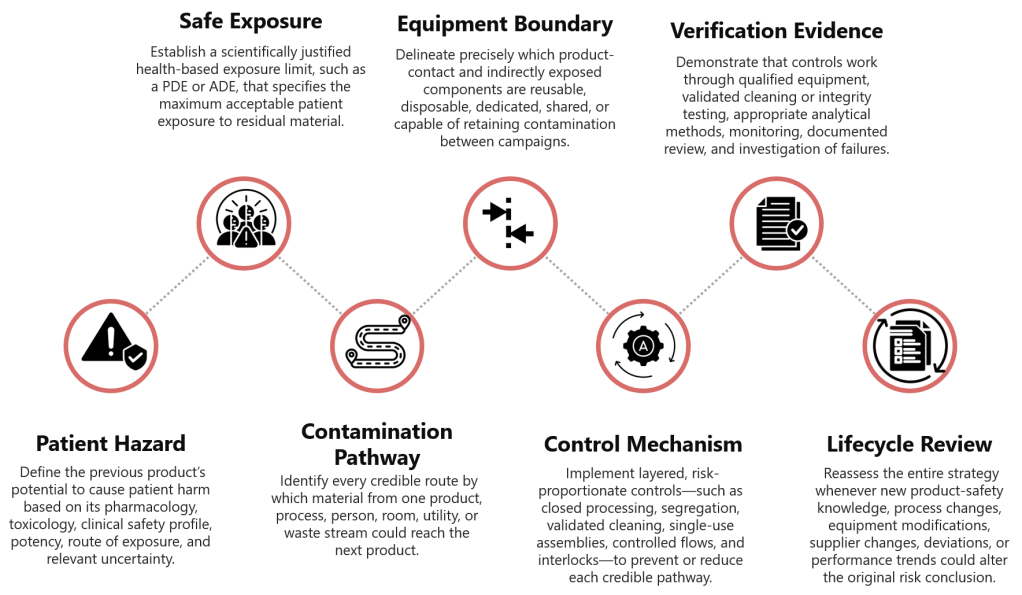
even-step contamination-control framework linking patient hazard to safe exposure, contamination pathways, equipment boundaries, control mechanisms, verification evidence, and lifecycle review for ongoing cross-contamination risk management.

Environmental Monitoring as a Falsifiable Story: Trending, Investigation, and the Illusion of Control

Environmental monitoring (EM) is not a hygiene check. It is a story we tell ourselves about whether our contamination control strategy actually works.

On paper, EM is straightforward: pick locations, define limits, collect samples, trend the data, investigate excursions. In practice, it sits at the messy intersection of microbiology, human behavior, facility design, and what I’ve elsewhere called unfalsifiable control strategies. When it works, EM quietly falsifies our fears by showing the facility behaving as predicted. When it fails, it often fails by never really testing the prediction in the first place.

This post is about that failure mode. More specifically, it is about two parts of the EM ecosystem that are chronically underpowered: trending and investigation. If you’ve read my earlier piece on Risk Assessment for Environmental Monitoring, think of this as the sequel where the risk model has to face its least forgiving critic: reality.

What Environmental Monitoring Is Really For

We often say EM is about verifying “state of control” in cleanrooms. It is a phrase that sounds reassuring and says almost nothing. State of control relative to what?

In Risk Assessment for Environmental Monitoring, I argued that an EM program should be anchored in a living risk assessment that behaves more like a heat map than a checklist. The assessment looks at:

  • Amenability of equipment and surfaces to cleaning and disinfection
  • Personnel presence and flow
  • Material flow and hand‑offs
  • Proximity to open product or direct-contact surfaces
  • Complexity and frequency of interventions

The result is not just a pretty risk matrix to staple behind Annex 1. It is a falsifiable prediction:

Given this process, this design, and these behaviors, contamination is most likely to appear here, here, and here.

Environmental monitoring is the ongoing experiment we run against that prediction. Every plate, every settle dish, every active air sample is data in a long-running test: does the world behave the way our contamination control strategy (CCS) says it should?

That framing matters. It changes the central trending question from “Are we under our alert and action limits?” to “Are the patterns we see consistent with the story our CCS tells?”

In Contamination Control, Risk Management and Change Control, I wrote that contamination control is a risk management problem that must be dynamically updated as we learn. EM is where that learning is supposed to happen. A CCS that cannot be contradicted by EM data is not a strategy; it is a belief system.

Aspirational Data vs Representative Data

Before we talk about trending, we have to talk about the data we are trending. Environmental monitoring quietly encourages a particular pathology: the production of aspirational data.

Aspirational data capture how we wish the facility behaved. Representative data capture how it actually behaves. The differences are subtle and often invisible in a quarterly slide deck.

Common ways organizations drift toward aspiration:

  • Pre-cleaned sampling. The team “freshens” the line before the EM tech arrives, creating a pristine snapshot of a room that never exists during peak operations.
  • Special sampling behavior. Operators slow their movements, avoid borderline practices, and “try harder” when plates are out. EM never sees the way work happens at 02:00 on day seven of a long campaign.
  • Convenience-based sites. Surfaces that are easy to access become the de facto sampling plan. Awkward, congested, or genuinely risky locations become afterthoughts.
  • Frozen plans. Once a sampling plan is approved, changing it is culturally hard. Risk shifts, processes evolve, but the plan clings to the path of least resistance.

The result is a dataset that looks pleasant in management reviews but has low epistemic value. It cannot falsify the CCS because it rarely goes near the conditions where the CCS is most likely to fail.

In Control Strategies, I described control strategies as knowledge systems that depend on feedback loops. EM is one of those loops. When EM is restricted to safe sampling, we quietly turn down the volume on our feedback. We get charts that signal control regardless of what is happening in the real system.

When an inspector asks, “How do you know this program is representative of normal operations?”, the reflex is to present design-intent documents: risk assessments, HVAC diagrams, EM SOPs. We rarely acknowledge the human side:

  • “We always clean right before EM.”
  • “Operators adjust their behavior during sampling.”

But these are exactly the kinds of issues that decide whether EM is a diagnostic or a performance. Representative programs will, at times, generate ugly data. That is what makes trending worth doing.

Trending as Hypothesis Testing, Not Chart Decoration

Trending has become a ritual. EM SOPs promise regular trend analysis. Quarterly reports bristle with plots and heat maps. Warning letter responses swear that “trends are monitored.”

Yet, in practice, most trending boils down to two actions:

  1. Plot excursion counts or percentages by area/quarter.
  2. Confirm that they are below predefined thresholds (excursion rate limits, contamination recovery rate limits, etc.).

This can catch gross failures. It does little for the subtler changes that matter most.

The Wrong Question: “Are We Under the Number?”

When trending is reduced to “staying under 1% excursions” or “within CRR limits,” we are asking the wrong question. Limits are not magic; they are guesses, often conservative and sometimes inherited, about what “normal” should look like.

If your excursion rate moves from 0.05% to 0.4% to 0.8% across four quarters and your only commentary is “still under 1%,” you are treating an arbitrary number as a metaphysical boundary. The system is speaking; you are ignoring it because the cell in the dashboard is still green.

The same goes for contamination recovery rates. USP <1116> introduced CRR specifically to get us away from binary hit/no‑hit thinking. But CRR can easily become just another “good/bad” threshold if we do not embed it in a broader hypothesis test.

The Right Question: “What Pattern Would Falsify Our Story?”

In my 2025 retrospective, I described investigations as opportunities to falsify the control strategy. Trending is the front end of that logic. Before you can falsify a story, you must decide what would count as falsification.

Most EM programs are full of unspoken hypotheses:

  • “If excursion rate ever exceeds X, we have a problem.”
  • “If mold appears in Grade C, the building envelope is compromised.”
  • “If we see TNTC in this room, an operator did something dramatically wrong.”

These thoughts exist as hallway comments and private thresholds in managers’ heads. They rarely make it into procedures.

A mature trending program would make them explicit. For example:

  • Predefined trend triggers:
    • Four consecutive quarters of increasing excursion rate, regardless of absolute level.
    • A statistically significant increase in CRR versus the prior two-year baseline.
    • Recurrence of the same organism species in the same location over multiple months.
    • Emergence of organisms outside the current disinfectant challenge panel.
  • Explicit CCS linkages:
    • “This pattern would contradict our assumption that weekly sporicide is sufficient in Buffer Prep.”
    • “This cluster would contradict our assumption that the gowning procedure is robust under peak traffic.”

In the Rechon warning letter post, I emphasized temporal correlation: contamination patterns aligned with specific campaigns, maintenance events, or staffing changes are not curiosities; they are tests of our explanatory model. Trend analysis that never confronts the CCS with these tests remains decorative.

Three Levels of Trend Analysis

Practically, it helps to distinguish three nested levels of trend analysis:

  1. Descriptive – What happened?
    • Excursion counts and percentages by room, grade, quarter.
    • CRR by parameter and area versus internal limits and historical baselines.
    • Organism distributions over time.
  2. Relational – What does it correlate with?
    • Overlay EM excursions with campaign schedules, change controls, shutdowns, HVAC events, and staffing patterns.
    • Ask, “When X happens, does Y tend to happen as well?”
  3. Explanatory – What does this say about our CCS?
    • Map observed trends back to specific CCS elements: cleaning regime, gowning, HVAC, material/personnel flow.
    • Ask, “If this pattern persists, which CCS or risk assessment statements would we need to rewrite?”

Most organizations live at level 1, dabble in level 2, and rarely touch level 3. But level 3 is where trending actually becomes hypothesis testing.

In The Quality Continuum in Pharmaceutical Manufacturing, I wrote about QC’s role in providing continuity across detection, response, and learning. EM trending is one of the places QC can either uphold that continuum or quietly break it by staying at the descriptive level.

Seasonal Molds and Convenient Amnesia

Seasonality is a good example of where EM trending and investigation often part ways with reality.

Many facilities can tell you, in a hand-wavy way, that “we always see more molds in the fall” or “pollen season is rough on our Grade D.” Fewer can show you a disciplined comparison of Q4 versus Q4 across multiple years, with room-by-room and species-level analysis.

The usual pattern looks like this:

  • A cluster of mold excursions appears in Q4.
  • Each individual event is investigated as a standalone deviation: root cause “seasonal loading,” “door left open,” “operator movement,” etc.
  • The quarterly report notes an “increase in mold recoveries consistent with seasonal variation.”
  • No one actually compares the magnitude and distribution of this Q4 spike to prior years in a way that could falsify the “just seasonal” story.

The phrase “consistent with” is doing a lot of work there. Consistent with does not mean explained by. It means “we can imagine a world where this pattern is seasonal.”

A more disciplined approach would:

  • Collect 3–5 years of Q4 data and compare mold counts and species distributions to other quarters.
  • Look at spatial patterns: are these molds appearing in the same areas repeatedly, or migrating?
  • Correlate with facility and CCS changes: new disinfectants, altered cleaning frequencies, HVAC modifications, construction, landscaping changes.

If the story is “seasonal loading,” that story should make predictions:

  • The spike should repeat with roughly similar magnitude and species profile year-on-year, absent major changes in controls.
  • Rooms with greater exchange with the external environment should be more affected than those with tight controls.

If those predictions do not hold, the hypothesis fails. Perhaps what we actually have is a cleaning regime that is adequate at baseline but fragile under seasonal stress; or a building envelope that slowly degraded; or a CCS that never truly considered spores as a separate risk dimension.

Trending without this kind of explicit, falsifiable seasonal analysis can lull us into a comforting narrative about inevitable variation, instead of pushing us to ask whether our controls are robust enough.

Investigation as the Continuation of Trending

If trending is hypothesis testing at the population level, investigation is the continuation of that testing at the event level.

In several posts, I have written about investigation craft:

  • Using cognitive interviewing instead of leading questions.
  • Avoiding the “Golden Day” fallacy, where we focus only on what was different on the day it went wrong and ignore the many days it went right.
  • Distinguishing between negative reasoning (“no evidence of”) and causal reasoning (“this factor contributed to…”).

EM gives us a special sort of investigation problem. We are often dealing with:

  • Low signal-to-noise ratio.
  • Long latency between event and detection.
  • Data that are inherently spatial and temporal (room, site, campaign, season).

When an EM excursion occurs, the temptation is to compress the narrative down to the single day, the single shift, the single operator. We write: “On this day, operator X failed to do Y, leading to Z.”

That can be true. It is rarely the whole truth.

The Golden Day vs the Typical Day

The Golden Day fallacy appears when we contrast the excursion day to an imaginary “typical day” and then attribute all differences to the excursion. The problem is that most of the time, we do not actually understand what a typical day looks like in any rigorous sense.

Trending should inform that understanding. For example:

  • If a room has a history of low-level hits clustered around certain interventions, then seeing a spike during such an intervention may be a case of the same mechanism operating more strongly, not a unique one-off.
  • If a species has appeared sporadically over months across different surfaces, the excursion might be the moment the underlying reservoir finally crossed a threshold, not the moment the contamination was created.

Good EM investigations make heavy use of trend data as context. They ask:

  • “What does the last year of data in this room look like?”
  • “Have we seen this organism before, and where?”
  • “Which parts of the CCS would predict that this should not happen here?”

The investigation then moves from “What happened on Tuesday?” to “What does Tuesday tell us about a pattern we may have been ignoring?”

Negative Evidence and Silent Failures

Another trap in EM investigations is the overuse of negative evidence:

  • “No HVAC deviations were noted.”
  • “Cleaning logs were complete.”
  • “No maintenance activities were recorded.”

Each of these is a statement about documentation, not reality. They are not useless—records matter—but they are not the same as positive evidence of proper behavior.

When we string together a series of “no deviations noted” statements and conclude that “no systemic issues were identified,” we have quietly moved from absence of evidence to evidence of absence.

Trend-informed EM investigations counter this by looking for silent failures:

  • If we see a slow increase in low-level counts in a room with “perfect” cleaning records, what does that say about the sensitivity of our cleaning oversight?
  • If we consistently recover organisms that our disinfectant efficacy studies never challenged, what does that say about our DE study design?

In other words, investigations should use EM data to question the sensitivity and specificity of our own controls, not just to confirm that paperwork exists.

A Composite Case: When EM Told Two Stories

Consider a composite, anonymized scenario that will feel familiar.

Over the course of a year, a facility sees:

  • A quarterly excursion rate that increases from 0.1% to 0.7%, always under the 1.0% internal limit.
  • Recurrent viable air excursions and occasional TNTC readings in two Grade C cell culture rooms during peak campaigns.
  • A cluster of mold recoveries in Q4 in both Grade C and D areas, including species not previously seen at the site.
  • A contamination recovery rate that remains within internal CRR limits for all grades.

The quarterly EM report dutifully notes:

  • “Excursion rate remains below 1%; EM program continues to demonstrate control.”
  • “Increased excursions seen in Grade C areas consistent with high activity.”
  • “Mold recoveries consistent with seasonal variation.”

Investigations for the individual deviations attribute causes to:

  • Operator aseptic technique.
  • Increased production activity.
  • Seasonal mold loading.

No trend deviation is opened. No update is made to the CCS.

From a strict, spec-driven point of view, this is plausible. From a hypothesis-testing point of view, it is deeply unsatisfying.

A more ambitious approach would treat the year’s data as a falsification challenge to the CCS:

  • The CCS claimed cleaning frequencies and disinfectant rotation were sufficient for Grade C under expected facility loading. Yet under peak load, the system appears fragile.
  • The CCS claimed gowning procedures and personnel flow were robust for cell culture operations. Recurrent TNTC and high viable air counts suggest a different story.
  • The CCS and DE study implicitly assumed the disinfectant panel and contact times were adequate against relevant molds. The appearance of new species and seasonal clustering should trigger a revisit of those assumptions.

In this view, the “trend deviation” is not an administrative nicety. It is the vehicle for making the CCS falsification explicit and forcing the organization to decide:

  • Do we update the control strategy and invest in new controls?
  • Or do we defend the current strategy with stronger evidence?

Either answer is more honest than quietly declaring everything “within limits.”

Making EM Falsifiable by Design

If EM is going to function as a falsifiable story rather than a compliance ritual, a few design principles help.

1. Design for Representation, Not Respectability

Sampling plans should start from the premise that data will sometimes be uncomfortable. That means:

  • Sampling when rooms are at their busiest, not when they are at their tidiest.
  • Including sites that are awkward, noisy, or politically sensitive because they are truly high risk.
  • Formalizing in procedures that pre‑cleaning specifically for EM is not permitted (and verifying this in practice).

If EM results never make anyone uncomfortable, they are probably not representative.

2. Treat Risk Assessments as Versioned Hypotheses

The EM risk assessment and CCS should be treated as versioned, hypothesis-bearing documents:

  • Each version should explicitly state key assumptions: e.g., “Weekly sporicide is sufficient for Grade C floors under expected traffic.”
  • Trend analysis should regularly review whether observed patterns still align with those assumptions.
  • When they do not, the CCS and risk assessment should be revised, not simply the justification text.

This links EM data to change control in a way that Contamination Control, Risk Management and Change Control sketched conceptually but rarely gets fully implemented.

3. Use Annual Organism Review as a Falsification Step

Annual organism reviews for disinfectant challenge panels are often treated as administrative ticks: yes, we still have a Gram-positive, a Gram-negative, a yeast, a mold, and maybe a facility isolate or two.

A more useful review would ask:

  • Which organisms actually dominated our EM recoveries this year?
  • Which organisms recurred in high-risk rooms?
  • Which organisms appeared for the first time, and where?
  • Which of these are covered by our current disinfectant efficacy panel, and which are not?

When there is a mismatch, that is a hypothesis failure: our DE panel is not representative of the real flora. The response might be to:

  • Add one or two high-frequency isolates to the next DE study.
  • Re‑evaluate contact times or concentrations.
  • Re-examine how disinfectant is applied in challenging locations.

This turns the organism review into an explicit test of how well our lab studies generalize to the field.

4. Integrate Trend Triggers into Investigation Governance

Trend triggers—like consecutive quarters of increase, or recurrent species in a location—should be codified and tied directly to deviation types. For example:

  • “Any four-quarter monotonic increase in excursion rate in a grade triggers a site-level EM trend deviation.”
  • “Any repeated recovery of the same mold in the same room over three months triggers a mold trend deviation.”

These trend deviations should then be treated with the same seriousness as a major one-off excursion, because they represent repeated falsification of a CCS assumption, not a single-point failure.

Culture: Pretty Charts vs Uncomfortable Truths

Behind all of this sits culture. Environmental monitoring lives in a tension between two expectations:

  • Regulators expect EM to be representative of normal operations.
  • Leadership often expects EM results to be respectable—low, stable, reassuring.

Those expectations are not always compatible.

A representative EM program will sometimes show uncomfortable patterns:

  • A room that is chronically fragile under certain campaigns.
  • A mold species that stubbornly reappears despite cleaning.
  • A slow drift upward in viable counts in a high-risk area.

If every excursion turns into a hunt for the “operator at fault,” people learn quickly that ignorance is safer than insight. Sampling windows get narrowed, “special cleaning” becomes routine, and the data gradually become aspirational.

Building a culture where EM can falsify our own stories requires a few commitments:

  • An excursion is the start of a learning conversation, not the end of a blame assignment.
  • Trend deviations are opportunities to reconsider strategies, not black marks.
  • Quality and operations jointly own the CCS and EM program; neither can use the other as a shield.

In Lessons from the Rechon Life Science Warning Letter, I argued that contamination events are often the visible tip of a long, shared history of decisions that made the system brittle. EM is one of the few tools that can reveal that history in real time—if we let it.

Questions to Ask of Your Own EM Program

If you want to stress-test your own EM trending and investigation system, a few questions can help. Treat this as a discussion tool, not a checklist.

About representation

  • When are most of your EM samples taken: during peak activity or during “quiet times”?
  • If you shadowed an EM tech for a week, what unwritten rules would you see about when and where they really sample?

About risk and CCS

  • Can you point to specific CCS statements that your EM data are actively testing?
  • When was the last time an EM trend led to a formal change to the CCS, rather than just a CAPA or training?

About trending

  • Do your trend reports do more than plot counts versus limits?
  • Have you defined patterns (e.g., consecutive increases, changing organism profiles) that automatically trigger deeper review?

About investigation

  • How often do EM investigations bring in trend data from previous months as part of the causal reasoning?
  • How often does the conclusion “no systemic issue identified” rest primarily on “no deviations found in records”?

About organisms and disinfectants

  • Does your current disinfectant efficacy panel match the organisms you actually recover?
  • Have you added or removed isolates based on organism review in the last three years?

If the honest answers make you uncomfortable, that is a good sign. It means there is room to turn EM from a hygiene ritual into a genuine falsification engine for your control strategy.

Environmental monitoring is, at its best, a continuous experiment we run on our own systems. Every sample is an invitation for the facility to contradict the story we tell about it. Trending and investigation are how we listen to those contradictions and decide whether to learn from them or explain them away.

We can continue to treat EM as a series of charts we wave at auditors. Or we can treat it as evidence in an ongoing argument between our control strategies and the stubbornness of reality.

The second option is harder. It is also the only one that moves us forward.

f

The Hidden Contamination Hazards: What the Catalent Warning Letter Reveals About Systemic Aseptic Processing Failures

The November 2025 FDA Warning Letter to Catalent Indiana, LLC reads like an autopsy report—a detailed dissection of how contamination hazards aren’t discovered but rather engineered into aseptic operations through a constellation of decisions that individually appear defensible yet collectively create what I’ve previously termed the “zemblanity field” in pharmaceutical quality. Section 2, addressing failures under 21 CFR 211.113(b), exposes contamination hazards that didn’t emerge from random misfortune but from deliberate choices about decontamination strategies, sampling methodologies, intervention protocols, and investigation rigor.​

What makes this warning letter particularly instructive isn’t the presence of contamination events—every aseptic facility battles microbial ingress—but rather the systematic architectural failures that allowed contamination hazards to persist unrecognized, uninvestigated, and unmitigated despite multiple warning signals spanning more than 20 deviations and customer complaints. The FDA’s critique centers on three interconnected contamination hazard categories: VHP decontamination failures involving occluded surfaces, inadequate environmental monitoring methods that substituted convenience for detection capability, and intervention risk assessments that ignored documented contamination routes.

For those of us responsible for contamination control in aseptic manufacturing, this warning letter demands we ask uncomfortable questions: How many of our VHP cycles are validated against surfaces that remain functionally occluded? How often have we chosen contact plates over swabs because they’re faster, not because they’re more effective? When was the last time we terminated a media fill and treated it with the investigative rigor of a batch contamination event?

The Occluded Surface Problem: When Decontamination Becomes Theatre

The FDA’s identification of occluded surfaces as contamination sources during VHP decontamination represents a failure mode I’ve observed with troubling frequency across aseptic facilities. The fundamental physics are unambiguous: vaporized hydrogen peroxide achieves sporicidal efficacy through direct surface contact at validated concentration-time profiles. Any surface the vapor doesn’t contact—or contacts at insufficient concentration—remains a potential contamination reservoir regardless of cycle completion indicators showing “successful” decontamination.​

The Catalent situation involved two distinct occluded surface scenarios, each revealing different architectural failures in contamination hazard assessment. First, equipment surfaces occluded during VHP decontamination that subsequently became contamination sources during atypical interventions involving equipment changes. The FDA noted that “the most probable root cause” of an environmental monitoring failure was equipment surfaces occluded during VHP decontamination, with contamination occurring during execution of an atypical intervention involving changes to components integral to stopper seating.​

This finding exposes a conceptual error I frequently encounter: treating VHP decontamination as a universal solution that overcomes design deficiencies rather than as a validated process with specific performance boundaries. The Catalent facility’s own risk assessments advised against interventions that could disturb potentially occluded surfaces, yet these interventions continued—creating the precise contamination pathway their risk assessments identified as unacceptable.​

The second occluded surface scenario involved wrapped components within the filling line where insufficient VHP exposure allowed potential contamination. The FDA cited “occluded surfaces on wrapped [components] within the [equipment] as the potential cause of contamination”. This represents a validation failure: if wrapping materials prevent adequate VHP penetration, either the wrapping must be eliminated, the decontamination method must change, or these surfaces must be treated through alternative validated processes.​

The literature on VHP decontamination is explicit about occluded surface risks. As Sandle notes, surfaces must be “designed and installed so that operations, maintenance, and repairs can be performed outside the cleanroom” and where unavoidable, “all surfaces needing decontaminated” must be explicitly identified. The PIC/S guidance is similarly unambiguous: “Continuously occluded surfaces do not qualify for such trials as they cannot be exposed to the process and should have been eliminated”. Yet facilities continue to validate VHP cycles that demonstrate biological indicator kill on readily accessible flat coupons while ignoring the complex geometries, wrapped items, and recessed surfaces actually present in their filling environments.

What does a robust approach to occluded surface assessment look like? Based on the regulatory expectations and technical literature, facilities should:

Conduct comprehensive occluded surface mapping during design qualification. Every component introduced into VHP-decontaminated spaces must undergo geometric analysis to identify surfaces that may not receive adequate vapor exposure. This includes crevices, threaded connections, wrapped items, hollow spaces, and any surface shadowed by another object. The mapping should document not just that surfaces exist but their accessibility to vapor flow based on the specific VHP distribution characteristics of the equipment.​

Validate VHP distribution using chemical and biological indicators placed on identified occluded surfaces. Flat coupon placement on readily accessible horizontal surfaces tells you nothing about vapor penetration into wrapped components or recessed geometries. Biological indicators should be positioned specifically where vapor exposure is questionable—inside wrapped items, within threaded connections, under equipment flanges, in dead-legs of transfer lines. If biological indicators in these locations don’t achieve the validated log reduction, the surfaces are occluded and require design modification or alternative decontamination methods.​

Establish clear intervention protocols that distinguish between “sterile-to-sterile” and “potentially contaminated” surface contact. The Catalent finding reveals that atypical interventions involving equipment changes exposed the Grade A environment to surfaces not reliably exposed to VHP. Intervention risk assessments must explicitly categorize whether the intervention involves only VHP-validated surfaces or introduces components from potentially occluded areas. The latter category demands heightened controls: localized Grade A air protection, pre-intervention surface swabbing and disinfection, real-time environmental monitoring during the intervention, and post-intervention investigation if environmental monitoring shows any deviation.​

Implement post-decontamination surface monitoring that targets historically occluded locations. If your facility has identified occluded surfaces that cannot be designed out, these become critical sampling locations for post-VHP environmental monitoring. Trending of these specific locations provides early detection of decontamination effectiveness degradation before contamination reaches product-contact surfaces.

The FDA’s remediation demand is appropriately comprehensive: “a review of VHP exposure to decontamination methods as well as permitted interventions, including a retrospective historical review of routine interventions and atypical interventions to determine their risks, a comprehensive identification of locations that are not reliably exposed to VHP decontamination (i.e., occluded surfaces), your plan to reduce occluded surfaces where feasible, review of currently permitted interventions and elimination of high-risk interventions entailing equipment manipulations during production campaigns that expose the ISO 5 environment to surfaces not exposed to a validated decontamination process, and redesign of any intervention that poses an unacceptable contamination risk”.​

This remediation framework represents best practice for any aseptic facility using VHP decontamination. The occluded surface problem isn’t limited to Catalent—it’s an industry-wide vulnerability wherever VHP validation focuses on demonstrating sporicidal activity under ideal conditions rather than confirming adequate vapor contact across all surfaces within the validated space.

Contact Plates Versus Swabs: The Detection Capability Trade-Off

The FDA’s critique of Catalent’s environmental monitoring methodology exposes a decision I’ve challenged repeatedly throughout my career: the use of contact plates for sampling irregular, product-contact surfaces in Grade A environments. The technical limitations are well-established, yet contact plates persist because they’re faster and operationally simpler—prioritizing workflow convenience over contamination detection capability.

The specific Catalent deficiency involved sampling filling line components using “contact plate, sampling [surfaces] with one sweeping sampling motion.” The FDA identified two fundamental inadequacies: “With this method, you are unable to attribute contamination events to specific [locations]” and “your firm’s use of contact plates is not as effective as using swab methods”. These limitations aren’t novel discoveries—they’re inherent to contact plate methodology and have been documented in the microbiological literature for decades.​

Contact plates—rigid agar surfaces pressed against the area to be sampled—were designed for flat, smooth surfaces where complete agar-to-surface contact can be achieved with uniform pressure. They perform adequately on stainless steel benchtops, isolator walls, and other horizontal surfaces. But filling line components—particularly those identified in the warning letter—present complex geometries: curved surfaces, corners, recesses, and irregular topographies where rigid agar cannot conform to achieve complete surface contact.

The microbial recovery implications are significant. When a contact plate fails to achieve complete surface contact, microorganisms in uncontacted areas remain unsampled. The result is a false-negative environmental monitoring reading that suggests contamination control while actual contamination persists undetected. Worse, the “sweeping sampling motion” described in the warning letter—moving a single contact plate across multiple locations—creates the additional problem the FDA identified: inability to attribute any recovered contamination to a specific surface. Was the contamination on the first component contacted? The third? Somewhere in between? This sampling approach provides data too imprecise for meaningful contamination source investigation.

The alternative—swab sampling—addresses both deficiencies. Swabs conform to irregular surfaces, accessing corners, recesses, and curved topographies that contact plates cannot reach. Swabs can be applied to specific, discrete locations, enabling precise attribution of any contamination recovered to a particular surface. The trade-off is operational: swab sampling requires more time, involves additional manipulative steps within Grade A environments, and demands different operator technique validation.​

Yet the Catalent warning letter makes clear that this operational inconvenience doesn’t justify compromised detection capability for critical product-contact surfaces. The FDA’s expectation—acknowledged in Catalent’s response—is swab sampling “to replace use of contact plates to sample irregular surfaces”. This represents a fundamental shift from convenience-optimized to detection-optimized environmental monitoring.​

What should a risk-based surface sampling strategy look like? The differentiation should be based on surface geometry and criticality:

Contact plates remain appropriate for flat, smooth, readily accessible surfaces where complete agar contact can be verified and where contamination risk is lower (Grade B floors, isolator walls, equipment external surfaces). The speed and simplicity advantages of contact plates justify their continued use in these applications.

Swab sampling should be mandatory for product-contact surfaces, irregular geometries, recessed areas, and any location where contact plate conformity is questionable. This includes filling needles, stopper bowls, vial transport mechanisms, crimping heads, and the specific equipment components cited in the Catalent letter. The additional time required for swab sampling is trivial compared to the contamination risk from inadequate monitoring.

Surface sampling protocols must specify the exact location sampled, not general equipment categories. Rather than “sample stopper bowl,” protocols should identify “internal rim of stopper bowl,” “external base of stopper bowl,” “stopper agitation mechanism interior surfaces.” This specificity enables contamination source attribution during investigations and ensures sampling actually reaches the highest-risk surfaces.

Swab technique must be validated to ensure consistent recovery from target surfaces. Simply switching from contact plates to swabs doesn’t guarantee improved detection unless swab technique—pressure applied, surface area contacted, swab saturation, transfer to growth media—is standardized and demonstrated to achieve adequate microbial recovery from the specific materials and geometries being sampled.​

The EU GMP Annex 1 and FDA guidance documents emphasize detection capability over convenience in environmental monitoring. The expectation isn’t perfect contamination prevention—that’s impossible in aseptic processing—but rather monitoring systems sensitive enough to detect contamination events when they occur, enabling investigation and corrective action before product impact. Contact plates on irregular surfaces fail this standard by design, not because of operator error or inadequate validation but because the fundamental methodology cannot access the surfaces requiring monitoring.​

The Intervention Paradox: When Risk Assessments Identify Hazards But Operations Ignore Them

Perhaps the most troubling element of the Catalent contamination hazards section isn’t the presence of occluded surfaces or inadequate sampling methods but rather the intervention management failure that reveals a disconnect between risk assessment and operational decision-making. Catalent’s risk assessments explicitly “advised against interventions that can disturb potentially occluded surfaces,” yet these high-risk interventions continued during production campaigns.​

This represents what I’ve termed “investigation theatre” in previous posts—creating the superficial appearance of risk-based decision-making while actual operations proceed according to production convenience rather than contamination risk mitigation. The risk assessment identified the hazard. The environmental monitoring data confirmed the hazard when contamination occurred during the intervention. Yet the intervention continued as an accepted operational practice.​

The specific intervention involved equipment changes to components “integral to stopper seating in the [filling line]”. These components operate at the critical interface between the sterile stopper and the vial—precisely the location where any contamination poses direct product impact risk. The intervention occurred during production campaigns rather than between campaigns when comprehensive decontamination and validation could occur. The intervention involved surfaces potentially occluded during VHP decontamination, meaning their microbiological state was unknown when introduced into the Grade A filling environment.​

Every element of this scenario screams “unacceptable contamination risk,” yet it persisted as accepted practice until FDA inspection. How does this happen? Based on my experience across multiple aseptic facilities, the failure mode follows a predictable pattern:

Production scheduling drives intervention timing rather than contamination risk assessment. Stopping a campaign for equipment maintenance creates schedule disruption, yield loss, and capacity constraints. The pressure to maintain campaign continuity overwhelms contamination risk considerations that appear theoretical compared to the immediate, quantifiable production impact.

Risk assessments become compliance artifacts disconnected from operational decision-making. The quality unit conducts a risk assessment, documents that certain interventions pose unacceptable contamination risk, and files the assessment. But when production encounters the situation requiring that intervention, the actual decision-making process references production need, equipment availability, and batch schedules—not the risk assessment that identified the intervention as high-risk.

Interventions become “normalized deviance”—accepted operational practices despite documented risks. After performing a high-risk intervention successfully (meaning without detected contamination) multiple times, it transitions from “high-risk intervention requiring exceptional controls” to “routine intervention” in operational thinking. The fact that adequate controls prevented contamination detection gets inverted into evidence that the intervention isn’t actually high-risk.

Environmental monitoring provides false assurance when contamination goes undetected. If a high-risk intervention occurs and subsequent environmental monitoring shows no contamination, operations interprets this as validation that the intervention is acceptable. But as discussed in the contact plate section, inadequate sampling methodology may fail to detect contamination that actually occurred. The absence of detected contamination becomes “proof” that contamination didn’t occur, reinforcing the normalization of high-risk interventions.

The EU GMP Annex 1 requirements for intervention management represent regulatory recognition of these failure modes. Annex 1 Section 8.16 requires “the list of interventions evaluated via risk analysis” and Section 9.36 requires that aseptic process simulations include “interventions and associated risks”. The framework is explicit: identify interventions, assess their contamination risk, validate that operators can perform them aseptically through media fills, and eliminate interventions that cannot be performed without unacceptable contamination risk.​

What does robust intervention risk management look like in practice?

Categorize interventions by contamination risk based on specific, documented criteria. The categorization should consider: surfaces contacted (sterile-to-sterile vs. potentially contaminated), duration of exposure, proximity to open product, operator actions required, first air protection feasibility, and frequency. This creates a risk hierarchy that enables differentiated control strategies rather than treating all interventions equivalently.​

Establish clear decision authorities for different intervention risk levels. Routine interventions (low contamination risk, validated through media fills, performed regularly) can proceed under operator judgment following standard procedures. High-risk interventions (those involving occluded surfaces, extended exposure, or proximity to open product) should require quality unit pre-approval including documented risk assessment and enhanced controls specification. Interventions identified as posing unacceptable risk should be prohibited until equipment redesign or process modification eliminates the contamination hazard.​

Validate intervention execution through media fills that specifically simulate the intervention’s contamination challenges. Generic media fills demonstrating overall aseptic processing capability don’t validate specific high-risk interventions. If your risk assessment identifies a particular intervention as posing contamination risk, your media fill program must include that intervention, performed by the operators who will execute it, under the conditions (campaign timing, equipment state, environmental conditions) where it will actually occur.​

Implement intervention-specific environmental monitoring that targets the contamination pathways identified in risk assessments. If the risk assessment identifies that an intervention may expose product to surfaces not reliably decontaminated, environmental monitoring immediately following that intervention should specifically sample those surfaces and adjacent areas. Trending this intervention-specific monitoring data separately from routine environmental monitoring enables detection of intervention-associated contamination patterns.​

Conduct post-intervention investigations when environmental monitoring shows any deviation. The Catalent warning letter describes an environmental monitoring failure whose “most probable root cause” was an atypical intervention involving equipment changes. This temporal association between intervention and contamination should trigger automatic investigation even if environmental monitoring results remain within action levels. The investigation should assess whether intervention protocols require modification or whether the intervention should be eliminated.​

The FDA’s remediation demand addresses this gap directly: “review of currently permitted interventions and elimination of high-risk interventions entailing equipment manipulations during production campaigns that expose the ISO 5 environment to surfaces not exposed to a validated decontamination process”. This requirement forces facilities to confront the intervention paradox: if your risk assessment identifies an intervention as high-risk, you cannot simultaneously permit it as routine operational practice. Either modify the intervention to reduce risk, validate enhanced controls that mitigate the risk, or eliminate the intervention entirely.​

Media Fill Terminations: When Failures Become Invisible

The Catalent warning letter’s discussion of media fill terminations exposes an investigation failure mode that reveals deeper quality system inadequacies. Since November 2023, Catalent terminated more than five media fill batches representing the filling line. Following two terminations for stoppering issues and extrinsic particle contamination, the facility “failed to open a deviation or an investigation at the time of each failure, as required by your SOPs”.​

Read that again. Media fills—the fundamental aseptic processing validation tool, the simulation specifically designed to challenge contamination control—were terminated due to failures, and no deviation was opened, no investigation initiated. The failures simply disappeared from the quality system, becoming invisible until FDA inspection revealed their existence.

The rationalization is predictable: “there was no impact to the SISPQ (Safety, Identity, Strength, Purity, Quality) of the terminated media batches or to any customer batches” because “these media fills were re-executed successfully with passing results”. This reasoning exposes a fundamental misunderstanding of media fill purpose that I’ve encountered with troubling frequency across the industry.​

A media fill is not a “test” that you pass or fail with product consequences. It is a simulation—a deliberate challenge to your aseptic processing capability using growth medium instead of product specifically to identify contamination risks without product impact. When a media fill is terminated due to a processing failure, that termination is itself the critical finding. The termination reveals that your process is vulnerable to exactly the failure mode that caused termination: stoppering problems that could occur during commercial filling, extrinsic particles that could contaminate product.

The FDA’s response is appropriately uncompromising: “You do not provide the investigations with a root cause that justifies aborting and re-executing the media fills, nor do you provide the corrective actions taken for each terminated media fill to ensure effective CAPAs were promptly initiated”. The regulatory expectation is clear: media fill terminations require investigation identical in rigor to commercial batch failures. Why did the stoppering issue occur? What equipment, material, or operator factors contributed? How do we prevent recurrence? What commercial batches may have experienced similar failures that went undetected?​

The re-execution logic is particularly insidious. By immediately re-running the media fill and achieving passing results, Catalent created the appearance of successful validation while ignoring the process vulnerability revealed by the termination. The successful re-execution proved only that under ideal conditions—now with heightened operator awareness following the initial failure—the process could be executed successfully. It provided no assurance that commercial operations, without that heightened awareness and under the same conditions that caused the initial termination, wouldn’t experience identical failures.

What should media fill termination management look like?

Treat every media fill termination as a critical deviation requiring immediate investigation initiation. The investigation should identify the root cause of the termination, assess whether the failure mode could occur during commercial manufacturing, evaluate whether previous commercial batches may have experienced similar failures, and establish corrective actions that prevent recurrence. This investigation must occur before re-execution, not instead of investigation.​

Require quality unit approval before media fill re-execution. The approval should be based on documented investigation findings demonstrating that the termination cause is understood, corrective actions are implemented, and re-execution will validate process capability under conditions that include the corrective actions. Re-execution without investigation approval perpetuates the “keep running until we get a pass” mentality that defeats media fill purpose.​

Implement media fill termination trending as a critical quality indicator. A facility terminating “more than five media fill batches” in a period should recognize this as a signal of fundamental process capability problems, not as a series of unrelated events requiring re-execution. Trending should identify common factors: specific operators, equipment states, intervention types, campaign timing.​

Ensure deviation tracking systems cannot exclude media fill terminations. The Catalent situation arose partly because “you failed to initiate a deviation record to capture the lack of an investigation for each of the terminated media fills, resulting in an undercounting of the deviations”. Quality metrics that exclude media fill terminations from deviation totals create perverse incentives to avoid formal deviation documentation, rendering media fill findings invisible to quality system oversight.​

The broader issue extends beyond media fill terminations to how aseptic processing validation integrates with quality systems. Media fills should function as early warning indicators—detecting aseptic processing vulnerabilities before product impact occurs. But this detection value requires that findings from media fills drive investigations, corrective actions, and process improvements with the same rigor as commercial batch deviations. When media fill failures can be erased through re-execution without investigation, the entire validation framework becomes performative rather than protective.

The Stopper Supplier Qualification Failure: Accepting Contamination at the Source

The stopper contamination issues discussed throughout the warning letter—mammalian hair found in or around stopper regions of vials from nearly 20 batches across multiple products—reveal a supplier qualification and incoming inspection failure that compounds the contamination hazards already discussed. The FDA’s critique focuses on Catalent’s “inappropriate reliance on pre-shipment samples (tailgate samples)” and failure to implement “enhanced or comparative sampling of stoppers from your other suppliers”.​

The pre-shipment or “tailgate” sample approach represents a fundamental violation of GMP sampling principles. Under this approach, the stopper supplier—not Catalent—collected samples from lots prior to shipment and sent these samples directly to Catalent for quality testing. Catalent then made accept/reject decisions for incoming stopper lots based on testing of supplier-selected samples that never passed through Catalent’s receiving or storage processes.​

Why does this matter? Because representative sampling requires that samples be selected from the material population actually received by the facility, stored under facility conditions, and handled through facility processes. Supplier-selected pre-shipment samples bypass every opportunity to detect contamination introduced during shipping, storage transitions, or handling. They enable a supplier to selectively sample from cleaner portions of production lots while shipping potentially contaminated material in the same lot to the customer.

The FDA guidance on this issue is explicit and has been for decades: samples for quality attribute testing “are to be taken at your facility from containers after receipt to ensure they are representative of the components in question”. This isn’t a new expectation emerging from enhanced regulatory scrutiny—it’s a baseline GMP requirement that Catalent systematically violated through reliance on tailgate samples.​

But the tailgate sample issue represents only one element of broader supplier qualification failures. The warning letter notes that “while stoppers from [one supplier] were the primary source of extrinsic particles, they were not the only source of foreign matter.” Yet Catalent implemented “limited, enhanced sampling strategy for one of your suppliers” while failing to “increase sampling oversight” for other suppliers. This selective enhancement—focusing remediation only on the most problematic supplier while ignoring systemic contamination risks across the stopper supply base—predictably failed to resolve ongoing contamination issues.​

What should stopper supplier qualification and incoming inspection look like for aseptic filling operations?

Eliminate pre-shipment or tailgate sampling entirely. All quality testing must be conducted on samples taken from received lots, stored in facility conditions, and selected using documented random sampling procedures. If suppliers require pre-shipment testing for their internal quality release, that’s their process requirement—it doesn’t substitute for the purchaser’s independent incoming inspection using facility-sampled material.​

Implement risk-based incoming inspection that intensifies sampling when contamination history indicates elevated risk. The warning letter notes that Catalent recognized stoppers as “a possible contributing factor for contamination with mammalian hairs” in July 2024 but didn’t implement enhanced sampling until May 2025—a ten-month delay. The inspection enhancement should be automatic and immediate when contamination events implicate incoming materials. The sampling intensity should remain elevated until trending data demonstrates sustained contamination reduction across multiple lots.​

Apply visual inspection with reject criteria specific to the defect types that create product contamination risk. Generic visual inspection looking for general “defects” fails to detect the specific contamination types—embedded hair, extrinsic particles, material fragments—that create sterile product risks. Inspection protocols must specify mammalian hair, fiber contamination, and particulate matter as reject criteria with sensitivity adequate to detect single-particle contamination in sampled stoppers.​

Require supplier process changes—not just enhanced sampling—when contamination trends indicate process capability problems. The warning letter acknowledges Catalent “worked with your suppliers to reduce the likelihood of mammalian hair contamination events” but notes that despite these efforts, “you continued to receive complaints from customers who observed mammalian hair contamination in drug products they received from you”. Enhanced sampling detects contamination; it doesn’t prevent it. Suppliers demonstrating persistent contamination require process audits, environmental control improvements, and validated contamination reduction demonstrated through process capability studies—not just promises to improve quality.​

Implement finished product visual inspection with heightened sensitivity for products using stoppers from suppliers with contamination history. The FDA notes that Catalent indicated “future batches found during visual inspection of finished drug products would undergo a re-inspection followed by tightened acceptable quality limit to ensure defective units would be removed” but didn’t provide the re-inspection procedure. This two-stage inspection approach—initial inspection followed by re-inspection with enhanced criteria for lots from high-risk suppliers—provides additional contamination detection but must be validated to demonstrate adequate defect removal.​

The broader lesson extends beyond stoppers to supplier qualification for any component used in sterile manufacturing. Components introduce contamination risks—microbial bioburden, particulate matter, chemical residues—that cannot be fully mitigated through end-product testing. Supplier qualification must function as a contamination prevention tool, ensuring that materials entering aseptic operations meet microbiological and particulate quality standards appropriate for their role in maintaining sterility. Reliance on tailgate samples, delayed sampling enhancement, and acceptance of persistent supplier contamination all represent failures to recognize suppliers as critical contamination control points requiring rigorous qualification and oversight.

The Systemic Pattern: From Contamination Hazards to Quality System Architecture

Stepping back from individual contamination hazards—occluded surfaces, inadequate sampling, high-risk interventions, media fill terminations, supplier qualification failures—a systemic pattern emerges that connects this warning letter to the broader zemblanity framework I’ve explored in previous posts. These aren’t independent, unrelated deficiencies that coincidentally occurred at the same facility. They represent interconnected architectural failures in how the quality system approaches contamination control.​

The pattern reveals itself through three consistent characteristics:

Detection systems optimized for convenience rather than capability. Contact plates instead of swabs for irregular surfaces. Pre-shipment samples instead of facility-based incoming inspection. Generic visual inspection instead of defect-specific contamination screening. Each choice prioritizes operational ease and workflow efficiency over contamination detection sensitivity. The result is a quality system that generates reassuring data—passing environmental monitoring, acceptable incoming inspection results, successful visual inspection—while actual contamination persists undetected.

Risk assessments that identify hazards without preventing their occurrence. Catalent’s risk assessments advised against interventions disturbing potentially occluded surfaces, yet these interventions continued. The facility recognized stoppers as contamination sources in July 2024 but delayed enhanced sampling until May 2025. Media fill terminations revealed aseptic processing vulnerabilities but triggered re-execution rather than investigation. Risk identification became separated from risk mitigation—the assessment process functioned as compliance theatre rather than decision-making input.​

Investigation systems that erase failures rather than learn from them. Media fill terminations occurred without deviation initiation. Mammalian hair contamination events were investigated individually without recognizing the trend across 20+ deviations. Root cause investigations concluded “no product impact” based on passing sterility tests rather than addressing the contamination source enabling future events. The investigation framework optimized for batch release justification rather than contamination prevention.​

These patterns don’t emerge from incompetent quality professionals or inadequate resource allocation. They emerge from quality system design choices that prioritize production efficiency, workflow continuity, and batch release over contamination detection, investigation rigor, and source elimination. The system delivers what it was designed to deliver: maximum throughput with minimum disruption. It fails to deliver what patients require: contamination control capable of detecting and eliminating sterility risks before product impact.

Recommendations: Building Contamination Hazard Detection Into System Architecture

What does effective contamination hazard management look like at the quality system architecture level? Based on the Catalent failures and broader industry patterns, several principles should guide aseptic operations:

Design decontamination validation around worst-case geometries, not ideal conditions. VHP validation using flat coupons on horizontal surfaces tells you nothing about vapor penetration into the complex geometries, wrapped components, and recessed surfaces actually present in your filling line. Biological indicator placement should target occluded surfaces specifically—if you can’t achieve validated kill on these locations, they’re contamination hazards requiring design modification or alternative decontamination methods.

Select environmental monitoring methods based on detection capability for the surfaces and conditions actually requiring monitoring. Contact plates are adequate for flat, smooth surfaces. They’re inadequate for irregular product-contact surfaces, recessed areas, and complex geometries. Swab sampling takes more time but provides contamination detection capability that contact plates cannot match. The operational convenience sacrifice is trivial compared to the contamination risk from monitoring methods incapable of detecting contamination when it occurs.​

Establish intervention risk classification with decision authorities proportional to contamination risk. Routine low-risk interventions validated through media fills can proceed under operator judgment. High-risk interventions—those involving occluded surfaces, extended exposure, or proximity to open product—require quality unit pre-approval with documented enhanced controls. Interventions identified as posing unacceptable risk should be prohibited pending equipment redesign.​

Treat media fill terminations as critical deviations requiring investigation before re-execution. The termination reveals process vulnerability—the investigation must identify root cause, assess commercial batch risk, and establish corrective actions before validation continues. Re-execution without investigation perpetuates the failures that caused termination.​

Implement supplier qualification with facility-based sampling, contamination-specific inspection criteria, and automatic sampling enhancement when contamination trends emerge. Tailgate samples cannot provide representative material assessment. Visual inspection must target the specific contamination types—mammalian hair, particulate matter, material fragments—that create product risks. Enhanced sampling should be automatic and sustained when contamination history indicates elevated risk.​

Build investigation systems that learn from contamination events rather than erasing them through re-execution or “no product impact” conclusions. Contamination events represent failures in contamination control regardless of whether subsequent testing shows product remains within specification. The investigation purpose is preventing recurrence, not justifying release.​

The FDA’s comprehensive remediation demands represent what quality system architecture should look like: independent assessment of investigation capability, CAPA effectiveness evaluation, contamination hazard risk assessment covering material flows and equipment placement, detailed remediation with specific improvements, and ongoing management oversight throughout the manufacturing lifecycle.​

The Contamination Control Strategy as Living System

The Catalent warning letter’s contamination hazards section serves as a case study in how quality systems can simultaneously maintain surface-level compliance while allowing fundamental contamination control failures to persist. The facility conducted VHP decontamination cycles, performed environmental monitoring, executed media fills, and inspected incoming materials—checking every compliance box. Yet contamination hazards proliferated because these activities optimized for operational convenience and batch release justification rather than contamination detection and source elimination.

The EU GMP Annex 1 Contamination Control Strategy requirement represents regulatory recognition that contamination control cannot be achieved through isolated compliance activities. It requires integrated systems where facility design, decontamination processes, environmental monitoring, intervention protocols, material qualification, and investigation practices function cohesively to detect, investigate, and eliminate contamination sources. The Catalent failures reveal what happens when these elements remain disconnected: decontamination cycles that don’t reach occluded surfaces, monitoring that can’t detect contamination on irregular geometries, interventions that proceed despite identified risks, investigations that erase failures through re-execution​

For those of us responsible for contamination control in aseptic manufacturing, the question isn’t whether our facilities face similar vulnerabilities—they do. The question is whether our quality systems are architected to detect these vulnerabilities before regulators discover them. Are your VHP validations addressing actual occluded surfaces or ideal flat coupons? Are you using contact plates because they detect contamination effectively or because they’re operationally convenient? Do your intervention protocols prevent the high-risk activities your risk assessments identify? When media fills terminate, do investigations occur before re-execution?

The Catalent warning letter provides a diagnostic framework for assessing contamination hazard management. Use it. Map your own decontamination validation against the occluded surface criteria. Evaluate your environmental monitoring method selection against detection capability requirements. Review intervention protocols for alignment with risk assessments. Examine media fill termination handling for investigation rigor. Assess supplier qualification for facility-based sampling and contamination-specific inspection.

The contamination hazards are already present in your aseptic operations. The question is whether your quality system architecture can detect them.

The Taxonomy of Clean: Why Confusing Microbial Control, Aseptic, and Sterile is Wrecking Your Contamination Control Strategy

If I had a dollar for every time I sat in a risk assessment workshop and heard someone use “aseptic” and “sterile” interchangeably, I could probably fund my own private isolator line. It is one of those semantic slips that seems harmless on the surface—like confusing “precision” with “accuracy”—but in the pharmaceutical quality world, these linguistic shortcuts are often the canary in the coal mine for a systemic failure of understanding.

We are currently navigating the post-Annex 1 implementation landscape, a world where the Contamination Control Strategy (CCS) has transitioned from a “nice-to-have” philosophy to a mandatory, living document. Yet, I frequently see CCS documents that read like a disorganized shopping list of controls rather than a coherent strategy. Why? Because the authors haven’t fundamentally distinguished between microbial control, aseptic processing, and sterility.

If we cannot agree on what we are trying to achieve, we certainly cannot build a strategy to achieve it. Today, I want to unpack these terms—not for the sake of pedantry, but because the distinction dictates your facility design, your risk profile, and ultimately, patient safety. We will also look at how these definitions map onto the spectrum of open and closed systems, and critically, how they apply across drug substance and drug product manufacturing. This last point is where I see the most confusion—and where the stakes are highest.

The Definitions: More Than Just Semantics

Let’s strip this back. These aren’t just vocabulary words; they are distinct operational states that demand different control philosophies.

Microbial Control: The Art of Management

Microbial control is the baseline. It is the broad umbrella under which all our activities sit, but it is not synonymous with sterility. In the world of non-sterile manufacturing (tablets, oral liquids, topicals), microbial control is about bioburden management. We aren’t trying to eliminate life; we are trying to keep it within safe, predefined limits and, crucially, ensure the absence of “objectionable organisms.”

In a sterile manufacturing context, microbial control is what happens before the sterilization step. It is the upstream battle. It is the control of raw materials, the WFI loops, the bioburden of the bulk solution prior to filtration.

Impact on CCS: If your CCS treats microbial control as “sterility light,” you will fail. A strategy for microbial control focuses on trend analysis, cleaning validation, and objectionable organism assessments. It relies heavily on understanding the microbiome of your facility. It accepts that microorganisms are present but demands they be the right kind (skin flora vs. fecal) and in the right numbers.

Sterile: The Absolute Negative

Sterility is an absolute. There is no such thing as “a little bit sterile.” It is a theoretical concept defined by a probability—the Sterility Assurance Level (SAL), typically 10⁻⁶.

Here is the critical philosophical point: Sterility is a negative quality attribute. You cannot test for it. You cannot inspect for it. By the time you get a sterility test result, the batch is already made. Therefore, you cannot “control” sterility in the same way you control pH or dissolved oxygen. You can only assure it through the validation of the process that delivered it.

Impact on CCS: Your CCS cannot rely on monitoring to prove sterility. Any strategy that points to “passing sterility tests” as a primary control measure is fundamentally flawed. The CCS for sterility must focus entirely on the robustness of the sterilization cycle (autoclave validation, gamma irradiation dosimetry, VHP cycles) and the integrity of the container closure system.

Aseptic: The Maintenance of State

This is where the confusion peaks. Aseptic does not mean “sterilizing.” Aseptic processing is the methodology of maintaining the sterility of components that have already been sterilized individually. It is the handling, the assembly, and the filling of sterile parts in a sterile environment.

If sterilization is the act of killing, aseptic processing is the act of not re-contaminating.

Impact on CCS: This is the highest risk area. Why? Because it involves the single dirtiest variable in our industry: people. An aseptic CCS is almost entirely focused on intervention management, first air protection, and behavioral controls. It is about the “tacit knowledge” of the operator—knowing how to move slowly, knowing not to block the HEPA flow. If your CCS focuses on environmental monitoring (EM) data here, you are reacting, not controlling. The strategy must be prevention of ingress.

Drug Substance vs. Drug Product: The Fork in the Road

This is where the plot thickens. Many quality professionals treat the CCS as a monolithic framework, but drug substance manufacturing and drug product manufacturing are fundamentally different activities with different contamination risks, different control philosophies, and different success criteria.

Let me be direct: confusing these two stages is the source of many failed validation studies, inappropriate risk assessments, and ultimately, preventable contamination events.

Drug Substance: The Upstream Challenge

Drug substance (the active pharmaceutical ingredient, or API) is typically manufactured in a dedicated facility, often from biological fermentation (for biotech) or chemical synthesis. The critical distinction is this: drug substance manufacturing is almost always a closed process.

Why? Because the bulk is continuously held in vessels, tanks, or bioreactors. It is rarely exposed to the open room environment. Even where additions occur (buffers, precipitants), these are often made through closed connectors or valving systems.

The CCS for drug substance therefore prioritizes:

  • Bioburden control of the bulk product at defined process stages. This is not about sterility assurance; it is about understanding the microbial load before formulation and the downstream sterilizing filter. The European guidance (CPMP Note for Guidance on Manufacture) is explicit: the maximum acceptable bioburden prior to sterilizing filtration is typically ≤10 CFU/100 mL for aseptically filled products.
  • Process hold times. One of the most underappreciated risks in drug substance manufacturing is the hold time between stages—the time the bulk sits in a vessel before the next operation. If you haven’t validated that microorganisms won’t grow during a 72-hour hold at room temperature, you haven’t validated your process. The pharmaceutical literature is littered with cases where insufficient attention to hold time validation led to unexpected bioburden increases (50-100× increases have been observed).
  • Intermediate bioburden testing. The CCS must specify where in the process bioburden is assessed. I advocate for testing at critical junctures:
    • At the start of manufacturing (raw materials/fermentation)
    • Post-purification (to assess effectiveness of unit operations)
    • Prior to formulation/final filtration (this is the regulatory checkpoint)
  • Equipment design and cleanliness. Drug substance vessels and transfer lines are part of the microbial control landscape. They are not Grade A environments (because the product is in a closed vessel), but they must be designed and maintained to prevent bioburden increase. This includes cleaning and disinfection, material of construction (stainless steel vs. single-use), and microbial monitoring of water used for equipment cleaning.
  • Water systems. The water used in drug substance manufacturing (for rinsing, for buffer preparation) is a critical contamination source. Water for Injection (WFI) has a specification of ≤0.1 CFU/mL. However, many drug substance processes use purified water or even highly purified water (HPW), where microbial control is looser. The CCS must specify the water system design, the microbial limits, and the monitoring frequency.

The environmental monitoring program for drug substance is quite different from drug product. There are no settle plates of the drug substance itself (it’s not open). Instead, EM focuses on the compressor room (if using compressed gases), water systems, and post-manufacturing equipment surfaces. The EM is about detecting facility drift, not about detecting product contamination in real-time.

Drug Product: The Aseptic Battlefield

Drug product manufacturing—the formulation, filling, and capping of the drug substance into vials or containers—is where the real contamination risk lives.

For sterile drug products, this is the aseptic filling stage. And here, the CCS is almost entirely different from drug substance.

The CCS for drug product prioritizes:

  • Intervention management and aseptic technique validation. Every opening of a sterile vial, every manual connection, every operator interaction is a potential contamination event. The CCS must specify:
    • Gowning requirements (Grade A background requires full body coverage, including hood, suit, and sterile gloves)
    • Aseptic technique training and periodic requalification (gloved hand aseptic technique, GHAT)
    • First-air protection (the air directly above the vial or connection point must be Grade A)
    • Speed of operations (rapid movements increase turbulence and microbial dispersion)
  • Container closure integrity. Once filled, the vial is sealed. But the window of vulnerability is the time between filling and capping. The CCS must specify maximum exposure times prior to closure (often 5-15 minutes, depending on the filling line). Any vial left uncapped beyond this window is at risk.
  • Real-time environmental monitoring. Unlike drug substance manufacturing, drug product EM is your primary detective. Settle plates in the Grade A filling zone, active air samplers, surface monitoring, and gloved-hand contact plates are all part of the CCS. The logic is: if you see a trend in EM data during the filling run, you can stop the batch and investigate. You cannot do this with end-product sterility testing (you get the result weeks later). This is why parametric monitoring of differential pressures, airflow velocities, and particle counts is critical—it gives you live feedback.
  • Container closure integrity testing. This is critical for the drug product CCS. You can fill a vial perfectly under Grade A conditions, but if the container closure system is compromised, the sterility is lost. The CCS must include:
    • Validation of the closure system during development
    • Routine CCI testing (often helium leak detection) as part of QC
    • Shelf-life stability studies that include CCI assessments

The key distinction: Drug substance CCS is about upstream prevention (keeping microorganisms out of the bulk). Drug product CCS is about downstream detection and prevention of re-contamination (because the product is no longer in a controlled vessel, it is now exposed).

The Bridge: Sterilizing Filtration

Here is where the two meet. The drug substance, with its controlled bioburden, passes through a sterilizing-grade filter (0.2 µm) into a sterile holding vessel. This is the handoff point. The filter is validated to remove ≥99.99999999% (log 10) of the challenge organisms.

The CCS must address this transition:

  • The bioburden before filtration must be ≤10 CFU/100 mL (European limit; the FDA requires “appropriate limits” but does not specify a number).
  • The filtration process itself must be validated with the actual drug substance and challenge organisms.
  • Post-filtration, the bulk is considered sterile (by probability) and enters aseptic filling.

Many failures I have seen involve inadequate attention to the state of the product at this handoff. A bulk solution that has grown from 5 CFU/mL to 500 CFU/mL during a hold time can still technically be “filtered.” But it challenges the sterilizing filter, increases the risk of breakthrough, and is frankly an indication of poor upstream control. The CCS must make this connection explicit.

From Definitions to Strategy: The Open vs. Closed Spectrum

Now that we have the definitions, and we understand the distinction between drug substance and drug product, we have to talk about where these activities happen. The regulatory wind (specifically Annex 1) is blowing hard in one direction: separation of the operator from the process.

This brings us to the concept of Open vs. Closed systems. This isn’t a binary switch; it’s a spectrum of risk.

The “Open” System: The Legacy Nightmare

In a truly open system, the product or critical surfaces are exposed to the cleanroom environment, which is shared by operators.

  • The Setup: A Grade A filling line with curtain barriers, or worse, just laminar flow hoods where operators reach in with gowned arms.
  • The Risk: The operator is part of the environment. Every movement sheds particles. Every intervention is a roll of the dice.
  • CCS Implications: If you are running an open system, your CCS is working overtime. You are relying heavily on personnel qualification, gowning discipline, and aggressive Environmental Monitoring (EM). You are essentially fighting a war of attrition against entropy. The “Microbial Control” aspect here is desperate; you are relying on airflow to sweep away the contamination that you know is being generated by the people in the room.

This is almost never used for drug substance (which is in a closed vessel) but remains common in older drug product filling lines.

The Restricted Access Barrier System (RABS): The Middle Ground

RABS attempts to separate the operator from the critical zone via a rigid wall and glove ports, but it retains a connection to the room’s air supply.

  • Active RABS: Has its own onboard fan/HEPA units.
  • Passive RABS: Relies on the ceiling HEPA filters of the room.
  • Closed RABS: Doors are kept locked during the batch.
  • Open RABS: Doors can be opened (though they shouldn’t be).

CCS Implications: Here, the CCS shifts. The reliance on gowning decreases slightly (though Grade B background is still required), and the focus shifts to intervention management. The “Aseptic” strategy here is about door discipline. If a door is opened, you have effectively reverted to an open system. The CCS must explicitly define what constitutes a “closed” state and rigorously justify any breach.

The Closed System: The Holy Grail

A closed system is one where the product is never exposed to the immediate room environment. This is achieved via Isolators (for drug product filling) or Single-Use Systems (SUS) (for both drug substance transfers and drug product formulation).

  • Isolators: These are fully sealed units, often biodecontaminated with VHP, operating at a pressure differential. The operator is physically walled off. The critical zone (inside the isolator) is often Class 5 or better, while the surrounding room can be Class 7 or Class 8.
  • Single-Use Systems (SUS): Gamma-irradiated bags, tubing, and connectors (like aseptic connectors or tube welders) that create a sterile fluid path from start to finish. For drug substance, SUS is increasingly the norm—a connected bioprocess using Flexel or similar technology. For drug product, SUS includes pre-filled syringe filling systems, which eliminate the open vial/filling needle risk.

CCS Implications:

This is where the definitions we discussed earlier truly diverge, and where the drug substance vs. drug product distinction becomes clear.

Microbial Control (Drug Substance in SUS): The environment outside the SUS matters almost not at all. The control focus moves to:

  • Integrity testing (leak testing the connections)
  • Bioburden of the incoming bulk (before it enters the SUS)
  • Duration of hold (how long can the sterile fluid path remain static without microbial growth?)
  • A drug substance process using SUS (e.g., a continuous perfusion bioreactor feeding into a SUS train for chromatography, buffer exchange, and concentration) can run in a Grade C or even Grade D facility. The process itself is closed.

Sterile (Isolator for Drug Product Filling): The focus is on the VHP cycle validation. The isolator is fumigated with vaporized hydrogen peroxide, and the cycle is validated to achieve a 6-log reduction of a challenge organism. Once biodecontaminated, the isolator is considered “sterile” (or more accurately, “free from viable organisms”), and the drug product filling occurs inside.

Aseptic (Within Closed Systems): The “aseptic” risk is reduced to the connection points. For example: In a SUS, the risk is the act of disconnecting the bag when the process is complete. This must be done aseptically (often with a tube welder).

In an isolator filling line, the risk is the transfer of vials into and out of the isolator (through a rapid transfer port, or RTP, or through a port that is first disinfected).

The CCS focuses on the make or break moment—the point where sterility can be compromised.

The “Functionally Closed” Trap

A word of caution: I often see processes described as “closed” that are merely “functionally closed.”

  • Example: A bioreactor is SIP’d (sterilized in place) and runs in a closed loop, but then an operator has to manually open a sampling port with a needle to withdraw samples for bioburden testing.
  • The Reality: That is an open operation in a closed vessel.
  • CCS Requirement: Your strategy must identify these “briefly open” moments. These are your Critical Control Points (CCPs) (if using HACCP terminology). The strategy must layer controls here:
    • Localized Grade A air (a laminar flow station or glovebox around the sampling port)
    • Strict behavioral training (the operator must don sterile gloves, swab the port with 70% isopropyl alcohol, and execute the sampling in <2 minutes)
    • Immediate closure and post-sampling disinfection

I have seen drug substance batches rejected because of a single bioburden sample taken during an open operation that exceeded action levels. The bioburden itself may not have been representative of the bulk; it may have been adventitious contamination during sampling. But the CCS failed to protect the process during that vulnerable moment.

The “So What?” for Your Contamination Control Strategy

So, how do we pull this together into a cohesive document that doesn’t just sit on a shelf gathering dust?

Map the Process, Not the Room

Stop writing your CCS based on room grades. Write it based on the process flow. Map the journey of the product.

For Drug Substance:

  • Where is it synthesized or fermented? (typically in closed bioreactors)
  • Where is it purified? (chromatography columns, which are generally closed)
  • Where is it concentrated or buffer-exchanged? (tangential flow filtration units, which are closed)
  • Where is it held before filtration? (hold vessels, which are closed)
  • Where does it become sterile (filtration through 0.2 µm filter)

For Drug Product:

  • Where is the sterile bulk formulated? (generally in closed tanks or bags)
  • Where is it filled? (either in an isolator, a RABS, or an open line)
  • Where is it sealed? (capping machine, which must maintain Grade A conditions)
  • Where is it tested (QC lab, which is a separate cleanroom environment)

Within each of these stages, identify:

  • Where microbial control is critical (e.g., bioburden monitoring in drug substance holds)
  • Where sterility is assured (e.g., the sterilizing filter)
  • Where aseptic state is maintained (e.g., the filling room, the isolator)

Differentiate the Detectors

  • For Microbial Control: Use in-process bioburden and endotoxin testing to trend “bulk product quality.” If you see a shift from 5 CFU/mL (upstream) to 100 CFU/mL (mid-process), your CCS has a problem. These are alerts, not just data points.
  • For Aseptic Processing: Use physical monitoring (differential pressures, airflow velocities, particle counts) as your primary real-time indicators. If the pressure drops in the isolator, the aseptic state is compromised, regardless of what the settle plate says 5 days later.
  • For Sterility: Focus on parametric release concepts. The sterilizing filter validation data, the VHP cycle documentation—these are the product assurance. The end-product sterility test is a confirmation, not a control.

Justify Your Choices: Open vs. Closed, Drug Substance vs. Drug Product

For Drug Substance:

  • If you are using a closed bioreactor or SUS, your CCS can focus on upstream bioburden control and process hold time validation. Environmental monitoring is secondary (you’re monitoring the facility, not the product).
  • If you are using an open process (e.g., open fermentation, open harvesting), your CCS must be much tighter, and you need extensive EM.

For Drug Product:

  • If you are using an isolator or SUS (pre-filled syringe), your CCS focuses on biodecontamination validation and connection point discipline. You can fill in a lower-grade environment.
  • If you are using an open line or RABS, your CCS must extensively cover gowning, aseptic technique, and real-time EM. This is the higher-risk approach, and Annex 1 is explicitly nudging you away from it.

Explicitly Connect the Two Stages

Your CCS should have a section titled something like “Drug Substance to Drug Product Handoff: The Sterilizing Filtration Stage.” This section should specify:

  • The target bioburden for the drug substance bulk prior to filtration (typically ≤10 CFU/100 mL)
  • The filter used (pore size, expected log-reduction value, vendor qualification)
  • The validation data supporting the filtration (challenge testing with the actual drug substance, with a representative microbial panel)
  • The post-filtration process (transfer to sterile holding tank, aseptic filling)

This handoff is where drug substance “becomes” sterile, and where aseptic processing “begins.” Do not gloss over it.

One final point, because I see this trip up good quality teams: your CCS must specify how data is collected, stored, analyzed, and acted upon.

For drug substance bioburden and endotoxin data:

  • Is trending performed monthly? Quarterly?
  • Who reviews the data?
  • At what point does a trend prompt investigation?
  • Are alert and action levels set based on historical facility data, not just pharmacopeial guidance?

For drug product environmental monitoring:

  • Are EM results reviewed during the filling run (with rapid methods) or after?
  • If a grow is seen, what is the protocol? Do you stop the batch?
  • Are microorganisms identified to species? If not, how do you know if it’s a contamination event or just normal flora?

A CCS is only as good as its data management infrastructure. If you are still printing out EM results and filing them in binders, you are not executing Annex 1 in its intended spirit.

Conclusion

The difference between microbial control, aseptic, and sterile is not academic. It is the difference between managing a risk, maintaining a state, and assuring an absolute.

When we confuse these terms, we get “sterile” manufacturing lines that rely on “microbial control” tactics—like trying to test quality into a product via settle plates. We get risk assessments that underestimate the “aseptic” challenge of a manual connection because we assume the “sterile” tube will save us. We get drug substance processes that are validated like drug product processes, with unnecessary Grade A facilities and excessive EM, when a tight bioburden control strategy would be more effective.

Worse, we get a single CCS that tries to cover both drug substance and drug product with the same language and the same controls. These are fundamentally different manufacturing activities with different risks and different control philosophies.

A robust Contamination Control Strategy requires us to be linguistically and technically precise. It demands that we move away from the comfort of open systems and the reliance on retrospective monitoring. It forces us to acknowledge that while we can control microbes in drug substance and assure sterility through sterilization, the aseptic state in drug product filling is a fragile thing, maintained only by the rigor of our design, the separation of the operator from the process, and the discipline of our decisions.

Stop ticking boxes. Start analyzing the process. Understand where you are dealing with microbial control, aseptic processing, or sterility assurance—and make sure your CCS reflects that understanding. And for the love of quality, stop using a single template to describe both drug substance and drug product manufacturing.

When Investigation Excellence Meets Contamination Reality: Lessons from the Rechon Life Science Warning Letter

The FDA’s April 30, 2025 warning letter to Rechon Life Science AB serves as a great learning opportunity about the importance robust investigation systems to contamination control to drive meaningful improvements. This Swedish contract manufacturer’s experience offers profound lessons for quality professionals navigating the intersection of EU Annex 1‘s contamination control strategy requirements and increasingly regulatory expectations. It is a mistake to think that just because the FDA doesn’t embrace the prescriptive nature of Annex 1 the agency is not fully aligned with the intent.

This Warning Letter resonates with similar systemic failures at companies like LeMaitre Vascular, Sanofi and others. The Rechon warning letter demonstrates a troubling but instructive pattern: organizations that fail to conduct meaningful contamination investigations inevitably find themselves facing regulatory action that could have been prevented through better investigation practices and systematic contamination control approaches.

The Cascade of Investigation Failures: Rechon’s Contamination Control Breakdown

Aseptic Process Failures and the Investigation Gap

Rechon’s primary violation centered on a fundamental breakdown in aseptic processing—operators were routinely touching critical product contact surfaces with gloved hands, a practice that was not only observed but explicitly permitted in their standard operating procedures. This represents more than poor technique; it reveals an organization that had normalized contamination risks through inadequate investigation and assessment processes.

The FDA’s citation noted that Rechon failed to provide environmental monitoring trend data for surface swab samples, representing exactly the kind of “aspirational data” problem. When investigation systems don’t capture representative information about actual manufacturing conditions, organizations operate in a state of regulatory blindness, making decisions based on incomplete or misleading data.

This pattern reflects a broader failure in contamination investigation methodology: environmental monitoring excursions require systematic evaluation that includes all environmental data (i.e. viable and non-viable tests) and must include areas that are physically adjacent or where related activities are performed. Rechon’s investigation gaps suggest they lacked these fundamental systematic approaches.

Environmental Monitoring Investigations: When Trend Analysis Fails

Perhaps more concerning was Rechon’s approach to persistent contamination with objectionable microorganisms—gram-negative organisms and spore formers—in ISO 5 and 7 areas since 2022. Their investigation into eight occurrences of gram-negative organisms concluded that the root cause was “operators talking in ISO 7 areas and an increase of staff illness,” a conclusion that demonstrates fundamental misunderstanding of contamination investigation principles.

As an aside, ISO7/Grade C is not normally an area we see face masks.

Effective investigations must provide comprehensive evaluation including:

  • Background and chronology of events with detailed timeline analysis
  • Investigation and data gathering activities including interviews and training record reviews
  • SME assessments from qualified microbiology and manufacturing science experts
  • Historical data review and trend analysis encompassing the full investigation zone
  • Manufacturing process assessment to determine potential contributing factors
  • Environmental conditions evaluation including HVAC, maintenance, and cleaning activities

Rechon’s investigation lacked virtually all of these elements, focusing instead on convenient behavioral explanations that avoided addressing systematic contamination sources. The persistence of gram-negative organisms and spore formers over a three-year period represented a clear adverse trend requiring a comprehensive investigation approach.

The Annex 1 Contamination Control Strategy Imperative: Beyond Compliance to Integration

The Paradigm Shift in Contamination Control

The revised EU Annex 1, effective since August 2023 demonstrates the current status of regulatory expectations around contamination control, moving from isolated compliance activities toward integrated risk management systems. The mandatory Contamination Control Strategy (CCS) requires manufacturers to develop comprehensive, living documents that integrate all aspects of contamination risk identification, mitigation, and monitoring.

Industry implementation experience since 2023 has revealed that many organizations are faiing to make meaningful connections between existing quality systems and the Annex 1 CCS requirements. Organizations struggle with the time and resource requirements needed to map existing contamination controls into coherent strategies, which often leads to discovering significant gaps in their understanding of their own processes.

Representative Environmental Monitoring Under Annex 1

The updated guidelines place emphasis on continuous monitoring and representative sampling that reflects actual production conditions rather than idealized scenarios. Rechon’s failure to provide comprehensive trend data demonstrates exactly the kind of gap that Annex 1 was designed to address.

Environmental monitoring must function as part of an integrated knowledge system that combines explicit knowledge (documented monitoring data, facility design specifications, cleaning validation reports) with tacit knowledge about facility-specific contamination risks and operational nuances. This integration demands investigation systems capable of revealing actual contamination patterns rather than providing comfortable explanations for uncomfortable realities.

The Design-First Philosophy

One of Annex 1’s most significant philosophical shifts is the emphasis on design-based contamination control rather than monitoring-based approaches. As we see from Warning Letters, and other regulatory intelligence, design gaps are frequently being cited as primary compliance failures, reinforcing the principle that organizations cannot monitor or control their way out of poor design.

This design-first philosophy fundamentally changes how contamination investigations must be conducted. Instead of simply investigating excursions after they occur, robust investigation systems must evaluate whether facility and process designs create inherent contamination risks that make excursions inevitable. Rechon’s persistent contamination issues suggest their investigation systems never addressed these fundamental design questions.

Best Practice 1: Implement Comprehensive Microbial Assessment Frameworks

Structured Organism Characterization

Effective contamination investigations begin with proper microbial assessments that characterize organisms based on actual risk profiles rather than convenient categorizations.

  • Complete microorganism documentation encompassing organism type, Gram stain characteristics, potential sources, spore-forming capability, and objectionable organism status. The structured approach outlined in formal assessment templates ensures consistent evaluation across different sample types (in-process, environmental monitoring, water and critical utilities).
  • Quantitative occurrence assessment using standardized vulnerability scoring systems that combine occurrence levels (Low, Medium, High) with nature and history evaluations. This matrix approach prevents investigators from minimizing serious contamination events through subjective assessments.
  • Severity evaluation based on actual manufacturing impact rather than theoretical scenarios. For environmental monitoring excursions, severity assessments must consider whether microorganisms were detected in controlled environments during actual production activities, the potential for product contamination, and the effectiveness of downstream processing steps.
  • Risk determination through systematic integration of vulnerability scores and severity ratings, providing objective classification of contamination risks that drives appropriate corrective action responses.

Rechon’s superficial investigation approach suggests they lacked these systematic assessment frameworks, focusing instead on behavioral explanations that avoided comprehensive organism characterization and risk assessment.

Best Practice 2: Establish Cross-Functional Investigation Teams with Defined Competencies

Investigation Team Composition and Qualifications

Major contamination investigations require dedicated cross-functional teams with clearly defined responsibilities and demonstrated competencies. The investigation lead must possess not only appropriate training and experience but also technical knowledge of the process and cGMP/quality system requirements, and ability to apply problem-solving tools.

Minimum team composition requirements for major investigations must include:

  • Impacted Department representatives (Manufacturing, Facilities) with direct operational knowledge
  • Subject Matter Experts (Manufacturing Sciences and Technology, QC Microbiology) with specialized technical expertise
  • Contamination Control specialists serving as Quality Assurance approvers with regulatory and risk assessment expertise

Investigation scope requirements must encompass systematic evaluation including background/chronology documentation, comprehensive data gathering activities (interviews, training record reviews), SME assessments, impact statement development, historical data review and trend analysis, and laboratory investigation summaries.

Training and Competency Management

Investigation team effectiveness depends on systematic competency development and maintenance. Teams must demonstrate proficiency in:

  • Root cause analysis methodologies including fishbone analysis, why-why questioning, fault tree analysis, and failure mode and effects analysis approaches suited to contamination investigation contexts.
  • Contamination microbiology principles including organism identification, source determination, growth condition assessment, and disinfectant efficacy evaluation specific to pharmaceutical manufacturing environments.
  • Risk assessment and impact evaluation capabilities that can translate investigation findings into meaningful product, process, and equipment risk determinations.
  • Regulatory requirement understanding encompassing both domestic and international contamination control expectations, investigation documentation standards, and CAPA development requirements.

The superficial nature of Rechon’s gram-negative organism investigation suggests their teams lacked these fundamental competencies, resulting in conclusions that satisfied neither regulatory expectations nor contamination control best practices.

Best Practice 3: Conduct Meaningful Historical Data Review and Comprehensive Trend Analysis

Investigation Zone Definition and Data Integration

Effective contamination investigations require comprehensive trend analysis that extends beyond simple excursion counting to encompass systematic pattern identification across related operational areas. As established in detailed investigation procedures, historical data review must include:

  • Physically adjacent areas and related activities recognition that contamination events rarely occur in isolation. Processing activities spanning multiple rooms, secondary gowning areas leading to processing zones, material transfer airlocks, and all critical utility distribution points must be included in investigation zones.
  • Comprehensive environmental data analysis encompassing all environmental data (i.e. viable and non-viable tests) to identify potential correlations between different contamination indicators that might not be apparent when examining single test types in isolation.
  • Extended historical review capabilities for situations where limited or no routine monitoring was performed during the questioned time frame, requiring investigation teams to expand their analytical scope to capture relevant contamination patterns.
  • Microorganism identification pattern assessment to determine shifts in routine microflora or atypical or objectionable organisms, enabling detection of contamination source changes that might indicate facility or process deterioration.

Temporal Correlation Analysis

Sophisticated trend analysis must correlate contamination events with operational activities, environmental conditions, and facility modifications that might contribute to adverse trends:

  • Manufacturing activity correlation examining whether contamination patterns correlate with specific production campaigns, personnel schedules, cleaning activities, or maintenance operations that might introduce contamination sources.
  • Environmental condition assessment including HVAC system performance, pressure differential maintenance, temperature and humidity control, and compressed air quality that could influence contamination recovery patterns.
  • Facility modification impact evaluation determining whether physical environment changes, equipment installations, utility upgrades, or process modifications correlate with contamination trend emergence or intensification.

Rechon’s three-year history of gram-negative and spore-former recovery represented exactly the kind of adverse trend requiring this comprehensive analytical approach. Their failure to conduct meaningful trend analysis prevented identification of systematic contamination sources that behavioral explanations could never address.

Best Practice 4: Integrate Investigation Findings with Dynamic Contamination Control Strategy

Knowledge Management and CCS Integration

Under Annex 1 requirements, investigation findings must feed directly into the overall Contamination Control Strategy, creating continuous improvement cycles that enhance contamination risk understanding and control effectiveness. This integration requires sophisticated knowledge management systems that capture both explicit investigation data and tacit operational insights.

  • Explicit knowledge integration encompasses formal investigation reports, corrective action documentation, trending analysis results, and regulatory correspondence that must be systematically incorporated into CCS risk assessments and control measure evaluations.
  • Tacit knowledge capture including personnel experiences with contamination events, operational observations about facility or process vulnerabilities, and institutional understanding about contamination source patterns that may not be fully documented but represent critical CCS inputs.

Risk Assessment Dynamic Updates

CCS implementation demands that investigation findings trigger systematic risk assessment updates that reflect enhanced understanding of contamination vulnerabilities:

  • Contamination source identification updates based on investigation findings that reveal previously unrecognized or underestimated contamination pathways requiring additional control measures or monitoring enhancements.
  • Control measure effectiveness verification through post-investigation monitoring that demonstrates whether implemented corrective actions actually reduce contamination risks or require further enhancement.
  • Monitoring program optimization based on investigation insights about contamination patterns that may indicate needs for additional sampling locations, modified sampling frequencies, or enhanced analytical methods.

Continuous Improvement Integration

The CCS must function as a living document that evolves based on investigation findings rather than remaining static until the next formal review cycle:

  • Investigation-driven CCS updates that incorporate new contamination risk understanding into facility design assessments, process control evaluations, and personnel training requirements.
  • Performance metrics integration that tracks investigation quality indicators alongside traditional contamination control metrics to ensure investigation systems themselves contribute to contamination risk reduction.
  • Cross-site knowledge sharing mechanisms that enable investigation insights from one facility to enhance contamination control strategies at related manufacturing sites.

Best Practice 5: Establish Investigation Quality Metrics and Systematic Oversight

Investigation Completeness and Quality Assessment

Organizations must implement systematic approaches to ensure investigation quality and prevent the superficial analysis demonstrated by Rechon. This requires comprehensive quality metrics that evaluate both investigation process compliance and outcome effectiveness:

  • Investigation completeness verification using a rubric or other standardized checklists that ensure all required investigation elements have been addressed before investigation closure. These must verify background documentation adequacy, data gathering comprehensiveness, SME assessment completion, impact evaluation thoroughness, and corrective action appropriateness.
  • Root cause determination quality assessment evaluating whether investigation conclusions demonstrate scientific rigor and logical connection between identified causes and observed contamination events. This includes verification that root cause analysis employed appropriate methodologies and that conclusions can withstand independent technical review.
  • Corrective action effectiveness verification through systematic post-implementation monitoring that demonstrates whether corrective actions achieved their intended contamination risk reduction objectives.

Management Review and Challenge Processes

Effective investigation oversight requires management systems that actively challenge investigation conclusions and ensure scientific rationale supports all determinations:

  • Technical review panels comprising independent SMEs who evaluate investigation methodology, data interpretation, and conclusion validity before investigation closure approval for major and critical deviations. I strongly recommend this as part of qualification and re-qualification activities.
  • Regulatory perspective integration ensuring investigation approaches and conclusions align with current regulatory expectations and enforcement trends rather than relying on outdated compliance interpretations.
  • Cross-functional impact assessment verifying that investigation findings and corrective actions consider all affected operational areas and don’t create unintended contamination risks in other facility areas.

CAPA System Integration and Effectiveness Tracking

Investigation findings must integrate with robust CAPA systems that ensure systematic improvements rather than isolated fixes:

  • Systematic improvement identification that links investigation findings to broader facility or process enhancement opportunities rather than limiting corrective actions to immediate excursion sources.
  • CAPA implementation quality management including resource allocation verification, timeline adherence monitoring, and effectiveness verification protocols that ensure corrective actions achieve intended risk reduction.
  • Knowledge management integration that captures investigation insights for application to similar contamination risks across the organization and incorporates lessons learned into training programs and preventive maintenance activities.

Rechon’s continued contamination issues despite previous investigations suggest their CAPA processes lacked this systematic improvement approach, treating each contamination event as isolated rather than symptoms of broader contamination control weaknesses.

A visual diagram presents a "Living Contamination Control Strategy" progressing toward a "Holistic Approach" through a winding path marked by five key best practices. Each best practice is highlighted in a circular node along the colored pathway.

Best Practice 01: Comprehensive microbial assessment frameworks through structured organism characterization.

Best Practice 02: Cross functional teams with the right competencies.

Best Practice 03: Meaningful historic data through investigation zones and temporal correlation.

Best Practice 04: Investigations integrated with Contamination Control Strategy.

Best Practice 05: Systematic oversight through metrics and challenge process.

The diagram represents a continuous improvement journey from foundational practices focused on organism assessment and team competency to integrating data, investigations, and oversight, culminating in a holistic contamination control strategy.

The Investigation-Annex 1 Integration Challenge: Building Investigation Resilience

Holistic Contamination Risk Assessment

Contamination control requires investigation systems that function as integral components of comprehensive strategies rather than reactive compliance activities.

Design-Investigation Integration demands that investigation findings inform facility design assessments and process modification evaluations. When investigations reveal design-related contamination sources, CCS updates must address whether facility modifications or process changes can eliminate contamination risks at their source rather than relying on monitoring and control measures.

Process Knowledge Enhancement through investigation activities that systematically build organizational understanding of contamination vulnerabilities, control measure effectiveness, and operational factors that influence contamination risk profiles.

Personnel Competency Development that leverages investigation findings to identify training needs, competency gaps, and behavioral factors that contribute to contamination risks requiring systematic rather than individual corrective approaches.

Technology Integration and Future Investigation Capabilities

Advanced Monitoring and Investigation Support Systems

The increasing sophistication of regulatory expectations necessitates corresponding advances in investigation support technologies that enable more comprehensive and efficient contamination risk assessment:

Real-time monitoring integration that provides investigation teams with comprehensive environmental data streams enabling correlation analysis between contamination events and operational variables that might not be captured through traditional discrete sampling approaches.

Automated trend analysis capabilities that identify contamination patterns and correlations across multiple data sources, facility areas, and time periods that might not be apparent through manual analysis methods.

Integrated knowledge management platforms that capture investigation insights, corrective action outcomes, and operational observations in formats that enable systematic application to future contamination risk assessments and control strategy optimization.

Investigation Standardization and Quality Enhancement

Technology solutions must also address investigation process standardization and quality improvement:

Investigation workflow management systems that ensure consistent application of investigation methodologies, prevent shortcuts that compromise investigation quality, and provide audit trails demonstrating compliance with regulatory expectations.

Cross-site investigation coordination capabilities that enable investigation insights from one facility to inform contamination risk assessments and investigation approaches at related manufacturing sites.

Building Organizational Investigation Excellence

Cultural Transformation Requirements

The evolution from compliance-focused contamination investigations toward risk-based contamination control strategies requires fundamental cultural changes that extend beyond procedural updates:

Leadership commitment demonstration through resource allocation for investigation system enhancement, personnel competency development, and technology infrastructure investment that enables comprehensive contamination risk assessment rather than minimal compliance achievement.

Cross-functional collaboration enhancement that breaks down organizational silos preventing comprehensive investigation approaches and ensures investigation teams have access to all relevant operational expertise and information sources.

Continuous improvement mindset development that views contamination investigations as opportunities for systematic facility and process enhancement rather than unfortunate compliance burdens to be minimized.

Investigation as Strategic Asset

Organizations that excel in contamination investigation develop capabilities that provide competitive advantages beyond regulatory compliance:

Process optimization opportunities identification through investigation activities that reveal operational inefficiencies, equipment performance issues, and facility design limitations that, when addressed, improve both contamination control and operational effectiveness.

Risk management capability enhancement that enables proactive identification and mitigation of contamination risks before they result in regulatory scrutiny or product quality issues requiring costly remediation.

Regulatory relationship management through demonstration of investigation competence and commitment to continuous improvement that can influence regulatory inspection frequency and focus areas.

The Cost of Investigation Mediocrity: Lessons from Enforcement

Regulatory Consequences and Business Impact

Rechon’s experience demonstrates the ultimate cost of inadequate contamination investigations: comprehensive regulatory action that threatens market access and operational continuity. The FDA’s requirements for extensive remediation—including independent assessment of investigation systems, comprehensive personnel and environmental monitoring program reviews, and retrospective out-of-specification result analysis—represent exactly the kind of work that should be conducted proactively rather than reactively.

Resource Allocation and Opportunity Cost

The remediation requirements imposed on companies receiving warning letters far exceed the resource investment required for proactive investigation system development:

  • Independent consultant engagement costs for comprehensive facility and system assessment that could be avoided through internal investigation capability development and systematic contamination control strategy implementation.
  • Production disruption resulting from regulatory holds, additional sampling requirements, and corrective action implementation that interrupts normal manufacturing operations and delays product release.
  • Market access limitations including potential product recalls, import restrictions, and regulatory approval delays that affect revenue streams and competitive positioning.

Reputation and Trust Impact

Beyond immediate regulatory and financial consequences, investigation failures create lasting reputation damage that affects customer relationships, regulatory standing, and business development opportunities:

  • Customer confidence erosion when investigation failures become public through warning letters, regulatory databases, and industry communications that affect long-term business relationships.
  • Regulatory relationship deterioration that can influence future inspection focus areas, approval timelines, and enforcement approaches that extend far beyond the original contamination control issues.
  • Industry standing impact that affects ability to attract quality personnel, develop partnerships, and maintain competitive positioning in increasingly regulated markets.

Gap Assessment Framework: Organizational Investigation Readiness

Investigation System Evaluation Criteria

Organizations should systematically assess their investigation capabilities against current regulatory expectations and best practice standards. This assessment encompasses multiple evaluation dimensions:

  • Technical Competency Assessment
    • Do investigation teams possess demonstrated expertise in contamination microbiology, facility design, process engineering, and regulatory requirements?
    • Are investigation methodologies standardized, documented, and consistently applied across different contamination scenarios?
    • Does investigation scope routinely include comprehensive trend analysis, adjacent area assessment, and environmental correlation analysis?
    • Are investigation conclusions supported by scientific rationale and independent technical review?
  • Resource Adequacy Evaluation
    • Are sufficient personnel resources allocated to enable comprehensive investigation completion within reasonable timeframes?
    • Do investigation teams have access to necessary analytical capabilities, reference materials, and technical support resources?
    • Are investigation budgets adequate to support comprehensive data gathering, expert consultation, and corrective action implementation?
    • Does management demonstrate commitment through resource allocation and investigation priority establishment?
  • Integration and Effectiveness Assessment
    • Are investigation findings systematically integrated into contamination control strategy updates and facility risk assessments?
    • Do CAPA systems ensure investigation insights drive systematic improvements rather than isolated fixes?
    • Are investigation outcomes tracked and verified to confirm contamination risk reduction achievement?
    • Do knowledge management systems capture and apply investigation insights across the organization?

From Investigation Adequacy to Investigation Excellence

Rechon Life Science’s experience serves as a cautionary tale about the consequences of investigation mediocrity, but it also illustrates the transformation potential inherent in comprehensive contamination control strategy implementation. When organizations invest in systematic investigation capabilities—encompassing proper team composition, comprehensive analytical approaches, effective knowledge management, and continuous improvement integration—they build competitive advantages that extend far beyond regulatory compliance.

The key insight emerging from regulatory enforcement patterns is that contamination control has evolved from a specialized technical discipline into a comprehensive business capability that affects every aspect of pharmaceutical manufacturing. The quality of an organization’s contamination investigations often determines whether contamination events become learning opportunities that strengthen operations or regulatory nightmares that threaten business continuity.

For quality professionals responsible for contamination control, the message is unambiguous: investigation excellence is not an optional enhancement to existing compliance programs—it’s a fundamental requirement for sustainable pharmaceutical manufacturing in the modern regulatory environment. The organizations that recognize this reality and invest accordingly will find themselves well-positioned not only for regulatory success but for operational excellence that drives competitive advantage in increasingly complex global markets.

The regulatory landscape has fundamentally changed, and traditional approaches to contamination investigation are no longer sufficient. Organizations must decide whether to embrace the investigation excellence imperative or face the consequences of continuing with approaches that regulatory agencies have clearly indicated are inadequate. The choice is clear, but the window for proactive transformation is narrowing as regulatory expectations continue to evolve and enforcement intensifies.

The question facing every pharmaceutical manufacturer is not whether contamination control investigations will face increased scrutiny—it’s whether their investigation systems will demonstrate the excellence necessary to transform regulatory challenges into competitive advantages. Those that choose investigation excellence will thrive; those that don’t will join Rechon Life Science and others in explaining their investigation failures to regulatory agencies rather than celebrating their contamination control successes in the marketplace.