The integration of Gigerenzer’s take-the-best heuristic with a causal reasoning framework creates a powerful approach to root cause analysis that addresses one of the most persistent problems in quality investigations: the tendency to generate exhaustive lists of contributing factors without identifying the causal mechanisms that actually drove the event.
Traditional root cause analysis often suffers from what we might call “factor proliferation”—the systematic identification of every possible contributing element without distinguishing between those that were causally necessary for the outcome and those that merely provide context. This comprehensive approach feels thorough but often obscures the most important causal relationships by giving equal weight to diagnostic and non-diagnostic factors.
The take-the-best heuristic offers an elegant solution by focusing investigative effort on identifying the single most causally powerful factor—the factor that, if changed, would have been most likely to prevent the event from occurring. This approach aligns perfectly with causal reasoning’s emphasis on identifying what was actually present and necessary for the outcome, rather than cataloging everything that might have been relevant.
From Counterfactuals to Causal Mechanisms
The most significant advantage of applying take-the-best to causal investigation is its natural resistance to the negative reasoning trap that dominates traditional root cause analysis. When investigators ask “What single factor was most causally responsible for this outcome?” they’re forced to identify positive causal mechanisms rather than falling back on counterfactuals like “failure to follow procedure” or “inadequate training.”
Consider a typical pharmaceutical deviation where a batch fails specification due to contamination. Traditional analysis might identify multiple contributing factors: inadequate cleaning validation, operator error, environmental monitoring gaps, supplier material variability, and equipment maintenance issues. Each factor receives roughly equal attention in the investigation report, leading to broad but shallow corrective actions.
A take-the-best causal approach would ask: “Which single factor, if it had been different, would most likely have prevented this contamination?” The investigation might reveal that the cleaning validation was adequate under normal conditions, but a specific equipment configuration created dead zones that weren’t addressed in the original validation. This equipment configuration becomes the take-the-best factor because changing it would have directly prevented the contamination, regardless of other contributing elements.
This focus on the most causally powerful factor doesn’t ignore other contributing elements—it prioritizes them based on their causal necessity rather than their mere presence during the event.
The Diagnostic Power of Singular Focus
One of Gigerenzer’s key insights about take-the-best is that focusing on the single most diagnostic factor can actually improve decision accuracy compared to complex multivariate approaches. In causal investigation, this translates to identifying the factor that had the greatest causal influence on the outcome—the factor that represents the strongest link in the causal chain.
This approach forces investigators to move beyond correlation and association toward genuine causal understanding. Instead of asking “What factors were present during this event?” the investigation asks “What factor was most necessary and sufficient for this specific outcome to occur?” This question naturally leads to the kind of specific, testable causal statements.
For example, rather than concluding that “multiple factors contributed to the deviation including inadequate procedures, training gaps, and environmental conditions,” a take-the-best causal analysis might conclude that “the deviation occurred because the procedure specified a 30-minute hold time that was insufficient for complete mixing under the actual environmental conditions present during manufacturing, leading to stratification that caused the observed variability.” This statement identifies the specific causal mechanism (insufficient hold time leading to incomplete mixing) while providing the time, place, and magnitude specificity that causal reasoning demands.
Preventing the Generic CAPA Trap
The take-the-best approach to causal investigation naturally prevents one of the most common failures in pharmaceutical quality: the generation of generic, unfocused corrective actions that address symptoms rather than causes. When investigators identify multiple contributing factors without clear causal prioritization, the resulting CAPAs often become diffuse efforts to “improve” everything without addressing the specific mechanisms that drove the event.
By focusing on the single most causally powerful factor, take-the-best investigations generate targeted corrective actions that address the specific mechanism identified as most necessary for the outcome. This creates more effective prevention strategies while avoiding the resource dilution that often accompanies broad-based improvement efforts.
The causal reasoning framework enhances this focus by requiring that the identified factor be described in terms of what actually happened rather than what failed to happen. Instead of “failure to follow cleaning procedures,” the investigation might identify “use of abbreviated cleaning cycle during shift change because operators prioritized production schedule over cleaning thoroughness.” This causal statement directly leads to specific corrective actions: modify shift change procedures, clarify prioritization guidance, or redesign cleaning cycles to be robust against time pressure.
Systematic Application
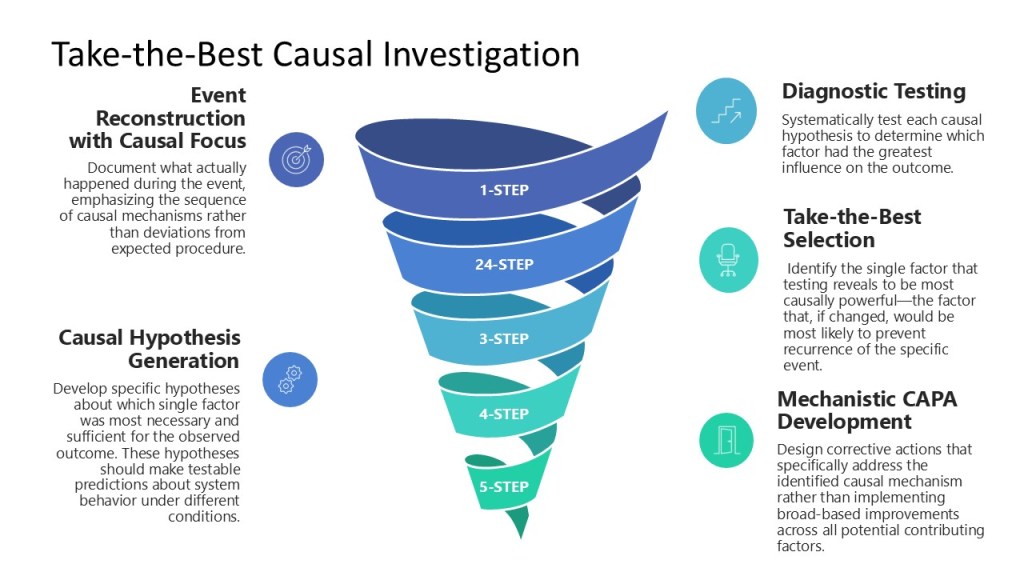
Implementing take-the-best causal investigation in pharmaceutical quality requires systematic attention to identifying and testing causal hypotheses rather than simply cataloging potential contributing factors. This process follows a structured approach:
Step 1: Event Reconstruction with Causal Focus – Document what actually happened during the event, emphasizing the sequence of causal mechanisms rather than deviations from expected procedure. Focus on understanding why actions made sense to the people involved at the time they occurred.
Step 2: Causal Hypothesis Generation – Develop specific hypotheses about which single factor was most necessary and sufficient for the observed outcome. These hypotheses should make testable predictions about system behavior under different conditions.
Step 3: Diagnostic Testing – Systematically test each causal hypothesis to determine which factor had the greatest influence on the outcome. This might involve data analysis, controlled experiments, or systematic comparison with similar events.
Step 4: Take-the-Best Selection – Identify the single factor that testing reveals to be most causally powerful—the factor that, if changed, would be most likely to prevent recurrence of the specific event.
Step 5: Mechanistic CAPA Development – Design corrective actions that specifically address the identified causal mechanism rather than implementing broad-based improvements across all potential contributing factors.
Integration with Falsifiable Quality Systems
The take-the-best approach to causal investigation creates naturally falsifiable hypotheses that can be tested and validated over time. When an investigation concludes that a specific factor was most causally responsible for an event, this conclusion makes testable predictions about system behavior that can be validated through subsequent experience.
For example, if a contamination investigation identifies equipment configuration as the take-the-best causal factor, this conclusion predicts that similar contamination events will be prevented by addressing equipment configuration issues, regardless of training improvements or procedural changes. This prediction can be tested systematically as the organization gains experience with similar situations.
This integration with falsifiable quality systems creates a learning loop where investigation conclusions are continuously refined based on their predictive accuracy. Investigations that correctly identify the most causally powerful factors will generate effective prevention strategies, while investigations that miss the key causal mechanisms will be revealed through continued problems despite implemented corrective actions.
The Leadership and Cultural Implications
Implementing take-the-best causal investigation requires leadership commitment to genuine learning rather than blame assignment. This approach often reveals system-level factors that leadership helped create or maintain, requiring the kind of organizational humility that the Energy Safety Canada framework emphasizes.
The cultural shift from comprehensive factor identification to focused causal analysis can be challenging for organizations accustomed to demonstrating thoroughness through exhaustive documentation. Leaders must support investigators in making causal judgments and prioritizing factors based on their diagnostic power rather than their visibility or political sensitivity.
This cultural change aligns with the broader shift toward scientific quality management that both the adaptive toolbox and falsifiable quality frameworks require. Organizations must develop comfort with making specific causal claims that can be tested and potentially proven wrong, rather than maintaining the false safety of comprehensive but non-specific factor lists.
The take-the-best approach to causal investigation represents a practical synthesis of rigorous scientific thinking and adaptive decision-making. By focusing on the single most causally powerful factor while maintaining the specific, testable language that causal reasoning demands, this approach generates investigations that are both scientifically valid and operationally useful—exactly what pharmaceutical quality management needs to move beyond the recurring problems that plague traditional root cause analysis.
The relationship between Gigerenzer’s adaptive toolbox approach and the falsifiable quality risk management framework outlined in “The Effectiveness Paradox” represents and incredibly intellectually satisfying convergences. Rather than competing philosophies, these approaches form a powerful synergy that addresses different but complementary aspects of the same fundamental challenge: making good decisions under uncertainty while maintaining scientific rigor.
The Philosophical Bridge: Bounded Rationality Meets Popperian Falsification
At first glance, heuristic decision-making and falsifiable hypothesis testing might seem to pull in opposite directions. Heuristics appear to shortcut rigorous analysis, while falsification demands systematic testing of explicit predictions. However, this apparent tension dissolves when we recognize that both approaches share a fundamental commitment to ecological rationality—the idea that good decision-making must be adapted to the actual constraints and characteristics of the environment in which decisions are made.
The effectiveness paradox reveals how traditional quality risk management falls into unfalsifiable territory by focusing on proving negatives (“nothing bad happened, therefore our system works”). Gigerenzer’s adaptive toolbox offers a path out of this epistemological trap by providing tools that are inherently testable and context-dependent. Fast-and-frugal heuristics make specific predictions about performance under different conditions, creating exactly the kind of falsifiable hypotheses that the effectiveness paradox demands.
Consider how this works in practice. A traditional risk assessment might conclude that “cleaning validation ensures no cross-contamination risk.” This statement is unfalsifiable—no amount of successful cleaning cycles can prove that contamination is impossible. In contrast, a fast-and-frugal approach might use the simple heuristic: “If visual inspection shows no residue AND the previous product was low-potency AND cleaning time exceeded standard protocol, then proceed to next campaign.” This heuristic makes specific, testable predictions about when cleaning is adequate and when additional verification is needed.
Resolving the Speed-Rigor Dilemma
One of the most persistent challenges in quality risk management is the apparent trade-off between decision speed and analytical rigor. The effectiveness paradox approach emphasizes the need for rigorous hypothesis testing, which seems to conflict with the practical reality that many quality decisions must be made quickly under pressure. Gigerenzer’s work dissolves this apparent contradiction by demonstrating that well-designed heuristics can be both fast AND more accurate than complex analytical methods under conditions of uncertainty.
This insight transforms how we think about the relationship between speed and rigor in quality decision-making. The issue isn’t whether to prioritize speed or accuracy—it’s whether our decision methods are adapted to the ecological structure of the problems we’re trying to solve. In quality environments characterized by uncertainty, limited information, and time pressure, fast-and-frugal heuristics often outperform comprehensive analytical approaches precisely because they’re designed for these conditions.
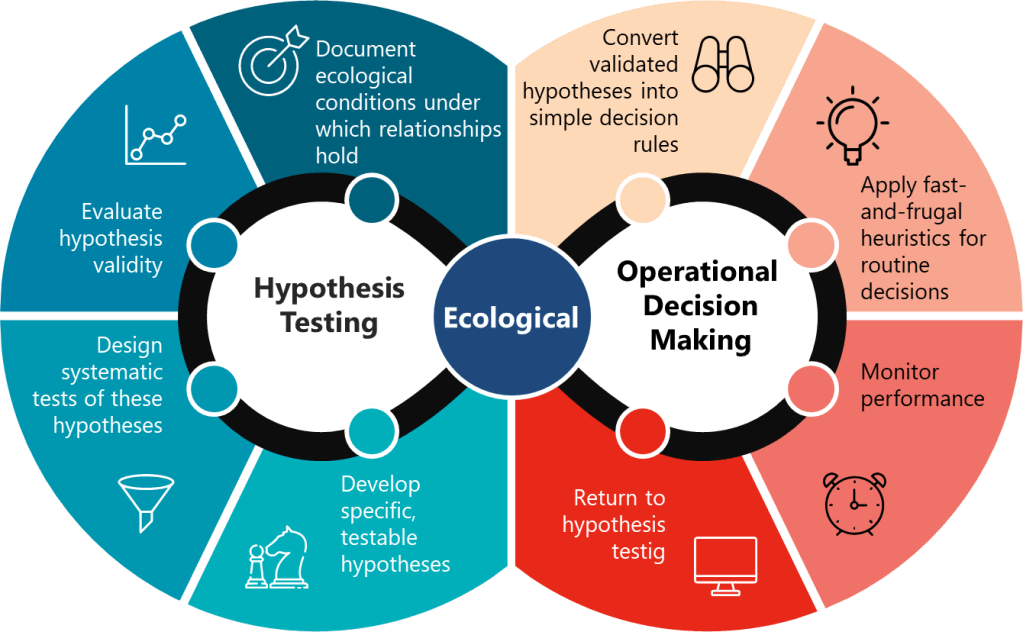
The key insight from combining both frameworks is that rigorous falsifiable testing should be used to develop and validate heuristics, which can then be applied rapidly in operational contexts. This creates a two-stage approach:
Stage 1: Hypothesis Development and Testing (Falsifiable Approach)
Develop specific, testable hypotheses about what drives quality outcomes
Design systematic tests of these hypotheses
Use rigorous statistical methods to evaluate hypothesis validity
Document the ecological conditions under which relationships hold
Convert validated hypotheses into simple decision rules
Apply fast-and-frugal heuristics for routine decisions
Monitor performance to detect when environmental conditions change
Return to Stage 1 when heuristics no longer perform effectively
The Recognition Heuristic in Quality Pattern Recognition
One of Gigerenzer’s most fascinating findings is the effectiveness of the recognition heuristic—the simple rule that recognized objects are often better than unrecognized ones. This heuristic works because recognition reflects accumulated positive experiences across many encounters, creating a surprisingly reliable indicator of quality or performance.
In quality risk management, experienced professionals develop sophisticated pattern recognition capabilities that often outperform formal analytical methods. A senior quality professional can often identify problematic deviations, concerning supplier trends, or emerging regulatory issues based on subtle patterns that would be difficult to capture in traditional risk matrices. The effectiveness paradox framework provides a way to test and validate these pattern recognition capabilities rather than dismissing them as “unscientific.”
For example, we might hypothesize that “deviations identified as ‘concerning’ by experienced quality professionals within 24 hours of initial review are 3x more likely to require extensive investigation than those not flagged.” This hypothesis can be tested systematically, and if validated, the experienced professionals’ pattern recognition can be formalized into a fast-and-frugal decision tree for deviation triage.
Take-the-Best Meets Hypothesis Testing
The take-the-best heuristic—which makes decisions based on the single most diagnostic cue—provides an elegant solution to one of the most persistent problems in falsifiable quality risk management. Traditional approaches to hypothesis testing often become paralyzed by the need to consider multiple interacting variables simultaneously. Take-the-best suggests focusing on the single most predictive factor and using that for decision-making.
This approach aligns perfectly with the falsifiable framework’s emphasis on making specific, testable predictions. Instead of developing complex multivariate models that are difficult to test and validate, we can develop hypotheses about which single factors are most diagnostic of quality outcomes. These hypotheses can be tested systematically, and the results used to create simple decision rules that focus on the most important factors.
For instance, rather than trying to predict supplier quality using complex scoring systems that weight multiple factors, we might test the hypothesis that “supplier performance on sterility testing is the single best predictor of overall supplier quality for this material category.” If validated, this insight can be converted into a simple take-the-best heuristic: “When comparing suppliers, choose the one with better sterility testing performance.”
The Less-Is-More Effect in Quality Analysis
One of Gigerenzer’s most counterintuitive findings is the less-is-more effect—situations where ignoring information actually improves decision accuracy. This phenomenon occurs when additional information introduces noise that obscures the signal from the most diagnostic factors. The effectiveness paradox provides a framework for systematically identifying when less-is-more effects occur in quality decision-making.
Traditional quality risk assessments often suffer from information overload, attempting to consider every possible factor that might affect outcomes. This comprehensive approach feels more rigorous but can actually reduce decision quality by giving equal weight to diagnostic and non-diagnostic factors. The falsifiable approach allows us to test specific hypotheses about which factors actually matter and which can be safely ignored.
Consider CAPA effectiveness evaluation. Traditional approaches might consider dozens of factors: timeline compliance, thoroughness of investigation, number of corrective actions implemented, management involvement, training completion rates, and so on. A less-is-more approach might hypothesize that “CAPA effectiveness is primarily determined by whether the root cause was correctly identified within 30 days of investigation completion.” This hypothesis can be tested by examining the relationship between early root cause identification and subsequent recurrence rates.
If validated, this insight enables much simpler and more effective CAPA evaluation: focus primarily on root cause identification quality and treat other factors as secondary. This not only improves decision speed but may actually improve accuracy by avoiding the noise introduced by less diagnostic factors.
Satisficing Versus Optimizing in Risk Management
Herbert Simon’s concept of satisficing—choosing the first option that meets acceptance criteria rather than searching for the optimal solution—provides another bridge between the adaptive toolbox and falsifiable approaches. Traditional quality risk management often falls into optimization traps, attempting to find the “best” possible solution through comprehensive analysis. But optimization requires complete information about alternatives and their consequences—conditions that rarely exist in quality management.
The effectiveness paradox reveals why optimization-focused approaches often produce unfalsifiable results. When we claim that our risk management approach is “optimal,” we create statements that can’t be tested because we don’t have access to all possible alternatives or their outcomes. Satisficing approaches make more modest claims that can be tested: “This approach meets our minimum requirements for patient safety and operational efficiency.”
The falsifiable framework allows us to test satisficing criteria systematically. We can develop hypotheses about what constitutes “good enough” performance and test whether decisions meeting these criteria actually produce acceptable outcomes. This creates a virtuous cycle where satisficing criteria become more refined over time based on empirical evidence.
Ecological Rationality in Regulatory Environments
The concept of ecological rationality—the idea that decision strategies should be adapted to the structure of the environment—provides crucial insights for applying both frameworks in regulatory contexts. Regulatory environments have specific characteristics: high uncertainty, severe consequences for certain types of errors, conservative decision-making preferences, and emphasis on process documentation.
Traditional approaches often try to apply the same decision methods across all contexts, leading to over-analysis in some situations and under-analysis in others. The combined framework suggests developing different decision strategies for different regulatory contexts:
High-Stakes Novel Situations: Use comprehensive falsifiable analysis to develop and test hypotheses about system behavior. Document the logic and evidence supporting conclusions.
Routine Operational Decisions: Apply validated fast-and-frugal heuristics that have been tested in similar contexts. Monitor performance and return to comprehensive analysis if performance degrades.
Emergency Situations: Use the simplest effective heuristics that can be applied quickly while maintaining safety. Design these heuristics based on prior falsifiable analysis of emergency scenarios.
The Integration Challenge: Building Hybrid Systems
The most practical application of combining these frameworks involves building hybrid quality systems that seamlessly integrate falsifiable hypothesis testing with adaptive heuristic application. This requires careful attention to when each approach is most appropriate and how transitions between approaches should be managed.
Situations where speed of response affects outcomes
Decisions by experienced personnel in their area of expertise
The key insight is that these aren’t competing approaches but complementary tools that should be applied strategically based on situational characteristics.
Practical Implementation: A Unified Framework
Implementing the combined approach requires systematic attention to both the development of falsifiable hypotheses and the creation of adaptive heuristics based on validated insights. This implementation follows a structured process:
Phase 1: Ecological Analysis
Characterize the decision environment: information availability, time constraints, consequence severity, frequency of similar decisions
Identify existing heuristics used by experienced personnel
Document decision patterns and outcomes in historical data
Phase 2: Hypothesis Development
Convert existing heuristics into specific, testable hypotheses
Develop hypotheses about environmental factors that affect decision quality
Create predictions about when different approaches will be most effective
Phase 3: Systematic Testing
Design studies to test hypothesis validity under different conditions
Collect data on decision outcomes using different approaches
Analyze performance across different environmental conditions
Phase 4: Heuristic Refinement
Convert validated hypotheses into simple decision rules
Design training materials for consistent heuristic application
Create monitoring systems to track heuristic performance
Phase 5: Adaptive Management
Monitor environmental conditions for changes that might affect heuristic validity
Design feedback systems that detect when re-analysis is needed
Create processes for updating heuristics based on new evidence
The Cultural Transformation: From Analysis Paralysis to Adaptive Excellence
Perhaps the most significant impact of combining these frameworks is the cultural shift from analysis paralysis to adaptive excellence. Traditional quality cultures often equate thoroughness with quality, leading to over-analysis of routine decisions and under-analysis of genuinely novel challenges. The combined framework provides clear criteria for matching analytical effort to decision importance and novelty.
This cultural shift requires leadership that understands the complementary nature of rigorous analysis and adaptive heuristics. Organizations must develop comfort with different decision approaches for different situations while maintaining consistent standards for decision quality and documentation.
Key Cultural Elements:
Scientific Humility: Acknowledge that our current understanding is provisional and may need revision based on new evidence
Adaptive Confidence: Trust validated heuristics in appropriate contexts while remaining alert to changing conditions
Learning Orientation: View both successful and unsuccessful decisions as opportunities to refine understanding
Contextual Wisdom: Develop judgment about when comprehensive analysis is needed versus when heuristics are sufficient
Addressing the Regulatory Acceptance Question
One persistent concern about implementing either falsifiable or heuristic approaches is regulatory acceptance. Will inspectors accept decision-making approaches that deviate from traditional comprehensive documentation? The answer lies in understanding that regulators themselves use both approaches routinely.
Experienced regulatory inspectors develop sophisticated heuristics for identifying potential problems and focusing their attention efficiently. They don’t systematically examine every aspect of every system—they use diagnostic shortcuts to guide their investigations. Similarly, regulatory agencies increasingly emphasize risk-based approaches that focus analytical effort where it provides the most value for patient safety.
The key to regulatory acceptance is demonstrating that combined approaches enhance rather than compromise patient safety through:
More Reliable Decision-Making: Heuristics validated through systematic testing are more reliable than ad hoc judgments
Faster Problem Detection: Adaptive approaches can identify and respond to emerging issues more quickly
Resource Optimization: Focus intensive analysis where it provides the most value for patient safety
Continuous Improvement: Systematic feedback enables ongoing refinement of decision approaches
The Future of Quality Decision-Making
The convergence of Gigerenzer’s adaptive toolbox with falsifiable quality risk management points toward a future where quality decision-making becomes both more scientific and more practical. This future involves:
Precision Decision-Making: Matching decision approaches to situational characteristics rather than applying one-size-fits-all methods.
Evidence-Based Heuristics: Simple decision rules backed by rigorous testing and validation rather than informal rules of thumb.
Adaptive Systems: Quality management approaches that evolve based on performance feedback and changing conditions rather than static compliance frameworks.
Scientific Culture: Organizations that embrace both rigorous hypothesis testing and practical heuristic application as complementary aspects of effective quality management.
Conclusion: The Best of Both Worlds
The relationship between Gigerenzer’s adaptive toolbox and falsifiable quality risk management demonstrates that the apparent tension between scientific rigor and practical decision-making is a false dichotomy. Both approaches share a commitment to ecological rationality and empirical validation, but they operate at different time scales and levels of analysis.
The effectiveness paradox reveals the limitations of traditional approaches that attempt to prove system effectiveness through negative evidence. Gigerenzer’s adaptive toolbox provides practical tools for making good decisions under the uncertainty that characterizes real quality environments. Together, they offer a path toward quality risk management that is both scientifically rigorous and operationally practical.
This synthesis doesn’t require choosing between speed and accuracy, or between intuition and analysis. Instead, it provides a framework for applying the right approach at the right time, backed by systematic evidence about when each approach works best. The result is quality decision-making that is simultaneously more rigorous and more adaptive—exactly what our industry needs to meet the challenges of an increasingly complex regulatory and competitive environment.
As quality professionals, we can often fall into the trap of believing that more analysis, more data, and more complex decision trees lead to better outcomes. But what if this fundamental assumption is not just wrong, but actively harmful to effective risk management? Gerd Gigerenzer‘s decades of research on bounded rationality and fast-and-frugal heuristics suggests exactly that—and the implications for how we approach quality risk management are profound.
The Myth of Optimization in Risk Management
Too much of our risk management practice assumes we operate like Laplacian demons—omniscient beings with unlimited computational power and perfect information. Gigerenzer calls this “unbounded rationality,” and it’s about as realistic as expecting your quality management system to implement itself.
In reality, experts operate under severe constraints: limited time, incomplete information, constantly changing regulations, and the perpetual pressure to balance risk mitigation with operational efficiency. How we move beyond thinking of these as bugs to be overcome, and build tools that address these concerns is critical to thinking of risk management as a science.
Enter the Adaptive Toolbox
Gigerenzer’s adaptive toolbox concept revolutionizes how we think about decision-making under uncertainty. Rather than viewing our mental shortcuts (heuristics) as cognitive failures that need to be corrected, the adaptive toolbox framework recognizes them as evolved tools that can outperform complex analytical methods in real-world conditions.
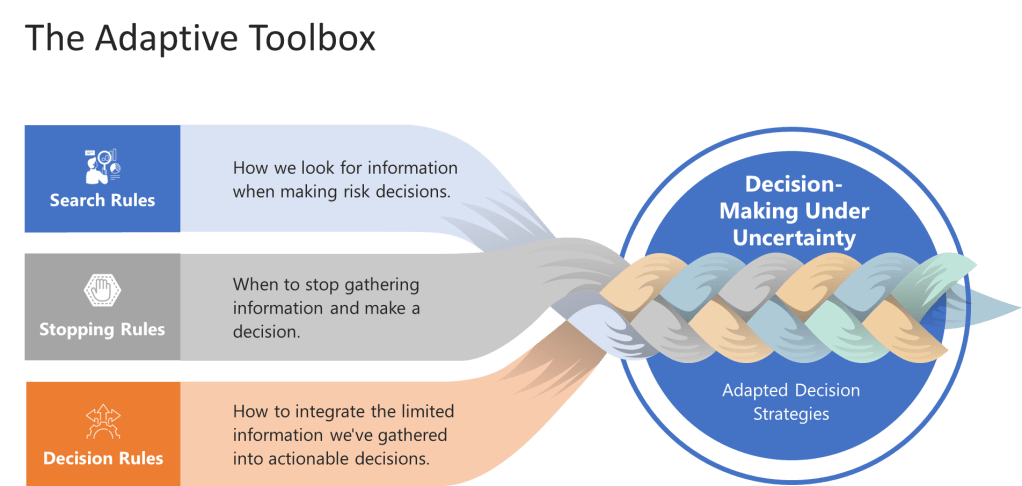
The toolbox consists of three key components that every risk manager should understand:
Search Rules: How we look for information when making risk decisions. Instead of trying to gather all possible data (which is impossible anyway), effective heuristics use smart search strategies that focus on the most diagnostic information first.
Stopping Rules: When to stop gathering information and make a decision. This is crucial in quality management where analysis paralysis can be as dangerous as hasty decisions.
Decision Rules: How to integrate the limited information we’ve gathered into actionable decisions.
These components work together to create what Gigerenzer calls “ecological rationality”—decision strategies that are adapted to the specific environment in which they operate. For quality professionals, this means developing risk management approaches that fit the actual constraints and characteristics of pharmaceutical manufacturing, not the theoretical world of perfect information.
The Less-Is-More Revolution
One of Gigerenzer’s most counterintuitive findings is the “less-is-more effect”—situations where ignoring information actually leads to better decisions. This challenges everything we think we know about evidence-based decision making in quality.
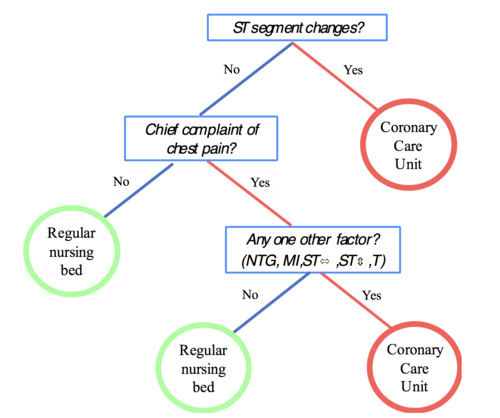
Consider an example from emergency medicine that directly parallels quality risk management challenges. When patients arrive with chest pain, doctors traditionally used complex diagnostic algorithms considering up to 19 different risk factors. But researchers found that a simple three-question decision tree outperformed the complex analysis in both speed and accuracy.
The fast-and-frugal tree asked only:
Are there ST segment changes on the EKG?
Is chest pain the chief complaint?
Does the patient have any additional high-risk factors?
Based on these three questions, doctors could quickly and accurately classify patients as high-risk (requiring immediate intensive care) or low-risk (suitable for regular monitoring). The key insight: the simple approach was not just faster—it was more accurate than the complex alternative.
Applying Fast-and-Frugal Trees to Quality Risk Management
This same principle applies directly to quality risk management decisions. Too often, we create elaborate risk assessment matrices that obscure rather than illuminate the critical decision factors. Fast-and-frugal trees offer a more effective alternative.
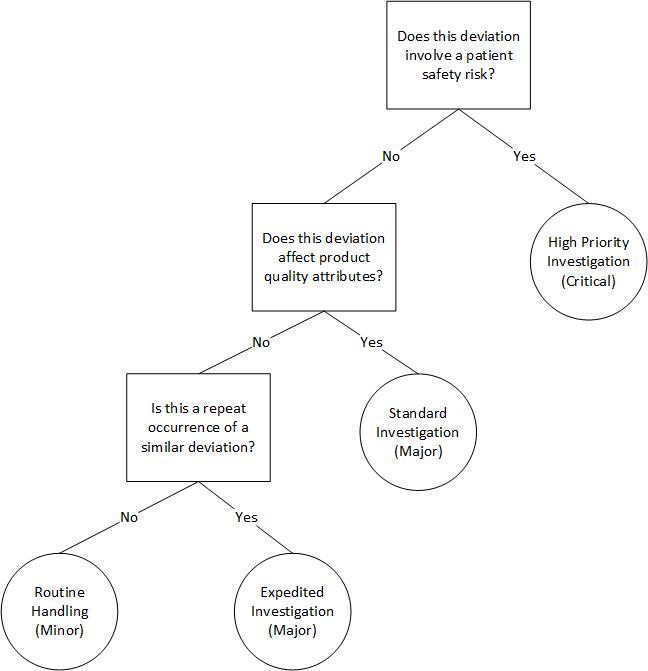
Let’s consider deviation classification—a daily challenge for quality professionals. Instead of complex scoring systems that attempt to quantify every possible risk dimension, a fast-and-frugal tree might ask:
Does this deviation involve a patient safety risk? If yes → High priority investigation (exit to immediate action)
Does this deviation affect product quality attributes? If yes → Standard investigation timeline
Is this a repeat occurrence of a similar deviation? If yes → Expedited investigation, if no → Routine handling
This simple decision tree accomplishes several things that complex matrices struggle with. First, it prioritizes patient safety above all other considerations—a value judgment that gets lost in numerical scoring systems. Second, it focuses investigative resources where they’re most needed. Third, it’s transparent and easy to train staff on, reducing variability in risk classification.
The beauty of fast-and-frugal trees isn’t just their simplicity. It is their robustness. Unlike complex models that break down when assumptions are violated, simple heuristics tend to perform consistently across different conditions.
The Recognition Heuristic in Supplier Quality
Another powerful tool from Gigerenzer’s adaptive toolbox is the recognition heuristic. This suggests that when choosing between two alternatives where one is recognized and the other isn’t, the recognized option is often the better choice.
In supplier qualification decisions, quality professionals often struggle with elaborate vendor assessment schemes that attempt to quantify every aspect of supplier capability. But experienced quality professionals know that supplier reputation—essentially a form of recognition—is often the best predictor of future performance.
The recognition heuristic doesn’t mean choosing suppliers solely on name recognition. Instead, it means understanding that recognition reflects accumulated positive experiences across the industry. When coupled with basic qualification criteria, recognition can be a powerful risk mitigation tool that’s more robust than complex scoring algorithms.
This principle extends to regulatory decision-making as well. Experienced quality professionals develop intuitive responses to regulatory trends and inspector concerns that often outperform elaborate compliance matrices. This isn’t unprofessional—it’s ecological rationality in action.
Take-the-Best Heuristic for Root Cause Analysis
The take-the-best heuristic offers an alternative approach to traditional root cause analysis. Instead of trying to weight and combine multiple potential root causes, this heuristic focuses on identifying the single most diagnostic factor and basing decisions primarily on that information.
In practice, this might mean:
Identifying potential root causes in order of their diagnostic power
Investigating the most powerful indicator first
If that investigation provides a clear direction, implementing corrective action
Only continuing to secondary factors if the primary investigation is inconclusive
This approach doesn’t mean ignoring secondary factors entirely, but it prevents the common problem of developing corrective action plans that try to address every conceivable contributing factor, often resulting in resource dilution and implementation challenges.
Managing Uncertainty in Validation Decisions
Validation represents one of the most uncertainty-rich areas of quality management. Traditional approaches attempt to reduce uncertainty through exhaustive testing, but Gigerenzer’s work suggests that some uncertainty is irreducible—and that trying to eliminate it entirely can actually harm decision quality.
Consider computer system validation decisions. Teams often struggle with determining how much testing is “enough,” leading to endless debates about edge cases and theoretical scenarios. The adaptive toolbox approach suggests developing simple rules that balance thoroughness with practical constraints:
The Satisficing Rule: Test until system functionality meets predefined acceptance criteria across critical business processes, then stop. Don’t continue testing just because more testing is theoretically possible.
The Critical Path Rule: Focus validation effort on the processes that directly impact patient safety and product quality. Treat administrative functions with less intensive validation approaches.
The Experience Rule: Leverage institutional knowledge about similar systems to guide validation scope. Don’t start every validation from scratch.
These heuristics don’t eliminate validation rigor—they channel it more effectively by recognizing that perfect validation is impossible and that attempting it can actually increase risk by delaying system implementation or consuming resources needed elsewhere.
Ecological Rationality in Regulatory Strategy
Perhaps nowhere is the adaptive toolbox more relevant than in regulatory strategy. Regulatory environments are characterized by uncertainty, incomplete information, and time pressure—exactly the conditions where fast-and-frugal heuristics excel.
Successful regulatory professionals develop intuitive responses to regulatory trends that often outperform complex compliance matrices. They recognize patterns in regulatory communications, anticipate inspector concerns, and adapt their strategies based on limited but diagnostic information.
The key insight from Gigerenzer’s work is that these intuitive responses aren’t unprofessional—they represent sophisticated pattern recognition based on evolved cognitive mechanisms. The challenge for quality organizations is to capture and systematize these insights without destroying their adaptive flexibility.
This might involve developing simple decision rules for common regulatory scenarios:
The Precedent Rule: When facing ambiguous regulatory requirements, look for relevant precedent in previous inspections or industry guidance rather than attempting exhaustive regulatory interpretation.
The Proactive Communication Rule: When regulatory risk is identified, communicate early with authorities rather than developing elaborate justification documents internally.
The Materiality Rule: Focus regulatory attention on changes that meaningfully affect product quality or patient safety rather than attempting to address every theoretical concern.
Building Adaptive Capability in Quality Organizations
Implementing Gigerenzer’s insights requires more than just teaching people about heuristics—it requires creating organizational conditions that support ecological rationality. This means:
Embracing Uncertainty: Stop pretending that perfect risk assessments are possible. Instead, develop decision-making approaches that are robust under uncertainty.
Valuing Experience: Recognize that experienced professionals’ intuitive responses often reflect sophisticated pattern recognition. Don’t automatically override professional judgment with algorithmic approaches.
Simplifying Decision Structures: Replace complex matrices and scoring systems with simple decision trees that focus on the most diagnostic factors.
Encouraging Rapid Iteration: Rather than trying to perfect decisions before implementation, develop approaches that allow rapid adjustment based on feedback.
Training Pattern Recognition: Help staff develop the pattern recognition skills that support effective heuristic decision-making.
The Subjectivity Challenge
One common objection to heuristic-based approaches is that they introduce subjectivity into risk management decisions. This concern reflects a fundamental misunderstanding of both traditional analytical methods and heuristic approaches.
Traditional risk matrices and analytical methods appear objective but are actually filled with subjective judgments: how risks are defined, how probabilities are estimated, how impacts are categorized, and how different risk dimensions are weighted. These subjective elements are simply hidden behind numerical facades.
Heuristic approaches make subjectivity explicit rather than hiding it. This transparency actually supports better risk management by forcing teams to acknowledge and discuss their value judgments rather than pretending they don’t exist.
The recent revision of ICH Q9 explicitly recognizes this challenge, noting that subjectivity cannot be eliminated from risk management but can be managed through appropriate process design. Fast-and-frugal heuristics support this goal by making decision logic transparent and teachable.
Four Essential Books by Gigerenzer
For quality professionals who want to dive deeper into this framework, here are four books by Gigerenzer to read:
1. “Simple Heuristics That Make Us Smart” (1999) – This foundational work, authored with Peter Todd and the ABC Research Group, establishes the theoretical framework for the adaptive toolbox. It demonstrates through extensive research how simple heuristics can outperform complex analytical methods across diverse domains. For quality professionals, this book provides the scientific foundation for understanding why less can indeed be more in risk assessment.
2. “Gut Feelings: The Intelligence of the Unconscious” (2007) – This more accessible book explores how intuitive decision-making works and when it can be trusted. It’s particularly valuable for quality professionals who need to balance analytical rigor with practical decision-making under pressure. The book provides actionable insights for recognizing when to trust professional judgment and when more analysis is needed.
3. “Risk Savvy: How to Make Good Decisions” (2014) – This book directly addresses risk perception and management, making it immediately relevant to quality professionals. It challenges common misconceptions about risk communication and provides practical tools for making better decisions under uncertainty. The sections on medical decision-making are particularly relevant to pharmaceutical quality management.
4. “The Intelligence of Intuition” (Cambridge University Press, 2023) – Gigerenzer’s latest work directly challenges the widespread dismissal of intuitive decision-making in favor of algorithmic solutions. In this compelling analysis, he traces what he calls the “war on intuition” in social sciences, from early gendered perceptions that dismissed intuition as feminine and therefore inferior, to modern technological paternalism that argues human judgment should be replaced by perfect algorithms. For quality professionals, this book is essential reading because it demonstrates that intuition is not irrational caprice but rather “unconscious intelligence based on years of experience” that evolved specifically to handle uncertain and dynamic situations where logic and big data algorithms provide little benefit. The book provides both theoretical foundation and practical guidance for distinguishing reliable intuitive responses from wishful thinking—a crucial skill for quality professionals who must balance analytical rigor with rapid decision-making under uncertainty.
The Implementation Challenge
Understanding the adaptive toolbox conceptually is different from implementing it organizationally. Quality systems are notoriously resistant to change, particularly when that change challenges fundamental assumptions about how decisions should be made.
Successful implementation requires a gradual approach that demonstrates value rather than demanding wholesale replacement of existing methods. Consider starting with pilot applications in lower-risk areas where the benefits of simpler approaches can be demonstrated without compromising patient safety.
Phase 1: Recognition and Documentation – Begin by documenting the informal heuristics that experienced staff already use. You’ll likely find that your most effective team members already use something resembling fast-and-frugal decision trees for routine decisions.
Phase 2: Formalization and Testing – Convert informal heuristics into explicit decision rules and test them against historical decisions. This helps build confidence and identifies areas where refinement is needed.
Phase 3: Training and Standardization – Train staff on the formalized heuristics and create simple reference tools that support consistent application.
Phase 4: Continuous Adaptation – Build feedback mechanisms that allow heuristics to evolve as conditions change and new patterns emerge.
Measuring Success with Ecological Metrics
Traditional quality metrics often focus on process compliance rather than decision quality. Implementing an adaptive toolbox approach requires different measures of success.
Instead of measuring how thoroughly risk assessments are documented, consider measuring:
Decision Speed: How quickly can teams classify and respond to different types of quality events?
Decision Consistency: How much variability exists in how similar situations are handled?
Resource Efficiency: What percentage of effort goes to analysis versus action?
Adaptation Rate: How quickly do decision approaches evolve in response to new information?
Outcome Quality: What are the actual consequences of decisions made using heuristic approaches?
These metrics align better with the goals of effective risk management: making good decisions quickly and consistently under uncertainty.
The Training Implication
If we accept that heuristic decision-making is not just inevitable but often superior, it changes how we think about quality training. Instead of teaching people to override their intuitive responses with analytical methods, we should focus on calibrating and improving their pattern recognition abilities.
This means:
Case-Based Learning: Using historical examples to help staff recognize patterns and develop appropriate responses
Scenario Training: Practicing decision-making under time pressure and incomplete information
Feedback Loops: Creating systems that help staff learn from decision outcomes
Expert Mentoring: Pairing experienced professionals with newer staff to transfer tacit knowledge
Cross-Functional Exposure: Giving staff experience across different areas to broaden their pattern recognition base
Addressing the Regulatory Concern
One persistent concern about heuristic approaches is regulatory acceptability. Will inspectors accept fast-and-frugal decision trees in place of traditional risk matrices?
The key insight from Gigerenzer’s work is that regulators themselves use heuristics extensively in their inspection and decision-making processes. Experienced inspectors develop pattern recognition skills that allow them to quickly identify potential problems and focus their attention appropriately. They don’t systematically evaluate every aspect of a quality system—they use diagnostic shortcuts to guide their investigations.
Understanding this reality suggests that well-designed heuristic approaches may actually be more acceptable to regulators than complex but opaque analytical methods. The key is ensuring that heuristics are:
Transparent: Decision logic should be clearly documented and explainable
Consistent: Similar situations should be handled similarly
Defensible: The rationale for the heuristic approach should be based on evidence and experience
Adaptive: The approach should evolve based on feedback and changing conditions
The Integration Challenge
The adaptive toolbox shouldn’t replace all analytical methods—it should complement them within a broader risk management framework. The key is understanding when to use which approach.
Use Heuristics When:
Time pressure is significant
Information is incomplete and unlikely to improve quickly
The decision context is familiar and patterns are recognizable
The consequences of being approximately right quickly outweigh being precisely right slowly
Resource constraints limit the feasibility of comprehensive analysis
Use Analytical Methods When:
Stakes are extremely high and errors could have catastrophic consequences
Time permits thorough analysis
The decision context is novel and patterns are unclear
Multiple stakeholders need to understand and agree on decision logic
Looking Forward
Gigerenzer’s work suggests that effective quality risk management will increasingly look like a hybrid approach that combines the best of analytical rigor with the adaptive flexibility of heuristic decision-making.
This evolution is already happening informally as quality professionals develop intuitive responses to common situations and use analytical methods primarily for novel or high-stakes decisions. The challenge is making this hybrid approach explicit and systematic rather than leaving it to individual discretion.
Future quality management systems will likely feature:
Adaptive Decision Support: Systems that learn from historical decisions and suggest appropriate heuristics for new situations
Context-Sensitive Approaches: Risk management methods that automatically adjust based on situational factors
Rapid Iteration Capabilities: Systems designed for quick adjustment rather than comprehensive upfront planning
Integrated Uncertainty Management: Approaches that explicitly acknowledge and work with uncertainty rather than trying to eliminate it
The Cultural Transformation
Perhaps the most significant challenge in implementing Gigerenzer’s insights isn’t technical—it’s cultural. Quality organizations have invested decades in building analytical capabilities and may resist approaches that appear to diminish the value of that investment.
The key to successful cultural transformation is demonstrating that heuristic approaches don’t eliminate analysis—they optimize it by focusing analytical effort where it provides the most value. This requires leadership that understands both the power and limitations of different decision-making approaches.
Organizations that successfully implement adaptive toolbox principles often find that they can:
Make decisions faster without sacrificing quality
Reduce analysis paralysis in routine situations
Free up analytical resources for genuinely complex problems
Improve decision consistency across teams
Adapt more quickly to changing conditions
Conclusion: Embracing Bounded Rationality
Gigerenzer’s adaptive toolbox offers a path forward that embraces rather than fights the reality of human cognition. By recognizing that our brains have evolved sophisticated mechanisms for making good decisions under uncertainty, we can develop quality systems that work with rather than against our cognitive strengths.
This doesn’t mean abandoning analytical rigor—it means applying it more strategically. It means recognizing that sometimes the best decision is the one made quickly with limited information rather than the one made slowly with comprehensive analysis. It means building systems that are robust to uncertainty rather than brittle in the face of incomplete information.
Most importantly, it means acknowledging that quality professionals are not computers. They are sophisticated pattern-recognition systems that have evolved to navigate uncertainty effectively. Our quality systems should amplify rather than override these capabilities.
The adaptive toolbox isn’t just a set of decision-making tools—it’s a different way of thinking about human rationality in organizational settings. For quality professionals willing to embrace this perspective, it offers the possibility of making better decisions, faster, with less stress and more confidence.
And in an industry where patient safety depends on the quality of our decisions, that possibility is worth pursuing, one heuristic at a time.
Risk management is a crucial aspect of any organization or project. However, it is often subject to human errors in subjective risk judgments. This is because most risk assessment methods rely on subjective inputs from experts. Without certain precautions, experts can make consistent errors in judgment about uncertainty and risk.
There are methods that can correct the systemic errors that people make, but very few organizations implement them. As a result, there is often an almost universal understatement of risk. We need to keep in mind a few rules about experience and expertise.
Experience is a nonrandom, nonscientific sample of events throughout our lifetime.
Experience is memory-based and we are very selective regarding what we choose to remember,
What we conclude from our experience can be full of logical errors
Unless we get reliable feedback on past decisions, there is no reason to believe our experience will tell us much.
No matter how much experience we accumulate, we seem to be very inconsistent in its application.
Experts have unconscious heuristics and biases that impact their judgment, some important ones include:
Misconceptions of chance: If you flip a coin six times, which result is more likely (H= heads, T= tails): HHHTTT or HTHTTH? They are both equal, but many people assume that because the first series looks “less random” than the second, it must be less likely. This is an example of representativeness bias. We appear to judge odds based on what we assume to be representative scenarios. Human beings easily confuse patterns and randomness.
The conjunction fallacy: We often see specific events as more likely than broader categories of events.
Irrational belief in small samples
Disregarding variance in small samples. Small samples have more random variance that large samples is considered less than it should be.
Insensitivity to prior probabilities: People tend to ignore the past and focus on new information when making subjective estimates.
This is all about overconfidence as an expert, which will consistently underestimate risks.
What are some ways to overcome this? I recommend the following be built into your risk management system.
Pretend you are in the future looking back at failure. Start with the assumption that a major disaster did happen and describe how it happened.
Look to risks from others. Gather a list of related failures, for example, regulatory agency observations, and think of risks in relation to those.
Include Everyone. Your organization has numerous experts on all sorts of specific risks. Make the effort to survey representatives of just about every job level.
Do peer reviews. Check assumptions by showing them to peers who are not immersed in the assessment.
Implement metrics for performance. The Brier score is a way to evaluate the result of predictions both by how often the team was right and by the probability the estimated for getting a correct answer.
Further Reading
Here are some sources that discuss the topic of human errors and subjective judgments in risk management:


 Investigations of a Dog