
Reducing Subjectivity in Quality Risk Management: Aligning with ICH Q9(R1)

In a previous post, I discussed how overcoming subjectivity in risk management and decision-making requires fostering a culture of quality and excellence. This is an issue that it is important to continue to evaluate and push for additional improvement.

The revised ICH Q9(R1) guideline, finalized in January 2023, introduces critical updates to Quality Risk Management (QRM) practices, emphasizing the need to address subjectivity, enhance formality, improve risk-based decision-making, and manage product availability risks. These revisions aim to ensure that QRM processes are more science-driven, knowledge-based, and effective in safeguarding product quality and patient safety. Two years later it is important to continue to build on key strategies for reducing subjectivity in QRM and aligning with the updated requirements.

Understanding Subjectivity in QRM

Subjectivity in QRM arises from personal opinions, biases, heuristics, or inconsistent interpretations of risks by stakeholders. This can impact every stage of the QRM process—from hazard identification to risk evaluation and mitigation. The revised ICH Q9(R1) explicitly addresses this issue by introducing a new subsection, “Managing and Minimizing Subjectivity,” which emphasizes that while subjectivity cannot be entirely eliminated, it can be controlled through structured approaches.

The guideline highlights that subjectivity often stems from poorly designed scoring systems, differing perceptions of hazards and risks among stakeholders, and cognitive biases. To mitigate these challenges, organizations must adopt robust strategies that prioritize scientific knowledge and data-driven decision-making.

Strategies to Reduce Subjectivity

Leveraging Knowledge Management

ICH Q9(R1) underscores the importance of knowledge management as a tool to reduce uncertainty and subjectivity in risk assessments. Effective knowledge management involves systematically capturing, organizing, and applying internal and external knowledge to inform QRM activities. This includes maintaining centralized repositories for technical data, fostering real-time information sharing across teams, and learning from past experiences through structured lessons-learned processes.

By integrating knowledge management into QRM, organizations can ensure that decisions are based on comprehensive data rather than subjective estimations. For example, using historical data on process performance or supplier reliability can provide objective insights into potential risks.

To integrate knowledge management (KM) more effectively into quality risk management (QRM), organizations can implement several strategies to ensure decisions are based on comprehensive data rather than subjective estimations:

Establish Robust Knowledge Repositories

Create centralized, easily accessible repositories for storing and organizing historical data, lessons learned, and best practices. These repositories should include:

  • Process performance data
  • Supplier reliability metrics
  • Deviation and CAPA records
  • Audit findings and inspection observations
  • Technology transfer documentation

By maintaining these repositories, organizations can quickly access relevant historical information when conducting risk assessments.

Implement Knowledge Mapping

Conduct knowledge mapping exercises to identify key sources of knowledge within the organization. This process helps to:

Use the resulting knowledge maps to guide risk assessment teams to relevant information and expertise.

Develop Data Analytics Capabilities

Invest in data analytics tools and capabilities to extract meaningful insights from historical data. For example:

  • Use statistical process control to identify trends in manufacturing performance
  • Apply machine learning algorithms to predict potential quality issues based on historical patterns
  • Utilize data visualization tools to present complex risk data in an easily understandable format

These analytics can provide objective, data-driven insights into potential risks and their likelihood of occurrence.

Integrate KM into QRM Processes

Embed KM activities directly into QRM processes to ensure consistent use of available knowledge:

  • Include a knowledge gathering step at the beginning of risk assessments
  • Require risk assessment teams to document the sources of knowledge used in their analysis
  • Implement a formal process for capturing new knowledge generated during risk assessments

This integration helps ensure that all relevant knowledge is considered and that new insights are captured for future use.

Foster a Knowledge-Sharing Culture

Encourage a culture of knowledge sharing and collaboration within the organization:

  • Implement mentoring programs to facilitate the transfer of tacit knowledge
  • Establish communities of practice around key risk areas
  • Recognize and reward employees who contribute valuable knowledge to risk management efforts

By promoting knowledge sharing, organizations can tap into the collective expertise of their workforce to improve risk assessments.

Implementing Structured Risk-Based Decision-Making

The revised guideline introduces a dedicated section on risk-based decision-making, emphasizing the need for structured approaches that consider the complexity, uncertainty, and importance of decisions. Organizations should establish clear criteria for decision-making processes, define acceptable risk tolerance levels, and use evidence-based methods to evaluate options.

Structured decision-making tools can help standardize how risks are assessed and prioritized. Additionally, calibrating expert opinions through formal elicitation techniques can further reduce variability in judgments.

Addressing Cognitive Biases

Cognitive biases—such as overconfidence or anchoring—can distort risk assessments and lead to inconsistent outcomes. To address this, organizations should provide training on recognizing common biases and their impact on decision-making. Encouraging diverse perspectives within risk assessment teams can also help counteract individual biases.

For example, using cross-functional teams ensures that different viewpoints are considered when evaluating risks, leading to more balanced assessments. Regularly reviewing risk assessment outputs for signs of bias or inconsistencies can further enhance objectivity.

Enhancing Formality in QRM

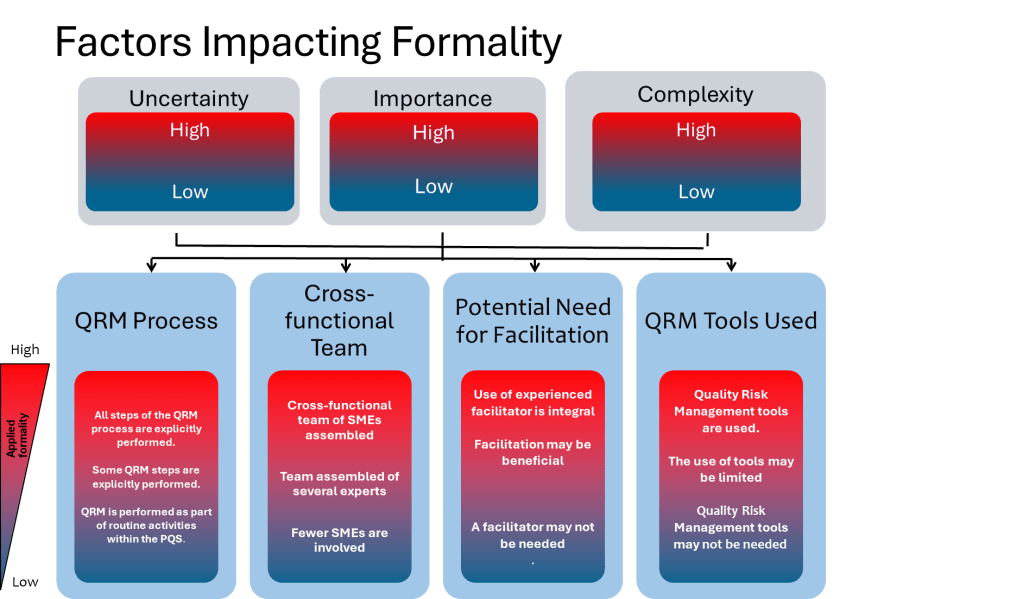
ICH Q9(R1) introduces the concept of a “formality continuum,” which aligns the level of effort and documentation with the complexity and significance of the risk being managed. This approach allows organizations to allocate resources effectively by applying less formal methods to lower-risk issues while reserving rigorous processes for high-risk scenarios.

For instance, routine quality checks may require minimal documentation compared to a comprehensive risk assessment for introducing new manufacturing technologies. By tailoring formality levels appropriately, organizations can ensure consistency while avoiding unnecessary complexity.
Calibrating Expert Opinions

We need to recognize the importance of expert knowledge in QRM activities, but also acknowledges the potential for subjectivity and bias in expert judgments. We need to ensure we:

  • Implement formal processes for expert opinion elicitation
  • Use techniques to calibrate expert judgments, especially when estimating probabilities
  • Provide training on common cognitive biases and their impact on risk assessment
  • Employ diverse teams to counteract individual biases
  • Regularly review risk assessment outputs for signs of bias or inconsistencies

Calibration techniques may include:

  • Structured elicitation protocols that break down complex judgments into more manageable components
  • Feedback and training to help experts align their subjective probability estimates with actual frequencies of events
  • Using multiple experts and aggregating their judgments through methods like Cooke’s classical model
  • Employing facilitation techniques to mitigate groupthink and encourage independent thinking

By calibrating expert opinions, organizations can leverage valuable expertise while minimizing subjectivity in risk assessments.

Utilizing Cooke’s Classical Model

Cooke’s Classical Model is a rigorous method for evaluating and combining expert judgments to quantify uncertainty. Here are the key steps for using the Classical Model to evaluate expert judgment:

Select and calibrate experts:
    • Choose 5-10 experts in the relevant field
    • Have experts assess uncertain quantities (“calibration questions”) for which true values are known or will be known soon
    • These calibration questions should be from the experts’ domain of expertise
    Elicit expert assessments:
      • Have experts provide probabilistic assessments (usually 5%, 50%, and 95% quantiles) for both calibration questions and questions of interest
      • Document experts’ reasoning and rationales
      Score expert performance:
      • Evaluate experts on two measures:
        a) Statistical accuracy: How well their probabilistic assessments match the true values of calibration questions
        b) Informativeness: How precise and focused their uncertainty ranges are
      Calculate performance-based weights:
        • Derive weights for each expert based on their statistical accuracy and informativeness scores
        • Experts performing poorly on calibration questions receive little or no weight
        Combine expert assessments:
        • Use the performance-based weights to aggregate experts’ judgments on the questions of interest
        • This creates a “Decision Maker” combining the experts’ assessments
        Validate the combined assessment:
        • Evaluate the performance of the weighted combination (“Decision Maker”) using the same scoring as for individual experts
        • Compare to equal-weight combination and best-performing individual experts
        Conduct robustness checks:
        • Perform cross-validation by using subsets of calibration questions to form weights
        • Assess how well performance on calibration questions predicts performance on questions of interest

        The Classical Model aims to create an optimal aggregate assessment that outperforms both equal-weight combinations and individual experts. By using objective performance measures from calibration questions, it provides a scientifically defensible method for evaluating and synthesizing expert judgment under uncertainty.

        Using Data to Support Decisions

        ICH Q9(R1) emphasizes the importance of basing risk management decisions on scientific knowledge and data. The guideline encourages organizations to:

        • Develop robust knowledge management systems to capture and maintain product and process knowledge
        • Create standardized repositories for technical data and information
        • Implement systems to collect and convert data into usable knowledge
        • Gather and analyze relevant data to support risk-based decisions
        • Use quantitative methods where feasible, such as statistical models or predictive analytics

        Specific approaches for using data in QRM may include:

        • Analyzing historical data on process performance, deviations, and quality issues to inform risk assessments
        • Employing statistical process control and process capability analysis to evaluate and monitor risks
        • Utilizing data mining and machine learning techniques to identify patterns and potential risks in large datasets
        • Implementing real-time data monitoring systems to enable proactive risk management
        • Conducting formal data quality assessments to ensure decisions are based on reliable information

        Digitalization and emerging technologies can support data-driven decision making, but remember that validation requirements for these technologies should not be overlooked.

        Improving Risk Assessment Tools

        The design of risk assessment tools plays a critical role in minimizing subjectivity. Tools with well-defined scoring criteria and clear guidance on interpreting results can reduce variability in how risks are evaluated. For example, using quantitative methods where feasible—such as statistical models or predictive analytics—can provide more objective insights compared to qualitative scoring systems.

        Organizations should also validate their tools periodically to ensure they remain fit-for-purpose and aligned with current regulatory expectations.

        Leverage Good Risk Questions

        A well-formulated risk question can significantly help reduce subjectivity in quality risk management (QRM) activities. Here’s how a good risk question contributes to reducing subjectivity:

        Clarity and Focus

        A good risk question provides clarity and focus for the risk assessment process. By clearly defining the scope and context of the risk being evaluated, it helps align all participants on what specifically needs to be assessed. This alignment reduces the potential for individual interpretations and subjective assumptions about the risk scenario.

        Specific and Measurable Terms

        Effective risk questions use specific and measurable terms rather than vague or ambiguous language. For example, instead of asking “What are the risks to product quality?”, a better question might be “What are the potential causes of out-of-specification dissolution results for Product X in the next 6 months?”. The specificity in the latter question helps anchor the assessment in objective, measurable criteria.

        Factual Basis

        A well-crafted risk question encourages the use of factual information and data rather than opinions or guesses. It should prompt the risk assessment team to seek out relevant data, historical information, and scientific knowledge to inform their evaluation. This focus on facts and evidence helps minimize the influence of personal biases and subjective judgments.

        Standardized Approach

        Using a consistent format for risk questions across different assessments promotes a standardized approach to risk identification and analysis. This consistency reduces variability in how risks are framed and evaluated, thereby decreasing the potential for subjective interpretations.

        Objective Criteria

        Good risk questions often incorporate or imply objective criteria for risk evaluation. For instance, a question like “What factors could lead to a deviation from the acceptable range of 5-10% for impurity Y?” sets clear, objective parameters for the assessment, reducing the room for subjective interpretation of what constitutes a significant risk.

        Promotes Structured Thinking

        Well-formulated risk questions encourage structured thinking about potential hazards, their causes, and consequences. This structured approach helps assessors focus on objective factors and causal relationships rather than relying on gut feelings or personal opinions.

        Facilitates Knowledge Utilization

        A good risk question should prompt the assessment team to utilize available knowledge effectively. It encourages the team to draw upon relevant data, past experiences, and scientific understanding, thereby grounding the assessment in objective information rather than subjective impressions.

        By crafting risk questions that embody these characteristics, QRM practitioners can significantly reduce the subjectivity in risk assessments, leading to more reliable, consistent, and scientifically sound risk management decisions.

        Fostering a Culture of Continuous Improvement

        Reducing subjectivity in QRM is an ongoing process that requires a commitment to continuous improvement. Organizations should regularly review their QRM practices to identify areas for enhancement and incorporate feedback from stakeholders. Investing in training programs that build competencies in risk assessment methodologies and decision-making frameworks is essential for sustaining progress.

        Moreover, fostering a culture that values transparency, collaboration, and accountability can empower teams to address subjectivity proactively. Encouraging open discussions about uncertainties or disagreements during risk assessments can lead to more robust outcomes.

        Conclusion

        The revisions introduced in ICH Q9(R1) represent a significant step forward in addressing long-standing challenges associated with subjectivity in QRM. By leveraging knowledge management, implementing structured decision-making processes, addressing cognitive biases, enhancing formality levels appropriately, and improving risk assessment tools, organizations can align their practices with the updated guidelines while ensuring more reliable and science-based outcomes.

        It has been two years, it is long past time be be addressing these in your risk management process and quality system.

        Ultimately, reducing subjectivity not only strengthens compliance with regulatory expectations but also enhances the quality of pharmaceutical products and safeguards patient safety—a goal that lies at the heart of effective Quality Risk Management.

        Assessing the Strength of Knowledge: A Framework for Decision-Making

        ICH Q9(R1) emphasizes that knowledge is fundamental to effective risk management. The guideline states that “QRM is part of building knowledge and understanding risk scenarios, so that appropriate risk control can be decided upon for use during the commercial manufacturing phase.” 

        We need to recognize the inverse relationship between knowledge and uncertainty in risk assessment. ICH Q9(R1) notes that uncertainty may be reduced “via effective knowledge management, which enables accumulated and new information (both internal and external) to be used to support risk-based decisions throughout the product lifecycle”

        In order to gauge the confidence in risk assessment we need to gauge our knowledge strength.

        The Spectrum of Knowledge Strength

        Knowledge strength can be categorized into three levels: weak, medium, and strong. Each level is determined by specific criteria that assess the reliability, consensus, and depth of understanding surrounding a particular subject.

        Indicators of Weak Knowledge

        Knowledge is considered weak if it exhibits one or more of the following characteristics:

        1. Oversimplified Assumptions: The foundations of the knowledge rely on strong simplifications that may not accurately represent reality.
        2. Lack of Reliable Data: There is little to no data available, or the existing information is highly unreliable or irrelevant.
        3. Expert Disagreement: There is significant disagreement among experts in the field.
        4. Poor Understanding of Phenomena: The underlying phenomena are poorly understood, and available models are either non-existent or known to provide inaccurate predictions.
        5. Unexamined Knowledge: The knowledge has not been thoroughly scrutinized, potentially overlooking critical “unknown knowns.”

        Hallmarks of Strong Knowledge

        On the other hand, knowledge is deemed strong when it meets all of the following criteria (where relevant):

        1. Reasonable Assumptions: The assumptions made are considered very reasonable and well-grounded.
        2. Abundant Reliable Data: Large amounts of reliable and relevant data or information are available.
        3. Expert Consensus: There is broad agreement among experts in the field.
        4. Well-Understood Phenomena: The phenomena involved are well understood, and the models used provide predictions with the required accuracy.
        5. Thoroughly Examined: The knowledge has been rigorously examined and tested.

        The Middle Ground: Medium Strength Knowledge

        Cases that fall between weak and strong are classified as medium strength knowledge. This category can be flexible, allowing for a broader range of scenarios to be considered strong. For example, knowledge could be classified as strong if at least one (or more) of the strong criteria are met while none of the weak criteria are present.

        Strong vs Weak Knowledge

        A Simplified Approach

        For practical applications, a simplified version of this framework can be used:

        • Strong: All criteria for strong knowledge are met.
        • Medium: One or two criteria for strong knowledge are not met.
        • Weak: Three or more criteria for strong knowledge are not met.

        Implications for Decision-Making

        Understanding the strength of our knowledge is crucial for effective decision-making. Strong knowledge provides a solid foundation for confident choices, while weak knowledge signals the need for caution and further investigation.

        When faced with weak knowledge:

        • Seek additional information or expert opinions
        • Consider multiple scenarios and potential outcomes
        • Implement risk mitigation strategies

        When working with strong knowledge:

        • Make decisions with greater confidence
        • Focus on implementation and optimization
        • Monitor outcomes to validate and refine understanding

        Knowledge Strength and Uncertainty

        The concept of knowledge strength aligns closely with the levels of uncertainty.

        Strong Knowledge and Low Uncertainty (Levels 1-2)

        Strong knowledge typically corresponds to lower levels of uncertainty:

        • Level 1 Uncertainty: This aligns closely with strong knowledge, where outcomes can be estimated with reasonable accuracy within a single system model. Strong knowledge is characterized by reasonable assumptions, abundant reliable data, and well-understood phenomena, which enable accurate predictions.
        • Level 2 Uncertainty: While displaying alternative futures, this level still operates within a single system where probability estimates can be applied confidently. Strong knowledge often allows for this level of certainty, as it involves broad expert agreement and thoroughly examined information.

        Medium Knowledge and Moderate Uncertainty (Level 3)

        Medium strength knowledge often corresponds to Level 3 uncertainty:

        • Level 3 Uncertainty: This level involves “a multiplicity of plausible futures” with multiple interacting systems, but still within a known range of outcomes. Medium knowledge strength might involve some gaps or disagreements but still provides a foundation for identifying potential outcomes.

        Weak Knowledge and Deep Uncertainty (Level 4)

        Weak knowledge aligns most closely with the deepest level of uncertainty:

        • Level 4 Uncertainty: This level leads to an “unknown future” where we don’t understand the system and are aware of crucial unknowns. Weak knowledge, characterized by oversimplified assumptions, lack of reliable data, and poor understanding of phenomena, often results in this level of deep uncertainty.

        Implications for Decision-Making

        1. When knowledge is strong and uncertainty is low (Levels 1-2), decision-makers can rely more confidently on predictions and probability estimates.
        2. As knowledge strength decreases and uncertainty increases (Levels 3-4), decision-makers must adopt more flexible and adaptive approaches to account for a wider range of possible futures.
        3. The principle that “uncertainty should always be considered at the deepest proposed level” unless proven otherwise aligns with the cautious approach of assessing knowledge strength. This ensures that potential weaknesses in knowledge are not overlooked.

        Conclusion

        By systematically evaluating the strength of our knowledge using this framework, we can make more informed decisions, identify areas that require further investigation, and better understand the limitations of our current understanding. Remember, the goal is not always to achieve perfect knowledge but to recognize the level of certainty we have and act accordingly.

        Requirements for Knowledge Management

        I was recently reviewing the updated Q9(R1) Annex 1- Q8/Q9/Q10 Questions & Answers (R5) related to ICH Q9(R1) Quality Risk Management (QRM) that were approved on 30 October 2024 and what they say about knowledge management. While there are some fun new questions asked, I particularly like “Do regulatory agencies expect to see a formal knowledge management approach during inspections?”

        To which the answer was: “No. There is no regulatory requirement for a formal knowledge management system. However. it is expected that knowledge from different processes and
        systems is appropriately utilised. Note: ‘formal’ in this context means a structured approach using a recognised methodology or (IT-) tool, executing and documenting something in a transparent and detailed manner.”

        What does appropriately utilized mean? What is the standard for determining it? The agencies are quite willing to leave that to you to figure out.

        As usual I think it is valuable to agree upon a few core assumptions for what appropriate utilization of knowledge management might look like.

        Accessibility and Sharing

        Knowledge should be easily accessible to those who need it within the organization. This means:

        • Implementing centralized knowledge repositories or databases
        • Ensuring information is structured and organized for easy retrieval
        • Fostering a culture of knowledge sharing among employees

        Relevance and Accuracy

        Appropriately utilized knowledge is:

        • Up-to-date and accurate
        • Relevant to the specific needs of the organization and its employees
        • Regularly reviewed and updated to maintain its value

        Integration into Processes

        Knowledge should be integrated into the organization’s workflows and decision-making processes:

        • Incorporated into standard operating procedures
        • Used to inform strategic planning and problem-solving
        • Applied to improve efficiency and productivity

        Measurable Impact

        Appropriate utilization of knowledge should result in tangible benefits:

        • Improved decision-making
        • Increased productivity and efficiency
        • Enhanced innovation and problem-solving capabilities
        • Reduced duplication of efforts

        Continuous Improvement

        Appropriate utilization of knowledge includes a commitment to ongoing improvement:

        • Regular assessment of knowledge management processes
        • Gathering feedback from users
        • Adapting strategies based on changing organizational needs

        Profound Knowledge

        In his System of Profound Knowledge, Deming provides a framework based on a deep and comprehensive understanding of a subject or system that goes beyond surface-level information to provide a holistic approach to leadership and management.

        Profound knowledge is central to a quality understanding as it is the ability to deeply understand an organization or its critical processes, delving beneath surface-level observations to uncover fundamental principles and truths. This knowledge is a guiding force for daily living, shaping one’s thinking and values, ultimately manifesting in their conduct. It embodies wisdom, morality, and deep insight, offering a comprehensive framework for understanding complex systems and making informed decisions. Profound knowledge goes beyond mere facts or data, encompassing a holistic view that allows individuals to navigate challenges and drive meaningful improvements within their organizations and personal lives.

        Components of Deming’s System of Profound Knowledge

        Deming’s SoPK consists of four interrelated components:

        1. Appreciation for a System: Understanding how different parts of an organization interact and work together as a whole system.
        2. Knowledge about Variation: Recognizing that variation exists in all processes and systems, and understanding how to interpret and manage it.
        3. Theory of Knowledge: Understanding how we learn and gain knowledge, including the importance of prediction and testing theories.
        4. Psychology: Understanding human behavior, motivation, and interactions within an organization.

        Applications of Profound Knowledge

        • Organizational Transformation: Profound knowledge provides a framework for improving and transforming systems.
        • Decision Making: It helps leaders make more informed decisions by providing a comprehensive lens through which to view organizational issues.
        • Continuous Improvement: The SoPK promotes ongoing learning and refinement of processes.
        • Leadership Development: It transforms managers into leaders by providing a new perspective on organizational management.

        Profound knowledge, as conceptualized by Deming, provides a comprehensive framework for understanding and improving complex systems, particularly in organizational and management contexts. It encourages a holistic view that goes beyond subject-matter expertise to foster true transformation and continuous improvement.

        Depth and Comprehensiveness

        Profound knowledge goes beyond surface-level understanding or mere subject matter expertise. It provides a deep, fundamental understanding of systems, principles, and underlying truths. While regular knowledge might focus on facts or specific skills, profound knowledge seeks to understand the interconnections and root causes within a system.

        Holistic Perspective

        Profound knowledge takes a holistic approach to understanding and improving systems. It consists of four interrelated components:

        1. Appreciation for a system
        2. Knowledge about variation
        3. Theory of knowledge
        4. Psychology

        These components work together to provide a comprehensive framework for understanding complex systems, especially in organizational contexts.

        Interdisciplinary Nature

        Profound knowledge often transcends traditional disciplinary boundaries. It combines insights from various fields, such as systems thinking, psychology, and epistemology, to create a more comprehensive understanding of complex phenomena.

        Focus on Improvement and Optimization

        While regular knowledge might be sufficient for maintaining the status quo, profound knowledge is geared towards improvement and optimization of systems. It provides a framework for understanding how to make meaningful changes and improvements in organizations and processes.

        Knowledge as Object or Social Action

        Deming’s System of Profound Knowledge can be easily seen as an application of knowledge as social action.

        The concept of knowledge as object versus knowledge as social action represents two distinct perspectives on the nature and function of knowledge in society. This dichotomy, rooted in sociological theory, offers contrasting views on how knowledge is created, understood, and utilized. Knowledge as object refers to the traditional view of knowledge as a static, codified entity that can be possessed, stored, and transferred independently of social context. In contrast, knowledge as social action emphasizes the dynamic, socially constructed nature of knowledge, viewing it as an active process embedded in social interactions and practices. This distinction, largely developed through the work of sociologists like Karl Mannheim, challenges us to consider how our understanding of knowledge shapes our approach to learning, decision-making, and social organization.

        Knowledge as Object

        Knowledge as object refers to knowledge as a static, codified entity that can be possessed, stored, and transferred. Key aspects include:

        • Knowledge is seen as propositional or factual information that can be articulated and recorded. For example, knowledge stored in documents or expert systems.
        • It involves an awareness of facts, familiarity with situations, or practical skills that an individual possesses.
        • Knowledge is often characterized as justified true belief – a belief that is both true and justified.
        • It can be understood as a cognitive state of an individual person.
        • Knowledge as object aligns with more traditional, rationalist views of knowledge as something that can be objectively defined and measured.

        Knowledge as Social Action

        Knowledge as social action views knowledge as an active, dynamic process that is socially constructed. Key aspects include:

        • Knowledge is produced through social interactions, relationships and collective processes rather than being a static entity.
        • It emphasizes how knowledge is created, shared and applied in social contexts.
        • Social action theories examine the motives and meanings of individuals as they engage in knowledge-related behaviors.
        • Knowledge is seen as emerging from and being shaped by social, cultural and historical contexts.
        • It focuses on knowledge as a process of knowing rather than a fixed object.
        • This view aligns with social constructivist and pragmatist perspectives on knowledge.

        Key Differences

        • Static vs. Dynamic: Knowledge as object is fixed and stable, while knowledge as social action is fluid and evolving.
        • Individual vs. Collective: The object view focuses on individual cognition, while the social action view emphasizes collective processes.
        • Product vs. Process: Knowledge as object treats knowledge as an end product, while social action views it as an ongoing process.
        • Context-independent vs. Context-dependent: The object view assumes knowledge can be decontextualized, while social action emphasizes situatedness.
        • Possession vs. Practice: Knowledge as object can be possessed, while knowledge as social action is enacted through practices.

        Knowledge as object reflects a more traditional, cognitive view of knowledge as factual information possessed by individuals. In contrast, knowledge as social action emphasizes the dynamic, socially constructed nature of knowledge as it is created and applied in social contexts. Both perspectives offer valuable insights into the nature of knowledge, with the social action view gaining prominence in fields like sociology of knowledge and science studies.

        Knowledge sharing as a form of social action plays a crucial role in modern organizations, influencing various aspects of organizational life and performance. Here’s an analysis of how knowledge as social action manifests in contemporary organizations:

        Knowledge Sharing as a Social Process

        In organizations knowledge sharing is increasingly viewed as a social process rather than a simple transfer of information. This perspective emphasizes:

        • The interactive nature of knowledge exchange
        • The importance of relationships and trust in facilitating sharing
        • The role of organizational culture in promoting or hindering knowledge flow

        Knowledge sharing becomes a form of social action when employees actively engage in exchanging ideas, experiences, and expertise with their colleagues.

        Impact on Organizational Culture

        Knowledge sharing as social action can significantly shape organizational culture by:

        • Fostering a climate of openness and collaboration
        • Encouraging continuous learning and innovation
        • Building trust and strengthening interpersonal relationships

        Organizations that successfully implement knowledge sharing practices often see a shift towards a more transparent and cooperative work environment.

        Enhancing Employee Engagement

        When knowledge sharing is embraced as a social action, it can boost employee engagement by:

        • Making employees feel valued for their expertise and contributions
        • Increasing their sense of belonging and connection to the organization
        • Empowering them with information to make better decisions

        Engaged employees are more likely to participate in knowledge sharing activities, creating a virtuous cycle of engagement and collaboration.

        Driving Innovation and Performance

        Knowledge as social action can be a powerful driver of innovation and organizational performance:

        • It facilitates the cross-pollination of ideas across departments
        • It helps in identifying and solving problems more efficiently
        • It reduces duplication of efforts and promotes best practices

        By leveraging collective knowledge through social interactions, organizations can enhance their problem-solving capabilities and competitive advantage.

        Challenges and Considerations

        While knowledge sharing as social action offers numerous benefits, organizations may face challenges in implementing and sustaining such practices:

        • Overcoming knowledge hoarding behaviors
        • Addressing power dynamics that may hinder open sharing
        • Ensuring equitable access to knowledge across the organization

        Leaders play a crucial role in addressing these challenges by modeling knowledge sharing behaviors and creating supportive structures.

        Technology as an Enabler

        Modern organizations often leverage technology to facilitate knowledge sharing as a social action:

        • Knowledge management systems
        • Collaborative platforms and social intranets
        • Virtual communities of practice

        These tools can help break down geographical and hierarchical barriers to knowledge flow, enabling more dynamic and inclusive sharing practices.

        Psychological Safety and Knowledge Sharing

        The concept of psychological safety is closely tied to knowledge sharing as social action:

        • A psychologically safe environment encourages risk-taking in interpersonal interactions
        • It reduces fear of negative consequences for sharing ideas or admitting mistakes
        • It promotes open communication and collective learning

        Organizations that foster psychological safety are more likely to see robust knowledge sharing practices among their employees.

        Viewing knowledge sharing as a form of social action in organizations highlights its transformative potential. It goes beyond mere information exchange to become a catalyst for cultural change, employee engagement, and organizational innovation. By recognizing and nurturing the social aspects of knowledge sharing, organizations can create more dynamic, adaptive, and high-performing work environments.