
Quality Book Shelf: Mastering Safety Risk Management for Medical and In Vitro Devices

Disclaimer: I have had the privilege of being a former colleague of Jayet’s, and hold him in immense regard.

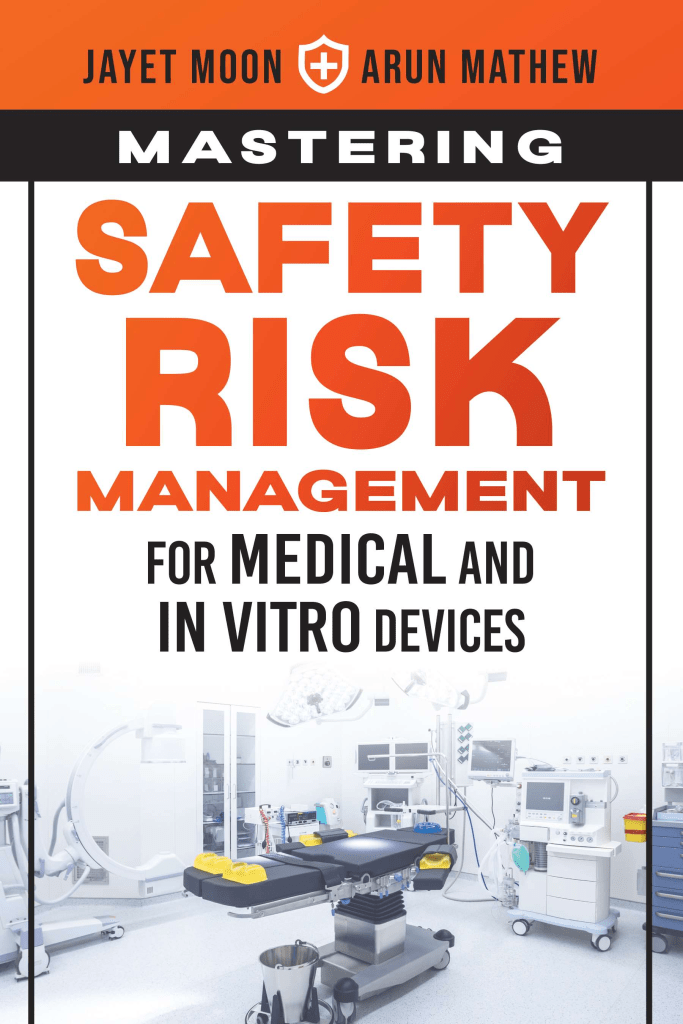
Mastering Safety Risk Management for Medical and In Vitro Devices by Jayet Moon and Arun Mathew is a comprehensive guide that addresses the critical aspects of risk management in medical and in vitro devices. This book is an essential resource for professionals involved in medical device design, production, and post-market phases, providing a structured approach to ensure product safety and regulatory compliance.

Starting with a solid overview of risk management principles that apply not only to medical devices under ISO13485 but will also teach pharmaceutical folks following ICH Q9 white a bit, this book delivers a heavy dose of knowledge and the benefit of wisdom in applying it.

The book then goes deep into the design assurance process, which is crucial for identifying, understanding, analyzing, and mitigating risks associated with healthcare product design. This foundational approach ensures that practitioners can perform a favorable benefit-risk assessment, which is vital for the safety and efficacy of medical devices.

Strengths

  • Regulatory Compliance: The authors provide detailed guidance on conforming to major international standards such as ISO 13485:2016, ISO 14971:2019, the European Union Medical Device Regulation (MDR), In Vitro Diagnostic Regulation (IVDR), and the US FDA regulations, including the new FDA Quality Management System Regulation (QMSR).
  • Risk Management Tools: The book offers a variety of tools and methodologies for effective risk management. These include risk analysis techniques, risk evaluation methods, and risk control measures, which are explained clearly and practically.
  • Lifecycle Approach: One of the standout features of this book is its lifecycle approach to risk management. It emphasizes that risk management does not end with product design but continues through production and into the post-market phase, ensuring ongoing safety and performance.

The authors, Jayet Moon and Arun Mathew, bring their extensive experience in the field to bear, providing real-world examples and case studies that illustrate the application of risk management principles in various scenarios. This practical approach helps readers to understand how to implement the theoretical concepts discussed in the book. This book is essential for anyone working in medical devices and a good read for other quality life sciences professionals as there is much to draw on here.
Component Manufacturers Validation Requirements

I recently got asked what a medical device component manufacturer’s validation requirements are. Here is my answer.

Component manufacturers play a crucial role in the medical device industry by producing various parts and components for proper functioning and assembly. Here are some key expectations and responsibilities of component manufacturers in the medical device sector:

  1. Quality and Precision Manufacturing: Medical device components often require high precision, accuracy, and quality to ensure patient safety and device efficacy. To meet these demanding standards, component manufacturers must adhere to stringent quality control measures, utilize advanced manufacturing techniques, and maintain strict tolerances.
  2. Regulatory Compliance: The medical device industry is heavily regulated, and component manufacturers must comply with relevant regulations and standards set by governing bodies like the FDA, ISO, and others. This includes maintaining proper documentation, implementing quality management systems, and ensuring traceability of materials and processes.
  3. Material Selection and Biocompatibility: Many medical device components come into direct contact with the human body or bodily fluids. Consequently, component manufacturers must carefully select biocompatible, non-toxic, and suitable materials for the intended application. They must also ensure proper sterilization and packaging to maintain sterility.
  4. Design and Engineering Support: Some component manufacturers offer design and engineering services in addition to manufacturing to assist medical device companies in developing new components or optimizing existing ones. This collaboration helps ensure that components meet specific performance, functional, and regulatory requirements.
  5. Supply Chain Management: Component manufacturers must have robust supply chain management systems to ensure the timely delivery of components to medical device manufacturers. This includes maintaining adequate inventory levels, managing logistics, and minimizing disruptions in the supply chain.

Yes, component manufacturers in the medical device industry are expected to validate their manufacturing processes to ensure the components they produce meet specified requirements and perform as intended.

  • Regulatory bodies like the FDA require that components critical to the safety and performance of medical devices be produced through validated processes. This helps ensure that components consistently meet quality standards.
  • Component manufacturers must perform Installation Qualification (IQ), Operational Qualification (OQ), and Performance Qualification (PQ) on their manufacturing equipment and processes.
  • Validation requirements apply to finished components and raw materials, sub-components received from suppliers, and any processes involved in producing the component. Traceability of validation activities throughout the supply chain is essential.
  • The level of validation required depends on the component’s criticality and risk to the final medical device. More stringent validation is expected for higher-risk components that directly contact the patient or are essential for device safety and efficacy.
  • The component manufacturer must maintain validation documentation such as protocols, test reports, and traceability matrices and provide it to the medical device company upon request for review and auditing purposes.

AI/ML-Based SaMD Framework

The US Food and Drug Administration’s proposed regulatory framework for artificial intelligence- (AI) and machine learning- (ML) based software as a medical device (SaMD) is fascinating in what it exposes about the uncertainty around the near-term future of a lot of industry 4.0 initiatives in pharmaceuticals and medical devices.

While focused on medical devices, this proposal is interesting read for folks interested in applying machine learning and artificial intelligence to other regulated areas, such as manufacturing.

We are seeing is the early stages of consensus building around the concept of Good Machine Learning Practices (GMLP), the idea of applying quality system practices to the unique challenges of machine learning.

John Oliver on Medical Devices

I firmly believe that quality and ethics go hand-in-hand, and frankly it shakes some of my confidence on my profession when I read of organizations that supposedly subscribe to quality principles and standards (such as the ISOs) still not meeting the grade.

There are four widely accepted principles in biomedicine, which applies equally to medical devices and pharmaceuticals:

  • Principle of respect for autonomy
  • Principle of nonmaleficence
  • Principle of beneficence
  • Principle of justice

It seems a failure of ISO 13458 that adherence to this quality standard does not lead to results aligned to these four principles. It should surprise no one who knows me that this is one of the reasons I support strong regulations in this space.

Sources

  • Beauchamp T, Childress J. Principles of Biomedical Ethics, 7th  Edition. New York: Oxford University Press, 2013