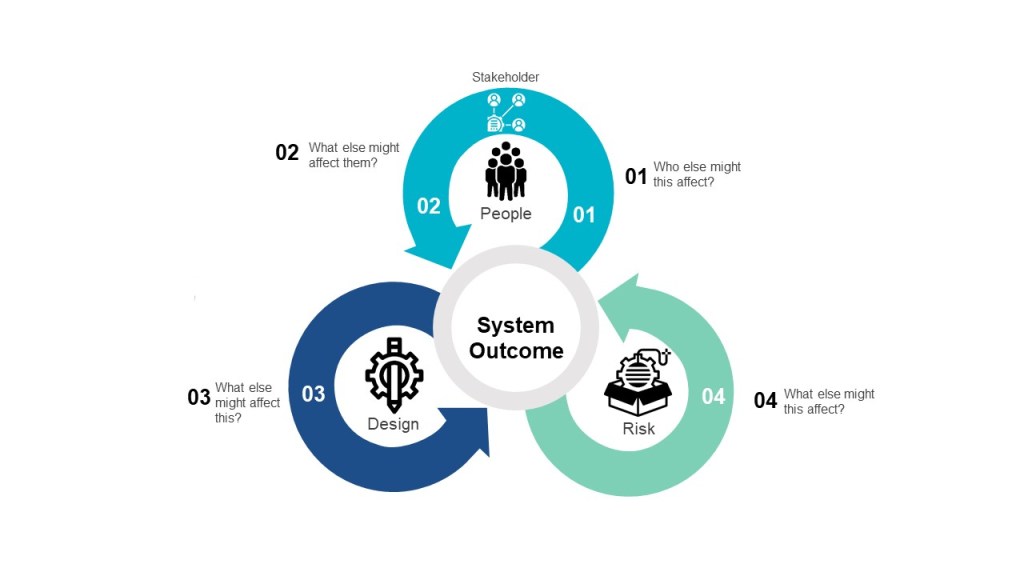
The Outcome Identification Loop asks four questions around a given outcome which can be very valuable in understanding a proposed design, event, or risk.
Through answering these questions, outcomes and relationships to further define a central question, and can be used to shape problem-solving, risk mitigation, and process improvement.
Questions 1 “Who else might this affect?’ and 2 “What else might affect them?’ are paired questions from stakeholder identification and analysis techniques.
Question 3 “What else might affect this?” relates to system analysis and design and can be fed by, and lead to, the chains of outcomes elicited using analysis methods, such as process modelling and root cause analysis.
Question 4 “What else might this affect?” considers uncertainty and risk.
These four questions can be iterative. Use them near the beginning to define the problem and then at the end to tie together the entire work.
Process drives the work we do. We can evaluate processes on two axis – complexity and strategy – that help us decide the best way to manage and improve the processes.
Process by Complexity and Strategy
Process complexity and dynamics are what types of tasks are involved in the process. Is it a simple, repetitive procedure with a few rules for handling cases outside of normal operation? Or is it a complex procedure with lots of decision points and special case rules? Think of this like driving somewhere. Driving to your local grocery is a simple procedure, with few possibilities of exceptions. Driving across the country has a ton of variables and dynamism to it.
While complexity can help drive the decision to automate, I strongly recommend that when thinking about it don’t ask if it can be automated, only ask what would be involved if a human were to do the job or how it is done with current technologies. Starting with the answer of automation leads to automation for automation’s sake, and that is a waste.
Dynamics is how much the process changes – some change rarely while others change rapidly to keep pace in response to changes in product or external factors (such as regulations).
Strategic importance asks about the value the process contributes to meeting requirements. Is the process a core competency, or an enabling process that needs to be accomplished to ensure that you can do something else that meets the core requirements? Needless to say, one company’s strategic process is another company’s routine process, which is why more and more we are looking at organizations as ecosystems.
Processes are in a hierarchy, and we use levels to describe the subdivision of processes. We’ve discussed the difference between process, procedure and task. At the process level we usually have the high-level process, the architecture level, which are the big things an organization does (e.g. research, manufacture, distribute), mid-level processes that are more discrete activities (e.g. perform a clinical study) to even more discrete processes (e.g. launch a study) which usually have several levels (e.g. select sites, manage TMF) to finally procedure and task.
Level of Process
Includes
Key Ways to Address
High-Level Process
How key objectives are met, highly cross functional
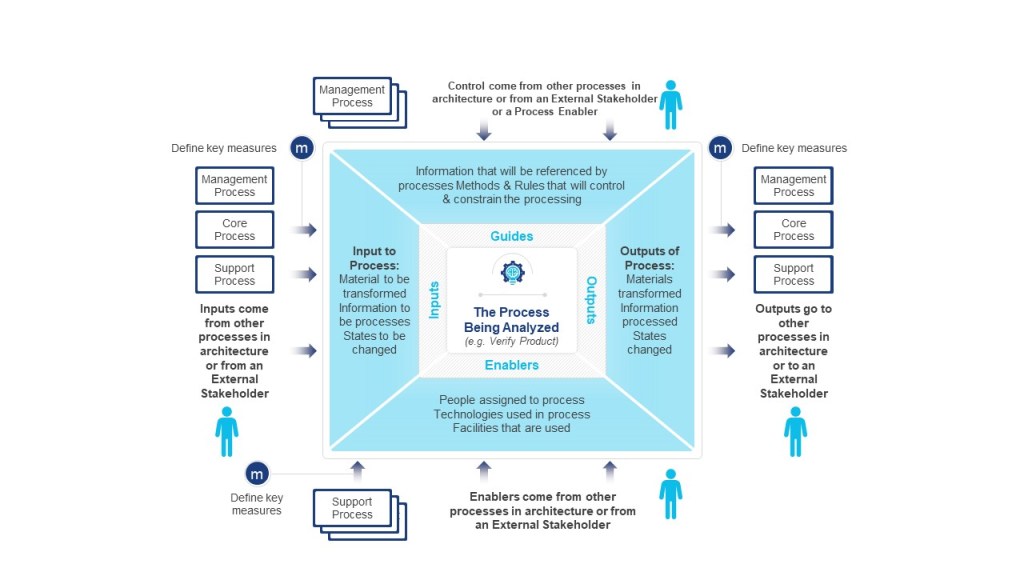
To truly get to this level of understanding of process, we need to understand just what our process is, which is where tools like the SIPOC or Process Scope diagram can come in handy.
Process Scope Diagram
To understand a process we want to understand six major aspects: Output, Input, Enablers, Controls, Process Flow, People.
Simple processes usually follow a consistent, well-defined sequence of steps with clearly defined rules. Each step or task can be precisely defined, and the sequence lacks branches or exceptions.
More complicated processes involve branches and exceptions, usually draw on many rules, and tend to be slightly less defined. Complicated processes require more initiative on the part of human performers.
Complex processes are ones that require a high level of initiative and creativity from people. These processes rapidly change and evolve as time passes. Successful performance usually requires a connection to an evolving body of knowledge. They are highly creative and have a large degree of unpredictability. Most complex processes are viewed at the system level.
Sources
Benedict, T. et al. BPM CBOK Version 4.0: Guide to the Business Process Management Common Body of Knowledge. ABMP International, 2019.
Harmon, Paul. Business Process Change. Morgan Kaufmann, 2019.
Nuland, Y. and Duffy, G. Validating a Best Practice. Productivity Press, 2020
People are at the heart of any organization. They set the organization’s goals, they manage it, they deal with suppliers and customers and they work together to produce results.
We manage this by processes. Process are on a continuum by how complicated and complex they are. Simpler jobs can be reliably done by following procedure. More complex ones require the ability to analyze a situation – using established rules – and decide which of several alternative paths to follow. In even more complex cases they analyze, diagnose, design, redesign, program, plan or schedule. In some cases, they create new products, processes and new ways of being. Very complex jobs require individuals who can analyze and solve very complex problems.
A task is the steps for doing a particular piece of work.
Procedure are activities made up of a series of tasks.
A process is an upper level description of a series of activities required to accomplish an objective. Processes are made up of procedures or tasks. They have inputs and outputs.
Process
Procedure
Task
Flow of sequences of activities that transform input elements into results
Specific and required way to carry out a process
Describe the correct steps to perform a specific task
What we do By Whom Where it takes place When it happens
How the work must be performed
How to accomplish a specific task within a process with very detailed directions
Orchestration the work
Mandatory method
Mandatory guidance
Can link to 0, 1 or more procedures
It may consist of 0, 1 or more task instructions
Focus on the instructions of 1 task
Transversal by business units
Cross functional or only 1 business unit
Only 1 business unit
Participate more than one role
Participate more than one role
Participate only one role
Encapsulates activities
Explains how to do but doesn’t get to all the details of how it is done
All of the detail of all the steps to follow in an activity
Provides the workflow model at the highest level using BPMN
Document with both narrative and images, usually in the form of use cases and workflow diagrams
Document with the maximum detail that explains step by step the instructions that must be carried out in an activity
A task analysis breaks down a complex task into its components – the steps involved and the knowledge required. To do a task analysis, you observe the work and interview a subject matter expert (SME) or key performer.
What do you want to identify in a task analysis?
Why someone would learn the skill
Prerequisite skills, knowledge and attitudes
Special materials or tools required
Warnings of dangers, both overall and at specific points in the process
The critical steps (no more than five to seven, otherwise you should split it into another task) and their sequence
Whether the sequence is critical or flexible
Any other steps necessary to complete the task and their sequence
How critical any given substep is
Conditions that must be satisfied before going on to the next step
Reasons for doing steps at a particular point
Signs of success for each step (for confirmations)
Signs of failure for each step
What is the process for doing a task analysis?
Review any documentation, manuals or process maps
Observe at least one expert and take notes as you observe
Either slow down experts during the task to ask questions or interview afterward
Identify each step
Document what you saw and what the expert told you, then ask for the SME’s reaction, there will almost always be gaps identified
Expect the process to be iterative
What should you ask the SME?
What is the SME doing?
Why is it important, or what is the rationale?
Why is the SME doing it that way?
Is there a warning necessary?
How does the SME know what to do next (if there is a choice between two or more actions)?
How can the SME tell if a step was done right?
How can the SME tell if a step was done wrong or incompletely?
How is the sequence critical?
What does the SME do that isn’t documented?
While often viewed from the training perspective, task analysis is a core quality tool that is utilized in procedure writing, automation, user interface development, problem solving and so much more.




 Investigations of a Dog