
What quality matters are on your radar?

What quality system concerns do you have? What are you investing time in figuring out? What are your best practices – the quality solutions you are proud to share?

The site I work at is under a consent decree (fairly late in the process now). I joined because I wanted the experience of building and refining quality systems in that environment and the last five years here have been incredibly rewarding for a whole host of reasons.

I started this blog because I had a whole host of things I wanted to share. It also serves as a reflective tool to refine several ideas that I am working on. The themes of change management, knowledge management, document management, risk management, computer systems and data integrity (amongst other things) are the items I have spent a lot of time on and are some of the topics driving the next stage of my career.

If I was to do a personal SWOT of where I am at (100% my opinions, does not represent anything official), it would look like this (with seasonal fall leaf structure):
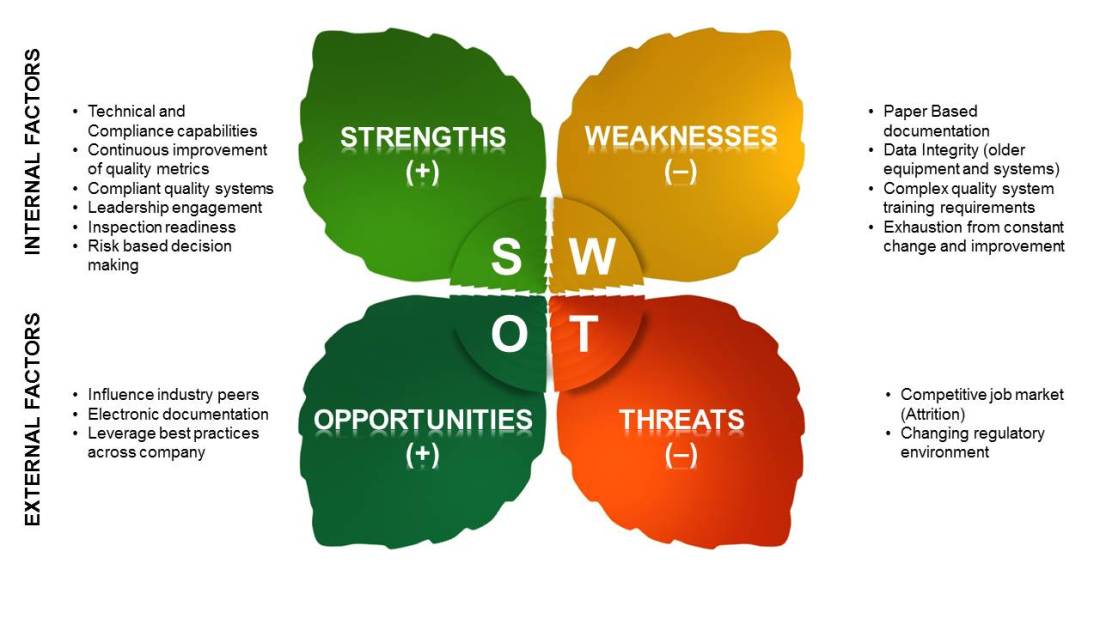
SWOT - personal experience

It is not that hard to draw from these to my topics of interest.

I am following a tried-and-true technique, that of thinking aloud, which allows me to reflect upon and clarify the problem and focus on what is next. “Thinking aloud” requires talking through the details, decisions, and the reasoning behind those decisions. This slowing down the process allows me to fully comprehend the problem. This blog then serves to experiment, consider, and then decide upon next steps.

I’ll end this asking the same question I started with: What are your quality system concerns? What would you like to talk about on this blog?

Deep expertise, quality culture and the long road

Dr. Zeynep Tufekci, a professor who writes about the social impact of technology, wrote and excellent Op-Ed in the New York Times this past weekend titled “What Elon Musk Should Learn From the Thailand Cave Rescue.” In this she takes to task silicon valley, stresses the importance of hard-earned expertise and the “safety culture” model. A topic near-and-dear to my heart as a quality professional, as she stresses the importance of deep expertise, lengthy training and the ability to learn from experience (and to incorporate the lessons of those experiences into future practices) as a valuable form of ingenuity.

Safety culture = quality culture. It has been said many times that the only real difference is that of the question asked (patient safety vs employee safety), but lets all agree that the tools used are pretty equivalent.

What this article really reminds me of is an article from A Lean Journey back in February titled “Lean Culture: Do You Want Firemen or Farmers in Your Organization.”

I see this a lot in Lean, especially early in the transformation process. An idea that any expert is equivalent, that quick, fast wins are the best. Which is sometimes relevant, often not good for the long run. Its interesting that we are, what, 30-40 years into Lean as a management methodology in this country (my entire adult life I have been involved in Lean projects of one sort or another) and it still feels new in most places.

I think that the trends Dr Tufekci and Mr McMahon are discussing are very similar. Stem from similar causes, and probably lead to why a lot of long-term transformations don’t get the benefits we intend.

Learning Culture

Over at the Harvard Business Review there is a great article on 4 Ways to Create a Learning Culture on Your Team. A learning culture is a quality culture, and enabling a learning culture should be a key element of a robust knowledge management system.

Frankly, this is an attribute that I think needs to be better reflected in the QBok, as it is a core trait of a successful quality leader. And supporting learning is a core element of any professional society.