International Plan of Mystery: ICH Guidelines for Generic Drugs

Back in October, FDA announced that it submitted a proposal to the International Council for Harmonization of Technical Requirements for Pharmaceuticals for Human Use (ICH) for the development of common global standards for generic drugs.
— Read on www.fdalawblog.net/2018/11/international-plan-of-mystery-ich-guidelines-for-generic-drugs/

Interesting blog post on FDA’s thoughts on the ICH creating some standards on generics.

Mylan Warning Letter

Mylan’s West Virginia plant received a Warning Letter this month and US FDA Commission Scott Gottlieb tweeted on it, and Mylan recently issued a press release.

I’ve made a few posts on their 483:

Mylan’s issues really need to be viewed as a lens of current regulatory body thinking and not as an issue of a company behind the times. In short, this could be you and if your company is not pouring through these and evaluating your own systems you should be.

The Warning Letter has a few trends we see in this sort of document:

  1. Requiring an independent review. If your system is broke than the agency doesn’t trust you to say its okay. Get an independent consultant.
  2. Lack of quality unit authority. One of the best things my site head of quality ever said (and if he is reading this, take this as a serious compliment) was to a group of high school interns when he said the quality unit is the only part of the Pharma manufacturing organization with duties required by law. That we have a legal duty to our companies and to the patients.
  3. Go to the ICH guidance documents
  4. This is happening at more than one site. Clean it up corporate wide.

The last one is worth further thought:

These repeated failures at multiple sites demonstrate that Mylan’s management oversight and control over the manufacture of drugs is inadequate.Your executive management remains responsible for fully resolving all deficiencies and ensuring ongoing CGMP compliance. You should immediately and comprehensively assess your company’s global manufacturing operations to ensure that systems and processes, and ultimately, the products you manufacture, consistently conform to FDA requirements.

It is a critical part of your inspection program to be evaluating issues at each and every one of your sites for all your sites. The CAPA program needs to have the ability to assess CAPAs for similar root cause at all sites, that’s part of the preventive, and without it you are truly not addressing all the potential risks in your organization.

In past decades Mylan was a golden-child of cGMPs, and a lot of thought has gone into why the massive backslide. Cases like this, and Toyota, really reaffirm how a quality culture is something that must be constantly maintained and grown, and how easy it is to go backwards.


Evolved Expendable Launch Vehicle (EELV) Quality Management

We determined that ULA, SpaceX, and AR were not performing adequate quality assurance management for the EELV program as evidenced by the 181 nonconformities to the AS9100C at the EELV contractor production facilities. This inadequate quality assurance management could increase costs, delay launch schedules, and increase the risk of mission failure.

From ”

Evaluation of the Evolved Expendable Launch Vehicle Program Quality Management System DODIG-2018-045, Department of Defense Office of Inspector General

It is useful to read audit reports and inspection findings from multiple industries. From this we can see trends, make connections and learn.

I see a few things that stand out.

DOD findings

Risk Register

Our evaluation of the RIO database showed that 11 out of 26 risks related to either Atlas V or Delta IV launch vehicle were in “red” status, which indicates that risk mitigation was behind schedule.

It is not enough to identify risks (though that is a critical place to start). You just can’t track them (though again, if you don’t track it you don’t see it). You actually have to have clear plans to mitigate and eliminate the risks. And this is where the program seemed to fall short.

Not a surprise. I think a lot of companies are having these difficulties. In the pharma world the regulatory agencies have been signaling pretty strongly that this is an issue.

Make sure you identify risks, track them, and have plans that are actually carried out to remediate.

Configuration Management

SpaceX failed to comply with AS9100C, section 7.1.3, which requires it to “establish, implement, and maintain a configuration management process.” Configuration management is a controlled process to establish the baseline configuration of a product and any changes to that product. This process should occur during the entire life cycle of a product to provide visibility and control of its physical, functional, and performance attributes.

First rule of reading inspection reports: Things probably went bad if a section starts with standard review 101 material.

That said, hello change management my dear friend.

This was the gist of my ASQ WCQI workshop last May, every industry needs good change management and change control.

Material Management

ULA and AR failed to comply with AS9100C, section 8.3, which requires them to “ensure that product which does not conform to product requirements are identified and controlled to prevent its unintended use or delivery.”

At ULA, we found 18 expired limited-life material items that were between 32 and 992 days past their expiration dates, but available for use on EELV flight hardware. This material should have been impounded and dispositioned. The use of expired limited-life items, such as glues and bonding agents, could result in product that does not meet specifications and may require costly rework.

I find it hard to believe that these companies aren’t tracking inventory. If they are tracking inventory and have any sort of cycle count process then the mechanism exists to ensure expired material is removed from the possibility of use. And yet we still see these observations across the pharma industry as well.

Concluding Thoughts

Quality Management has it its core the same principles, no matter the industry. We use similar tools. Leverage the best practices out there. Read about stresses other companies are having, learn from them and remediate at your own organization.

FDA signals – no such thing as a planned deviation

The subject of planned deviations made for a raucous “Breakfast with the FDA” session Sept. 25 at the Parenteral Drug Association/FDA conference in Washington.

These are the deviations from standard operating procedures that workers carry out on purpose, typically to keep a pharmaceutical plant operating when for one reason or another they won’t be doing it the way the company said they would.

FDA Compliance Experts Advise Against Treating Minor Changes As ‘Planned Deviations’” – Bowman Cox, Pink Sheet

I wish I had gone to the PDA/FDA conference this year, if for nothing else to have been able to stand up and cheer wildly when this was said:

Brooke Higgins, a senior policy advisor in the FDA drug center’s Office of Compliance, agreed that “it’s a very strange term, and it kind of makes your skin crawl a little bit.”

There is a whole lot more good stuff over at the Pink Sheet’s summary.

I am a firm believer that there are no such things as planned changes. There are change controls, some of which are temporary, occasionally even ones that are retroactive (deviation identifies a change which is formalized in a change control). But all are through the same system, with the same evaluations and assessments and the same sorts of actions.

Keep all changes together. Its a true best practice.


Look for trends in inspection activities

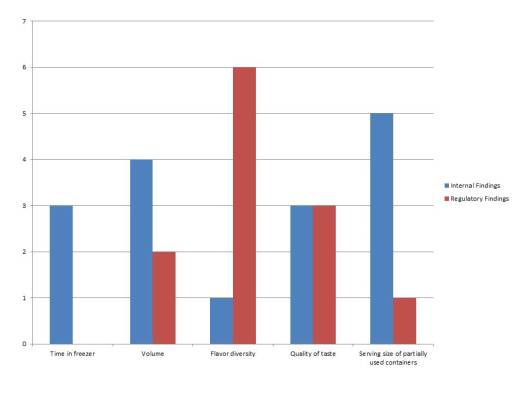
I’m in charge of ice cream, an important element of my household and as a result there are agreed upon criteria for success. I have internal inspectors (me) and external (my teenagers). I can thus produce a fairly simple graph of internal and external inspections and see the areas where there is a difference.

ice cream audit

From this I can tell which categories of findings are pain points and can look for systematic ways to fix them.

In my case, it’s clear the kids do not appreciate only having vanilla, strawberry and chocolate ice cream.

You can apply the same process to your internal vs. regulatory agencies (or certifying body or similar) audit findings.

You can quickly find two major patterns:

  1. Places you are gapping
  2. Places you are tougher than regulatory agencies

For those areas where you are gapping, evaluate your systems and determine what process improvements are necessary. A good area to include in this evaluation is the skill set of your internal auditors. For example, do you need more intensive data integrity training?

For those areas where you are tougher than regulatory agencies, do a quick check to ensure internal expectations are appropriately aligned. And then congratulate yourself.

You might have some areas where you have internal findings but absolutely no external. This might be a good indication that this might be a cutting edge area and you are doing a great job keeping ahead of the curve.

Take an additional step. Go to a source of inspection findings, such as the FDA’s 483 collection, and add them to your graph. This can help you identify additional areas of potential improvement. This can be especially helpful if you are a smaller company that does not have a wealth of data to draw.

We should all be doing what we can to anticipate trends and benchmark ourselves. This sort of data review and go a long way to finding some potential pain points before they get worse.