
Quality Review

Maintaining high-quality products is paramount, and a critical component of ensuring quality is implementing a robust review of work by a second or third person, a peer review, and/or quality review—also known as a work product review process. Like many tools, it can be underutilized. It also gets to the heart of the question of Quality Unit oversight.

Introduction to Work Product Review

Work product review systematically evaluates the output from various processes or tasks to ensure they meet predefined quality standards. This review is crucial in environments where the quality of the final product directly impacts safety and efficacy, such as in pharmaceutical manufacturing. Work product review aims to identify any deviations or defects early in the process, allowing for timely corrections and minimizing the risk of non-compliance with regulatory requirements.

Criteria for Work Product Review

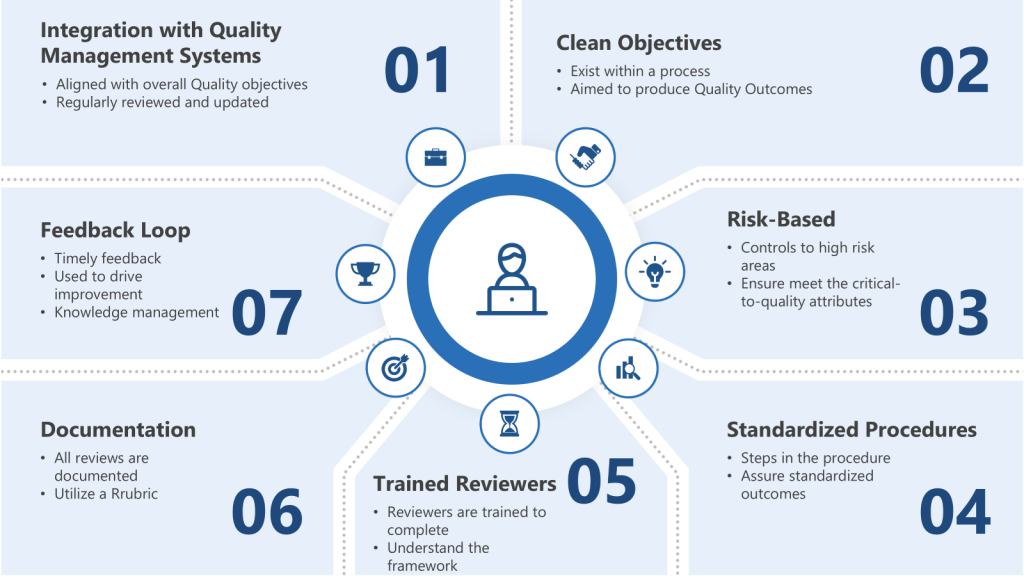
To ensure that work product reviews are effective, several key criteria should be established:

  1. Integration with Quality Management Systems: Integrate risk-based thinking into the quality management system to ensure that work product reviews are aligned with overall quality objectives. This involves regularly reviewing and updating risk assessments to reflect changes in processes or new information.
  2. Clear Objectives: The review should have well-defined objectives that align with the process they exist within and regulatory requirements. For instance, in pharmaceutical manufacturing, these objectives might include ensuring that all documentation is accurate and complete and that manufacturing processes adhere to GMP standards.
  3. Risk-Based: Apply work product reviews to areas identified as high-risk during the risk assessment. This ensures that resources are allocated efficiently, focusing on processes that have the greatest potential impact on quality.
  4. Standardized Procedures: Standardized procedures should be established for conducting the review. These procedures should outline the steps involved, the reviewers’ roles and responsibilities, and the criteria for accepting or rejecting the work product.
  5. Trained Reviewers: Reviewers should be adequately trained and competent in the subject matter. This means understanding not just the deliverable being reviewed but the regulatory framework it sits within and how it applies to the specific work products being reviewed in a GMP environment.
  6. Documentation: All reviews should be thoroughly documented. This documentation should include the review’s results, any findings or issues identified, and actions taken to address these issues.
  7. Feedback Loop: There should be a mechanism for feedback from the review process to improve future work products. This could involve revising procedures or providing additional training to personnel.
Bridging the Gap Between Work-as-Imagined, Work-as-Prescribed, and Work-as-Done

Work product review is a systematic process that evaluates the output from various tasks to ensure they meet predefined quality standards connecting to work-as-imagined, work-as-prescribed, and work-as-done. Work product review serves as a bridge between these concepts by systematically evaluating the output of work processes. Here’s how it connects:

  • Alignment with Work-as-Prescribed: Work product review ensures that outputs comply with established standards and procedures (work-as-prescribed), helping to maintain regulatory compliance and quality standards.
  • Insight into Work-as-Done: Through the review process, organizations gain insight into how work is actually being performed (work-as-done). This helps identify any deviations from prescribed procedures and allows for adjustments to improve alignment between work-as-prescribed and work-as-done.
  • Closing the Gap with Work-as-Imagined: By documenting and addressing discrepancies between work-as-imagined and work-as-done, work product review facilitates communication and feedback that can refine policies and procedures. This helps to bring work-as-imagined closer to the realities of work-as-done, improving the effectiveness of quality oversight.

Work product review is essential for ensuring that the quality of work outputs aligns with both prescribed standards and the realities of how work is actually performed. By bridging the gaps between work-as-imagined, work-as-prescribed, and work-as-done, organizations can enhance their quality management systems and maintain high standards of quality, safety and efficacy.

Aligning to the Role of Quality Unit Oversight

While work product review does not guarantee Quality Unit Oversight, it is a potential control to ensure this oversight.

In the pharmaceutical industry, the Quality Unit plays a pivotal role in ensuring drug products’ safety, efficacy, and quality. It oversees all quality-related aspects, from raw material selection to final product release. However, the Quality Unit must be enabled appropriately and structured within the organization to effectively exercise its authority and fulfill its responsibilities. This blog post explores what it means for a Quality Unit to have the necessary authority and how insufficient implementation of its responsibilities can impact pharmaceutical manufacturing.

Responsibilities of the Quality Unit

Establishing and Maintaining the Quality System: The Quality Unit must set up and continuously update the quality management system to ensure compliance with GxPs and industry best practices.

Auditing and Compliance: Conduct internal audits to ensure adherence to policies and procedures, and report quality system performance metrics.

Approving and Rejecting Components and Products: The Quality Unit has the authority to approve or reject components, drug products, and packaging materials based on quality standards.

Investigating Nonconformities: Ensuring thorough investigations into production errors, discrepancies, and complaints related to product quality.

Keeping Management Informed: Reporting on product, process, and system risks, as well as outcomes of regulatory inspections.

What It Means for a Quality Unit to Be Enabled

For a Quality Unit to be effectively enabled, it must have:

  • Independence: The Quality Unit should operate independently of production units to avoid conflicts of interest and ensure unbiased decision-making.
  • Authority: It must have the authority to approve or reject the work product without undue influence from other departments.
  • Resources: Adequate personnel are essential for conducting the quality unit functions.
  • Documentation and Procedures: Clear, documented procedures outlining responsibilities and processes are crucial for maintaining consistency and compliance.

Insufficient Implementation of Responsibilities

When a Quality Unit insufficiently implements its responsibilities, it can lead to significant issues, including:

  • Regulatory Noncompliance: Failure to adhere to GxPs and regulatory standards can result in regulatory action.
  • Product Quality Issues: Inadequate oversight can lead to the release of substandard products, posing risks to patient safety and public health.
  • Lack of Continuous Improvement: Without effective quality systems in place, opportunities for process improvements and innovation may be missed.

The Quality Unit is the backbone of pharmaceutical manufacturing, ensuring that products meet the highest standards of quality and safety. By understanding the Quality Unit’s responsibilities and ensuring it has the necessary authority and resources, pharmaceutical companies can maintain compliance, protect public health, and foster a culture of continuous improvement. Inadequate implementation of these responsibilities can have severe consequences, emphasizing the importance of a well-structured and empowered Quality Unit.

By understanding these responsibilities, we can take a risk-based approach to applying quality review.

When to Apply Quality Review as Work Product Review

Work product review by Quality should be applied at critical stages to guarantee critical-to-quality attributes, including adherence to the regulations. This should be a risk-based approach. As such, it should be identified as controls in a living risks assessment and adjusted (add more, remove where unnecessary) as appropriate.

Closely scrutinize the responsibilities of the Quality Unit in the regulations to ensure all are met.

Best Practices in Quality Review

Rubrics are a great way to standardize quality reviews. If it is important enough to require a work review, it is important enough to standardize. The process owner should develop and maintain these rubrics with an appropriate group of stakeholder custodians. This is a key part of knowledge management. Having this cross-functional perspective on the output and what quality looks like is critical. This rubric should include:

  • Definition of prescribed work and the intended output that is being reviewed
  • Potential outcomes related to critical attributes, including definitions of technical accuracy
  • Methods and techniques used to generate the outcome
  • Operating experience and lessons learned
  • Risks, hazards, and user-centered design considerations
  • Requirements, standards, and code compliance
  • Planning, oversight, and acceptance testing
  • Input data and sources
  • Assumptions
  • Documentation required
  • Reviews and approvals required
  • Program or procedural obstacles to desired performance
  • Surprise situations, for example, unanticipated risk factors, schedule or scope changes, and organizational issues
  • Engineering human performance tool(s) applicable to activities being reviewed.

The rubric should have an assessment component, and that assessment should feed back into the originator’s qualified state.

Work product reviews must be early enough to allow feedback into the normal work for repetitive tasks. This should lead to gates in processes, quality-on-the-floor, or better-trained supervisors performing better and more effective reviews. This feedback should always be to the responsible person – the originator—and should be, wherever possible, face-to-face feedback to resolve the particular issues identified. This dialogue is critical.

Conclusion

Work product review is a powerful tool for enhancing quality oversight. By aligning this process with the responsibilities of the Quality Unit and implementing best practices such as standardized rubrics and a risk-based approach, companies can ensure that their products meet the highest standards of quality and safety. Effective work product review not only supports regulatory compliance but also fosters a culture of continuous improvement, which is essential for maintaining excellence in the pharmaceutical industry.
Assessing the Quality of Our Risk Management Activities

Twenty years on, risk management in the pharmaceutical world continues to be challenging. Ensure that risk assessments are systematic, structured, and based on scientific knowledge. A large part of the ICH Q9(R1) revision was written to address continued struggles with subjectivity, formality, and decision-making. And quite frankly, it’s clear to me that we, as an industry, are still working to absorb those messages these last two years.

A big challenge is that we struggle to measure the effectiveness of our risk assessments. Quite frankly, this is a great place for a rubric.

Luckily, we have a good tool out there to adopt: the Risk Analysis Quality Test (RAQT1.0), developed by the Society for Risk Analysis (SRA). This comprehensive framework is designed to evaluate and improve the quality of risk assessments. We can apply this tool to meet the requirements of the International Conference on Harmonisation (ICH) Q9, which outlines quality risk management principles for the pharmaceutical industry. From that, we can drive continued improvement in our risk management activities.

Components of RAQT1.0

The Risk Analysis Quality Test consists of 76 questions organized into 15 categories:

  • Framing the Analysis and Its Interface with Decision Making
  • Capturing the Risk Generating Process (RGP)
  • Communication
  • Stakeholder Involvement
  • Assumptions and Scope Boundary Issues
  • Proactive Creation of Alternative Courses of Action
  • Basis of Knowledge
  • Data Limitations
  • Analysis Limitations
  • Uncertainty
  • Consideration of Alternative Analysis Approaches
  • Robustness and Resilience of Action Strategies
  • Model and Analysis Validation and Documentation
  • Reporting
  • Budget and Schedule Adequacy

Application to ICH Q9 Requirements

ICH Q9 emphasizes the importance of a systematic and structured risk assessment process. The RAQT can be used to ensure that risk assessments are thorough and meet quality standards. For example, Category G (Basis of Knowledge) and Category H (Data Limitations) help in evaluating the scientific basis and data quality of the risk assessment, aligning with ICH Q9’s requirement for using available knowledge and data.

The RAQT’s Category B (Capturing the Risk Generating Process) and Category C (Communication) can help in identifying and communicating risks effectively. This aligns with ICH Q9’s requirement to identify potential risks based on scientific knowledge and understanding of the process.

Categories such as Category I (Analysis Limitations) and Category J (Uncertainty) in the RAQT help in analyzing the risks and addressing uncertainties, which is a key aspect of ICH Q9. These categories ensure that the analysis is robust and considers all relevant factors.

The RAQT’s Category A (Framing the Analysis and Its Interface with Decision Making) and Category F (Proactive Creation of Alternative Courses of Action) are crucial for evaluating risks and developing mitigation strategies. This aligns with ICH Q9’s requirement to evaluate risks and determine the need for risk reduction.

Categories like Category L (Robustness and Resilience of Action Strategies) and Category M (Model and Analysis Validation and Documentation) in the RAQT help in ensuring that the risk control measures are robust and well-documented. This is consistent with ICH Q9’s emphasis on implementing and reviewing controls.

Category D (Stakeholder Involvement) of the RAQT ensures that stakeholders are engaged in the risk management process, which is a requirement under ICH Q9 for effective communication and collaboration.

The RAQT can be applied both retrospectively and prospectively, allowing for the evaluation of past risk assessments and the planning of future ones. This aligns with ICH Q9’s requirement for periodic review and continuous improvement of the risk management process.

Creating a Rubric

To make this actionable we need a tool, a rubric, to allow folks to evaluate what goods look like. I would insert this tool into the quality oversite of risk management.

Category A: Framing the Analysis and Its Interface With Decision Making

CriteriaExcellent (4)Good (3)Fair (2)Poor (1)
Problem DefinitionClearly and comprehensively defines the problem, including all relevant aspects and stakeholdersAdequately defines the problem with most relevant aspects consideredPartially defines the problem with some key aspects missingPoorly defines the problem or misses critical aspects
Analytical ApproachSelects and justifies an optimal analytical approach, demonstrating deep understanding of methodologiesChooses an appropriate analytical approach with reasonable justificationSelects a somewhat relevant approach with limited justificationChooses an inappropriate approach or provides no justification
Data Collection and ManagementThoroughly identifies all necessary data sources and outlines a comprehensive data management planIdentifies most relevant data sources and provides a adequate data management planIdentifies some relevant data sources and offers a basic data management planFails to identify key data sources or lacks a coherent data management plan
Stakeholder IdentificationComprehensively identifies all relevant stakeholders and their interestsIdentifies most key stakeholders and their primary interestsIdentifies some stakeholders but misses important ones or their interestsFails to identify major stakeholders or their interests
Decision-Making ContextProvides a thorough analysis of the decision-making context, including constraints and opportunitiesAdequately describes the decision-making context with most key factors consideredPartially describes the decision-making context, missing some important factorsPoorly describes or misunderstands the decision-making context
Alignment with Organizational GoalsDemonstrates perfect alignment between the analysis and broader organizational objectivesShows good alignment with organizational goals, with minor gapsPartially aligns with organizational goals, with significant gapsFails to align with or contradicts organizational goals
Communication StrategyDevelops a comprehensive strategy for communicating results to all relevant decision-makersOutlines a good communication strategy covering most key decision-makersProvides a basic communication plan with some gapsLacks a clear strategy for communicating results to decision-makers

This rubric provides a framework for assessing the quality of work in framing an analysis and its interface with decision-making. It covers key aspects such as problem definition, analytical approach, data management, stakeholder consideration, decision-making context, alignment with organizational goals, and communication strategy. Each criterion is evaluated on a scale from 1 (Poor) to 4 (Excellent), allowing for nuanced assessment of performance in each area.

To use this rubric effectively:

  1. Adjust the criteria and descriptions as needed to fit your specific context or requirements.
  2. Ensure that the expectations for each level (Excellent, Good, Fair, Poor) are clear and distinguishable.

My next steps will be to add specific examples or indicators for each level to provide more guidance to both assessors and those being assessed.

I also may, depending on internal needs, want to assign different weights to each criterion based on their relative importance in your specific context. In this case I think each ends up being pretty similar.

I would then go and add the other sections. For example, here is category B with some possible weighting.

Category B: Capturing the Risk Generating Process (RGP)

ComponentWeight FactorExcellentSatisfactoryNeeds ImprovementPoor
B1. Comprehensiveness4The analysis includes: i) A structured taxonomy of hazards/events demonstrating comprehensiveness ii) Each scenario spelled out with causes and types of change iii) Explicit addressing of potential “Black Swan” events iv) Clear description of implications of such events for risk managementThe analysis includes 3 out of 4 elements from the Excellent criteria, with minor gaps that do not significantly impact understandingThe analysis includes only 2 out of 4 elements from the Excellent criteria, or has significant gaps in comprehensivenessThe analysis includes 1 or fewer elements from the Excellent criteria, severely lacking in comprehensiveness
B2. Basic Structure of RGP2Clearly identifies and accounts for the basic structure of the RGP (e.g. linear, chaotic, complex adaptive) AND Uses appropriate mathematical structures (e.g. linear, quadratic, exponential) that match the RGP structureIdentifies the basic structure of the RGP BUT does not fully align mathematical structures with the RGPAttempts to identify the RGP structure but does so incorrectly or incompletely OR Uses mathematical structures that do not align with the RGPDoes not identify or account for the basic structure of the RGP
B3. Complexity of RGP3Lists all important causal and associative links in the RGP AND Demonstrates how each link is accounted for in the analysisLists most important causal and associative links in the RGP AND Demonstrates how most links are accounted for in the analysisLists some causal and associative links but misses key elements OR Does not adequately demonstrate how links are accounted for in the analysisDoes not list causal and associative links or account for them in the analysis
B4. Early Warning Detection3Includes a clear process for detecting early warnings of potential surprising risk aspects, beyond just concrete eventsIncludes a process for detecting early warnings, but it may be limited in scope or not fully developedMentions the need for early warning detection but does not provide a clear processDoes not address early warning detection
B5. System Changes2Fully considers the possibility of system changes AND Establishes adequate mechanisms to detect those changesConsiders the possibility of system changes BUT mechanisms to detect changes are not fully developedMentions the possibility of system changes but does not adequately consider or establish detection mechanismsDoes not consider or address the possibility of system changes

    I definitely need to go back and add more around structure requirements. The SRA RAQT tool needs some more interpretation here.

    Category C: Risk Communication

    ComponentWeight FactorExcellentSatisfactoryNeeds ImprovementPoor
    C1. Integration of Communication into Risk Analysis3Communication is fully integrated into the risk analysis following established norms). All aspects of the methodology are clearly addressed including context establishment, risk assessment (identification, analysis, evaluation), and risk treatment. There is clear evidence of pre-assessment, management, appraisal, characterization and evaluation. Knowledge about the risk is thoroughly categorized.Communication is integrated into the risk analysis following most aspects of established norms. Most key elements of methodologies like ISO 31000 or IRGC are addressed, but some minor aspects may be missing or unclear. Knowledge about the risk is categorized, but may lack some detail.Communication is partially integrated into the risk analysis, but significant aspects of established norms are missing. Only some elements of methodologies like ISO 31000 or IRGC are addressed. Knowledge categorization about the risk is incomplete or unclear.There is little to no evidence of communication being integrated into the risk analysis following established norms. Methodologies like ISO 31000 or IRGC are not followed. Knowledge about the risk is not categorized.
    C2. Adequacy of Risk Communication3All considerations for effective risk communication have been applied to ensure adequacy between analysts and decision makers, analysts and other stakeholders, and decision makers and stakeholders. There is clear evidence that all parties agree the communication is adequate.Most considerations for effective risk communication have been applied. Communication appears adequate between most parties, but there may be minor gaps or areas where agreement on adequacy is not explicitly stated.Some considerations for effective risk communication have been applied, but there are significant gaps. Communication adequacy is questionable between one or more sets of parties. There is limited evidence of agreement on communication adequacy.Few to no considerations for effective risk communication have been applied. There is no evidence of adequate communication between analysts, decision makers, and stakeholders. There is no indication of agreement on communication adequacy.

    Category D: Stakeholder Involvement

    CriteriaWeightExcellent (4)Satisfactory (3)Needs Improvement (2)Poor (1)
    Stakeholder Identification4All relevant stakeholders are systematically and comprehensively identifiedMost relevant stakeholders are identified, with minor omissionsSome relevant stakeholders are identified, but significant groups are missedFew or no relevant stakeholders are identified
    Stakeholder Consultation3All identified stakeholders are thoroughly consulted, with their perceptions and concerns fully consideredMost identified stakeholders are consulted, with their main concerns consideredSome stakeholders are consulted, but consultation is limited in scope or depthFew or no stakeholders are consulted
    Stakeholder Engagement3Stakeholders are actively engaged throughout the entire risk management process, including problem framing, decision-making, and implementationStakeholders are engaged in most key stages of the risk management processStakeholders are engaged in some aspects of the risk management process, but engagement is inconsistentStakeholders are minimally engaged or not engaged at all in the risk management process
    Effectiveness of Involvement2All stakeholders would agree that they were effectively consulted and engagedMost stakeholders would agree that they were adequately consulted and engagedSome stakeholders may feel their involvement was insufficient or ineffectiveMost stakeholders would likely feel their involvement was inadequate or ineffective

    Category E: Assumptions and Scope Boundary Issues

    CriterionWeightExcellent (4)Satisfactory (3)Needs Improvement (2)Poor (1)
    E1. Important assumptions and implications listed4All important assumptions and their implications for risk management are systematically listed in clear language understandable to decision makers. Comprehensive and well-organized.Most important assumptions and implications are listed in language generally clear to decision makers. Some minor omissions or lack of clarity.Some important assumptions and implications are listed, but significant gaps exist. Language is not always clear to decision makers.Few or no important assumptions and implications are listed. Language is unclear or incomprehensible to decision makers.
    E2. Risks of assumption deviations evaluated3Risks of all significant assumptions deviating from the actual Risk Generating Process are thoroughly evaluated. Consequences and implications are clearly communicated to decision makers.Most risks of significant assumption deviations are evaluated. Consequences and implications are generally communicated to decision makers, with minor gaps.Some risks of assumption deviations are evaluated, but significant gaps exist. Communication to decision makers is incomplete or unclear.Few or no risks of assumption deviations are evaluated. Little to no communication of consequences and implications to decision makers.
    E3. Scope boundary issues and implications listed3All important scope boundary issues and their implications for risk management are systematically listed in clear language understandable to decision makers. Comprehensive and well-organized.Most important scope boundary issues and implications are listed in language generally clear to decision makers. Some minor omissions or lack of clarity.Some important scope boundary issues and implications are listed, but significant gaps exist. Language is not always clear to decision makers.Few or no important scope boundary issues and implications are listed. Language is unclear or incomprehensible to decision makers.

    Category F: Proactive Creation of Alternative Courses of Action

    CriteriaWeightExcellent (4)Satisfactory (3)Needs Improvement (2)Poor (1)
    Systematic generation of alternatives4A comprehensive and structured process is used to systematically generate a wide range of alternative courses of action, going well beyond initially considered optionsA deliberate process is used to generate multiple alternative courses of action beyond those initially consideredSome effort is made to generate alternatives, but the process is not systematic or comprehensiveLittle to no effort is made to generate alternatives beyond those initially considered
    Goal-focused creation3All generated alternatives are clearly aligned with and directly address the stated goals of the analysisMost generated alternatives align with the stated goals of the analysisSome generated alternatives align with the goals, but others seem tangential or unrelatedGenerated alternatives (if any) do not align with or address the stated goals
    Consideration of robust/resilient options3Multiple robust and resilient alternatives are developed to address various uncertainty scenariosAt least one robust or resilient alternative is developed to address uncertaintyRobustness and resilience are considered, but not fully incorporated into alternativesRobustness and resilience are not considered in alternative generation
    Examination of unintended consequences2Thorough examination of potential unintended consequences for each alternative, including action-reaction spiralsSome examination of potential unintended consequences for most alternativesLimited examination of unintended consequences for some alternativesNo consideration of potential unintended consequences
    Documentation of alternative creation process1The process of alternative generation is fully documented, including rationale for each alternativeThe process of alternative generation is mostly documentedThe process of alternative generation is partially documentedThe process of alternative generation is not documented

    Category G: Basis of Knowledge

    CriterionWeightExcellent (4)Satisfactory (3)Needs Improvement (2)Poor (1)
    G1. Characterization of knowledge basis4All inputs are clearly characterized (empirical, expert elicitation, testing, modeling, etc.). Distinctions between broadly accepted and novel analyses are explicitly stated.Most inputs are characterized, with some minor omissions. Distinctions between accepted and novel analyses are mostly clear.Some inputs are characterized, but significant gaps exist. Limited distinction between accepted and novel analyses.Little to no characterization of knowledge basis. No distinction between accepted and novel analyses.
    G2. Strength of knowledge adequacy3Strength of knowledge is thoroughly characterized in terms of its adequacy to support risk management decisions. Limitations are clearly articulated.Strength of knowledge is mostly characterized, with some minor gaps in relating to decision support adequacy.Limited characterization of knowledge strength. Unclear how it relates to decision support adequacy.No characterization of knowledge strength or its adequacy for decision support.
    G3. Communication of knowledge limitations4All knowledge limitations and their implications for risk management are clearly communicated to decision makers in understandable language.Most knowledge limitations and implications are communicated, with minor clarity issues.Some knowledge limitations are communicated, but significant gaps exist in clarity or completeness.Knowledge limitations are not communicated or are presented in a way decision makers cannot understand.
    G4. Consideration of surprises and unforeseen events3Thorough consideration of potential surprises and unforeseen events (Black Swans). Their importance is clearly articulated.Consideration of surprises and unforeseen events is present, with some minor gaps in articulating their importance.Limited consideration of surprises and unforeseen events. Their importance is not clearly articulated.No consideration of surprises or unforeseen events.
    G5. Conflicting expert opinions2All conflicting expert opinions are systematically considered and reported to decision makers as a source of uncertainty.Most conflicting expert opinions are considered and reported, with minor omissions.Some conflicting expert opinions are considered, but significant gaps exist in reporting or consideration.Conflicting expert opinions are not considered or reported.
    G6. Consideration of unconsidered knowledge2Explicit measures are implemented to check for knowledge outside the analysis group (e.g., independent review).Some measures are in place to check for outside knowledge, but they may not be comprehensive.Limited consideration of knowledge outside the analysis group. No formal measures in place.No consideration of knowledge outside the analysis group.
    G7. Consideration of disregarded low-probability events1Explicit measures are implemented to check for events disregarded due to low probabilities based on critical assumptions.Some consideration of low-probability events, but measures may not be comprehensive.Limited consideration of low-probability events. No formal measures in place.No consideration of events disregarded due to low probabilities.

    This rubric, once done, is a tool to guide assessment and provide feedback. It should be flexible enough to accommodate unique aspects of individual work while maintaining consistent standards across evaluations. I’d embed it in the quality approval step.

    Metrics Scoring

    As I develop metrics for FUSE, it is important to have a method rating a metric for effectiveness. Here’s the rubric I’ll be using.

    RelevanceMeasurabilityPrecisionActionabilityPresence of Baseline
    Rating ScaleHow strongly does this metric connect to business objectives?How much effort would it take to track this metric?How often and by what margin does the metric change?Can we clearly articulate actions we would take in response to this metric?Does internal or external baseline data exist to indicate good/poor performance for this metric?
    5Empirically Direct – Data proves the metric directly supports at least one business objectiveAlmost None – Data already collected and visualized in a centralized systemHighly Predictable -– Metric fluctuates narrowly and infrequentlyClear consensus on action, and capability currently exists to take actionBaseline can be based on both internal and external data
    4Logically Direct – Clear logic shows how the metric directly supports at least one business objectiveLow – Data collected and measured consistently, but not aggregated in central system.Somewhat Predictable – Metric fluxtuates either narrowly or infrequentlySome consensus on action, and capability currently exists to take actionBaseline can be based on either internal or external data
    3Empirically Indirect – Data proves the metric indirectly supports at least one business objectiveMedium – Data exists but in local systems, minor collection or measurement challenges may exist.Neither Volatile or PredictableSome consensus on action, and capability to take action expected in the futureBaseline must be based on incomplete or directional data
    2Logically Indirect – Clear logic shows how the metric indirectly supports at least one business objectiveHigh – Inconsistent measurements across sites, data not being collected regularly.Somewhat Volatile – Metric fluctuates either widely or frequentlySome consensus on action, but no current or expected future capability to take actionNo data exists to establish baseline, but data can be generated within six months
    1Unclear – Connection to business objective is unclearPotentially Prohibitive – No defined measurement or collection method in place.Highly Volatile – Metric fluctuates widely and frequentlyNo consensus on actionNo data exists to establish baseline, and data needed will take more than a year to generate
    Weights25%20%20%25%10%

    Utilizing Rubrics

    A rubric is a tool used primarily in educational settings to evaluate and assess student performance. It provides a clear set of criteria and standards that describe varying levels of quality for a specific assignment or task. Rubrics are designed to ensure consistency and objectivity in grading and feedback, making them a valuable resource for both teachers and students.

    Rubrics are useful in assessing competencies and skills within organizations, providing a structured way to evaluate strengths and weaknesses, which makes them perfect for knowledge based activities to gauge appropriate training and execution. They can really help demonstrate that an outcome is a good one.

    Key Features of a Rubric

    • Criteria: Rubrics list specific criteria that are important for the assignment. These criteria outline what is expected from the intended work, such as clarity, organization, and mechanics in a writing assignment.
    • Performance Levels: Rubrics define different levels of achievement for each criterion, often using descriptive language (e.g., excellent, good, needs improvement) or numerical scores (e.g., 4, 3, 2, 1).
    • Feedback and Guidance: Rubrics provide detailed feedback, helping individuals understand their strengths and areas for improvement. This feedback can guide executors in revising their work to meet learning objectives more effectively.

    Types of Rubrics

    • Analytic Rubrics: These break down the assignment into several components, each with its own set of criteria and performance levels. This type provides detailed feedback on specific areas of the work.
    • Holistic Rubrics: These assess the work as a whole rather than individual components. They provide a single overall score based on the general quality of the work.
    • Single-Point Rubrics: These focus on a single level of performance for each criterion, highlighting areas that meet expectations and those that need improvement.
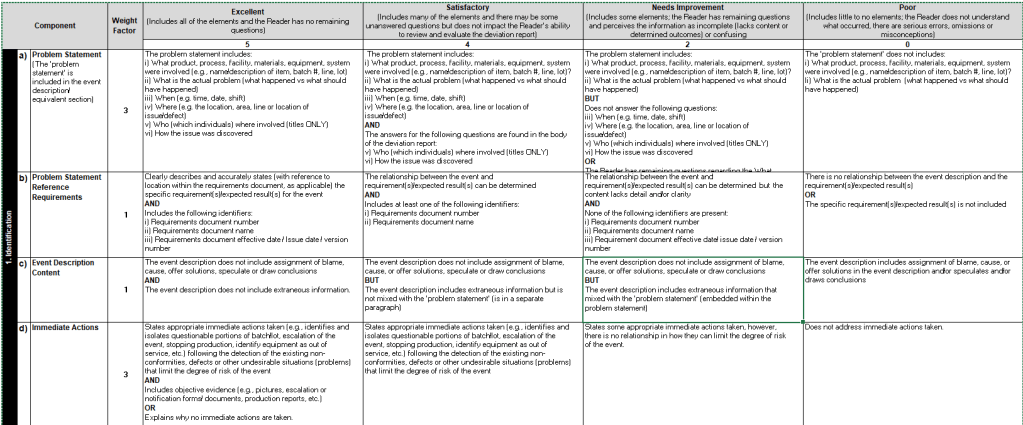
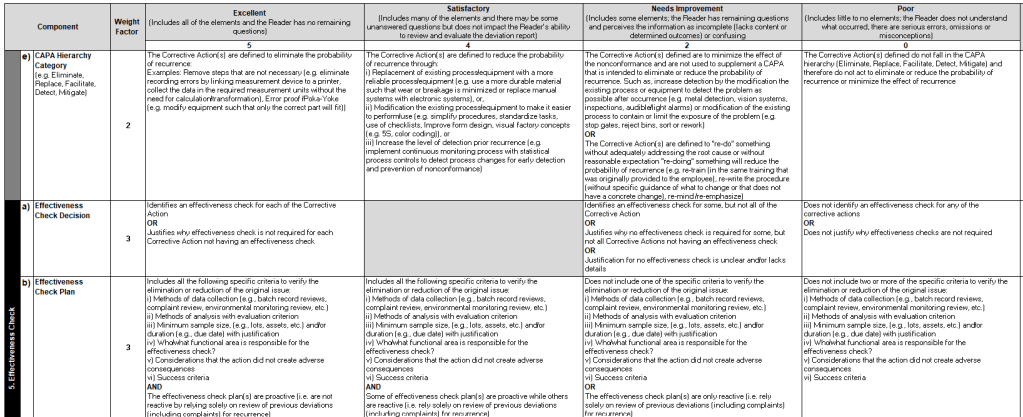
    An example from a deviation rubric

    Benefits of Using Rubrics

    • Clarity and Consistency: Rubrics help clarify expectations for students, ensuring they understand what is required to be good. They also promote consistency across activities.
    • Self-Assessment: Rubrics encourage individuals to reflect on their own work and understand the standards they need to meet. This can lead to improved learning outcomes as individuals become more aware of their progress and areas needing improvement.

    I love rubrics. They are great for all quality systems. They can be used for on-the-job training, for record writing and review, for re-qualifications. By creatin rubrics you define what good looks like by providing a structured and objective framework that improves clarity, consistency, and specificity in evaluations. It holds both the writer and the reviewer accountable.