
Self-checking is one of the most effective tools we can teach and use. Rooted in the four aspects of risk-based thinking (anticipate, monitor, respond, and learn), it refers to the procedures and checks that employees perform as part of their routine tasks to ensure the quality and accuracy of their work. This practice is often implemented in industries where precision is critical, and errors can lead to significant consequences. For instance, in manufacturing or engineering, workers might perform self-checks to verify that their work meets the required specifications before moving on to the next production stage.
A proactive approach enhances the reliability, safety, and quality of various systems and practices by allowing for immediate detection and correction of errors, thereby preventing potential failures or flaws from escalating into more significant issues.
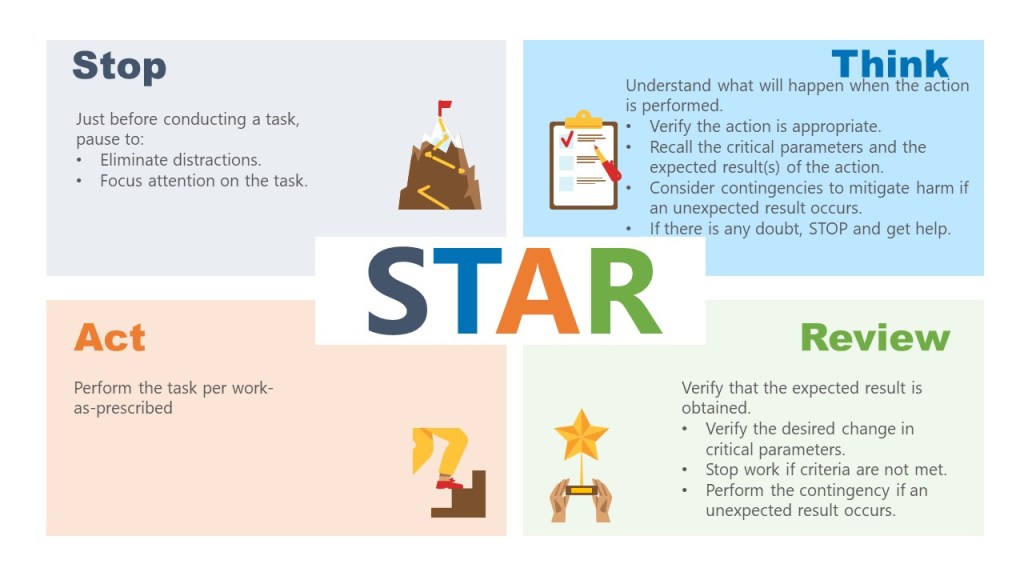
The memory aid STAR (stop, think, act, review) helps the user recall the thoughts and actions associated with self-checking.
- Stop – Just before conducting a task, pause to:
- Eliminate distractions.
- Focus attention on the task.
- Think – Understand what will happen when the action is performed.
- Verify the action is appropriate.
- Recall the critical parameters and the action’s expected result(s).
- Consider contingencies to mitigate harm if an unexpected result occurs.
- If there is any doubt, STOP and get help.
- Act – Perform the task per work-as-prescribed
- Review – Verify that the expected result is obtained.
- Verify the desired change in critical parameters.
- Stop work if criteria are not met.
- Perform the contingency if an unexpected result occurs.
 Investigations of a Dog