
Semantic Meaning

Over on Squire to Giants, Steve Schefer, writes about the semantic drift of the word triage in business talk.

I think it can be a really valuable exercise to consider, and align on semantic meaning of words, even words that may seem to everyone to mean one particular thing, and triage is a great example of that. When we spend time agonizing over words in documents, arguing about glossaries, what we are doing is aligning over semantic usage for terms that may have drifted a lot.

And don’t even get started on cultural appropriation of words.

The technical nature of our work means that semantic change, which is already a natural and inevitable process in language evolution, is going to happen. Words that we regularly use acquire new meanings or shift in their usage over time. Look what we’ve done to the poor word leverage or pipeline for just to examples.

Like data, we need word stewards, the keeper of the glossary. This role is in service to the process owners to enforce them agreeing on terms and using them the same way as possible. This is why I strongly believe in central glossaries. The dangers of not doing this can be impaired communication, with the message being lost or misinterpreted. And that leads to inefficiencies, and errors, and history has shown us those errors can get pretty significant.

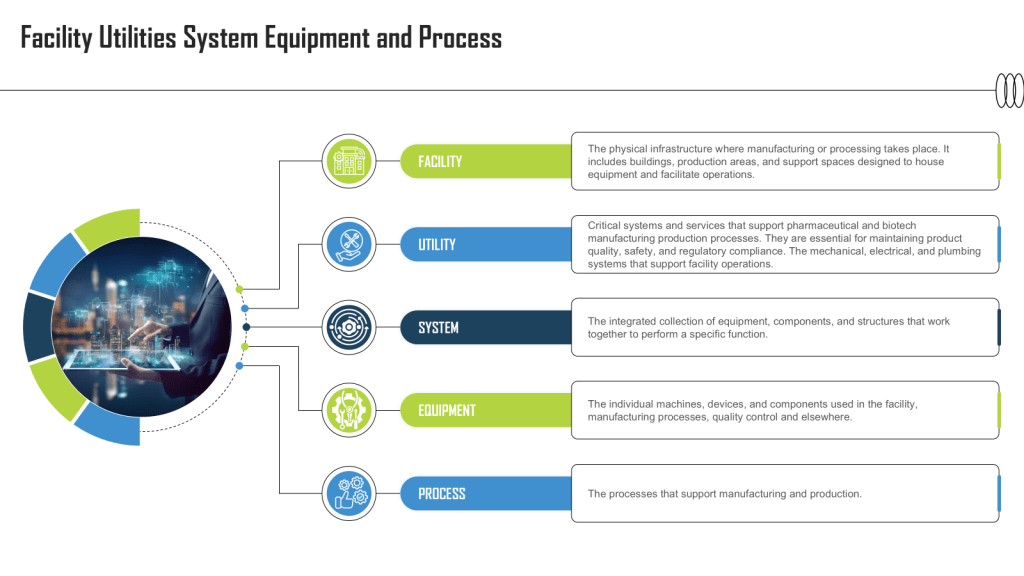
    Photo by Leeloo The First on Pexels.com

    FUSE and FUSE(P) – Definitions

    I’ve been utilizing a few acronyms in a lazy way, and it is important to define them moving forward.

    The acronyms FUSE stands for Facility Utility System Equipment; and FUSE(P) adds Process. This framework is used to describe and manage critical components of systems in facilities, particularly in industrial and pharmaceutical manufacturing settings. Here’s a breakdown of its elements:

    Facility

    This refers to the physical infrastructure where manufacturing or processing takes place. It includes buildings, production areas, and support spaces designed to house equipment and facilitate operations.

    Utility Systems

    Utilities are critical systems and services that support pharmaceutical and biotech manufacturing production processes. They are essential for maintaining product quality, safety, and regulatory compliance. The mechanical, electrical, and plumbing systems that support facility operations. Key utility systems include:

    • Heating, Ventilation, and Air Conditioning (HVAC)
    • Electrical distribution
    • Water systems (purified, process, and domestic)
    • Compressed air and gas systems
    • Waste management systems

    System

    In this context, a system refers to the integrated collection of equipment, components, and structures that work together to perform a specific function.

    Equipment

    This encompasses the individual machines, devices, and components used in the facility, manufacturing processes, quality control and elsewhere. Examples include mixing tanks, filling machines, packaging equipment, and quality control instruments

    Process

    This element refers to the manufacturing or production processes that the facility and its utility systems support. It includes:

    • Production workflows
    • Environmental control
    • Cleaning
    • Computer systems for managing manufacturing and operational processes:

    The FUSE(P) framework emphasizes the interconnected nature of these elements and their collective impact on product quality, safety, and operational efficiency. It guides the design, implementation, and management of facility utility systems to ensure they meet Good Manufacturing Practice (GMP) standards and support reliable production processes.

    The Use of Glossaries

    I’ve gone on record with my disdain for reference sections in documents, and similarly, I am not a huge fan of glossary sections. A glossary section is a point of failure in that the same terms used across documents will inevitably start drifting. A preferred practice is to have a common glossary instead so there is one source of truth. Several eDMS platforms even have this as a feature.

    Go a step further and just use the already existing glossaries. The WHO’s Quality Assurance of Medicines Terminology Database is an underutilized resource in the pharmaceutical quality world. One should use this as a starting point for your glossary or, better yet, only provide terms not in this database. Again, I know of at least one eDMS where you can point the glossary feature at this external database.

    Forms, forms, everywhere

    Unless you work in the factory of the future the chances are you have forms — if you are like me over 1100 of them. So what is a form and how does it fit into our document management system?

    Merriam-Webster Dictionary defines form (amongst other things) as “a printed or typed document with blank spaces for insertion of required or requested information.”

    We use forms to tell what information needs to be captured, and usually to record when and by whom. Forms have the following advantages in our document management system:

    • The user has to write less
    • The user is told or reminded what information has to be supplied
    • There is uniformity
    • Information is collected in writing and so can be reexamined later. Forms almost always have a signature field to allow someone to take responsibility

    It is useful to note here that electronic systems do basically the same thing.

    Returning to our three major types of documents:

    • Functional Documents provide instructions so people can perform tasks and make decisions safely effectively, compliantly and consistently. This usually includes things like procedures, process instructions, protocols, methods and specifications. Many of these need some sort of training decision. Functional documents should involve a process to ensure they are up-to-date, especially in relation to current practices and relevant standards (periodic review)
    • Records provide evidence that actions were taken and decisions were made in keeping with procedures. This includes batch manufacturing records, logbooks and laboratory data sheets and notebooks. Records are a popular target for electronic alternatives.
    • Reports provide specific information on a particular topic on a formal, standardized way. Reports may include data summaries, findings and actions to be taken.

    A form is a functional document that once printed and has data entered onto it becomes a record. That record then needs to be managed and has all sorts of good documentation and data integrity concerns including traceability and retention (archiving).

    It is helpful here to also differentiate between a template and a form. A template is a form that is specifically used to build another document — an SOP template or a protocol template for example. Usually the template gives you a document that then goes through its own lifecycle.