The Annex 15 Revision Is Coming: What It Means for Validation, Control Strategy, and Industry Maturity

On January 19, 2026, the EMA GMP/GDP Inspectors Working Group and PIC/S published a concept paper proposing a targeted revision of EU GMP Annex 15—Qualification and Validation. The public consultation opened on February 9 and runs through April 9, 2026. If you work in active substance manufacturing, or if your drug product quality depends on active substance quality—which is to say, if you work in this industry at all—this document deserves your attention.

The headline is straightforward: Annex 15 will become mandatory for active substance manufacturers. But what makes this revision significant isn’t just the shift from optional to mandatory. It’s what the shift reveals about where the regulatory landscape is heading, and how many of the themes I’ve been writing about on this blog—living risk management, control strategy as connective tissue, the validation lifecycle as a knowledge system—are now being codified into explicit regulatory expectations for a sector that has, frankly, lagged behind.

The Nitrosamine Wake-Up Call

The revision traces its origin directly to the N-nitrosamine crisis in sartan medicines. The EMA’s June 2020 lessons-learnt report was unsparing: one root cause of nitrosamine contamination was “the lack of sufficient process and product knowledge during the development stage and GMP deficiencies by active substance manufacturers, including inadequate investigation of quality issues and insufficient contamination control measures”. This wasn’t a novel finding at the time, but the sartans case gave regulators the political and scientific impetus to act.

Paragraph 4.2.2 of that lessons-learnt report specifically recommended making Annex 15 mandatory for active substance manufacturers to address the shortcomings identified during inspections. It took several years of deliberation—the GMP/GDP IWG formally agreed to proceed at its 115th meeting in September 2024—but the wheels are now turning.

The lesson here is one I’ve returned to repeatedly: knowledge gaps don’t stay dormant. They surface as deviations, contamination events, and regulatory actions. The sartans crisis was, at its core, a failure of process understanding and control strategy—areas where Annex 15 is now being strengthened precisely because too many active substance manufacturers treated validation as peripheral rather than foundational.

What the Concept Paper Actually Proposes

Let me walk through the key elements of the proposed revision, because the specifics matter more than the headline.

Scope Extension

The revised Annex 15 will apply to manufacturers of both chemical and biological active substances. EU and PIC/S inspectorates will enforce compliance during regulatory inspections. This is a paradigm shift for API manufacturers who have historically operated under Part II of the EU GMP Guide with Annex 15 as optional supplementary guidance. The concept paper is clear: “Although annex 15 is not currently mandatory for AS manufacturers, the applicability of its principles in this sector is generally recognised”. In other words, the expectation already existed—now it will have enforcement teeth.

Validation Master File, Policy, and Change Control

The concept paper proposes extending the Validation Master File, the Qualification and Validation Policy, and formal change control requirements to active substance manufacturers. These aren’t new concepts for drug product manufacturers, but their extension to AS manufacturers signals a regulatory expectation of structured, documented validation programs rather than ad hoc approaches.

Change control, in particular, is described as “an important part of knowledge management”. This language is deliberate and echoes what I’ve been writing about in the context of control strategies and the feedback-feedforward controls hub: change control isn’t bureaucratic overhead—it’s the mechanism through which accumulated process knowledge is preserved, evaluated, and applied.

Validation Discrepancies

The revision will extend the requirement to investigate results that fail to meet pre-defined acceptance criteria during validation activities. This extension, the concept paper notes, “will promote AS manufacturers to have a more in-depth knowledge of their processes.” This is one of the most quietly important provisions. In my experience, the gap between drug product and active substance manufacturers is often widest in investigation rigor. Robust investigation of validation failures isn’t just about compliance—it’s about generating the process knowledge that underpins meaningful control strategies.

Qualification Stages: URS, FAT/SAT, DQ/IQ/OQ/PQ

The concept paper extends the formal qualification lifecycle—User Requirements Specifications, Factory Acceptance Testing, Site Acceptance Testing, and the traditional DQ/IQ/OQ/PQ sequence—to active substance manufacturing. For those of us who have worked in the ASTM E2500 and ISPE commissioning and qualification frameworks, this is a natural evolution. As I discussed in my posts on CQV and engineering runs, these qualification stages aren’t separate activities—they form a continuum where each stage builds on the knowledge generated in the previous one. Extending this structured approach to API manufacturing strengthens the design-validation continuum that is essential for robust control strategies.

Process Validation: Development, Concurrent Validation, CPV, and Recovery

Several process validation enhancements are proposed:

  • Emphasis on robust process development: Clarifying that validation begins with development, not with the first PPQ batch.
  • Clarification of concurrent validation: Tightening expectations on when and how concurrent validation may be used.
  • Continuous process verification and hybrid approaches: Extending Stage 3/CPV thinking to active substance manufacturing.
  • Recovery of materials and solvents: Extending validation requirements to solvent and material recovery processes.
  • Supplier qualification: Emphasizing the role of supplier qualification in the validation ecosystem.
  • Periodic review: Reinforcing the expectation that validation is a lifecycle activity, not a one-time event.

This aligns directly with what I wrote about in Continuous Process Verification (CPV) Methodology and Tool Selection: CPV is “not an isolated activity but a continuation of the knowledge gained in earlier stages”. The lifecycle approach—Process Design (Stage 1), Process Qualification (Stage 2), Continued Process Verification (Stage 3)—is being explicitly extended to a sector that has too often treated validation as a discrete project rather than an ongoing program.

Transport Verification

The revision extends expectations for transport verification, linking GMP with Good Distribution Practices (GDP) for active substances. This addresses a gap that has been hiding in plain sight: product knowledge must include understanding of how transportation affects quality. For biologically-derived active substances in particular, this provision acknowledges that the supply chain is part of the process, not external to it.

ICH Q9 (R1) Integration

The concept paper mandates incorporation of ICH Q9 (R1) quality risk management principles throughout validation and qualification activities. Specifically:

  • QRM in the design and validation/qualification of monitoring systems
  • Risk review activities to support ongoing validation and qualification
  • Emphasis on QRM in the context of traditional processes

This integration is overdue. As I discussed in Living Risk in the Validation Lifecycle and Risk Management is a Living Process, effective risk management isn’t a one-time exercise performed during design—it’s a living system that evolves throughout the product lifecycle. ICH Q9 (R1) itself emphasizes that “the level of effort, formality and documentation of the quality risk management process should be commensurate with the level of risk.” It introduces the importance-complexity-uncertainty framework for calibrating risk assessment rigor. The Annex 15 revision will make these principles explicitly applicable to qualification and validation decisions in active substance manufacturing.

Why This Matters: The Industry-Wide Implications

Closing the Knowledge Gap

The fundamental driver of this revision is a knowledge deficit. The nitrosamine crisis exposed what many of us already suspected: a significant number of active substance manufacturers lacked the process understanding necessary to predict, prevent, and detect quality problems. Making Annex 15 mandatory doesn’t automatically create knowledge, but it creates the structural requirements—validation master plans, formal qualification stages, investigation requirements, CPV programs—that force organizations to build and maintain it.

As I explored in Control Strategies, control strategies represent “the central mechanism through which pharmaceutical companies ensure quality, manage risk, and leverage knowledge”. Without the foundational process knowledge that structured validation generates, control strategies are hollow documents. The Annex 15 revision, by mandating the validation activities that generate this knowledge for active substance manufacturers, strengthens the entire control strategy ecosystem from the ground up.

From Compliance Burden to Audit Readiness

In my analysis of the 2025 State of Validation data, I noted a striking reversal: audit readiness has overtaken compliance burden as the industry’s primary validation challenge. This shift reflects a maturation of validation programs—organizations are moving from the scramble to implement validation to the discipline of sustaining it. The Annex 15 revision will push active substance manufacturers through a similar maturation arc. The initial impact will feel like compliance burden. But the long-term trajectory, if organizations approach it with the right mindset, is toward sustained audit readiness grounded in genuine process knowledge.

Risk Management as the Connective Thread

The integration of ICH Q9 (R1) throughout the revised Annex 15 reinforces a theme I’ve been tracking across multiple regulatory developments: risk management is no longer a supporting tool—it’s the connective thread that runs through every quality decision. The parallel revision of EudraLex Chapter 1, the new Annex 11 requirements for computerized systems, and the forthcoming Annex 22 for artificial intelligence all place quality risk management at their center. The Annex 15 revision ensures that qualification and validation are no exception.

This convergence means that organizations need integrated risk management capabilities—not siloed risk assessments performed by different teams for different purposes, but a coherent QRM framework that connects design risk, process risk, facility risk, and supply chain risk into a unified picture. As I wrote in my piece on risk management and change management: “Risk management leads to change management. Change management contains risk management”. The revised Annex 15 makes this cycle explicit for active substance manufacturers.

The Control Strategy Connection

Perhaps the most significant implication is how this revision strengthens the link between validation and control strategy. In Control Strategies, I described how control strategies occupy “that critical program-level space between overarching quality policies and detailed operational procedures” and serve as “the blueprint for how quality will be achieved, maintained, and improved throughout a product’s lifecycle”.

The Annex 15 revision reinforces every dimension of this blueprint for active substance manufacturing:

  • Validation Master File → documents the overall validation approach and connects it to the control strategy
  • Formal qualification stages → ensure that facility and equipment design supports the intended control strategy
  • Process validation with CPV → generates the ongoing data that validates and refines the control strategy
  • Investigation of failures → feeds new knowledge back into the control strategy through the feedback loop
  • Change control as knowledge management → ensures that the control strategy evolves based on accumulated understanding
  • Transport verification → extends the control strategy to encompass the supply chain

This is the feedback-feedforward controls hub in action. Each element of the revised Annex 15 either generates knowledge that feeds into the control strategy or applies knowledge from the control strategy to operational decisions.

The PLCM Document and Established Conditions

Looking forward, this revision also has implications for how active substance manufacturers engage with ICH Q12 concepts. As I discussed in my recent post on the Product Lifecycle Management (PLCM) document, the distinction between comprehensive control strategy elements and Established Conditions is critical for enabling continuous improvement. Active substance manufacturers who build robust validation and knowledge management programs now—in response to the Annex 15 revision—will be better positioned to participate in lifecycle management frameworks that reward process understanding with regulatory flexibility.

The concept paper’s emphasis on “change control as an important part of knowledge management” directly supports this trajectory. Organizations that treat change control as a bureaucratic hurdle will miss the point. Those that treat it as a knowledge capture mechanism will find themselves building the foundation for more sophisticated lifecycle management.

The Timeline and What to Do Now

The proposed timetable is aggressive:

MilestoneDate
Concept paper public consultationFebruary – April 2026
Draft guideline consultationApril – June 2026
EMA GMP/GDP IWG endorsementJuly 2026
Publication by European CommissionDecember 2026
PIC/S adoptionDecember 2026

The concept paper includes four stakeholder questions that are worth engaging with seriously:

  1. What is the current level of use of Annex 15 principles in active substance manufacturing?
  2. What would be the impact of making Annex 15 mandatory?
  3. What is the current understanding and use of ICH Q9 (R1) in active substance manufacturing?
  4. What would be the impact of incorporating Q9 (R1)?

If you manufacture active substances—or if you’re a drug product manufacturer who depends on active substance suppliers—now is the time to:

  • Perform a gap assessment against the current Annex 15 requirements, assuming mandatory application
  • Evaluate your Validation Master Plan or equivalent program documentation for active substance operations
  • Review your qualification lifecycle to ensure URS, FAT/SAT, and formal qualification stages are documented and traceable
  • Assess your CPV program for active substance processes—does it exist? Is it generating actionable knowledge?
  • Examine your investigation process for validation failures against pre-defined acceptance criteria
  • Review your QRM integration into qualification and validation activities against ICH Q9 (R1) expectations
  • Engage with the public consultation by the April 9, 2026 deadline

The Bigger Picture

The concept paper notes that the GMP/GDP IWG also agreed that “a comprehensive review of Annex 15 should be initiated in the future, once the current targeted revision is finished”. This targeted revision is just the beginning. A full-scope revision will likely address the broader evolution of validation thinking—digital systems, advanced analytics, platform approaches—that I’ve been tracking in posts on the evolving validation landscape.

The world of validation is no longer controlled by periodic updates or leisurely transitions. Change is the new baseline. The Annex 15 revision is another data point in a pattern that includes the Annex 1 overhaul, the Annex 11 modernization, the introduction of Annex 22, the ICH Q9 (R1) revision, and the convergence of global regulators around lifecycle, risk-based, and knowledge-driven approaches to quality.

For active substance manufacturers, the message is clear: the era of treating validation as optional supplementary guidance is over. For the rest of us, the message is equally important: the quality of our medicines depends on the quality of knowledge throughout the supply chain, and regulators are now ensuring that the structural requirements to generate and maintain that knowledge extend to every link in the chain.
Evolution of GMP Documentation: Analyzing the Transformative Changes in Draft EU Chapter 4

The draft revision of EU GMP Chapter 4 on Documentation represents more than just an update—it signals a paradigm shift toward digitalization, enhanced data integrity, and risk-based quality management in pharmaceutical manufacturing.

The Digital Transformation Imperative

The draft Chapter 4 emerges from a recognition that pharmaceutical manufacturing has fundamentally changed since 2011. The rise of Industry 4.0, artificial intelligence in manufacturing decisions, and the critical importance of data integrity following numerous regulatory actions have necessitated a complete reconceptualization of documentation requirements.

The new framework introduces comprehensive data governance systems, risk-based approaches throughout the documentation lifecycle, and explicit requirements for hybrid systems that combine paper and electronic elements. These changes reflect lessons learned from data integrity violations that have cost the industry billions in remediation and lost revenue.

Detailed Document Type Analysis

Master Documents: Foundation of Quality Systems

Document TypeCurrent Chapter 4 (2011) RequirementsDraft Chapter 4 (2025) RequirementsFDA 21 CFR 211ICH Q7WHO GMPISO 13485
Site Master FileA document describing the GMP related activities of the manufacturerRefer to EU GMP Guidelines, Volume 4 ‘Explanatory Notes on the preparation of a Site Master File’No specific equivalent, but facility information requirements under §211.176Section 2.5 – Documentation system should include site master file equivalent informationSection 4.1 – Site master file requirements similar to EU GMPQuality manual requirements under Section 4.2.2
Validation Master PlanNot specifiedA document describing the key elements of the site qualification and validation programProcess validation requirements under §211.100 and §211.110Section 12 – Validation requirements for critical operationsSection 4.2 – Validation and qualification programsValidation planning under Section 7.5.6 and design validation

The introduction of the Validation Master Plan as a mandatory master document represents the most significant addition to this category. This change acknowledges the critical role of systematic validation in modern pharmaceutical manufacturing and aligns EU GMP with global best practices seen in FDA and ICH frameworks.

The Site Master File requirement, while maintained, now references more detailed guidance, suggesting increased regulatory scrutiny of facility information and manufacturing capabilities.

Instructions: The Operational Backbone

Document TypeCurrent Chapter 4 (2011) RequirementsDraft Chapter 4 (2025) RequirementsFDA 21 CFR 211ICH Q7WHO GMPISO 13485
SpecificationsDescribe in detail the requirements with which the products or materials used or obtained during manufacture have to conform. They serve as a basis for quality evaluationRefer to glossary for definitionComponent specifications §211.84, drug product specifications §211.160Section 7.3 – Specifications for starting materials, intermediates, and APIsSection 4.12 – Specifications for starting materials and finished productsRequirements specifications under Section 7.2.1
Manufacturing Formulae, Processing, Packaging and Testing InstructionsProvide detail all the starting materials, equipment and computerised systems (if any) to be used and specify all processing, packaging, sampling and testing instructionsProvide complete detail on all the starting materials, equipment, and computerised systems (if any) to be used and specify all processing, packaging, sampling, and testing instructions to ensure batch to batch consistencyMaster production and control records §211.186, production record requirements §211.188Section 6.4 – Master production instructions and batch production recordsSection 4.13 – Manufacturing formulae and processing instructionsProduction and service provision instructions Section 7.5.1
Procedures (SOPs)Give directions for performing certain operationsOtherwise known as Standard Operating Procedures, documented set of instructions for performing and recording operationsWritten procedures required throughout Part 211 for various operationsSection 6.1 – Written procedures for all critical operationsSection 4.14 – Standard operating procedures for all operationsDocumented procedures throughout the standard, Section 4.2.1
Technical/Quality AgreementsAre agreed between contract givers and acceptors for outsourced activitiesWritten proof of agreement between contract givers and acceptors for outsourced activitiesContract manufacturing requirements implied, vendor qualificationSection 16 – Contract manufacturers agreements and responsibilitiesSection 7 – Contract manufacture and analysis agreementsOutsourcing agreements under Section 7.4 – Purchasing

The enhancement of Manufacturing Instructions to explicitly require “batch to batch consistency” represents a crucial evolution. This change reflects increased regulatory focus on manufacturing reproducibility and aligns with FDA’s process validation lifecycle approach and ICH Q7’s emphasis on consistent API production.

Procedures (SOPs) now explicitly encompass both “performing and recording operations,” emphasizing the dual nature of documentation as both instruction and evidence creation1. This mirrors FDA 21 CFR 211’s comprehensive procedural requirements and ISO 13485’s systematic approach to documented procedures910.

The transformation of Technical Agreements into Technical/Quality Agreements with emphasis on “written proof” reflects lessons learned from outsourcing challenges and regulatory enforcement actions. This change aligns with ICH Q7’s detailed contract manufacturer requirements and strengthens oversight of critical outsourced activities.

Records and Reports: Evidence of Compliance

Document TypeCurrent Chapter 4 (2011) RequirementsDraft Chapter 4 (2025) RequirementsFDA 21 CFR 211ICH Q7WHO GMPISO 13485
RecordsProvide evidence of various actions taken to demonstrate compliance with instructions, e.g. activities, events, investigations, and in the case of manufactured batches a history of each batch of productProvide evidence of various actions taken to demonstrate compliance with instructions, e.g. activities, events, investigations, and in the case of manufactured batches a history of each batch of product, including its distribution. Records include the raw data which is used to generate other recordsComprehensive record requirements throughout Part 211, §211.180 general requirementsSection 6.5 – Batch production records and Section 6.6 – Laboratory control recordsSection 4.16 – Records requirements for all GMP activitiesQuality records requirements under Section 4.2.4
Certificate of AnalysisProvide a summary of testing results on samples of products or materials together with the evaluation for compliance to a stated specificationProvide a summary of testing results on samples of products or materials together with the evaluation for compliance to a stated specificationLaboratory records and test results §211.194, certificate requirementsSection 11.15 – Certificate of analysis for APIsSection 6.8 – Certificates of analysis requirementsTest records and certificates under Section 7.5.3
ReportsDocument the conduct of particular exercises, projects or investigations, together with results, conclusions and recommendationsDocument the conduct of exercises, studies, assessments, projects or investigations, together with results, conclusions and recommendationsInvestigation reports §211.192, validation reportsSection 15 – Complaints and recalls, investigation reportsSection 4.17 – Reports for deviations, investigations, and studiesManagement review reports Section 5.6, validation reports

The expansion of Records to explicitly include “raw data” and “distribution information” represents perhaps the most impactful change for day-to-day operations. This enhancement directly addresses data integrity concerns highlighted by regulatory inspections and enforcement actions globally. The definition now states that “Records include the raw data which is used to generate other records,” establishing clear expectations for data traceability that align with FDA’s data integrity guidance and ICH Q7’s comprehensive record requirements.

Reports now encompass “exercises, studies, assessments, projects or investigations,” broadening the scope beyond the current “particular exercises, projects or investigations”. This expansion aligns with modern pharmaceutical operations that increasingly rely on various analytical studies and assessments for decision-making, matching ISO 13485’s comprehensive reporting requirements.

Revolutionary Framework Elements

Data Governance Revolution

The draft introduces an entirely new paradigm through its Data Governance Systems (Sections 4.10-4.18). This framework establishes:

  • Complete lifecycle management from data creation through retirement
  • Risk-based approaches considering data criticality and data risk
  • Service provider oversight with periodic review requirements
  • Ownership accountability throughout the data lifecycle

This comprehensive approach exceeds traditional GMP requirements and positions EU regulations at the forefront of data integrity management, surpassing even FDA’s current frameworks in systematic approach.

ALCOA++ Formalization

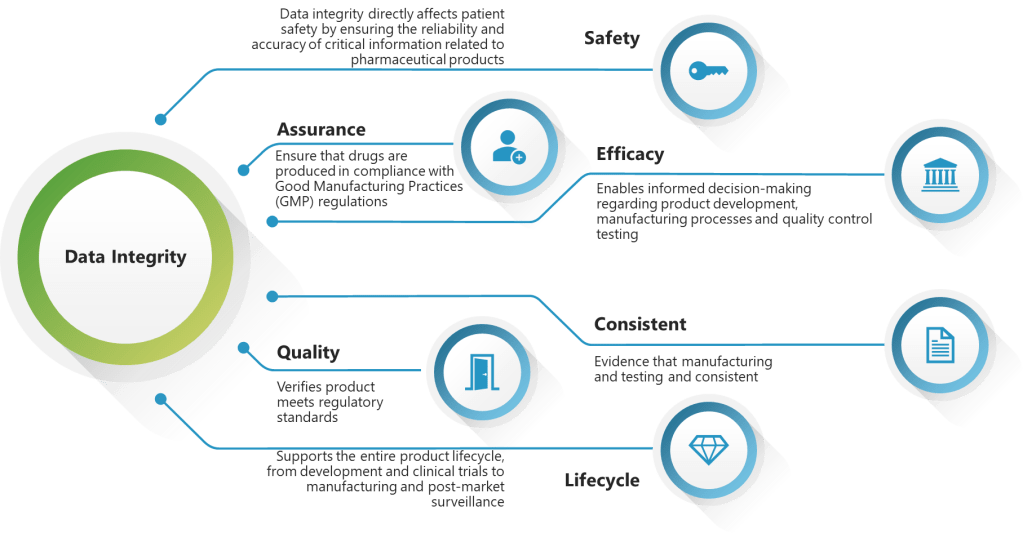
The draft formalizes ALCOA++ principles (Attributable, Legible, Contemporaneous, Original, Accurate, Complete, Consistent, Enduring, Available, Traceable) with detailed definitions for each attribute. This represents a major comprehensive regulatory codification of these principles, providing unprecedented clarity for industry implementation.

ALCOA++ Principles: Comprehensive Data Integrity Framework

The Draft EU GMP Chapter 4 (2025) formalizes the ALCOA++ principles as the foundation for data integrity in pharmaceutical manufacturing. This represents the first comprehensive regulatory codification of these expanded data integrity principles, building upon the traditional ALCOA framework with five additional critical elements.

Complete ALCOA++ Requirements Table

PrincipleCore RequirementPaper ImplementationElectronic Implementation
A – AttributableIdentify who performed the task and whenSignatures, dates, initialsUser authentication, e-signatures
L – LegibleInformation must be readable and unambiguousClear writing, permanent inkProper formats, search functionality
C – ContemporaneousRecord actions as they happen in real-timeImmediate recordingSystem timestamps, workflow controls
O – OriginalPreserve first capture of informationOriginal documents retainedDatabase integrity, backups
A – AccurateEnsure truthful representation of factsTraining, calibrated equipmentSystem validation, automated checks
+ CompleteInclude all critical information and metadataComplete data, no missing pagesMetadata capture, completeness checks
+ ConsistentStandardize data creation and processingStandard formats, consistent unitsData standards, validation rules
+ EnduringMaintain records throughout retention periodArchival materials, proper storageDatabase integrity, migration plans
+ AvailableEnsure accessibility for authorized personnelOrganized filing, access controlsRole-based access, query capabilities
+ TraceableEnable tracing of data history and changesSequential numbering, change logsAudit trails, version control

Hybrid Systems Management

Recognizing the reality of modern pharmaceutical operations, the draft dedicates sections 4.82-4.85 to hybrid systems that combine paper and electronic elements. This practical approach acknowledges that many manufacturers operate in mixed environments and provides specific requirements for managing these complex systems.

A New Era of Pharmaceutical Documentation

The draft EU GMP Chapter 4 represents the most significant evolution in pharmaceutical documentation requirements in over a decade. By introducing comprehensive data governance frameworks, formalizing data integrity principles, and acknowledging the reality of digital transformation, these changes position European regulations as global leaders in modern pharmaceutical quality management.

For industry professionals, these changes offer both challenges and opportunities. Organizations that proactively embrace these new paradigms will not only achieve regulatory compliance but will also realize operational benefits through improved data quality, enhanced decision-making capabilities, and reduced compliance costs.

The evolution from simple documentation requirements to comprehensive data governance systems reflects the maturation of the pharmaceutical industry and its embrace of digital technologies. As we move toward implementation, the industry’s response to these changes will shape the future of pharmaceutical manufacturing for decades to come.

The message is clear: the future of pharmaceutical documentation is digital, risk-based, and comprehensive. Organizations that recognize this shift and act accordingly will thrive in the new regulatory environment, while those that cling to outdated approaches risk being left behind in an increasingly sophisticated and demanding regulatory landscape.

Validation Planning – A visual approach

Normally, when I write a blog post, I include the graphics, but I decided to separate them out to show some of my thought processes for designing slides.

I start with a nice slide that introduces the topic I am going to discuss, introducing the main concept, the Validation Master Plan (VMP), and the Validation Plan (VP.)

My next slide details the Validation Master Plan in more depth, covering the VMP’s core characteristics.

Then dive into the reasons for having a VMP.

Then cover the Validation plan characteristics.

These are still rather wordy, and I think the last slide can be divided into two. But I have a pretty good training here.

Validation Planning in the Quality System

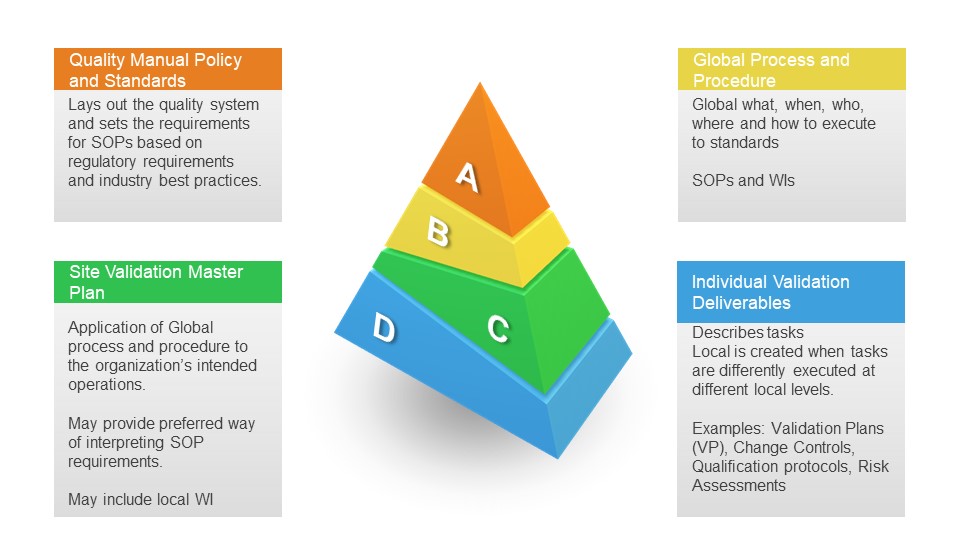
The Validation Master Plan (VMP) and Validation Plan (VP) are integral to the validation process but differ significantly in their scope, detail, and application. The VMP provides a strategic and comprehensive outline for validation activities (often capturing the whole commissioning/qualification/validation lifecycle) across an organization, ensuring compliance and coherence. The VP, derived from the VMP, focuses on specific validation projects, detailing the procedures, responsibilities, and requirements needed to achieve compliance for those specific systems or projects.

Validation Master Plan (VMP)

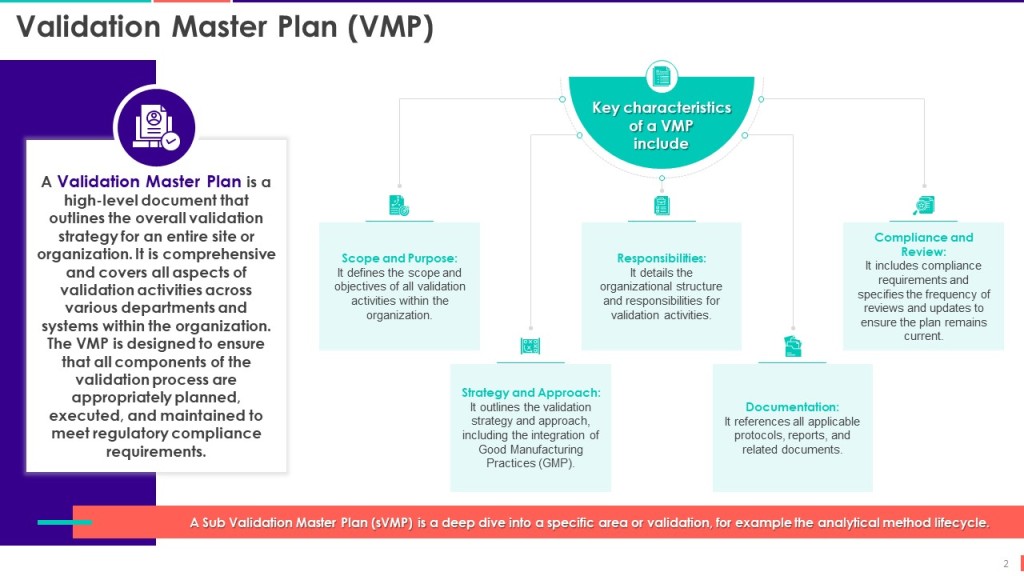
A Validation Master Plan is a high-level document that outlines the overall validation strategy for an entire site or organization. It is comprehensive and covers all aspects of validation activities across various departments and systems within the organization. The VMP is designed to ensure that all components of the validation process are appropriately planned, executed, and maintained to meet regulatory compliance requirements.

Key characteristics of a VMP include:

  • Scope and Purpose: It defines the scope and objectives of all validation activities within the organization.
  • Strategy and Approach: It outlines the validation strategy and approach, including integrating Good Manufacturing Practices (GMP).
  • Responsibilities: It details the organizational structure and responsibilities for validation activities.
  • Documentation: It references all applicable protocols, reports, and related documents.
  • Compliance and Review: It includes compliance requirements and specifies the frequency of reviews and updates to ensure the plan remains current.

A Subvalidation Master Plan (sVMP) is a deep dive into a specific area or validation, such as the analytical method lifecycle.

The purpose of a Validation Master Plan (VMP) is multifaceted, primarily serving as a comprehensive document that outlines the strategy for validation activities within an organization. It is designed to ensure that all validation processes are conducted correctly and comply with regulatory standards.

Here are the key purposes of a VMP:

  1. Documentation of Compliance Requirements: The VMP documents the organization’s compliance requirements, ensuring that all validation activities meet the necessary regulatory standards.
  2. Strategic Planning: Acts as a roadmap for validation, detailing what, how, and when validation activities will be executed. This includes the lifecycle of the manufacturing validation process and integrates Good Manufacturing Practices (GMP).
  3. Resource Planning: The VMP identifies anticipated resource needs and provides key input into scheduling project timelines, which is crucial for efficient validation execution.
  4. Control and Direction: The VMP controls and defines different parts of the production process to ensure consistency over time and directs validation strategies for instruments and systems.
  5. Risk Mitigation: The VMP helps mitigate risks associated with product manufacturing by outlining the validation approach and specific validation activities.
  6. Educational Tool: The VMP informs and educates senior management and other stakeholders about the importance of validation in terms of its impact on product quality, thereby fostering an understanding and support for validation activities.
  7. Regulatory Audit Support: It provides essential documentation regulators require during an audit, demonstrating the organization’s control over quality and compliance with GMPs.
  8. Organizational Alignment: The VMP enables stakeholders within the organization to unify around the details of the validation strategy, eliminating ambiguity and justifying validation activities internally and externally.

The Validation Master Plan is crucial for ensuring that all aspects of validation are planned, executed, and documented in accordance with regulatory requirements and organizational goals. It serves as a compliance tool and a strategic guide for managing and conducting validation activities effectively.

Validation Plan (VP)

A Validation Plan (VP) is more specific and detailed than a VMP and is typically written for a particular validation project or system. The VP focuses on the specific validation activities for individual pieces of equipment, systems, or processes and is derived from the broader directives set out in the VMP.

Key characteristics of a VP include:

  • Detailed Scope and Objectives: It describes what is to be validated, the specific tasks to be performed, and the expected outcomes.
  • Project-Specific Details: These include timelines, specific procedures, and responsibilities for the particular validation project.
  • Risk Assessments and Requirements: It details the risk assessments, quality parameters, and regulatory requirements specific to the system or project being validated.

Differences and Relationship

Level of Detail: The VMP is a high-level document that provides an overarching framework and strategy for validation activities across an organization. In contrast, a VP is a detailed, project-specific document that outlines the execution of validation activities for specific systems or projects.

Purpose and Use: The VMP sets the stage for all validation efforts within an organization and ensures consistency and compliance with industry standards. The VP, derived from the VMP, focuses on specific validation tasks and how they will be accomplished.

Scope: While the VMP covers an organization’s entire validation program, a VP is limited to a particular project or system.

Periodic Review and Updates

A Validation Master Plan (VMP) should be reviewed and updated regularly to remain current and effective. The specific frequency of these reviews can vary depending on the organization’s needs, the complexity of the systems, and regulatory requirements. However, it is generally recommended that a VMP be reviewed at least annually.

This annual review is crucial to address any changes in the manufacturing process, regulatory updates, or modifications in the validation strategy. The review process should include evaluating the progress of validation activities, assessing the impact of any changes in the process or equipment, and updating the plan to reflect new or altered validation requirements.

Additionally, the VMP should be updated whenever significant changes occur that could affect the validation status of the systems or processes described in the plan. This could include major equipment upgrades, product design changes, or regulatory standard shifts.

Validation Plans (VP) should be revised based on changes in the project’s scope. Sometimes, a VP may be opened for an extended period of time for a complex project, in which case it should be evaluated for accuracy and completeness based on the project lifecycle.