The concepts of work-as-imagined, work-as-prescribed, work-as-done, work-as-disclosed, and work-as-reported have been discussed and developed primarily within the field of human factors and ergonomics. These concepts have been elaborated by various experts, including Steven Shorrock, who has written extensively on the topic and I cannot recommend enough.
Work-as-Imagined: This concept refers to how people think work should be done or imagine it is done. It is often used by policymakers, regulators, and managers who design work processes without direct involvement in the actual work.
Work-as-Prescribed: This involves the formalization of work through rules, procedures, and guidelines. It is how work is officially supposed to be done, often documented in organizational standards.
Work-as-Done: This represents the reality of how work is actually performed in practice, including the adaptations and adjustments made by workers to meet real-world demands.
Work-as-Disclosed: Also known as work-as-reported or work-as-explained, this is how people describe or report their work, which may differ from both work-as-prescribed and work-as-done due to various factors, including safety and organizational culture[3][4].
Work-as-Reported: This term is often used interchangeably with work-as-disclosed and refers to the accounts of work provided by workers, which may be influenced by what they believe should be communicated to others.
Work-as-Measured: The quantifiable aspects of work that are tracked and assessed, often focusing on performance metrics and outcomes
ISO9001:2015 states “Top management shall review the organization’s quality management system, at planned intervals, to ensure its continuing suitability, adequacy, effectiveness and alignment with the strategic direction of the organization.”
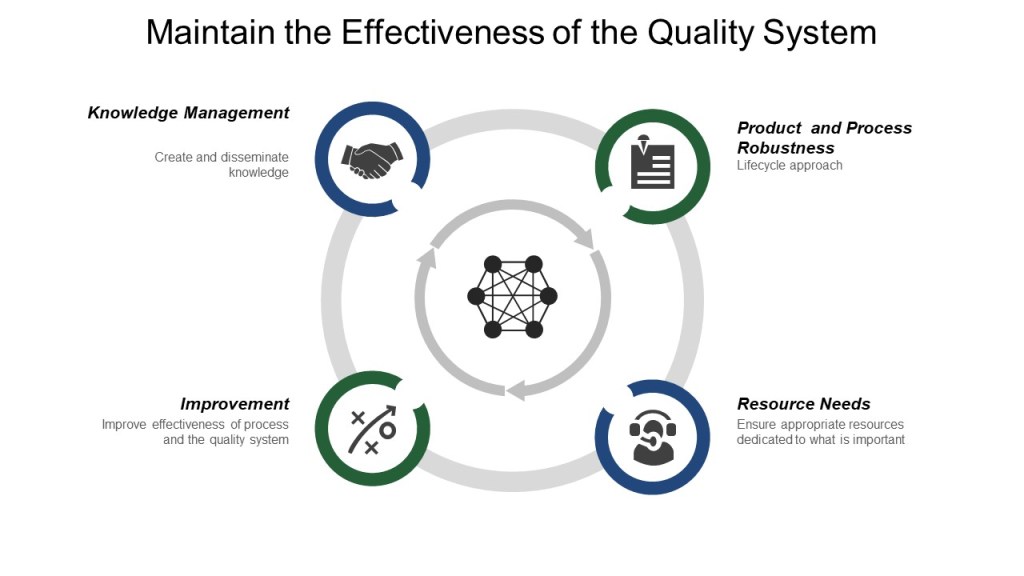
Management review takes inputs of system performance and converts it to outputs that drive improvement.
Just about every standard and guidance aligns with the ISO9001:2015 structure.
The Use of PowerPoint in Management Review
Everyone makes fun of PowerPoint, and yet it is still with us. As a mechanism for formal communication it is the go-to form, and I do not believe that will change anytime soon.
One of the best pieces of research on PowerPoint and management review is Kaplan’s examination of PowerPoint slides used in a manufacturing firm. Kaplan found that generating slides was “embedded in the discursive practices of strategic knowledge production” and made up “part of the epistemic machinery that undergirds the know-ledge production culture.” Further, “the affordances of PowerPoint,” Kaplan pointed out, “enabled the difficult task of collaborating to negotiate meaning in an uncertain environment, creating spaces for discussion, making recombinations possible, [and] allowing for adjustments as ideas evolved”. She concluded that PowerPoint slide decks should be regarded not as merely effective or ineffective reports but rather as an essential part of strategic decision making.
Kaplan’s findings are not isolated, there is a broad wealth of relevant research in the fields of genre and composition studies as well as research on material objects that draw similar conclusions. Powerpoint, as a method of formal communication, can be effective.
Management Review as Formal Communication
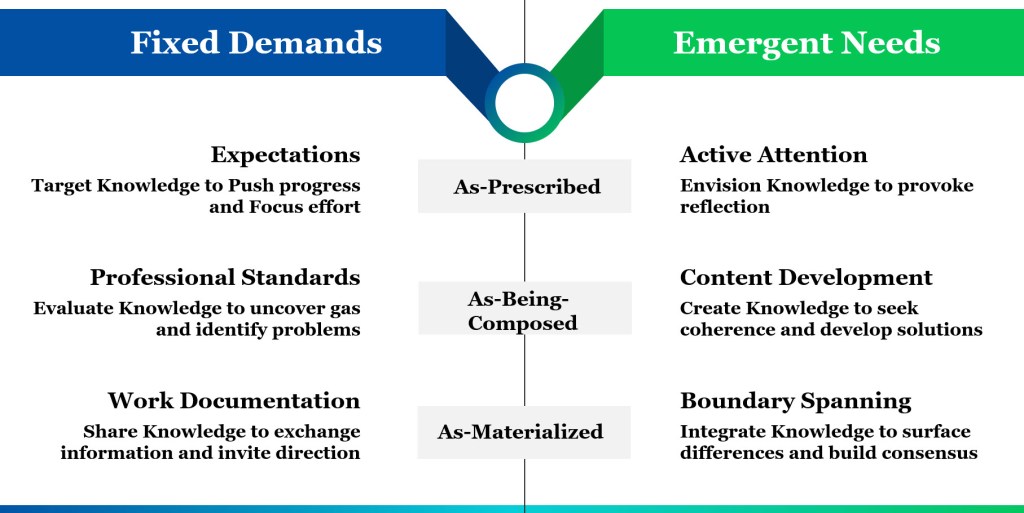
Management review is a formal communication and by understanding how these formal communications participate in the fixed and emergent conditions of knowledge work as prescribed, being-composed, and materialized-texts-in-use, we can understand how to better structure our knowledge sharing.
Management review mediates between Work-As-Imagined and Work-As-Done.
The quality management reviews have “fixity” and bring a reliable structure to the knowledge-work process by specifying what needs to become known and by when, forming a step-by-step learning process.
As-Being-Composed
Quality management always starts with a plan for activities, but in the process of providing analysis through management review, the organization learns much more about the topic, discovers new ideas, and uncover inconsistencies in our thinking that cause us to step back, refine, and sometimes radically change our plan. By engaging in the writing of these presentations we make the tacit knowledge explicit.
A successful management review imagines the audience who needs the information, asks questions, raises objections, and brings to the presentation a body of experience and a perspective that differs from that of the party line. Management review should be a process of dialogue that draws inferences and constructs relationships between ideas, apply logic to build complex arguments, reformulate ideas, reflects on what is already known, and comes to understand the material in a new way.
As-Materialized
Management review is a textually mediated conversation that enables knowledge integration within and across groups in, and outside of, the organization. The records of management review are focal points around which users can discuss what they have learned, discover diverse understandings, and depersonalize debate. Management review records drive the process of incorporating the different domain specific knowledge of various decision makers and experts into some form of systemic group knowledge and applies that knowledge to decision making and action.
Sources
Alvesson, M. (2004). Knowledge work and knowledge-intensive firms. Oxford University Press.
Bazerman, C. (2003). What is not institutionally visible does not count: The problem of making activity assessable, accountable, and plannable. In C. Bazerman & D. Russell (Eds.), Writing selves/writing societies: Research from activity perspectives (pp. 428–482). WAC Clearinghouse
Edmondson, A. C. (2012). Teaming: How organizations learn, innovate, and compete in the knowledge economy. Jossey-Bass
Kaplan, S. (2015). Strategy and PowerPoint: An inquiry into the epistemic culture and machinery of strategy making. Organization Science, 22, 320–346.
Levitin, D. J. (2014). The organized mind: Thinking straight in the age of information overload. Penguin
Mengis, J. (2007). Integrating knowledge through communication: The case of experts and decision makers. In Proceedings of the 2007 International Conference on Organizational Knowledge, Learning, and Capabilities (pp. 699–720). OLKC. Retrieved from https://warwick.ac.uk/fac/soc/wbs/conf/olkc/archive/olkc2/papers/mengis.pdf

 Investigations of a Dog