
Building a Part 11/Annex 11 Course

I have realized I need to build a Part 11 and Annex 11 course. I’ve evaluated some external offerings and decided they really lack that applicability layer, which I am going to focus on.

Here are my draft learning objectives.

21 CFR Part 11 Learning Objectives

  1. Understanding Regulatory Focus: Understand the current regulatory focus on data integrity and relevant regulatory observations.
  2. FDA Requirements: Learn the detailed requirements within Part 11 for electronic records, electronic signatures, and open systems.
  3. Implementation: Understand how to implement the principles of 21 CFR Part 11 in both computer hardware and software systems used in manufacturing, QA, regulatory, and process control.
  4. Compliance: Learn to meet the 21 CFR Part 11 requirements, including the USFDA interpretation in the Scope and Application Guidance.
  5. Risk Management: Apply the current industry risk-based good practice approach to compliant electronic records and signatures.
  6. Practical Examples: Review practical examples covering the implementation of FDA requirements.
  7. Data Integrity: Understand the need for data integrity throughout the system and data life cycles and how to maintain it.
  8. Cloud Computing and Mobile Applications: Learn approaches to cloud computing and mobile applications in the GxP environment.

EMA Annex 11 Learning Objectives

  1. General Guidance: Understand the general guidance on managing risks, personnel responsibilities, and working with third-party suppliers and service providers.
  2. Validation: Learn best practices for validation and what should be included in validation documentation.
  3. Operational Phase: During the operational phase, gain knowledge on data management, security, and risk minimization for computerized systems.
  4. Electronic Signatures: Understand the requirements for electronic signatures and how they should be permanently linked to the respective record, including time and date.
  5. Audit Trails: Learn about the implementation and review of audit trails to ensure data integrity.
  6. Security Access: Understand the requirements for security access to protect electronic records and electronic signatures.
  7. Data Governance: Evaluate the requirements for a robust data governance system.
  8. Compliance with EU Regulations: Learn how to align with Annex 11 to ensure compliance with related EU regulations.

Course Outline: 21 CFR Part 11 and EMA Annex 11 for IT Professionals

Module 1: Introduction and Regulatory Overview

  • History and background of 21 CFR Part 11 and EMA Annex 11
  • Purpose and scope of the regulations
  • Applicability to electronic records and electronic signatures
  • Regulatory bodies and enforcement

Module 2: 21 CFR Part 11 Requirements

  • Subpart A: General Provisions
  • Definitions of key terms
  • Implementation and scope
  • Subpart B: Electronic Records
  • Controls for closed and open systems
  • Audit trails
  • Operational and device checks
  • Authority checks
  • Record retention and availability
  • Subpart C: Electronic Signatures
  • General requirements
  • Electronic signature components and controls
  • Identification codes and passwords

Module 3: EMA Annex 11 Requirements

  • General requirements
  • Risk management
  • Personnel roles and responsibilities
  • Suppliers and service providers
  • Project phase
  • User requirements and specifications
  • System design and development
  • System validation
  • Testing and release management
  • Operational phase
  • Data governance and integrity
  • Audit trails and change control
  • Periodic evaluations
  • Security measures
  • Electronic signatures
  • Business continuity planning

Module 4: PIC/S Data Integrity Requirements

  • Data Governance System
    • Structure and control of the Quality Management System (QMS)
    • Policies related to organizational values, quality, staff conduct, and ethics
  • Organizational Influences
    • Roles and responsibilities for data integrity
    • Training and awareness programs
  • General Data Integrity Principles
    • ALCOA+ principles (Attributable, Legible, Contemporaneous, Original, Accurate, Complete, Consistent, Enduring, and Available)
    • Data lifecycle management
  • Specific Considerations for Computerized Systems
    • Qualification and validation of computerized systems
    • System security and access controls
    • Audit trails and data review
    • Management of hybrid systems
  • Outsourced Activities
    • Data integrity considerations for third-party suppliers
    • Contractual agreements and oversight
  • Regulatory Actions and Remediation
    • Responding to data integrity issues
    • Remediation strategies and corrective actions
  • Periodic System Evaluation
    • Regular reviews and re-validation
    • Risk-based approach to system updates and maintenance

Module 5: Compliance Strategies and Best Practices

  • Interpreting regulatory guidance documents
  • Conducting risk assessments
  • Our validation approach
  • Leveraging suppliers and third-party service providers
  • Implementing audit trails and electronic signatures
  • Data integrity and security controls
  • Change and configuration management
  • Training and documentation requirements

Module 6: Case Studies and Industry Examples

  • Review of FDA warning letters and 483 observations
  • Lessons learned from industry compliance initiatives
  • Practical examples of system validation and audits

Module 7: Future Trends and Developments

  • Regulatory updates and revisions
  • Impact of new technologies (AI, cloud, etc.)
  • Harmonization efforts between global regulations
  • Continuous compliance monitoring

The course will include interactive elements such as hands-on exercises, quizzes, and group discussions to reinforce the learning objectives. The course will provide practical insights for IT professionals by focusing on real-world examples from our company.
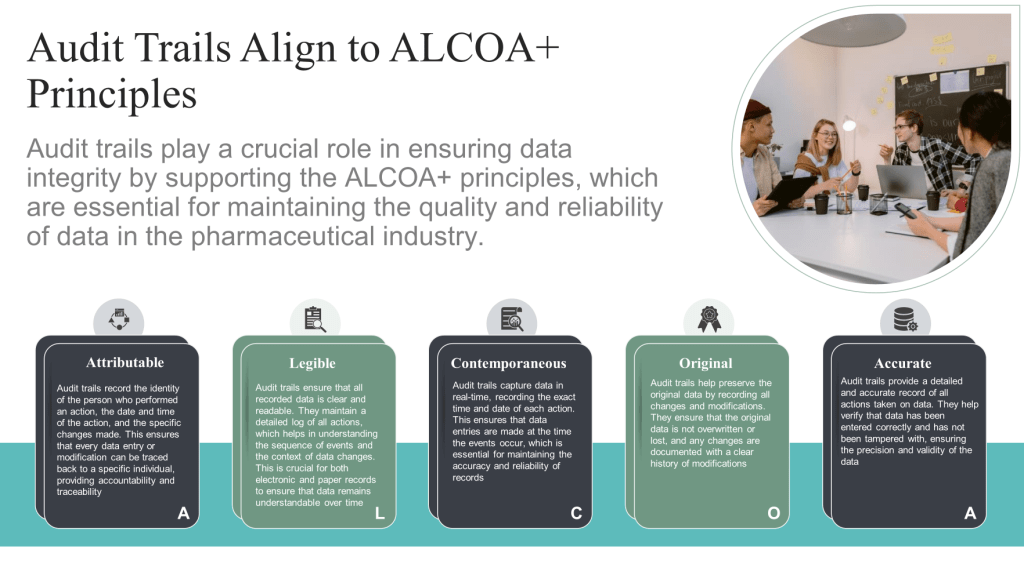
The Audit Trail and Data Integrity

Requirement

Description

Attributable (Traceable)

  • Each audit trail entry must be attributable to the individual responsible for the direct data input so all changes or creation of data with the persons making those changes. When using a user’s unique ID, this must identify an individual pers on.
  • Each audit trail must be linked to the relevant record throughout the data life cycle.

Legible

  • The system should be able to print or provide an electronic copy of the audit trail.
  • The audit trail must be available in a meaningful format when. viewed in the system or as hardcopy.

Contemporaneous

  • Each audit trail entry must be date- and time-stamped according to a controlled clock which cannot be altered. The time should either be based on central server time or a local time, so long as it is clear in which time zone the entry was performed.

Original

  • The audit trail should retain the dynamic functionalities found in the computerized system, included search functionality to facilitate audit trail review activities.

Accurate

  • Audit trail functionality must be verified to ensure the data written to the audit trail equals the data entered or system generated.
  • Audit trail data must be stored in a secure manner and users cannot have the ability to amend, delete, or switch off the audit trail. Where a system administrator amends, or switches off the audit trail, a record of that action must be retained.

Complete

  • The audit trail entries must be automatically captured by the computerized system whenever an electronic record is created, modified, or deleted.
  • Audit trails, at minimum, must record all end user initiated processes related to critical data. The following parameters must be included:
    • The identity of the person performing the action.
    • In the case of a change or deletion, the detail of the change or deletion, and a record of the original entry.
    • The reason for any GxP change or deletion.
    • The time and date when the action was performed.

Consistent

  • Audit trails are used to review, detect, report, and address data integrity issues.
  • Audit trail reviewers must have appropriate training, system knowledge and knowledge of the process to perform the audit trail review. The review of the relevant audit trails must be documented.
  • Audit trail discrepancies must be addressed, investigated, and escalated to JEB management and national authorities, as necessary.

Enduring

  • The audit trail must be retained for the same duration as the associated electronic record.

Available

  • The audit trail must be available for review at any time by inspectors and auditors during the required retention period.
  • The audit trail must be accessible in a human readable format.

21CFR Part 11 Requirements

Definition: An audit trail is a secure, computer-generated, time-stamped electronic record that allows for the reconstruction of events related to the creation, modification, and deletion of an electronic record.

Requirements:

  • Availability: Audit trails must be easily accessible for review and copying by the FDA during inspections.
  • Automation: Entries must be automatically captured by the system without manual intervention.
  • Components: Each entry must include a timestamp, user ID, original and new values, and reasons for changes where applicable.
  • Security: Audit trail data must be securely stored and not accessible for editing by users

EMA Annex 11 (Eudralex Volume 4) Requirements

Definition: Audit trails are records of all GMP-relevant changes and deletions, created by the system to ensure traceability and accountability.

Requirements:

  • Risk-Based Approach: Building audit trails into the system for all GMP-relevant changes and deletions should be considered based on a risk assessment.
  • Documentation: The reasons for changes or deletions must be documented.
  • Review: Audit trails must be available, convertible into a generally readable form, and regularly reviewed.
  • Validation: The audit trail functionality must be validated to ensure it captures all necessary data accurately and securely.

Requirements from PIC/S GMP Data Integrity Guidance

Definition: Audit trails are metadata recorded about critical information such as changes or deletions of GMP/GDP relevant data to enable the reconstruction of activities.

Requirements:

  • Review: Critical audit trails related to each operation should be independently reviewed with all other records related to the operation, especially before batch release.
  • Documentation: Significant deviations found during the audit trail review must be fully investigated and documented.

That Vacation Helps Your Creativity, Schedule Now

It is almost summer in the northern hemisphere, and if you are like me, you are scratching your head, thinking, “I probably should have scheduled some vacation time by now.” So, if you haven’t done that yet, now is the time.

There are many reasons to take a vacation, but since I’ve been writing about critical thinking and creativity this week, here are a few specific reasons a vacation can help.

1. Mental Detachment and Relaxation

Vacations provide a break from the daily routine and work-related stress, allowing the mind to relax and recover. This mental detachment is crucial for creativity as it helps in reducing cognitive fatigue and stress, which can otherwise stifle creative thinking. Studies have shown that employees often perceive increased creativity about two weeks after returning from vacation, suggesting that the recovery period allows for restoring cognitive resources.

2. Exposure to Novel Experiences

Traveling introduces individuals to new environments, cultures, and experiences, which can stimulate the brain and foster creative thinking. The sensory overload from new sights, sounds, tastes, and textures can inspire new ideas and perspectives. Engaging with different cultures and stepping out of one’s comfort zone can challenge existing thought patterns and encourage innovative thinking.

3. Mastery Experiences

Vacations that include learning new skills or engaging in challenging activities can enhance creativity. Mastery experiences, such as learning a new language or trying a new sport, can boost self-efficacy and cognitive flexibility, which are important for creative problem-solving.

4. Reduction of Stress

Lower stress levels during vacations can lead to better mental health and cognitive functioning. Reduced stress allows for better focus and mental clarity, which is essential for creative thinking.

5. Increased Openness and Confidence

Traveling can increase openness to new experiences and boost confidence. This openness is linked to higher levels of creativity as it involves curiosity, imagination, and a willingness to explore new ideas. Confidence gained from overcoming travel-related challenges can also translate into a greater willingness to take creative risks in other areas of life.

6. Time for Reflection

Vacations often provide moments of solitude and reflection, which can lead to deeper insights and creative ideas. The downtime allows individuals to process their experiences and thoughts, often leading to new connections and innovative solutions.


The Use of Glossaries

I’ve gone on record with my disdain for reference sections in documents, and similarly, I am not a huge fan of glossary sections. A glossary section is a point of failure in that the same terms used across documents will inevitably start drifting. A preferred practice is to have a common glossary instead so there is one source of truth. Several eDMS platforms even have this as a feature.

Go a step further and just use the already existing glossaries. The WHO’s Quality Assurance of Medicines Terminology Database is an underutilized resource in the pharmaceutical quality world. One should use this as a starting point for your glossary or, better yet, only provide terms not in this database. Again, I know of at least one eDMS where you can point the glossary feature at this external database.

Build Wonder in the Organization

A sense of wonder significantly enhances critical thinking by fostering curiosity, creativity, and deeper engagement with the subject matter.

  1. Curiosity and Inquiry: Wonder naturally leads to curiosity, prompting individuals to ask questions and seek answers. This inquisitive mindset is a cornerstone of critical thinking, as it drives the exploration of new ideas and the examination of existing knowledge.
  2. Engagement and Motivation: Experiencing awe and wonder can make learning more engaging and enjoyable. This emotional engagement motivates individuals to delve deeper into subjects, enhancing their understanding and retention of information.
  3. Creativity and Imagination: Wonder stimulates the imagination, allowing individuals to think beyond conventional boundaries and explore new possibilities. This creative thinking is essential for problem-solving and innovation. Critical thinking involves analyzing information and synthesizing new ideas, which is facilitated by a sense of wonder.
  4. Empathy and Perspective-Taking: Wonder can also foster empathy by encouraging individuals to see the world from different perspectives. This empathetic understanding is crucial for critical thinking, allowing for a more comprehensive and nuanced analysis of issues.
  5. Mindfulness and Reflection: Engaging with wonder often involves mindfulness and reflection, which are essential for critical thinking. Taking time to contemplate and reflect on experiences allows individuals to process information more thoroughly and develop well-reasoned conclusions. This reflective practice helps shift perspectives and integrate new knowledge.
Photo by Magda Ehlers: https://www.pexels.com/photo/brown-monkey-photo-767197/

Building a sense of wonder in the workplace involves creating an environment that encourages curiosity, creativity, and engagement.

1. Encourage Curiosity and Open-Mindedness

  • Ask Open-Ended Questions: Encourage open-ended questions that stimulate thinking and discussion to promote a culture where employees feel comfortable asking questions and exploring new ideas.
  • Vocalize Thoughts: Create an environment where employees are encouraged to share their thoughts and ideas openly, without fear of judgment. This helps in fostering a culture of curiosity and innovation.

2. Foster a Positive and Supportive Environment

  • Effective Communication: Ensure that communication within the organization is open and transparent. This builds trust and collaboration among team members, essential for a positive work environment.
  • Recognition and Rewards: Acknowledge and celebrate achievements. This boosts morale and encourages employees to continue exploring and innovating.

3. Create Opportunities for Exploration and Learning

  • Professional Development: Offer opportunities for continuous learning and professional growth. This can include training sessions, workshops, and access to educational resources.
  • Encourage Experimentation: Allow employees to experiment with new ideas and projects. The freedom to explore can lead to innovative solutions and a greater sense of wonder.

4. Incorporate Sensory Experiences

  • Engage the Senses: Create a work environment that stimulates the senses. This can include visual displays and frequent and deliberate time on the front line. Engaging the senses can enhance well-being and foster a sense of wonder.
  • Mindful Practices: Encourage mindfulness practices such as meditation or nature walks. These activities can help employees stay present and appreciate the beauty and complexity of their surroundings.

5. Promote a Culture of Reflection and Feedback

  • Reflective Space: Provide spaces where employees can reflect and think deeply about their work. This can be a quiet room or a designated area for contemplation.
  • Feedback Mechanisms: Implement regular feedback sessions where employees can discuss their experiences and insights. This helps continuous improvement and fosters a culture of learning and wonder.

6. Lead by Example

  • Leadership Engagement: Leaders should model a sense of wonder by being curious, open-minded, and engaged. When leaders demonstrate these qualities, it sets a tone for the entire organization.
  • Beginner’s Mindset: Encourage leaders and employees to adopt a beginner’s mindset, approach problems and opportunities with fresh eyes, and be open to new possibilities.