
The Art of Active Listening

As quality professionals and leaders of all stripes information bombards us from all directions. This is why the ability to truly listen is a core and valuable skill. Whether in personal relationships, professional settings, or casual interactions, effective listening can be the key to building stronger connections, resolving conflicts, and fostering mutual understanding.

In this post, I want to look at four powerful techniques that I am working to refine to continually improve my listening skills, and that can help you in your journey to be a more empathetic and insightful communicator.

The Importance of Active Listening

Before we explore the techniques, it’s crucial to understand why active listening is so vital. Active listening goes beyond merely hearing words; it involves fully engaging with the speaker, processing their message, and responding thoughtfully. This skill can lead to:

  • Improved relationships and trust
  • Better problem-solving and decision-making
  • Reduced misunderstandings and conflicts
  • Enhanced empathy and emotional intelligence
  • Increased productivity in professional settings

Now, let’s dive into the four techniques that can elevate your listening game.

Technique 1: Listen Until the End

The Power of Patience

One of the most common pitfalls in communication is the tendency to interrupt or jump in before the speaker has finished expressing their thoughts. This habit not only disrupts the flow of conversation but also sends a message that you value your own input more than the speaker’s.

Benefits of Listening Completely:

  • You gain a full understanding of the speaker’s perspective
  • The speaker feels respected and valued
  • You avoid making premature judgments or assumptions

How to Practice:

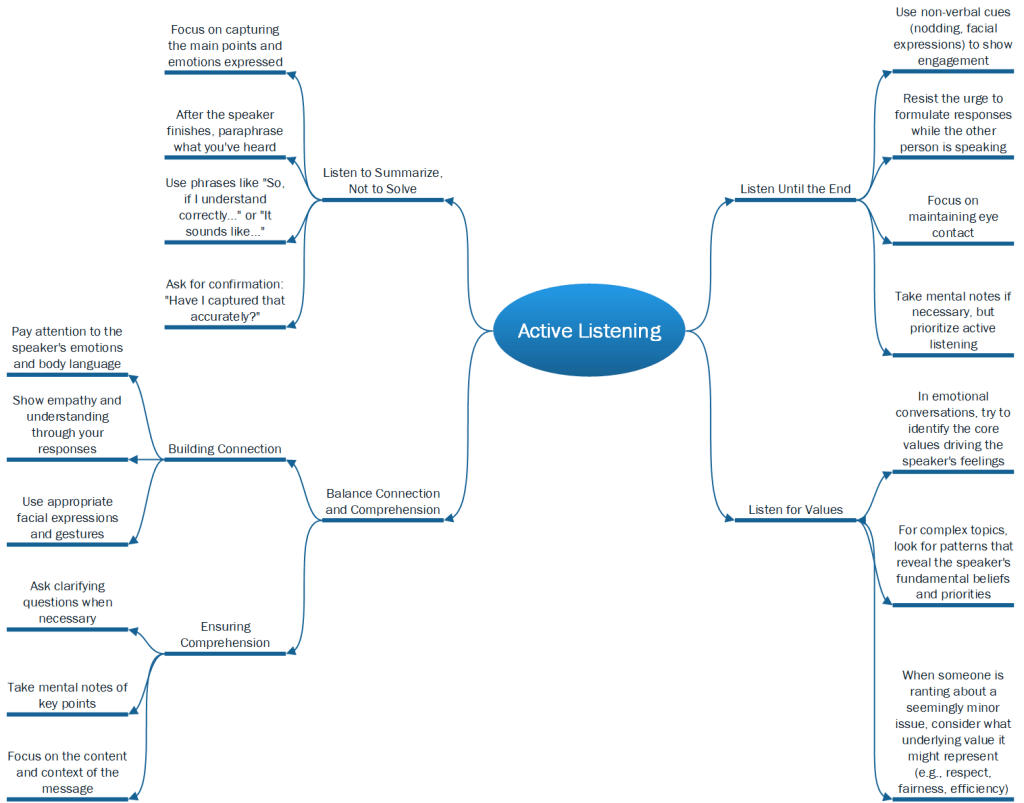
  • Focus on maintaining eye contact
  • Use non-verbal cues (nodding, facial expressions) to show engagement
  • Resist the urge to formulate responses while the other person is speaking
  • Take mental notes if necessary, but prioritize active listening

By allowing the speaker to complete their thoughts without interruption, you create an environment of trust and openness, which is essential for effective communication.

Technique 2: Listen to Summarize, Not to Solve

The Art of Understanding

When someone shares a problem or concern, our natural instinct is often to jump into problem-solving mode. However, this approach can be counterproductive, especially if the speaker is simply looking to be heard and understood.

Why Summarizing is Crucial:

  • It ensures you’ve accurately grasped the speaker’s message
  • It demonstrates that you’re fully engaged in the conversation
  • It allows the speaker to clarify any misunderstandings
  • It gives the speaker a chance to reflect on their own thoughts

Implementing This Technique:

  • Focus on capturing the main points and emotions expressed
  • After the speaker finishes, paraphrase what you’ve heard
  • Use phrases like “So, if I understand correctly…” or “It sounds like…”
  • Ask for confirmation: “Have I captured that accurately?”

By prioritizing understanding over immediate problem-solving, you create a space where the speaker feels truly heard, which can often lead to more effective resolution of issues in the long run.

Technique 3: Balance Connection and Comprehension

The Dual Focus of Effective Listening

Listening is not just about absorbing information; it’s also about building a connection with the speaker. Striking the right balance between these two aspects is crucial for meaningful communication.

Aspects to Focus On:

  1. Building Connection:
    • Pay attention to the speaker’s emotions and body language
    • Show empathy and understanding through your responses
    • Use appropriate facial expressions and gestures
  2. Ensuring Comprehension:
    • Focus on the content and context of the message
    • Ask clarifying questions when necessary
    • Take mental notes of key points

Strategies for Balancing Both:

  • Practice active empathy by putting yourself in the speaker’s shoes
  • Use reflective listening techniques to confirm understanding while showing support
  • Alternate between focusing on emotional cues and factual content

By mastering this balance, you not only gain a deeper understanding of the issue at hand but also strengthen your relationship with the speaker, fostering trust and open communication.

Technique 4: Listen for Values

Uncovering the Hidden Layers

Every conversation, whether it’s a casual chat or an emotional outpouring, offers a window into the speaker’s values and priorities. By tuning into these underlying messages, you can gain profound insights into what truly matters to the person you’re communicating with.

Why Listening for Values Matters:

  • It deepens your understanding of the speaker’s motivations
  • It helps you respond more empathetically and effectively
  • It strengthens your connection by showing genuine interest in the speaker’s worldview

How to Identify Values in Conversation:

  • Pay attention to recurring themes or concerns
  • Notice what elicits strong emotional responses
  • Listen for statements about what “should” or “ought to” be
  • Observe which topics the speaker spends the most time on

Applying This Technique:

  • When someone is ranting about a seemingly minor issue, consider what underlying value it might represent (e.g., respect, fairness, efficiency)
  • In emotional conversations, try to identify the core values driving the speaker’s feelings
  • For complex topics, look for patterns that reveal the speaker’s fundamental beliefs and priorities

By listening for values, you transform every interaction into an opportunity for deeper understanding and connection, enriching your relationships and broadening your perspective.
Conclusion

Mastering these four listening techniques – listening until the end, summarizing rather than solving, balancing connection and comprehension, and listening for values – can revolutionize your communication skills. These strategies not only enhance your ability to understand and connect with others but also contribute to your personal and professional growth.

Remember, effective listening is a skill that requires practice and patience. As you implement these techniques in your daily interactions, you’ll likely find that your conversations become more meaningful, your relationships stronger, and your understanding of others more profound. In a world where genuine connection is increasingly valuable, honing your listening skills is an investment that pays dividends in all areas of life.

So, the next time you engage in a conversation, challenge yourself to apply these techniques. You might be surprised at how much you can learn and how much deeper your connections can become when you truly listen with intention and care.

Viral Risk Management

While rare, viral contamination events can have severe consequences, potentially impacting product quality, patient safety, and company reputation. And while a consent decree is a good way to grow your skills, I tend to prefer to avoid causing one to happen.

Luckily, regulatory bodies have provided comprehensive guidelines, with ICH Q5A(R2) being a cornerstone document. Let’s explore the best practices for viral risk management in biotech, drawing from ICH Q5A and other relevant guidances.

The Three Pillars of Viral Safety

ICH Q5A outlines three complementary approaches to control potential viral contamination:

  1. Selection and testing of cell lines and raw materials
  2. Assessment of viral clearance capacity in production processes
  3. Testing of the product at appropriate stages for contaminating viruses

These pillars form the foundation of a robust viral safety strategy.

Cell Line and Raw Material Control

  • Thoroughly document the origin and history of cell lines
  • Implement comprehensive testing programs for cell banks, including master and working cell banks
  • Carefully assess and control animal-derived raw materials
  • Consider using chemically-defined or animal-free raw materials where possible
  • Implement stringent change control and quality agreements with raw material suppliers

Viral Clearance Capacity

  • Design manufacturing processes with multiple orthogonal viral clearance steps
  • Validate the effectiveness of viral clearance steps using model viruses
  • Aim for a cumulative viral reduction factor of at least 4 log10 per the USP guidelines
  • Consider both dedicated viral inactivation steps (e.g., low pH treatment) and removal steps (e.g., nanofiltration)
  • For continuous manufacturing, assess the impact of process dynamics on viral clearance

In-Process and Final Product Testing

  • Develop a comprehensive testing strategy for in-process materials and final product
  • Utilize state-of-the-art detection methods, including PCR and next-generation sequencing (NGS)
  • Consider replacing traditional in vivo assays with molecular methods where appropriate
  • Implement a testing program that covers a broad spectrum of potential viral contaminants

Risk-Based Approach

The revised ICH Q5A(R2) emphasizes a risk-based approach to viral safety. This involves:

  • Conducting thorough risk assessments of the entire manufacturing process
  • Identifying critical control points for viral contamination
  • Implementing appropriate mitigation strategies based on risk levels
  • Continuously monitoring and updating the risk assessment as new information becomes available

Prior knowledge, including “in-house” experience, plays a crucial role in viral risk assessment and management for biopharmaceutical manufacturing. Here’s how it can be effectively utilized:

Leveraging Historical Data

  • Review past viral contamination events or near-misses within the organization
  • Analyze trends in raw material quality and supplier performance
  • Evaluate the effectiveness of previous risk mitigation strategies

Process Design and Optimization

  • Apply lessons learned from previous manufacturing campaigns to improve process robustness
  • Use historical data to identify critical control points for viral contamination
  • Optimize viral clearance steps based on past validation studies

Cell Line Susceptibility

  • Use accumulated data on cell line susceptibility to various viruses to inform risk assessments
  • Apply knowledge of cell line behavior under different conditions to enhance contamination detection

Risk Assessment Approach

The risk assessment process should take a holistic approach, focusing on:

  • Raw material sourcing and testing
    • Identifying high-risk materials, especially animal-derived components
    • Assessing chemically-undefined components like hydrolysates and peptones
    • Evaluating materials produced or stored in non-controlled environments
  • Cell substrate selection and characterization
    • Documenting the derivation and source history of the cell line
    • Testing cell banks extensively for adventitious agents
    • Assessing the cell line’s susceptibility to various viruses
  • Process design for viral clearance
    • Designing manufacturing processes with multiple orthogonal viral clearance steps
  • Facility design and operations
    • Implementing robust cleaning and sanitization procedures
    • Ensuring proper facility layout and air handling systems to prevent contamination spread
  • Personnel training and practices
    • Training on proper gowning procedures and personal protective equipment (PPE) usage
    • Policies on illness reporting and exclusion of sick employees from critical areas

Preparedness and Response

While prevention is key, being prepared for a potential contamination event is crucial:

  • Develop a comprehensive viral contamination response plan[6]
  • Regularly practice and update the response plan through mock drills
  • Establish clear communication channels and decision-making processes
  • Prepare strategies for containment, decontamination, and facility restart

Continuous Improvement

Viral risk management is an ongoing process:

  • Stay updated on emerging technologies and regulatory guidance
  • Participate in industry forums and share best practices
  • Invest in employee training and awareness programs
  • Continuously evaluate and improve viral safety strategies

By implementing these best practices and adhering to regulatory guidances like ICH Q5A, we can strive to significantly mitigate the risk of viral contamination. While no approach can guarantee absolute safety, a comprehensive, risk-based strategy that leverages cutting-edge technologies and emphasizes preparedness will go a long way in protecting patients, products, and the industry as a whole.

Be Your Authentic Self

The best quality folks I know, indeed the best of any profession I know, are those who manage to bring their authentic self to the job. This capability is core to building psychological safety and driving quality culture. And yet, too often, we teach people how to bury it or reward a degree of inauthenticity in service of some idea of “professional.” People quickly tune out, disengage, and lose trust when they sense insincerity. Being authentic allows you to connect and relate much more quickly with and bond with our fellow workers. To be an authentic quality champion, you must create a safe space to encourage people to open up and express themselves without fearing retribution. If people do not feel comfortable or safe conveying their feelings, they won’t be able to present their true, authentic selves. Trust is the key to encouraging others to express their thoughts and feelings. Without trust and authenticity, there can be no learning culture, no improvement, and little to no quality.

Be Yourself

Authenticity starts with being true to who you are. Don’t try to adopt a stereotypical quality personality or style that doesn’t feel natural to you. Instead:

  • Embrace your unique personality and style, whether that’s reserved, energetic, or straightforward
  • Be honest about your knowledge and expertise
  • Admit when you don’t know something rather than pretending

By bringing your true self to the role, you build trust and create a psychologically safe environment.

Foster Genuine Connections

By building authentic relationships with colleagues, we can enhance collaboration, boost job satisfaction, and contribute to a more fulfilling professional experience. These connections go beyond superficial interactions and involve showing a genuine interest in coworkers’ success, engaging in healthy competition, and contributing to an authentic workplace culture.

  • Strive to find time for relationship-building with and among your fellows
  • Share personal anecdotes and experiences when relevant
  • Demonstrate vulnerability by discussing your own learning journey and challenges you’ve overcome

Practice Active Listening

Active listening contributes to authenticity by encouraging open communication and transparency. When we actively listen to one another, we create a safe space for sharing ideas, concerns, and feedback without fear of judgment. This openness allows individuals to be true to their personalities and values, fostering a culture where authenticity is valued and respected. Moreover, active listening helps in recognizing the unsaid emotions and underlying messages, enabling a deeper understanding of colleagues’ experiences and perspectives.

  • Give your full attention to speakers, noting both verbal and non-verbal cues
  • Paraphrase and summarize to ensure you’ve understood correctly
  • Ask probing questions to dig deeper into folk’s thoughts and ideas

Model the Desired Culture

When a quality partner brings their authentic self to the team, they set the tone. This demonstrates the behaviors and attitudes we want to see in our culture. This is important at all levels of the quality organization, but frankly I think quality leaders may be a little to uncomfortable here. Many people get ahead in quality by being analytical, which means thse who are outside that norm are asked to act like they are to get ahead. Which frankly, can be prety disastrrious.