Harnessing the Power of “What, So What, Now What” in Data Storytelling

In today’s data-driven world, effectively communicating insights is crucial for driving informed decision-making. By combining the “What, So What, Now What” reflective model with data storytelling techniques, we can create compelling narratives that not only present findings but also inspire action. Let’s explore how to leverage this approach to organize recommendations from problem-solving or gap assessments.

The “What, So What, Now What” Framework

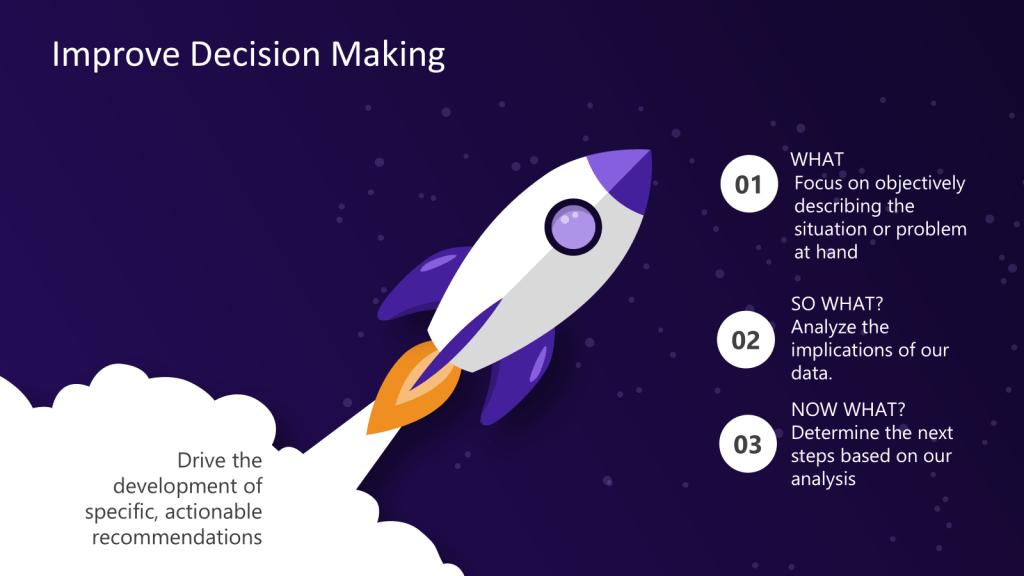
The “What, So What, Now What” model, originally developed by Terry Borton in the 1970s, provides a simple yet powerful structure for reflection and analysis.

What?

This stage focuses on objectively describing the situation or problem at hand. In data storytelling, this is where we present the raw facts and figures without interpretation. Frame the problem and provide the data.

So What?

Here, we analyze the implications of our data. This is the stage where we extract meaning from the numbers and identify patterns or trends. We provide the root cause analysis.

Now What?

Finally, we determine the next steps based on our analysis. This is where we formulate actionable recommendations and outline a path forward.

Integrating Data Storytelling

To effectively utilize this framework in data storytelling, we need to consider three key elements: data, visuals, and narrative. Let’s break down how to incorporate these elements into each stage of our “What, So What, Now What” approach.

What? – Setting the Scene

  1. Present the Data: Start by clearly presenting the relevant data points. Use simple, easy-to-understand visualizations to highlight key metrics.
  2. Provide Context: Explain the background of the situation or problem. What led to this analysis? What were the initial goals or expectations?
  3. Engage the Audience: Use narrative techniques to draw your audience in. For example, you might start with a provocative question or a surprising statistic to capture attention.

So What? – Analyzing the Implications

  1. Identify Patterns and Trends: Use more complex visualizations to illustrate relationships within the data. Consider using interactive elements to allow your audience to explore the data themselves.
  2. Compare to Benchmarks: Put your findings in context by comparing them to regulations, industry standards or historical performance.
  3. Highlight Key Insights: Use narrative techniques to guide your audience through your analysis. Emphasize the most important findings and explain their significance.

Now What? – Formulating Recommendations

  1. Present Clear Action Items: Based on your analysis, outline specific, actionable recommendations. Use visual aids like flowcharts or decision trees to illustrate proposed processes or strategies.
  2. Quantify Potential Impact: Where possible, use data to project the potential outcomes of your recommendations. This could include forecasts, scenario analyses, or cost-benefit calculations.
  3. Tell a Future Story: Use narrative techniques to paint a picture of what success could look like if your recommendations are implemented. This helps make your proposals more tangible and motivating.

Best Practices for Effective Data Storytelling

To maximize the impact of your “What, So What, Now What” data story, keep these best practices in mind:

  1. Know Your Audience: Tailor your language, level of technical detail, and choice of visualizations to your specific audience.
  2. Use a Clear Narrative Arc: Structure your story with a beginning, middle, and end. This helps maintain engagement and ensures your key messages are memorable.
  3. Choose Appropriate Visualizations: Select chart types that best represent your data and support your narrative. Avoid cluttered or overly complex visuals.
  4. Highlight the Human Element: Where possible, include anecdotes or case studies that illustrate the real-world impact of your data and recommendations.
  5. Practice Data Ethics: Be transparent about your data sources and methodologies. Address potential biases or limitations in your analysis.

By combining the structured reflection of the “What, So What, Now What” model with powerful data storytelling techniques, you can create compelling narratives that not only present your findings but also drive meaningful action. This approach helps bridge the gap between data analysis and decision-making, ensuring that your insights translate into real-world impact.

Remember, effective data storytelling is both an art and a science. It requires a deep understanding of your data, a clear grasp of your audience’s needs, and the ability to weave these elements into a coherent and engaging narrative. With practice and refinement, you can master this powerful tool for driving data-informed change in your organization.

WHO Points to Consider on Continuous Manufacturing

The World Health Organization (WHO) has recently released draft guidelines on continuous manufacturing (CM) in the pharmaceutical industry, marking a significant step towards global harmonization of this innovative manufacturing approach. This guidance comes a few years after the International Council for Harmonisation’s (ICH) Q13 guideline, which was finalized in 2023. Let’s explore the main points of the WHO draft guidance and how it compares to ICH Q13.

Key Points of WHO Draft Guidance on Continuous Manufacturing

Risk Management

The document emphasizes the importance of robust risk management strategies in CM processes. Manufacturers are expected to identify, assess, and mitigate potential risks associated with the continuous nature of production.

Control Strategies

WHO outlines best practices for developing and implementing effective control strategies in CM. This includes real-time monitoring and control of critical process parameters and quality attributes.

Process Dynamics

The guidance addresses the unique challenges of managing process dynamics in continuous systems, including strategies for handling transient states and disturbances.

Validation of Computerized Systems

Given the heavy reliance on automation and digital systems in CM, the WHO document provides specific guidance on validating computerized systems used in continuous manufacturing processes.

Batch Definition and Traceability

The guidance offers recommendations on defining batches in a continuous process and ensuring traceability throughout the manufacturing chain.

Comparison with ICH Q13

While the WHO draft guidance and ICH Q13 share many common elements, there are some notable differences and complementary aspects:

Scope and Applicability

  • ICH Q13: Applies to CM of drug substances and drug products for chemical entities and therapeutic proteins, including biosimilars.
  • WHO Guidance: Likely to have a broader scope, covering even excipient manufacturing.

Regulatory Approach

  • ICH Q13: Provides a harmonized approach for regulatory submissions and assessments across ICH member countries.
  • WHO Guidance: Aims to provide a global framework that can be adopted by regulatory authorities worldwide, especially in countries not part of ICH.

Technical Detail

  • ICH Q13: Offers in-depth technical guidance, including annexes for specific types of products and manufacturing scenarios.
  • WHO Guidance: May provide more general principles and best practices that can be adapted to various regulatory and manufacturing contexts.

Implementation Focus

  • ICH Q13: Emphasizes scientific and regulatory considerations for development, implementation, and lifecycle management of CM.
  • WHO Guidance: Likely to include more practical considerations for implementing CM in diverse manufacturing environments, including resource-limited settings.

Implications for the Pharmaceutical Industry

The release of the WHO draft guidance on continuous manufacturing, following ICH Q13, signifies a growing global consensus on the importance and potential of CM in pharmaceutical production. This alignment between major global health organizations is expected to:

  1. Accelerate the adoption of continuous manufacturing technologies worldwide.
  2. Provide clearer pathways for regulatory approval of CM processes, especially in non-ICH countries.
  3. Encourage innovation in pharmaceutical manufacturing, potentially leading to more efficient and flexible production of essential medicines.
  4. Improve global supply chain resilience by enabling more localized and adaptable manufacturing capabilities.

As the pharmaceutical industry continues to evolve, the harmonization of guidance documents from WHO and ICH on continuous manufacturing will play a crucial role in shaping the future of drug production. Manufacturers, regulators, and other stakeholders should closely follow the finalization of these guidelines and prepare for a new era of pharmaceutical manufacturing that promises improved quality, efficiency, and accessibility of medicines worldwide.

How-How (Brown Cow)

Effective problem-solving is crucial for maintaining quality, making decisions, managing risks, and implementing changes. One visual brainstorming technique that can significantly enhance your work and should be in everyone’s tool box, is the How-How Diagram.

Understanding the How-How Diagram

The How-How Diagram is a structured approach to breaking down complex problems into manageable, actionable steps. It works by repeatedly asking “How?” to generate increasingly specific solutions. This method is particularly effective for collaborative problem-solving, as it encourages team members to think critically and creatively about potential solutions.

As similar structure as the Why-Why, many folks will find this tool comfortable to use.

Creating a How-How Diagram

Example template for a How-How diagram

Step 1: State the Problem

Begin by clearly defining the primary problem or need. Write this on a card or Post-It Note and place it on the left side of your workspace. Ensure that the problem is framed as a need to facilitate the “How?” question.

Step 2: Ask “How can this be done?”

Generate initial solutions by asking, “How can this be done?” Write each solution on a separate card and place them to the right of the problem statement.

Step 3: Identify Relationships

Some solutions may be alternatives, while others might need to occur together. Indicate these relationships by writing “and” or “or” between the cards.

Step 4: Repeat the Process

For each solution generated, ask “How?” again to break it down further. Continue this process, building a hierarchy of increasingly specific actions.

Step 5: Review and Refine

Once you’ve exhausted all possibilities, review the diagram. You may choose to draw connecting lines between related items, but it’s often best to leave this until the end to allow for easy rearrangement of cards.

Applying How-How Diagrams in CAPA Development

In CAPA processes, How-How Diagrams can be invaluable for:

  1. Root Cause Analysis: Break down potential causes of issues to identify the true root cause.
  2. Action Planning: Develop detailed, step-by-step corrective and preventive actions.
  3. Implementation Strategy: Map out the specific steps needed to implement CAPA solutions effectively.

Enhancing Risk Management with How-How Diagrams

Risk management can benefit from How-How Diagrams in several ways:

  1. Risk Identification: Systematically explore potential risks by asking “How could this go wrong?”
  2. Mitigation Planning: Develop comprehensive risk mitigation strategies by breaking down each risk into manageable actions.
  3. Contingency Planning: Create detailed contingency plans for identified risks.

Streamlining Change Control with How-How Diagrams

In change control processes, How-How Diagrams can:

  1. Impact Analysis: Thoroughly explore the potential impacts of proposed changes.
  2. Implementation Planning: Break down the change process into specific, actionable steps.
  3. Communication Strategy: Develop a clear plan for communicating changes to all stakeholders.

Best Practices for Using How-How Diagrams

To maximize the effectiveness of How-How Diagrams:

  1. Encourage Participation: Involve diverse team members to gain multiple perspectives.
  2. Stay Focused: Keep the discussion centered on the main problem or goal.
  3. Be Specific: Aim for concrete, actionable solutions rather than vague ideas.
  4. Prioritize: Once the diagram is complete, identify the most critical or impactful actions.
  5. Document: Capture the final diagram and use it as a reference for implementation and follow-up.

Conclusion

The How-How Diagram is a versatile and powerful tool for problem-solving by providing a structured approach to breaking down complex issues. It enables teams to develop comprehensive, actionable plans. Whether you’re addressing quality issues, managing risks, or implementing changes, the How-How Diagram can help you navigate the process with clarity and precision.

2024 FDA 483 Data

The FDA has published the 2024 Inspectional Observation Data Sets. I don’t think there are any surprise that on what the inspection observations data for fiscal year 2024 shows and what key GMP inspection themes emerge for drug manufacturers:

Quality Systems and Documentation

Inadequate Procedures and Documentation

  • Failure to establish or follow written procedures for various operations, including quality control, production, and process controls.
  • Lack of complete documentation for investigations, batch records, and laboratory testing.

Quality Control Unit Deficiencies

  • Inadequate responsibilities and authority of the quality control unit.
  • Failure to approve or reject components, products, procedures, or specifications.

Manufacturing and Process Controls

Equipment and Facility Issues

  • Inadequate design, maintenance, or cleaning of manufacturing equipment.
  • Deficiencies in facility maintenance, sanitation, and environmental controls.

Process Validation and Control

  • Lack of adequate process validation, especially for sterile drug products.
  • Insufficient control procedures to monitor and validate manufacturing processes.

Laboratory Controls

Inadequate Laboratory Practices

  • Failure to establish scientifically sound laboratory controls.
  • Deficiencies in test methods validation and stability testing programs.

Component Testing

  • Inadequate testing of drug components and reliance on supplier certificates without proper verification.

Sterile Drug Manufacturing

Aseptic Processing Deficiencies

  • Inadequate procedures and validation for sterile drug products.
  • Deficiencies in environmental monitoring and control systems for aseptic processing areas.

Training and Personnel

Inadequate Employee Training

  • Insufficient training of employees in GMP and specific job function.

Complaint Handling and Product Quality Reviews

Deficient Complaint Procedures

  • Inadequate procedures for handling product complaints.

Annual Product Quality Review

  • Failure to conduct adequate annual product quality reviews.

Equipment Related

Out of the 365 observations that mention equipment, 277 are from just 5 regulations. Let’s take a deeper look.

Reference Number Short Description Long Description Frequency
21 CFR 211.63 Equipment Design, Size and Location Equipment used in the manufacture, processing, packing or holding of drug products is not [of appropriate design] [of adequate size] [suitably located] to facilitate operations for its [intended use] [cleaning and maintenance]. Specifically, *** 85
21 CFR 211.67(a) Cleaning / Sanitizing / Maintenance Equipment and utensils are not [cleaned] [maintained] [sanitized] at appropriate intervals to prevent [malfunctions] [contamination] that would alter the safety, identity, strength, quality or purity of the drug product. Specifically, *** 76
21 CFR 211.67(b) Written procedures not established/followed Written procedures are not [established] [followed] for the cleaning and maintenance of equipment, including utensils, used in the manufacture, processing, packing or holding of a drug product. Specifically, *** 60
21 CFR 211.68(a) Calibration/Inspection/Checking not done Routine [calibration] [inspection] [checking] of [automatic] [mechanical] [electronic] equipment is not performed according to a written program designed to assure proper performance. Specifically, *** 30

Improper design and qualification, improper cleaning, improper calibration and inspections. Yes these take work, but these are all areas that effort can improve.

The Lotus Blossom Brainstorming Technique

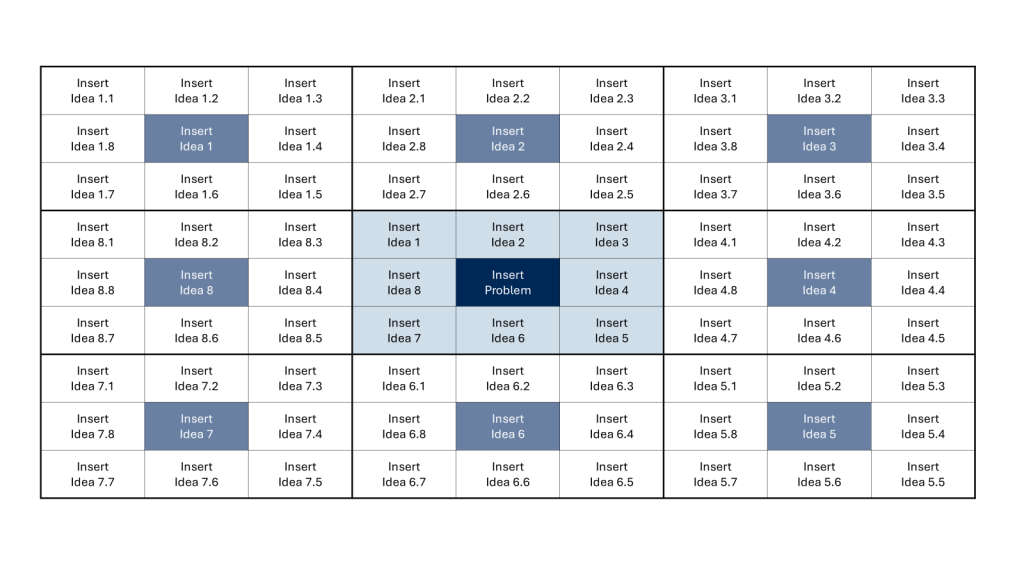
In the world of creative problem-solving and idea generation, the Lotus Blossom technique stands out as a powerful and structured approach to brainstorming. Developed by Yasuo Matsumura, a Japanese management consultant, this method combines the free-flowing nature of traditional brainstorming with a systematic framework that encourages deeper exploration of ideas.

How It Works

The Lotus Blossom technique uses a visual diagram resembling a lotus flower, hence its name. Here’s a step-by-step breakdown of the process:

  1. Start with a central idea or problem in the middle of a 3×3 grid.
  2. Surround the central concept with eight related ideas or themes.
  3. Take each of these eight ideas and make them the center of their own 3×3 grids.
  4. Generate eight new ideas for each of these secondary grids.
  5. Repeat the process until you have a fully bloomed “lotus” of ideas.

By the end of this process, you’ll have generated up to 64 ideas stemming from your original concept.

Benefits of the Lotus Blossom Technique

Structured Creativity: Unlike traditional brainstorming, which can sometimes feel chaotic, the Lotus Blossom method provides a clear structure for idea generation.

Depth and Breadth: This technique encourages both broad thinking and deep exploration of specific themes.

Visual Organization: The diagram format helps visualize connections between ideas and keeps the brainstorming process organized.

Flexibility: It can be used individually or in small groups, making it versatile for various settings.

Tips for Success

To make the most of the Lotus Blossom technique, consider these tips:

  • Embrace All Ideas: Don’t self-censor. Even seemingly unrelated or far-fetched ideas can spark innovation.
  • Time Management: Set time limits for each phase to maintain momentum and prevent overthinking.
  • Iterate and Refine: After completing the diagram, review and refine your ideas. Look for patterns or combinations that might lead to breakthrough solutions.