The Quality Continuum in Pharmaceutical Manufacturing

In the highly regulated pharmaceutical industry, ensuring the quality, safety, and efficacy of products is paramount. Two critical components of pharmaceutical quality management are Quality Assurance (QA) and Quality Control (QC). While these terms are sometimes used interchangeably, they represent distinct approaches with different focuses, methodologies, and objectives within pharmaceutical manufacturing. Understanding the differences between QA and QC is essential for pharmaceutical companies to effectively manage their quality processes and meet regulatory requirements.

Quality Assurance (QA) and Quality Control (QC) are both essential and complementary pillars of pharmaceutical quality management, each playing a distinct yet interconnected role in ensuring product safety, efficacy, and regulatory compliance. QA establishes the systems, procedures, and preventive measures that form the foundation for consistent quality throughout the manufacturing process, while QC verifies the effectiveness of these systems by testing and inspecting products to ensure they meet established standards. The synergy between QA and QC creates a robust feedback loop: QC identifies deviations or defects through analytical testing, and QA uses this information to drive process improvements, update protocols, and implement corrective and preventive actions. This collaboration not only helps prevent the release of substandard products but also fosters a culture of continuous improvement, risk mitigation, and regulatory compliance, making both QA and QC indispensable for maintaining the highest standards in pharmaceutical manufacturing.

Definition and Scope

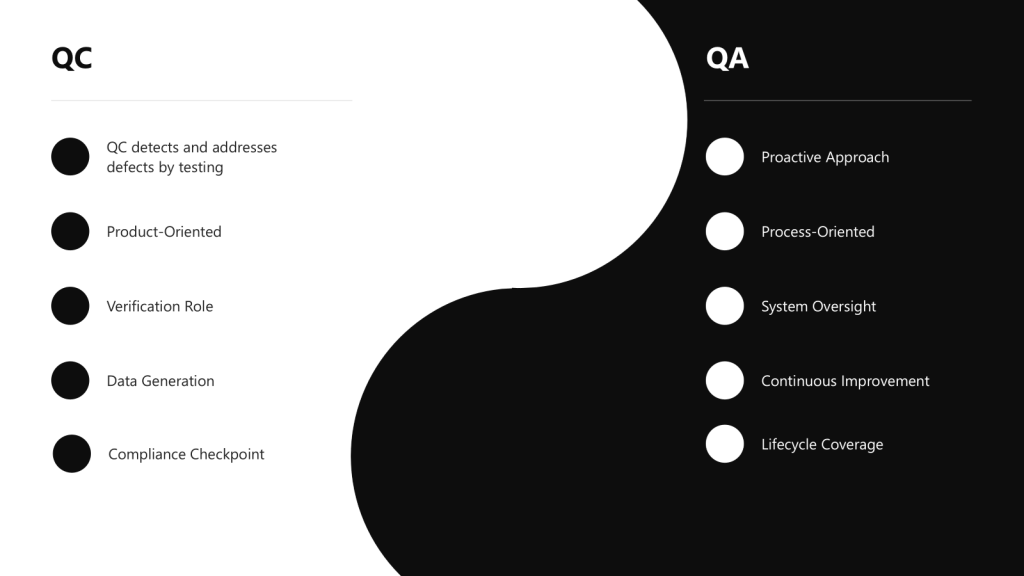
Quality Assurance (QA) is a comprehensive, proactive approach focused on preventing defects by establishing robust systems and processes throughout the entire product lifecycle. It encompasses the totality of arrangements made to ensure pharmaceutical products meet the quality required for their intended use. QA is process-oriented and aims to build quality into every stage of development and manufacturing.

Quality Control (QC) is a reactive, product-oriented approach that involves testing, inspection, and verification of finished products to detect and address defects or deviations from established standards. QC serves as a checkpoint to identify any issues that may have slipped through the manufacturing process.

Approach: Proactive vs. Reactive

One of the most fundamental differences between QA and QC lies in their approach to quality management:

  • QA takes a proactive approach by focusing on preventing defects and deviations before they occur. It establishes robust quality management systems, procedures, and processes to minimize the risk of quality issues.
  • QC takes a reactive approach by focusing on detecting and addressing deviations and defects after they have occurred. It involves testing, sampling, and inspection activities to identify non-conformities and ensure products meet established quality standards.

Focus: Process vs. Product

  • QA is process-oriented, focusing on establishing and maintaining robust processes and procedures to ensure consistent product quality. It involves developing standard operating procedures (SOPs), documentation, and validation protocols.
  • QC is product-oriented, focusing on verifying the quality of finished products through testing and inspection. It ensures that the final product meets predetermined specifications before release to the market.

Comparison Table: QA vs. QC in Pharmaceutical Manufacturing

AspectQuality Assurance (QA)Quality Control (QC)
DefinitionA comprehensive, proactive approach focused on preventing defects by establishing robust systems and processesA reactive, product-oriented approach that involves testing and verification of finished products
FocusProcess-oriented, focusing on how products are madeProduct-oriented, focusing on what is produced
ApproachProactive – prevents defects before they occurReactive – detects defects after they occur
TimingBefore and during productionDuring and after production
ResponsibilityEstablishing systems, procedures, and documentationTesting, inspection, and verification of products

This includes the appropriate control of analytical methods.
ActivitiesSystem development, documentation, risk management, training, audits, supplier management, change control, validationRaw materials testing, in-process testing, finished product testing, dissolution testing, stability testing, microbiological testing
ObjectiveTo build quality into every stage of development and manufacturingTo identify non-conformities and ensure products meet specifications
MethodologyEstablishing SOPs, validation protocols, and quality management systemsSampling, testing, inspection, and verification activities
ScopeSpans the entire product lifecycle from development to discontinuationPrimarily focused on manufacturing and finished products
Relationship to GMPEnsures GMP implementation through systems and processesVerifies GMP compliance through testing and inspection

The Quality Continuum: QA and QC as Complementary Approaches

Rather than viewing QA and QC as separate entities, modern pharmaceutical quality systems recognize them as part of a continuous spectrum of quality management activities. This continuum spans the entire product lifecycle, from development through manufacturing to post-market surveillance.

The Integrated Quality Approach

QA and QC represent different points on the quality continuum but work together to ensure comprehensive quality management. The overlap between QA and QC creates an integrated quality approach where both preventive and detective measures work in harmony. This integration is essential for maintaining what regulators call a “state of control” – a condition in which the set of controls consistently provides assurance of continued process performance and product quality.

Quality Risk Management as a Bridge

Quality Risk Management (QRM) serves as a bridge between QA and QC activities, providing a systematic approach to quality decision-making. By identifying, assessing, and controlling risks throughout the product lifecycle, QRM helps determine where QA preventive measures and QC detective measures should be applied most effectively.

The concept of a “criticality continuum” further illustrates how QA and QC work together. Rather than categorizing quality attributes and process parameters as simply critical or non-critical, this approach recognizes varying degrees of criticality that require different levels of control and monitoring.

Organizational Models for QA and QC in Pharmaceutical Companies

Pharmaceutical companies employ various organizational structures to manage their quality functions. The choice of structure depends on factors such as company size, product portfolio complexity, regulatory requirements, and corporate culture.

Common Organizational Models

Integrated Quality Unit

In this model, QA and QC functions are combined under a single Quality Unit with shared leadership and resources. This approach promotes streamlined communication and a unified approach to quality management. However, it may present challenges related to potential conflicts of interest and lack of independent verification.

Separate QA and QC Departments

Many pharmaceutical companies maintain separate QA and QC departments, each with distinct leadership reporting to a higher-level quality executive. This structure provides clear separation of responsibilities and specialized focus but may create communication barriers and resource inefficiencies.

QA as a Standalone Department, QC Integrated with Operations

In this organizational model, the Quality Assurance (QA) function operates as an independent department, while Quality Control (QC) is grouped within the same department as other operations functions, such as manufacturing and production. This structure is designed to balance independent oversight with operational efficiency.

Centralized Quality Organization

Large pharmaceutical companies often adopt a centralized quality organization where quality functions are consolidated at the corporate level with standardized processes across all manufacturing sites. This model ensures consistent quality standards and efficient knowledge sharing but may be less adaptable to site-specific needs.

Decentralized Quality Organization

In contrast, some companies distribute quality functions across manufacturing sites with site-specific quality teams. This approach allows for site-specific quality focus and faster decision-making but may lead to inconsistent quality practices and regulatory compliance challenges.

Matrix Quality Organization

A matrix quality organization combines elements of both centralized and decentralized models. Quality personnel report to both functional quality leaders and operational/site leaders, providing a balance between standardization and site-specific needs. However, this structure can create complex reporting relationships and potential conflicts in priorities.

The Quality Unit: Overarching Responsibility for Pharmaceutical Quality

Concept and Definition of the Quality Unit

The Quality Unit is a fundamental concept in pharmaceutical manufacturing, representing the organizational entity responsible for overseeing all quality-related activities. According to FDA guidance, the Quality Unit is “any person or organizational element designated by the firm to be responsible for the duties relating to quality control”.

The concept of a Quality Unit was solidified in FDA’s 2006 guidance, “Quality Systems Approach to Pharmaceutical Current Good Manufacturing Practice Regulations,” which defined it as the entity responsible for creating, monitoring, and implementing a quality system.

Independence and Authority of the Quality Unit

Regulatory agencies emphasize that the Quality Unit must maintain independence from production operations to ensure objective quality oversight. This independence is critical for the Quality Unit to fulfill its responsibility of approving or rejecting materials, processes, and products without undue influence from production pressures.

The Quality Unit must have sufficient authority and resources to carry out its responsibilities effectively. This includes the authority to investigate quality issues, implement corrective actions, and make final decisions regarding product release.

How QA and QC Contribute to Environmental Monitoring and Contamination Control

Environmental monitoring (EM) and contamination control are critical pillars of pharmaceutical manufacturing quality systems, requiring the coordinated efforts of both Quality Assurance (QA) and Quality Control (QC) functions. While QA focuses on establishing preventive systems and procedures, QC provides the verification and testing that ensures these systems are effective. Together, they create a comprehensive framework for maintaining aseptic manufacturing environments and protecting product integrity. This also serves as a great example of the continuum in action.

QA Contributions to Environmental Monitoring and Contamination Control

System Design and Program Development

Quality Assurance takes the lead in establishing the foundational framework for environmental monitoring programs. QA is responsible for designing comprehensive EM programs that include sampling plans, alert and action limits, and risk-based monitoring locations. This involves developing a systematic approach that addresses all critical elements including types of monitoring methods, culture media and incubation conditions, frequency of environmental monitoring, and selection of sample sites.

For example, QA establishes the overall contamination control strategy (CCS) that defines and assesses the effectiveness of all critical control points, including design, procedural, technical, and organizational controls employed to manage contamination risks. This strategy encompasses the entire facility and provides a comprehensive framework for contamination prevention.

Risk Management and Assessment

QA implements quality risk management principles to provide a proactive means of identifying, scientifically evaluating, and controlling potential risks to quality. This involves conducting thorough risk assessments that cover all human interactions with clean room areas, equipment placement and ergonomics, and air quality considerations. The risk-based approach ensures that monitoring efforts are focused on the most critical areas and processes where contamination could have the greatest impact on product quality.

QA also establishes risk-based environmental monitoring programs that are re-evaluated at defined intervals to confirm effectiveness, considering factors such as facility aging, barrier and cleanroom design optimization, and personnel changes. This ongoing assessment ensures that the monitoring program remains relevant and effective as conditions change over time.

Procedural Oversight and Documentation

QA ensures the development and maintenance of standardized operating procedures (SOPs) for all aspects of environmental monitoring, including air sampling, surface sampling, and personnel sampling protocols. These procedures ensure consistency in monitoring activities and provide clear guidance for personnel conducting environmental monitoring tasks.

The documentation responsibilities of QA extend to creating comprehensive quality management plans that clearly define responsibilities and duties to ensure that environmental monitoring data generated are of the required type, quality, and quantity. This includes establishing procedures for data analysis, trending, investigative responses to action level excursions, and appropriate corrective and preventative actions.

Compliance Assurance and Regulatory Alignment

QA ensures that environmental monitoring protocols meet Good Manufacturing Practice (GMP) requirements and align with current regulatory expectations such as the EU Annex 1 guidelines.

QA also manages the overall quality system to ensure that environmental monitoring activities support regulatory compliance and facilitate successful inspections and audits. This involves maintaining proper documentation, training records, and quality improvement processes that demonstrate ongoing commitment to contamination control.

QC Contributions to Environmental Monitoring and Contamination Control

Execution of Testing and Sampling

Quality Control is responsible for the hands-on execution of environmental monitoring testing protocols. QC personnel conduct microbiological testing including bioburden and endotoxin testing, as well as particle counting for non-viable particulate monitoring. This includes performing microbial air sampling using techniques such as active air sampling and settle plates, along with surface and personnel sampling using swabbing and contact plates.

For example, QC technicians perform routine environmental monitoring of classified manufacturing and filling areas, conducting both routine and investigational sampling to assess environmental conditions. They utilize calibrated active air samplers and strategically placed settle plates throughout cleanrooms, while also conducting surface and personnel sampling periodically, especially after critical interventions.

Data Analysis and Trend Monitoring

QC plays a crucial role in analyzing environmental monitoring data and identifying trends that may indicate potential contamination issues. When alert or action limits are exceeded, QC personnel initiate immediate investigations and document findings according to established protocols. This includes performing regular trend analysis on collected data to understand the state of control in cleanrooms and identify potential contamination risks before they lead to significant problems.

QC also maintains environmental monitoring programs and ensures all data is properly logged into Laboratory Information Management Systems (LIMS) for comprehensive tracking and analysis . This systematic approach to data management enables effective trending and supports decision-making processes related to contamination control.

Validation and Verification Activities

QC conducts critical validation activities to simulate aseptic processes and verify the effectiveness of contamination control measures. These activities provide direct evidence that manufacturing processes maintain sterility and/or bioburden control and that environmental controls are functioning as intended.

QC also performs specific testing protocols including dissolution testing, stability testing, and comprehensive analysis of finished products to ensure they meet quality specifications and are free from contamination. This testing provides the verification that QA-established systems are effectively preventing contamination.

Real-Time Monitoring and Response

QC supports continuous monitoring efforts through the implementation of Process Analytical Technology (PAT) for real-time quality verification. This includes continuous monitoring of non-viable particulates, which helps detect events that could potentially increase contamination risk and enables immediate corrective measures.

When deviations occur, QC personnel immediately report findings and place products on hold for further evaluation, providing documented reports and track-and-trend data to support decision-making processes. This rapid response capability is essential for preventing contaminated products from reaching the market.

Conclusion

While Quality Assurance and Quality Control in pharmaceutical manufacturing represent distinct processes with different focuses and approaches, they form a complementary continuum that ensures product quality throughout the lifecycle. QA is proactive, process-oriented, and focused on preventing quality issues through robust systems and procedures. QC is reactive, product-oriented, and focused on detecting and addressing quality issues through testing and inspection.

The organizational structure of quality functions in pharmaceutical companies varies, with models ranging from integrated quality units to separate departments, centralized or decentralized organizations, and matrix structures. Regardless of the organizational model, the Quality Unit plays a critical role in overseeing all quality-related activities and ensuring compliance with regulatory requirements.

The Pharmaceutical Quality System provides an overarching framework that integrates QA and QC activities within a comprehensive approach to quality management. By implementing effective quality systems and fostering a culture of quality, pharmaceutical companies can ensure the safety, efficacy, and quality of their products while meeting regulatory requirements and continuously improving their processes.

Heh Marty, Guess the Trains are Not Running On Time

So much for the trains running on time at the FDA, as the agency notifies Kalvista that it will be unable to issue a decision on their therapy by the PDUFA date by June 17 because of a “heavy workload and limited resources.” The regulator expects to deliver a verdict within about four weeks, Kalvista said.  https://www.businesswire.com/news/home/20250613608281/en/KalVista-Pharmaceuticals-Announces-FDA-Will-Not-Meet-PDUFA-Goal-Date-for-Sebetralstat-NDA-for-Hereditary-Angioedema-Due-to-FDA-Resource-Constraints

Four weeks may not seem a lot to outsides (though every day of delay counts when you are talking launch plans) but I am thinking this is not the last, or the greatest, of delays ahead.

Transforming Crisis into Capability: How Consent Decrees and Regulatory Pressures Accelerate Expertise Development

People who have gone through consent decrees and other regulatory challenges (and I know several individuals who have done so more than once) tend to joke that every year under a consent decree is equivalent to 10 years of experience anywhere else. There is something to this joke, as consent decrees represent unique opportunities for accelerated learning and expertise development that can fundamentally transform organizational capabilities. This phenomenon aligns with established scientific principles of learning under pressure and deliberate practice that your organization can harness to create sustainable, healthy development programs.

Understanding Consent Decrees and PAI/PLI as Learning Accelerators

A consent decree is a legal agreement between the FDA and a pharmaceutical company that typically emerges after serious violations of Good Manufacturing Practice (GMP) requirements. Similarly, Post-Approval Inspections (PAI) and Pre-License Inspections (PLI) create intense regulatory scrutiny that demands rapid organizational adaptation. These experiences share common characteristics that create powerful learning environments:

High-Stakes Context: Organizations face potential manufacturing shutdowns, product holds, and significant financial penalties, creating the psychological pressure that research shows can accelerate skill acquisition. Studies demonstrate that under high-pressure conditions, individuals with strong psychological resources—including self-efficacy and resilience—demonstrate faster initial skill acquisition compared to low-pressure scenarios.

Forced Focus on Systems Thinking: As outlined in the Excellence Triad framework, regulatory challenges force organizations to simultaneously pursue efficiency, effectiveness, and elegance in their quality systems. This integrated approach accelerates learning by requiring teams to think holistically about process interconnections rather than isolated procedures.

Third-Party Expert Integration: Consent decrees typically require independent oversight and expert guidance, creating what educational research identifies as optimal learning conditions with immediate feedback and mentorship. This aligns with deliberate practice principles that emphasize feedback, repetition, and progressive skill development.

The Science Behind Accelerated Learning Under Pressure

Recent neuroscience research reveals that fast learners demonstrate distinct brain activity patterns, particularly in visual processing regions and areas responsible for muscle movement planning and error correction. These findings suggest that high-pressure learning environments, when properly structured, can enhance neural plasticity and accelerate skill development.

The psychological mechanisms underlying accelerated learning under pressure operate through several pathways:

Stress Buffering: Individuals with high psychological resources can reframe stressful situations as challenges rather than threats, leading to improved performance outcomes. This aligns with the transactional model of stress and coping, where resource availability determines emotional responses to demanding situations.

Enhanced Attention and Focus: Pressure situations naturally eliminate distractions and force concentration on critical elements, creating conditions similar to what cognitive scientists call “desirable difficulties”. These challenging learning conditions promote deeper processing and better retention.

Evidence-Based Learning Strategies

Scientific research validates several strategies that can be leveraged during consent decree or PAI/PLI situations:

Retrieval Practice: Actively recalling information from memory strengthens neural pathways and improves long-term retention. This translates to regular assessment of procedure knowledge and systematic review of quality standards.

Spaced Practice: Distributing learning sessions over time rather than massing them together significantly improves retention. This principle supports the extended timelines typical of consent decree remediation efforts.

Interleaved Practice: Mixing different types of problems or skills during practice sessions enhances learning transfer and adaptability. This approach mirrors the multifaceted nature of regulatory compliance challenges.

Elaboration and Dual Coding: Connecting new information to existing knowledge and using both verbal and visual learning modes enhances comprehension and retention.

Creating Sustainable and Healthy Learning Programs

The Sustainability Imperative

Organizations must evolve beyond treating compliance as a checkbox exercise to embedding continuous readiness into their operational DNA. This transition requires sustainable learning practices that can be maintained long after regulatory pressure subsides.

  • Cultural Integration: Sustainable learning requires embedding development activities into daily work rather than treating them as separate initiatives.
  • Knowledge Transfer Systems: Sustainable programs must include systematic knowledge transfer mechanisms.

Healthy Learning Practices

Research emphasizes that accelerated learning must be balanced with psychological well-being to prevent burnout and ensure long-term effectiveness:

  • Psychological Safety: Creating environments where team members can report near-misses and ask questions without fear promotes both learning and quality culture.
  • Manageable Challenge Levels: Effective learning requires tasks that are challenging but not overwhelming. The deliberate practice framework emphasizes that practice must be designed for current skill levels while progressively increasing difficulty.
  • Recovery and Reflection: Sustainable learning includes periods for consolidation and reflection. This prevents cognitive overload and allows for deeper processing of new information.

Program Management Framework

Successful management of regulatory learning initiatives requires dedicated program management infrastructure. Key components include:

  • Governance Structure: Clear accountability lines with executive sponsorship and cross-functional representation ensure sustained commitment and resource allocation.
  • Milestone Management: Breaking complex remediation into manageable phases with clear deliverables enables progress tracking and early success recognition. This approach aligns with research showing that perceived progress enhances motivation and engagement.
  • Resource Allocation: Strategic management of resources tied to specific deliverables and outcomes optimizes learning transfer and cost-effectiveness.

Implementation Strategy

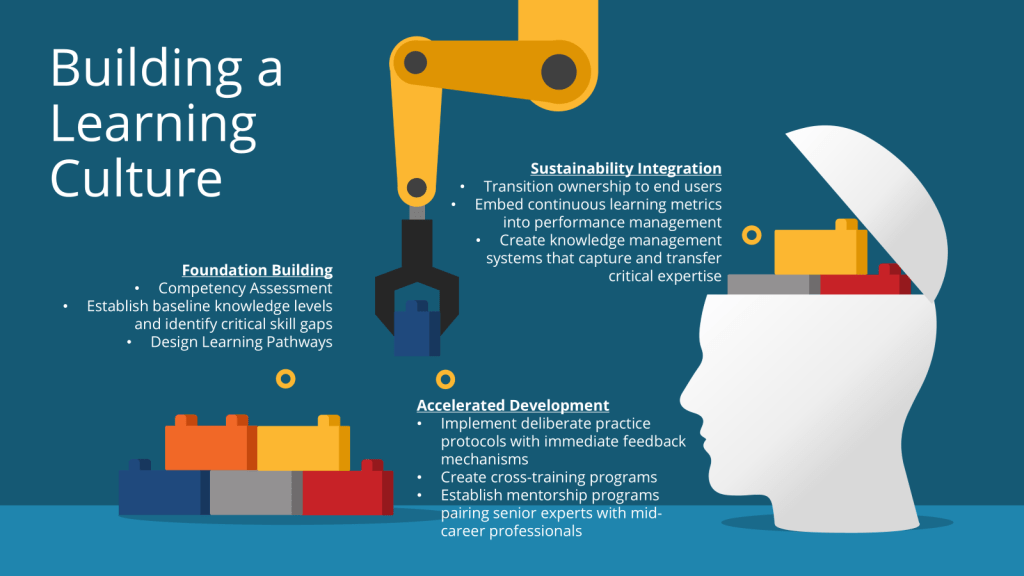
Phase 1: Foundation Building

  • Conduct comprehensive competency assessments
  • Establish baseline knowledge levels and identify critical skill gaps
  • Design learning pathways that integrate regulatory requirements with operational excellence

Phase 2: Accelerated Development

  • Implement deliberate practice protocols with immediate feedback mechanisms
  • Create cross-training programs
  • Establish mentorship programs pairing senior experts with mid-career professionals

Phase 3: Sustainability Integration

  • Transition ownership of new systems and processes to end users
  • Embed continuous learning metrics into performance management systems
  • Create knowledge management systems that capture and transfer critical expertise

Measurement and Continuous Improvement

Leading Indicators:

  • Competency assessment scores across critical skill areas
  • Knowledge transfer effectiveness metrics
  • Employee engagement and psychological safety measures

Lagging Indicators:

  • Regulatory inspection outcomes
  • System reliability and deviation rates
  • Employee retention and career progression metrics

Kirkpatrick LevelCategoryMetric TypeExamplePurposeData Source
Level 1: ReactionKPILeading% Training Satisfaction Surveys CompletedMeasures engagement and perceived relevance of GMP trainingLMS (Learning Management System)
Level 1: ReactionKRILeading% Surveys with Negative Feedback (<70%)Identifies risk of disengagement or poor training designSurvey Tools
Level 1: ReactionKBILeadingParticipation in Post-Training FeedbackEncourages proactive communication about training gapsAttendance Logs
Level 2: LearningKPILeadingPre/Post-Training Quiz Pass Rate (≥90%)Validates knowledge retention of GMP principlesAssessment Software
Level 2: LearningKRILeading% Trainees Requiring Remediation (>15%)Predicts future compliance risks due to knowledge gapsLMS Remediation Reports
Level 2: LearningKBILaggingReduction in Knowledge Assessment RetakesValidates long-term retention of GMP conceptsTraining Records
Level 3: BehaviorKPILeadingObserved GMP Compliance Rate During AuditsMeasures real-time application of training in daily workflowsAudit Checklists
Level 3: BehaviorKRILeadingNear-Miss Reports Linked to Training GapsIdentifies emerging behavioral risks before incidents occurQMS (Quality Management System)
Level 3: BehaviorKBILeadingFrequency of Peer-to-Peer Knowledge SharingEncourages a culture of continuous learning and collaborationMeeting Logs
Level 4: ResultsKPILagging% Reduction in Repeat Deviations Post-TrainingQuantifies training’s impact on operational qualityDeviation Management Systems
Level 4: ResultsKRILaggingAudit Findings Related to Training EffectivenessReflects systemic training failures impacting complianceRegulatory Audit Reports
Level 4: ResultsKBILaggingEmployee TurnoverAssesses cultural impact of training on staff retentionHR Records
Level 2: LearningKPILeadingKnowledge Retention Rate% of critical knowledge retained after training or turnoverPost-training assessments, knowledge tests
Level 3: BehaviorKPILeadingEmployee Participation Rate% of staff engaging in knowledge-sharing activitiesParticipation logs, attendance records
Level 3: BehaviorKPILeadingFrequency of Knowledge Sharing EventsNumber of formal/informal knowledge-sharing sessions in a periodEvent calendars, meeting logs
Level 3: BehaviorKPILeadingAdoption Rate of Knowledge Tools% of employees actively using knowledge systemsSystem usage analytics
Level 2: LearningKPILeadingSearch EffectivenessAverage time to retrieve information from knowledge systemsSystem logs, user surveys
Level 2: LearningKPILaggingTime to ProficiencyAverage days for employees to reach full productivityOnboarding records, manager assessments
Level 4: ResultsKPILaggingReduction in Rework/Errors% decrease in errors attributed to knowledge gapsDeviation/error logs
Level 2: LearningKPILaggingQuality of Transferred KnowledgeAverage rating of knowledge accuracy/usefulnessPeer reviews, user ratings
Level 3: BehaviorKPILaggingPlanned Activities Completed% of scheduled knowledge transfer activities executedProject management records
Level 4: ResultsKPILaggingIncidents from Knowledge GapsNumber of operational errors/delays linked to insufficient knowledgeIncident reports, root cause analyses

The Transformation Opportunity

Organizations that successfully leverage consent decrees and regulatory challenges as learning accelerators emerge with several competitive advantages:

  • Enhanced Organizational Resilience: Teams develop adaptive capacity that serves them well beyond the initial regulatory challenge. This creates “always-ready” systems, where quality becomes a strategic asset rather than a cost center.
  • Accelerated Digital Maturation: Regulatory pressure often catalyzes adoption of data-centric approaches that improve efficiency and effectiveness.
  • Cultural Evolution: The shared experience of overcoming regulatory challenges can strengthen team cohesion and commitment to quality excellence. This cultural transformation often outlasts the specific regulatory requirements that initiated it.

Conclusion

Consent decrees, PAI, and PLI experiences, while challenging, represent unique opportunities for accelerated organizational learning and expertise development. By applying evidence-based learning strategies within a structured program management framework, organizations can transform regulatory pressure into sustainable competitive advantage.

The key lies in recognizing these experiences not as temporary compliance exercises but as catalysts for fundamental capability building. Organizations that embrace this perspective, supported by scientific principles of accelerated learning and sustainable development practices, emerge stronger, more capable, and better positioned for long-term success in increasingly complex regulatory environments.

Success requires balancing the urgency of regulatory compliance with the patience needed for deep, sustainable learning. When properly managed, these experiences create organizational transformation that extends far beyond the immediate regulatory requirements, establishing foundations for continuous excellence and innovation. Smart organizations can utilzie the same principles to drive improvement.

Some Further Reading

TopicSource/StudyKey Finding/Contribution
Accelerated Learning Techniqueshttps://soeonline.american.edu/blog/accelerated-learning-techniques/

https://vanguardgiftedacademy.org/latest-news/the-science-behind-accelerated-learning-principles
Evidence-based methods (retrieval, spacing, etc.)
Stress & Learninghttps://pmc.ncbi.nlm.nih.gov/articles/PMC5201132/

https://www.nature.com/articles/npjscilearn201611
Moderate stress can help, chronic stress harms
Deliberate Practicehttps://graphics8.nytimes.com/images/blogs/freakonomics/pdf/DeliberatePractice(PsychologicalReview).pdfStructured, feedback-rich practice builds expertise
Psychological Safetyhttps://www.nature.com/articles/s41599-024-04037-7Essential for team learning and innovation
Organizational Learninghttps://journals.scholarpublishing.org/index.php/ASSRJ/article/download/4085/2492/10693

https://www.elibrary.imf.org/display/book/9781475546675/ch007.xml
Regulatory pressure can drive learning if managed

Allston Landing’s Uncertain Future

I’m greatly saddened to hear about the six sites Resilience is shutting down. This impacts a lot of good people, at a time when our industry has had a lot of announced layoffs. My heart goes out to everyone impacted. And please know whatever little help I can do, I will.

For me, there is also a lot of sadness for the site, which was a very definitive part of my career. It truly feels like the end of an era.

Current Status of the Allston Site

National Resilience’s Allston facility at 500 Soldiers Field Road is among the six manufacturing sites being closed as part of the company’s restructuring efforts. The site, which operates in a former Genzyme manufacturing plant built in 1991, is being wound down through legal proceedings initiated by a leaseholder affiliate.

The closure is part of National Resilience’s broader strategy to address overcapacity issues, as CEO William Marth acknowledged that “our capacity expansion has outpaced industry demand”. The company secured $250 million in bridge financing to support this consolidation and is pursuing additional debt financing for future operations. To be frank, some folks bet very poorly.

Harvard’s Property Ownership and Lease Arrangements

The Allston site sits on Harvard-owned land, and the property arrangement involves a complex ownership structure:

  • Land Ownership: Harvard University owns the underlying land at 500 Soldiers Field Road
  • Facility Operations: National Resilience took over the lease for the building from Sanofi in 2021, inheriting operations of the former Genzyme plant
  • Historical Context: Genzyme originally built the facility in 1991 on Harvard land through a long-term lease arrangement

When Sanofi (which had acquired Genzyme) decided to consolidate operations at its Framingham campus, it transferred the lease to National Resilience rather than selling the property outright. This transfer required termination of the site’s special tax-break status through the Boston Planning & Development Agency.

What Happens After National Resilience’s Departure

While I have no definitive answer, I’m fearing the following will drive the site closure and ceasing to be a manufacturing site:

  • Lease Structure: Since Harvard owns the land and National Resilience operates under a lease arrangement, the property would typically revert to Harvard’s direct control once the lease is terminated or expires.
  • Strategic Location: The site is strategically positioned within Harvard’s broader Allston development plans, sitting adjacent to the university’s Enterprise Research Campus project. Harvard’s construction updates consistently reference the facility as a landmark bordering their major mixed-use development.
  • Harvard’s Allston Holdings: The university owns approximately 360 acres in Allston and has been actively developing the area as part of its long-term expansion strategy. The 500 Soldiers Field Road site represents a significant piece of this puzzle.

Integration with Harvard’s Development Plans

Harvard’s ongoing Enterprise Research Campus development directly borders the National Resilience facility, with construction updates regularly using it as a reference point for the project boundaries. The campus will include:

  • Two laboratory buildings for research and development
  • A 343-unit residential building with affordable housing components
  • A hotel and conference center
  • Public green space and programming areas

The proximity and Harvard’s ownership structure suggest the Allston site could potentially be integrated into future phases of the university’s development plans, though no specific announcements have been made regarding immediate reuse plans.

I don’t think it will surprise anyone that Harvard had reached out to Sanofi many times to discuss taking back the site over the years.

It is odd enough now to drive by and know the site is a shadow of its former self. Knowing that later this year it will be fully closed down is heart breaking.

Recent Troubles at the FDA and Their Impact on Transparency

The FDA’s long-standing commitment to transparency faces unprecedented challenges in 2025 following a series of organizational disruptions that threaten to undermine the agency’s ability to share critical regulatory information with stakeholders and the public. These developments represent a significant departure from the agency’s historical transparency trajectory and raise serious concerns about the future accessibility of regulatory data and decision-making processes.

Mass Workforce Reductions and Organizational Disruption

The most significant challenge facing FDA transparency stems from the massive reduction in force implemented in April 2025. The Department of Health and Human Services terminated approximately 3,500 FDA employees on April 1, 2025, representing nearly 20% of the agency’s workforce. This dramatic downsizing followed an earlier reduction in February 2025 that eliminated approximately 700 workers, creating a cumulative impact that has fundamentally altered the agency’s operational capacity.

While HHS officials emphasized that the cuts would not directly impact medical product reviewers, food reviewers, or inspectors, the layoffs eliminated critical support staff across multiple areas essential to transparency operations. The reduction in force targeted employees in policy development, communications, information technology, procurement, and project management—all functions that are integral to maintaining the agency’s transparency infrastructure.

Former FDA Commissioner Robert Califf captured the gravity of the situation in a LinkedIn post stating, “The FDA as we’ve known it is finished”. This assessment reflects the widespread concern that the agency’s foundational capabilities for information sharing and public communication have been irreparably damaged.

Communication Infrastructure Breakdown

Press Releases and Public Information Systems

The workforce reductions have created significant gaps in the FDA’s ability to communicate with the public and industry stakeholders. Communications staff responsible for issuing press releases, updating the FDA’s website, and informing consumers about health risks and new product approvals were among those eliminated. This has resulted in delays and inconsistencies in the dissemination of critical safety information and regulatory updates.

The impact on communication capabilities became evident through reports of delayed updates to key databases and reduced responsiveness to routine inquiries from industry participants. Even before the April layoffs, industry observers had noted a decline in FDA’s responsiveness, particularly to non-essential or routine questions, suggesting that the communication infrastructure was already under strain.

Website and Database Management Issues

The FDA’s digital transparency infrastructure has suffered significant disruptions due to the loss of IT support staff. Key databases that physicians and public health experts rely on for drug safety and manufacturing information have been neglected, leaving health professionals without access to basic information about medications they prescribe. An FDA official described the situation as “really a nightmare,” noting that “things that used to function are no longer functioning”.

Specific database problems include missing labeling information in the FDA’s drug database, which provides critical information about drug approvals, labeling changes, and market withdrawals. Most entries since the April 1 job cuts are missing essential labeling information that tells doctors what drugs are approved for, contraindications, dosing instructions, and side effects. Additionally, the National Drug Code Directory, which provides identification codes for pharmaceutical products, has experienced delayed updates due to staff cuts.

Drug Safety Information Delays

One of the most concerning transparency impacts involves delays in drug safety reporting. The FDA’s Drug Safety-Related Labeling Changes (SrLC) database, which typically receives updates every four days, had gone extended periods without updates. This database contains critical information about newly identified risks or side effects of medications already on the market.

Inspection and Compliance Reporting

The FDA’s ability to maintain its extensive inspection and compliance reporting systems faces significant challenges due to support staff reductions. While inspectors themselves were reportedly not affected by the layoffs, inspection support staff responsible for booking travel, securing translators, and managing administrative functions were eliminated.

The impact on inspection transparency is particularly concerning given the FDA’s existing challenges with inspection backlogs. Prior to the workforce reductions, the agency faced criticism for failing to meet pre-pandemic inspection levels, with roughly 2,000 pharmaceutical manufacturers not inspected since before COVID-19. The additional strain from reduced support staff threatens to further compromise the agency’s ability to maintain transparency about facility compliance and inspection outcomes..

Long-term Transparency Implications

Institutional Knowledge Loss

The elimination of thousands of experienced FDA employees represents a significant loss of institutional knowledge that has traditionally supported the agency’s transparency initiatives. Scientists who developed regulatory science standards, policy staff who interpreted regulations, and communications professionals who translated complex regulatory information for public consumption have been removed from the agency.

This knowledge loss threatens the continuity of transparency practices and may result in inconsistent application of disclosure policies as remaining staff struggle to maintain established processes with reduced resources and experience.

Stakeholder Confidence and Trust

The disruption to FDA transparency systems has undermined stakeholder confidence in the agency’s ability to maintain its historical commitment to open government and regulatory clarity. Over 200 biotech leaders signed a letter to the Senate Health, Education, Labor, and Pensions Committee urging the government to “quickly preserve and restore” the FDA’s core functions and avoid delays to promised drug-approval decision dates.

The breakdown of communication systems and delays in critical safety information sharing have created an environment of uncertainty that challenges the trust-based relationship between the FDA and the industries it regulates. This erosion of confidence may have long-term implications for voluntary compliance and cooperative regulatory relationships that have traditionally supported the agency’s transparency objectives.

Conclusion

The recent troubles at the FDA represent the most significant threat to regulatory transparency in decades. The massive workforce reductions, communication infrastructure breakdown, database management failures, and operational disruptions have created a perfect storm that undermines the agency’s ability to maintain its historical commitment to open government and stakeholder engagement.

While the full impact of these changes continues to unfold, early evidence suggests that the FDA’s capacity for transparent regulatory oversight has been fundamentally compromised. The loss of critical support staff, breakdown of communication systems, and delays in safety information sharing represent a dramatic departure from the agency’s transparency trajectory and raise serious questions about the future accessibility of regulatory information.

The implications extend far beyond administrative efficiency, as transparency failures can impact patient safety, undermine industry confidence, and compromise the integrity of the regulatory system. Restoring the FDA’s transparency capabilities will require not only addressing immediate staffing needs but also rebuilding the institutional infrastructure that has traditionally supported the agency’s commitment to open government and regulatory clarity.

Sources

  1. https://cen.acs.org/pharmaceuticals/drug-development/FDA-changes-reshape-drug-approval/103/web/2025/05
  2. https://gardner.law/news/fda-review-shifting-timelines
  3. https://medcitynews.com/2025/01/fda-wraps-up-2024-handing-out-several-notable-regulatory-decisions/
  4. https://medshadow.org/mission-critical-update-medication-safety-updates-from-the-fda-delayed/
  5. https://news.bloomberglaw.com/health-law-and-business/fdas-new-guidance-plan-to-face-trumps-transparency-efforts
  6. https://news.bloomberglaw.com/health-law-and-business/trumps-fda-staff-cuts-weigh-on-agencys-drug-oversight-work
  7. https://perkinscoie.com/insights/update/fda-and-usda-five-key-issues-watch-2025
  8. https://www.acla.com/acla-challenges-fdas-final-rule-to-regulate-laboratory-developed-testing-services-as-medical-devices/
  9. https://www.allucent.com/resources/blog/navigating-regulatory-uncertainty-fda-changes-2025
  10. https://www.axios.com/2025/04/24/fda-data-missing-doge-cuts
  11. https://www.bioprocessintl.com/regulatory-affairs/avoiding-pitfalls-in-fda-inspections-a-guide-for-the-pharmaceutical-and-medical-technology-industries
  12. https://www.fda.gov/inspections-compliance-enforcement-and-criminal-investigations/compliance-actions-and-activities/warning-letters
  13. https://www.fda.gov/news-events/press-announcements/fda-takes-action-address-data-integrity-concerns-two-chinese-third-party-testing-firms
  14. https://www.fda.gov/safety/recalls-market-withdrawals-safety-alerts
  15. https://www.foodnavigator-usa.com/Article/2025/02/11/fdas-communication-freeze-and-its-potential-impact-on-food/
  16. https://www.foodpoisoningnews.com/the-changes-and-challenges-facing-the-fda-in-2025/
  17. https://www.foodsafetynews.com/2025/01/publishers-platform-why-the-lack-of-transparency-fda/
  18. https://www.forbes.com/sites/louisbiscotti/2025/05/06/fda-job-cuts-spark-food-safety-debate/
  19. https://www.iconplc.com/insights/blog/2025/04/14/understanding-new-draft-fda-guidance-data-monitoring-committees
  20. https://www.jpands.org/vol25no2/huntoon.pdf
  21. https://www.medicaleconomics.com/view/fda-layoffs-delaying-medical-device-reviews
  22. https://www.medtechdive.com/news/fda-cdrh-cuts-device-industry-impact/740528/
  23. https://www.morganlewis.com/pubs/2025/04/fda-drug-inspections-post-workforce-reductions-potential-implications-and-practical-steps-forward
  24. https://www.opb.org/article/2025/04/18/cuts-to-support-staff-hamstring-fda-inspectors/
  25. https://www.pharmamanufacturing.com/all-articles/article/55282739/10-companies-hit-by-fdas-2025-inspection-crackdown
  26. https://www.pharmexec.com/view/asembia-fda-uncertainty-sparks-shift-outsourced-pharma-support
  27. https://www.propharmagroup.com/thought-leadership/impact-fda-layoffs-medical-device-developers
  28. https://www.raps.org/news-and-articles/news-articles/2025/4/fda-official-says-data-integrity-issues-are-the-ma
  29. https://www.raps.org/news-and-articles/news-articles/2025/4/thousands-of-fda-staff-fired-in-latest-rif
  30. https://www.reuters.com/business/healthcare-pharmaceuticals/trump-administration-begins-mass-layoffs-health-agencies-sources-say-2025-04-01/
  31. https://www.skadden.com/insights/publications/2025/04/trump-administrations-first-100-days/mass-layoffs-at-fda
  32. https://www.statnews.com/2025/03/27/hhs-job-cuts-include-3500-fda-layoffs-anxious-workers-await-friday-layoff-notices/
  33. https://www.thefdagroup.com/blog/510k-submissions-fda-changes
  34. https://www.thefdalawblog.com/2025/05/radical-transparency-and-deregulation-from-trump-and-rfk-jr-s-fda-unless-its-useful-to-the-device-industry/
  35. https://www.thepharmanavigator.com/news/fda-inspection-backlog-delays-overseas-drug-approvals
  36. https://www.transparimed.org/single-post/fdaaa-citizen-petition-1
  37. https://www.uaem.org/news/fda-has-neglected-clinical-trial-transparency-plus-45-billion-in-fines