Traditional document management approaches, rooted in paper-based paradigms, create artificial boundaries between engineering activities and quality oversight. These silos become particularly problematic when implementing Quality Risk Management-based integrated Commissioning and Qualification strategies. The solution lies not in better document control procedures, but in embracing data-centric architectures that treat documents as dynamic views of underlying quality data rather than static containers of information.
The Engineering Quality Process: Beyond Document Control
The Engineering Quality Process (EQP) represents an evolution beyond traditional document management, establishing the critical interface between Good Engineering Practice and the Pharmaceutical Quality System. This integration becomes particularly crucial when we consider that engineering documents are not merely administrative artifacts—they are the embodiment of technical knowledge that directly impacts product quality and patient safety.
EQP implementation requires understanding that documents exist within complex data ecosystems where engineering specifications, risk assessments, change records, and validation protocols are interconnected through multiple quality processes. The challenge lies in creating systems that maintain this connectivity while ensuring ALCOA+ principles are embedded throughout the document lifecycle.
Building Systematic Document Governance
The foundation of effective GEP document management begins with recognizing that documents serve multiple masters—engineering teams need technical accuracy and accessibility, quality assurance requires compliance and traceability, and operations demands practical usability. This multiplicity of requirements necessitates what I call “multi-dimensional document governance”—systems that can simultaneously satisfy engineering, quality, and operational needs without creating redundant or conflicting documentation streams.
Effective governance structures must establish clear boundaries between engineering autonomy and quality oversight while ensuring seamless information flow across these interfaces. This requires moving beyond simple approval workflows toward sophisticated quality risk management integration where document criticality drives the level of oversight and control applied.
Electronic Quality Management System Integration: The Technical Architecture
The integration of eQMS platforms with engineering documentation can be surprisingly complex. The fundamental issue is that most eQMS solutions were designed around quality department workflows, while engineering documents flow through fundamentally different processes that emphasize technical iteration, collaborative development, and evolutionary refinement.
Core Integration Principles
Unified Data Models: Rather than treating engineering documents as separate entities, leading implementations create unified data models where engineering specifications, quality requirements, and validation protocols share common data structures. This approach eliminates the traditional handoffs between systems and creates seamless information flow from initial design through validation and into operational maintenance.
Risk-Driven Document Classification: We need to move beyond user driven classification and implement risk classification algorithms that automatically determine the level of quality oversight required based on document content, intended use, and potential impact on product quality. This automated classification reduces administrative burden while ensuring critical documents receive appropriate attention.
Contextual Access Controls: Advanced eQMS platforms provide dynamic permission systems that adjust access rights based on document lifecycle stage, user role, and current quality status. During active engineering development, technical teams have broader access rights, but as documents approach finalization and quality approval, access becomes more controlled and audited.
Validation Management System Integration
The integration of electronic Validation Management Systems (eVMS) represents a particularly sophisticated challenge because validation activities span the boundary between engineering development and quality assurance. Modern implementations create bidirectional data flows where engineering documents automatically populate validation protocols, while validation results feed back into engineering documentation and quality risk assessments.
Protocol Generation: Advanced systems can automatically generate validation protocols from engineering specifications, user requirements, and risk assessments. This automation ensures consistency between design intent and validation activities while reducing the manual effort typically required for protocol development.
Evidence Linking: Sophisticated eVMS platforms create automated linkages between engineering documents, validation protocols, execution records, and final reports. These linkages ensure complete traceability from initial requirements through final qualification while maintaining the data integrity principles essential for regulatory compliance.
Continuous Verification: Modern systems support continuous verification approaches aligned with ASTM E2500 principles, where validation becomes an ongoing process integrated with change management rather than discrete qualification events.
Data Integrity Foundations: ALCOA+ in Engineering Documentation
The application of ALCOA+ principles to engineering documentation can create challenges because engineering processes involve significant collaboration, iteration, and refinement—activities that can conflict with traditional interpretations of data integrity requirements. The solution lies in understanding that ALCOA+ principles must be applied contextually, with different requirements during active development versus finalized documentation.
Attributability in Collaborative Engineering
Engineering documents often represent collective intelligence rather than individual contributions. Address this challenge through granular attribution mechanisms that can track individual contributions to collaborative documents while maintaining overall document integrity. This includes sophisticated version control systems that maintain complete histories of who contributed what content, when changes were made, and why modifications were implemented.
Contemporaneous Recording in Design Evolution
Traditional interpretations of contemporaneous recording can conflict with engineering design processes that involve iterative refinement and retrospective analysis. Implement design evolution tracking that captures the timing and reasoning behind design decisions while allowing for the natural iteration cycles inherent in engineering development.
Managing Original Records in Digital Environments
The concept of “original” records becomes complex in engineering environments where documents evolve through multiple versions and iterations. Establish authoritative record concepts where the system maintains clear designation of authoritative versions while preserving complete historical records of all iterations and the reasoning behind changes.
Best Practices for eQMS Integration
Systematic Architecture Design
Effective eQMS integration begins with architectural thinking rather than tool selection. Organizations must first establish clear data models that define how engineering information flows through their quality ecosystem. This includes mapping the relationships between user requirements, functional specifications, design documents, risk assessments, validation protocols, and operational procedures.
Cross-Functional Integration Teams: Successful implementations establish integrated teams that include engineering, quality, IT, and operations representatives from project inception. These teams ensure that system design serves all stakeholders’ needs rather than optimizing for a single department’s workflows.
Phased Implementation Strategies: Rather than attempting wholesale system replacement, leading organizations implement phased approaches that gradually integrate engineering documentation with quality systems. This allows for learning and refinement while maintaining operational continuity.
Change Management Integration
The integration of change management across engineering and quality systems represents a critical success factor. Create unified change control processes where engineering changes automatically trigger appropriate quality assessments, risk evaluations, and validation impact analyses.
Automated Impact Assessment: Ensure your system can automatically assess the impact of engineering changes on existing validation status, quality risk profiles, and operational procedures. This automation ensures that changes are comprehensively evaluated while reducing the administrative burden on technical teams.
Stakeholder Notification Systems: Provide contextual notifications to relevant stakeholders based on change impact analysis. This ensures that quality, operations, and regulatory affairs teams are informed of changes that could affect their areas of responsibility.
Knowledge Management Integration
Capturing Engineering Intelligence
One of the most significant opportunities in modern GEP document management lies in systematically capturing engineering intelligence that traditionally exists only in informal networks and individual expertise. Implement knowledge harvesting mechanisms that can extract insights from engineering documents, design decisions, and problem-solving approaches.
Design Decision Rationale: Require and capture the reasoning behind engineering decisions, not just the decisions themselves. This creates valuable organizational knowledge that can inform future projects while providing the transparency required for quality oversight.
Lessons Learned Integration: Rather than maintaining separate lessons learned databases, integrate insights directly into engineering templates and standard documents. This ensures that organizational knowledge is immediately available to teams working on similar challenges.
Expert Knowledge Networks
Create dynamic expert networks where subject matter experts are automatically identified and connected based on document contributions, problem-solving history, and technical expertise areas. These networks facilitate knowledge transfer while ensuring that critical engineering knowledge doesn’t remain locked in individual experts’ experience.
Technology Platform Considerations
System Architecture Requirements
Effective GEP document management requires platform architectures that can support complex data relationships, sophisticated workflow management, and seamless integration with external engineering tools. This includes the ability to integrate with Computer-Aided Design systems, engineering calculation tools, and specialized pharmaceutical engineering software.
API Integration Capabilities: Modern implementations require robust API frameworks that enable integration with the diverse tool ecosystem typically used in pharmaceutical engineering. This includes everything from CAD systems to process simulation software to specialized validation tools.
Scalability Considerations: Pharmaceutical engineering projects can generate massive amounts of documentation, particularly during complex facility builds or major system implementations. Platforms must be designed to handle this scale while maintaining performance and usability.
Validation and Compliance Framework
The platforms supporting GEP document management must themselves be validated according to pharmaceutical industry standards. This creates unique challenges because engineering systems often require more flexibility than traditional quality management applications.
GAMP 5 Compliance: Follow GAMP 5 principles for computerized system validation while maintaining the flexibility required for engineering applications. This includes risk-based validation approaches that focus validation efforts on critical system functions.
Continuous Compliance: Modern systems support continuous compliance monitoring rather than point-in-time validation. This is particularly important for engineering systems that may receive frequent updates to support evolving project needs.
Building Organizational Maturity
Cultural Transformation Requirements
The successful implementation of integrated GEP document management requires cultural transformation that goes beyond technology deployment. Engineering organizations must embrace quality oversight as value-adding rather than bureaucratic, while quality organizations must understand and support the iterative nature of engineering development.
Cross-Functional Competency Development: Success requires developing transdisciplinary competence where engineering professionals understand quality requirements and quality professionals understand engineering processes. This shared understanding is essential for creating systems that serve both communities effectively.
Evidence-Based Decision Making: Organizations must cultivate cultures that value systematic evidence gathering and rigorous analysis across both technical and quality domains. This includes establishing standards for what constitutes adequate evidence for engineering decisions and quality assessments.
Maturity Model Implementation
Organizations can assess and develop their GEP document management capabilities using maturity model frameworks that provide clear progression paths from reactive document control to sophisticated knowledge-enabled quality systems.
Level 1 – Reactive: Basic document control with manual processes and limited integration between engineering and quality systems.
Level 2 – Developing: Electronic systems with basic workflow automation and beginning integration between engineering and quality processes.
Level 3 – Systematic: Comprehensive eQMS integration with risk-based document management and sophisticated workflow automation.
Level 4 – Integrated: Unified data architectures with seamless information flow between engineering, quality, and operational systems.
Level 5 – Optimizing: Knowledge-enabled systems with predictive analytics, automated intelligence extraction, and continuous improvement capabilities.
Future Directions and Emerging Technologies
Artificial Intelligence Integration
The convergence of AI technologies with GEP document management creates unprecedented opportunities for intelligent document analysis, automated compliance checking, and predictive quality insights. The promise is systems that can analyze engineering documents to identify potential quality risks, suggest appropriate validation strategies, and automatically generate compliance reports.
Natural Language Processing: AI-powered systems can analyze technical documents to extract key information, identify inconsistencies, and suggest improvements based on organizational knowledge and industry best practices.
Predictive Analytics: Advanced analytics can identify patterns in engineering decisions and their outcomes, providing insights that improve future project planning and risk management.
Building Excellence Through Integration
The transformation of GEP document management from compliance-driven bureaucracy to value-creating knowledge systems represents one of the most significant opportunities available to pharmaceutical organizations. Success requires moving beyond traditional document control paradigms toward data-centric architectures that treat documents as dynamic views of underlying quality data.
The integration of eQMS platforms with engineering workflows, when properly implemented, creates seamless quality ecosystems where engineering intelligence flows naturally through validation processes and into operational excellence. This integration eliminates the traditional handoffs and translation losses that have historically plagued pharmaceutical quality systems while maintaining the oversight and control required for regulatory compliance.
Organizations that embrace these integrated approaches will find themselves better positioned to implement Quality by Design principles, respond effectively to regulatory expectations for science-based quality systems, and build the organizational knowledge capabilities required for sustained competitive advantage in an increasingly complex regulatory environment.
The future belongs to organizations that can seamlessly blend engineering excellence with quality rigor through sophisticated information architectures that serve both engineering creativity and quality assurance requirements. The technology exists; the regulatory framework supports it; the question remaining is organizational commitment to the cultural and architectural transformations required for success.
As we continue evolving toward more evidence-based quality practice, the organizations that invest in building coherent, integrated document management systems will find themselves uniquely positioned to navigate the increasing complexity of pharmaceutical quality requirements while maintaining the engineering innovation essential for bringing life-saving products to market efficiently and safely.
I think we all have a central challenge in our professional life: How do we distinguish between genuine scientific insights that enhance our practice and the seductive allure of popularized psychological concepts that promise quick fixes but deliver questionable results. This tension between rigorous evidence and intuitive appeal represents more than an academic debate, it strikes at the heart of our professional identity and effectiveness.
The emergence of emotional intelligence as a dominant workplace paradigm exemplifies this challenge. While interpersonal skills undoubtedly matter in quality management, the uncritical adoption of psychological frameworks without scientific scrutiny creates what Dave Snowden aptly terms the “Woozle effect”—a phenomenon where repeated citation transforms unvalidated concepts into accepted truth. As quality thinkers, we must navigate this landscape with both intellectual honesty and practical wisdom, building systems that honor the genuine insights about human behavior while maintaining rigorous standards for evidence.
This exploration connects directly to the cognitive foundations of risk management excellence we’ve previously examined. The same systematic biases that compromise risk assessments—confirmation bias, anchoring effects, and overconfidence—also make us vulnerable to appealing but unsubstantiated management theories. By understanding these connections, we can develop more robust approaches that integrate the best of scientific evidence with the practical realities of human interaction in quality systems.
The Seductive Appeal of Pop Psychology in Quality Management
The proliferation of psychological concepts in business environments reflects a genuine need. Quality professionals recognize that technical competence alone cannot ensure organizational success. We need effective communication, collaborative problem-solving, and the ability to navigate complex human dynamics. This recognition creates fertile ground for frameworks that promise to unlock the mysteries of human behavior and transform our organizational effectiveness.
However, the popularity of concepts like emotional intelligence often stems from their intuitive appeal rather than their scientific rigor. As Professor Merve Emre’s critique reveals, such frameworks can become “morality plays for a secular era, performed before audiences of mainly white professionals”. They offer the comfortable illusion of control over complex interpersonal dynamics while potentially obscuring more fundamental issues of power, inequality, and systemic dysfunction.
The quality profession’s embrace of these concepts reflects our broader struggle with what researchers call “pseudoscience at work”. Despite our commitment to evidence-based thinking in technical domains, we can fall prey to the same cognitive biases that affect other professionals. The competitive nature of modern quality management creates pressure to adopt the latest insights, leading us to embrace concepts that feel innovative and transformative without subjecting them to the same scrutiny we apply to our technical methodologies.
This phenomenon becomes particularly problematic when we consider the Woozle effect in action. Dave Snowden’s analysis demonstrates how concepts can achieve credibility through repeated citation rather than empirical validation. In the echo chambers of professional conferences and business literature, unvalidated theories gain momentum through repetition, eventually becoming embedded in our standard practices despite lacking scientific foundation.
Understanding why quality professionals become susceptible to popularized psychological concepts requires examining the cognitive architecture underlying our decision-making processes. The same mechanisms that enable our technical expertise can also create vulnerabilities when applied to interpersonal and organizational challenges.
Our professional training emphasizes systematic thinking, data-driven analysis, and evidence-based conclusions. These capabilities serve us well in technical domains where variables can be controlled and measured. However, when confronting the messier realities of human behavior and organizational dynamics, we may unconsciously lower our evidentiary standards, accepting frameworks that align with our intuitions rather than demanding the same level of proof we require for technical decisions.
This shift reflects what cognitive scientists call “domain-specific expertise limitations.” Our deep knowledge in quality systems doesn’t automatically transfer to psychology or organizational behavior. Yet our confidence in our technical judgment can create overconfidence in our ability to evaluate non-technical concepts, leading to what researchers identify as a key vulnerability in professional decision-making.
The research on cognitive biases in professional settings reveals consistent patterns across management, finance, medicine, and law. Overconfidence emerges as the most pervasive bias, leading professionals to overestimate their ability to evaluate evidence outside their domain of expertise. In quality management, this might manifest as quick adoption of communication frameworks without questioning their empirical foundation, or assuming that our systematic thinking skills automatically extend to understanding human psychology.
Confirmation bias compounds this challenge by leading us to seek information that supports our preferred approaches while ignoring contradictory evidence. If we find an interpersonal framework appealing, perhaps because it aligns with our values or promises to solve persistent challenges, we may unconsciously filter available information to support our conclusion. This creates the self-reinforcing cycles that allow questionable concepts to become embedded in our practice.
Evidence-Based Approaches to Interpersonal Effectiveness
The solution to the pop psychology problem doesn’t lie in dismissing the importance of interpersonal skills or communication effectiveness. Instead, it requires applying the same rigorous standards to behavioral insights that we apply to technical knowledge. This means moving beyond frameworks that merely feel right toward approaches grounded in systematic research and validated through empirical study.
Evidence-based management provides a framework for navigating this challenge. Rather than relying solely on intuition, tradition, or popular trends, evidence-based approaches emphasize the systematic use of four sources of evidence: scientific literature, organizational data, professional expertise, and stakeholder perspectives. This framework enables us to evaluate interpersonal and communication concepts with the same rigor we apply to technical decisions.
Scientific literature offers the most robust foundation for understanding interpersonal effectiveness. Research in organizational psychology, communication science, and related fields provides extensive evidence about what actually works in workplace interactions. For example, studies on psychological safety demonstrate clear relationships between specific leadership behaviors and team performance outcomes. This research enables us to move beyond generic concepts like “emotional intelligence” toward specific, actionable insights about creating environments where teams can perform effectively.
Organizational data provides another crucial source of evidence for evaluating interpersonal approaches. Rather than assuming that communication training programs or team-building initiatives are effective, we can measure their actual impact on quality outcomes, employee engagement, and organizational performance. This data-driven approach helps distinguish between interventions that feel good and those that genuinely improve results.
Professional expertise remains valuable, but it must be systematically captured and validated rather than simply accepted as received wisdom. This means documenting the reasoning behind successful interpersonal approaches, testing assumptions about what works, and creating mechanisms for updating our understanding as new evidence emerges. The risk management excellence framework we’ve previously explored provides a model for this systematic approach to knowledge management.
The Integration Challenge: Systematic Thinking Meets Human Reality
The most significant challenge facing quality professionals lies in integrating rigorous, evidence-based approaches with the messy realities of human interaction. Technical systems can be optimized through systematic analysis and controlled improvement, but human systems involve emotions, relationships, and cultural dynamics that resist simple optimization approaches.
This integration challenge requires what we might call “systematic humility“—the recognition that our technical expertise creates capabilities but also limitations. We can apply systematic thinking to interpersonal challenges, but we must acknowledge the increased uncertainty and complexity involved. This doesn’t mean abandoning rigor; instead, it means adapting our approaches to acknowledge the different evidence standards and validation methods required for human-centered interventions.
The cognitive foundations of risk management excellence provide a useful model for this integration. Just as effective risk management requires combining systematic analysis with recognition of cognitive limitations, effective interpersonal approaches require combining evidence-based insights with acknowledgment of human complexity. We can use research on communication effectiveness, team dynamics, and organizational behavior to inform our approaches while remaining humble about the limitations of our knowledge.
One practical approach involves treating interpersonal interventions as experiments rather than solutions. Instead of implementing communication training programs or team-building initiatives based on popular frameworks, we can design systematic pilots that test specific hypotheses about what will improve outcomes in our particular context. This experimental approach enables us to learn from both successes and failures while building organizational knowledge about what actually works.
The systems thinking perspective offers another valuable framework for integration. Rather than viewing interpersonal skills as individual capabilities separate from technical systems, we can understand them as components of larger organizational systems. This perspective helps us recognize how communication patterns, relationship dynamics, and cultural factors interact with technical processes to influence quality outcomes.
Systems thinking also emphasizes feedback loops and emergent properties that can’t be predicted from individual components. In interpersonal contexts, this means recognizing that the effectiveness of communication approaches depends on context, relationships, and organizational culture in ways that may not be immediately apparent. This systemic perspective encourages more nuanced approaches that consider the broader organizational ecosystem rather than assuming that generic interpersonal frameworks will work universally.
Building Knowledge-Enabled Quality Systems
The path forward requires developing what we can call “knowledge-enabled quality systems“—organizational approaches that systematically integrate evidence about both technical and interpersonal effectiveness while maintaining appropriate skepticism about unvalidated claims. These systems combine the rigorous analysis we apply to technical challenges with equally systematic approaches to understanding and improving human dynamics.
Knowledge-enabled systems begin with systematic evidence requirements that apply across all domains of quality management. Whether evaluating a new measurement technology or a communication framework, we should require similar levels of evidence about effectiveness, limitations, and appropriate application contexts. This doesn’t mean identical evidence—the nature of proof differs between technical and behavioral domains—but it does mean consistent standards for what constitutes adequate justification for adopting new approaches.
These systems also require structured approaches to capturing and validating organizational knowledge about interpersonal effectiveness. Rather than relying on informal networks or individual expertise, we need systematic methods for documenting what works in specific contexts, testing assumptions about effective approaches, and updating our understanding as conditions change. The knowledge management principles discussed in our risk management excellence framework provide a foundation for these systematic approaches.
Cognitive bias mitigation becomes particularly important in knowledge-enabled systems because the stakes of interpersonal decisions can be as significant as technical ones. Poor communication can undermine the best technical solutions, while ineffective team dynamics can prevent organizations from identifying and addressing quality risks. This means applying the same systematic approaches to bias recognition and mitigation that we use in technical risk assessment.
The development of these systems requires what we might call “transdisciplinary competence”—the ability to work effectively across technical and behavioral domains while maintaining appropriate standards for evidence and validation in each. This competence involves understanding the different types of evidence available in different domains, recognizing the limitations of our expertise across domains, and developing systematic approaches to learning and validation that work across different types of challenges.
From Theory to Organizational Reality
Translating these concepts into practical organizational improvements requires systematic approaches that can be implemented incrementally while building toward more comprehensive transformation. The maturity model framework provides a useful structure for understanding this progression.
Continuing ineffective programs due to past investment
Defending communication strategies despite poor results
Regular program evaluation with clear exit criteria
Organizations beginning this journey typically operate at the reactive level, where interpersonal approaches are adopted based on popularity, intuition, or immediate perceived need rather than systematic evaluation. Moving toward evidence-based interpersonal effectiveness requires progressing through increasingly sophisticated approaches to evidence gathering, validation, and integration.
The developing level involves beginning to apply evidence standards to interpersonal approaches while maintaining flexibility about the types of evidence required. This might include piloting communication frameworks with clear success metrics, gathering feedback data about team effectiveness initiatives, or systematically documenting the outcomes of different approaches to stakeholder engagement.
Systematic-level organizations develop formal processes for evaluating and implementing interpersonal interventions with the same rigor applied to technical improvements. This includes structured approaches to literature review, systematic pilot design, clear success criteria, and documented decision rationales. At this level, organizations treat interpersonal effectiveness as a systematic capability rather than a collection of individual skills.
Integration-level organizations embed evidence-based approaches to interpersonal effectiveness throughout their quality systems. Communication training becomes part of comprehensive competency development programs grounded in learning science. Team dynamics initiatives connect directly to quality outcomes through systematic measurement and feedback. Stakeholder engagement approaches are selected and refined based on empirical evidence about effectiveness in specific contexts.
The optimizing level involves sophisticated approaches to learning and adaptation that treat both technical and interpersonal challenges as part of integrated quality systems. Organizations at this level use predictive analytics to identify potential interpersonal challenges before they impact quality outcomes, apply systematic approaches to cultural change and development, and contribute to broader professional knowledge about effective integration of technical and behavioral approaches.
Level
Approach to Evidence
Interpersonal Communication
Risk Management
Knowledge Management
1 – Reactive
Ad-hoc, opinion-based decisions
Relies on traditional hierarchies, informal networks
Reactive problem-solving, limited risk awareness
Tacit knowledge silos, informal transfer
2 – Developing
Occasional use of data, mixed with intuition
Recognizes communication importance, limited training
Cognitive Bias Recognition and Mitigation in Practice
Understanding cognitive biases intellectually is different from developing practical capabilities to recognize and address them in real-world quality management situations. The research on professional decision-making reveals that even when people understand cognitive biases conceptually, they often fail to recognize them in their own decision-making processes.
This challenge requires systematic approaches to bias recognition and mitigation that can be embedded in routine quality management processes. Rather than relying on individual awareness or good intentions, we need organizational systems that prompt systematic consideration of potential biases and provide structured approaches to counter them.
The development of bias-resistant processes requires understanding the specific contexts where different biases are most likely to emerge. Confirmation bias becomes particularly problematic when evaluating approaches that align with our existing beliefs or preferences. Anchoring bias affects situations where initial information heavily influences subsequent analysis. Availability bias impacts decisions where recent or memorable experiences overshadow systematic data analysis.
Effective countermeasures must be tailored to specific biases and integrated into routine processes rather than applied as separate activities. Devil’s advocate processes work well for confirmation bias but may be less effective for anchoring bias, which requires multiple perspective requirements and systematic questioning of initial assumptions. Availability bias requires structured approaches to data analysis that emphasize patterns over individual incidents.
The key insight from cognitive bias research is that awareness alone is insufficient for bias mitigation. Effective approaches require systematic processes that make bias recognition routine and provide concrete steps for addressing identified biases. This means embedding bias checks into standard procedures, training teams in specific bias recognition techniques, and creating organizational cultures that reward systematic thinking over quick decision-making.
The Future of Evidence-Based Quality Practice
The evolution toward evidence-based quality practice represents more than a methodological shift—it reflects a fundamental maturation of our profession. As quality management becomes increasingly complex and consequential, we must develop more sophisticated approaches to distinguishing between genuine insights and appealing but unsubstantiated concepts.
This evolution requires what we might call “methodological pluralism”—the recognition that different types of questions require different approaches to evidence gathering and validation while maintaining consistent standards for rigor and critical evaluation. Technical questions can often be answered through controlled experiments and statistical analysis, while interpersonal effectiveness may require ethnographic study, longitudinal observation, and systematic case analysis.
The development of this methodological sophistication will likely involve closer collaboration between quality professionals and researchers in organizational psychology, communication science, and related fields. Rather than adopting popularized versions of behavioral insights, we can engage directly with the underlying research to understand both the validated findings and their limitations.
Technology will play an increasingly important role in enabling evidence-based approaches to interpersonal effectiveness. Communication analytics can provide objective data about information flow and interaction patterns. Sentiment analysis and engagement measurement can offer insights into the effectiveness of different approaches to stakeholder communication. Machine learning can help identify patterns in organizational behavior that might not be apparent through traditional analysis.
However, technology alone cannot address the fundamental challenge of developing organizational cultures that value evidence over intuition, systematic analysis over quick solutions, and intellectual humility over overconfident assertion. This cultural transformation requires leadership commitment, systematic training, and organizational systems that reinforce evidence-based thinking across all domains of quality management.
Organizational Learning and Knowledge Management
The systematic integration of evidence-based approaches to interpersonal effectiveness requires sophisticated approaches to organizational learning that can capture insights from both technical and behavioral domains while maintaining appropriate standards for validation and application.
Traditional approaches to organizational learning often treat interpersonal insights as informal knowledge that spreads through networks and mentoring relationships. While these mechanisms have value, they also create vulnerabilities to the transmission of unvalidated concepts and the perpetuation of approaches that feel effective but lack empirical support.
Evidence-based organizational learning requires systematic approaches to capturing, validating, and disseminating insights about interpersonal effectiveness. This includes documenting the reasoning behind successful communication approaches, testing assumptions about what works in different contexts, and creating systematic mechanisms for updating understanding as new evidence emerges.
The knowledge management principles from our risk management excellence work provide a foundation for these systematic approaches. Just as effective risk management requires systematic capture and validation of technical knowledge, effective interpersonal approaches require similar systems for behavioral insights. This means creating repositories of validated communication approaches, systematic documentation of context-specific effectiveness, and structured approaches to knowledge transfer and application.
One particularly important aspect of this knowledge management involves tacit knowledge: the experiential insights that effective practitioners develop but often cannot articulate explicitly. While tacit knowledge has value, it also creates vulnerabilities when it embeds unvalidated assumptions or biases. Systematic approaches to making tacit knowledge explicit enable organizations to subject experiential insights to the same validation processes applied to other forms of evidence.
The development of effective knowledge management systems also requires recognition of the different types of evidence available in interpersonal domains. Unlike technical knowledge, which can often be validated through controlled experiments, behavioral insights may require longitudinal observation, systematic case analysis, or ethnographic study. Organizations need to develop competencies in evaluating these different types of evidence while maintaining appropriate standards for validation and application.
Measurement and Continuous Improvement
The application of evidence-based approaches to interpersonal effectiveness requires sophisticated measurement systems that can capture both qualitative and quantitative aspects of communication, collaboration, and organizational culture while avoiding the reductionism that can make measurement counterproductive.
Traditional quality metrics focus on technical outcomes that can be measured objectively and tracked over time. Interpersonal effectiveness involves more complex phenomena that may require different measurement approaches while maintaining similar standards for validity and reliability. This includes developing metrics that capture communication effectiveness, team performance, stakeholder satisfaction, and cultural indicators while recognizing the limitations and potential unintended consequences of measurement systems.
One promising approach involves what researchers call “multi-method assessment”—the use of multiple measurement techniques to triangulate insights about interpersonal effectiveness. This might include quantitative metrics like response times and engagement levels, qualitative assessment through systematic observation and feedback, and longitudinal tracking of relationship quality and collaboration effectiveness.
The key insight from measurement research is that effective metrics must balance precision with validity—the ability to capture what actually matters rather than just what can be easily measured. In interpersonal contexts, this often means accepting greater measurement uncertainty in exchange for metrics that better reflect the complex realities of human interaction and organizational culture.
Continuous improvement in interpersonal effectiveness also requires systematic approaches to experimentation and learning that can test specific hypotheses about what works while building broader organizational capabilities over time. This experimental approach treats interpersonal interventions as systematic tests of specific assumptions rather than permanent solutions, enabling organizations to learn from both successes and failures while building knowledge about what works in their particular context.
Integration with the Quality System
The ultimate goal of evidence-based approaches to interpersonal effectiveness is not to create separate systems for behavioral and technical aspects of quality management, but to develop integrated approaches that recognize the interconnections between technical excellence and interpersonal effectiveness.
This integration requires understanding how communication patterns, relationship dynamics, and cultural factors interact with technical processes to influence quality outcomes. Poor communication can undermine the best technical solutions, while ineffective stakeholder engagement can prevent organizations from identifying and addressing quality risks. Conversely, technical problems can create interpersonal tensions that affect team performance and organizational culture.
Systems thinking provides a valuable framework for understanding these interconnections. Rather than treating technical and interpersonal aspects as separate domains, systems thinking helps us recognize how they function as components of larger organizational systems with complex feedback loops and emergent properties.
This systematic perspective also helps us avoid the reductionism that can make both technical and interpersonal approaches less effective. Technical solutions that ignore human factors often fail in implementation, while interpersonal approaches that ignore technical realities may improve relationships without enhancing quality outcomes. Integrated approaches recognize that sustainable quality improvement requires attention to both technical excellence and the human systems that implement and maintain technical solutions.
The development of integrated approaches requires what we might call “transdisciplinary competence”—the ability to work effectively across technical and behavioral domains while maintaining appropriate standards for evidence and validation in each. This competence involves understanding the different types of evidence available in different domains, recognizing the limitations of expertise across domains, and developing systematic approaches to learning and validation that work across different types of challenges.
Building Professional Maturity Through Evidence-Based Practice
The challenge of distinguishing between genuine scientific insights and popularized psychological concepts represents a crucial test of our profession’s maturity. As quality management becomes increasingly complex and consequential, we must develop more sophisticated approaches to evidence evaluation that can work across technical and interpersonal domains while maintaining consistent standards for rigor and validation.
This evolution requires moving beyond the comfortable dichotomy between technical expertise and interpersonal skills toward integrated approaches that apply systematic thinking to both domains. We must develop capabilities to evaluate behavioral insights with the same rigor we apply to technical knowledge while recognizing the different types of evidence and validation methods required in each domain.
The path forward involves building organizational cultures that value evidence over intuition, systematic analysis over quick solutions, and intellectual humility over overconfident assertion. This cultural transformation requires leadership commitment, systematic training, and organizational systems that reinforce evidence-based thinking across all aspects of quality management.
The cognitive foundations of risk management excellence provide a model for this evolution. Just as effective risk management requires systematic approaches to bias recognition and knowledge validation, effective interpersonal practice requires similar systematic approaches adapted to the complexities of human behavior and organizational culture.
The ultimate goal is not to eliminate the human elements that make quality management challenging and rewarding, but to develop more sophisticated ways of understanding and working with human reality while maintaining the intellectual honesty and systematic thinking that define our profession at its best. This represents not a rejection of interpersonal effectiveness, but its elevation to the same standards of evidence and validation that characterize our technical practice.
As we continue to evolve as a profession, our ability to navigate the evidence-practice divide will determine whether we develop into sophisticated practitioners capable of addressing complex challenges with both technical excellence and interpersonal effectiveness, or remain vulnerable to the latest trends and popularized concepts that promise easy solutions to difficult problems. The choice, and the opportunity, remains ours to make.
The future of quality management depends not on choosing between technical rigor and interpersonal effectiveness, but on developing integrated approaches that bring the best of both domains together in service of genuine organizational improvement and sustainable quality excellence. This integration requires ongoing commitment to learning, systematic approaches to evidence evaluation, and the intellectual courage to question even our most cherished assumptions about what works in human systems.
Through this commitment to evidence-based practice across all domains of quality management, we can build more robust, effective, and genuinely transformative approaches that honor both the complexity of technical systems and the richness of human experience while maintaining the intellectual honesty and systematic thinking that define excellence in our profession.
The pharmaceutical industry has long operated under what Michael Hudson aptly describes in his recent Forbes article as “symphonic control, “carefully orchestrated strategies executed with rigid precision, where quality units can function like conductors trying to control every note. But as Hudson observes, when our meticulously crafted risk assessments collide with chaotic reality, what emerges is often discordant. The time has come for quality risk management to embrace what I am going to call “rhythmic excellence,” a jazz-inspired approach that maintains rigorous standards while enabling adaptive performance in our increasingly BANI (Brittle, Anxious, Non-linear, and Incomprehensible) regulatory and manufacturing environment.
And since I love a good metaphor, I bring you:
Rhythmic Quality Risk Management
Recent research by Amy Edmondson and colleagues at Harvard Business School provides compelling evidence for rhythmic approaches to complex work. After studying more than 160 innovation teams, they found that performance suffered when teams mixed reflective activities (like risk assessments and control strategy development) with exploratory activities (like hazard identification and opportunity analysis) in the same time period. The highest-performing teams established rhythms that alternated between exploration and reflection, creating distinct beats for different quality activities.
This finding resonates deeply with the challenges we face in pharmaceutical quality risk management. Too often, our risk assessment meetings become frantic affairs where hazard identification, risk analysis, control strategy development, and regulatory communication all happen simultaneously. Teams push through these sessions exhausted and unsatisfied, delivering risk assessments they aren’t proud of—what Hudson describes as “cognitive whiplash”.
From Symphonic Control to Jazz-Based Quality Leadership
The traditional approach to pharmaceutical quality risk management mirrors what Hudson calls symphonic leadership—attempting to impose top-down structure as if more constraint and direction are what teams need to work with confidence. We create detailed risk assessment procedures, prescriptive FMEA templates, and rigid review schedules, then wonder why our teams struggle to adapt when new hazards emerge or when manufacturing conditions change unexpectedly.
Karl Weick’s work on organizational sensemaking reveals why this approach undermines our quality objectives: complex manufacturing environments require “mindful organizing” and the ability to notice subtle changes and respond fluidly. Setting a quality rhythm and letting go of excessive control provides support without constraint, giving teams the freedom to explore emerging risks, experiment with novel control strategies, and make sense of the quality challenges they face.
This represents a fundamental shift in how we conceptualize quality risk management leadership. Instead of being the conductor trying to orchestrate every risk assessment note, quality leaders should function as the rhythm section—establishing predictable beats that keep everyone synchronized while allowing individual expertise to flourish.
The Quality Rhythm Framework: Four Essential Beats
Drawing from Hudson’s research-backed insights and integrating them with ICH Q9(R1) requirements, I envision a Quality Rhythm Framework built on four essential beats:
Beat 1: Find Your Risk Cadence
Establish predictable rhythms that create temporal anchors for your quality team while maintaining ICH Q9 compliance. Weekly hazard identification sessions, daily deviation assessments, monthly control strategy reviews, and quarterly risk communication cycles aren’t just meetings—they’re the beats that keep everyone synchronized while allowing individual risk management expression.
The ICH Q9(R1) revision’s emphasis on proportional formality aligns perfectly with this rhythmic approach. High-risk processes require more frequent beats, while lower-risk areas can operate with extended rhythms. The key is consistency within each risk category, creating what Weick calls “structured flexibility”—the ability to respond creatively within clear boundaries.
Consider implementing these quality-specific rhythmic structures:
Daily Risk Pulse: Brief stand-ups focused on emerging quality signals—not comprehensive risk assessments, but awareness-building sessions that keep the team attuned to the manufacturing environment.
Weekly Hazard Identification Sessions: Dedicated time for exploring “what could go wrong” and, following ISO 31000 principles, “what could go better than expected.” These sessions should alternate between different product lines or process areas to maintain focus.
Monthly Control Strategy Reviews: Deeper evaluations of existing risk controls, including assessment of whether they remain appropriate and identification of optimization opportunities.
Quarterly Risk Communication Cycles: Structured information sharing with stakeholders, including regulatory bodies when appropriate, ensuring that risk insights flow effectively throughout the organization.
Beat 2: Pause for Quality Breaths
Hudson emphasizes that jazz musicians know silence is as important as sound, and quality risk management desperately needs structured pauses. Build quality breaths into your organizational rhythm—moments for reflection, integration, and recovery from the intense focus required for effective risk assessment.
Research by performance expert Jim Loehr demonstrates that sustainable excellence requires oscillation, not relentless execution. In quality contexts, this means creating space between intensive risk assessment activities and implementation of control strategies. These pauses allow teams to process complex risk information, integrate diverse perspectives, and avoid the decision fatigue that leads to poor risk judgments.
Practical quality breaths include:
Post-Assessment Integration Time: Following comprehensive risk assessments, build in periods where team members can reflect on findings, consult additional resources, and refine their thinking before finalizing control strategies.
Cross-Functional Synthesis Sessions: Regular meetings where different functions (Quality, Operations, Regulatory, Technical) come together not to make decisions, but to share perspectives and build collective understanding of quality risks.
Knowledge Capture Moments: Structured time for documenting lessons learned, updating risk models based on new experience, and creating institutional memory that enhances future risk assessments.
Beat 3: Encourage Quality Experimentation
Within your rhythmic structure, create psychological safety and confidence that team members can explore novel risk identification approaches without fear of hitting “wrong notes.” When learning and reflection are part of a predictable beat, trust grows and experimentation becomes part of the quality flow.
The ICH Q9(R1) revision’s focus on managing subjectivity in risk assessments creates opportunities for experimental approaches. Instead of viewing subjectivity as a problem to eliminate, we can experiment with structured methods for harnessing diverse perspectives while maintaining analytical rigor.
Hudson’s research shows that predictable rhythm facilitates innovation—when people are comfortable with the rhythm, they’re free to experiment with the melody. In quality risk management, this means establishing consistent frameworks that enable creative hazard identification and innovative control strategy development.
Experimental approaches might include:
Success Mode and Benefits Analysis (SMBA): As I’ve discussed previously, complement traditional FMEA with systematic identification of positive potential outcomes. Experiment with different SMBA formats and approaches to find what works best for specific process areas.
Cross-Industry Risk Insights: Dedicate portions of risk assessment sessions to exploring how other industries handle similar quality challenges. These experiments in perspective-taking can reveal blind spots in traditional pharmaceutical approaches.
Scenario-Based Risk Planning: Experiment with “what if” exercises that go beyond traditional failure modes to explore complex, interdependent risk situations that might emerge in dynamic manufacturing environments.
Beat 4: Enable Quality Solos
Just as jazz musicians trade solos while the ensemble provides support, look for opportunities for individual quality team members to drive specific risk management initiatives. This distributed leadership approach builds capability while maintaining collective coherence around quality objectives.
Hudson’s framework emphasizes that adaptive leaders don’t try to be conductors but create conditions for others to lead. In quality risk management, this means identifying team members with specific expertise or interest areas and empowering them to lead risk assessments in those domains.
Quality leadership solos might include:
Process Expert Risk Leadership: Assign experienced operators or engineers to lead risk assessments for processes they know intimately, with quality professionals providing methodological support.
Cross-Functional Risk Coordination: Empower individuals to coordinate risk management across organizational boundaries, taking ownership for ensuring all relevant perspectives are incorporated.
Innovation Risk Championship: Designate team members to lead risk assessments for new technologies or novel approaches, building expertise in emerging quality challenges.
The Rhythmic Advantage: Three Quality Transformation Benefits
Mastering these rhythmic approaches to quality risk management provide three advantages that mirror Hudson’s leadership research:
Fluid Quality Structure
A jazz ensemble can improvise because musicians share a rhythm. Similarly, quality rhythms keep teams functioning together while offering freedom to adapt to emerging risks, changing regulatory requirements, or novel manufacturing challenges. Management researchers call this “structured flexibility”—exactly what ICH Q9(R1) envisions when it emphasizes proportional formality.
When quality teams operate with shared rhythms, they can respond more effectively to unexpected events. A contamination incident doesn’t require completely reinventing risk assessment approaches—teams can accelerate their established rhythms, bringing familiar frameworks to bear on novel challenges while maintaining analytical rigor.
Sustainable Quality Energy
Quality risk management is inherently demanding work that requires sustained attention to complex, interconnected risks. Traditional approaches often lead to burnout as teams struggle with relentless pressure to identify every possible hazard and implement perfect controls. Rhythmic approaches prevent this exhaustion by regulating pace and integrating recovery.
More importantly, rhythmic quality management aligns teams around purpose and vision rather than merely compliance deadlines. This enables what performance researchers call “sustainable high performance”—quality excellence that endures rather than depletes organizational energy.
When quality professionals find rhythm in their risk management work, they develop what Mihaly Csikszentmihalyi identified as “flow state,” moments when attention is fully focused and performance feels effortless. These states are crucial for the deep thinking required for effective hazard identification and the creative problem-solving needed for innovative control strategies.
Enhanced Quality Trust and Innovation
The paradox Hudson identifies, that some constraint enables creativity, applies directly to quality risk management. Predictable rhythms don’t stifle innovation; they provide the stable foundation from which teams can explore novel approaches to quality challenges.
When quality teams know they have regular, structured opportunities for risk exploration, they’re more willing to raise difficult questions, challenge assumptions, and propose unconventional solutions. The rhythm creates psychological safety for intellectual risk-taking within the controlled environment of systematic risk assessment.
This enhanced innovation capability is particularly crucial as pharmaceutical manufacturing becomes increasingly complex, with continuous manufacturing, advanced process controls, and novel drug modalities creating quality challenges that traditional risk management approaches weren’t designed to address.
Integrating Rhythmic Principles with ICH Q9(R1) Compliance
The beauty of rhythmic quality risk management lies in its fundamental compatibility with ICH Q9(R1) requirements. The revision’s emphasis on scientific knowledge, proportional formality, and risk-based decision-making aligns perfectly with rhythmic approaches that create structured flexibility for quality teams.
Rhythmic Risk Assessment Enhancement
ICH Q9 requires systematic hazard identification, risk analysis, and risk evaluation. Rhythmic approaches enhance these activities by establishing regular, focused sessions for each component rather than trying to accomplish everything in marathon meetings.
During dedicated hazard identification beats, teams can employ diverse techniques—traditional brainstorming, structured what-if analysis, cross-industry benchmarking, and the Success Mode and Benefits Analysis I’ve advocated. The rhythm ensures these activities receive appropriate attention while preventing the cognitive overload that reduces identification effectiveness.
Risk analysis benefits from rhythmic separation between data gathering and interpretation activities. Teams can establish rhythms for collecting process data, manufacturing experience, and regulatory intelligence, followed by separate beats for analyzing this information and developing risk models.
Rhythmic Risk Control Development
The ICH Q9(R1) emphasis on risk-based decision-making aligns perfectly with rhythmic approaches to control strategy development. Instead of rushing from risk assessment to control implementation, rhythmic approaches create space for thoughtful strategy development that considers multiple options and their implications.
Rhythmic control development might include beats for:
Control Strategy Ideation: Creative sessions focused on generating potential control approaches without immediate evaluation of feasibility or cost.
Implementation Planning: Separate sessions for detailed planning of selected control strategies, including resource requirements, timeline development, and change management considerations.
Effectiveness Assessment: Regular rhythms for evaluating implemented controls, gathering performance data, and identifying optimization opportunities.
Rhythmic Risk Communication
ICH Q9’s communication requirements benefit significantly from rhythmic approaches. Instead of ad hoc communication when problems arise, establish regular rhythms for sharing risk insights, control strategy updates, and lessons learned.
Quality communication rhythms should align with organizational decision-making cycles, ensuring that risk insights reach stakeholders when they’re most useful for decision-making. This might include monthly updates to senior leadership, quarterly reports to regulatory affairs, and annual comprehensive risk reviews for long-term strategic planning.
Practical Implementation: Building Your Quality Rhythm
Implementing rhythmic quality risk management requires systematic integration rather than wholesale replacement of existing approaches. Start by evaluating your current risk management processes to identify natural rhythm points and opportunities for enhancement.
Phase 1: Rhythm Assessment and Planning
Map your existing quality risk management activities against rhythmic principles. Identify where teams experience the cognitive whiplash Hudson describes—trying to accomplish too many different types of thinking in single sessions. Look for opportunities to separate exploration from analysis, strategy development from implementation planning, and individual reflection from group decision-making.
Establish criteria for quality rhythm frequency based on risk significance, process complexity, and organizational capacity. High-risk processes might require daily pulse checks and weekly deep dives, while lower-risk areas might operate effectively with monthly assessment rhythms.
Train quality teams on rhythmic principles and their application to risk management. Help them understand how rhythm enhances rather than constrains their analytical capabilities, providing structure that enables deeper thinking and more creative problem-solving.
Phase 2: Pilot Program Development
Select pilot areas where rhythmic approaches are most likely to demonstrate clear benefits. New product development projects, technology implementation initiatives, or process improvement activities often provide ideal testing grounds because their inherent uncertainty creates natural opportunities for both risk management and opportunity identification.
Design pilot programs to test specific rhythmic principles:
Rhythm Separation: Compare traditional comprehensive risk assessment meetings with rhythmic approaches that separate hazard identification, risk analysis, and control strategy development into distinct sessions.
Quality Breathing: Experiment with structured pauses between intensive risk assessment activities and measure their impact on decision quality and team satisfaction.
Distributed Leadership: Identify opportunities for team members to lead specific aspects of risk management and evaluate the impact on engagement and expertise development.
Phase 3: Organizational Integration
Based on pilot results, develop systematic approaches for scaling rhythmic quality risk management across the organization. This requires integration with existing quality systems, regulatory processes, and organizational governance structures.
Consider how rhythmic approaches will interact with regulatory inspection activities, change control processes, and continuous improvement initiatives. Ensure that rhythmic flexibility doesn’t compromise documentation requirements or audit trail integrity.
Establish metrics for evaluating rhythmic quality risk management effectiveness, including both traditional risk management indicators (incident rates, control effectiveness, regulatory compliance) and rhythm-specific measures (team engagement, innovation frequency, decision speed).
Phase 4: Continuous Enhancement and Cultural Integration
Like all aspects of quality risk management, rhythmic approaches require continuous improvement based on experience and changing needs. Regular assessment of rhythm effectiveness helps refine approaches over time and ensures sustained benefits.
The ultimate goal is cultural integration—making rhythmic thinking a natural part of how quality professionals approach risk management challenges. This requires consistent leadership modeling, recognition of rhythmic successes, and integration of rhythmic principles into performance expectations and career development.
Measuring Rhythmic Quality Success
Traditional quality metrics focus primarily on negative outcome prevention: deviation rates, batch failures, regulatory findings, and compliance scores. While these remain important, rhythmic quality risk management requires expanded measurement approaches that capture both defensive effectiveness and adaptive capability.
Enhanced metrics should include:
Rhythm Consistency Indicators: Frequency of established quality rhythms, participation rates in rhythmic activities, and adherence to planned cadences.
Innovation and Adaptation Measures: Number of novel risk identification approaches tested, implementation rate of creative control strategies, and frequency of process improvements emerging from risk management activities.
Team Engagement and Development: Participation in quality leadership opportunities, cross-functional collaboration frequency, and professional development within risk management capabilities.
Decision Quality Indicators: Time from risk identification to control implementation, stakeholder satisfaction with risk communication, and long-term effectiveness of implemented controls.
Regulatory Considerations: Communicating Rhythmic Value
Regulatory agencies are increasingly interested in risk-based approaches that demonstrate genuine process understanding and continuous improvement capabilities. Rhythmic quality risk management strengthens regulatory relationships by showing sophisticated thinking about process optimization and quality enhancement within established frameworks.
When communicating with regulatory agencies, emphasize how rhythmic approaches improve process understanding, enhance control strategy development, and support continuous improvement objectives. Show how structured flexibility leads to better patient protection through more responsive and adaptive quality systems.
Focus regulatory communications on how enhanced risk understanding leads to better quality outcomes rather than on operational efficiency benefits that might appear secondary to regulatory objectives. Demonstrate how rhythmic approaches maintain analytical rigor while enabling more effective responses to emerging quality challenges.
The Future of Quality Risk Management: Beyond Rhythm to Resonance
As we master rhythmic approaches to quality risk management, the next evolution involves what I call “quality resonance”—the phenomenon that occurs when individual quality rhythms align and amplify each other across organizational boundaries. Just as musical instruments can create resonance that produces sounds more powerful than any individual instrument, quality organizations can achieve resonant states where risk management effectiveness transcends the sum of individual contributions.
Resonant quality organizations share several characteristics:
Synchronized Rhythm Networks: Quality rhythms in different departments, processes, and product lines align to create organization-wide patterns of risk awareness and response capability.
Harmonic Risk Communication: Information flows between quality functions create harmonics that amplify important signals while filtering noise, enabling more effective decision-making at all organizational levels.
Emergent Quality Intelligence: The interaction of multiple rhythmic quality processes generates insights and capabilities that wouldn’t be possible through individual efforts alone.
Building toward quality resonance requires sustained commitment to rhythmic principles, continuous refinement of quality cadences, and patient development of organizational capability. The payoff, however, is transformational: quality risk management that not only prevents problems but actively creates value through enhanced understanding, improved processes, and strengthened competitive position.
Finding Your Quality Beat
Uncertainty is inevitable in pharmaceutical manufacturing, regulatory environments, and global supply chains. As Hudson emphasizes, the choice is whether to exhaust ourselves trying to conduct every quality note or to lay down rhythms that enable entire teams to create something extraordinary together.
Tomorrow morning, when you walk into that risk assessment meeting, you’ll face this choice in real time. Will you pick up the conductor’s baton, trying to control every analytical voice? Or will you sit at the back of the stage and create the beat on which your quality team can find its flow?
The research is clear: rhythmic approaches to complex work create better outcomes, higher engagement, and more sustainable performance. The ICH Q9(R1) framework provides the flexibility needed to implement rhythmic quality risk management while maintaining regulatory compliance. The tools and techniques exist to transform quality risk management from a defensive necessity into an adaptive capability that drives innovation and competitive advantage.
The question isn’t whether rhythmic quality risk management will emerge—it’s whether your organization will lead this transformation or struggle to catch up. The teams that master quality rhythm first will be best positioned to thrive in our increasingly BANI pharmaceutical world, turning uncertainty into opportunity while maintaining the rigorous standards our patients deserve.
Start with one beat. Find one aspect of your current quality risk management where you can separate exploration from analysis, create space for reflection, or enable someone to lead. Feel the difference that rhythm makes. Then gradually expand, building the quality jazz ensemble that our complex manufacturing world demands.
The rhythm section is waiting. It’s time to find your quality beat.
The integration of hypothesis-driven validation with traditional worst-case testing requirements represents a fundamental evolution in how we approach pharmaceutical process validation. Rather than replacing worst-case concepts, the hypothesis-driven approach provides scientific rigor and enhanced understanding while fully satisfying regulatory expectations for challenging process conditions under extreme scenarios.
The Evolution of Worst-Case Concepts in Modern Validation
The concept of “worst-case” testing has undergone significant refinement since the original 1987 FDA guidance, which defined worst-case as “a set of conditions encompassing upper and lower limits and circumstances, including those within standard operating procedures, which pose the greatest chance of process or product failure when compared to ideal conditions”. The FDA’s 2011 Process Validation guidance shifted emphasis from conducting validation runs under worst-case conditions to incorporating worst-case considerations throughout the process design and qualification phases.
This evolution aligns perfectly with hypothesis-driven validation principles. Rather than conducting three validation batches under artificially extreme conditions that may not represent actual manufacturing scenarios, the modern lifecycle approach integrates worst-case testing throughout process development, qualification, and continued verification stages. Hypothesis-driven validation enhances this approach by making the scientific rationale for worst-case selection explicit and testable.
Guidance/Regulation
Agency
Year Published
Page
Requirement
EU Annex 15 Qualification and Validation
EMA
2015
5
PPQ should include tests under normal operating conditions with worst case batch sizes
EU Annex 15 Qualification and Validation
EMA
2015
16
Definition: Worst Case – A condition or set of conditions encompassing upper and lower processing limits and circumstances, within standard operating procedures, which pose the greatest chance of product or process failure
EMA Process Validation for Biotechnology-Derived Active Substances
EMA
2016
5
Evaluation of selected step(s) operating in worst case and/or non-standard conditions (e.g. impurity spiking challenge) can be performed to support process robustness
EMA Process Validation for Biotechnology-Derived Active Substances
EMA
2016
10
Evaluation of purification steps operating in worst case and/or non-standard conditions (e.g. process hold times, spiking challenge) to document process robustness
EMA Process Validation for Biotechnology-Derived Active Substances
EMA
2016
11
Studies conducted under worst case conditions and/or non-standard conditions (e.g. higher temperature, longer time) to support suitability of claimed conditions
WHO GMP Validation Guidelines (Annex 3)
WHO
2015
125
Where necessary, worst-case situations or specific challenge tests should be considered for inclusion in the qualification and validation
PIC/S Validation Master Plan Guide (PI 006-3)
PIC/S
2007
13
Challenge element to determine robustness of the process, generally referred to as a “worst case” exercise using starting materials on the extremes of specification
FDA Process Validation General Principles and Practices
FDA
2011
Not specified
While not explicitly requiring worst case testing for PPQ, emphasizes understanding and controlling variability and process robustness
Scientific Framework for Worst-Case Integration
Hypothesis-Based Worst-Case Definition
Traditional worst-case selection often relies on subjective expert judgment or generic industry practices. The hypothesis-driven approach transforms this into a scientifically rigorous process by developing specific, testable hypotheses about which conditions truly represent the most challenging scenarios for process performance.
For the mAb cell culture example, instead of generically testing “upper and lower limits” of all parameters, we develop specific hypotheses about worst-case interactions:
Hypothesis-Based Worst-Case Selection: The combination of minimum pH (6.95), maximum temperature (37.5°C), and minimum dissolved oxygen (35%) during high cell density phase (days 8-12) represents the worst-case scenario for maintaining both titer and product quality, as this combination will result in >25% reduction in viable cell density and >15% increase in acidic charge variants compared to center-point conditions.
This hypothesis is falsifiable and provides clear scientific justification for why these specific conditions constitute “worst-case” rather than other possible extreme combinations.
Process Design Stage Integration
ICH Q7 and modern validation approaches emphasize that worst-case considerations should be integrated during process design rather than only during validation execution. The hypothesis-driven approach strengthens this integration by ensuring worst-case scenarios are based on mechanistic understanding rather than arbitrary parameter combinations.
Design Space Boundary Testing
During process development, systematic testing of design space boundaries provides scientific evidence for worst-case identification. For example, if our hypothesis predicts that pH-temperature interactions are critical, we systematically test these boundaries to identify the specific combinations that represent genuine worst-case conditions rather than simply testing all possible parameter extremes.
Regulatory Compliance Through Enhanced Scientific Rigor
EMA Biotechnology Guidance Alignment
The EMA guidance on biotechnology-derived active substances specifically requires that “Studies conducted under worst case conditions should be performed to document the robustness of the process”. The hypothesis-driven approach exceeds these requirements by:
Scientific Justification: Providing mechanistic understanding of why specific conditions represent worst-case scenarios
Predictive Capability: Enabling prediction of process behavior under conditions not directly tested
Risk-Based Assessment: Linking worst-case selection to patient safety through quality attribute impact assessment
ICH Q7 Process Validation Requirements
ICH Q7 requires that process validation demonstrate “that the process operates within established parameters and yields product meeting its predetermined specifications and quality characteristics”. The hypothesis-driven approach satisfies these requirements while providing additional value
Traditional ICH Q7 Compliance:
Demonstrates process operates within established parameters
Shows consistent product quality
Provides documented evidence
Enhanced Hypothesis-Driven Compliance:
Demonstrates process operates within established parameters
Shows consistent product quality
Provides documented evidence
Explains why parameters are set at specific levels
Predicts process behavior under untested conditions
Provides scientific basis for parameter range justification
Practical Implementation of Worst-Case Hypothesis Testing
Cell Culture Bioreactor Example
For a CHO cell culture process, worst-case testing integration follows this structured approach:
Phase 1: Worst-Case Hypothesis Development
Instead of testing arbitrary parameter combinations, develop specific hypotheses about failure mechanisms:
Metabolic Stress Hypothesis: The worst-case metabolic stress condition occurs when glucose depletion coincides with high lactate accumulation (>4 g/L) and elevated CO₂ (>10%) simultaneously, leading to >50% reduction in specific productivity within 24 hours.
Product Quality Degradation Hypothesis: The worst-case condition for charge variant formation is the combination of extended culture duration (>14 days) with pH drift above 7.2 for >12 hours, resulting in >10% increase in acidic variants.
Phase 2: Systematic Worst-Case Testing Design
Rather than three worst-case validation batches, integrate systematic testing throughout process qualification:
Study Phase
Traditional Approach
Hypothesis-Driven Integration
Process Development
Limited worst-case exploration
Systematic boundary testing to validate worst-case hypotheses
Process Qualification
3 batches under arbitrary worst-case
Multiple studies testing specific worst-case mechanisms
Commercial Monitoring
Reactive deviation investigation
Proactive monitoring for predicted worst-case indicators
Phase 3: Worst-Case Challenge Studies
Design specific studies to test worst-case hypotheses under controlled conditions:
Controlled pH Deviation Study:
Deliberately induce pH drift to 7.3 for 18 hours during production phase
Testable Prediction: Acidic variants will increase by 8-12%
Falsification Criteria: If variant increase is <5% or >15%, hypothesis requires revision
Regulatory Value: Demonstrates process robustness under worst-case pH conditions
Metabolic Stress Challenge:
Create controlled glucose limitation combined with high CO₂ environment
Testable Prediction: Cell viability will drop to <80% within 36 hours
Falsification Criteria: If viability remains >90%, worst-case assumptions are incorrect
Regulatory Value: Provides quantitative data on process failure mechanisms
Meeting Matrix and Bracketing Requirements
Traditional validation often uses matrix and bracketing approaches to reduce validation burden while ensuring worst-case coverage. The hypothesis-driven approach enhances these strategies by providing scientific justification for grouping and worst-case selection decisions.
Enhanced Matrix Approach
Instead of grouping based on similar equipment size or configuration, group based on mechanistic similarity as defined by validated hypotheses:
Traditional Matrix Grouping: All 1000L bioreactors with similar impeller configuration are grouped together.
Hypothesis-Driven Matrix Grouping: All bioreactors where oxygen mass transfer coefficient (kLa) falls within 15% and mixing time is <30 seconds are grouped together, as validated hypotheses demonstrate these parameters control product quality variability.
Scientific Bracketing Strategy
The hypothesis-driven approach transforms bracketing from arbitrary extreme testing to mechanistically justified boundary evaluation:
Bracketing Hypothesis: If the process performs adequately under maximum metabolic demand conditions (highest cell density with minimum nutrient feeding rate) and minimum metabolic demand conditions (lowest cell density with maximum feeding rate), then all intermediate conditions will perform within acceptable ranges because metabolic stress is the primary driver of process failure.
This hypothesis can be tested and potentially falsified, providing genuine scientific basis for bracketing strategies rather than regulatory convenience.
Enhanced Validation Reports
Hypothesis-driven validation reports provide regulators with significantly more insight than traditional approaches:
Traditional Worst-Case Documentation: Three validation batches were executed under worst-case conditions (maximum and minimum parameter ranges). All batches met specifications, demonstrating process robustness.
Hypothesis-Driven Documentation: Process robustness was demonstrated through systematic testing of six specific hypotheses about failure mechanisms. Worst-case conditions were scientifically selected based on mechanistic understanding of metabolic stress, pH sensitivity, and product degradation pathways. Results confirm process operates reliably even under conditions that challenge the primary failure mechanisms.
Regulatory Submission Enhancement
The hypothesis-driven approach strengthens regulatory submissions by providing:
Scientific Rationale: Clear explanation of worst-case selection criteria
Predictive Capability: Evidence that process behavior can be predicted under untested conditions
Risk Assessment: Quantitative understanding of failure probability under different scenarios
Continuous Improvement: Framework for ongoing process optimization based on mechanistic understanding
Integration with Quality by Design (QbD) Principles
The hypothesis-driven approach to worst-case testing aligns perfectly with ICH Q8-Q11 Quality by Design principles while satisfying traditional validation requirements:
Design Space Verification
Instead of arbitrary worst-case testing, systematically verify design space boundaries through hypothesis testing:
Design Space Hypothesis: Operation anywhere within the defined design space (pH 6.95-7.10, Temperature 36-37°C, DO 35-50%) will result in product meeting CQA specifications with >95% confidence.
Worst-Case Verification: Test this hypothesis by deliberately operating at design space boundaries and measuring CQA response, providing scientific evidence for design space validity rather than compliance demonstration.
Hypothesis-driven worst-case testing provides scientific justification for control strategy elements:
Traditional Control Strategy: pH must be controlled between 6.95-7.10 based on validation data.
Enhanced Control Strategy: pH must be controlled between 6.95-7.10 because validated hypotheses demonstrate that pH excursions above 7.15 for >8 hours increase acidic variants beyond specification limits, while pH below 6.90 reduces cell viability by >20% within 12 hours.
Scientific Rigor Enhances Regulatory Compliance
The hypothesis-driven approach to validation doesn’t circumvent worst-case testing requirements—it elevates them from compliance exercises to genuine scientific inquiry. By developing specific, testable hypotheses about what constitutes worst-case conditions and why, we satisfy regulatory expectations while building genuine process understanding that supports continuous improvement and regulatory flexibility.
This approach provides regulators with the scientific evidence they need to have confidence in process robustness while giving manufacturers the process understanding necessary for lifecycle management, change control, and optimization. The result is validation that serves both compliance and business objectives through enhanced scientific rigor rather than additional bureaucracy.
The integration of worst-case testing with hypothesis-driven validation represents the evolution of pharmaceutical process validation from documentation exercises toward genuine scientific methodology. An evolution that strengthens rather than weakens regulatory compliance while providing the process understanding necessary for 21st-century pharmaceutical manufacturing.
The pharmaceutical industry has long operated under a fundamental epistemological fallacy that undermines our ability to truly understand the effectiveness of our quality systems. We celebrate zero deviations, zero recalls, zero adverse events, and zero regulatory observations as evidence that our systems are working. But a fundamental fact we tend to ignore is that we are confusing the absence of evidence with evidence of absence—a logical error that not only fails to prove effectiveness but actively impedes our ability to build more robust, science-based quality systems.
This challenge strikes at the heart of how we approach quality risk management. When our primary evidence of “success” is that nothing bad happened, we create unfalsifiable systems that can never truly be proven wrong.
The Philosophical Foundation: Falsifiability in Quality Risk Management
Karl Popper’s theory of falsification fundamentally challenges how we think about scientific validity. For Popper, the distinguishing characteristic of genuine scientific theories is not that they can be proven true, but that they can be proven false. A theory that cannot conceivably be refuted by any possible observation is not scientific—it’s metaphysical speculation.
Applied to quality risk management, this creates an uncomfortable truth: most of our current approaches to demonstrating system effectiveness are fundamentally unscientific. When we design quality systems around preventing negative outcomes and then use the absence of those outcomes as evidence of effectiveness, we create what Popper would call unfalsifiable propositions. No possible observation could ever prove our system ineffective as long as we frame effectiveness in terms of what didn’t happen.
Consider the typical pharmaceutical quality narrative: “Our manufacturing process is validated because we haven’t had any quality failures in twelve months.” This statement is unfalsifiable because it can always accommodate new information. If a failure occurs next month, we simply adjust our understanding of the system’s reliability without questioning the fundamental assumption that absence of failure equals validation. We might implement corrective actions, but we rarely question whether our original validation approach was capable of detecting the problems that eventually manifested.
Most of our current risk models are either highly predictive but untestable (making them useful for operational decisions but scientifically questionable) or neither predictive nor testable (making them primarily compliance exercises). The goal should be to move toward models are both scientifically rigorous and practically useful.
This philosophical foundation has practical implications for how we design and evaluate quality risk management systems. Instead of asking “How can we prevent bad things from happening?” we should be asking “How can we design systems that will fail in predictable ways when our underlying assumptions are wrong?” The first question leads to unfalsifiable defensive strategies; the second leads to falsifiable, scientifically valid approaches to quality assurance.
Why “Nothing Bad Happened” Isn’t Evidence of Effectiveness
The fundamental problem with using negative evidence to prove positive claims extends far beyond philosophical niceties, it creates systemic blindness that prevents us from understanding what actually drives quality outcomes. When we frame effectiveness in terms of absence, we lose the ability to distinguish between systems that work for the right reasons and systems that appear to work due to luck, external factors, or measurement limitations.
Scenario
Null Hypothesis
What Rejection Proves
What Non-Rejection Proves
Popperian Assessment
Traditional Efficacy Testing
No difference between treatment and control
Treatment is effective
Cannot prove effectiveness
Falsifiable and useful
Traditional Safety Testing
No increased risk
Treatment increases risk
Cannot prove safety
Unfalsifiable for safety
Absence of Events (Current)
No safety signal detected
Cannot prove anything
Cannot prove safety
Unfalsifiable
Non-inferiority Approach
Excess risk > acceptable margin
Treatment is acceptably safe
Cannot prove safety
Partially falsifiable
Falsification-Based Safety
Safety controls are inadequate
Current safety measures fail
Safety controls are adequate
Falsifiable and actionable
The table above demonstrates how traditional safety and effectiveness assessments fall into unfalsifiable categories. Traditional safety testing, for example, attempts to prove that something doesn’t increase risk, but this can never be definitively demonstrated—we can only fail to detect increased risk within the limitations of our study design. This creates a false confidence that may not be justified by the actual evidence.
The Sampling Illusion: When we observe zero deviations in a batch of 1000 units, we often conclude that our process is in control. But this conclusion conflates statistical power with actual system performance. With typical sampling strategies, we might have only 10% power to detect a 1% defect rate. The “zero observations” reflect our measurement limitations, not process capability.
The Survivorship Bias: Systems that appear effective may be surviving not because they’re well-designed, but because they haven’t yet encountered the conditions that would reveal their weaknesses. Our quality systems are often validated under ideal conditions and then extrapolated to real-world operations where different failure modes may dominate.
The Attribution Problem: When nothing bad happens, we attribute success to our quality systems without considering alternative explanations. Market forces, supplier improvements, regulatory changes, or simple random variation might be the actual drivers of observed outcomes.
Observable Outcome
Traditional Interpretation
Popperian Critique
What We Actually Know
Testable Alternative
Zero adverse events in 1000 patients
“The drug is safe”
Absence of evidence does not equal Evidence of absence
No events detected in this sample
Test limits of safety margin
Zero manufacturing deviations in 12 months
“The process is in control”
No failures observed does not equal a Failure-proof system
No deviations detected with current methods
Challenge process with stress conditions
Zero regulatory observations
“The system is compliant”
No findings does not equal No problems exist
No issues found during inspection
Audit against specific failure modes
Zero product recalls
“Quality is assured”
No recalls does not equal No quality issues
No quality failures reached market
Test recall procedures and detection
Zero patient complaints
“Customer satisfaction achieved”
No complaints does not equal No problems
No complaints received through channels
Actively solicit feedback mechanisms
This table illustrates how traditional interpretations of “positive” outcomes (nothing bad happened) fail to provide actionable knowledge. The Popperian critique reveals that these observations tell us far less than we typically assume, and the testable alternatives provide pathways toward more rigorous evaluation of system effectiveness.
The pharmaceutical industry’s reliance on these unfalsifiable approaches creates several downstream problems. First, it prevents genuine learning and improvement because we can’t distinguish effective interventions from ineffective ones. Second, it encourages defensive mindsets that prioritize risk avoidance over value creation. Third, it undermines our ability to make resource allocation decisions based on actual evidence of what works.
The Model Usefulness Problem: When Predictions Don’t Match Reality
George Box’s famous aphorism that “all models are wrong, but some are useful” provides a pragmatic framework for this challenge, but it doesn’t resolve the deeper question of how to determine when a model has crossed from “useful” to “misleading.” Popper’s falsifiability criterion offers one approach: useful models should make specific, testable predictions that could potentially be proven wrong by future observations.
The challenge in pharmaceutical quality management is that our models often serve multiple purposes that may be in tension with each other. Models used for regulatory submission need to demonstrate conservative estimates of risk to ensure patient safety. Models used for operational decision-making need to provide actionable insights for process optimization. Models used for resource allocation need to enable comparison of risks across different areas of the business.
When the same model serves all these purposes, it often fails to serve any of them well. Regulatory models become so conservative that they provide little guidance for actual operations. Operational models become so complex that they’re difficult to validate or falsify. Resource allocation models become so simplified that they obscure important differences in risk characteristics.
The solution isn’t to abandon modeling, but to be more explicit about the purpose each model serves and the criteria by which its usefulness should be judged. For regulatory purposes, conservative models that err on the side of safety may be appropriate even if they systematically overestimate risks. For operational decision-making, models should be judged primarily on their ability to correctly rank-order interventions by their impact on relevant outcomes. For scientific understanding, models should be designed to make falsifiable predictions that can be tested through controlled experiments or systematic observation.
Consider the example of cleaning validation, where we use models to predict the probability of cross-contamination between manufacturing campaigns. Traditional approaches focus on demonstrating that residual contamination levels are below acceptance criteria—essentially proving a negative. But this approach tells us nothing about the relative importance of different cleaning parameters, the margin of safety in our current procedures, or the conditions under which our cleaning might fail.
A more falsifiable approach would make specific predictions about how changes in cleaning parameters affect contamination levels. We might hypothesize that doubling the rinse time reduces contamination by 50%, or that certain product sequences create systematically higher contamination risks. These hypotheses can be tested and potentially falsified, providing genuine learning about the underlying system behavior.
From Defensive to Testable Risk Management
The evolution from defensive to testable risk management represents a fundamental shift in how we conceptualize quality systems. Traditional defensive approaches ask, “How can we prevent failures?” Testable approaches ask, “How can we design systems that fail predictably when our assumptions are wrong?” This shift moves us from unfalsifiable defensive strategies toward scientifically rigorous quality management.
This transition aligns with the broader evolution in risk thinking documented in ICH Q9(R1) and ISO 31000, which recognize risk as “the effect of uncertainty on objectives” where that effect can be positive, negative, or both. By expanding our definition of risk to include opportunities as well as threats, we create space for falsifiable hypotheses about system performance.
The integration of opportunity-based thinking with Popperian falsifiability creates powerful synergies. When we hypothesize that a particular quality intervention will not only reduce defects but also improve efficiency, we create multiple testable predictions. If the intervention reduces defects but doesn’t improve efficiency, we learn something important about the underlying system mechanics. If it improves efficiency but doesn’t reduce defects, we gain different insights. If it does neither, we discover that our fundamental understanding of the system may be flawed.
This approach requires a cultural shift from celebrating the absence of problems to celebrating the presence of learning. Organizations that embrace falsifiable quality management actively seek conditions that would reveal the limitations of their current systems. They design experiments to test the boundaries of their process capabilities. They view unexpected results not as failures to be explained away, but as opportunities to refine their understanding of system behavior.
The practical implementation of testable risk management involves several key elements:
Hypothesis-Driven Validation: Instead of demonstrating that processes meet specifications, validation activities should test specific hypotheses about process behavior. For example, rather than proving that a sterilization cycle achieves a 6-log reduction, we might test the hypothesis that cycle modifications affect sterility assurance in predictable ways. Instead of demonstrating that the CHO cell culture process consistently produces mAb drug substance meeting predetermined specifications, hypothesis-driven validation would test the specific prediction that maintaining pH at 7.0 ± 0.05 during the production phase will result in final titers that are 15% ± 5% higher than pH maintained at 6.9 ± 0.05, creating a falsifiable hypothesis that can be definitively proven wrong if the predicted titer improvement fails to materialize within the specified confidence intervals
Falsifiable Control Strategies: Control strategies should include specific predictions about how the system will behave under different conditions. These predictions should be testable and potentially falsifiable through routine monitoring or designed experiments.
Learning-Oriented Metrics: Key indicators should be designed to detect when our assumptions about system behavior are incorrect, not just when systems are performing within specification. Metrics that only measure compliance tell us nothing about the underlying system dynamics.
Proactive Stress Testing: Rather than waiting for problems to occur naturally, we should actively probe the boundaries of system performance through controlled stress conditions. This approach reveals failure modes before they impact patients while providing valuable data about system robustness.
Designing Falsifiable Quality Systems
The practical challenge of designing falsifiable quality systems requires a fundamental reconceptualization of how we approach quality assurance. Instead of building systems designed to prevent all possible failures, we need systems designed to fail in instructive ways when our underlying assumptions are incorrect.
This approach starts with making our assumptions explicit and testable. Traditional quality systems often embed numerous unstated assumptions about process behavior, material characteristics, environmental conditions, and human performance. These assumptions are rarely articulated clearly enough to be tested, making the systems inherently unfalsifiable. A falsifiable quality system makes these assumptions explicit and designs tests to evaluate their validity.
Consider the design of a typical pharmaceutical manufacturing process. Traditional approaches focus on demonstrating that the process consistently produces product meeting specifications under defined conditions. This demonstration typically involves process validation studies that show the process works under idealized conditions, followed by ongoing monitoring to detect deviations from expected performance.
A falsifiable approach would start by articulating specific hypotheses about what drives process performance. We might hypothesize that product quality is primarily determined by three critical process parameters, that these parameters interact in predictable ways, and that environmental variations within specified ranges don’t significantly impact these relationships. Each of these hypotheses can be tested and potentially falsified through designed experiments or systematic observation of process performance.
The key insight is that falsifiable quality systems are designed around testable theories of what makes quality systems effective, rather than around defensive strategies for preventing all possible problems. This shift enables genuine learning and continuous improvement because we can distinguish between interventions that work for the right reasons and those that appear to work for unknown or incorrect reasons.
Structured Hypothesis Formation: Quality requirements should be built around explicit hypotheses about cause-and-effect relationships in critical processes. These hypotheses should be specific enough to be tested and potentially falsified through systematic observation or experimentation.
Predictive Monitoring: Instead of monitoring for compliance with specifications, systems should monitor for deviations from predicted behavior. When predictions prove incorrect, this provides valuable information about the accuracy of our underlying process understanding.
Experimental Integration: Routine operations should be designed to provide ongoing tests of system hypotheses. Process changes, material variations, and environmental fluctuations should be treated as natural experiments that provide data about system behavior rather than disturbances to be minimized.
Failure Mode Anticipation: Quality systems should explicitly anticipate the ways failures might happen and design detection mechanisms for these failure modes. This proactive approach contrasts with reactive systems that only detect problems after they occur.
The Evolution of Risk Assessment: From Compliance to Science
The evolution of pharmaceutical risk assessment from compliance-focused activities to genuine scientific inquiry represents one of the most significant opportunities for improving quality outcomes. Traditional risk assessments often function primarily as documentation exercises designed to satisfy regulatory requirements rather than tools for genuine learning and improvement.
ICH Q9(R1) recognizes this limitation and calls for more scientifically rigorous approaches to quality risk management. The updated guidance emphasizes the need for risk assessments to be based on scientific knowledge and to provide actionable insights for quality improvement. This represents a shift away from checklist-based compliance activities toward hypothesis-driven scientific inquiry.
The integration of falsifiability principles with ICH Q9(R1) requirements creates opportunities for more rigorous and useful risk assessments. Instead of asking generic questions about what could go wrong, falsifiable risk assessments develop specific hypotheses about failure modes and design tests to evaluate these hypotheses. This approach provides more actionable insights while meeting regulatory expectations for systematic risk evaluation.
Consider the evolution of Failure Mode and Effects Analysis (FMEA) from a traditional compliance tool to a falsifiable risk assessment method. Traditional FMEA often devolves into generic lists of potential failures with subjective probability and impact assessments. The results provide limited insight because the assessments can’t be systematically tested or validated.
A falsifiable FMEA would start with specific hypotheses about failure mechanisms and their relationships to process parameters, material characteristics, or operational conditions. These hypotheses would be tested through historical data analysis, designed experiments, or systematic monitoring programs. The results would provide genuine insights into system behavior while creating a foundation for continuous improvement.
This evolution requires changes in how we approach several key risk assessment activities:
Hazard Identification: Instead of brainstorming all possible things that could go wrong, risk identification should focus on developing testable hypotheses about specific failure mechanisms and their triggers.
Risk Analysis: Probability and impact assessments should be based on testable models of system behavior rather than subjective expert judgment. When models prove inaccurate, this provides valuable information about the need to revise our understanding of system dynamics.
Risk Control: Control measures should be designed around testable theories of how interventions affect system behavior. The effectiveness of controls should be evaluated through systematic monitoring and periodic testing rather than assumed based on their implementation.
Risk Review: Risk review activities should focus on testing the accuracy of previous risk predictions and updating risk models based on new evidence. This creates a learning loop that continuously improves the quality of risk assessments over time.
Practical Framework for Falsifiable Quality Risk Management
The implementation of falsifiable quality risk management requires a systematic framework that integrates Popperian principles with practical pharmaceutical quality requirements. This framework must be sophisticated enough to generate genuine scientific insights while remaining practical for routine quality management activities.
The foundation of this framework rests on the principle that effective quality systems are built around testable theories of what drives quality outcomes. These theories should make specific predictions that can be evaluated through systematic observation, controlled experimentation, or historical data analysis. When predictions prove incorrect, this provides valuable information about the need to revise our understanding of system behavior.
Phase 1: Hypothesis Development
The first phase involves developing specific, testable hypotheses about system behavior. These hypotheses should address fundamental questions about what drives quality outcomes in specific operational contexts. Rather than generic statements about quality risks, hypotheses should make specific predictions about relationships between process parameters, material characteristics, environmental conditions, and quality outcomes.
For example, instead of the generic hypothesis that “temperature variations affect product quality,” a falsifiable hypothesis might state that “temperature excursions above 25°C for more than 30 minutes during the mixing phase increase the probability of out-of-specification results by at least 20%.” This hypothesis is specific enough to be tested and potentially falsified through systematic data collection and analysis.
Phase 2: Experimental Design
The second phase involves designing systematic approaches to test the hypotheses developed in Phase 1. This might involve controlled experiments, systematic analysis of historical data, or structured monitoring programs designed to capture relevant data about hypothesis validity.
The key principle is that testing approaches should be capable of falsifying the hypotheses if they are incorrect. This requires careful attention to statistical power, measurement systems, and potential confounding factors that might obscure true relationships between variables.
Phase 3: Evidence Collection
The third phase focuses on systematic collection of evidence relevant to hypothesis testing. This evidence might come from designed experiments, routine monitoring data, or systematic analysis of historical performance. The critical requirement is that evidence collection should be structured around hypothesis testing rather than generic performance monitoring.
Evidence collection systems should be designed to detect when hypotheses are incorrect, not just when systems are performing within specifications. This requires more sophisticated approaches to data analysis and interpretation than traditional compliance-focused monitoring.
Phase 4: Hypothesis Evaluation
The fourth phase involves systematic evaluation of evidence against the hypotheses developed in Phase 1. This evaluation should follow rigorous statistical methods and should be designed to reach definitive conclusions about hypothesis validity whenever possible.
When hypotheses are falsified, this provides valuable information about the need to revise our understanding of system behavior. When hypotheses are supported by evidence, this provides confidence in our current understanding while suggesting areas for further testing and refinement.
Phase 5: System Adaptation
The final phase involves adapting quality systems based on the insights gained through hypothesis testing. This might involve modifying control strategies, updating risk assessments, or redesigning monitoring programs based on improved understanding of system behavior.
The critical principle is that system adaptations should be based on genuine learning about system behavior rather than reactive responses to compliance issues or external pressures. This creates a foundation for continuous improvement that builds cumulative knowledge about what drives quality outcomes.
Implementation Challenges
The transition to falsifiable quality risk management faces several practical challenges that must be addressed for successful implementation. These challenges range from technical issues related to experimental design and statistical analysis to cultural and organizational barriers that may resist more scientifically rigorous approaches to quality management.
Technical Challenges
The most immediate technical challenge involves designing falsifiable hypotheses that are relevant to pharmaceutical quality management. Many quality professionals have extensive experience with compliance-focused activities but limited experience with experimental design and hypothesis testing. This skills gap must be addressed through targeted training and development programs.
Statistical power represents another significant technical challenge. Many quality systems operate with very low baseline failure rates, making it difficult to design experiments with adequate power to detect meaningful differences in system performance. This requires sophisticated approaches to experimental design and may necessitate longer observation periods or larger sample sizes than traditionally used in quality management.
Measurement systems present additional challenges. Many pharmaceutical quality attributes are difficult to measure precisely, introducing uncertainty that can obscure true relationships between process parameters and quality outcomes. This requires careful attention to measurement system validation and uncertainty quantification.
Cultural and Organizational Challenges
Perhaps more challenging than technical issues are the cultural and organizational barriers to implementing more scientifically rigorous quality management approaches. Many pharmaceutical organizations have deeply embedded cultures that prioritize risk avoidance and compliance over learning and improvement.
The shift to falsifiable quality management requires cultural change that embraces controlled failure as a learning opportunity rather than something to be avoided at all costs. This represents a fundamental change in how many organizations think about quality management and may encounter significant resistance.
Regulatory relationships present additional organizational challenges. Many quality professionals worry that more rigorous scientific approaches to quality management might raise regulatory concerns or create compliance burdens. This requires careful communication with regulatory agencies to demonstrate that falsifiable approaches enhance rather than compromise patient safety.
Strategic Solutions
Successfully implementing falsifiable quality risk management requires strategic approaches that address both technical and cultural challenges. These solutions must be tailored to specific organizational contexts while maintaining scientific rigor and regulatory compliance.
Pilot Programs: Implementation should begin with carefully selected pilot programs in areas where falsifiable approaches can demonstrate clear value. These pilots should be designed to generate success stories that support broader organizational adoption while building internal capability and confidence.
Training and Development: Comprehensive training programs should be developed to build organizational capability in experimental design, statistical analysis, and hypothesis testing. These programs should be tailored to pharmaceutical quality contexts and should emphasize practical applications rather than theoretical concepts.
Regulatory Engagement: Proactive engagement with regulatory agencies should emphasize how falsifiable approaches enhance patient safety through improved understanding of system behavior. This communication should focus on the scientific rigor of the approach rather than on business benefits that might appear secondary to regulatory objectives.
Cultural Change Management: Systematic change management programs should address cultural barriers to embracing controlled failure as a learning opportunity. These programs should emphasize how falsifiable approaches support regulatory compliance and patient safety rather than replacing these priorities with business objectives.
Case Studies: Falsifiability in Practice
The practical application of falsifiable quality risk management can be illustrated through several case studies that demonstrate how Popperian principles can be integrated with routine pharmaceutical quality activities. These examples show how hypotheses can be developed, tested, and used to improve quality outcomes while maintaining regulatory compliance.
Case Study 1: Cleaning Validation Optimization
A biologics manufacturer was experiencing occasional cross-contamination events despite having validated cleaning procedures that consistently met acceptance criteria. Traditional approaches focused on demonstrating that cleaning procedures reduced contamination below specified limits, but provided no insight into the factors that occasionally caused this system to fail.
The falsifiable approach began with developing specific hypotheses about cleaning effectiveness. The team hypothesized that cleaning effectiveness was primarily determined by three factors: contact time with cleaning solution, mechanical action intensity, and rinse water temperature. They further hypothesized that these factors interacted in predictable ways and that current procedures provided a specific margin of safety above minimum requirements.
These hypotheses were tested through a designed experiment that systematically varied each cleaning parameter while measuring residual contamination levels. The results revealed that current procedures were adequate under ideal conditions but provided minimal margin of safety when multiple factors were simultaneously at their worst-case levels within specified ranges.
Based on these findings, the cleaning procedure was modified to provide greater margin of safety during worst-case conditions. More importantly, ongoing monitoring was redesigned to test the continued validity of the hypotheses about cleaning effectiveness rather than simply verifying compliance with acceptance criteria.
Case Study 2: Process Control Strategy Development
A pharmaceutical manufacturer was developing a control strategy for a new manufacturing process. Traditional approaches would have focused on identifying critical process parameters and establishing control limits based on process validation studies. Instead, the team used a falsifiable approach that started with explicit hypotheses about process behavior.
The team hypothesized that product quality was primarily controlled by the interaction between temperature and pH during the reaction phase, that these parameters had linear effects on product quality within the normal operating range, and that environmental factors had negligible impact on these relationships.
These hypotheses were tested through systematic experimentation during process development. The results confirmed the importance of the temperature-pH interaction but revealed nonlinear effects that weren’t captured in the original hypotheses. More importantly, environmental humidity was found to have significant effects on process behavior under certain conditions.
The control strategy was designed around the revised understanding of process behavior gained through hypothesis testing. Ongoing process monitoring was structured to continue testing key assumptions about process behavior rather than simply detecting deviations from target conditions.
Case Study 3: Supplier Quality Management
A biotechnology company was managing quality risks from a critical raw material supplier. Traditional approaches focused on incoming inspection and supplier auditing to verify compliance with specifications and quality system requirements. However, occasional quality issues suggested that these approaches weren’t capturing all relevant quality risks.
The falsifiable approach started with specific hypotheses about what drove supplier quality performance. The team hypothesized that supplier quality was primarily determined by their process control during critical manufacturing steps, that certain environmental conditions increased the probability of quality issues, and that supplier quality system maturity was predictive of long-term quality performance.
These hypotheses were tested through systematic analysis of supplier quality data, enhanced supplier auditing focused on specific process control elements, and structured data collection about environmental conditions during material manufacturing. The results revealed that traditional quality system assessments were poor predictors of actual quality performance, but that specific process control practices were strongly predictive of quality outcomes.
The supplier management program was redesigned around the insights gained through hypothesis testing. Instead of generic quality system requirements, the program focused on specific process control elements that were demonstrated to drive quality outcomes. Supplier performance monitoring was structured around testing continued validity of the relationships between process control and quality outcomes.
Measuring Success in Falsifiable Quality Systems
The evaluation of falsifiable quality systems requires fundamentally different approaches to performance measurement than traditional compliance-focused systems. Instead of measuring the absence of problems, we need to measure the presence of learning and the accuracy of our predictions about system behavior.
Traditional quality metrics focus on outcomes: defect rates, deviation frequencies, audit findings, and regulatory observations. While these metrics remain important for regulatory compliance and business performance, they provide limited insight into whether our quality systems are actually effective or merely lucky. Falsifiable quality systems require additional metrics that evaluate the scientific validity of our approach to quality management.
Predictive Accuracy Metrics
The most direct measure of a falsifiable quality system’s effectiveness is the accuracy of its predictions about system behavior. These metrics evaluate how well our hypotheses about quality system behavior match observed outcomes. High predictive accuracy suggests that we understand the underlying drivers of quality outcomes. Low predictive accuracy indicates that our understanding needs refinement.
Predictive accuracy metrics might include the percentage of process control predictions that prove correct, the accuracy of risk assessments in predicting actual quality issues, or the correlation between predicted and observed responses to process changes. These metrics provide direct feedback about the validity of our theoretical understanding of quality systems.
Learning Rate Metrics
Another important category of metrics evaluates how quickly our understanding of quality systems improves over time. These metrics measure the rate at which falsified hypotheses lead to improved system performance or more accurate predictions. High learning rates indicate that the organization is effectively using falsifiable approaches to improve quality outcomes.
Learning rate metrics might include the time required to identify and correct false assumptions about system behavior, the frequency of successful process improvements based on hypothesis testing, or the rate of improvement in predictive accuracy over time. These metrics evaluate the dynamic effectiveness of falsifiable quality management approaches.
Hypothesis Quality Metrics
The quality of hypotheses generated by quality risk management processes represents another important performance dimension. High-quality hypotheses are specific, testable, and relevant to important quality outcomes. Poor-quality hypotheses are vague, untestable, or focused on trivial aspects of system performance.
Hypothesis quality can be evaluated through structured peer review processes, assessment of testability and specificity, and evaluation of relevance to critical quality attributes. Organizations with high-quality hypothesis generation processes are more likely to gain meaningful insights from their quality risk management activities.
System Robustness Metrics
Falsifiable quality systems should become more robust over time as learning accumulates and system understanding improves. Robustness can be measured through the system’s ability to maintain performance despite variations in operating conditions, changes in materials or equipment, or other sources of uncertainty.
Robustness metrics might include the stability of process performance across different operating conditions, the effectiveness of control strategies under stress conditions, or the system’s ability to detect and respond to emerging quality risks. These metrics evaluate whether falsifiable approaches actually lead to more reliable quality systems.
Regulatory Implications and Opportunities
The integration of falsifiable principles with pharmaceutical quality risk management creates both challenges and opportunities in regulatory relationships. While some regulatory agencies may initially view scientific approaches to quality management with skepticism, the ultimate result should be enhanced regulatory confidence in quality systems that can demonstrate genuine understanding of what drives quality outcomes.
The key to successful regulatory engagement lies in emphasizing how falsifiable approaches enhance patient safety rather than replacing regulatory compliance with business optimization. Regulatory agencies are primarily concerned with patient safety and product quality. Falsifiable quality systems support these objectives by providing more rigorous and reliable approaches to ensuring quality outcomes.
Enhanced Regulatory Submissions
Regulatory submissions based on falsifiable quality systems can provide more compelling evidence of system effectiveness than traditional compliance-focused approaches. Instead of demonstrating that systems meet minimum requirements, falsifiable approaches can show genuine understanding of what drives quality outcomes and how systems will behave under different conditions.
This enhanced evidence can support regulatory flexibility in areas such as process validation, change control, and ongoing monitoring requirements. Regulatory agencies may be willing to accept risk-based approaches to these activities when they’re supported by rigorous scientific evidence rather than generic compliance activities.
Proactive Risk Communication
Falsifiable quality systems enable more proactive and meaningful communication with regulatory agencies about quality risks and mitigation strategies. Instead of reactive communication about compliance issues, organizations can engage in scientific discussions about system behavior and improvement strategies.
This proactive communication can build regulatory confidence in organizational quality management capabilities while providing opportunities for regulatory agencies to provide input on scientific approaches to quality improvement. The result should be more collaborative regulatory relationships based on shared commitment to scientific rigor and patient safety.
Regulatory Science Advancement
The pharmaceutical industry’s adoption of more scientifically rigorous approaches to quality management can contribute to the advancement of regulatory science more broadly. Regulatory agencies benefit from industry innovations in risk assessment, process understanding, and quality assurance methods.
Organizations that successfully implement falsifiable quality risk management can serve as case studies for regulatory guidance development and can provide evidence for the effectiveness of science-based approaches to quality assurance. This contribution to regulatory science advancement creates value that extends beyond individual organizational benefits.
Toward a More Scientific Quality Culture
The long-term vision for falsifiable quality risk management extends beyond individual organizational implementations to encompass fundamental changes in how the pharmaceutical industry approaches quality assurance. This vision includes more rigorous scientific approaches to quality management, enhanced collaboration between industry and regulatory agencies, and continuous advancement in our understanding of what drives quality outcomes.
Industry-Wide Learning Networks
One promising direction involves the development of industry-wide learning networks that share insights from falsifiable quality management implementations. These networks facilitate collaborative hypothesis testing, shared learning from experimental results, and development of common methodologies for scientific approaches to quality assurance.
Such networks accelerate the advancement of quality science while maintaining appropriate competitive boundaries. Organizations should share methodological insights and general findings while protecting proprietary information about specific processes or products. The result would be faster advancement in quality management science that benefits the entire industry.
Advanced Analytics Integration
The integration of advanced analytics and machine learning techniques with falsifiable quality management approaches represents another promising direction. These technologies can enhance our ability to develop testable hypotheses, design efficient experiments, and analyze complex datasets to evaluate hypothesis validity.
Machine learning approaches are particularly valuable for identifying patterns in complex quality datasets that might not be apparent through traditional analysis methods. However, these approaches must be integrated with falsifiable frameworks to ensure that insights can be validated and that predictive models can be systematically tested and improved.
Regulatory Harmonization
The global harmonization of regulatory approaches to science-based quality management represents a significant opportunity for advancing patient safety and regulatory efficiency. As individual regulatory agencies gain experience with falsifiable quality management approaches, there are opportunities to develop harmonized guidance that supports consistent global implementation.
ICH Q9(r1) was a great step. I would love to see continued work in this area.
Embracing the Discomfort of Scientific Rigor
The transition from compliance-focused to scientifically rigorous quality risk management represents more than a methodological change—it requires fundamentally rethinking how we approach quality assurance in pharmaceutical manufacturing. By embracing Popper’s challenge that genuine scientific theories must be falsifiable, we move beyond the comfortable but ultimately unhelpful world of proving negatives toward the more demanding but ultimately more rewarding world of testing positive claims about system behavior.
The effectiveness paradox that motivates this discussion—the problem of determining what works when our primary evidence is that “nothing bad happened”—cannot be resolved through better compliance strategies or more sophisticated documentation. It requires genuine scientific inquiry into the mechanisms that drive quality outcomes. This inquiry must be built around testable hypotheses that can be proven wrong, not around defensive strategies that can always accommodate any possible outcome.
The practical implementation of falsifiable quality risk management is not without challenges. It requires new skills, different cultural approaches, and more sophisticated methodologies than traditional compliance-focused activities. However, the potential benefits—genuine learning about system behavior, more reliable quality outcomes, and enhanced regulatory confidence—justify the investment required for successful implementation.
Perhaps most importantly, the shift to falsifiable quality management moves us toward a more honest assessment of what we actually know about quality systems versus what we merely assume or hope to be true. This honesty is uncomfortable but essential for building quality systems that genuinely serve patient safety rather than organizational comfort.
The question is not whether pharmaceutical quality management will eventually embrace more scientific approaches—the pressures of regulatory evolution, competitive dynamics, and patient safety demands make this inevitable. The question is whether individual organizations will lead this transition or be forced to follow. Those that embrace the discomfort of scientific rigor now will be better positioned to thrive in a future where quality management is evaluated based on genuine effectiveness rather than compliance theater.
As we continue to navigate an increasingly complex regulatory and competitive environment, the organizations that master the art of turning uncertainty into testable knowledge will be best positioned to deliver consistent quality outcomes while maintaining the flexibility needed for innovation and continuous improvement. The integration of Popperian falsifiability with modern quality risk management provides a roadmap for achieving this mastery while maintaining the rigorous standards our industry demands.
The path forward requires courage to question our current assumptions, discipline to design rigorous tests of our theories, and wisdom to learn from both our successes and our failures. But for those willing to embrace these challenges, the reward is quality systems that are not only compliant but genuinely effective. Systems that we can defend not because they’ve never been proven wrong, but because they’ve been proven right through systematic, scientific inquiry.

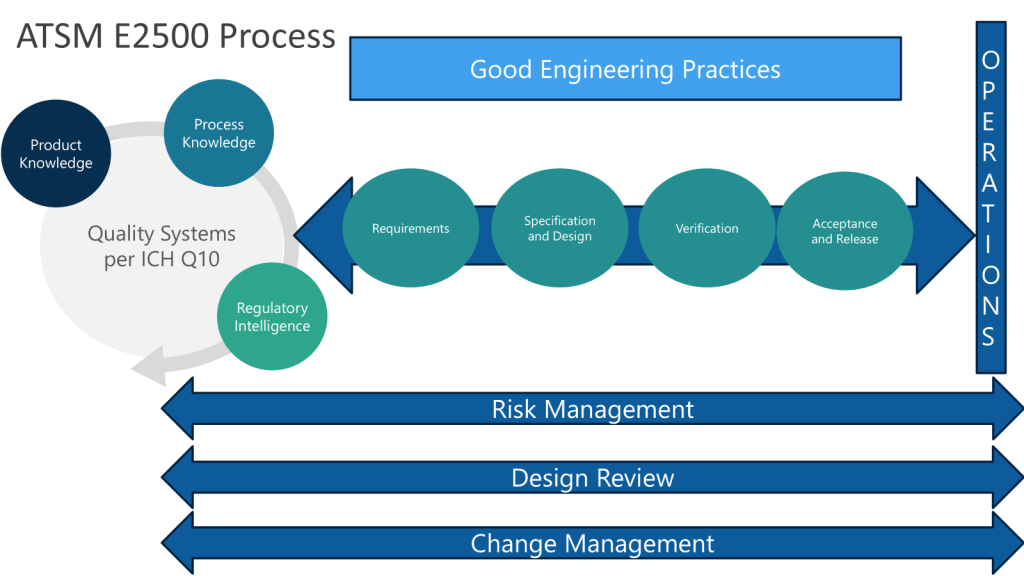
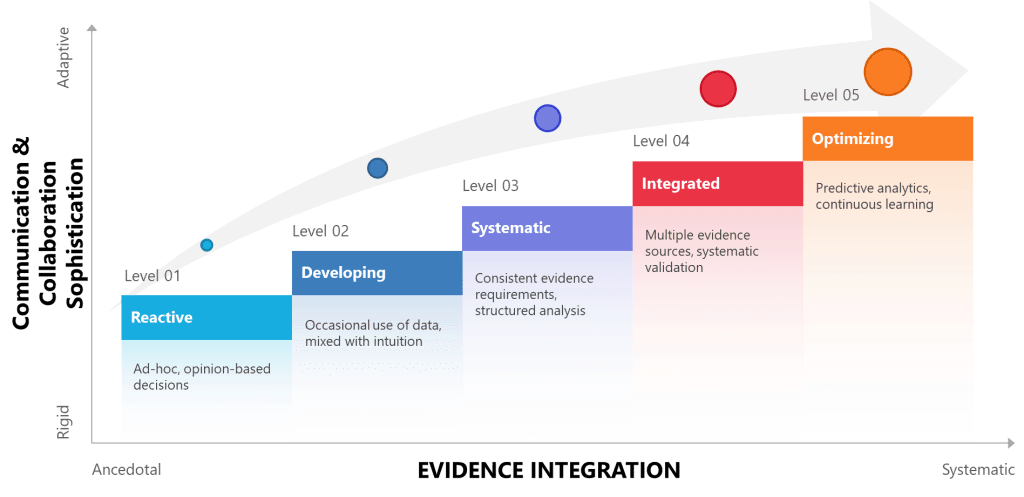
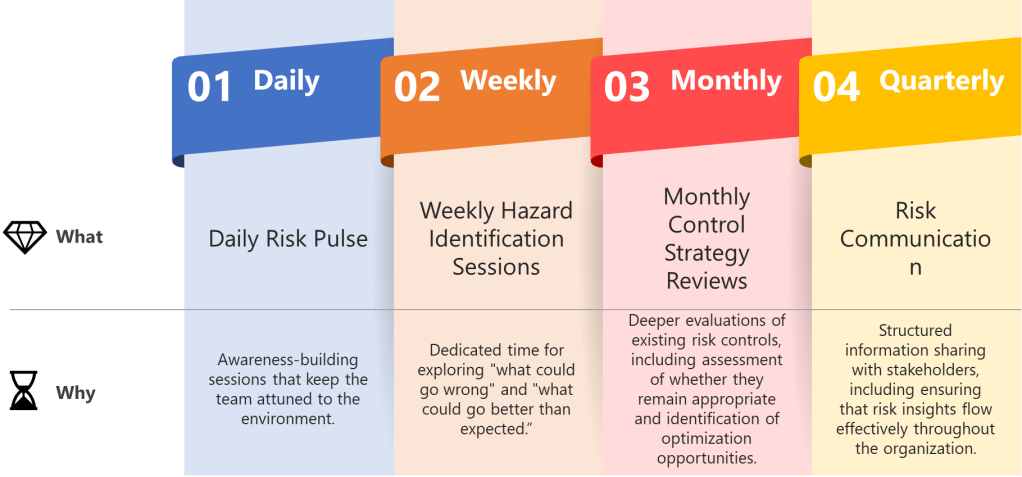
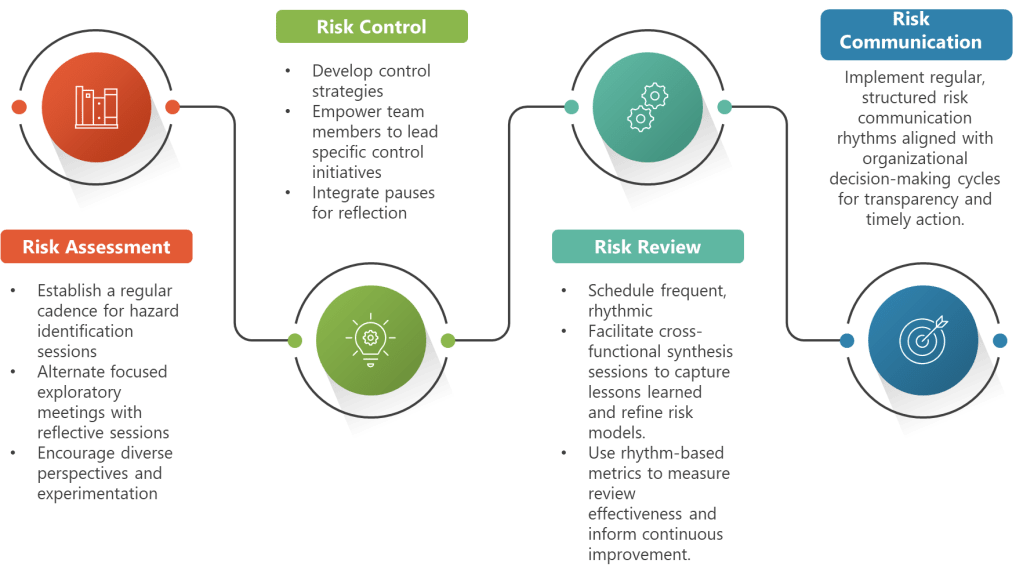
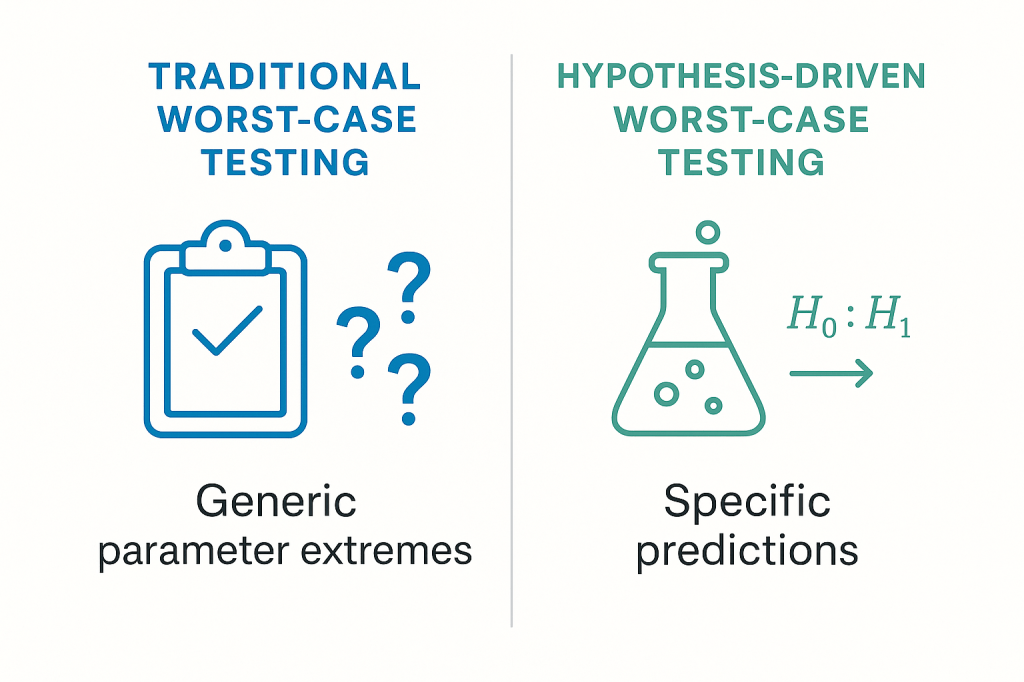
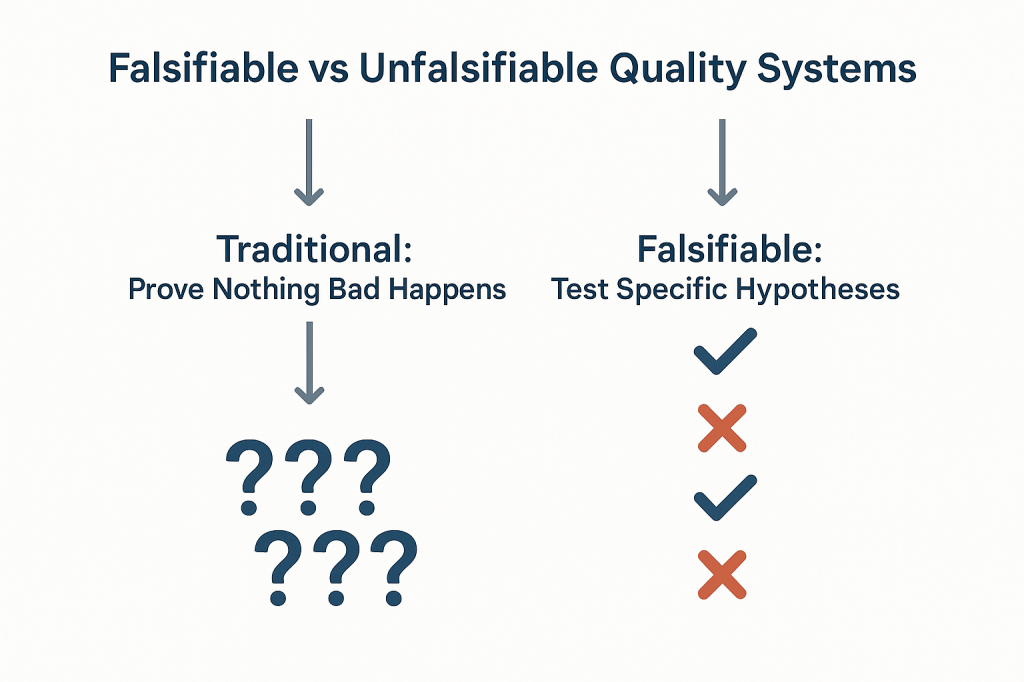
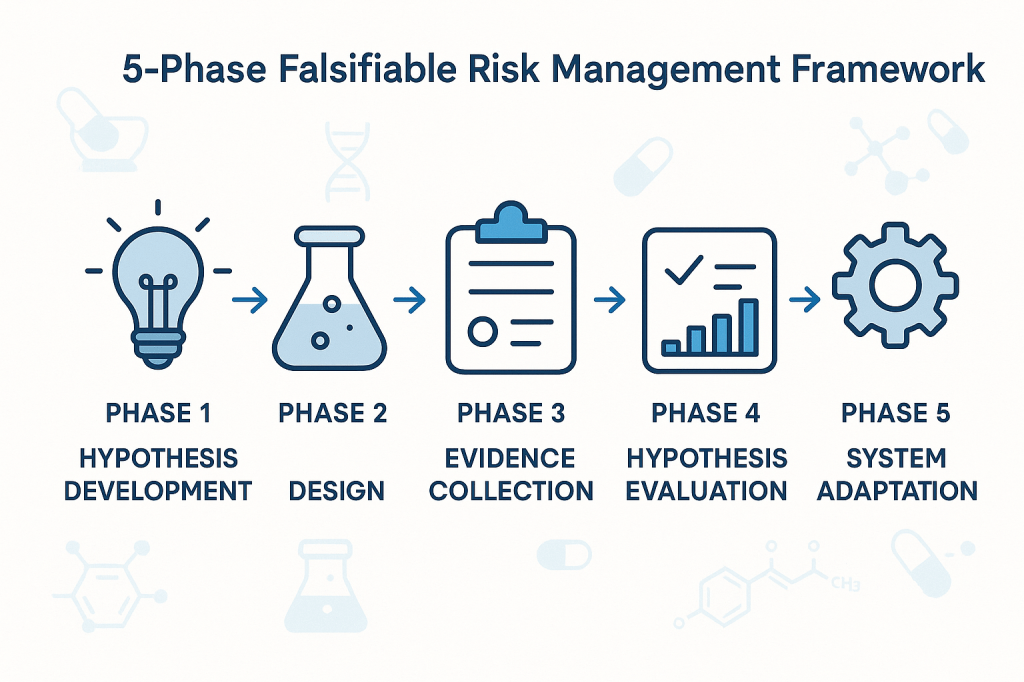
 Investigations of a Dog