
Levels of Problems in Culture

When thinking about root cause analysis it is useful to think of whether the problem is stemming from a cultural level or when it may be coming from an operational. We can think of these problems as hazards stemming from three areas:

  • Culture/philosophy is the over-arching view of how the organization conducts business from top-level decision-makers on through the corporate culture of an organization.
  • Policies are the broad specifications of the manner in which operations are performed. This includes the end-to-end processes.
  • Policies lead to the development of process and procedures, which are specifications for a task or series of tasks to accomplish a predetermined goal leading to a high degree of consistency and uniformity in performance.
Hazards unrecognized (risks not known or correctly appraised)Hazards forseen (risks anticipated but response not adequate)
Culture/Philosophy
Quality not source of corporate pride
Regulatory standards seen as maxima
Culture/Philosophy
Quality seen as source of corporate pride
Regulatory standards seen as minima
Policy
Internal monitoring schemes inadequate (e.g. employee concerns not communicated upwards)
Insufficient resources allocated to quality
Managers insufficiently trained or equipped
Reliance on other organization’s criteria (e.g. equipment manufacturer)
Policy
Known deficiencies (e.g. equipment, maintenance) not addressed
Defenses not adequately monitored
Defenses compromised by other policies (e.g. adversarial employee relations, incentive systems, performance monitoring)
Procedures
No written procedures
Procedures
Documentation inadequate
Inadequate, or Loop-hole in, controls
Procedures conflict with one another or with organizational policy

This approach on problems avoids a focus on the individuals involved and avoids a blame culture, which will optimize learning culture. Blaming the individuals risks creating an unsafe culture and creates difficulties for speaking up which should be an espoused quality value. Focus on deficiencies in the system to truly address the problem.
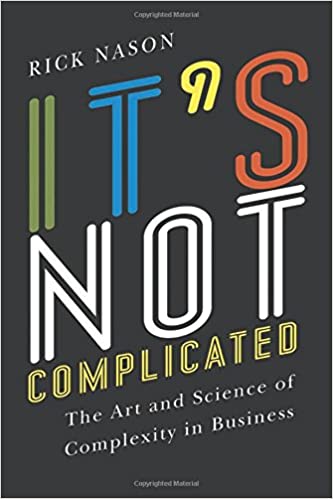
Quality Book Shelf – It’s Not Complicated

It’s Not Complicated: The Art and Science of Complexity in Business by Rick Nason

Nason states at the beginning of the book: “Engineers, scientists, and ecologists have been thinking in terms of complexity for fifty years, and it is time that the business community considered some of the valuable and interesting lessons the field has to offer.”

This book is a great introduction to the concept of complexity, and I think it should be required reading.

Complexity generally occurs whenever and wherever there are human interactions.” 

“It is thinking, creativity, and risk taking that lead to sustainable competitive advantage.” 

Over-reliance on data can be dangerous, and Nason goes into detail on how US Secretary of Defense, Robert McNamara disastrously managed the Vietnam War with spreadsheets: “You cannot collect data on things that are unknown … even if the factors are known, the precision needed for the data to be useful for a complex problem would not be achievable.”

None of us are as smart as all of us, and nature trumps us all. Nason refers to Orgel’s Second Rule that, “evolution is smarter than you are and that events in the business [human] world turn out to be more creative and clever than the best minds can imagine.” In addition, serendipity plays a critical role: “Complicated systems allow us the illusion that luck or serendipity played at best a limited role in our success and thus, that whatever success we have is almost exclusively the result of our own skills and effort.”

I could basically cut-and-paste quotes all day.

As someone who feels we overuse complicated and complex as synonyms, I recommend this book to all as a way to get familiar with the core concepts. I sort of wish he would write the companion volume, “No, that’s not complex.”

Level of Training

I want to talk about levels of training. I am not going to go into an Instructional Design model/framework, but more stay focused on the purpose of training in the quality system. I am also going to try to discuss training in terms that will make sense to folks who mostly dwell in a verification/validation mindset. So, all my professional learning developer friends please be gentle.

Categories of Training

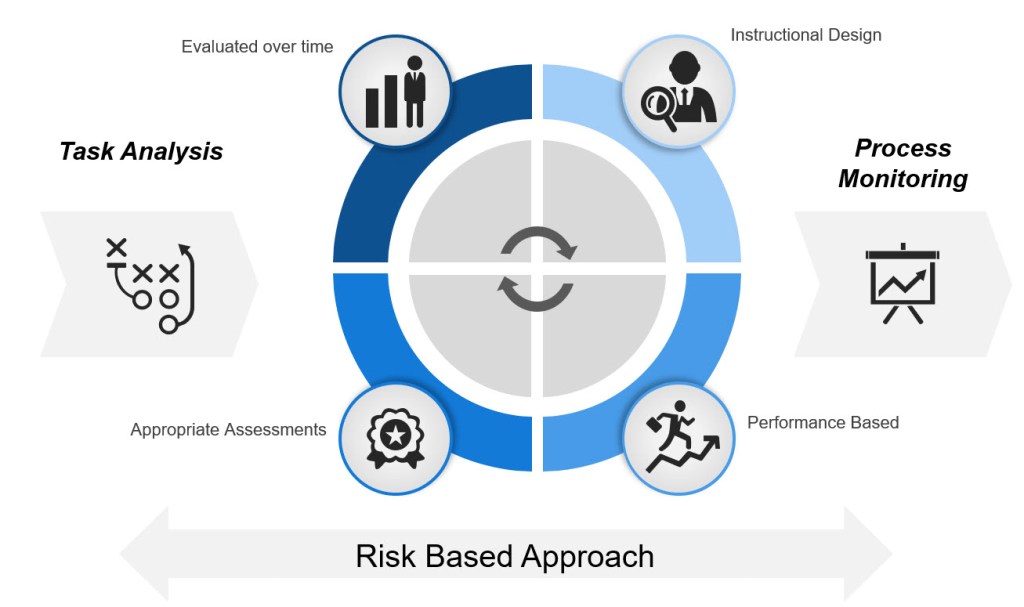
There are three levels of training (lots of subdivides) that can be viewed as a risk based approach

Awareness Training

This can be barely considered training. Awareness training conveys the subject matter to an audience with the goal of making the audience aware of the content of the communication. It is either informational or actionable. At best, just a ”tell” activity.

Read-and-understand fits in this bucket.

Facilitated Training

Facilitated training strives to improve the workplace proficiency and is hopefully based on some real adult learning principles. There are a lot of delivery modalities that are usually broken into two big buckets of eLearning and classroom delivery. It always has an assessment component to ensure the training had the desired impact. Usually a “tell, show” model with limited “do”.

Employee Qualification

On the job, hands on training that confirms the individual can do the work by independently performing the tasks while being monitored and assessed by the trainer. Usually follows a “tell, show, do, follow-up” model.

The Level of Training is Risk Based

The level of training should be driven by the criticality of the process/procedure/task. I recommend several questions driving this:

  • The complexity knowledge or skills needed to execute the changed process?
  • How complicated/complex is the process/procedure/task?
  • Criticality of Process and risk of performance error? What is the difficulty in detecting errors?
  • What is the identified audience (e.g., location, size, department, single site vs. multiple sites)?
  • Is the goal to change workers conditioned behavior?

The Personnel Qualification Model

Qualification means fitness for some purpose, shown by meeting necessary conditions or qualifying criteria. This applies as much to our people as it does to our equipment, and we can break this own with the three phases of IQ/OQ/PQ:

  • Personnel IQ is provides objective evidence that the trainee has the requisite education and experience for the process/procedure/task.
  • Personnel OQ is proves that the trainee can function in the training situation (event) in an appropriate fashion and performance is within the control limits set by the process/procedure/task. It proves that the trainee can perform the task correctly and independently.
  • Personnel PQ demonstrates the acceptable performance during representative operational conditions. The trainee’s performance consistently produces results that meet the standards set by the process/procedure/task.

Once the process of employee qualification I successfully completed, the employee is qualified and stays so unless and until they become disqualified or the process/procedure/task changes significantly enough to require requalification.

Disqualification and requalification

There should be a process for disqualification, whether from extended absences, job changes or a detrimental trend in performance such as serious or repeated deviations.

Process, Procedure and Task

A task is the steps for doing a particular piece of work.

Procedure are activities made up of a series of tasks.

A process is an upper level description of a series of activities required to accomplish an objective. Processes are made up of procedures or tasks. They have inputs and outputs.

ProcessProcedureTask
Flow of sequences of activities that transform input elements into resultsSpecific and required way to carry out a processDescribe the correct steps to perform a specific task
What we do By Whom Where it takes place When it happensHow the work must be performedHow to accomplish a specific task within a process with very detailed directions
Orchestration the workMandatory methodMandatory guidance
Can link to 0, 1 or more proceduresIt may consist of 0, 1 or more task instructionsFocus on the instructions of 1 task
Transversal by business unitsCross functional or only 1 business unitOnly 1 business unit
Participate more than one roleParticipate more than one roleParticipate only one role
Encapsulates activitiesExplains how to do but doesn’t get to all the details of how it is doneAll of the detail of all the steps to follow in an activity
Provides the workflow model at the highest level using  BPMNDocument with both narrative and images, usually in the form of use cases and workflow diagramsDocument with the maximum detail that explains step by step the instructions that must be carried out in an activity
Process, Procedure and Task Differences

This is the middle of a traditional document hierarchy and forms the Functional set of documents.

Document hierarchy pyramid