India releases draft guideline on Good Distribution Practices (GDP)

The Indian regulatory authority CDSCO (Central Drugs Standard Control Organization) has published a 21-page draft on Good Distribution Practices (GDP) for pharmaceutical products.

The draft covers topics that are well aligned to other good distribution practices, and is aligned to the ICH framework.

It is good to see India moving ahead in adopting best practices. This is a huge market, a growing source of production and it will be a huge center of innovation in the near future. It is important for CDSCO to continue to push forward in a better regulatory regime and to tighten their quality practices.

The guidance contains some of my favorite themes of GDP (and other pharma) practices, including::

  • Each company must hold one person responsible for ensuring a quality system is implemented and maintained.
  • All distributors of pharmaceutical products have to establish and maintain a quality system supported by a documented quality system.
  • Senior management has to ensure that all parts of the quality system are adequately resourced with competent personnel and suitable and sufficient premises, equipment and facilities.

The responsible person/quality person model is one of the more problematic aspects of our field. Yes, there is someone who is responsible for quality, its called the officers of the company. But this idea that one person sits on the top of the pyramid and makes ALL the best decisions is a problematic thing that regulations tend to enshrine.


Change Management of multi-site implementations

A colleague asks in response to my post Group change controls:

… deploying a Learning + documentation system … all around the word [as a global deployment]  … do we I initiate a GLOBAL CC or does each site created a local CC.

The answer is usually, in my experience, both.

Change management is about process, organization, technology and people. Any change control needs to capture the actions necessary to successful implement the change.

so at implementation I would do two sets of changes. A global to capture all the global level changes and to implement the new (hopefully) harmonized system And then a local change control at each site to capture all the site impact.

System Element Global Local
Process Introduce the new global process

Update all global standards, procedures, etc

How will local procedures change? How will local system interactions change – clean up all the local procedures to ensure the point to the new global procedures and are harmonized as necessary.
Technology Computer system validation

Global interfaces

Global migration strategy

Local interfaces (if any) and configurations

Are local technologies being replaced? Plan for decommissioning.

Local migration (tactical)

People What do people do on the global level?

How will people interact within the system in the future?

Global training

What will be different for people at each individual site?

Localized training

Organization Will there be new organizational structures in place? Is this system being run out of a global group? How will communication be run.

System governance and change management

Site organization changes

How will different organizations and sub organizations adopt, adapt and work with the system

If you just have a global change control you are at real risk of missing a ton of local uniqueness and leaving in place a bunch of old ways of thinking and doing things.

If you just do local change controls you will be at risk of not seeing the big picture and getting the full benefits of harmonization. You also will probably have way too many change controls that regurgitate the same content, and then are at risk of divergence – a compliance nightmare.

This structure allows you better capture the diversity of perspectives at the sites. A global change control tends to be dominated by the folks at each site who own the system (all your documents and training folks in this example), while a site change will hopefully include other functions, such as engineering and operations. Trust me, they will have all sorts of impact.

This structure also allows you to have rolling implementations. The global implements when the technology is validated and the core processes are effective. each site then can implement based on their site deliverables. useful when deploying a document management system and you have a lot of migration.
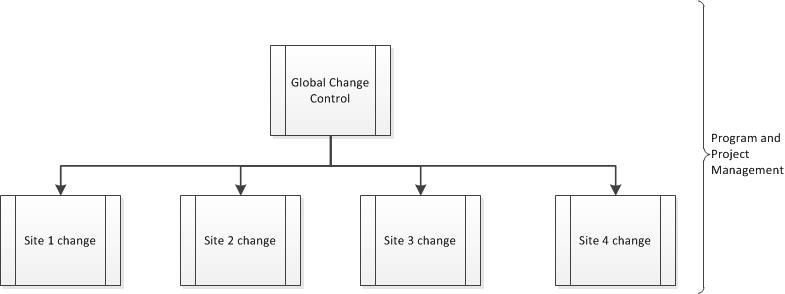
Multisite changes

As part of the deployment make sure to think through matters of governance, especially change management. Once deployed it is easy to imagine many changes just needing a central change control. But be sure to have thought through the criteria that will require site change controls – such as impact other interrelated systems, site validation or different implementation dates.

I’ve done a lot of changes and a lot of deployment of systems. This structure has always worked well. I’ve never done just a global and been happy with the final results, they always leave too much unchanged elements behind that come back to haunt you. In the last year I’ve done 2 major changes to great success with this model, and seen one where the decision not to use this model has left us with lots of little messes to clean up.

As a final comment, keep the questions coming and I would love to hear other folks perspectives on these matters. I’m perpetually learning and I know there are lots of permutations to explore.

Forms, forms, everywhere

Unless you work in the factory of the future the chances are you have forms — if you are like me over 1100 of them. So what is a form and how does it fit into our document management system?

Merriam-Webster Dictionary defines form (amongst other things) as “a printed or typed document with blank spaces for insertion of required or requested information.”

We use forms to tell what information needs to be captured, and usually to record when and by whom. Forms have the following advantages in our document management system:

  • The user has to write less
  • The user is told or reminded what information has to be supplied
  • There is uniformity
  • Information is collected in writing and so can be reexamined later. Forms almost always have a signature field to allow someone to take responsibility

It is useful to note here that electronic systems do basically the same thing.

Returning to our three major types of documents:

  • Functional Documents provide instructions so people can perform tasks and make decisions safely effectively, compliantly and consistently. This usually includes things like procedures, process instructions, protocols, methods and specifications. Many of these need some sort of training decision. Functional documents should involve a process to ensure they are up-to-date, especially in relation to current practices and relevant standards (periodic review)
  • Records provide evidence that actions were taken and decisions were made in keeping with procedures. This includes batch manufacturing records, logbooks and laboratory data sheets and notebooks. Records are a popular target for electronic alternatives.
  • Reports provide specific information on a particular topic on a formal, standardized way. Reports may include data summaries, findings and actions to be taken.

A form is a functional document that once printed and has data entered onto it becomes a record. That record then needs to be managed and has all sorts of good documentation and data integrity concerns including traceability and retention (archiving).

It is helpful here to also differentiate between a template and a form. A template is a form that is specifically used to build another document — an SOP template or a protocol template for example. Usually the template gives you a document that then goes through its own lifecycle.

Measures of success for changes

A colleague asks:

Is it a compliance risk to extend timelines on a change control?

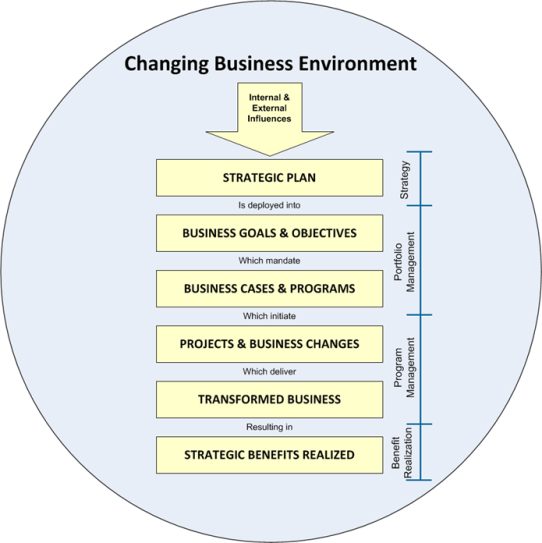
I want to take a step back to an important fundamental of change management to answer this question. All changes are done to realize strategic purposes; a good change management system is all about accelerating change. From the big transformations to the emergency changes to keep product being made each and every change has a strategic goal.

changing business environment

From this alignment to the strategy, each change has success metrics. Success metrics include economic, quality, technical and organization (among others) and they drive the how and the when of our change.

For example, a change driven by a CAPA to prevent reoccurrence will potentially have a different timeline than a change tied to a strategic goal to leverage a new way of working. But both have timelines driven by strategic to the tactical needs, usually filtered through a risk based prioritization tool.

And sometimes these change. The compliance aspect is not so much did you extend, it’s did you know what was happening with the change control in enough time to influence it in such a way to assure meeting the how.

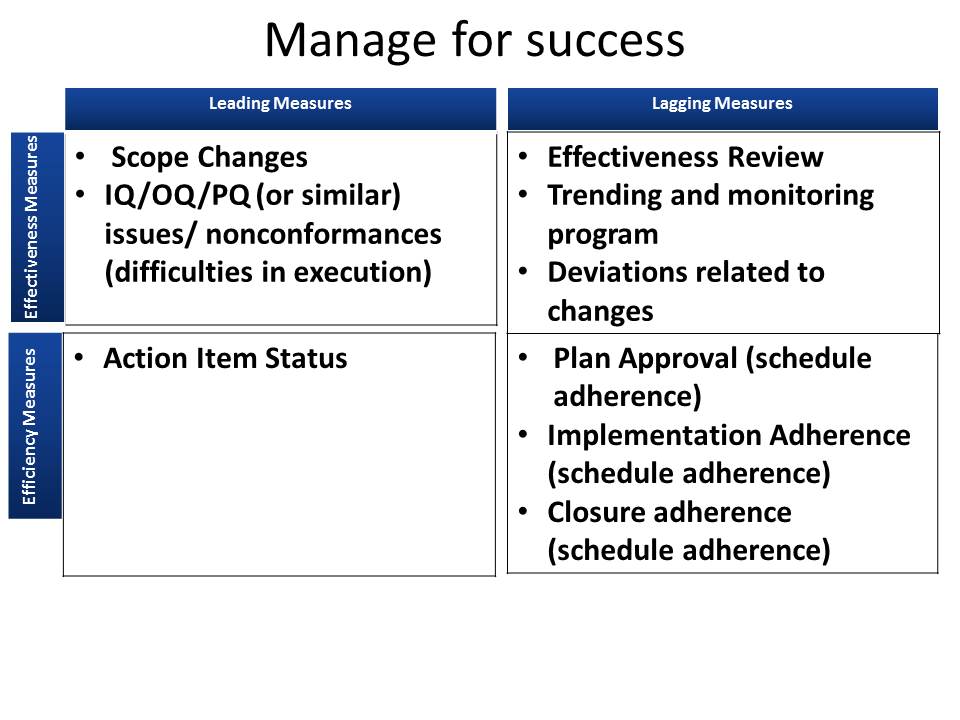
The KPIs and other measures built into your system should monitor and ensure your changes reach the intended benefits.

manage for success

To return to the original question. Unlike deviations/conformances where there is a specific requirements to complete in a timely way, and CAPAs where the root cause needs to be dealt with as soon as possible, change controls have their own internal timeline based on the drivers (which may be a CAPA). Extensions are not bad in a specific one-by-one change control approach. Instead they are indicative of larger troubles in the system and should be dealt with holistically to ensure you get the maximum benefit from your changes in the best possible time.

Look for trends in inspection activities

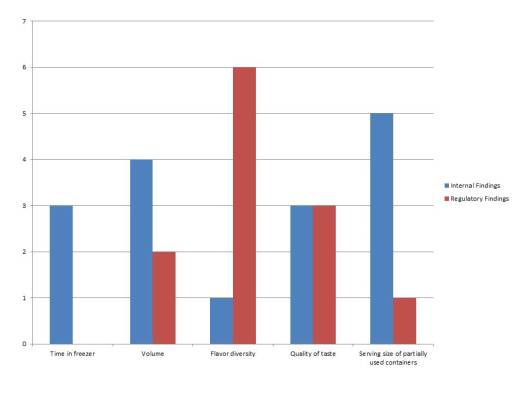
I’m in charge of ice cream, an important element of my household and as a result there are agreed upon criteria for success. I have internal inspectors (me) and external (my teenagers). I can thus produce a fairly simple graph of internal and external inspections and see the areas where there is a difference.

ice cream audit

From this I can tell which categories of findings are pain points and can look for systematic ways to fix them.

In my case, it’s clear the kids do not appreciate only having vanilla, strawberry and chocolate ice cream.

You can apply the same process to your internal vs. regulatory agencies (or certifying body or similar) audit findings.

You can quickly find two major patterns:

  1. Places you are gapping
  2. Places you are tougher than regulatory agencies

For those areas where you are gapping, evaluate your systems and determine what process improvements are necessary. A good area to include in this evaluation is the skill set of your internal auditors. For example, do you need more intensive data integrity training?

For those areas where you are tougher than regulatory agencies, do a quick check to ensure internal expectations are appropriately aligned. And then congratulate yourself.

You might have some areas where you have internal findings but absolutely no external. This might be a good indication that this might be a cutting edge area and you are doing a great job keeping ahead of the curve.

Take an additional step. Go to a source of inspection findings, such as the FDA’s 483 collection, and add them to your graph. This can help you identify additional areas of potential improvement. This can be especially helpful if you are a smaller company that does not have a wealth of data to draw.

We should all be doing what we can to anticipate trends and benchmark ourselves. This sort of data review and go a long way to finding some potential pain points before they get worse.