FDA Under Fire: The Troubling Impacts of Trump’s First 100 Days

The first 100 days of President Trump’s second term have been nothing short of seismic for the Food and Drug Administration (FDA). Sweeping layoffs, high-profile firings, and a mass exodus of experienced staff have left the agency reeling, raising urgent questions about the safety of drugs, devices, and food in the United States.

Unprecedented Layoffs and Firings

Mass Layoffs and Restructuring

On April 1, 2025, the Department of Health and Human Services (HHS) executed a reduction in force that eliminated 3,500 FDA employees. This was part of a larger federal downsizing that saw at least 121,000 federal workers dismissed across 30 agencies in Trump’s first 100 days, with health agencies like the FDA, CDC, and NIH particularly hard hit. Security guards barred entry to some FDA staff just hours after they received termination notices, underscoring the abruptness and scale of the cuts.

The layoffs were not limited to support staff. Policy experts, project managers, regulatory scientists, and communications professionals were let go, gutting the agency’s capacity to write guidance documents, manage application reviews, test product safety, and communicate risks to the public. Even before the April layoffs, industry had noticed a sharp decline in FDA responsiveness to routine and nonessential queries-a problem now set to worsen.

High-Profile Departures and Forced Resignations

The leadership vacuum is equally alarming. Key figures forced out or resigning under pressure include:

  • Dr. Peter Marks, CBER Director and the nation’s top vaccine official, dismissed after opposing the administration’s vaccine safety stance.
  • Dr. Robert Temple, a 52-year FDA veteran and regulatory pioneer, retired amidst the turmoil.
  • Dr. Namandjé N. Bumpus, Deputy Commissioner; Dr. Doug Throckmorton, Deputy Director for regulatory programs; Celia Witten, CBER Deputy Director; Peter Stein, Director of the Office of Drugs; and Brian King, head of the Center for Tobacco Products, all departed-some resigning when faced with termination.
  • Communications, compliance, and policy offices were decimated, with all FDA communications now centralized under HHS, ending decades of agency independence.

The new FDA Commissioner, Martin “Marty” Makary, inherits an agency stripped of much of its institutional memory and scientific expertise. Add to this very real questions about about Makary’s capabilities and approach:

1. Lack of FDA Institutional Memory and Support: Makary steps into the role just as the FDA’s deep bench of experienced scientists, regulators, and administrators has been depleted. The departure of key leaders and thousands of staff means Makary cannot rely on the usual institutional memory or internal expertise that historically guided complex regulatory decisions. The agency’s diminished capacity raises concerns about whether Makary can maintain the rigorous review standards and enforcement practices needed to protect public health.

2. Unconventional Background and Public Persona: While Makary is an accomplished surgeon and health policy researcher, his career has been marked by a willingness to challenge medical orthodoxy and criticize federal health agencies, including the FDA itself. His public rhetoric-often sharply critical and sometimes inflammatory-contrasts with the FDA’s traditionally cautious, evidence-based communication style. For example, Makary has accused government agencies of “lying” about COVID-19 boosters and has called the U.S. food supply “poison,” positions that have worried many in the scientific and public health communities.

3. Alignment with Political Leadership and Potential Conflicts: Makary’s views align closely with those of HHS Secretary Robert F. Kennedy Jr., particularly in their skepticism of certain mainstream public health measures and their focus on food additives, pesticides, and environmental contributors to chronic disease. This alignment raises questions about the degree to which Makary will prioritize political directives over established scientific consensus, especially in controversial areas like vaccine policy, food safety, and chemical regulation.

4. Contrarianism and a Tendency Towards Conspiracy: Makary’s recent writings, such as his book Blind Spots, emphasize his distrust of medical consensus and advocacy for challenging “groupthink” in health policy. Critics worry this may lead to the dismissal of well-established scientific standards in favor of less-tested or more ideologically driven policies. As Harvard’s Dr. Aaron Kesselheim notes, Makary will need to make decisions based on evolving evidence, even if that means occasionally being wrong-a process that requires humility and openness to expert input, both of which could be hampered by the loss of institutional expertise.

5. Immediate Regulatory and Ethical Challenges: Makary inherits unresolved, high-stakes regulatory issues, such as the controversy over compounded GLP-1 drugs and the agency’s approach to ultra-processed foods and food additives. His prior involvement with telehealth companies and outspoken positions on food chemicals could present conflicts of interest or at least the appearance of bias, further complicating his ability to act as an impartial regulator.

Impact on Patient Health and Safety

Reduced Oversight and Enforcement

The loss of thousands of staff-including scientists and specialists-means fewer eyes on the safety of drugs, devices, and food. Despite HHS assurances that product reviewers and inspectors were spared, the reality is that critical support staff who enable and assist reviews and inspections were let go. This has already resulted in:

  • Delays and unpredictability in drug and device approvals, as fewer project managers are available to coordinate and communicate with industry.
  • A likely reduction in inspections, as administrative staff who book travel and provide translation for inspectors are gone, forcing inspectors to take on additional tasks and leading to bottlenecks.
  • The pausing of FDA’s unannounced foreign inspection pilot program, raising the risk of substandard or adulterated imported products entering the U.S. market.

Diminished Public Communication

With the elimination of FDA’s communications staff and the centralization of messaging under HHS, the agency’s ability to quickly inform the public about recalls, safety alerts, and emerging health threats is severely compromised. This loss of transparency and direct communication could delay critical warnings about unsafe products or outbreaks.

Loss of Scientific Capacity

The departure of regulatory scientists and the decimation of the National Center for Toxicological Research threaten the FDA’s ability to conduct the regulatory science that underpins product safety and efficacy standards. As former Commissioner Robert Califf warned, “The FDA as we’ve known it is over, with most leaders who possess knowledge and deep understanding product development safety no longer in their positions… I believe that history will regard this as a grave error”.

Impact on Clinical Studies

Oversight and Ethical Safeguards Eroded

FDA oversight of clinical trials has plummeted. During Trump’s previous term, the agency sent far fewer warning letters for clinical trial violations than under Obama (just 12 in Trump’s first three years, compared to 99 in Obama’s first three), a trend likely to worsen with the latest staff cuts. The loss of experienced reviewers and compliance staff means less scrutiny of trial protocols, informed consent, and data integrity, potentially exposing participants to greater risk and undermining the credibility of U.S. clinical research.

Delays and Uncertainty for Sponsors

With fewer staff to provide guidance, answer questions, and manage applications, sponsors of clinical trials and new product applications face longer wait times and less predictable review timelines. The loss of informal dispute resolution mechanisms and scientific advisory capacity further complicates the regulatory landscape, making the U.S. a less attractive environment for innovation.

Impact on Good Manufacturing Practices (GMPs)

Inspections and Compliance at Risk

While HHS claims inspectors were not cut, the loss of support staff and administrative personnel is already affecting the FDA’s inspection regime. Inspectors now must handle both investigative and administrative tasks, increasing the risk of missed deficiencies and delayed responses to manufacturing problems. The FDA may increasingly rely on remote, paper-based inspections, which proved less effective during the COVID-19 pandemic and could allow GMP violations to go undetected.

Global Supply Chain Vulnerabilities

The rollback of foreign inspection programs and diminished regulatory science capacity further expose the U.S. to risks from overseas manufacturers, particularly in countries with less robust regulatory oversight. This could lead to more recalls, shortages, and public health emergencies.

A Historic Setback for Public Health

The Trump administration’s first 100 days have left the FDA a shell of its former self. The mass layoffs, firings, and resignations have gutted the agency’s scientific, regulatory, and communications capacity, with immediate and long-term consequences for patient safety, clinical research, and the integrity of the U.S. medical supply. The loss of institutional knowledge, the erosion of oversight, and the retreat from global leadership represent a profound setback for public health-one that will take years, if not decades, to repair.

As former FDA Commissioner Califf put it, “No segment of FDA is untouched. No one knows what the plan is”. The nation-and the world-are watching to see if the agency can recover from this unprecedented upheaval.

Citations:

Engineering Runs in the ASTM E2500 Validation Lifecycle

Engineering runs (ERs) represent a critical yet often underappreciated component of modern biopharmaceutical validation strategies. Defined as non-GMP-scale trials that simulate production processes to identify risks and optimize parameters, Engineering Runs bridge the gap between theoretical process design and manufacturing. Their integration into the ASTM E2500 verification framework creates a powerful synergy – combining Good Engineering Practice (GEP) with Quality Risk Management (QRM) to meet evolving regulatory expectations.

When aligned with ICH Q10’s pharmaceutical quality system (PQS) and the ASTM E2500 lifecycle approach, ERs transform from operational exercises into strategic tools for:

  • Design space verification per ICH Q8
  • Scale-up risk mitigation during technology transfer
  • Preparing for operational stability
  • Continuous process verification in commercial manufacturing

ASTM E2500 Framework Primer: The Four Pillars of Modern Verification

ASTM E2500 offers an iterative lifecycle approach to validation:

  1. Requirements Definition
    Subject Matter Experts (SMEs) collaboratively identify critical aspects impacting product quality using QRM tools. This phase emphasizes:
    • Process understanding over checklist compliance
    • Supplier quality systems evaluation
    • Risk-based testing prioritization
  2. Specification & Design
    The standard mandates “right-sized” documentation – detailed enough to ensure product quality without unnecessary bureaucracy.
  3. Verification
    This phase provides a unified verification approach focusing on:
    • Critical process parameters (CPPs)
    • Worst-case scenario testing
    • Leveraging vendor testing data
  4. Acceptance & Release
    Final review incorporates ICH Q10’s management responsibilities, ensuring traceability from initial risk assessments to verification outcomes.

Engineering runs serve as a critical bridge between design verification and formal Process Performance Qualification (PPQ). ERs validate critical aspects of manufacturing systems by confirming:

  1. Equipment functionality under simulated GMP conditions
  2. Process parameter boundaries for Critical Process Parameters (CPPs)
  3. Facility readiness through stress-testing utilities, workflows, and contamination controls
 Demonstration/ Training Run prior to GMP areaShakedown. Demonstration/Training Run in GMP areaEngineering RuncGMP Manufacturing
Room and Equipment
RoomN/AIOQ Post-ApprovalReleased and Active
Process GasGeneration and Distribution Released Point of use assembly PQ complete
Process utility
Process EquipmentFunctionally verified or calibrated as required (commissioned)IOQ ApprovedFull released
Analytical EquipmentReleased
AlarmsN/AAlarm ranges and plan definedAlarms qualified
Raw Materials
Bill of MaterialsRM in progressApproved
SuppliersApproval in ProgressApproved
SpecificationsIn DraftEffective
ReleaseNon-GMP Usage decisionReleased
Process Documentation
Source DocumentationTo be defined in Tech Transfer PlanEngineering Run ProtocolTech Transfer closed
Batch Records and product specific Work InstructionsDraftReviewed DraftApproved
Process and Equipment SOPsN/ADraftEffective
Product LabelsN/ADraft LabelsApproved Labels
QC Testing and Documentation
BSC and Personnel Environmental MonitoringN/AEffective
Analytical MethodsSuitable for usePhase Appropriate Validation
StabilityN/AIn place
Certificate of AnalysisN/ADefined in Engineering ProtocolEffective
Sampling PlanDraftDraft use as defined in engineering protocolEffective
Operations/Execution
Operator TrainingObserve and perform operations to gain hands on experience with SME observationProcess specific equipment OJT Gown qualifiedBSC OJT Aseptic OJT Material Transfer OJT (All training in eQMS)Training in Use
Process LockAs defined in Tech Transfer Plan6-week prior to executionApproved Process Description
DeviationsN/AN/AProcess – Per Engineering Run protocol FUSE – per SOPPer SOP
Final DispositionN/AN/ANot for Human UsePer SOP
OversitePP&DMS&TQA on the floor and MS&T as necessary

Understanding the Distinction Between Impact and Risk

Two concepts—impact and risk — are often discussed but sometimes conflated within quality systems. While related, these concepts serve distinct purposes and drive different decisions throughout the quality system. Let’s explore.

The Fundamental Difference: Impact vs. Risk

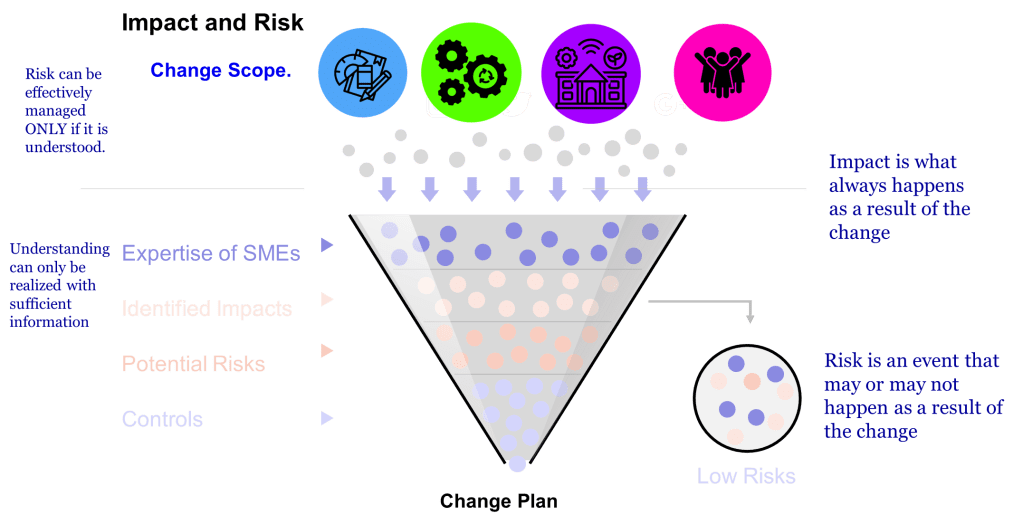
The difference between impact and risk is fundamental to effective quality management. The difference between impact and risk is critical. Impact is best thought of as ‘What do I need to do to make the change.’ Risk is ‘What could go wrong in making this change?'”

Impact assessment focuses on evaluating the effects of a proposed change on various elements such as documentation, equipment, processes, and training. It helps identify the scope and reach of a change. Risk assessment, by contrast, looks ahead to identify potential failures that might occur due to the change – it’s preventive and focused on possible consequences.

This distinction isn’t merely academic – it directly affects how we approach actions and decisions in our quality systems, impacting core functions of CAPA, Change Control and Management Review.

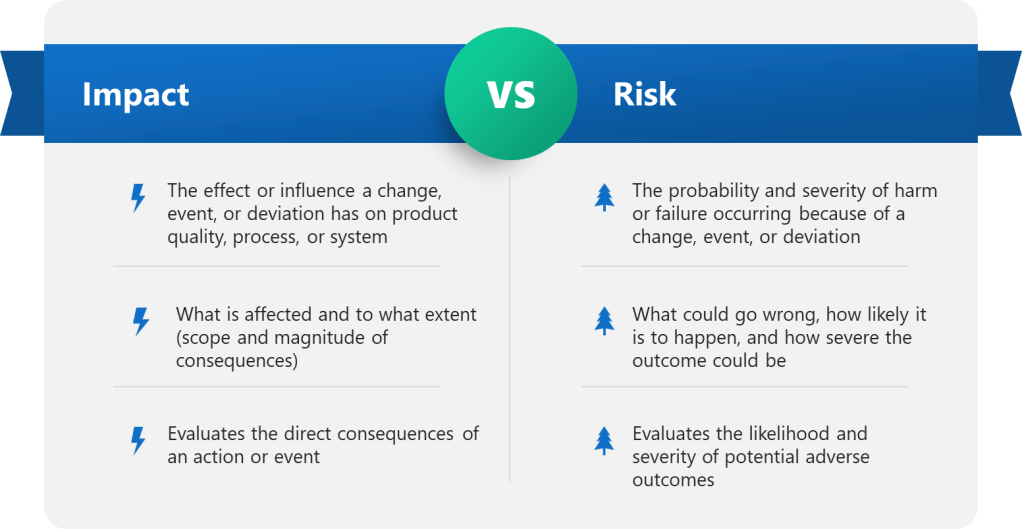
AspectImpactRisk
DefinitionThe effect or influence a change, event, or deviation has on product quality, process, or systemThe probability and severity of harm or failure occurring as a result of a change, event, or deviation
FocusWhat is affected and to what extent (scope and magnitude of consequences)What could go wrong, how likely it is to happen, and how severe the outcome could be
Assessment TypeEvaluates the direct consequences of an action or eventEvaluates the likelihood and severity of potential adverse outcomes
Typical UseUsed in change control to determine which documents, systems, or processes are impactedUsed to prioritize actions, allocate resources, and implement controls to minimize negative outcomes
MeasurementUsually described qualitatively (e.g., minor, moderate, major, critical)Often quantified by combining probability and impact scores to assign a risk level (e.g., low, medium, high)
ExampleA change in raw material supplier impacts the manufacturing process and documentation.The risk is that the new supplier’s material could fail to meet quality standards, leading to product defects.

Change Control: Different Questions, Different Purposes

Within change management, the PIC/S Recommendation PI 054-1 notes that “In some cases, especially for simple and minor/low risk changes, an impact assessment is sufficient to document the risk-based rationale for a change without the use of more formal risk assessment tools or approaches.”

Impact Assessment in Change Control

  • Determines what documentation requires updating
  • Identifies affected systems, equipment, and processes
  • Establishes validation requirements
  • Determines training needs

Risk Assessment in Change Control

  • Identifies potential failures that could result from the change
  • Evaluates possible consequences to product quality and patient safety
  • Determines likelihood of those consequences occurring
  • Guides preventive measures

A common mistake is conflating these concepts or shortcutting one assessment. For example, companies often rush to designate changes as “like-for-like” without supporting data, effectively bypassing proper risk assessment. This highlights why maintaining the distinction is crucial.

Validation: Complementary Approaches

In validation, the impact-risk distinction shapes our entire approach.

Impact in validation relates to identifying what aspects of product quality could be affected by a system or process. For example, when qualifying manufacturing equipment, we determine which critical quality attributes (CQAs) might be influenced by the equipment’s performance.

Risk assessment in validation explores what could go wrong with the equipment or process that might lead to quality failures. Risk management plays a pivotal role in validation by enabling a risk-based approach to defining validation strategies, ensuring regulatory compliance, mitigating product quality and safety risks, facilitating continuous improvement, and promoting cross-functional collaboration.

In Design Qualification, we verify that the critical aspects (CAs) and critical design elements (CDEs) necessary to control risks identified during the quality risk assessment (QRA) are present in the design. This illustrates how impact assessment (identifying critical aspects) works together with risk assessment (identifying what could go wrong).

When we perform Design Review and Design Qualification, we focus on Critical Aspects: Prioritize design elements that directly impact product quality and patient safety. Here, impact assessment identifies critical aspects, while risk assessment helps prioritize based on potential consequences.

Following Design Qualification, Verification activities such as Installation Qualification (IQ), Operational Qualification (OQ), and Performance Qualification (PQ) serve to confirm that the system or equipment performs as intended under actual operating conditions. Here, impact assessment identifies the specific parameters and functions that must be verified to ensure no critical quality attributes are compromised. Simultaneously, risk assessment guides the selection and extent of tests by focusing on areas with the highest potential for failure or deviation. This dual approach ensures that verification not only confirms the intended impact of the design but also proactively mitigates risks before routine use.

Validation does not end with initial qualification. Continuous Validation involves ongoing monitoring and trending of process performance and product quality to confirm that the validated state is maintained over time. Impact assessment plays a role in identifying which parameters and quality attributes require ongoing scrutiny, while risk assessment helps prioritize monitoring efforts based on the likelihood and severity of potential deviations. This continuous cycle allows quality systems to detect emerging risks early and implement corrective actions promptly, reinforcing a proactive, risk-based culture that safeguards product quality throughout the product lifecycle.

Data Integrity: A Clear Example

Data integrity offers perhaps the clearest illustration of the impact-risk distinction.

As I’ve previously noted, Data quality is not a risk. It is a causal factor in the failure or severity. Poor data quality isn’t itself a risk; rather, it’s a factor that can influence the severity or likelihood of risks.

When assessing data integrity issues:

  • Impact assessment identifies what data is affected and which processes rely on that data
  • Risk assessment evaluates potential consequences of data integrity lapses

In my risk-based data integrity assessment methodology, I use a risk rating system that considers both impact and risk factors:

Risk RatingActionMitigation
>25High Risk-Potential Impact to Patient Safety or Product QualityMandatory
12-25Moderate Risk-No Impact to Patient Safety or Product Quality but Potential Regulatory RiskRecommended
<12Negligible DI RiskNot Required

This system integrates both impact (on patient safety or product quality) and risk (likelihood and detectability of issues) to guide mitigation decisions.

The Golden Day: Impact and Risk in Deviation Management

The Golden Day concept for deviation management provides an excellent practical example. Within the first 24 hours of discovering a deviation, we conduct:

  1. An impact assessment to determine:
    • Which products, materials, or batches are affected
    • Potential effects on critical quality attributes
    • Possible regulatory implications
  2. A risk assessment to evaluate:
    • Patient safety implications
    • Product quality impact
    • Compliance with registered specifications
    • Level of investigation required

This impact assessment is also the initial risk assessment, which will help guide the level of effort put into the deviation. This statement shows how the two concepts, while distinct, work together to inform quality decisions.

Quality Escalation: When Impact Triggers a Response

In quality escalation, we often use specific criteria based on both impact and risk:

Escalation CriteriaExamples of Quality Events for Escalation
Potential to adversely affect quality, safety, efficacy, performance or compliance of product– Contamination – Product defect/deviation from process parameters or specification – Significant GMP deviations
Product counterfeiting, tampering, theft– Product counterfeiting, tampering, theft reportable to Health Authority – Lost/stolen IMP
Product shortage likely to disrupt patient care– Disruption of product supply due to product quality events
Potential to cause patient harm associated with a product quality event– Urgent Safety Measure, Serious Breach, Significant Product Complaint

These criteria demonstrate how we use both impact (what’s affected) and risk (potential consequences) to determine when issues require escalation.

Both Are Essential

Understanding the difference between impact and risk fundamentally changes how we approach quality management. Impact assessment without risk assessment may identify what’s affected but fails to prevent potential issues. Risk assessment without impact assessment might focus on theoretical problems without understanding the actual scope.

The pharmaceutical quality system requires both perspectives:

  1. Impact tells us the scope – what’s affected
  2. Risk tells us the consequences – what could go wrong

By maintaining this distinction and applying both concepts appropriately across change control, validation, and data integrity management, we build more robust quality systems that not only comply with regulations but actually protect product quality and patient safety.

Worker’s Rights: The Bedrock of True Quality Management – A May Day Reflection

As we celebrate International Workers’ Day this May 1st, it is an opportune moment to reflect on the profound connection between workers’ rights and effective quality management. The pursuit of quality cannot be separated from how we treat, empower, and respect the rights of those who create that quality daily. Today’s post examines this critical relationship, drawing from the principles I’ve advocated throughout my blog, and challenges us to reimagine quality management as fundamentally worker-centered.

The Historical Connection Between Workers’ Rights and Quality

International Workers’ Day commemorates the historic struggles and gains made by workers and the labor movement. This celebration reminds us that the evolution of quality management has paralleled the fight for workers’ rights. Quality is inherently a progressive endeavor, fundamentally anti-Taylorist in nature. Frederick Taylor’s scientific management approach reduced workers to interchangeable parts in a machine, stripping them of autonomy and creativity – precisely the opposite of what modern quality management demands.

The quality movement, from Deming onwards, has recognized that treating workers as mere cogs undermines the very foundations of quality. When we champion human rights and center those whose rights are challenged, we’re not engaging in politics separate from quality – we’re acknowledging the fundamental truth that quality cannot exist without empowered, respected workers.

Driving Out Fear: The Essential Quality Right

“No one can put in his best performance unless he feels secure,” wrote Deming thirty-five years ago. Yet today, fear remains ubiquitous in corporate culture, undermining the very quality we seek to create. As quality professionals, we must confront this reality at every opportunity.

Fear in the workplace manifests in multiple ways, each destructive to quality:

Source of FearDescriptionImpact on Quality
CompetitionManagers often view anxiety generated by competition between co-workers as positive, encouraging competition for scarce resources, power, and statusUndermines collaboration necessary for system-wide quality improvements
“Us and Them” CultureSilos proliferate, creating barriers between staff and supervisorsPrevents holistic quality approaches that span departmental boundaries
Blame CultureFocus on finding fault rather than improving systems, often centered around the concept of “human error”Discourages reporting of issues, driving quality problems underground

When workers operate in fear, quality inevitably suffers. They hide mistakes rather than report them, avoid innovation for fear of failure, and focus on protecting themselves rather than improving systems. Driving out fear isn’t just humane – it’s essential for quality.

Key Worker Rights in Quality Management

Quality management systems that respect workers’ rights create environments where quality can flourish. Based on workplace investigation principles, these rights extend naturally to all quality processes.

The Right to Information

In any quality system, clarity is essential. Workers have the right to understand quality requirements, the rationale behind procedures, and how their work contributes to the overall quality system. Transparency sets the stage for collaboration, where everyone works toward a common quality goal with full understanding.

The Right to Confidentiality and Non-Retaliation

Workers must feel safe reporting quality issues without fear of punishment. This means protecting their confidentiality when appropriate and establishing clear non-retaliation policies. One of the pillars of workplace equity is ensuring that employees are shielded from retaliation when they raise concerns, reinforcing a commitment to a culture where individuals can voice quality issues without fear.

The Right to Participation and Representation

The Who-What Matrix is a powerful tool to ensure the right people are involved in quality processes. By including a wider set of people, this approach creates trust, commitment, and a sense of procedural justice-all essential for quality success. Workers deserve representation in decisions that affect their ability to produce quality work.

Worker Empowerment: The Foundation of Quality Culture

Empowerment is not just a nice-to-have; it’s a foundational element of any true quality culture. When workers are entrusted with authority to make decisions, initiate actions, and take responsibility for outcomes, both job satisfaction and quality improve. Unfortunately, empowerment rhetoric is sometimes misused within quality frameworks like TQM, Lean, and Six Sigma to justify increased work demands rather than genuinely empowering workers.

The concept of empowerment has its roots in social movements, including civil rights and women’s rights, where it described the process of gaining autonomy and self-determination for marginalized groups. In quality management, this translates to giving workers real authority to improve processes and address quality issues.

Mary Parker Follett’s Approach to Quality Through Autonomy

Follett emphasized giving workers autonomy to complete their jobs effectively, believing that when workers have freedom, they become happier, more productive, and more engaged. Her “power with” principle suggests that power should be shared broadly rather than concentrated, fostering a collaborative environment where quality can thrive.

Rejecting the Great Man Fallacy

Quality regulations often fall into the trap of the “Great Man Fallacy” – the misguided notion that one person through education, experience, and authority can ensure product safety, efficacy, and quality. This approach is fundamentally flawed.

People only perform successfully when they operate within well-built systems. Process drives success by leveraging the right people at the right time making the right decisions with the right information. No single person can ensure quality, and thinking otherwise sets up both individuals and systems for failure.

Instead, we need to build processes that leverage teams, democratize decisions, and drive reliable results. This approach aligns perfectly with respecting workers’ rights and empowering them as quality partners rather than subjects of quality control.

Quality Management as a Program: Centering Workers’ Rights

Quality needs to be managed as a program, walking a delicate line between long-term goals, short-term objectives, and day-to-day operations. As quality professionals, we must integrate workers’ rights into this program approach.

The challenges facing quality today-from hyperautomation to shifting customer expectations-can only be addressed through worker empowerment. Consider how these challenges demand a worker-centered approach:

ChallengeImpact on Quality ManagementWorker-Centered Approach
Advanced AnalyticsRequires holistic data analysis and applicationDevelop talent strategies that upskill workers rather than replacing them
Hyper-AutomationTasks previously done by humans being automatedInvolve workers in automation decisions; focus on how automation can enhance rather than replace human work
Virtualization of WorkRethinking how quality is executed in digital environmentsEnsure workers have input on how virtual quality processes are designed
Shift to Resilient OperationsNeed to adapt to changing risk levels in real-timeEnable employees to make faster decisions by building quality-informed judgment
Digitally Native WorkforceChanged expectations for how work is managedConnect quality to values employees care about: autonomy, innovation, social issues

To meet these challenges, we must shift from viewing quality as a function to quality as an interdisciplinary, participatory process. We need to break down silos and build autonomy, encouraging personal buy-in through participatory quality management.

May Day as a Reminder of Our Quality Mission

As International Workers’ Day approaches, I’m reminded that our quality mission is inseparable from our commitment to workers’ rights. This May Day, I encourage all quality professionals to:

  1. Evaluate how your quality systems either support or undermine workers’ rights
  2. Identify and eliminate sources of fear in your quality processes
  3. Create mechanisms for meaningful worker participation in quality decisions
  4. Reject hierarchical quality models in favor of democratic, empowering approaches
  5. Recognize that centering workers’ rights isn’t just ethical-it’s essential for quality

Quality management without respect for workers’ rights is not just morally questionable-it’s ineffective. The future of quality lies in approaches that are predictive, connected, flexible, and embedded. These can only be achieved when workers are treated as valued partners with protected rights and real authority.

This May Day, let’s renew our commitment to driving out fear, empowering workers, and building quality systems that respect the dignity and rights of every person who contributes to them. In doing so, we honor not just the historical struggles of workers, but also the true spirit of quality that puts people at its center.

What steps will you take this International Workers’ Day to strengthen the connection between workers’ rights and quality in your organization?

The Golden Start to a Deviation Investigation

How you respond in the first 24 hours after discovering a deviation can make the difference between a minor quality issue and a major compliance problem. This critical window-what I call “The Golden Day”-represents your best opportunity to capture accurate information, contain potential risks, and set the stage for a successful investigation. When managed effectively, this initial day creates the foundation for identifying true root causes and implementing effective corrective actions that protect product quality and patient safety.

Why the First 24 Hours Matter: The Evidence

The initial response to a deviation is crucial for both regulatory compliance and effective problem-solving. Industry practice and regulatory expectations align on the importance of quick, systematic responses to deviations.

  • Regulatory expectations explicitly state that deviation investigation and root cause determination should be completed in a timely manner, and industry expectations usually align on deviations being completed within 30 days of discovery.
  • In the landmark U.S. v. Barr Laboratories case, “the Court declared that all failure investigations must be performed promptly, within thirty business days of the problem’s occurrence”
  • Best practices recommend assembling a cross-functional team immediately after deviation discovery and conduct initial risk assessment within 24 hours”
  • Initial actions taken in the first day directly impact the quality and effectiveness of the entire investigation process

When you capitalize on this golden window, you’re working with fresh memories, intact evidence, and the highest chance of observing actual conditions that contributed to the deviation.

Identifying the Problem: Clarity from the Start

Clear, precise problem definition forms the foundation of any effective investigation. Vague or incomplete problem statements lead to misdirected investigations and ultimately, inadequate corrective actions.

  • Document using specific, factual language that describes what occurred versus what was expected
  • Include all relevant details such as procedure and equipment numbers, product names and lot numbers
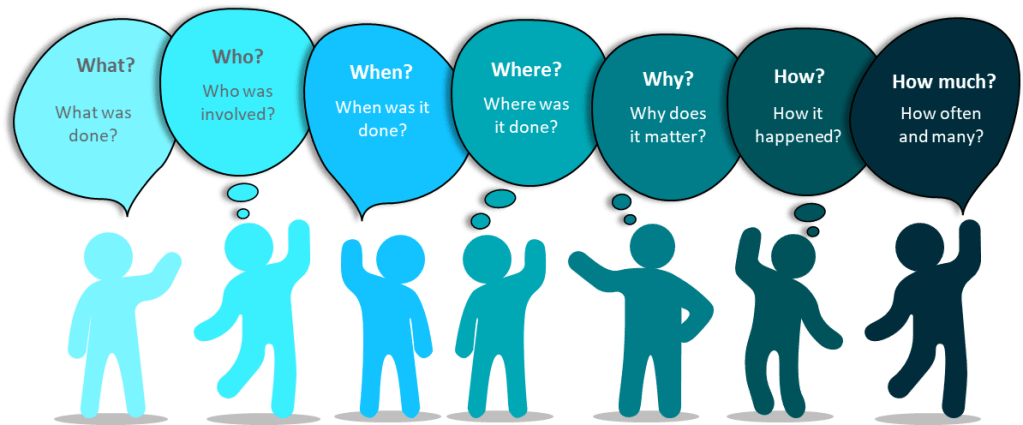
  • Apply the 5W2H method (What, When, Where, Who, Why if known, How much is involved, and How it was discovered)
  • Avoid speculation about causes in the initial description
  • Remember that the description should incorporate relevant records and photographs of discovered defects.
5W2HTypical questionsContains
Who?Who are the people directly concerned with the problem? Who does this? Who should be involved but wasn’t? Was someone involved who shouldn’t be?User IDs, Roles and Departments
What?What happened?Action, steps, description
When?When did the problem occur?Times, dates, place In process
Where?Where did the problem occur?Location
Why is it important?Why did we do this? What are the requirements? What is the expected condition?Justification, reason
How?How did we discover. Where in the process was it?Method, process, procedure
How Many? How Much?How many things are involved? How often did the situation happen? How much did it impact?Number, frequency

The quality of your deviation documentation begins with this initial identification. As I’ve emphasized in previous posts, the investigation/deviation report should tell a story that can be easily understood by all parties well after the event and the investigation. This narrative begins with clear identification on day one.

ElementsProblem Statement
Is used to…Understand and target a problem. Providing a scope. Evaluate any risks. Make objective decisions
Answers the following… (5W2H)What? (problem that occurred);When? (timing of what occurred); Where? (location of what occurred); Who? (persons involved/observers); Why? (why it matters, not why it occurred); How Much/Many? (volume or count); How Often? (First/only occurrence or multiple)
Contains…Object (What was affected?); Defect (What went wrong?)
Provides direction for…Escalation(s); Investigation

Going to the GEMBA: Being Where the Action Is

GEMBA-the actual place where work happens-is a cornerstone concept in quality management. When a deviation occurs, there is no substitute for being physically present at the location.

  • Observe the actual conditions and environment firsthand
  • Notice details that might not be captured in written reports
  • Understand the workflow and context surrounding the deviation
  • Gather physical evidence before it’s lost or conditions change
  • Create the opportunity for meaningful conversations with operators

Human error occurs because we are human beings. The extent of our knowledge, training, and skill has little to do with the mistakes we make. We tire, our minds wander and lose concentration, and we must navigate complex processes while satisfying competing goals and priorities – compliance, schedule adherence, efficiency, etc.

Foremost to understanding human performance is knowing that people do what makes sense to them given the available cues, tools, and focus of their attention at the time. Simply put, people come to work to do a good job – if it made sense for them to do what they did, it will make sense to others given similar conditions. The following factors significantly shape human performance and should be the focus of any human error investigation:

Physical Environment
Environment, tools, procedures, process design
Organizational Culture
Just- or blame-culture, attitude towards error
Management and Supervision
Management of personnel, training, procedures
Stress Factors
Personal, circumstantial, organizational

We do not want to see or experience human error – but when we do, it’s imperative to view it as a valuable opportunity to improve the system or process. This mindset is the heart of effective human error prevention.

Conducting an Effective GEMBA Walk for Deviations

When conducting your GEMBA walk specifically for deviation investigation:

  • Arrive with a clear purpose and structured approach
  • Observe before asking questions
  • Document observations with photos when appropriate
  • Look for environmental factors that might not appear in reports
  • Pay attention to equipment configuration and conditions
  • Note how operators interact with the process or equipment

A deviation gemba is a cross-functional team meeting that is assembled where a potential deviation event occurred. Going to the gemba and “freezing the scene” as close as possible to the time the event occurred will yield valuable clues about the environment that existed at the time – and fresher memories will provide higher quality interviews. This gemba has specific objectives:

  • Obtain a common understanding of the event: what happened, when and where it happened, who observed it, who was involved – all the facts surrounding the event. Is it a deviation?
  • Clearly describe actions taken, or that need to be taken, to contain impact from the event: product quarantine, physical or mechanical interventions, management or regulatory notifications, etc.
  • Interview involved operators: ask open-ended questions, like how the event unfolded or was discovered, from their perspective, or how the event could have been prevented, in their opinion – insights from personnel experienced with the process can prove invaluable during an investigation.

Deviation GEMBA Tips

Typically there is time between when notification of a deviation gemba goes out and when the team is scheduled to assemble. It is important to come prepared to help facilitate an efficient gemba:

  • Assemble procedures and other relevant documents and records. This will make references easier during the gemba.
  • Keep your team on-track – the gemba should end with the team having a common understanding of the event, actions taken to contain impact, and the agreed-upon next steps of the investigation.

You will gain plenty of investigational leads from your observations and interviews at the gemba – which documents to review, which personnel to interview, which equipment history to inspect, and more. The gemba is such an invaluable experience that, for many minor events, root cause and CAPA can be determined fairly easily from information gathered solely at the gemba.

Informal Rubric for Conducting a Good Deviation GEMBA

  • Describe the timeliness of the team gathering at the gemba.
  • Were all required roles and experts present?
  • Was someone leading or facilitating the gemba?
  • Describe any interviews the team performed during the gemba.
  • Did the team get sidetracked or off-topic during the gemba
  • Was the team prepared with relevant documentation or information?
  • Did the team determine batch impact and any reportability requirements?
  • Did the team satisfy the objectives of the gemba?
  • What did the team do well?
  • What could the team improve upon?

Speaking with Operators: The Power of Cognitive Interviewing

Interviewing personnel who were present when the deviation occurred requires special techniques to elicit accurate, complete information. Traditional questioning often fails to capture critical details.

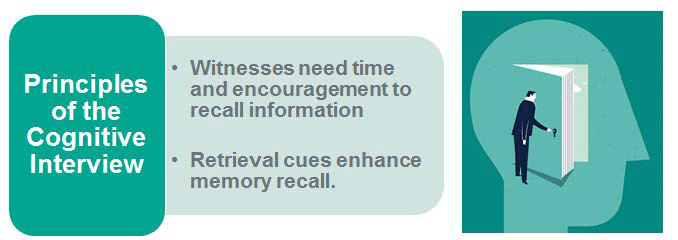
Cognitive interviewing, as I outlined in my previous post on “Interviewing,” was originally created for law enforcement and later adopted during accident investigations by the National Transportation Safety Board (NTSB). This approach is based on two key principles:

  • Witnesses need time and encouragement to recall information
  • Retrieval cues enhance memory recall

How to Apply Cognitive Interviewing in Deviation Investigations

  • Mental Reinstatement: Encourage the interviewee to mentally recreate the environment and people involved
  • In-Depth Reporting: Encourage the reporting of all the details, even if it is minor or not directly related
  • Multiple Perspectives: Ask the interviewee to recall the event from others’ points of view
  • Several Orders: Ask the interviewee to recount the timeline in different ways. Beginning to end, end to beginning

Most importantly, conduct these interviews at the actual location where the deviation occurred. A key part of this is that retrieval cues access memory. This is why doing the interview on the scene (or Gemba) is so effective.

ComponentWhat It Consists of
Mental ReinstatementEncourage the interviewee to mentally recreate the environment and people involved.
In-Depth ReportingEncourage the reporting of all the details.
Multiple PerspectivesAsk the interviewee to recall the event from others’ points of view.
Several OrdersAsk the interviewee to recount the timeline in different ways.
  • Approach the Interviewee Positively:
    • Ask for the interview.
    • State the purpose of the interview.
    • Tell interviewee why he/she was selected.
    • Avoid statements that imply blame.
    • Focus on the need to capture knowledge
    • Answer questions about the interview.
    • Acknowledge and respond to concerns.
    • Manage negative emotions.
  • Apply these Four Components:
    • Use mental reinstatement.
    • Report everything.
    • Change the perspective.
    • Change the order.
  • Apply these Two Principles:
    • Witnesses need time and encouragement to recall information.
    • Retrieval cues enhance memory recall.
  • Demonstrate these Skills:
    • Recreate the original context and had them walk you through process.
    • Tell the witness to actively generate information.
    • Adopt the witness’s perspective.
    • Listen actively, do not interrupt, and pause before asking follow-up questions.
    • Ask open-ended questions.
    • Encourage the witness to use imagery.
    • Perform interview at the Gemba.
    • Follow sequence of the four major components.
    • Bring support materials.
    • Establish a connection with the witness.
    • Do Not tell them how they made the mistake.

Initial Impact Assessment: Understanding the Scope

Within the first 24 hours, a preliminary impact assessment is essential for determining the scope of the deviation and the appropriate response.

  • Apply a risk-based approach to categorize the deviation as critical, major, or minor
  • Evaluate all potentially affected products, materials, or batches
  • Consider potential effects on critical quality attributes
  • Assess possible regulatory implications
  • Determine if released products may be affected

This impact assessment is also the initial risk assessment, which will help guide the level of effort put into the deviation.

Factors to Consider in Initial Risk Assessment

  • Patient safety implications
  • Product quality impact
  • Compliance with registered specifications
  • Potential for impact on other batches or products
  • Regulatory reporting requirements
  • Level of investigation required

This initial assessment will guide subsequent decisions about quarantine, notification requirements, and the depth of investigation needed. Remember, this is a preliminary assessment that will be refined as the investigation progresses.

Immediate Actions: Containing the Issue

Once you’ve identified the deviation and assessed its potential impact, immediate actions must be taken to contain the issue and prevent further risk.

  • Quarantine potentially affected products or materials to prevent their release or further use
  • Notify key stakeholders, including quality assurance, production supervision, and relevant department heads
  • Implement temporary corrective or containment measures
  • Document the deviation in your quality management system
  • Secure relevant evidence and documentation
  • Consider whether to stop related processes

Industry best practices emphasize that you should Report the deviation in real-time. Notify QA within 24 hours and hold the GEMBA. Remember that “if you don’t document it, it didn’t happen” – thorough documentation of both the deviation and your immediate response is essential.

Affected vs Related Batches

Not every Impact is the same, so it can be helpful to have two concepts: Affected and Related.

  • Affected Batch:  Product directly impacted by the event at the time of discovery, for instance, the batch being manufactured or tested when the deviation occurred.
  • Related Batch:  Product manufactured or tested under the same conditions or parameters using the process in which the deviation occurred and determined as part of the deviation investigation process to have no impact on product quality.

Setting Up for a Successful Full Investigation

The final step in the golden day is establishing the foundation for the comprehensive investigation that will follow.

  • Assemble a cross-functional investigation team with relevant expertise
  • Define clear roles and responsibilities for team members
  • Establish a timeline for the investigation (remembering the 30-day guideline)
  • Identify additional data or evidence that needs to be collected
  • Plan for any necessary testing or analysis
  • Schedule follow-up interviews or observations

In my post on handling deviations, I emphasized that you must perform a time-sensitive and thorough investigation within 30 days. The groundwork laid during the golden day will make this timeline achievable while maintaining investigation quality.

Planning for Root Cause Analysis

During this setup phase, you should also begin planning which root cause analysis tools might be most appropriate for your investigation. Select tools based on the event complexity and the number of potential root causes and when “human error” appears to be involved, prepare to dig deeper as this is rarely the true root cause

Identifying Phase of your Investigation

IfThen you are at
The problem is not understood. Boundaries have not been set. There could be more than one problemProblem Understanding
Data needs to be collected. There are questions about frequency or occurrence. You have not had interviewsData Collection
Data has been collected but not analyszedData Analysis
The root cause needs to be determined from the analyzed dataIdentify Root Cause
Root Cause Analysis Tools Chart body { font-family: Arial, sans-serif; line-height: 1.6; margin: 20px; } table { border-collapse: collapse; width: 100%; margin-bottom: 20px; } th, td { border: 1px solid #ddd; padding: 8px 12px; vertical-align: top; } th { background-color: #f2f2f2; font-weight: bold; text-align: left; } tr:nth-child(even) { background-color: #f9f9f9; } .purpose-cell { font-weight: bold; } h1 { text-align: center; color: #333; } ul { margin: 0; padding-left: 20px; }

Root Cause Analysis Tools Chart

Purpose Tool Description
Problem Understanding Process Map A picture of the separate steps of a process in sequential order, including:
  • materials or services entering or leaving the process (inputs and outputs)
  • decisions that must be made
  • people who become involved
  • time involved at each step, and/or
  • process measurements.
Critical Incident Technique (CIT) A process used for collecting direct observations of human behavior that
  • have critical significance, and
  • meet methodically defined criteria.
Comparative Analysis A technique that focuses a problem-solving team on a problem. It compares one or more elements of a problem or process to evaluate elements that are similar or different (e.g. comparing a standard process to a failing process).
Performance Matrix A tool that describes the participation by various roles in completing tasks or deliverables for a project or business process.
Note: It is especially useful in clarifying roles and responsibilities in cross-functional/departmental positions.
5W2H Analysis An approach that defines a problem and its underlying contributing factors by systematically asking questions related to who, what, when, where, why, how, and how much/often.
Data Collection Surveys A technique for gathering data from a targeted audience based on a standard set of criteria.
Check Sheets A technique to compile data or observations to detect and show trends/patterns.
Cognitive Interview An interview technique used by investigators to help the interviewee recall specific memories from a specific event.
KNOT Chart A data collection and classification tool to organize data based on what is
  • Known
  • Need to know
  • Opinion, and
  • Think we know.
Data Analysis Pareto Chart A technique that focuses efforts on problems offering the greatest potential for improvement.
Histogram A tool that
  • summarizes data collected over a period of time, and
  • graphically presents frequency distribution.
Scatter Chart A tool to study possible relationships between changes in two different sets of variables.
Run Chart A tool that captures study data for trends/patterns over time.
Affinity Diagram A technique for brainstorming and summarizing ideas into natural groupings to understand a problem.
Root Cause Analysis Interrelationship Digraphs A tool to identify, analyze, and classify cause and effect relationships among issues so that drivers become part of an effective solution.
Why-Why A technique that allows one to explore the cause-and-effect relationships of a particular problem by asking why; drilling down through the underlying contributing causes to identify root cause.
Is/Is Not A technique that guides the search for causes of a problem by isolating the who, what, when, where, and how of an event. It narrows the investigation to factors that have an impact and eliminates factors that do not have an impact. By comparing what the problem is with what the problem is not, we can see what is distinctive about a problem which leads to possible causes.
Structured Brainstorming A technique to identify, explore, and display the
  • factors within each root cause category that may be affecting the problem/issue, and/or
  • effect being studied through this structured idea-generating tool.
Cause and Effect Diagram (Ishikawa/Fishbone) A tool to display potential causes of an event based on root cause categories defined by structured brainstorming using this tool as a visual aid.
Causal Factor Charting A tool to
  • analyze human factors and behaviors that contribute to errors, and
  • identify behavior-influencing factors and gaps.
Other Tools Prioritization Matrix A tool to systematically compare choices through applying and weighting criteria.
Control Chart A tool to monitor process performance over time by studying its variation and source.
Process Capability A tool to determine whether a process is capable of meeting requirements or specifications.

Making the Most of Your Golden Day

The first 24 hours after discovering a deviation represent a unique opportunity that should not be wasted. By following the structured approach outlined in this post-identifying the problem clearly, going to the GEMBA, interviewing operators using cognitive techniques, conducting an initial impact assessment, taking immediate containment actions, and setting up for the full investigation-you maximize the value of this golden day.

Remember that excellent deviation management is directly linked to product quality, patient safety, and regulatory compliance. Each well-managed deviation is an opportunity to strengthen your quality system.

I encourage you to assess your current approach to the first 24 hours of deviation management. Are you capturing the full value of this golden day, or are you letting critical information slip away? Implement these strategies, train your team on proper deviation triage, and transform your deviation response from reactive to proactive.

Your deviation management effectiveness doesn’t begin when the investigation report is initiated-it begins the moment a deviation is discovered. Make that golden day count.