FDA Under Fire: The Troubling Impacts of Trump’s First 100 Days

The first 100 days of President Trump’s second term have been nothing short of seismic for the Food and Drug Administration (FDA). Sweeping layoffs, high-profile firings, and a mass exodus of experienced staff have left the agency reeling, raising urgent questions about the safety of drugs, devices, and food in the United States.

Unprecedented Layoffs and Firings

Mass Layoffs and Restructuring

On April 1, 2025, the Department of Health and Human Services (HHS) executed a reduction in force that eliminated 3,500 FDA employees. This was part of a larger federal downsizing that saw at least 121,000 federal workers dismissed across 30 agencies in Trump’s first 100 days, with health agencies like the FDA, CDC, and NIH particularly hard hit. Security guards barred entry to some FDA staff just hours after they received termination notices, underscoring the abruptness and scale of the cuts.

The layoffs were not limited to support staff. Policy experts, project managers, regulatory scientists, and communications professionals were let go, gutting the agency’s capacity to write guidance documents, manage application reviews, test product safety, and communicate risks to the public. Even before the April layoffs, industry had noticed a sharp decline in FDA responsiveness to routine and nonessential queries-a problem now set to worsen.

High-Profile Departures and Forced Resignations

The leadership vacuum is equally alarming. Key figures forced out or resigning under pressure include:

  • Dr. Peter Marks, CBER Director and the nation’s top vaccine official, dismissed after opposing the administration’s vaccine safety stance.
  • Dr. Robert Temple, a 52-year FDA veteran and regulatory pioneer, retired amidst the turmoil.
  • Dr. Namandjé N. Bumpus, Deputy Commissioner; Dr. Doug Throckmorton, Deputy Director for regulatory programs; Celia Witten, CBER Deputy Director; Peter Stein, Director of the Office of Drugs; and Brian King, head of the Center for Tobacco Products, all departed-some resigning when faced with termination.
  • Communications, compliance, and policy offices were decimated, with all FDA communications now centralized under HHS, ending decades of agency independence.

The new FDA Commissioner, Martin “Marty” Makary, inherits an agency stripped of much of its institutional memory and scientific expertise. Add to this very real questions about about Makary’s capabilities and approach:

1. Lack of FDA Institutional Memory and Support: Makary steps into the role just as the FDA’s deep bench of experienced scientists, regulators, and administrators has been depleted. The departure of key leaders and thousands of staff means Makary cannot rely on the usual institutional memory or internal expertise that historically guided complex regulatory decisions. The agency’s diminished capacity raises concerns about whether Makary can maintain the rigorous review standards and enforcement practices needed to protect public health.

2. Unconventional Background and Public Persona: While Makary is an accomplished surgeon and health policy researcher, his career has been marked by a willingness to challenge medical orthodoxy and criticize federal health agencies, including the FDA itself. His public rhetoric-often sharply critical and sometimes inflammatory-contrasts with the FDA’s traditionally cautious, evidence-based communication style. For example, Makary has accused government agencies of “lying” about COVID-19 boosters and has called the U.S. food supply “poison,” positions that have worried many in the scientific and public health communities.

3. Alignment with Political Leadership and Potential Conflicts: Makary’s views align closely with those of HHS Secretary Robert F. Kennedy Jr., particularly in their skepticism of certain mainstream public health measures and their focus on food additives, pesticides, and environmental contributors to chronic disease. This alignment raises questions about the degree to which Makary will prioritize political directives over established scientific consensus, especially in controversial areas like vaccine policy, food safety, and chemical regulation.

4. Contrarianism and a Tendency Towards Conspiracy: Makary’s recent writings, such as his book Blind Spots, emphasize his distrust of medical consensus and advocacy for challenging “groupthink” in health policy. Critics worry this may lead to the dismissal of well-established scientific standards in favor of less-tested or more ideologically driven policies. As Harvard’s Dr. Aaron Kesselheim notes, Makary will need to make decisions based on evolving evidence, even if that means occasionally being wrong-a process that requires humility and openness to expert input, both of which could be hampered by the loss of institutional expertise.

5. Immediate Regulatory and Ethical Challenges: Makary inherits unresolved, high-stakes regulatory issues, such as the controversy over compounded GLP-1 drugs and the agency’s approach to ultra-processed foods and food additives. His prior involvement with telehealth companies and outspoken positions on food chemicals could present conflicts of interest or at least the appearance of bias, further complicating his ability to act as an impartial regulator.

Impact on Patient Health and Safety

Reduced Oversight and Enforcement

The loss of thousands of staff-including scientists and specialists-means fewer eyes on the safety of drugs, devices, and food. Despite HHS assurances that product reviewers and inspectors were spared, the reality is that critical support staff who enable and assist reviews and inspections were let go. This has already resulted in:

  • Delays and unpredictability in drug and device approvals, as fewer project managers are available to coordinate and communicate with industry.
  • A likely reduction in inspections, as administrative staff who book travel and provide translation for inspectors are gone, forcing inspectors to take on additional tasks and leading to bottlenecks.
  • The pausing of FDA’s unannounced foreign inspection pilot program, raising the risk of substandard or adulterated imported products entering the U.S. market.

Diminished Public Communication

With the elimination of FDA’s communications staff and the centralization of messaging under HHS, the agency’s ability to quickly inform the public about recalls, safety alerts, and emerging health threats is severely compromised. This loss of transparency and direct communication could delay critical warnings about unsafe products or outbreaks.

Loss of Scientific Capacity

The departure of regulatory scientists and the decimation of the National Center for Toxicological Research threaten the FDA’s ability to conduct the regulatory science that underpins product safety and efficacy standards. As former Commissioner Robert Califf warned, “The FDA as we’ve known it is over, with most leaders who possess knowledge and deep understanding product development safety no longer in their positions… I believe that history will regard this as a grave error”.

Impact on Clinical Studies

Oversight and Ethical Safeguards Eroded

FDA oversight of clinical trials has plummeted. During Trump’s previous term, the agency sent far fewer warning letters for clinical trial violations than under Obama (just 12 in Trump’s first three years, compared to 99 in Obama’s first three), a trend likely to worsen with the latest staff cuts. The loss of experienced reviewers and compliance staff means less scrutiny of trial protocols, informed consent, and data integrity, potentially exposing participants to greater risk and undermining the credibility of U.S. clinical research.

Delays and Uncertainty for Sponsors

With fewer staff to provide guidance, answer questions, and manage applications, sponsors of clinical trials and new product applications face longer wait times and less predictable review timelines. The loss of informal dispute resolution mechanisms and scientific advisory capacity further complicates the regulatory landscape, making the U.S. a less attractive environment for innovation.

Impact on Good Manufacturing Practices (GMPs)

Inspections and Compliance at Risk

While HHS claims inspectors were not cut, the loss of support staff and administrative personnel is already affecting the FDA’s inspection regime. Inspectors now must handle both investigative and administrative tasks, increasing the risk of missed deficiencies and delayed responses to manufacturing problems. The FDA may increasingly rely on remote, paper-based inspections, which proved less effective during the COVID-19 pandemic and could allow GMP violations to go undetected.

Global Supply Chain Vulnerabilities

The rollback of foreign inspection programs and diminished regulatory science capacity further expose the U.S. to risks from overseas manufacturers, particularly in countries with less robust regulatory oversight. This could lead to more recalls, shortages, and public health emergencies.

A Historic Setback for Public Health

The Trump administration’s first 100 days have left the FDA a shell of its former self. The mass layoffs, firings, and resignations have gutted the agency’s scientific, regulatory, and communications capacity, with immediate and long-term consequences for patient safety, clinical research, and the integrity of the U.S. medical supply. The loss of institutional knowledge, the erosion of oversight, and the retreat from global leadership represent a profound setback for public health-one that will take years, if not decades, to repair.

As former FDA Commissioner Califf put it, “No segment of FDA is untouched. No one knows what the plan is”. The nation-and the world-are watching to see if the agency can recover from this unprecedented upheaval.

Citations:

Engineering Runs in the ASTM E2500 Validation Lifecycle

Engineering runs (ERs) represent a critical yet often underappreciated component of modern biopharmaceutical validation strategies. Defined as non-GMP-scale trials that simulate production processes to identify risks and optimize parameters, Engineering Runs bridge the gap between theoretical process design and manufacturing. Their integration into the ASTM E2500 verification framework creates a powerful synergy – combining Good Engineering Practice (GEP) with Quality Risk Management (QRM) to meet evolving regulatory expectations.

When aligned with ICH Q10’s pharmaceutical quality system (PQS) and the ASTM E2500 lifecycle approach, ERs transform from operational exercises into strategic tools for:

  • Design space verification per ICH Q8
  • Scale-up risk mitigation during technology transfer
  • Preparing for operational stability
  • Continuous process verification in commercial manufacturing

ASTM E2500 Framework Primer: The Four Pillars of Modern Verification

ASTM E2500 offers an iterative lifecycle approach to validation:

  1. Requirements Definition
    Subject Matter Experts (SMEs) collaboratively identify critical aspects impacting product quality using QRM tools. This phase emphasizes:
    • Process understanding over checklist compliance
    • Supplier quality systems evaluation
    • Risk-based testing prioritization
  2. Specification & Design
    The standard mandates “right-sized” documentation – detailed enough to ensure product quality without unnecessary bureaucracy.
  3. Verification
    This phase provides a unified verification approach focusing on:
    • Critical process parameters (CPPs)
    • Worst-case scenario testing
    • Leveraging vendor testing data
  4. Acceptance & Release
    Final review incorporates ICH Q10’s management responsibilities, ensuring traceability from initial risk assessments to verification outcomes.

Engineering runs serve as a critical bridge between design verification and formal Process Performance Qualification (PPQ). ERs validate critical aspects of manufacturing systems by confirming:

  1. Equipment functionality under simulated GMP conditions
  2. Process parameter boundaries for Critical Process Parameters (CPPs)
  3. Facility readiness through stress-testing utilities, workflows, and contamination controls
 Demonstration/ Training Run prior to GMP areaShakedown. Demonstration/Training Run in GMP areaEngineering RuncGMP Manufacturing
Room and Equipment
RoomN/AIOQ Post-ApprovalReleased and Active
Process GasGeneration and Distribution Released Point of use assembly PQ complete
Process utility
Process EquipmentFunctionally verified or calibrated as required (commissioned)IOQ ApprovedFull released
Analytical EquipmentReleased
AlarmsN/AAlarm ranges and plan definedAlarms qualified
Raw Materials
Bill of MaterialsRM in progressApproved
SuppliersApproval in ProgressApproved
SpecificationsIn DraftEffective
ReleaseNon-GMP Usage decisionReleased
Process Documentation
Source DocumentationTo be defined in Tech Transfer PlanEngineering Run ProtocolTech Transfer closed
Batch Records and product specific Work InstructionsDraftReviewed DraftApproved
Process and Equipment SOPsN/ADraftEffective
Product LabelsN/ADraft LabelsApproved Labels
QC Testing and Documentation
BSC and Personnel Environmental MonitoringN/AEffective
Analytical MethodsSuitable for usePhase Appropriate Validation
StabilityN/AIn place
Certificate of AnalysisN/ADefined in Engineering ProtocolEffective
Sampling PlanDraftDraft use as defined in engineering protocolEffective
Operations/Execution
Operator TrainingObserve and perform operations to gain hands on experience with SME observationProcess specific equipment OJT Gown qualifiedBSC OJT Aseptic OJT Material Transfer OJT (All training in eQMS)Training in Use
Process LockAs defined in Tech Transfer Plan6-week prior to executionApproved Process Description
DeviationsN/AN/AProcess – Per Engineering Run protocol FUSE – per SOPPer SOP
Final DispositionN/AN/ANot for Human UsePer SOP
OversitePP&DMS&TQA on the floor and MS&T as necessary

U.S. Pharmacopeia’s draft chapter〈1110〉Microbial Contamination Control Strategy Considerations

The pharmaceutical industry is navigating a transformative period in contamination control, driven by the convergence of updated international standards. The U.S. Pharmacopeia’s draft chapter〈1110〉 Microbial Contamination Control Strategy Considerations (March 2025) joins EU GMP Annex 1 (2022) in emphasizing risk-based strategies but differ in technical requirements and classification systems.

USP〈1110〉: A Lifecycle-Oriented Microbial Control Framework

The draft USP chapter introduces a comprehensive contamination control strategy (CCS) that spans the entire product lifecycle, from facility design to post-market surveillance. It emphasizes microbial, endotoxin, and pyrogen risks, requiring manufacturers to integrate quality risk management (QRM) into every operational phase. Facilities must adopt ISO 14644-1 cleanroom classifications, with ISO Class 5 (≤3,520 particles ≥0.5 µm/m³) mandated for aseptic processing areas. Environmental monitoring programs must include both viable (microbial) and nonviable particles, with data trends analyzed quarterly to refine alert/action levels. Unlike Annex 1, USP allows flexibility in risk assessment methodologies but mandates documented justifications for control measures, such as the use of closed systems or isolators to minimize human intervention.

EU GMP Annex 1: Granular Cleanroom and Sterilization Requirements

Annex 1 builds on ISO 14644-1 cleanroom standards but introduces pharmaceutical-specific adaptations through its Grade A–D system. Grade A zones (critical processing areas) require ISO Class 5 conditions during both “at-rest” and “in-operation” states, with continuous particle monitoring and microbial limits of <1 CFU/m³. Annex 1 also mandates smoke studies to validate unidirectional airflow patterns in Grade A areas, a requirement absent in ISO 14644-1. Sterilization processes, such as autoclaving and vaporized hydrogen peroxide (VHP) treatments, require pre- and post-use integrity testing, aligning with its focus on sterility assurance.

Reconciling Annex 1 and ISO 14644-1 Cleanroom Classifications

While both frameworks reference ISO 14644-1, Annex 1 overlays additional pharmaceutical requirements:

AspectEU GMP Annex 1ISO 14644-1
Classification SystemGrades A–D mapped to ISO classesISO Class 1–9 based on particle counts
Particle Size≥0.5 µm and ≥5.0 µm monitoring for Grades A–B≥0.1 µm to ≥5.0 µm, depending on class
Microbial LimitsExplicit CFU/m³ limits for each gradeNo microbial criteria; focuses on particles
Operational StatesQualification required for “at-rest” and “in-operation” statesSingle-state classification permitted
Airflow ValidationSmoke studies mandatory for Grade AAirflow pattern testing optional

For example, a Grade B cleanroom (ISO Class 7 at rest) must maintain ISO Class 7 particle counts during production but adheres to stricter microbial limits (≤10 CFU/m³) than ISO 14644-1 alone. Manufacturers must design monitoring programs that satisfy both standards, such as deploying continuous particle counters for Annex 1 compliance while maintaining ISO certification reports.

ClassificationDescription
Grade ACritical area for high-risk and aseptic operations that corresponds to ISO 5 at rest/static and ISO 4.8 (in-operation/dynamic). Grade A areas apply to aseptic operations where the sterile product, product primary packaging components and product-contact surfaces are exposed to the environment. Normally Grade A conditions are provided by localized air flow protection, such as unidirectional airflow workstations within a Restricted Access Barrier System (RABS) or isolator. Direct intervention (e.g., without the protection of barrier and glove port protection) into the Grade A area by operators must be minimized by premises, equipment, process, or procedural design.
Grade BFor aseptic preparation and filling, this is the background area for Grade A (where it is not an isolator) and corresponds to ISO 5 at rest/static and ISO 7 in-operation/dynamic. Air pressure differences must be continuously monitored. Classified spaces of lower grade can be considered with the appropriate risk assessment and technical justification.
Grade CUsed for carrying out less critical steps in the manufacture of aseptically filled sterile products or as a background for isolators. They can also be used for the preparation/filling of terminally sterilized products. Grade C correspond to ISO 7 at rest/static and ISO 8 in-operation/dynamic.
Grade DUsed to carry out non-sterile operations and corresponds to ISO 8 at rest/static and in-operation/dynamic.

Risk Management: Divergent Philosophies, Shared Objectives

Both frameworks require Quality Risk Management. USP〈1110〉advocates for a flexible, science-driven approach, allowing tools like HACCP (Hazard Analysis Critical Control Points) or FMEA (Failure Modes Effects Analysis) to identify critical control points. For instance, a biologics manufacturer might use HACCP to prioritize endotoxin controls during cell culture harvesting. USP also emphasizes lifecycle risk reviews, requiring CCS updates after facility modifications or adverse trend detections.

Annex 1 mandates formal QRM processes with documented risk assessments for all sterilization and aseptic processes. Its Annex 1.25 clause requires FMEA for media fill simulations, ensuring worst-case scenarios (e.g., maximum personnel presence) are tested. Risk assessments must also justify cleanroom recovery times after interventions, linking airflow validation data to contamination probability.

A harmonized approach involves:

  1. Baseline Risk Identification: Use HACCP to map contamination risks across product stages, aligning with USP’s lifecycle focus.
  2. Control Measure Integration: Apply Annex 1’s sterilization and airflow requirements to critical risks identified in USP’s CCS.
  3. Continuous Monitoring: Combine USP’s trend analysis with continuous monitoring for real-time risk mitigation.

Strategic Implementation Considerations

Reconciling these standards requires a multi-layered strategy. Facilities must first achieve ISO 14644-1 certification for particle counts, then overlay Annex 1’s microbial and operational requirements. For example, an ISO Class 7 cleanroom used for vial filling would need Grade B microbial monitoring (≤10 CFU/m³) and quarterly smoke studies to validate airflow. Risk management documentation should cross-reference USP’s CCS objectives with Annex 1’s sterilization validations, creating a unified audit trail. Training programs must blend USP’s aseptic technique modules with Annex 1’s cleanroom behavior protocols, ensuring personnel understand both particle control and microbial hygiene.

Toward Global Harmonization

The draft USP〈1110〉and Annex 1 represent complementary pillars of modern contamination control. By anchoring cleanroom designs to ISO 14644-1 and layering region-specific requirements, manufacturers can streamline compliance across jurisdictions. Proactive risk management—combining USP’s flexibility with Annex 1’s rigor—will be pivotal in navigating this evolving landscape. As regulatory expectations converge, firms that invest in integrated CCS platforms will gain agility in an increasingly complex global market.

FDA’s Warning Letter to Advanced Pharmaceutical Technology: Insights on Process Validation

The recent FDA warning letter issued to Advanced Pharmaceutical Technology highlights critical deficiencies in process validation and compliance with Current Good Manufacturing Practices (CGMP).

What the Warning Letter Reveals About Process Validation

The FDA’s inspection identified several violations that directly pertain to inadequate process validation. Process validation is essential for ensuring that drug manufacturing processes consistently produce products meeting their intended specifications. Here are the notable findings:

Failure to Validate Sterilization Processes:

    • The firm did not establish adequate controls to prevent microbiological contamination in drug products purporting to be sterile. Specifically, it relied on sterilization processes without monitoring pre-sterilization bioburden or maintaining appropriate environmental conditions.
    • The FDA emphasized that sterility testing alone is insufficient to assure product safety. It must be part of a broader validation strategy that includes pre-sterilization controls and environmental monitoring.

    Inadequate Validation of Controlled-Release Dosage Forms:

      • The company failed to demonstrate that its controlled-release products conformed to specifications for active ingredient release rates. This lack of validation raises concerns about therapeutic efficacy and patient safety.
      • The response provided by the firm was deemed inadequate as it lacked retrospective assessments of marketed products and a detailed plan for corrective actions.

      Insufficient Procedures for Production and Process Control:

        • The firm increased batch sizes without validating the impact on product quality and failed to include critical process parameters in batch records.
        • The FDA highlighted the importance of process qualification studies, which evaluate intra-batch variations and establish a state of control before commercial distribution.

        Key Learnings for Pharmaceutical Manufacturers

        The violations outlined in this warning letter provide valuable lessons for manufacturers aiming to maintain CGMP compliance:

        Comprehensive Process Validation is Non-Negotiable

        Process validation must encompass all stages of manufacturing, from raw materials to finished products. Manufacturers should:

        • Conduct rigorous qualification studies before scaling up production.
        • Validate sterilization processes, including pre-sterilization bioburden testing, environmental controls, and monitoring systems.

        Sterility Testing Alone is Insufficient

        Sterility testing should complement other preventive measures rather than serve as the sole assurance mechanism. Manufacturers must implement controls throughout the production lifecycle to minimize contamination risks.

        Quality Control Units Must Exercise Oversight

        The role of quality control units (QU) is pivotal in ensuring compliance across all operations, including oversight of contract testing laboratories and contract manufacturing organizations (CMOs). Failure to enforce proper testing protocols can lead to regulatory action.

        Repeat Violations Signal Systemic Failures

        The letter noted repeated violations from prior inspections in 2019 and 2021, indicating insufficient executive management oversight.

        The Effective Date of Documents

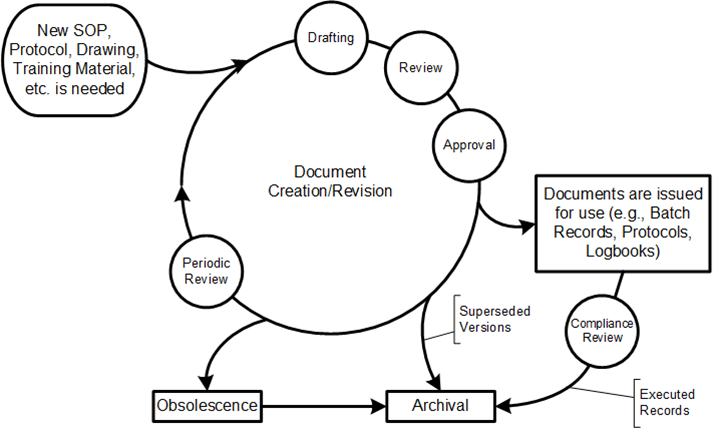
        Document change control has a core set of requirements for managing critical information throughout its lifecycle. These requirements encompass:

        1. Approval of documents based on fit-for-purpose and fit-for-use before issuance
        2. Review and document updates as needed (including reapprovals)
        3. Managing changes and revision status
        4. Ensuring availability of current versions
        5. Maintaining document legibility and identification
        6. Controlling distribution of external documents

        This lifecycle usually has three critical dates associated with approval:

        • Approval Date: When designated authorities have reviewed and approved the document
        • Issuance Date: When the document is released into the document management system
        • Effective Date: When the document officially takes effect and must be followed

        These dates are dependent on the type of document and can change as a result of workflow decisions.

        Type of DocumentApproval DateIssuance dateEffective Date
        Functional Date Approved by final approver (sequential or parallel)Date Training Made AvailableEnd of Training Period
        RecordDate Approved by final approver (sequential or parallel)Usually automated to be same as Date ApprovedUsually same as Date Approved
        ReportDate Approved by final approver (sequential or parallel)Usually automated to be same as Date ApprovedUsually same as Date Approved

        At the heart of the difference between these three days is the question of implementation and the Effective Date. At its core, the effective date is the date on which the requirements, instructions, or obligations in a document become binding for all affected parties. In the context of GxP document management, this represents the moment when:

        • Previous versions of the document are officially superseded
        • All operations must follow the new procedures outlined in the document
        • Training on the new procedures must be completed
        • Compliance audits will use the new document as their reference standard

        Why Training Periods Matter in GxP Environments

        One of the most frequently overlooked aspects of document management is the implementation period between document approval and its effective date. This period serves a critical purpose: ensuring that all affected personnel understand the document’s content and can execute its requirements correctly before it becomes binding.

        In order to implement a new process change in a compliant manner, people must be trained in the new procedure before the document becomes effective. This fundamental principle ensures that by the time a new process goes “live,” everyone is prepared to perform the revised activity correctly and training records have been completed. Without this preparation period, organizations risk introducing non-compliance at the very moment they attempt to improve quality.

        The implementation period bridges the gap between formal approval and practical application, addressing the human element of quality systems that automated solutions alone cannot solve.

        Selecting Appropriate Implementation Periods

        When configuring document change control systems, organizations must establish clear guidelines for determining implementation periods. The most effective approach is to build this determination into the change control workflow itself.

        Several factors should influence the selection of implementation periods:

        • Urgency: In cases of immediate risk to patient safety or product quality, implementation periods may be compressed while still ensuring adequate training.
        • Risk Assessment: Higher-risk changes typically require more extensive training and therefore longer implementation periods.
        • Operational Impact: Changes affecting critical operations may need carefully staged implementation.
        • Training Complexity: Documents requiring hands-on training necessitate longer periods than read-only procedures.
        • Resource Availability: Consider the availability of trainers and affected personnel

        Determining Appropriate Training Periods

        The time required for training should be determined during the impact assessment phase of the change approval process. This assessment should consider:

        1. The number of people requiring training
        2. The complexity of the procedural changes
        3. The type of training required (read-only versus observed assessment)
        4. Operational constraints (shift patterns, production schedules)

        Many organizations standardize on a default period (typically two weeks), but the most effective approach tailors the implementation period to each document’s specific requirements. For critical processes with many stakeholders, longer periods may be necessary, while simple updates affecting few staff might require only minimal time.

        Consider this scenario: Your facility operates two shifts with 70 people during the day and 30 at night. An updated SOP requires all operators to complete not just read-only training but also a one-hour classroom assessment. If manufacturing schedules permit only 10 operators per shift to attend training, you would need a minimum of 7 days before the document becomes effective. Without this calculated implementation period, every operator would instantly become non-compliant when the new procedure takes effect.

        Early Use of Documents

        The distinction between a procedure’s approval date and its effective date serves a critical purpose. This gap allows for proper training and implementation before the procedure becomes binding. However, there are specific circumstances when personnel might appropriately use a procedure they’ve been trained on before its official effective date.

        1. Urgent Safety or Quality Concerns

        When there is an immediate risk to patient safety or product quality, the time between approval and effectiveness may be compressed. For these cases there should be a mechanism to move up the effective date.

        In such cases, the organization should prioritize training and implementation while still maintaining proper documentation of the accelerated timeline.

        2. During Implementation Period for Training Purposes

        The implementation period itself is designed to allow for training and controlled introduction of the new procedure. During this time, a limited number of trained personnel may need to use the new procedure to:

        • Train others on the new requirements
        • Test the procedure in a controlled environment
        • Prepare systems and equipment for the full implementation

        These are all tasks that should be captured in the change control.

        3. For Qualification and Validation Activities

        During qualification protocol execution, procedures that have been approved but are not yet effective may be used under controlled conditions to validate systems, equipment, or processes. These activities typically occur before full implementation and are carefully documented to demonstrate compliance. Again these are captured in the change control and appropriate validation plan.

        In some regulatory contexts, such as IRB approvals in clinical research, there are provisions for “approval with conditions” where certain activities may proceed before all requirements are finalized2. While not directly analogous to procedure implementation, this demonstrates regulatory recognition of staged implementation approaches.

        Required Controls When Using Pre-Effective Procedures

        If an organization determines it necessary to use an approved but not yet effective procedure, the following controls should be in place:

        1. Documented Risk Assessment: A risk assessment should be conducted and documented to justify the early use of the procedure, especially considering potential impacts on product quality, data integrity, or patient safety.
        2. Authorization: Special authorization from management and quality assurance should be obtained and documented.
        3. Verification of Training: Evidence must be available confirming that the individuals using the procedure have been properly trained and assessed on the new requirements.

        What About Parallel Compliance with Current Effective Procedures?

        In all cases, the currently effective procedure must still be followed until the new procedure’s effective date. However there are changes, usually as a result of process improvement, usually in knowledge work processes where it is possible to use parts of the new procedure. For example, the new version of the deviation procedure adds additional requirements for assessing the deviation, or a new risk management tool is rolled out. In these cases you can meet the new compliance path without violating the current compliance path. The organization should demonstrate how both compliance paths are being maintained.

        In cases where the new compliance path does not contain the old, but instead offers a new pathway, it is critical to maintain one way of work-as-prescribed and the effective date is a solid line.

        Organizations should remember that the implementation period exists to ensure a smooth, compliant transition between procedures. Any exception to this standard approach should be carefully considered, well-justified, and thoroughly documented to maintain GxP compliance and minimize regulatory risk.