First, what impacts knowledge workers’ energy is not the sheer amount of time they spend in meetings, but the relative proportion of meeting time compared to what they spend on individual tasks. We found that, on a given day, the more time knowledge workers dedicate to meetings relative to their own individual tasks, the less they engage in small break activities (e.g., a short walk, casual conversations, brief fun reading) to restore their energy during that day. The absence of such break activities, which are crucial for periodic replenishment, harms their workday energy. The impaired energy in turn has a negative impact on the knowledge workers’ task performance, creativity, and job satisfaction at work.
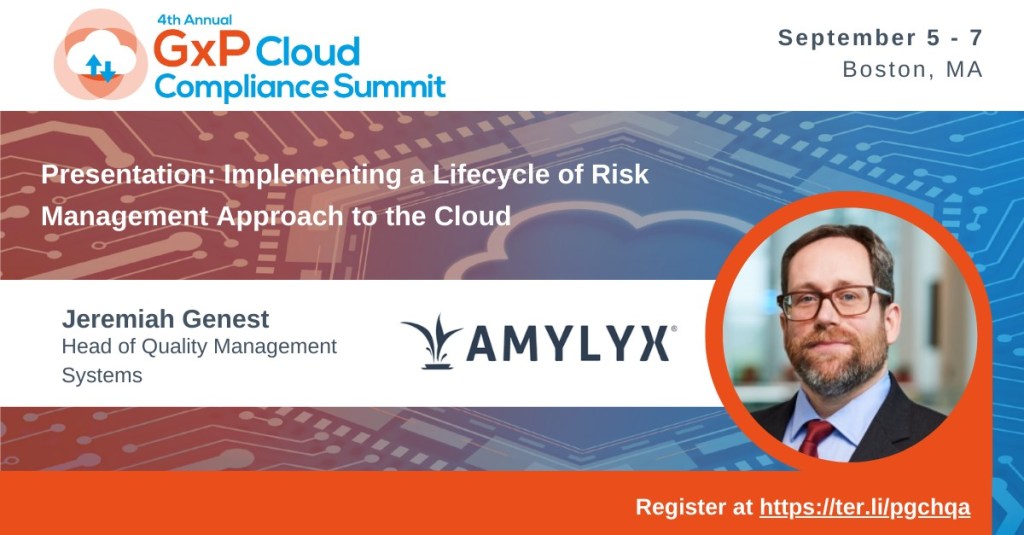
I am looking forward to speaking at the GxP Cloud Compliance Summit in Boston in September on Implementing a Lifecycle Risk Management Approach to the Cloud. I’ll be discussing some of my favorite topics:
Best practices to harness a life cycle risk management approach to protect product quality and patient data
What does a living risk assessment look like when key parts of your IT infrastructure is maintained by cloud service providers
How does Q9 R1 impact functional and usage assessments around cloud applications
I am looking forward to meeting and discussing some of the critical questions in our heady embrace of the cloud.
Cloud based GxP systems have shifted in the last few years from “Something I guess we should figure out” to “Well guess we have it now” to “Well that is all I seem to have now.” And where 5 years ago it seemed we were obsessed about the fine details of Open vs Closed systems and what cloud-based applications are, we are now looking at much more mature questions around a risk based strategy that evaluates and ensures appropriate controls around Data Integrity, Privacy, and Security. Through a risk-based approach, we drive activities such as auditing, change control, qualification/validation, and oversight.
I am looking forward to having this discussion with my peers and sharing best practices and experiences. It is only though this type of event that we can grow as a professional.
This Guide applies to computerized systems used in regulated activities covered by:
•Good Manufacturing Practice (GMP) (pharmaceutical, including Active Pharmaceutical Ingredient (API), veterinary, and blood)
•Good Clinical Practice (GCP)
•Good Laboratory Practice (GLP)•Good Distribution Practice (GDP)
•Good Pharmacovigilance Practices (GVP)
•Medical Device Regulations (where applicable and appropriate, e.g., for systems used as part of production or the quality system, and for some examples of Software as a Medical Device (SaMD1))
GAMP 5: A Risk-Based Approach to Compliant GxP Computerized Systems (2nd edition),
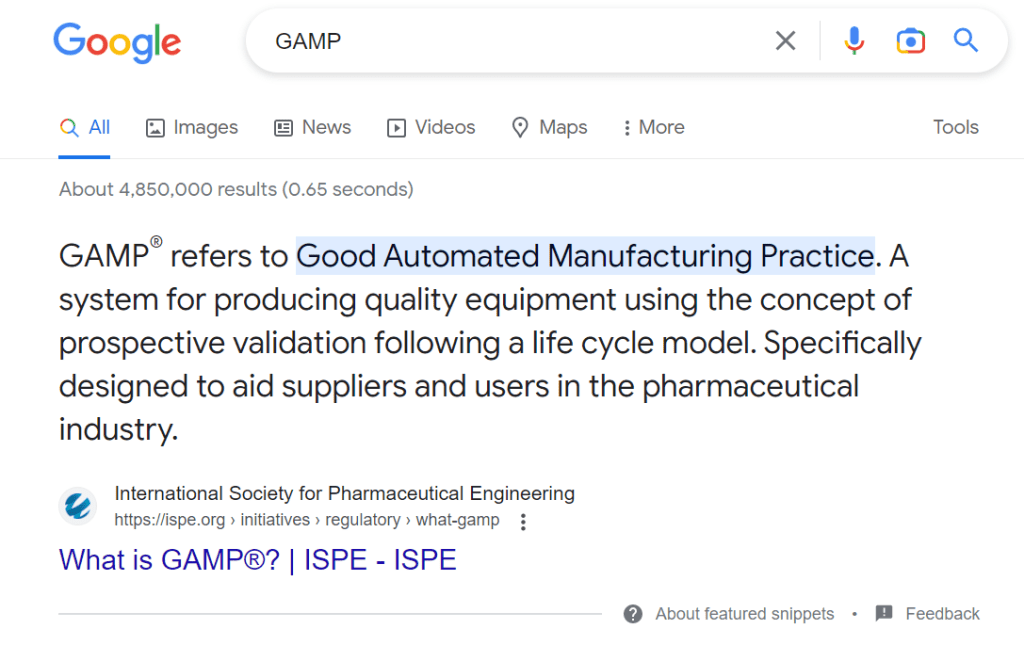
The biggest problem with GAMP is when you search GAMP you get:
This means that I spend a lot of time explaining why GAMP is relevant outside of manufacturing, to a lot of skeptical people who already struggle with the idea that GCP or GLP isn’t some special and unique flower.
To add to that, it is structured like a GxP. I see a G-some letters-P I instantly think Good <something> Practices. It is how my brain and the brain of every single person who works in the GxPs have been trained.
Second, what is that 5? What does it mean? It’s such a bit of esoteric lore that I have to spend more time explaining. For absolutely no value.
And then last, I inevitably have to deal with skepticism about something published by the International Society of Pharmaceutical Engineering being even remotely relevant to the work a study investigator is doing.
Without a doubt, GAMP is a powerful methodology and toolbox. It just shoots itself in the foot every time. It is unfortunate that with the 2nd edition the ISPE did not take a big breath and successfully rebrand as maybe GDIP or something.
My fellow PowerPoint jockies, we have been outdone by ROCHE LIMIT, a surrealist point and click horror adventure that was created (and is played in) Microsoft PowerPoint.
The current build of ROCHE LIMIT takes around 20 minutes to play through and features one of the multiple planned endings to the full game. The actual narrative is quite Lynchian and appears to revolve around you accepting your (and possibly the human race’s) inevitable demise and a higher power’s ambivalence towards it. It’s a fun, quick little game, with excellent audio design and pixel art animation throughout.
Our PowerPoint presentations have a new standard, and that standard is this wild little game.
For a lot of reasons paper (and paper-on-glass) documents are with us for a long time. So it continually surprises me when I see documents in some basic, reduced readability font .
Even when we go to electronic systems that choice of font is going to be an important one. And it’s probably not the same font as what worked for you in a paper world.
And then there is all that training material and presentations (including conference material).
So spend some time and choose the fonts that works for you and your users. But please for goodness sake don’t default to a font because it is what you have always used.


 Investigations of a Dog