WCQI – Member Leader Day

I made it to Anaheim, I must admit I am pretty surprised, as I’ve backed out of a few other events this year for reasons of family and health, and while I did do the ISPE Aseptic Conference, being at a WCQI feels almost surreal, especially since this is a fairly small WCQI compared to pre-pandemic years.

I decided to attend the member leader workshops. I thought long and hard, as I have had a rough and rocky road as a member leader during the pandemic and I’ll need to think about what that looks like going forward. I made the decision to attend because I hope the experience will help drive action on my part. Also, in some transparency, I bought my plane ticket without realizing that I would otherwise have a free day, and Disney is not my jam.

I think member leaders have a difficult role. There is a lot of administrative work, on top of the need/desire to drive programming. The changes in ASQs financial structure has made that even harder, with the need to be more revenue-neutral driving a lot of decisions. So member leaders have to find the time to be organizers, raise funds, and make programming happen. All while keeping the day job. I always tend to think this is one of the reasons so many seem to be consultants, who can leverage the time as a way to build a reputation.

Building a reputation as a subject matter expert is a fairly traditional path for many of us. At the heart of a professional organization is the question “How do you build real expertise instead of shallow?” and I think member leaders are one part of the answer to that question.

The future of professional societies strikes me as an interesting one. What is the mix of in-person and remote events? Do you try to do hybrids (my recommendation is no). How do you maintain focus. I was hoping to hear that today, but in general, I do not think I did.

The elephant in the room is that the last few years has seen a lot of change forced on the ASQ. Change often feels like it was done to the membership instead of driven by the membership. The ASQ has really struggled to put the tools and methodologies it advocates for into action. And then, on top of everything, there was the horrible nature of the pandemic, which has slowed down and fragmented change.

For example, the change in the membership model where everyone can join every technical community (divisions) is one that has not been really absorbed beyond the major hit to the budget (again something that feels imposed upon the society).

Perhaps I am some sort of radical and think the technical communities need to be decomposed and restructured, but I think this is a real core thing for my experience. Sometimes it feels like technical communities are fighting for the same volunteers and what any technical community focuses on has more to do with the volunteer base than any rhyme or reason to the QBok.

There was a lot of obvious frustration on the part of the technical community members about their role in the organization.

My.ASQ still remains a major point of contention. I tend to think this stems from a combination of technical design and structure. The design need to push technical communities had led to some real balkanization within the structure, which makes it difficult to find content. Add to the fact the tool is not very flexible in how it manages the content and we have a painful adoption three years later.

Technical communities really exist to drive content creation. But I sometimes feel they are more content silos. Content curation is a topic from and center in a lot of member leaders’ minds.

I’m always disappointed when quality professionals get together and there is no structure, no facilitation. When we don’t use the tools our profession is based on. An over-reliance on brainstorming and discussion I think really limits the value of these events as it feels like we are swirling around the same topics.

I attended the following three breakout sessions.

Young professionals

Less than 10% of the membership is under 35, with students being around 5%. I think the central question for all professional societies is how do we change this? Let’s be honest, I am not a spring chicken at 51 and I sometimes feel young at ASQ events.

I think it’s telling on the communication issue that the NexGen section on my.ASQ, touted during this talk, has 3 posts, the last in February.

Mentorship programs are a lot of work for the mentors involved (and the mentees). How do we incentive folks to do it? What does real mentorship look like?

The Power of Collaboration

The ASQ and ASQE split (one of those things done to members, not from members) certainly are central to the question of collaboration within the ASQ. At the heart of collaboration is the central question of content creation.

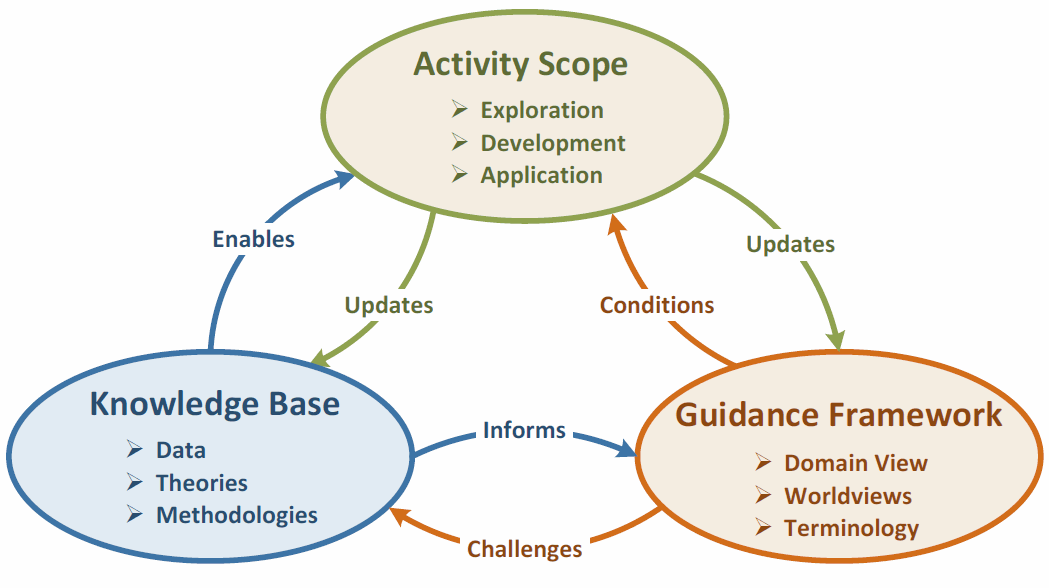
I feel the ASQ is suffering from a lack of a strong model here. The connections between the QBok and the member organizations (technical and geographical) are weak in many places. There is no real definition of activity scope, guidance framework, and knowledge base.
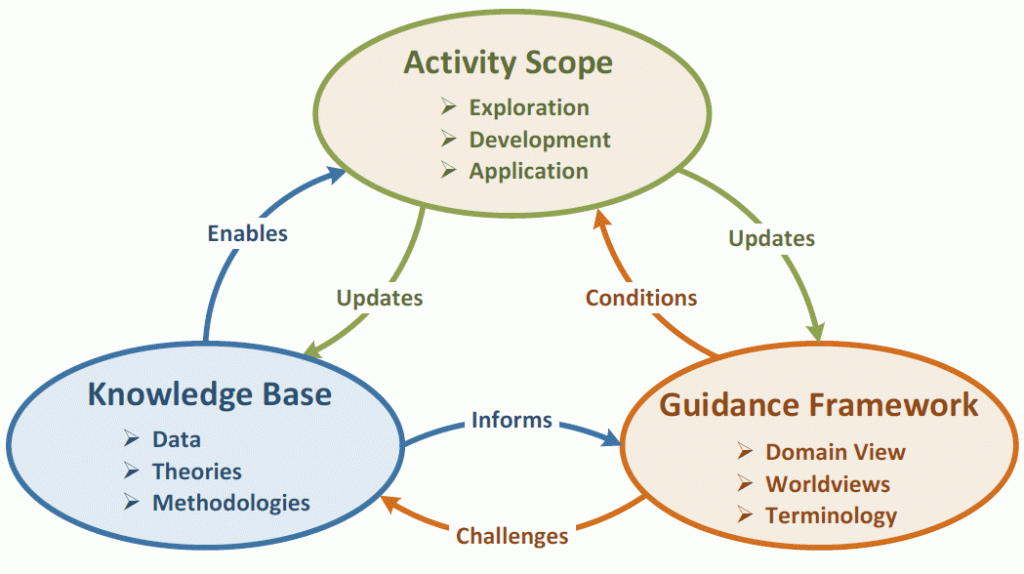
The central question for collaboration in the ASQ is how do we bring more content that is valuable to our members, which means we need to do a better job of identifying what members need.

WhatWhat is this?My thoughts on what this means for the ASQ?
Guidance FrameworkThe guidance framework typically involves multiple worldviews. The same subject matter can be studied from different worldviews, and the theories around a given subject can be interpreted differently from different worldview perspectives.The ASQ as a whole, the principles of the profession.
Knowledge BaseThe data, theories, and methodologies that drive the disciplineThis is the Qbok and the technical communities that serve specific methodologies and approaches (Lean, Statistics, HD&L, QMD, TWEF, Six Signa, etc)
Activity Scope The range of activities in a disciple, including the professional practice.These are the industry segment specific technical communities

There is a real tension right now in that the board of the ASQ and certainly headquarters, wants to see the technical communities generating more content, more IP. But many in the technical communities are feeling tense, and a little abused by the process.

I think a central question is how do we connect folks with questions to subject matter experts who can answer those questions. my.ASQ hasn’t really solved that issue. And something like Connex is really a marketplace to sell consulting services. This leads us to the third breakout session I attended.

Subject Matter Experts of Tomorrow

Building expertise is a particular focus of mine, and I think it is really important for the ASQ to think about what areas we need subject matter experts (SME) in, and how to leverage those SMEs.

I think we really grapple with just what topics are valuable to quality. Frankly, I think we haven’t reached the promise of the core, the foundational knowledge. We need to avoid thinking sexy “whats” are the key to a profession that focuses more on the hows and whys.

Want to call out the facilitators for using a tool to facilitate the session, while still brainstorming it made a difference.

The central question to answer the question about how we can connect knowledge experts with the skills necessary to be an effective SME?

The key is deliberative practice. As an organization, we need to have a deliberative practice pathway that builds skills in speaking, presentation, and develop area expertise. While we cannot directly give most people a job opportunity to do something, we can look for other opportunities to further e

Closing Thoughts

I have many questions, many thoughts, and no good answers. I waited until after the conference to make sure I had a chance to reflect.

Balancing Expertise

Quality professionals are often defined by our technical knowledge, and with that can come a genuine and intense love and interest in the work. In the pharmaceutical/med-device work, I work in this is defined by both a knowledge of the science and of the regulations (and that stuff inbetween – regulatory science).

The challenge here is that we start defining ourselves by our role as we progress as representing the highest level of expertise in this technical expertise, which means senior Quality (as in the department) jobs are defined in terms of in service to our function – patient safety and product quality (safety, efficacy, and quality). This can then lead to seeing people as the “means” to that end. This inevitably leads to prioritizing that outcome over people.

Do not get me wrong, results matter, and I am a firm proponent of product quality and patient safety. But this approach is reductionist and does not serve to drive fear out of the organization. How can people be safe if they are considered a means to produce value? We need to shift so that we realize we can only get to quality by focusing on our people.

Quality Goes Way Beyond a Few Regulations

The quality profession in the pharmaceutical industry is wider than the overseeing regulations from health authorities. The GXPs are truly a starting point, not an ending point which is why we often use that little “c” for “current.”

The GXPs (and the regulations behind them) serve an important purpose. But they are the start of excellence and not the end.

The GXPs are an outline. When we start with these requirements and then fill in the details we build a robust and beautiful engine for quality.

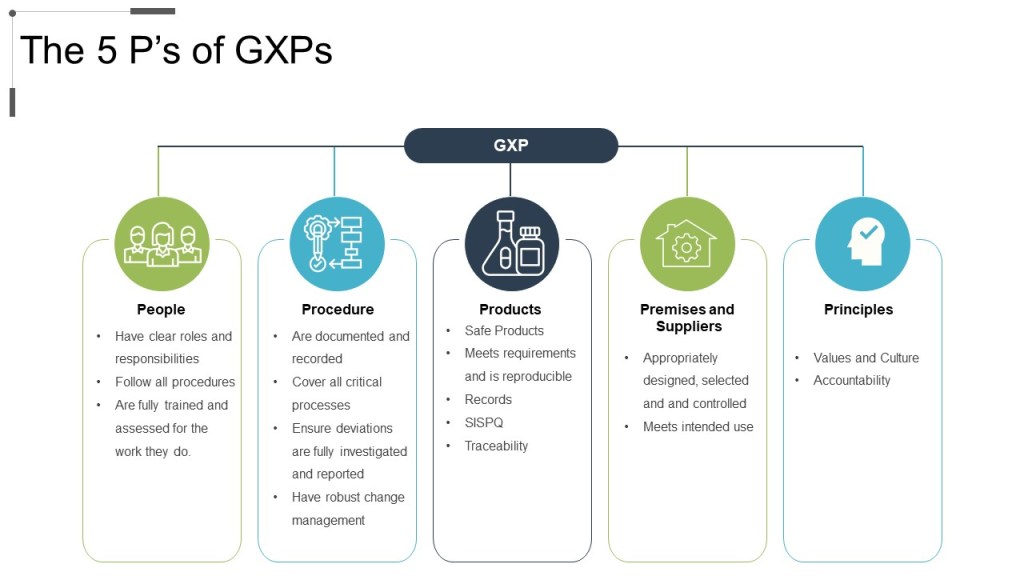
The 5Ps of GXPs: People, Procedure, Product, Premise, and Principles.

This is often why we talk about compliance being the start of quality, and not the end.

What is this quality profession all about?

A theme of this year for me has been focusing more and more on the difference between the product integrity focused approach to quality that folks in my profession normally focus in on and a more excellence focused approach. The two are not in opposition, but I can’t help feeling that the product integrity exclusiveness of many pharmaceutical quality professionals is holding us back.

This is especially on my mind coming back from ASQ WCQI and thinking about just how few of my pharma colleagues identify with that organization There are a whole host of reasons (including the fact that many people don’t associate with ANY professional association) but I can’t help but contemplate how do we make the excellence side of quality more relevant to not just pharmaceuticals but to wider questions of just what is quality anyway?

I’ve discussed the need to realize that we have different types of domain knowledges, but just what is this domain we call quality and is it truly its own discipline?

Disciplines can be modeled as a system comprising an “activity scope” that is enabled by a “knowledge base” but conditioned by a “guidance framework”.

From Rousseau, et al “A Typology for the Systems Field”
  • The guidance framework typically involves multiple worldviews. The same subject matter can be studied from different worldviews, and the theories around a given subject can be interpreted differently from different worldview perspectives. You can see this in the various flavors of continuous improvement or better yet, the presence of a sustainability push within the society.
  • The knowledge base is the data, theories and methodologies that drive the discipline
  • The activity scope describes the range of activities in a disciple, including the professional practice.

We’re probably truly multi-disciplinarian, in that the we draw from multiple other disciplines, a short list includes: Engineering, Computing, Control Theory, Mathematics, Information Theory, Operations research, system theory, Management sciences, a whole range of social sciences and more than I can think.

What does this mean?

I am more thinking aloud than anything at this point, but I think it’s important to work on developing the QBOK along a guidance framework, knowledge base and activity scope methodology. Then as we develop sub-body of knowledges we drill down from there, either in a very knowledge base way (such as the CMQ/OE) or in an activity scope (like the CPGP). I often feel that the way we develop these are more hit-and-miss and could do with some coherence – the biomedical auditor and hazop auditor are great examples of wanting to meet a very narrow need and thus being very very specific to a small set of the knowledge base.

I guess I’m striving towards applying theory to our practice a little more deliberately.

Some of the technical forums (Human Development and Leadership comes to mind) seem especially designed to pull information from one or two different originating disciplines and adapt it to the knowledge base. I think this process would be added by a coherent understanding of our guidance framework and just what the activity scope we are trying to address as discipline.

In short I am just thinking that a little more coherence, strategy and transparency would aid us as a profession. As I heard in many a conversation last week, we should probably as an organization be better at what we preach.

Sources

  • Bourke, J (2014). On Process Excellence vs. Operational Excellence vs. Business Excellence. BEX Institute.
  • Rousseau, D., Wilby, J., Billingham, J., & Blachfellner, S. (2016). A Typology for the Systems Field. Systema 4(1), 15-47
  • Wageeh, N. A. (2016). The Role of Organizational Agility in Enhancing Organizational Excellence: A Study on Telecommunications Sector in Egypt. International Journal of Business and Management, 11(4), 121

Being a Quality Leader

Domain Knowledge

Having recently said farewell to a leader in our quality organization, I have been reflecting on quality leaders and what makes one great. As I often do, I look to standards, in this case the American Society of Quality (ASQ).

The Certified Manager of Quality/Organizational Excellence (CMQ/OE)leads and champions process improvement initiatives—that can have regional or global focus—in various service and industrial settings. A CMQ/OE facilitates and leads team efforts to establish and monitor customer/supplier relations,supports strategic planning and deployment initiatives, and helps develop measurement systems to determine organizational improvement.

American Society of Quality

The ASQ’s Certified Manager of Quality/Operation Excellence (CMQ/OE) body of knowledge‘s first section is on leadership. 

To be honest, the current body of knowledge (bok) is a hodge-podge collection of stuff that is sort of related but often misses a real thematic underpinning. The bok (and the exam) could use a healthy dose of structure when laying out the principles of roles and responsibilities, change management, leadership techniques and empowerment.

There are fundamental skills to being a leader:

  • Shape a vision that is exciting and challenging for your team (or division/unit/organization).
  • Translate that vision into a clear strategy about what actions to take, and what not to do.
  • Recruit, develop, and reward a team of great people to carry out the strategy.
  • Focus on measurable results.
  • Foster innovation and learning to sustain your team (or organization) and grow new leaders.
  • Lead yourself — know yourself, improve yourself, and manage the appropriate balance in your own life.

In order to do these things a leader needs to demonstrate skills in communication, critical thinking, problem solving, and skills motivating and leading teams (and self).

The best leaders know a lot about the domain in which they are leading, and part of what makes them successful in a management role is technical competence. A Quality leader needs to know quality as a domain AND the domain of the industry they are within.

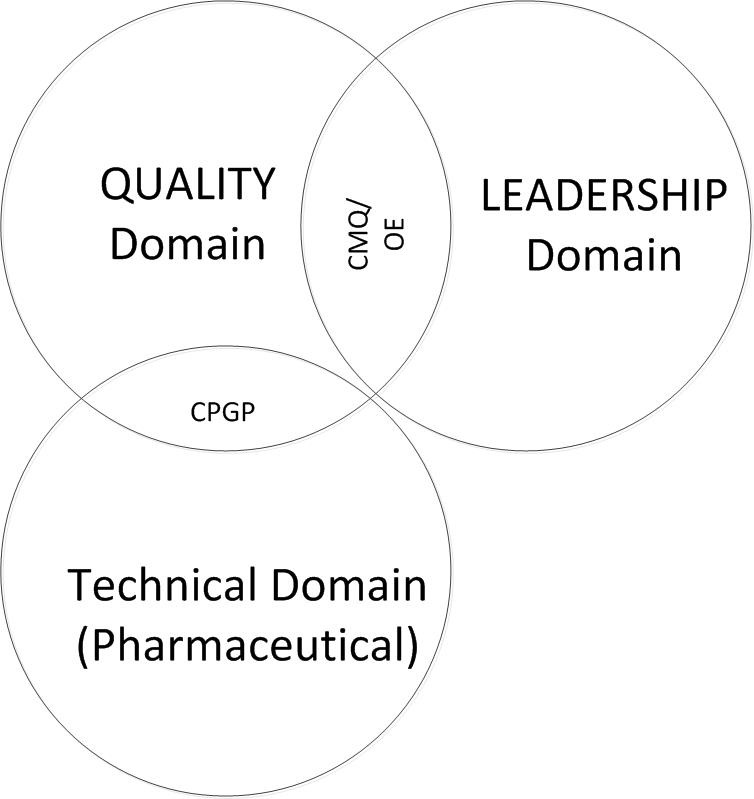
Three domains necessary for a quality leader

In my industry it is just not enough to know quality (for now we’ll define that as the ASQ BoK) nor is it enough to know pharmaceuticals (with regulatory being a subdomain). It is not enough just to have leadership skills. It is critical to be able to operate in all three areas. 

To excel as a leader in practice, you also need a lot of expertise in a particular domain. 

As an example, take the skill of thinking critically in order to find the essence of a situation. To do that well, you must have specific, technical expertise. The critical information an engineer needs to design a purification system is different from the knowledge used to understand drug safety, and both of those differ in important ways from what is needed to negotiate a good business deal.

When you begin to look at any of the core skills that leaders have, it quickly becomes clear that domain-specific expertise is bound up in all of them. And the domains of expertise required may also be fairly specific. Even business is not really a single domain. Leadership in pharmaceuticals, transportation, and internet (for example) all require a lot of specific knowledge.

Similarly, with only leadership and technical, you are going to fumble. Quality brings a set of practices necessary for success. A domain filled with analytical and decision making capabilities that cross-over with leadership (critical thinking and problem-solving) but are deepened with that perspective. 

There are also other smaller domains, or flavors of domains. If I was building this model out more seriously I would have an interesting cluster of Health and Safety with Quality (the wider bucket of compliance even). I’m simplifying for this post.

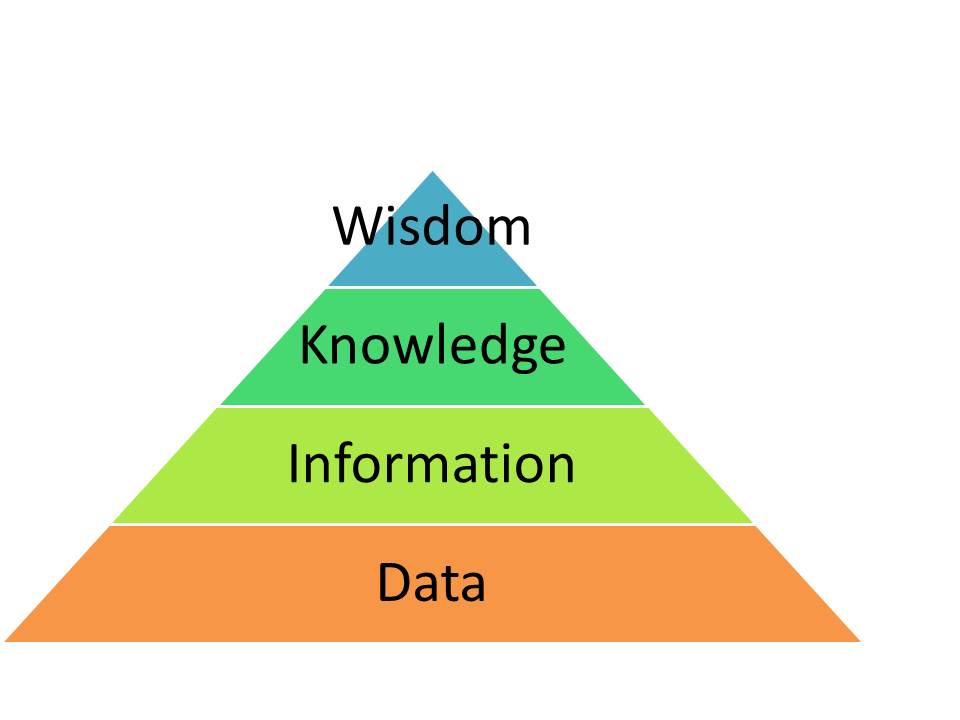
Development of knowledge

To go a step further. These three domains are critical for any quality professional. What changes is the development of wisdom and the widening of scope. This is why tenure is important. People need to be able to settle down and develop the skills they need to be successful in all three domains. 

Good quality leaders recognize all this and look to build their organizations to reflect the growth of technical, quality and leadership domain.