A task analysis breaks down a complex task into its components – the steps involved and the knowledge required. To do a task analysis, you observe the work and interview a subject matter expert (SME) or key performer.
What do you want to identify in a task analysis?
Why someone would learn the skill
Prerequisite skills, knowledge and attitudes
Special materials or tools required
Warnings of dangers, both overall and at specific points in the process
The critical steps (no more than five to seven, otherwise you should split it into another task) and their sequence
Whether the sequence is critical or flexible
Any other steps necessary to complete the task and their sequence
How critical any given substep is
Conditions that must be satisfied before going on to the next step
Reasons for doing steps at a particular point
Signs of success for each step (for confirmations)
Signs of failure for each step
What is the process for doing a task analysis?
Review any documentation, manuals or process maps
Observe at least one expert and take notes as you observe
Either slow down experts during the task to ask questions or interview afterward
Identify each step
Document what you saw and what the expert told you, then ask for the SME’s reaction, there will almost always be gaps identified
Expect the process to be iterative
What should you ask the SME?
What is the SME doing?
Why is it important, or what is the rationale?
Why is the SME doing it that way?
Is there a warning necessary?
How does the SME know what to do next (if there is a choice between two or more actions)?
How can the SME tell if a step was done right?
How can the SME tell if a step was done wrong or incompletely?
How is the sequence critical?
What does the SME do that isn’t documented?
While often viewed from the training perspective, task analysis is a core quality tool that is utilized in procedure writing, automation, user interface development, problem solving and so much more.
Every change (and lets be frank, most everything involves change) requires understanding the individuals and groups that will participate or are affected – directly or indirectly.
Stakeholder analysis involves identifying the stakeholders and analyzing their various characteristics. These characteristics can include:
Level of authority within the organization and the domain of change
Attitudes toward or interest in the change
Attitudes towards the process
Level of decision-making authority
The goal of stakeholder analysis is to choose the best collaboration and communication approaches and to appropriately plan for stakeholder risks.
There are a variety of mechanisms for doing this and then mapping it out.
Start by brainstorming a list of the stakeholders by answering these questions:
Who will be impacted?
Who will be responsible or accountable
Who will have decision authority
Who can support
Who can obstruct
Who has been involved in something similar in the past?
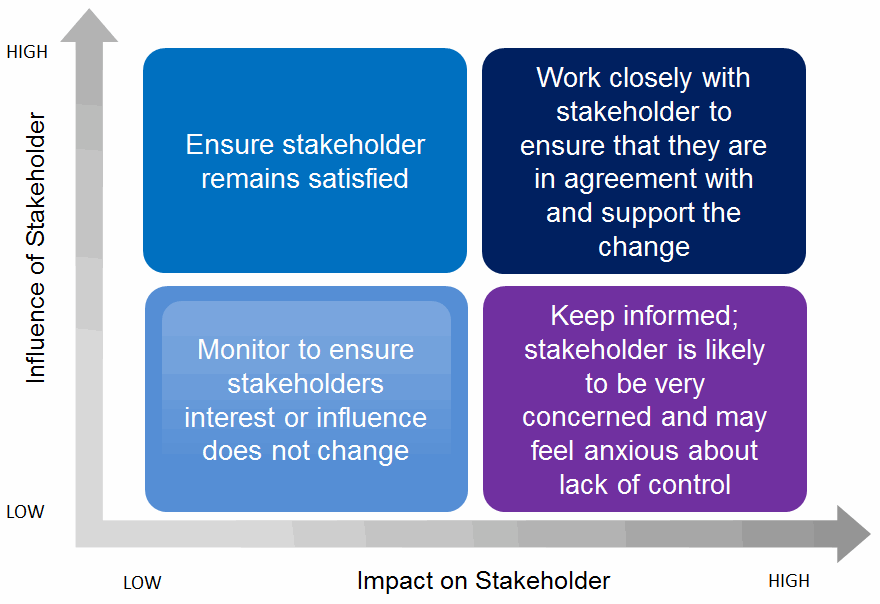
Map these on a stakeholder matrix based on relative power and interest. This should be an iterative process.
Stakeholder Matrix
High influence/High Impact: these are key players and effort should be focused here to engage this group regularly
High influence/Low impact: these stakeholders have needs that should be met so engage and consult with them while also attempting to increase their level of interest.
Low influence/High impact: these stakeholders are supporters and potential goodwill ambassadors. Engage the group for their input and show interests in their needs.
Low influence/Low impact: the stakeholders can be kept informed using general communications. Additional targeted engagement may move them into the goodwill ambassador quadrant.
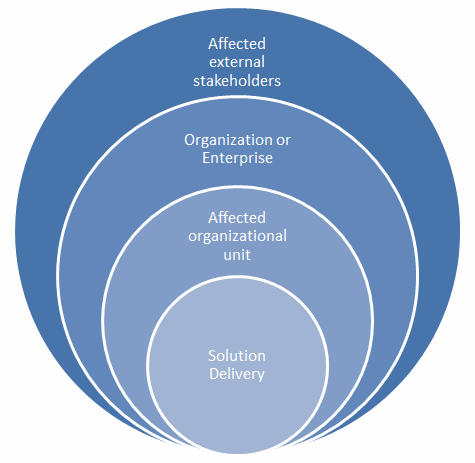
Another way to look at stakeholders is though an onion diagram.
A RACI is another popular way to look at stakeholders.
Once stakeholders are identified is is important to define how communication and engagement will achieved. There is usually no one sized fits all approach and it is important to meet the needs of each stakeholder group to ensure their interest and involvement is maintained. Some considerations include:
timing and frequency
location
tools
delivery methods (in-person or virtual)
preferences of the stakeholders
geographic considerations or impact
Document this in a communication plan, including:
what needs to be communicated
what is the appropriate delivery method
who the appropriate audience is
when communication should occur
frequency of communication
level of detail appropriate for the communication and stakeholder
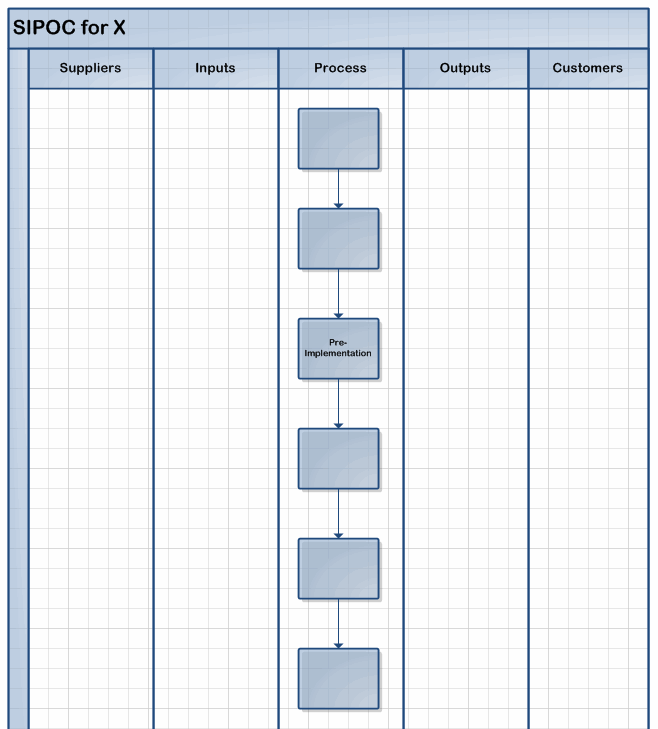
I am a huge fan of a SIPOC which stands for suppliers-inputs-process-outputs-customers. A SIPOC diagram is a quick broad overview of all the elements of a process and serves as a great visual tool.
Blank SIPOC
Start with the process
Provide the key steps of the process in the middle column
and briefly describe its key steps. A
SIPOC diagram is a high-level process map and is designed to get a birds-eye
overview of the process. Do not include decision points or feedback loops.
Identify the outputs of the process
Focus on the key outputs of the process. In this step, write
down the three or more main outputs. Use nouns for the most part and avoid
categorizing your outputs into good or bad ones – that’s not the point of the
diagram.
Identify the customers
List the people who benefit from the process. These don’t
have to be the literal “customers.” E.g., if you are working on a diagram for
an internal process, the “customers” are your coworkers. Think of who benefits
from this process. Who would be upset if the process is not complete?
List the inputs for the process
List the inputs required for the process to function
properly. Just like with every previous step, focus on the most important ones.
Three to six main inputs should do.
Identify the suppliers of the inputs
List the suppliers based on what inputs the process uses. Be
sure to mention any specific suppliers whose input has a direct influence on
the output.
Making sound strategic decisions is crucial for organizational success, however, human judgment can be unreliable, leading to errors that can significantly impact that success. To address this challenge, a structured approach to strategic decision-making is essential.
Organizations can be viewed as decision factories, where the primary output is not physical products, but rather judgments and choices that shape the company’s future. This perspective, popularized by thinkers like Daniel Kahneman, emphasizes the critical role of decision-making in organizational success.
In a decision factory, every employee is part of the production line, contributing to the quality and efficiency of decisions made. Just as a traditional factory focuses on optimizing its manufacturing processes, a decision factory must refine its decision-making processes to ensure high-quality outcomes. This involves carefully designing the organizational structure, clarifying decision rights, and establishing effective methodologies.
To improve the quality of decisions, organizations should focus on several key areas. First, they need to align their decision-making processes with their strategic direction, ensuring that decisions at all levels support the company’s overall goals. Second, they should implement robust methodologies and processes that facilitate evidence-based analysis. Finally, cultivating a culture that values data-driven insights, encourages diverse perspectives, and promotes accountability is crucial for maintaining a high-performing decision factory.
The Challenge of Evaluative Judgments
These quality decisions are fundamentally evaluative judgments. They require decision-makers to process large amounts of complex information and either:
Assign numerical scores to competing options
Make a yes-no decision on a specific course of action
These judgments are susceptible to errors stemming from cognitive biases and random variations, often referred to as “noise”. Recognizing this unreliability is the first step towards improving the decision-making process.
There are several really good tools, such as Multi-Criteria Decision-Making, to help drive to good decision making. The Mediating Assessments Protocol , a method from the book “Noise”, designed by Daniel Kahneman and Olivier Sibony, “with noise mitigation as a primary objective” is an excellent, if slightly simpler, tool that deserves to be in your toolbox.
The Mediating Assessments Protocol (MAP)
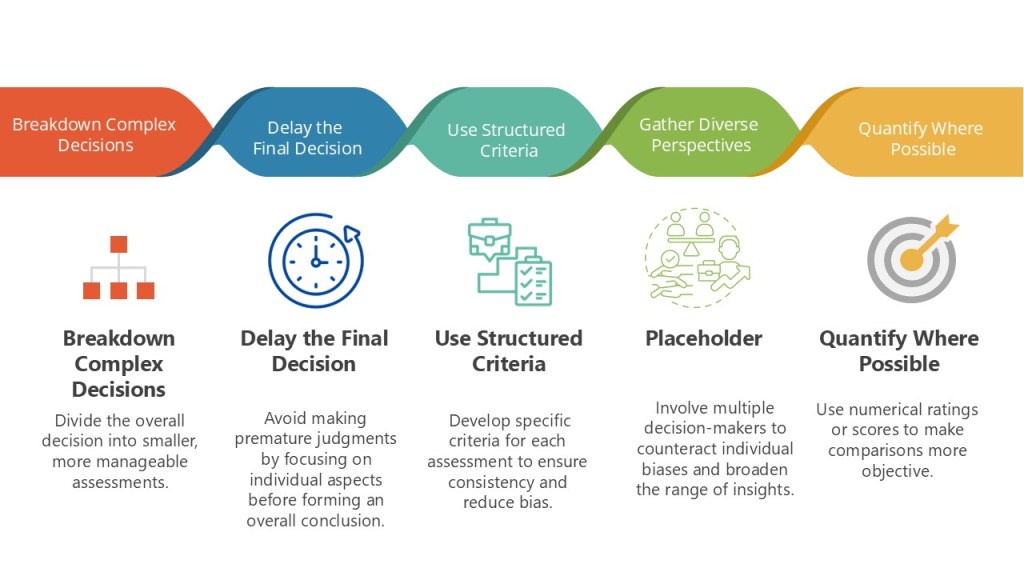
The Mediating Assessments Protocol (MAP) is a structured approach to strategic decision-making aims to reduce errors and improve the quality of judgments. I think this a good tool for the toolbox, as it:
Break down complex decisions: Divide the overall decision into smaller, more manageable assessments.
Delay the final decision: Avoid making premature judgments by focusing on individual aspects before forming an overall conclusion.
Use structured criteria: Develop specific criteria for each assessment to ensure consistency and reduce bias.
Gather diverse perspectives: Involve multiple decision-makers to counteract individual biases and broaden the range of insights.
Quantify where possible: Use numerical ratings or scores to make comparisons more objective.
Implementing a structured approach like MAP can yield several benefits. First and foremost, it significantly reduces bias in the decision-making process. By breaking decisions into smaller components, the influence of initial impressions or irrelevant factors is minimized. This allows decision-makers to focus on each aspect individually, leading to more objective evaluations.
Another key advantage is improved consistency. Structured criteria ensure that all options are evaluated on the same basis, eliminating the variability that often occurs when different decision-makers use their own subjective standards. This consistency not only improves the quality of decisions but also makes it easier to compare and contrast different options.
Enhanced transparency is yet another benefit of a structured approach. The decision-making process becomes clearer and more defensible when each step is well-defined and documented. This transparency can be particularly valuable in organizations where decisions need to be justified to stakeholders or where there’s a need for accountability.
Lastly, a structured approach like MAP can lead to better group dynamics. By providing a framework for evaluation, it helps prevent groupthink and encourages diverse viewpoints. Team members are more likely to voice their opinions when there’s a clear process for considering different aspects of a decision, leading to more robust and well-rounded strategic choices.
To adopt a structured approach to strategic decision-making:
Identify key decisions: Determine which strategic decisions would benefit most from a structured approach.
Develop assessment criteria: Create specific, measurable criteria for each aspect of the decision.
Train decision-makers: Ensure that all involved parties understand the MAP process and its benefits.
Document the process: Keep records of assessments and final decisions for future reference and learning.
Review and refine: Regularly evaluate the effectiveness of your structured approach and make improvements as needed.
By adopting a structured approach like MAP, organizations can significantly improve the quality of their strategic decisions. This method helps mitigate cognitive biases, reduces noise in the decision-making process, and ultimately leads to more reliable and successful outcomes. In an increasingly complex business landscape, such an approach can provide a crucial competitive advantage.
References
Kahneman, D., Lovallo, D., & Sibony, O. (2019). A structured approach to strategic decisions. MIT Sloan Management Review, 60(3), 67-73.
Sinnaiah, T., Adam, S., & Mahadi, B. (2023). A strategic management process: the role of decision-making style and organisational performance. Journal of Work-Applied Management, 15(1), 37-50.
Mintzberg, H., Ahlstrand, B., & Lampel, J. (2020). Strategy safari: A guided tour through the wilds of strategic management. Free Press.
Calabretta, G., Gemser, G., & Wijnberg, N. M. (2017). The interplay between intuition and rationality in strategic decision making: A paradox perspective. Organization Studies, 38(3-4), 365-401.
Hodgkinson, G. P., & Sadler-Smith, E. (2018). The dynamics of intuition and analysis in managerial and organizational decision making. Academy of Management Perspectives, 32(4), 473-492.
Keeney, R. L. (1982). Decision analysis: An overview. Operations Research, 30(5), 803-838.
Gregory, R., Failing, L., Harstone, M., Long, G., McDaniels, T., & Ohlson, D. (2012). Structured decision making: A practical guide to environmental management choices. John Wiley & Sons.
Eisenhardt, K. M., & Zbaracki, M. J. (1992). Strategic decision making. Strategic Management Journal, 13(S2), 17-37.
Hammond, J. S., Keeney, R. L., & Raiffa, H. (1998). The hidden traps in decision making. Harvard Business Review, 76(5), 47-58.
Papadakis, V. M., Lioukas, S., & Chambers, D. (1998). Strategic decision-making processes: The role of management and context. Strategic Management Journal, 19(2), 115-147.
The personal audit is a tool used in change and project
management (and such) to help team members and sponsors judge their strengths
and weaknesses with respect to change leadership. It illustrates some skills
from the full range necessary to introduce change into an organization.
This exercise is great to do at the beginning of the project, where it can help team members begin to understand some of the human issues applicable to all projects. As one mentor once told me – If this exercise strikes team members as inapplicable, then they really need to do it.
Domain
What I do Well
What I Need to Work On
Manage Attention: To what
extent do I manage my time, energy, passion, focus and agenda?
Adopt change roles? How much attention do I pay to matters like: Creating a need, Shaping a vision, Mobilizing commitment, Monitoring progress, Finishing the job, Anchoring the change)
Technical competence: To what extent to I demonstrate competence in technical abilities?
Interpersonal competence:
how skilled am I at interacting with others?
Vision: How well can I
articulate the desired outcome of the project and the benefits to others?
Teamwork: How often do I recognize good work done by teammates?
Diplomacy: How closely am I working with all the groups affected by this project?
Conflict management: Can I
deal with disagreement without avoiding it or blowing up?


 Investigations of a Dog