Requirements for Knowledge Management

I was recently reviewing the updated Q9(R1) Annex 1- Q8/Q9/Q10 Questions & Answers (R5) related to ICH Q9(R1) Quality Risk Management (QRM) that were approved on 30 October 2024 and what they say about knowledge management. While there are some fun new questions asked, I particularly like “Do regulatory agencies expect to see a formal knowledge management approach during inspections?”

To which the answer was: “No. There is no regulatory requirement for a formal knowledge management system. However. it is expected that knowledge from different processes and
systems is appropriately utilised. Note: ‘formal’ in this context means a structured approach using a recognised methodology or (IT-) tool, executing and documenting something in a transparent and detailed manner.”

What does appropriately utilized mean? What is the standard for determining it? The agencies are quite willing to leave that to you to figure out.

As usual I think it is valuable to agree upon a few core assumptions for what appropriate utilization of knowledge management might look like.

Accessibility and Sharing

Knowledge should be easily accessible to those who need it within the organization. This means:

  • Implementing centralized knowledge repositories or databases
  • Ensuring information is structured and organized for easy retrieval
  • Fostering a culture of knowledge sharing among employees

Relevance and Accuracy

Appropriately utilized knowledge is:

  • Up-to-date and accurate
  • Relevant to the specific needs of the organization and its employees
  • Regularly reviewed and updated to maintain its value

Integration into Processes

Knowledge should be integrated into the organization’s workflows and decision-making processes:

  • Incorporated into standard operating procedures
  • Used to inform strategic planning and problem-solving
  • Applied to improve efficiency and productivity

Measurable Impact

Appropriate utilization of knowledge should result in tangible benefits:

  • Improved decision-making
  • Increased productivity and efficiency
  • Enhanced innovation and problem-solving capabilities
  • Reduced duplication of efforts

Continuous Improvement

Appropriate utilization of knowledge includes a commitment to ongoing improvement:

  • Regular assessment of knowledge management processes
  • Gathering feedback from users
  • Adapting strategies based on changing organizational needs

Process Mapping to Process Modeling – The Next Step

In the last two posts (here and here) I’ve been talking about how process mapping is a valuable set of techniques to create a visual representation of the processes within an organization. Fundamental tools, every quality professional should be fluent in them.

The next level of maturity is process modeling which involves creating a digital representation of a process that can be analyzed, simulated, and optimized. Way more comprehensive, and frankly, very very hard to do and maintain.

Process MapProcess ModelWhy is this Important?
Notation ambiguousStandardized notation conventionStandardized notation conventions for process modeling, such as Business Process Model and Notation (BPMN), drive clarity, consistency, communication and process improvements.
Precision usually lackingAs precise as neededPrecision drives model accuracy and effectiveness. Too often process maps are all over the place.
Icons (representing process components made up or loosely definedIcons are objectively defined and standardizedThe use of common modeling conventions ensures that all process creators represent models consistently, regardless of who in the organization created them.
Relationship of icons portrayed visuallyIcon relationships definite and explained in annotations, process model glossary, and process narrativesReducing ambiguity, improving standardization and easing knowledge transfer are the whole goal here. And frankly, the average process map can fall really short.
Limited to portrayal of simple ideasCan depict appropriate complexityWe need to strive  to represent complex workflows in a visually comprehensible manner, striking a balance between detail and clarity. The ability to have scalable detail cannot be undersold.
One-time snapshotCan grow, evolve, matureHow many times have you sat down to a project and started fresh with a process map? Enough said.
May be created with simple drawing toolsCreated with a tool appropriate to the needThe right tool for the right job
Difficult to use for the simplest manual simulationsMay provide manual or automated process simulationIn w world of more and more automation, being able to do a good process simulation is critical.
Difficult to link with related diagram or mapVertical and horizontal linking, showing relationships among processes and different process levelsProcesses don’t stand along, they are interconnected in a variety of ways. Being able to move up and down in detail and across the process family is great for diagnosing problems.
Uses simple file storage with no inherent relationshipsUses a repository of related models within a BPM systemIt is fairly common to do process maps and keep them separate, maybe in an SOP, but more often in a dozen different, unconnected places, making it difficult to put your hands on it. Process modeling maturity moves us towards a library approach, with drives knowledge management.
Appropriate for quick capture of ideasAppropriate for any level of process capture, analysis and designProcesses are living and breathing, our tools should take that into account.

This is all about moving to a process repository and away from a document mindset. I think it is a great shame that the eQMS players don’t consider this part of their core mission. This is because most quality units don’t see this as part of their core mission. We as quality leaders should be seeing process management as critical for future success. This is all about profound knowledge and utilizing it to drive true improvements.

Profound Knowledge

In his System of Profound Knowledge, Deming provides a framework based on a deep and comprehensive understanding of a subject or system that goes beyond surface-level information to provide a holistic approach to leadership and management.

Profound knowledge is central to a quality understanding as it is the ability to deeply understand an organization or its critical processes, delving beneath surface-level observations to uncover fundamental principles and truths. This knowledge is a guiding force for daily living, shaping one’s thinking and values, ultimately manifesting in their conduct. It embodies wisdom, morality, and deep insight, offering a comprehensive framework for understanding complex systems and making informed decisions. Profound knowledge goes beyond mere facts or data, encompassing a holistic view that allows individuals to navigate challenges and drive meaningful improvements within their organizations and personal lives.

Components of Deming’s System of Profound Knowledge

Deming’s SoPK consists of four interrelated components:

  1. Appreciation for a System: Understanding how different parts of an organization interact and work together as a whole system.
  2. Knowledge about Variation: Recognizing that variation exists in all processes and systems, and understanding how to interpret and manage it.
  3. Theory of Knowledge: Understanding how we learn and gain knowledge, including the importance of prediction and testing theories.
  4. Psychology: Understanding human behavior, motivation, and interactions within an organization.

Applications of Profound Knowledge

  • Organizational Transformation: Profound knowledge provides a framework for improving and transforming systems.
  • Decision Making: It helps leaders make more informed decisions by providing a comprehensive lens through which to view organizational issues.
  • Continuous Improvement: The SoPK promotes ongoing learning and refinement of processes.
  • Leadership Development: It transforms managers into leaders by providing a new perspective on organizational management.

Profound knowledge, as conceptualized by Deming, provides a comprehensive framework for understanding and improving complex systems, particularly in organizational and management contexts. It encourages a holistic view that goes beyond subject-matter expertise to foster true transformation and continuous improvement.

Depth and Comprehensiveness

Profound knowledge goes beyond surface-level understanding or mere subject matter expertise. It provides a deep, fundamental understanding of systems, principles, and underlying truths. While regular knowledge might focus on facts or specific skills, profound knowledge seeks to understand the interconnections and root causes within a system.

Holistic Perspective

Profound knowledge takes a holistic approach to understanding and improving systems. It consists of four interrelated components:

  1. Appreciation for a system
  2. Knowledge about variation
  3. Theory of knowledge
  4. Psychology

These components work together to provide a comprehensive framework for understanding complex systems, especially in organizational contexts.

Interdisciplinary Nature

Profound knowledge often transcends traditional disciplinary boundaries. It combines insights from various fields, such as systems thinking, psychology, and epistemology, to create a more comprehensive understanding of complex phenomena.

Focus on Improvement and Optimization

While regular knowledge might be sufficient for maintaining the status quo, profound knowledge is geared towards improvement and optimization of systems. It provides a framework for understanding how to make meaningful changes and improvements in organizations and processes.

Knowledge as Object or Social Action

Deming’s System of Profound Knowledge can be easily seen as an application of knowledge as social action.

The concept of knowledge as object versus knowledge as social action represents two distinct perspectives on the nature and function of knowledge in society. This dichotomy, rooted in sociological theory, offers contrasting views on how knowledge is created, understood, and utilized. Knowledge as object refers to the traditional view of knowledge as a static, codified entity that can be possessed, stored, and transferred independently of social context. In contrast, knowledge as social action emphasizes the dynamic, socially constructed nature of knowledge, viewing it as an active process embedded in social interactions and practices. This distinction, largely developed through the work of sociologists like Karl Mannheim, challenges us to consider how our understanding of knowledge shapes our approach to learning, decision-making, and social organization.

Knowledge as Object

Knowledge as object refers to knowledge as a static, codified entity that can be possessed, stored, and transferred. Key aspects include:

  • Knowledge is seen as propositional or factual information that can be articulated and recorded. For example, knowledge stored in documents or expert systems.
  • It involves an awareness of facts, familiarity with situations, or practical skills that an individual possesses.
  • Knowledge is often characterized as justified true belief – a belief that is both true and justified.
  • It can be understood as a cognitive state of an individual person.
  • Knowledge as object aligns with more traditional, rationalist views of knowledge as something that can be objectively defined and measured.

Knowledge as Social Action

Knowledge as social action views knowledge as an active, dynamic process that is socially constructed. Key aspects include:

  • Knowledge is produced through social interactions, relationships and collective processes rather than being a static entity.
  • It emphasizes how knowledge is created, shared and applied in social contexts.
  • Social action theories examine the motives and meanings of individuals as they engage in knowledge-related behaviors.
  • Knowledge is seen as emerging from and being shaped by social, cultural and historical contexts.
  • It focuses on knowledge as a process of knowing rather than a fixed object.
  • This view aligns with social constructivist and pragmatist perspectives on knowledge.

Key Differences

  • Static vs. Dynamic: Knowledge as object is fixed and stable, while knowledge as social action is fluid and evolving.
  • Individual vs. Collective: The object view focuses on individual cognition, while the social action view emphasizes collective processes.
  • Product vs. Process: Knowledge as object treats knowledge as an end product, while social action views it as an ongoing process.
  • Context-independent vs. Context-dependent: The object view assumes knowledge can be decontextualized, while social action emphasizes situatedness.
  • Possession vs. Practice: Knowledge as object can be possessed, while knowledge as social action is enacted through practices.

Knowledge as object reflects a more traditional, cognitive view of knowledge as factual information possessed by individuals. In contrast, knowledge as social action emphasizes the dynamic, socially constructed nature of knowledge as it is created and applied in social contexts. Both perspectives offer valuable insights into the nature of knowledge, with the social action view gaining prominence in fields like sociology of knowledge and science studies.

Knowledge sharing as a form of social action plays a crucial role in modern organizations, influencing various aspects of organizational life and performance. Here’s an analysis of how knowledge as social action manifests in contemporary organizations:

Knowledge Sharing as a Social Process

In organizations knowledge sharing is increasingly viewed as a social process rather than a simple transfer of information. This perspective emphasizes:

  • The interactive nature of knowledge exchange
  • The importance of relationships and trust in facilitating sharing
  • The role of organizational culture in promoting or hindering knowledge flow

Knowledge sharing becomes a form of social action when employees actively engage in exchanging ideas, experiences, and expertise with their colleagues.

Impact on Organizational Culture

Knowledge sharing as social action can significantly shape organizational culture by:

  • Fostering a climate of openness and collaboration
  • Encouraging continuous learning and innovation
  • Building trust and strengthening interpersonal relationships

Organizations that successfully implement knowledge sharing practices often see a shift towards a more transparent and cooperative work environment.

Enhancing Employee Engagement

When knowledge sharing is embraced as a social action, it can boost employee engagement by:

  • Making employees feel valued for their expertise and contributions
  • Increasing their sense of belonging and connection to the organization
  • Empowering them with information to make better decisions

Engaged employees are more likely to participate in knowledge sharing activities, creating a virtuous cycle of engagement and collaboration.

Driving Innovation and Performance

Knowledge as social action can be a powerful driver of innovation and organizational performance:

  • It facilitates the cross-pollination of ideas across departments
  • It helps in identifying and solving problems more efficiently
  • It reduces duplication of efforts and promotes best practices

By leveraging collective knowledge through social interactions, organizations can enhance their problem-solving capabilities and competitive advantage.

Challenges and Considerations

While knowledge sharing as social action offers numerous benefits, organizations may face challenges in implementing and sustaining such practices:

  • Overcoming knowledge hoarding behaviors
  • Addressing power dynamics that may hinder open sharing
  • Ensuring equitable access to knowledge across the organization

Leaders play a crucial role in addressing these challenges by modeling knowledge sharing behaviors and creating supportive structures.

Technology as an Enabler

Modern organizations often leverage technology to facilitate knowledge sharing as a social action:

  • Knowledge management systems
  • Collaborative platforms and social intranets
  • Virtual communities of practice

These tools can help break down geographical and hierarchical barriers to knowledge flow, enabling more dynamic and inclusive sharing practices.

Psychological Safety and Knowledge Sharing

The concept of psychological safety is closely tied to knowledge sharing as social action:

  • A psychologically safe environment encourages risk-taking in interpersonal interactions
  • It reduces fear of negative consequences for sharing ideas or admitting mistakes
  • It promotes open communication and collective learning

Organizations that foster psychological safety are more likely to see robust knowledge sharing practices among their employees.

Viewing knowledge sharing as a form of social action in organizations highlights its transformative potential. It goes beyond mere information exchange to become a catalyst for cultural change, employee engagement, and organizational innovation. By recognizing and nurturing the social aspects of knowledge sharing, organizations can create more dynamic, adaptive, and high-performing work environments.

The Attributes of Good Procedure

Good documentation practices when documenting Work as Prescribed stresses the clarity, accuracy, thoroughness and control of the procedural instruction being written.

Clarity and Accuracy: Documentation should be clear and free from errors, ensuring that instructions are understood and followed correctly. This aligns with the concept of being precise in documentation.

Thoroughness: All relevant activities impacting quality should be recorded and controlled, indicating a need for comprehensive documentation practices.

Control and Integrity: The need for strict control over documentation to maintain integrity, accuracy, and availability throughout its lifecycle.

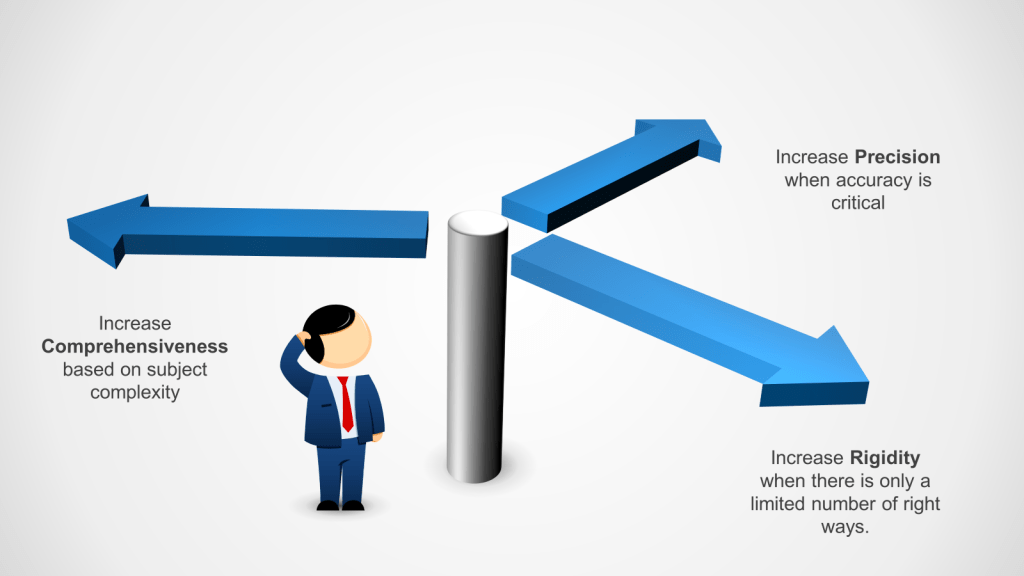
To meet these requirements we leverage three writing principles of precise, comprehensive and rigid.

Type of InstructionDefinitionAttributesWhen NeededWhyDifferencesExample
Precise Exact and accurate, leaving little room for interpretation.– Specific
– Detailed
– Unambiguous
When accuracy is critical, such as in scientific experiments or programming.Regulatory agencies require precise documentation to ensure tasks are performed consistently and correctlyFocuses on exactness and clarity, ensuring tasks are performed without deviation.Instructions for assembling a computer, specifying exact components and steps.
Comprehensive Complete and covering all necessary aspects of a task.– Thorough
– Inclusive
– Exhaustive
When a task is complex and requires understanding of all components, such as in training manuals.Comprehensive SOPs are crucial for ensuring all aspects of a process are covered, ensuring compliance with regulatory requirements.Provides a full overview, ensuring no part of the task is overlooked.Employee onboarding manual covering company policies, procedures, and culture.
Rigid Strict and inflexible, not allowing for changes.– Fixed
– Inflexible
– Consistent
When safety and compliance are paramount, such as batch recordsRigid instructions ensure compliance with strict regulatory standards.Ensures consistency and adherence to specific protocols, minimizing risks.Safety procedures for operating heavy machinery, with no deviations allowed.

When writing documents based on cognitive principles these three are often excellent for detailed task design but there are significant trade-offs inherent in these attributes when we codify knowledge:

  • The more comprehensive the instructions, the less likely that they can be absorbed, understood, and remembered by those responsible for execution – which is why it is important these instructions are followed at time of execution. Moreover, comprehensive instructions also risk can dilute the sense of responsibility felt by the person executing.
  • The more precise the instructions, the less they allow for customization or the exercise of employee initiative.
  • The more rigid the instructions, the less they will be able to evolve spontaneously as circumstances change. They require rigorous change management.

This means these tools are really good for complicated executions that must follow a specific set of steps. Ideal for equipment operations, testing, batch records. But as we shade into complex processes, which relies on domain knowledge, we start decreasing the rigidity, lowering the degree of precision, and walking a fine line on comprehensiveness.

Where organizations continue to struggle is in this understanding that it is not one size fits all. Every procedure is on a continuum and the level of comprehensiveness, precision and rigidity change as a result. Processes involving human judgement, customization for specific needs, or adaptations for changing circumstances should be written to a different standard than those involving execution of a test. It is also important to remember that a document may require high comprehensiveness, medium precision and low rigidity (for example a validation process).

Remember to use them with other tools for document writing. The goal here is to write documents that are usable to reach the necessary outcome.

Utilizing Rubrics

A rubric is a tool used primarily in educational settings to evaluate and assess student performance. It provides a clear set of criteria and standards that describe varying levels of quality for a specific assignment or task. Rubrics are designed to ensure consistency and objectivity in grading and feedback, making them a valuable resource for both teachers and students.

Rubrics are useful in assessing competencies and skills within organizations, providing a structured way to evaluate strengths and weaknesses, which makes them perfect for knowledge based activities to gauge appropriate training and execution. They can really help demonstrate that an outcome is a good one.

Key Features of a Rubric

  • Criteria: Rubrics list specific criteria that are important for the assignment. These criteria outline what is expected from the intended work, such as clarity, organization, and mechanics in a writing assignment.
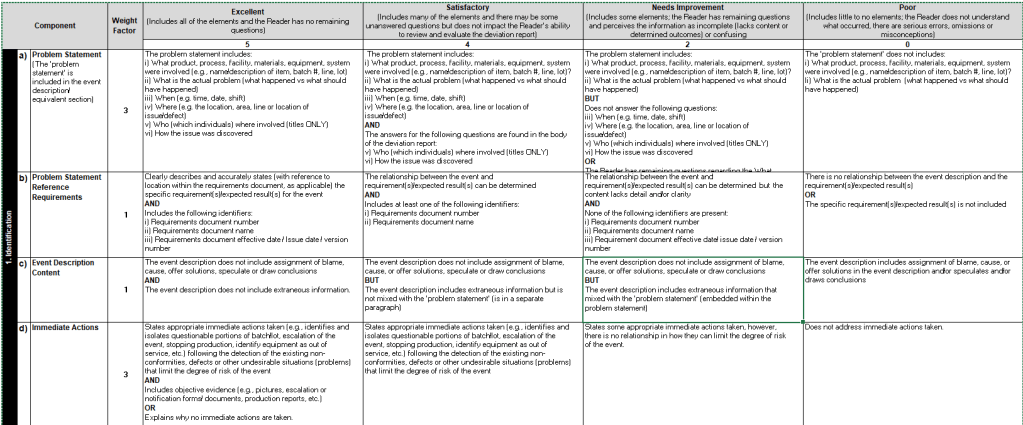
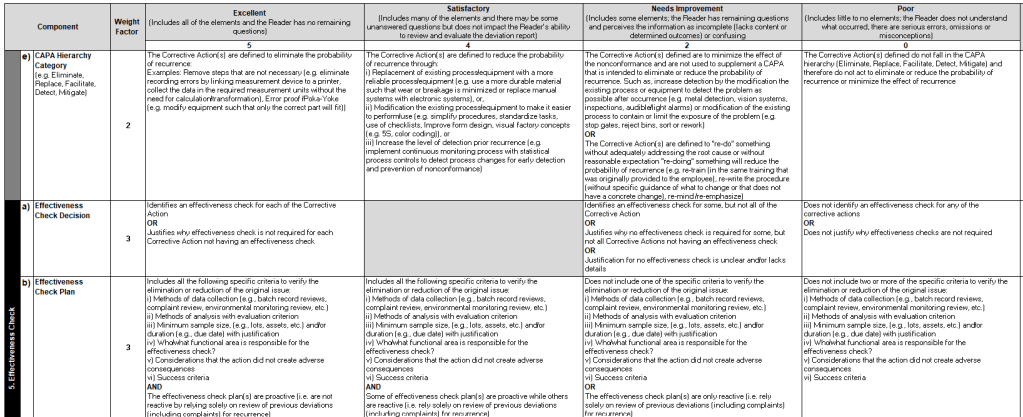
  • Performance Levels: Rubrics define different levels of achievement for each criterion, often using descriptive language (e.g., excellent, good, needs improvement) or numerical scores (e.g., 4, 3, 2, 1).
  • Feedback and Guidance: Rubrics provide detailed feedback, helping individuals understand their strengths and areas for improvement. This feedback can guide executors in revising their work to meet learning objectives more effectively.

Types of Rubrics

  • Analytic Rubrics: These break down the assignment into several components, each with its own set of criteria and performance levels. This type provides detailed feedback on specific areas of the work.
  • Holistic Rubrics: These assess the work as a whole rather than individual components. They provide a single overall score based on the general quality of the work.
  • Single-Point Rubrics: These focus on a single level of performance for each criterion, highlighting areas that meet expectations and those that need improvement.
An example from a deviation rubric

Benefits of Using Rubrics

  • Clarity and Consistency: Rubrics help clarify expectations for students, ensuring they understand what is required to be good. They also promote consistency across activities.
  • Self-Assessment: Rubrics encourage individuals to reflect on their own work and understand the standards they need to meet. This can lead to improved learning outcomes as individuals become more aware of their progress and areas needing improvement.

I love rubrics. They are great for all quality systems. They can be used for on-the-job training, for record writing and review, for re-qualifications. By creatin rubrics you define what good looks like by providing a structured and objective framework that improves clarity, consistency, and specificity in evaluations. It holds both the writer and the reviewer accountable.